CONDITIONS
SUPPORTING
LIFE
by Sarah Galea
MSS 4307
PGCE Biology Seminar
2015
WEEKS DEDICATED
• Number of week - 5 weeks
• Number of Lesson
20 single lessons (40 minutes)
or
10 double lessons (80 minutes)
2
3
MISCONCEPTIONS
‘’Students understanding of ecological
relationships depends on their concepts of
‘plant’ and ‘animal’, and also on their
knowledge of habitats and use of physical
principles.
For instance, many students consider only
large land animals as animals.’’
‘’Carnivores can exist in a plant free world
if they reproduce enough.’’
‘’Few students think of oxygen
need as a reason why animals
can’t live without plants.’’
‘’A change in the population of one
species would affect only those species
related to it directly as predator or prey.’’
‘’A change in the size of prey
population would have no effect
on its predator population.’’
4
RECURRING THEMES
• That all organisms in an ecosystem depend on
their physical environment to survive
• That animals cannot survive without the
presence of plants in their ecosystem
• Plants do not need animals in their ecosystem
to flourish and grow
• How biotic organisms react to both biotic and
abiotic conditions in their ecosystem determines
population size
5
INTRODUCING
THE
TOPIC
6
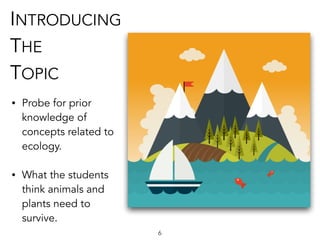
• Probe for prior
knowledge of
concepts related to
ecology.
• What the students
think animals and
plants need to
survive.
7
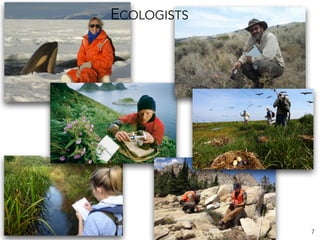
ECOLOGISTS
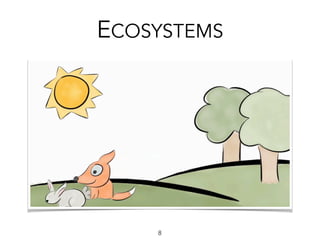
ECOSYSTEMS
8
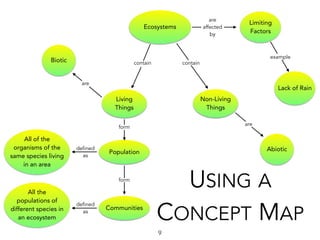
Ecosystems
Limiting
Factors
Lack of Rain
Non-Living
Things
Living
Things
Abiotic
Biotic
Population
Communities
All of the
organisms of the
same species living
in an area
All the
populations of
different species in
an ecosystem
are
contain contain
are
are
affected
by
defined
as
defined
as
form
form
USING A
CONCEPT MAP
example
9
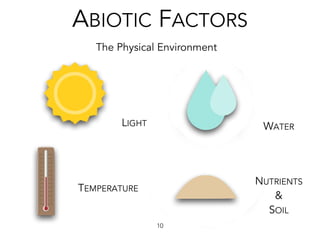
LIGHT
TEMPERATURE
WATER
NUTRIENTS
&
SOIL
10
ABIOTIC FACTORS
The Physical Environment
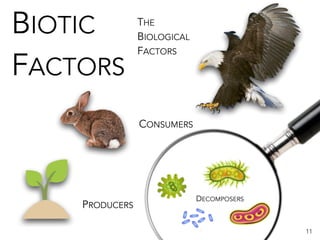
PRODUCERS
CONSUMERS
11
THE
BIOLOGICAL
FACTORS
DECOMPOSERS
BIOTIC
FACTORS
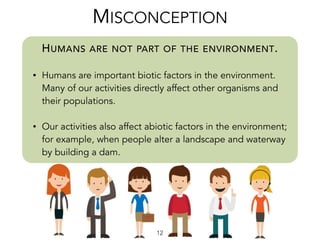
HUMANS ARE NOT PART OF THE ENVIRONMENT.
• Humans are important biotic factors in the environment.
Many of our activities directly affect other organisms and
their populations.
• Our activities also affect abiotic factors in the environment;
for example, when people alter a landscape and waterway
by building a dam.
MISCONCEPTION
12
13
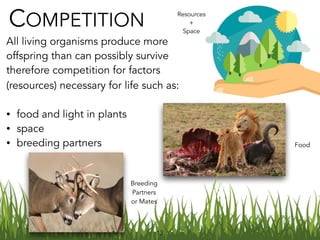
COMPETITION
All living organisms produce more
offspring than can possibly survive
therefore ︎competition for factors
(resources) necessary for life such as:
• food and light in plants
• space
• breeding partners 

Resources
+
Space
Food
Breeding
Partners
or Mates
14
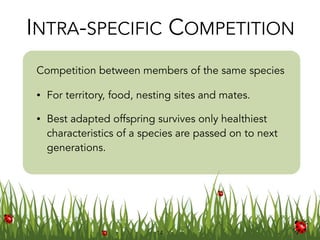
INTRA-SPECIFIC COMPETITION
Competition︎ between members of the same species
• For territory, food, nesting sites and mates.
• Best adapted offspring survives only healthiest
characteristics of a species are passed on to next
generations. 

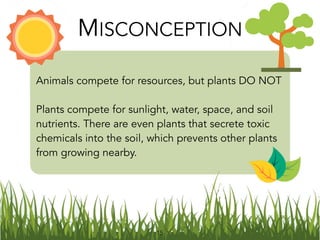
Animals compete for resources, but plants DO NOT
Plants compete for sunlight, water, space, and soil
nutrients. There are even plants that secrete toxic
chemicals into the soil, which prevents other plants
from growing nearby.
MISCONCEPTION
15
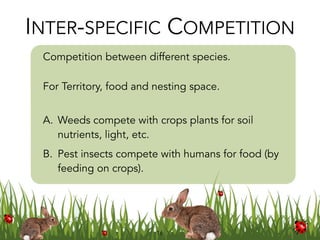
Competition ︎between different species.

For Territory, food and nesting space.
A. Weeds compete with crops plants for soil
nutrients, light, etc.
B. Pest insects compete with humans for food (by
feeding on crops). 

16
INTER-SPECIFIC COMPETITION
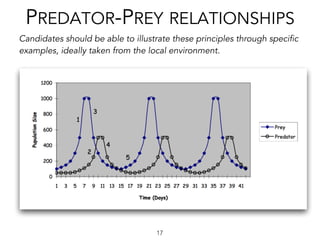
PREDATOR-PREY RELATIONSHIPS
Candidates should be able to illustrate these principles through specific
examples, ideally taken from the local environment.
17
18
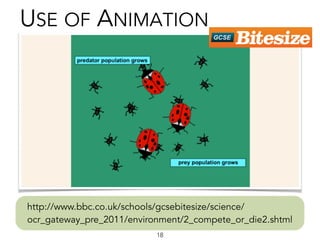
USE OF ANIMATION
http://www.bbc.co.uk/schools/gcsebitesize/science/
ocr_gateway_pre_2011/environment/2_compete_or_die2.shtml
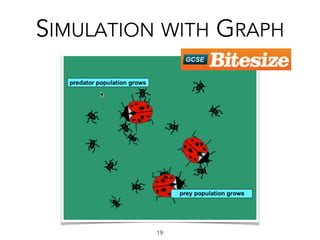
SIMULATION WITH GRAPH
19
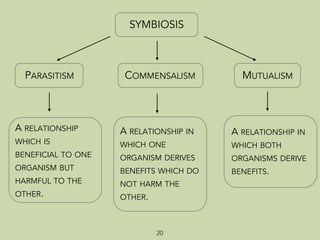
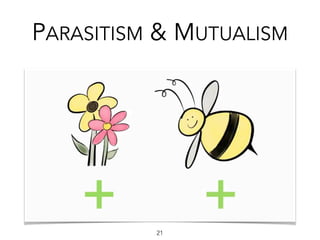
SYMBIOSIS
PARASITISM COMMENSALISM MUTUALISM
A RELATIONSHIP
WHICH IS
BENEFICIAL TO ONE
ORGANISM BUT
HARMFUL TO THE
OTHER.
A RELATIONSHIP IN
WHICH ONE
ORGANISM DERIVES
BENEFITS WHICH DO
NOT HARM THE
OTHER.
A RELATIONSHIP IN
WHICH BOTH
ORGANISMS DERIVE
BENEFITS.
20
PARASITISM & MUTUALISM
21
2222
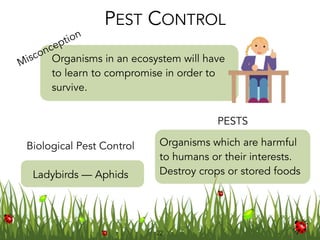
PEST CONTROL
Biological Pest Control
Organisms in an ecosystem will have
to learn to compromise in order to
survive.
Misconception
Organisms which are harmful
to humans or their interests.
Destroy crops or stored foods
PESTS
Ladybirds — Aphids
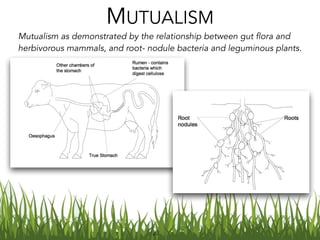
Mutualism as demonstrated by the relationship between gut flora and
herbivorous mammals, and root- nodule bacteria and leguminous plants.
MUTUALISM
23
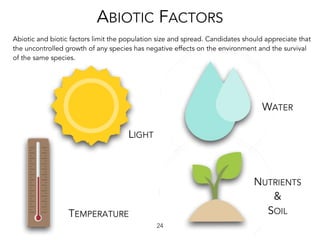
LIGHT
TEMPERATURE
WATER
NUTRIENTS
&
SOIL
24
ABIOTIC FACTORS
Abiotic and biotic factors limit the population size and spread. Candidates should appreciate that
the uncontrolled growth of any species has negative effects on the environment and the survival
of the same species.
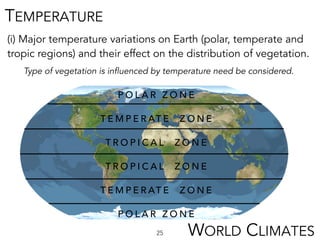
(i) Major temperature variations on Earth (polar, temperate and
tropic regions) and their effect on the distribution of vegetation.
TEMPERATURE
Type of vegetation is influenced by temperature need be considered.
25
ecosystems
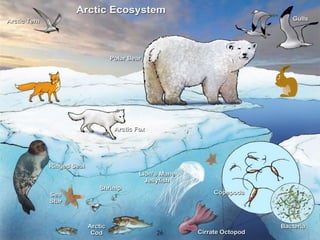
workshop — diff climate animals
T E M P E R AT E Z O N E
P O L A R Z O N E
T R O P I C A L Z O N E
P O L A R Z O N E
WORLD CLIMATES
26
27
http://www.abpischools.org.uk/res/coResourceImport/modules/
skin/en-flash/skinstructure.cfm
INTERACTIVE ANIMATION
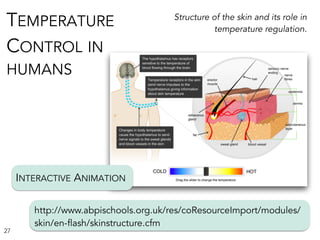
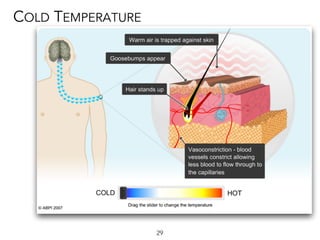
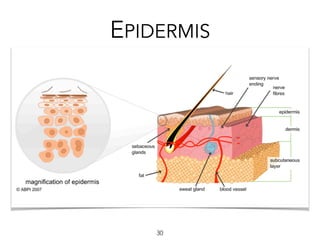
Structure of the skin and its role in
temperature regulation.
TEMPERATURE
CONTROL IN
HUMANS
28
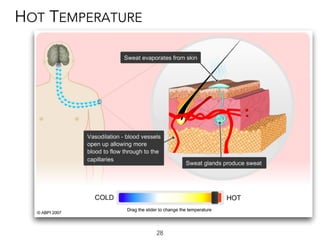
HOT TEMPERATURE
29
COLD TEMPERATURE
EPIDERMIS
30
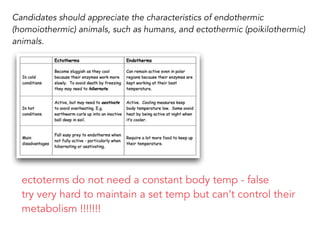
Candidates should appreciate the characteristics of endothermic
(homoiothermic) animals, such as humans, and ectothermic (poikilothermic)
animals.
ectoterms do not need a constant body temp - false
try very hard to maintain a set temp but can’t control their
metabolism !!!!!!!
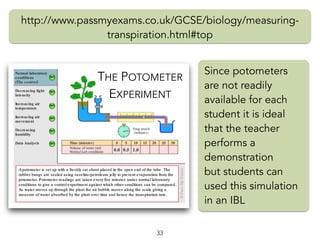
Transpiration and adaptations of plants to reduce water loss.
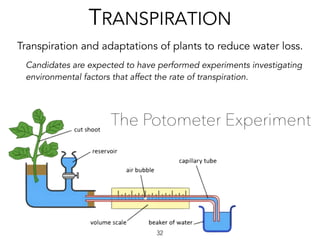
TRANSPIRATION
Candidates are expected to have performed experiments investigating
environmental factors that affect the rate of transpiration.
32
The Potometer Experiment
THE POTOMETER
EXPERIMENT
http://www.passmyexams.co.uk/GCSE/biology/measuring-
transpiration.html#top
33
Since potometers
are not readily
available for each
student it is ideal
that the teacher
performs a
demonstration
but students can
used this simulation
in an IBL
‘’Plants absorb water through their leaves.’’
MISCONCEPTIONS
34
‘’Plants take their food in through the roots
and then store it in their leaves. .’’
RESPONSE OF PLANTS TO
ABIOTIC FACTORS - TROPISMS
• Positive phototropism of stems
• Geotropism of roots and stems
• Important concepts to be understood
by students
• Inquiry based learning a possibility
35
36
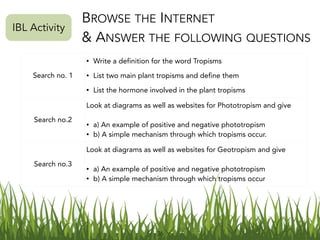
Search no. 1
• Write a definition for the word Tropisms
• List two main plant tropisms and define them
• List the hormone involved in the plant tropisms
Search no.2
Look at diagrams as well as websites for Phototropism and give
• a) An example of positive and negative phototropism
• b) A simple mechanism through which tropisms occur.
Search no.3
Look at diagrams as well as websites for Geotropism and give
• a) An example of positive and negative phototropism
• b) A simple mechanism through which tropisms occur
BROWSE THE INTERNET
& ANSWER THE FOLLOWING QUESTIONS
IBL Activity
• Bitesize
• Controlling Plant
Growth
• Great Resources
• Concise & Factual
Information
http://www.bbc.co.uk/schools/gcsebitesize/science/
add_gateway_pre_2011/living/controlplantgrowthrev1.shtml
37
http://www.sumanasinc.com/webcontent/animations/biology.html
38
• Great Website for
Animations
• Some of them are too
advanced for this stage
but can be edited to suit
your needs during
lessons
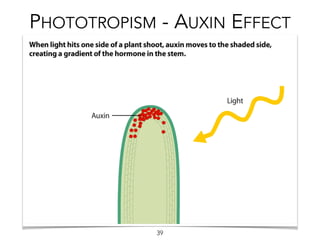
PHOTOTROPISM - AUXIN EFFECT
39
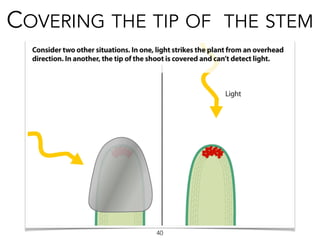
COVERING THE TIP OF THE STEM
40
41
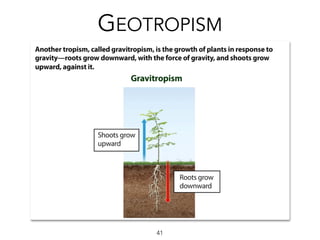
GEOTROPISM
HUMAN POPULATION
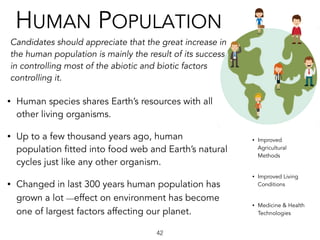
Candidates should appreciate that the great increase in
the human population is mainly the result of its success
in controlling most of the abiotic and biotic factors
controlling it.
42
• Human species shares Earth’s resources with all
other living organisms. 

• Up to a few thousand years ago, human
population fitted into food web and Earth’s natural 

cycles just like any other organism. 

• Changed in last 300 years ︎human population has
grown a lot ︎—effect on environment has become
one of largest factors affecting our planet.
• Improved
Agricultural
Methods
• Improved Living
Conditions
• Medicine & Health
Technologies
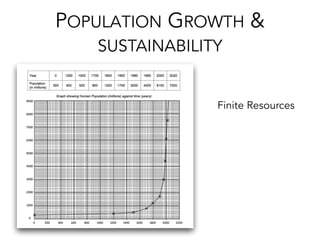
POPULATION GROWTH &
SUSTAINABILITY
Finite Resources
THANK YOU FOR
LISTENING

Conditions Supporting Life