Conditional Random Fields
a popular probabilistic method for structured prediction
Nishant Mahat 074MSCSK006
Rachana Kunwar 074MSCSK009
Suresh Mainali 074MSCSK014
Suresh Pokharel 074MSCSK015
Presented by:
M.Sc. in Computer System and Knowledge Engineering
Institute of Engineering, Pulchowk Campus
Background
● Markov Property
○ Process has Markov property when the value of the next state only
depends on the current state
○ Does not depend on the sequence of events that preceded it, but only on
the state that the model is in at that point
● Generative and Discriminative Models
○ A generative model is a joint distribution that models p(t, w) = p(t)p(w|t)
or p(w)p(t|w).
○ Generative describe how the output is probabilistically generated as a
function of the input
○ Discriminative focus solely on the conditional distribution p(y|x).
2
Background Cont...
● Discriminative model just cares about the conditional distribution p(t|w),
does not model p(w)
● In practice, estimating p(w)p(t|w) and then finding p(t|w) yields a different
answer than just finding p(t|w) directly. This is due to the fact that we never
actually have the true distribution in our training data.
3
Background Cont...
● Hidden Markov Model
○ Models a sequence of observations X = {xt} T t=1 by assuming that there is an underlying
sequence of states Y = {yt} T t=1 drawn from a finite state set S
○ To model the joint distribution p(y, x) tractably, an HMM makes two independence
assumptions.
○ It assumes that each state depends only on its immediate predecessor, that is, each state yt is
independent of all its ancestors y1, y2, . . . , yt−2 given the preceding state yt−1
It also assumes that each observation variable xt depends only on the current state yt
○ With these assumptions, we can specify an HMM using three probability distributions: first,
the distribution p(y1) over initial states; second, the transition distribution p(yt |yt−1); and
finally, the observation distribution p(xt |yt).
4
Introduction
● More commonly used variance of Markov Networks
● Undirected graphical model that is discriminative, used for predicting
sequences.
● Construct conditional model p(Y|X)
● Commonly used in pattern recognition, machine learning and used for
structured prediction.
● It uses contextual information from previous labels, thus increasing the
amount of information the model has to make a good prediction.
5
CRF - Definition
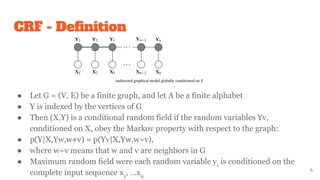
● Let G = (V, E) be a finite graph, and let A be a finite alphabet
● Y is indexed by the vertices of G
● Then (X,Y) is a conditional random field if the random variables Yv,
conditioned on X, obey the Markov property with respect to the graph:
● p(Y|X,Yw,w≠v) = p(Yv|X,Yw,w~v),
● where w~v means that w and v are neighbors in G
● Maximum random field were each random variable yi
is conditioned on the
complete input sequence x1
, …xn
6
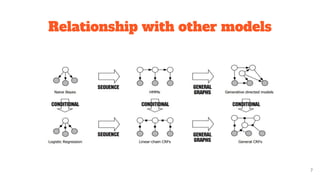
Relationship with other models
7
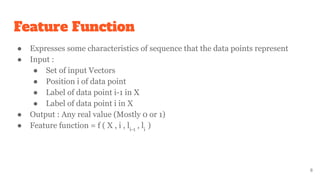
Feature Function
● Expresses some characteristics of sequence that the data points represent
● Input :
● Set of input Vectors
● Position i of data point
● Label of data point i-1 in X
● Label of data point i in X
● Output : Any real value (Mostly 0 or 1)
● Feature function = f ( X , i , li-1
, li
)
8
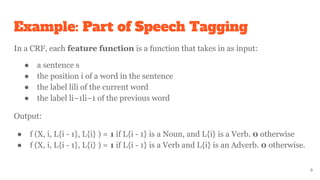
Example: Part of Speech Tagging
In a CRF, each feature function is a function that takes in as input:
● a sentence s
● the position i of a word in the sentence
● the label lili of the current word
● the label li−1li−1 of the previous word
Output:
● f (X, i, L{i - 1}, L{i} ) = 1 if L{i - 1} is a Noun, and L{i} is a Verb. 0 otherwise
● f (X, i, L{i - 1}, L{i} ) = 1 if L{i - 1} is a Verb and L{i} is an Adverb. 0 otherwise.
9
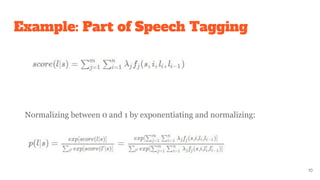
Example: Part of Speech Tagging
10
Normalizing between 0 and 1 by exponentiating and normalizing:
Example Contd...
● Each feature function is based on label of previous word and current word
● Next, assign weights λj
to each feature function fj
.
● Use optimization algorithms, e.g. gradient descent, to learn the weights.
11
Applications of CRFs
● Natural Language Processing,
○ Parts-of-Speech tagging
○ Named Entity recognition
○ Parsing text
○ Extracting Proper nouns from sentences
● Parts-recognition in Images
● Estimating the score in a game
● Gene prediction
Conditional Random Fields can be used to predict any sequence in which multiple
variables depend on each other
12
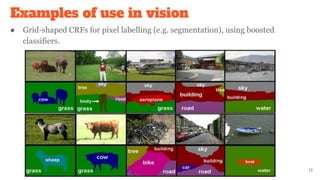
Examples of use in vision
● Grid-shaped CRFs for pixel labelling (e.g. segmentation), using boosted
classifiers.
13
Conclusion
● Conditional Random Fields are a probabilistic framework for labeling and
segmenting structured data, such as sequences, trees.
● Don’t need to model distribution over variables, we don’t care about.
● Allows models with highly expressive features, without worrying about wrong
independencies.
● The primary advantage of CRFs is the relaxation of the independence
assumption
14
References
● https://medium.com/ml2vec/overview-of-conditional-random-fields-68a2a20fa
541
● https://arxiv.org/pdf/1011.4088.pdf
● https://www3.nd.edu/~dchiang/teaching/nlp/2015/notes/chapter8v1.pdf
15
Thank You!
16

Conditional Random Fields

  • 1.
    Conditional Random Fields apopular probabilistic method for structured prediction Nishant Mahat 074MSCSK006 Rachana Kunwar 074MSCSK009 Suresh Mainali 074MSCSK014 Suresh Pokharel 074MSCSK015 Presented by: M.Sc. in Computer System and Knowledge Engineering Institute of Engineering, Pulchowk Campus
  • 2.
    Background ● Markov Property ○Process has Markov property when the value of the next state only depends on the current state ○ Does not depend on the sequence of events that preceded it, but only on the state that the model is in at that point ● Generative and Discriminative Models ○ A generative model is a joint distribution that models p(t, w) = p(t)p(w|t) or p(w)p(t|w). ○ Generative describe how the output is probabilistically generated as a function of the input ○ Discriminative focus solely on the conditional distribution p(y|x). 2
  • 3.
    Background Cont... ● Discriminativemodel just cares about the conditional distribution p(t|w), does not model p(w) ● In practice, estimating p(w)p(t|w) and then finding p(t|w) yields a different answer than just finding p(t|w) directly. This is due to the fact that we never actually have the true distribution in our training data. 3
  • 4.
    Background Cont... ● HiddenMarkov Model ○ Models a sequence of observations X = {xt} T t=1 by assuming that there is an underlying sequence of states Y = {yt} T t=1 drawn from a finite state set S ○ To model the joint distribution p(y, x) tractably, an HMM makes two independence assumptions. ○ It assumes that each state depends only on its immediate predecessor, that is, each state yt is independent of all its ancestors y1, y2, . . . , yt−2 given the preceding state yt−1 It also assumes that each observation variable xt depends only on the current state yt ○ With these assumptions, we can specify an HMM using three probability distributions: first, the distribution p(y1) over initial states; second, the transition distribution p(yt |yt−1); and finally, the observation distribution p(xt |yt). 4
  • 5.
    Introduction ● More commonlyused variance of Markov Networks ● Undirected graphical model that is discriminative, used for predicting sequences. ● Construct conditional model p(Y|X) ● Commonly used in pattern recognition, machine learning and used for structured prediction. ● It uses contextual information from previous labels, thus increasing the amount of information the model has to make a good prediction. 5
  • 6.
    CRF - Definition ●Let G = (V, E) be a finite graph, and let A be a finite alphabet ● Y is indexed by the vertices of G ● Then (X,Y) is a conditional random field if the random variables Yv, conditioned on X, obey the Markov property with respect to the graph: ● p(Y|X,Yw,w≠v) = p(Yv|X,Yw,w~v), ● where w~v means that w and v are neighbors in G ● Maximum random field were each random variable yi is conditioned on the complete input sequence x1 , …xn 6
  • 7.
  • 8.
    Feature Function ● Expressessome characteristics of sequence that the data points represent ● Input : ● Set of input Vectors ● Position i of data point ● Label of data point i-1 in X ● Label of data point i in X ● Output : Any real value (Mostly 0 or 1) ● Feature function = f ( X , i , li-1 , li ) 8
  • 9.
    Example: Part ofSpeech Tagging In a CRF, each feature function is a function that takes in as input: ● a sentence s ● the position i of a word in the sentence ● the label lili of the current word ● the label li−1li−1 of the previous word Output: ● f (X, i, L{i - 1}, L{i} ) = 1 if L{i - 1} is a Noun, and L{i} is a Verb. 0 otherwise ● f (X, i, L{i - 1}, L{i} ) = 1 if L{i - 1} is a Verb and L{i} is an Adverb. 0 otherwise. 9
  • 10.
    Example: Part ofSpeech Tagging 10 Normalizing between 0 and 1 by exponentiating and normalizing:
  • 11.
    Example Contd... ● Eachfeature function is based on label of previous word and current word ● Next, assign weights λj to each feature function fj . ● Use optimization algorithms, e.g. gradient descent, to learn the weights. 11
  • 12.
    Applications of CRFs ●Natural Language Processing, ○ Parts-of-Speech tagging ○ Named Entity recognition ○ Parsing text ○ Extracting Proper nouns from sentences ● Parts-recognition in Images ● Estimating the score in a game ● Gene prediction Conditional Random Fields can be used to predict any sequence in which multiple variables depend on each other 12
  • 13.
    Examples of usein vision ● Grid-shaped CRFs for pixel labelling (e.g. segmentation), using boosted classifiers. 13
  • 14.
    Conclusion ● Conditional RandomFields are a probabilistic framework for labeling and segmenting structured data, such as sequences, trees. ● Don’t need to model distribution over variables, we don’t care about. ● Allows models with highly expressive features, without worrying about wrong independencies. ● The primary advantage of CRFs is the relaxation of the independence assumption 14
  • 15.
  • 16.