CNN based Handwritten
Signature Recognition
Presented By:
Suresh Pokharel, IOE Pulchowk Campus
Santosh Giri, Kathford Int’l College of Engg. and Mgmt.
Prof. Dr. Subarna Shakya, IOE Pulchowk Campus
Outline
❏ Background
❏ Motivation
❏ Methodology
❏ Results
❏ Summary
❏ Limitations
❏ Future Enhancement
2
Background
● Signature is commonly accepted as a means of verifying
the legality of documents such as certificates, checks,
drafts, letters, approvals etc.
● Problems in countering the forgery and falsification of
such documents in diverse financial, legal, academic, and
other commercial settings.
3
Background
❏ Signature verification task is very critical and often
presents difficulties like high variability
(Factors: Age, behavior and environment, similarities
between signatures of different person and similarity in
duplication or forgery of one’s signature.)
4
Background
Types of Signature Verification Techniques:
❏ Online Verification
Consists of electronic signing system that uses dynamic
data features such as the speed, pressure, pen’s position,
altitude angle etc.
❏ Offline Verification
Takes use of static features of two dimensional image
pixel. 5
Motivation
● Validation of signature in legal documents are highly critical.
● Failure in the authentication may lead to serious
consequences and damages.
● New and complex forgery and fraud techniques are
emerging.
6
Methodology
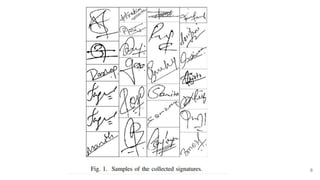
Data collection and Preprocessing:
❏ Collected in hard copy
❏ Converted into an image scanner
❏ Image Preprocessing Techniques:
cropping, scaling (224px X 224px)
❏ Image Size: 40 KiloBytes (Approx.)
7
8
Methodology (Contd...)
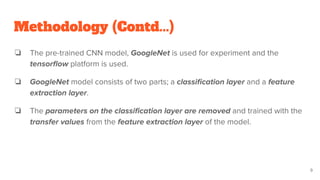
❏ The pre-trained CNN model, GoogleNet is used for experiment and the
tensorflow platform is used.
❏ GoogleNet model consists of two parts; a classification layer and a feature
extraction layer.
❏ The parameters on the classification layer are removed and trained with the
transfer values from the feature extraction layer of the model.
9
Experiment Setup
10
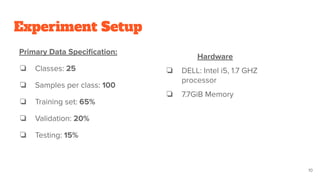
Primary Data Specification:
❏ Classes: 25
❏ Samples per class: 100
❏ Training set: 65%
❏ Validation: 20%
❏ Testing: 15%
Hardware
❏ DELL: Intel i5, 1.7 GHZ
processor
❏ 7.7GiB Memory
Results
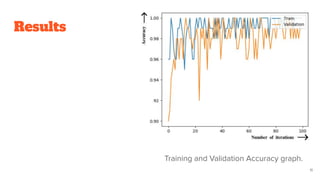
Training and Validation Accuracy graph.
11
Results
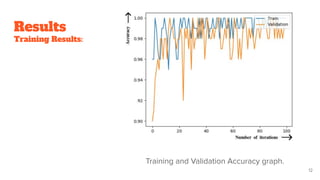
Training Results:
Training and Validation Accuracy graph.
12
Thank You
13

CNN based Handwritten Signature Recognition

  • 1.
    CNN based Handwritten SignatureRecognition Presented By: Suresh Pokharel, IOE Pulchowk Campus Santosh Giri, Kathford Int’l College of Engg. and Mgmt. Prof. Dr. Subarna Shakya, IOE Pulchowk Campus
  • 2.
    Outline ❏ Background ❏ Motivation ❏Methodology ❏ Results ❏ Summary ❏ Limitations ❏ Future Enhancement 2
  • 3.
    Background ● Signature iscommonly accepted as a means of verifying the legality of documents such as certificates, checks, drafts, letters, approvals etc. ● Problems in countering the forgery and falsification of such documents in diverse financial, legal, academic, and other commercial settings. 3
  • 4.
    Background ❏ Signature verificationtask is very critical and often presents difficulties like high variability (Factors: Age, behavior and environment, similarities between signatures of different person and similarity in duplication or forgery of one’s signature.) 4
  • 5.
    Background Types of SignatureVerification Techniques: ❏ Online Verification Consists of electronic signing system that uses dynamic data features such as the speed, pressure, pen’s position, altitude angle etc. ❏ Offline Verification Takes use of static features of two dimensional image pixel. 5
  • 6.
    Motivation ● Validation ofsignature in legal documents are highly critical. ● Failure in the authentication may lead to serious consequences and damages. ● New and complex forgery and fraud techniques are emerging. 6
  • 7.
    Methodology Data collection andPreprocessing: ❏ Collected in hard copy ❏ Converted into an image scanner ❏ Image Preprocessing Techniques: cropping, scaling (224px X 224px) ❏ Image Size: 40 KiloBytes (Approx.) 7
  • 8.
  • 9.
    Methodology (Contd...) ❏ Thepre-trained CNN model, GoogleNet is used for experiment and the tensorflow platform is used. ❏ GoogleNet model consists of two parts; a classification layer and a feature extraction layer. ❏ The parameters on the classification layer are removed and trained with the transfer values from the feature extraction layer of the model. 9
  • 10.
    Experiment Setup 10 Primary DataSpecification: ❏ Classes: 25 ❏ Samples per class: 100 ❏ Training set: 65% ❏ Validation: 20% ❏ Testing: 15% Hardware ❏ DELL: Intel i5, 1.7 GHZ processor ❏ 7.7GiB Memory
  • 11.
  • 12.
    Results Training Results: Training andValidation Accuracy graph. 12
  • 13.