1
As we have seen in section 4 conditional probability density
functions are useful to update the information about an
event based on the knowledge about some other related
event (refer to example 4.7). In this section, we shall
analyze the situation where the related event happens to be a
random variable that is dependent on the one of interest.
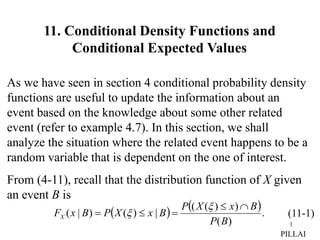
From (4-11), recall that the distribution function of X given
an event B is
(11-1)
   .
)
(
)
)
(
(
|
)
(
)
|
(
B
P
B
x
X
P
B
x
X
P
B
x
FX







PILLAI
11. Conditional Density Functions and
Conditional Expected Values
2
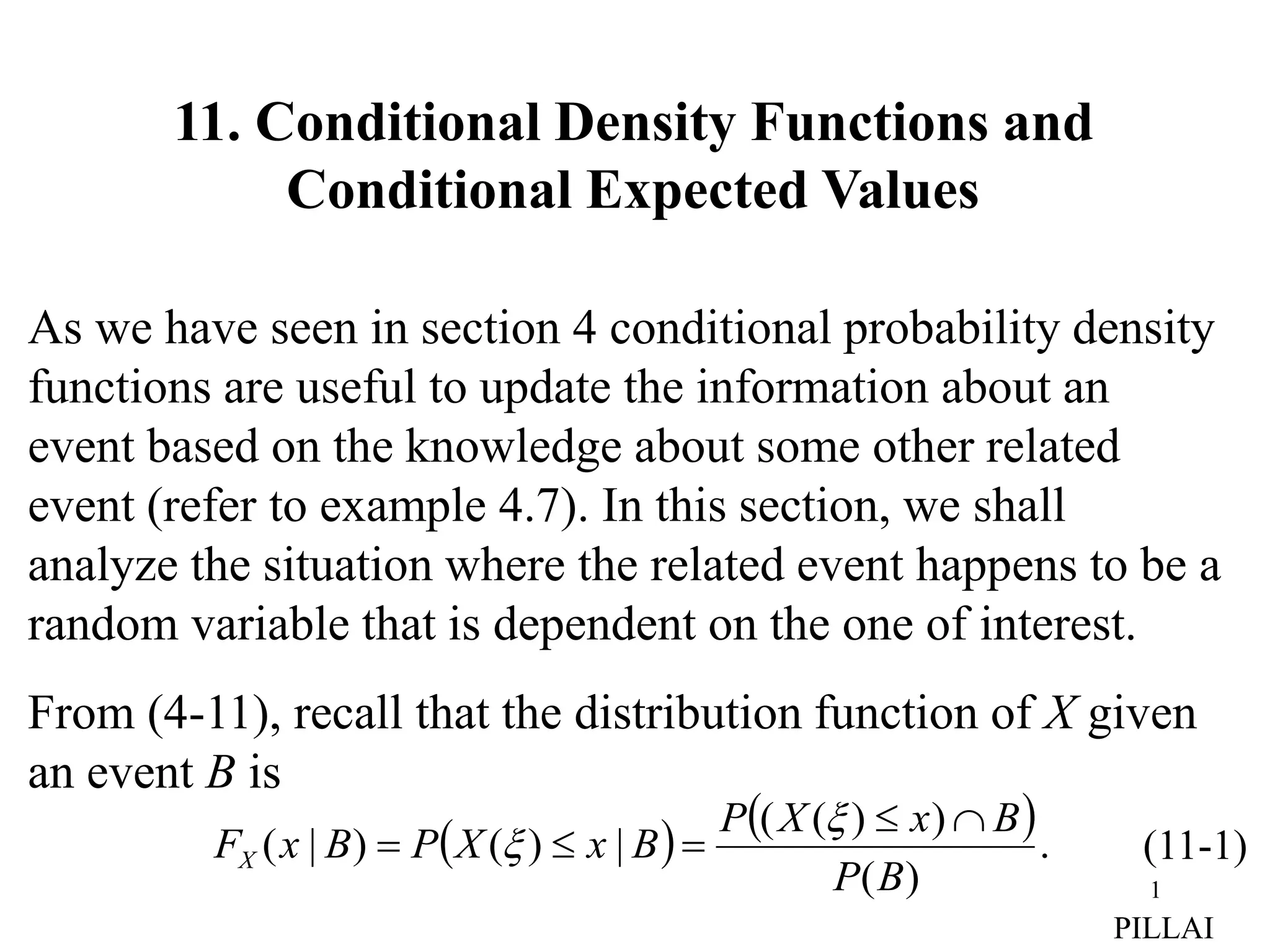
Suppose, we let
Substituting (11-2) into (11-1), we get
where we have made use of (7-4). But using (3-28) and (7-7)
we can rewrite (11-3) as
To determine, the limiting case we can let
and in (11-4).
 .
)
( 2
1 y
Y
y
B 

 
(11-3)
(11-2)
 
,
)
(
)
(
)
,
(
)
,
(
)
)
(
(
)
(
,
)
(
)
|
(
1
2
1
2
2
1
2
1
2
1
y
F
y
F
y
x
F
y
x
F
y
Y
y
P
y
Y
y
x
X
P
y
Y
y
x
F
Y
Y
XY
XY
X














.
)
(
)
,
(
)
|
( 2
1
2
1
2
1

 




 y
y
Y
x y
y
XY
X
dv
v
f
dudv
v
u
f
y
Y
y
x
F
(11-4)
),
|
( y
Y
x
FX  y
y 
1
y
y
y 


2
PILLAI
3
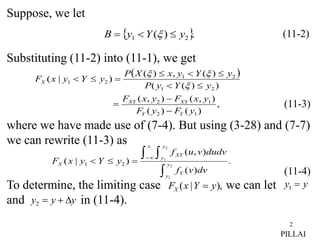
This gives
and hence in the limit
(To remind about the conditional nature on the left hand
side, we shall use the subscript X | Y (instead of X) there).
Thus
Differentiating (11-7) with respect to x using (8-7), we get
(11-5)
(11-6)
.
)
(
)
,
(
)
|
(
lim
)
|
(
0 y
f
du
y
u
f
y
y
Y
y
x
F
y
Y
x
F
Y
x
XY
X
y
X
 










(11-7)
(11-8)
y
y
f
y
du
y
u
f
dv
v
f
dudv
v
u
f
y
y
Y
y
x
F
Y
x
XY
y
y
y
Y
x y
y
y
XY
X










  







)
(
)
,
(
)
(
)
,
(
)
|
(
.
)
(
)
,
(
)
|
(
|
y
f
du
y
u
f
y
Y
x
F
Y
x
XY
Y
X
 



.
)
(
)
,
(
)
|
(
|
y
f
y
x
f
y
Y
x
f
Y
XY
Y
X 

PILLAI
4
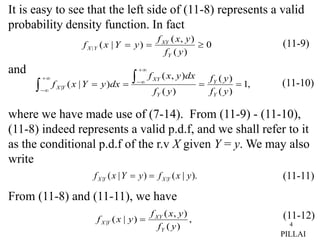
It is easy to see that the left side of (11-8) represents a valid
probability density function. In fact
and
where we have made use of (7-14). From (11-9) - (11-10),
(11-8) indeed represents a valid p.d.f, and we shall refer to it
as the conditional p.d.f of the r.v X given Y = y. We may also
write
From (11-8) and (11-11), we have
(11-9)
|
( , )
( | ) 0
( )
XY
X Y
Y
f x y
f x Y y
f y
  
,
1
)
(
)
(
)
(
)
,
(
)
|
(
| 












 y
f
y
f
y
f
dx
y
x
f
dx
y
Y
x
f
Y
Y
Y
XY
Y
X
(11-10)
(11-11)
,
)
(
)
,
(
)
|
(
|
y
f
y
x
f
y
x
f
Y
XY
Y
X  (11-12)
PILLAI
).
|
(
)
|
( |
| y
x
f
y
Y
x
f Y
X
Y
X 

5
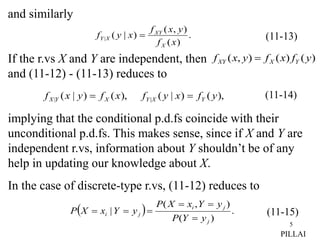
and similarly
If the r.vs X and Y are independent, then
and (11-12) - (11-13) reduces to
implying that the conditional p.d.fs coincide with their
unconditional p.d.fs. This makes sense, since if X and Y are
independent r.vs, information about Y shouldn’t be of any
help in updating our knowledge about X.
In the case of discrete-type r.vs, (11-12) reduces to
)
(
)
(
)
,
( y
f
x
f
y
x
f Y
X
XY 
(11-13)
(11-14)
(11-15)
.
)
(
)
,
(
)
|
(
|
x
f
y
x
f
x
y
f
X
XY
X
Y 
),
(
)
|
(
),
(
)
|
( |
| y
f
x
y
f
x
f
y
x
f Y
X
Y
X
Y
X 

  .
)
(
)
,
(
|
j
j
i
j
i
y
Y
P
y
Y
x
X
P
y
Y
x
X
P






PILLAI
6
Next we shall illustrate the method of obtaining conditional
p.d.fs through an example.
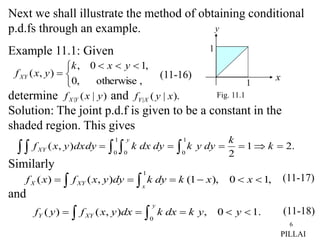
Example 11.1: Given
determine and
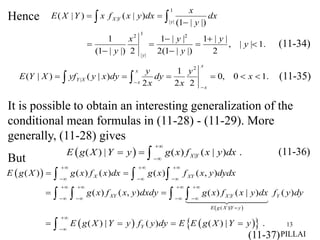
Solution: The joint p.d.f is given to be a constant in the
shaded region. This gives
Similarly
and
(11-16)


 



,
otherwise
,
0
,
1
0
,
)
,
(
y
x
k
y
x
fXY
.
2
1
2
)
,
(
1
0
1
0 0





 
   k
k
dy
y
k
dy
dx
k
dxdy
y
x
f
y
XY
)
|
(
| y
x
f Y
X ).
|
(
| x
y
f X
Y
x
y
1
1
Fig. 11.1
,
1
0
),
1
(
)
,
(
)
(
1





 
 x
x
k
dy
k
dy
y
x
f
x
f
x
XY
X
(11-17)
.
1
0
,
)
,
(
)
(
0




 
 y
y
k
dx
k
dx
y
x
f
y
f
y
XY
Y
(11-18)
PILLAI
7
From (11-16) - (11-18), we get
and
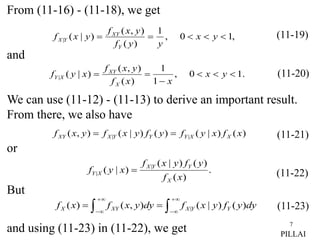
We can use (11-12) - (11-13) to derive an important result.
From there, we also have
or
But
and using (11-23) in (11-22), we get
(11-19)
(11-20)
(11-21)
,
1
0
,
1
)
(
)
,
(
)
|
(
| 



 y
x
y
y
f
y
x
f
y
x
f
Y
XY
Y
X
.
1
0
,
1
1
)
(
)
,
(
)
|
(
| 




 y
x
x
x
f
y
x
f
x
y
f
X
XY
X
Y
)
(
)
|
(
)
(
)
|
(
)
,
( |
| x
f
x
y
f
y
f
y
x
f
y
x
f X
X
Y
Y
Y
X
XY 

.
)
(
)
(
)
|
(
)
|
( |
|
x
f
y
f
y
x
f
x
y
f
X
Y
Y
X
X
Y  (11-22)











 | )
(
)
|
(
)
,
(
)
( dy
y
f
y
x
f
dy
y
x
f
x
f Y
Y
X
XY
X (11-23)
PILLAI
8
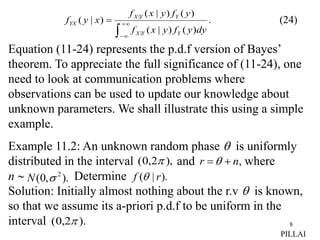
Equation (11-24) represents the p.d.f version of Bayes’
theorem. To appreciate the full significance of (11-24), one
need to look at communication problems where
observations can be used to update our knowledge about
unknown parameters. We shall illustrate this using a simple
example.
Example 11.2: An unknown random phase  is uniformly
distributed in the interval and where
n  Determine
Solution: Initially almost nothing about the r.v  is known,
so that we assume its a-priori p.d.f to be uniform in the
interval
.
)
(
)
|
(
)
(
)
|
(
)
|
(
|
|






dy
y
f
y
x
f
y
f
y
x
f
x
y
f
Y
Y
X
Y
Y
X
YX (24)
),
2
,
0
(  ,
n
r 

).
,
0
( 2

N ).
|
( r
f 
).
2
,
0
( 
PILLAI
9
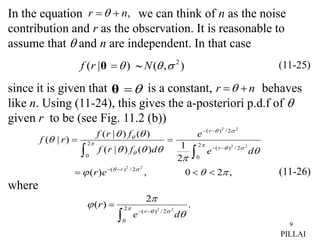
In the equation we can think of n as the noise
contribution and r as the observation. It is reasonable to
assume that  and n are independent. In that case

since it is given that is a constant, behaves
like n. Using (11-24), this gives the a-posteriori p.d.f of 
given r to be (see Fig. 11.2 (b))
where
,
n
r 

)
,
(
)
|
( 2


 N
r
f 
θ (11-25)


θ
,
2
0
,
)
(
2
1
)
(
)
|
(
)
(
)
|
(
)
|
(
2
2
2
2
2
2
2
/
)
(
2
0
2
/
)
(
2
/
)
(
2
0


































r
r
r
e
r
d
e
e
d
f
r
f
f
r
f
r
f
.
2
)
( 2
0
2
/
)
( 2
2



 





d
e
r
r
(11-26)
n
r 

PILLAI
10
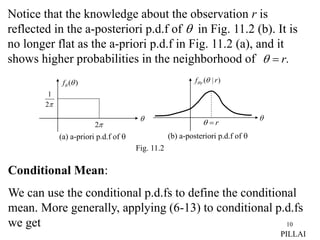
Notice that the knowledge about the observation r is
reflected in the a-posteriori p.d.f of  in Fig. 11.2 (b). It is
no longer flat as the a-priori p.d.f in Fig. 11.2 (a), and it
shows higher probabilities in the neighborhood of .
r


)
|
(
| r
f r 


(b) a-posteriori p.d.f of 
r


Fig. 11.2
Conditional Mean:
We can use the conditional p.d.fs to define the conditional
mean. More generally, applying (6-13) to conditional p.d.fs
we get
)
(

f

(a) a-priori p.d.f of 

2
1

2
PILLAI
11
 
( ) | ( ) ( | ) .
X
E g X B g x f x B dx


  (11-27)
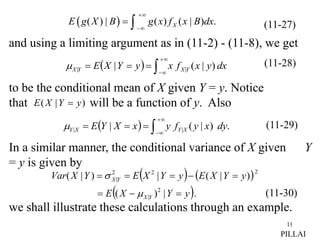
and using a limiting argument as in (11-2) - (11-8), we get
to be the conditional mean of X given Y = y. Notice
that will be a function of y. Also
In a similar manner, the conditional variance of X given Y
= y is given by
we shall illustrate these calculations through an example.
  






 |
| )
|
(
| dx
y
x
f
x
y
Y
X
E Y
X
Y
X
 (11-28)
)
|
( y
Y
X
E 
  .
)
|
(
| |
| 






 dy
x
y
f
y
x
X
Y
E X
Y
X
Y
 (11-29)
   
 .
|
)
(
)
|
(
|
)
|
(
2
|
2
2
2
|
y
Y
X
E
y
Y
X
E
y
Y
X
E
Y
X
Var
Y
X
Y
X










(11-30)
PILLAI
12
Example 11.3: Let
Determine and
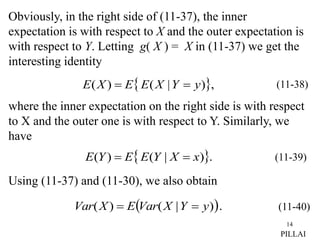
Solution: As Fig. 11.3 shows,
in the shaded area, and zero elsewhere.
From there
and
This gives
and


 



.
otherwise
,
0
,
1
|
|
0
,
1
)
,
(
x
y
y
x
fXY (11-31)
)
|
( Y
X
E ).
|
( X
Y
E
,
1
0
,
2
)
,
(
)
( 


 
x
x
dy
y
x
f
x
f
x
x
XY
X
1
| |
( ) 1 1 | |, | | 1,
Y
y
f y dx y y
   

,
1
|
|
0
,
|
|
1
1
)
(
)
,
(
)
|
(
| 




 x
y
y
y
f
y
x
f
y
x
f
Y
XY
Y
X
.
1
|
|
0
,
2
1
)
(
)
,
(
)
|
(
| 



 x
y
x
x
f
y
x
f
x
y
f
X
XY
X
Y
(11-32)
(11-33)
x
y
1
Fig. 11.3
1
)
,
( 
y
x
fXY
PILLAI
13
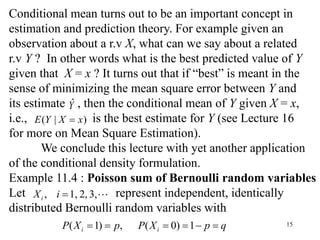
Hence
It is possible to obtain an interesting generalization of the
conditional mean formulas in (11-28) - (11-29). More
generally, (11-28) gives
But
.
1
|
|
,
2
|
|
1
|)
|
1
(
2
|
|
1
2
|)
|
1
(
1
|)
|
1
(
)
|
(
)
|
(
2
1
|
|
2
1
|
|
|










  
y
y
y
y
x
y
dx
y
x
dx
y
x
f
x
Y
X
E
y
y
Y
X
.
1
0
,
0
2
2
1
2
)
|
(
)
|
(
2
| 







  x
y
x
dy
x
y
dy
x
y
yf
X
Y
E
x
x
x
x
X
Y
(11-34)
(11-35)
 
 
 
|
( )|
( ) ( ) ( ) ( ) ( , )
( ) ( , ) ( ) ( | ) ( )
( ) | ( )
X XY
XY X Y Y
E g X Y y
Y
E g X g x f x dx g x f x y dydx
g x f x y dxdy g x f x y dx f y dy
E g X Y y f y dy E E
  
  
   
   



 
 
  
  
   
  
 
( ) | .
g X Y y

  |
( ) | ( ) ( | ) .
X Y
E g X Y y g x f x y dx


   (11-36)
(11-37)PILLAI
14
Obviously, in the right side of (11-37), the inner
expectation is with respect to X and the outer expectation is
with respect to Y. Letting g( X ) = X in (11-37) we get the
interesting identity
where the inner expectation on the right side is with respect
to X and the outer one is with respect to Y. Similarly, we
have
Using (11-37) and (11-30), we also obtain
 ,
)
|
(
)
( y
Y
X
E
E
X
E 

 .
)
|
(
)
( x
X
Y
E
E
Y
E 

(11-38)
(11-39)
 .
)
|
(
)
( y
Y
X
Var
E
X
Var 
 (11-40)
PILLAI
15
Conditional mean turns out to be an important concept in
estimation and prediction theory. For example given an
observation about a r.v X, what can we say about a related
r.v Y ? In other words what is the best predicted value of Y
given that X = x ? It turns out that if “best” is meant in the
sense of minimizing the mean square error between Y and
its estimate , then the conditional mean of Y given X = x,
i.e., is the best estimate for Y (see Lecture 16
for more on Mean Square Estimation).
We conclude this lecture with yet another application
of the conditional density formulation.
Example 11.4 : Poisson sum of Bernoulli random variables
Let represent independent, identically
distributed Bernoulli random variables with
Yˆ
)
|
( x
X
Y
E 

3,
2,
1,
, 
i
Xi
q
p
X
P
p
X
P i
i 




 1
)
0
(
,
)
1
(
16
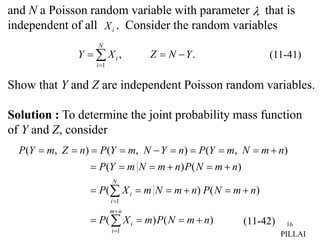
and N a Poisson random variable with parameter that is
independent of all . Consider the random variables
Show that Y and Z are independent Poisson random variables.
Solution : To determine the joint probability mass function
of Y and Z, consider
.
,
1
Y
N
Z
X
Y
N
i
i 

 

(11-41)
i
X

PILLAI































n
m
i
i
N
i
i
n
m
N
P
m
X
P
n
m
N
P
n
m
N
m
X
P
n
m
N
P
n
m
N
m
Y
P
n
m
N
m
Y
P
n
Y
N
m
Y
P
n
Z
m
Y
P
1
1
)
(
)
(
)
(
)
(
)
(
)
(
)
,
(
)
,
(
)
,
(
(11-42)
17
)
)
,
(
~
( of
t
independen
are
and
that
Note
1
N
s
X
p
n
m
B
X i
n
m
i
i 



(11-43)
( )!
! ! ( )!
m n
m n
m n
p q e
m n m n
  

  
 
    

   












 

!
)
(
!
)
(
n
q
e
m
p
e
n
q
m
p 
 

).
(
)
( n
Z
P
m
Y
P 


PILLAI
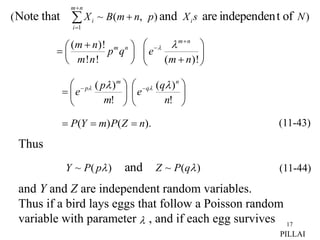
Thus
and Y and Z are independent random variables.
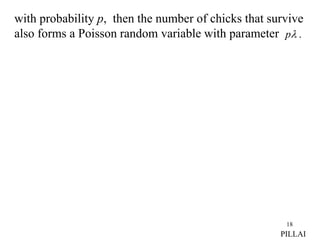
Thus if a bird lays eggs that follow a Poisson random
variable with parameter , and if each egg survives
)
(
~
)
(
~ and 
 q
P
Z
p
P
Y (11-44)

18
with probability p, then the number of chicks that survive
also forms a Poisson random variable with parameter .

p
PILLAI

Conditional density function ectr11a.ppt

  • 1.
    1 As we haveseen in section 4 conditional probability density functions are useful to update the information about an event based on the knowledge about some other related event (refer to example 4.7). In this section, we shall analyze the situation where the related event happens to be a random variable that is dependent on the one of interest. From (4-11), recall that the distribution function of X given an event B is (11-1)    . ) ( ) ) ( ( | ) ( ) | ( B P B x X P B x X P B x FX        PILLAI 11. Conditional Density Functions and Conditional Expected Values
  • 2.
    2 Suppose, we let Substituting(11-2) into (11-1), we get where we have made use of (7-4). But using (3-28) and (7-7) we can rewrite (11-3) as To determine, the limiting case we can let and in (11-4).  . ) ( 2 1 y Y y B     (11-3) (11-2)   , ) ( ) ( ) , ( ) , ( ) ) ( ( ) ( , ) ( ) | ( 1 2 1 2 2 1 2 1 2 1 y F y F y x F y x F y Y y P y Y y x X P y Y y x F Y Y XY XY X               . ) ( ) , ( ) | ( 2 1 2 1 2 1         y y Y x y y XY X dv v f dudv v u f y Y y x F (11-4) ), | ( y Y x FX  y y  1 y y y    2 PILLAI
  • 3.
    3 This gives and hencein the limit (To remind about the conditional nature on the left hand side, we shall use the subscript X | Y (instead of X) there). Thus Differentiating (11-7) with respect to x using (8-7), we get (11-5) (11-6) . ) ( ) , ( ) | ( lim ) | ( 0 y f du y u f y y Y y x F y Y x F Y x XY X y X             (11-7) (11-8) y y f y du y u f dv v f dudv v u f y y Y y x F Y x XY y y y Y x y y y XY X                     ) ( ) , ( ) ( ) , ( ) | ( . ) ( ) , ( ) | ( | y f du y u f y Y x F Y x XY Y X      . ) ( ) , ( ) | ( | y f y x f y Y x f Y XY Y X   PILLAI
  • 4.
    4 It is easyto see that the left side of (11-8) represents a valid probability density function. In fact and where we have made use of (7-14). From (11-9) - (11-10), (11-8) indeed represents a valid p.d.f, and we shall refer to it as the conditional p.d.f of the r.v X given Y = y. We may also write From (11-8) and (11-11), we have (11-9) | ( , ) ( | ) 0 ( ) XY X Y Y f x y f x Y y f y    , 1 ) ( ) ( ) ( ) , ( ) | ( |               y f y f y f dx y x f dx y Y x f Y Y Y XY Y X (11-10) (11-11) , ) ( ) , ( ) | ( | y f y x f y x f Y XY Y X  (11-12) PILLAI ). | ( ) | ( | | y x f y Y x f Y X Y X  
  • 5.
    5 and similarly If ther.vs X and Y are independent, then and (11-12) - (11-13) reduces to implying that the conditional p.d.fs coincide with their unconditional p.d.fs. This makes sense, since if X and Y are independent r.vs, information about Y shouldn’t be of any help in updating our knowledge about X. In the case of discrete-type r.vs, (11-12) reduces to ) ( ) ( ) , ( y f x f y x f Y X XY  (11-13) (11-14) (11-15) . ) ( ) , ( ) | ( | x f y x f x y f X XY X Y  ), ( ) | ( ), ( ) | ( | | y f x y f x f y x f Y X Y X Y X     . ) ( ) , ( | j j i j i y Y P y Y x X P y Y x X P       PILLAI
  • 6.
    6 Next we shallillustrate the method of obtaining conditional p.d.fs through an example. Example 11.1: Given determine and Solution: The joint p.d.f is given to be a constant in the shaded region. This gives Similarly and (11-16)        , otherwise , 0 , 1 0 , ) , ( y x k y x fXY . 2 1 2 ) , ( 1 0 1 0 0           k k dy y k dy dx k dxdy y x f y XY ) | ( | y x f Y X ). | ( | x y f X Y x y 1 1 Fig. 11.1 , 1 0 ), 1 ( ) , ( ) ( 1         x x k dy k dy y x f x f x XY X (11-17) . 1 0 , ) , ( ) ( 0        y y k dx k dx y x f y f y XY Y (11-18) PILLAI
  • 7.
    7 From (11-16) -(11-18), we get and We can use (11-12) - (11-13) to derive an important result. From there, we also have or But and using (11-23) in (11-22), we get (11-19) (11-20) (11-21) , 1 0 , 1 ) ( ) , ( ) | ( |      y x y y f y x f y x f Y XY Y X . 1 0 , 1 1 ) ( ) , ( ) | ( |       y x x x f y x f x y f X XY X Y ) ( ) | ( ) ( ) | ( ) , ( | | x f x y f y f y x f y x f X X Y Y Y X XY   . ) ( ) ( ) | ( ) | ( | | x f y f y x f x y f X Y Y X X Y  (11-22)             | ) ( ) | ( ) , ( ) ( dy y f y x f dy y x f x f Y Y X XY X (11-23) PILLAI
  • 8.
    8 Equation (11-24) representsthe p.d.f version of Bayes’ theorem. To appreciate the full significance of (11-24), one need to look at communication problems where observations can be used to update our knowledge about unknown parameters. We shall illustrate this using a simple example. Example 11.2: An unknown random phase  is uniformly distributed in the interval and where n  Determine Solution: Initially almost nothing about the r.v  is known, so that we assume its a-priori p.d.f to be uniform in the interval . ) ( ) | ( ) ( ) | ( ) | ( | |       dy y f y x f y f y x f x y f Y Y X Y Y X YX (24) ), 2 , 0 (  , n r   ). , 0 ( 2  N ). | ( r f  ). 2 , 0 (  PILLAI
  • 9.
    9 In the equationwe can think of n as the noise contribution and r as the observation. It is reasonable to assume that  and n are independent. In that case  since it is given that is a constant, behaves like n. Using (11-24), this gives the a-posteriori p.d.f of  given r to be (see Fig. 11.2 (b)) where , n r   ) , ( ) | ( 2    N r f  θ (11-25)   θ , 2 0 , ) ( 2 1 ) ( ) | ( ) ( ) | ( ) | ( 2 2 2 2 2 2 2 / ) ( 2 0 2 / ) ( 2 / ) ( 2 0                                   r r r e r d e e d f r f f r f r f . 2 ) ( 2 0 2 / ) ( 2 2           d e r r (11-26) n r   PILLAI
  • 10.
    10 Notice that theknowledge about the observation r is reflected in the a-posteriori p.d.f of  in Fig. 11.2 (b). It is no longer flat as the a-priori p.d.f in Fig. 11.2 (a), and it shows higher probabilities in the neighborhood of . r   ) | ( | r f r    (b) a-posteriori p.d.f of  r   Fig. 11.2 Conditional Mean: We can use the conditional p.d.fs to define the conditional mean. More generally, applying (6-13) to conditional p.d.fs we get ) (  f  (a) a-priori p.d.f of   2 1  2 PILLAI
  • 11.
    11   ( )| ( ) ( | ) . X E g X B g x f x B dx     (11-27) and using a limiting argument as in (11-2) - (11-8), we get to be the conditional mean of X given Y = y. Notice that will be a function of y. Also In a similar manner, the conditional variance of X given Y = y is given by we shall illustrate these calculations through an example.           | | ) | ( | dx y x f x y Y X E Y X Y X  (11-28) ) | ( y Y X E    . ) | ( | | |         dy x y f y x X Y E X Y X Y  (11-29)      . | ) ( ) | ( | ) | ( 2 | 2 2 2 | y Y X E y Y X E y Y X E Y X Var Y X Y X           (11-30) PILLAI
  • 12.
    12 Example 11.3: Let Determineand Solution: As Fig. 11.3 shows, in the shaded area, and zero elsewhere. From there and This gives and        . otherwise , 0 , 1 | | 0 , 1 ) , ( x y y x fXY (11-31) ) | ( Y X E ). | ( X Y E , 1 0 , 2 ) , ( ) (      x x dy y x f x f x x XY X 1 | | ( ) 1 1 | |, | | 1, Y y f y dx y y      , 1 | | 0 , | | 1 1 ) ( ) , ( ) | ( |       x y y y f y x f y x f Y XY Y X . 1 | | 0 , 2 1 ) ( ) , ( ) | ( |      x y x x f y x f x y f X XY X Y (11-32) (11-33) x y 1 Fig. 11.3 1 ) , (  y x fXY PILLAI
  • 13.
    13 Hence It is possibleto obtain an interesting generalization of the conditional mean formulas in (11-28) - (11-29). More generally, (11-28) gives But . 1 | | , 2 | | 1 |) | 1 ( 2 | | 1 2 |) | 1 ( 1 |) | 1 ( ) | ( ) | ( 2 1 | | 2 1 | | |              y y y y x y dx y x dx y x f x Y X E y y Y X . 1 0 , 0 2 2 1 2 ) | ( ) | ( 2 |           x y x dy x y dy x y yf X Y E x x x x X Y (11-34) (11-35)       | ( )| ( ) ( ) ( ) ( ) ( , ) ( ) ( , ) ( ) ( | ) ( ) ( ) | ( ) X XY XY X Y Y E g X Y y Y E g X g x f x dx g x f x y dydx g x f x y dxdy g x f x y dx f y dy E g X Y y f y dy E E                                     ( ) | . g X Y y    | ( ) | ( ) ( | ) . X Y E g X Y y g x f x y dx      (11-36) (11-37)PILLAI
  • 14.
    14 Obviously, in theright side of (11-37), the inner expectation is with respect to X and the outer expectation is with respect to Y. Letting g( X ) = X in (11-37) we get the interesting identity where the inner expectation on the right side is with respect to X and the outer one is with respect to Y. Similarly, we have Using (11-37) and (11-30), we also obtain  , ) | ( ) ( y Y X E E X E    . ) | ( ) ( x X Y E E Y E   (11-38) (11-39)  . ) | ( ) ( y Y X Var E X Var   (11-40) PILLAI
  • 15.
    15 Conditional mean turnsout to be an important concept in estimation and prediction theory. For example given an observation about a r.v X, what can we say about a related r.v Y ? In other words what is the best predicted value of Y given that X = x ? It turns out that if “best” is meant in the sense of minimizing the mean square error between Y and its estimate , then the conditional mean of Y given X = x, i.e., is the best estimate for Y (see Lecture 16 for more on Mean Square Estimation). We conclude this lecture with yet another application of the conditional density formulation. Example 11.4 : Poisson sum of Bernoulli random variables Let represent independent, identically distributed Bernoulli random variables with Yˆ ) | ( x X Y E   3, 2, 1, ,  i Xi q p X P p X P i i       1 ) 0 ( , ) 1 (
  • 16.
    16 and N aPoisson random variable with parameter that is independent of all . Consider the random variables Show that Y and Z are independent Poisson random variables. Solution : To determine the joint probability mass function of Y and Z, consider . , 1 Y N Z X Y N i i      (11-41) i X  PILLAI                                n m i i N i i n m N P m X P n m N P n m N m X P n m N P n m N m Y P n m N m Y P n Y N m Y P n Z m Y P 1 1 ) ( ) ( ) ( ) ( ) ( ) ( ) , ( ) , ( ) , ( (11-42)
  • 17.
    17 ) ) , ( ~ ( of t independen are and that Note 1 N s X p n m B X i n m i i    (11-43) ( )! ! ! ( )! m n m n m n p q e m n m n                                   ! ) ( ! ) ( n q e m p e n q m p     ). ( ) ( n Z P m Y P    PILLAI Thus and Y and Z are independent random variables. Thus if a bird lays eggs that follow a Poisson random variable with parameter , and if each egg survives ) ( ~ ) ( ~ and   q P Z p P Y (11-44) 
  • 18.
    18 with probability p,then the number of chicks that survive also forms a Poisson random variable with parameter .  p PILLAI