DATA STRUCTURES
STACK OPERATIONS
- Dr. Gopika S
Asst Professor
Department of Computer Science
Kristu Jayanti College
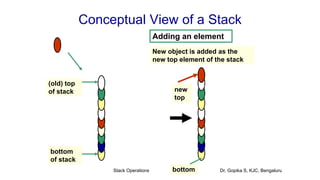
Conceptual View of a Stack
bottom
of stack
(old) top
of stack
New object is added as the
new top element of the stack
Adding an element
new
top
bottom
Stack Operations Dr. Gopika S, KJC, Bengaluru
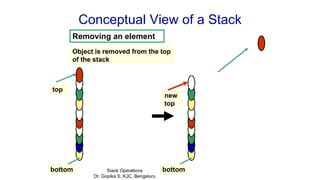
Conceptual View of a Stack
Object is removed from the top
of the stack
Removing an element
top
bottom
new
top
bottom
Stack Operations
Dr. Gopika S, KJC, Bengaluru
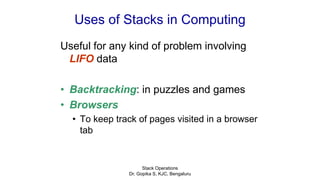
Uses of Stacks in Computing
Useful for any kind of problem involving
LIFO data
• Backtracking: in puzzles and games
• Browsers
• To keep track of pages visited in a browser
tab
Stack Operations
Dr. Gopika S, KJC, Bengaluru
Uses of Stacks in Computing
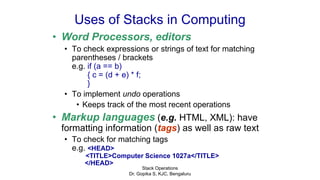
• Word Processors, editors
• To check expressions or strings of text for matching
parentheses / brackets
e.g. if (a == b)
{ c = (d + e) * f;
}
• To implement undo operations
• Keeps track of the most recent operations
• Markup languages (e.g. HTML, XML): have
formatting information (tags) as well as raw text
• To check for matching tags
e.g. <HEAD>
<TITLE>Computer Science 1027a</TITLE>
</HEAD>
Stack Operations
Dr. Gopika S, KJC, Bengaluru
Uses of Stacks in Computing
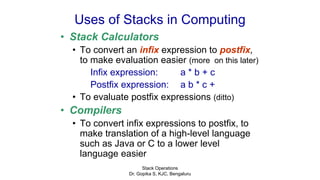
• Stack Calculators
• To convert an infix expression to postfix,
to make evaluation easier (more on this later)
Infix expression: a * b + c
Postfix expression: a b * c +
• To evaluate postfix expressions (ditto)
• Compilers
• To convert infix expressions to postfix, to
make translation of a high-level language
such as Java or C to a lower level
language easier
Stack Operations
Dr. Gopika S, KJC, Bengaluru
Uses of Stacks in Computing
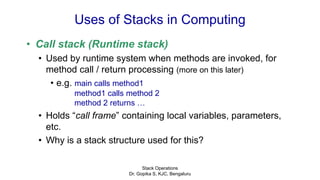
• Call stack (Runtime stack)
• Used by runtime system when methods are invoked, for
method call / return processing (more on this later)
• e.g. main calls method1
method1 calls method 2
method 2 returns …
• Holds “call frame” containing local variables, parameters,
etc.
• Why is a stack structure used for this?
Stack Operations
Dr. Gopika S, KJC, Bengaluru
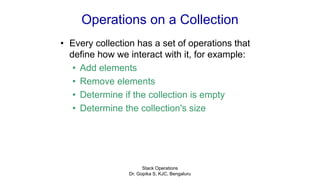
Operations on a Collection
• Every collection has a set of operations that
define how we interact with it, for example:
• Add elements
• Remove elements
• Determine if the collection is empty
• Determine the collection's size
Stack Operations
Dr. Gopika S, KJC, Bengaluru
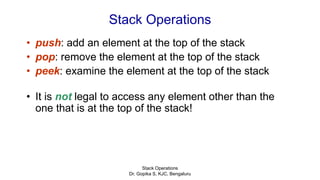
Stack Operations
• push: add an element at the top of the stack
• pop: remove the element at the top of the stack
• peek: examine the element at the top of the stack
• It is not legal to access any element other than the
one that is at the top of the stack!
Stack Operations
Dr. Gopika S, KJC, Bengaluru
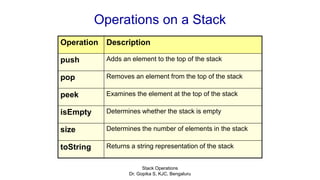
Operations on a Stack
Operation Description
push Adds an element to the top of the stack
pop Removes an element from the top of the stack
peek Examines the element at the top of the stack
isEmpty Determines whether the stack is empty
size Determines the number of elements in the stack
toString Returns a string representation of the stack
Stack Operations
Dr. Gopika S, KJC, Bengaluru

Data Structures: Stack Operations

  • 1.
    DATA STRUCTURES STACK OPERATIONS -Dr. Gopika S Asst Professor Department of Computer Science Kristu Jayanti College
  • 2.
    Conceptual View ofa Stack bottom of stack (old) top of stack New object is added as the new top element of the stack Adding an element new top bottom Stack Operations Dr. Gopika S, KJC, Bengaluru
  • 3.
    Conceptual View ofa Stack Object is removed from the top of the stack Removing an element top bottom new top bottom Stack Operations Dr. Gopika S, KJC, Bengaluru
  • 4.
    Uses of Stacksin Computing Useful for any kind of problem involving LIFO data • Backtracking: in puzzles and games • Browsers • To keep track of pages visited in a browser tab Stack Operations Dr. Gopika S, KJC, Bengaluru
  • 5.
    Uses of Stacksin Computing • Word Processors, editors • To check expressions or strings of text for matching parentheses / brackets e.g. if (a == b) { c = (d + e) * f; } • To implement undo operations • Keeps track of the most recent operations • Markup languages (e.g. HTML, XML): have formatting information (tags) as well as raw text • To check for matching tags e.g. <HEAD> <TITLE>Computer Science 1027a</TITLE> </HEAD> Stack Operations Dr. Gopika S, KJC, Bengaluru
  • 6.
    Uses of Stacksin Computing • Stack Calculators • To convert an infix expression to postfix, to make evaluation easier (more on this later) Infix expression: a * b + c Postfix expression: a b * c + • To evaluate postfix expressions (ditto) • Compilers • To convert infix expressions to postfix, to make translation of a high-level language such as Java or C to a lower level language easier Stack Operations Dr. Gopika S, KJC, Bengaluru
  • 7.
    Uses of Stacksin Computing • Call stack (Runtime stack) • Used by runtime system when methods are invoked, for method call / return processing (more on this later) • e.g. main calls method1 method1 calls method 2 method 2 returns … • Holds “call frame” containing local variables, parameters, etc. • Why is a stack structure used for this? Stack Operations Dr. Gopika S, KJC, Bengaluru
  • 8.
    Operations on aCollection • Every collection has a set of operations that define how we interact with it, for example: • Add elements • Remove elements • Determine if the collection is empty • Determine the collection's size Stack Operations Dr. Gopika S, KJC, Bengaluru
  • 9.
    Stack Operations • push:add an element at the top of the stack • pop: remove the element at the top of the stack • peek: examine the element at the top of the stack • It is not legal to access any element other than the one that is at the top of the stack! Stack Operations Dr. Gopika S, KJC, Bengaluru
  • 10.
    Operations on aStack Operation Description push Adds an element to the top of the stack pop Removes an element from the top of the stack peek Examines the element at the top of the stack isEmpty Determines whether the stack is empty size Determines the number of elements in the stack toString Returns a string representation of the stack Stack Operations Dr. Gopika S, KJC, Bengaluru