Concrete Defects
CB 557
Inspection, Maintenance and Repair of
Structures
Dr. Karim Helmy
FRESH CONCRETE DEFECTS
CB 557 Notes by Dr. Karim Helmy
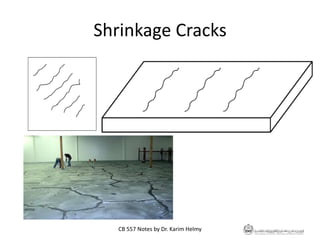
Shrinkage Cracks
• Caused by evaporation of mix water in fresh
concrete, the extent of which will depend on
– The amount of water in concrete increasing water
in the mix increases cracking
– The weather conditions (heat, low humidity and
wind increases evaporation and therefore cracks)
– Curing (lack of curing increases shrinkage)
CB 557 Notes by Dr. Karim Helmy
Shrinkage Cracks
CB 557 Notes by Dr. Karim Helmy
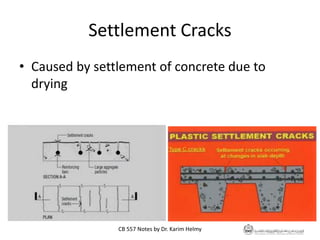
Settlement Cracks
• Caused by settlement of concrete due to
drying
CB 557 Notes by Dr. Karim Helmy
Movement of formwork
CB 557 Notes by Dr. Karim Helmy
How to minimize fresh concrete cracks
• Do not use excessive water in the mix
• Proper compaction
• Do not cast in hot weather
– If you have to cast in hot weather use chilled
water or crushed ice
• Proper curing
• Proper construction and monitoring of
formwork during pouring of concrete
CB 557 Notes by Dr. Karim Helmy
DESIGN AND DETAILING ERRORS
CB 557 Notes by Dr. Karim Helmy
Design Errors
• Not taking into consideration all load cases e.g.
temperature, wind, construction loads etc.
• Not taking into consideration order of
construction
• Complex details
• Not complying with minimum design
requirements like minimum spacing and
reinforcement ratios
• Not providing sufficient details specially in cases
of irregular geometry or cases where suggested
code detail do not apply
CB 557 Notes by Dr. Karim Helmy
Detailing Errors
Insufficient Spacing between bars
Causes honey combs and voids
Distance between bars 1.5 max aggregate size or max
CB 557 Notes by Dr. Karim Helmy
Detailing Errors
At least 1/3 of lower reinforcement should extend to the columns
Incorrect
Correct
CB 557 Notes by Dr. Karim Helmy
Detailing Errors
L
<1.5L
L
≥1.5L
Incorrect
Correct
CB 557 Notes by Dr. Karim Helmy
Detailing Errors
Incorrect (Walls) Correct (Walls)
Slabs
CB 557 Notes by Dr. Karim Helmy
Detailing Errors
• Sudden change in depth
Incorrect
Correct
CB 557 Notes by Dr. Karim Helmy
Detailing Errors
CB 557 Notes by Dr. Karim Helmy
CONSTRUCTION ERRORS
CB 557 Notes by Dr. Karim Helmy
Construction Errors
• Increasing water in the mix
–Increased shrinkage
–Decreased strength
–Increase void sizes which decrease
durability
CB 557 Notes by Dr. Karim Helmy
Insufficient Compaction
• Causes Voids and honeycombs which reduces
durability as it exposes the reinforcement to
the environment and may reduce the strength
of the concrete sections
CB 557 Notes by Dr. Karim Helmy
Honey Combs and Voids
CB 557 Notes by Dr. Karim Helmy
Construction Errors
• Excessive vibration of concrete
– Causes bleeding and segregation of concrete
CB 557 Notes by Dr. Karim Helmy
Insufficient tying of reinforcement
• Causes movement of reinforcement
CB 557 Notes by Dr. Karim Helmy
Insufficient chairs and spacers
• Causes sagging of reinforcement which leads
to
– Reduction in concrete cover
– Reduction in effective depth of sections
Concrete cover
d
d
CB 557 Notes by Dr. Karim Helmy
Improper Casting of long Columns
• Causes segregation of concrete
CB 557 Notes by Dr. Karim Helmy
TEMPERATURE EFFECTS
CB 557 Notes by Dr. Karim Helmy
Drying Shrinkage and Dimensional
Changes Caused by Temperature
• Changes in dimensions either due to drying
shrinkage or thermal expansion or contraction
will cause stresses in restrained structures
• Cracking will occur due if the stresses exceed
the capacity of the concrete this will occur in
the following cases
– Construction errors leading to excessive shrinkage
– Poorly designed or constructed expansion joints
– Design errors
CB 557 Notes by Dr. Karim Helmy
Freezing and Thawing
• Water present in the voids of concrete will
expand on freezing causing some internal
pressure.
• The repeated cycles of freezing and thawing
will weaken the concrete causing crakes and
spalling
• This could be prevented by using air entrained
concrete
CB 557 Notes by Dr. Karim Helmy
CHEMICAL EFFECTS
CB 557 Notes by Dr. Karim Helmy
Alkali Aggregate Reaction
• Alkali aggregate reaction results in deleterious
expansive cracking of concrete occurring at
later ages after construction. While mostly
inert, some concrete aggregates, can react in
the highly alkaline environment in concrete
resulting in internal expansion that causes
deleterious cracking
CB 557 Notes by Dr. Karim Helmy
Alkali Aggregate Reaction
Slabs Walls and Abutments
CB 557 Notes by Dr. Karim Helmy
Sulphate Attack
• Solution of the sulfates of various bases
including sodium, potassium, magnesium and
calcium react with hydrated cement paste
forming gypsum or a compound called
ettringite (sulphoaluminate) which leads to
the expansion and disruption of the concrete
and mortar this process is referred as sulphate
attack.
CB 557 Notes by Dr. Karim Helmy
Sulphate Attack
CB 557 Notes by Dr. Karim Helmy
Corrosion of Reinforcement Steel
• The alkalinity of concrete provides a
protective layer that protects the
reinforcement from corrosion
CB 557 Notes by Dr. Karim Helmy
Corrosion of Reinforcement Steel
• If the PH of the concrete is reduced below 9 by
carbonation for example or if the protective layer is
eroded by the presence of chemicals like chlorides or
sulphates either from the environment or from
within the concrete corrosion will occur
CB 557 Notes by Dr. Karim Helmy
Corrosion of Reinforcement Steel
• Corrosion is an electro-chemical reaction that
requires the presence of
– Oxygen
– Water
– Conductive medium
CB 557 Notes by Dr. Karim Helmy
Corrosion of Reinforcement Steel
• Corroded steel is pours, weak and expansive
which allow the progress of the corrosion
process also causes cracking of the concrete
CB 557 Notes by Dr. Karim Helmy
Corrosion of Reinforcement Steel
• Crack patterns slabs
CB 557 Notes by Dr. Karim Helmy
Corrosion of Reinforcement Steel
• Crack patterns beams
CB 557 Notes by Dr. Karim Helmy
Corrosion of Reinforcement Steel
• Crack patterns columns
CB 557 Notes by Dr. Karim Helmy
OVERLOADING
CB 557 Notes by Dr. Karim Helmy
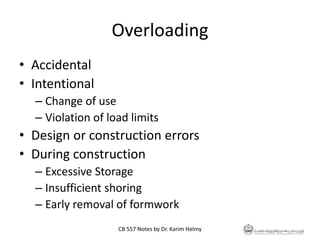
Overloading
• Accidental
• Intentional
– Change of use
– Violation of load limits
• Design or construction errors
• During construction
– Excessive Storage
– Insufficient shoring
– Early removal of formwork
CB 557 Notes by Dr. Karim Helmy
Overloading One Way Slabs
CB 557 Notes by Dr. Karim Helmy
Overloading Two Way Slabs
CB 557 Notes by Dr. Karim Helmy
Overloading Beams
Bending
Shear
CB 557 Notes by Dr. Karim Helmy
Overloading Columns
Shear Compression Buckling
CB 557 Notes by Dr. Karim Helmy
Overloading Columns
Compression
CB 557 Notes by Dr. Karim Helmy

Concrete defects.pdf

  • 1.
    Concrete Defects CB 557 Inspection,Maintenance and Repair of Structures Dr. Karim Helmy
  • 2.
    FRESH CONCRETE DEFECTS CB557 Notes by Dr. Karim Helmy
  • 3.
    Shrinkage Cracks • Causedby evaporation of mix water in fresh concrete, the extent of which will depend on – The amount of water in concrete increasing water in the mix increases cracking – The weather conditions (heat, low humidity and wind increases evaporation and therefore cracks) – Curing (lack of curing increases shrinkage) CB 557 Notes by Dr. Karim Helmy
  • 4.
    Shrinkage Cracks CB 557Notes by Dr. Karim Helmy
  • 5.
    Settlement Cracks • Causedby settlement of concrete due to drying CB 557 Notes by Dr. Karim Helmy
  • 6.
    Movement of formwork CB557 Notes by Dr. Karim Helmy
  • 7.
    How to minimizefresh concrete cracks • Do not use excessive water in the mix • Proper compaction • Do not cast in hot weather – If you have to cast in hot weather use chilled water or crushed ice • Proper curing • Proper construction and monitoring of formwork during pouring of concrete CB 557 Notes by Dr. Karim Helmy
  • 8.
    DESIGN AND DETAILINGERRORS CB 557 Notes by Dr. Karim Helmy
  • 9.
    Design Errors • Nottaking into consideration all load cases e.g. temperature, wind, construction loads etc. • Not taking into consideration order of construction • Complex details • Not complying with minimum design requirements like minimum spacing and reinforcement ratios • Not providing sufficient details specially in cases of irregular geometry or cases where suggested code detail do not apply CB 557 Notes by Dr. Karim Helmy
  • 10.
    Detailing Errors Insufficient Spacingbetween bars Causes honey combs and voids Distance between bars 1.5 max aggregate size or max CB 557 Notes by Dr. Karim Helmy
  • 11.
    Detailing Errors At least1/3 of lower reinforcement should extend to the columns Incorrect Correct CB 557 Notes by Dr. Karim Helmy
  • 12.
  • 13.
    Detailing Errors Incorrect (Walls)Correct (Walls) Slabs CB 557 Notes by Dr. Karim Helmy
  • 14.
    Detailing Errors • Suddenchange in depth Incorrect Correct CB 557 Notes by Dr. Karim Helmy
  • 15.
    Detailing Errors CB 557Notes by Dr. Karim Helmy
  • 16.
    CONSTRUCTION ERRORS CB 557Notes by Dr. Karim Helmy
  • 17.
    Construction Errors • Increasingwater in the mix –Increased shrinkage –Decreased strength –Increase void sizes which decrease durability CB 557 Notes by Dr. Karim Helmy
  • 18.
    Insufficient Compaction • CausesVoids and honeycombs which reduces durability as it exposes the reinforcement to the environment and may reduce the strength of the concrete sections CB 557 Notes by Dr. Karim Helmy
  • 19.
    Honey Combs andVoids CB 557 Notes by Dr. Karim Helmy
  • 20.
    Construction Errors • Excessivevibration of concrete – Causes bleeding and segregation of concrete CB 557 Notes by Dr. Karim Helmy
  • 21.
    Insufficient tying ofreinforcement • Causes movement of reinforcement CB 557 Notes by Dr. Karim Helmy
  • 22.
    Insufficient chairs andspacers • Causes sagging of reinforcement which leads to – Reduction in concrete cover – Reduction in effective depth of sections Concrete cover d d CB 557 Notes by Dr. Karim Helmy
  • 23.
    Improper Casting oflong Columns • Causes segregation of concrete CB 557 Notes by Dr. Karim Helmy
  • 24.
    TEMPERATURE EFFECTS CB 557Notes by Dr. Karim Helmy
  • 25.
    Drying Shrinkage andDimensional Changes Caused by Temperature • Changes in dimensions either due to drying shrinkage or thermal expansion or contraction will cause stresses in restrained structures • Cracking will occur due if the stresses exceed the capacity of the concrete this will occur in the following cases – Construction errors leading to excessive shrinkage – Poorly designed or constructed expansion joints – Design errors CB 557 Notes by Dr. Karim Helmy
  • 26.
    Freezing and Thawing •Water present in the voids of concrete will expand on freezing causing some internal pressure. • The repeated cycles of freezing and thawing will weaken the concrete causing crakes and spalling • This could be prevented by using air entrained concrete CB 557 Notes by Dr. Karim Helmy
  • 27.
    CHEMICAL EFFECTS CB 557Notes by Dr. Karim Helmy
  • 28.
    Alkali Aggregate Reaction •Alkali aggregate reaction results in deleterious expansive cracking of concrete occurring at later ages after construction. While mostly inert, some concrete aggregates, can react in the highly alkaline environment in concrete resulting in internal expansion that causes deleterious cracking CB 557 Notes by Dr. Karim Helmy
  • 29.
    Alkali Aggregate Reaction SlabsWalls and Abutments CB 557 Notes by Dr. Karim Helmy
  • 30.
    Sulphate Attack • Solutionof the sulfates of various bases including sodium, potassium, magnesium and calcium react with hydrated cement paste forming gypsum or a compound called ettringite (sulphoaluminate) which leads to the expansion and disruption of the concrete and mortar this process is referred as sulphate attack. CB 557 Notes by Dr. Karim Helmy
  • 31.
    Sulphate Attack CB 557Notes by Dr. Karim Helmy
  • 32.
    Corrosion of ReinforcementSteel • The alkalinity of concrete provides a protective layer that protects the reinforcement from corrosion CB 557 Notes by Dr. Karim Helmy
  • 33.
    Corrosion of ReinforcementSteel • If the PH of the concrete is reduced below 9 by carbonation for example or if the protective layer is eroded by the presence of chemicals like chlorides or sulphates either from the environment or from within the concrete corrosion will occur CB 557 Notes by Dr. Karim Helmy
  • 34.
    Corrosion of ReinforcementSteel • Corrosion is an electro-chemical reaction that requires the presence of – Oxygen – Water – Conductive medium CB 557 Notes by Dr. Karim Helmy
  • 35.
    Corrosion of ReinforcementSteel • Corroded steel is pours, weak and expansive which allow the progress of the corrosion process also causes cracking of the concrete CB 557 Notes by Dr. Karim Helmy
  • 36.
    Corrosion of ReinforcementSteel • Crack patterns slabs CB 557 Notes by Dr. Karim Helmy
  • 37.
    Corrosion of ReinforcementSteel • Crack patterns beams CB 557 Notes by Dr. Karim Helmy
  • 38.
    Corrosion of ReinforcementSteel • Crack patterns columns CB 557 Notes by Dr. Karim Helmy
  • 39.
    OVERLOADING CB 557 Notesby Dr. Karim Helmy
  • 40.
    Overloading • Accidental • Intentional –Change of use – Violation of load limits • Design or construction errors • During construction – Excessive Storage – Insufficient shoring – Early removal of formwork CB 557 Notes by Dr. Karim Helmy
  • 41.
    Overloading One WaySlabs CB 557 Notes by Dr. Karim Helmy
  • 42.
    Overloading Two WaySlabs CB 557 Notes by Dr. Karim Helmy
  • 43.
  • 44.
    Overloading Columns Shear CompressionBuckling CB 557 Notes by Dr. Karim Helmy
  • 45.