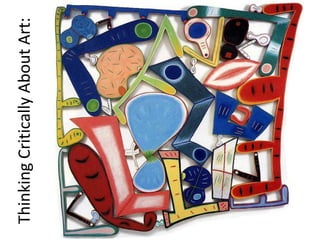
Thinking Critically About Art:
•   Elizabeth Murray was born
    in Chicago in 1940 and died
    of lung cancer at age 66 on
    August 12, 2007
•   She was born to a working-
    class family that struggled to
    make ends meet.
•   Her interest in art started at
    a young age and she drew
    constantly.
Large Still Life with a Pedestal
                                                    Table, Pablo Picasso, 1931


                                                                                           Cubism
                    Paul Cezanne, Still Life With
                    a Basket of Apples, 1893


                                                                                  Disney
The Persistence of Time,
Salvador Dali


                                     Surrealism
• Cubists rejected the idea that art should copy nature and refused to adopt the traditional
  techniques of perspective, modeling and foreshortening used to create realistic imagery.


• The Spanish artist Pablo Picasso and the French
  artist Georges Braque initiated the movement,
  between 1907 and 1914.


                                    • They wanted instead to emphasize the two-
                                      dimensionality of the canvas. So they reduced and
                                      fractured objects into geometric forms, and then
                                      reassembled these within a shallow picture space so
                                      that they appeared to be seen from many angles at
                                      once.
                                    • Other cubists:
• The Surrealist movement began in Paris in 1924
• A small group of writers and artists, influenced by the work of Sigmund Freud, began looking
  at the power of the unconscious mind as a means to unlock the imagination.
• In 1924, French writer André Breton, the leader of the movement, wrote Le Manifeste du
  Surréalisme. In it, he defined Surrealism as:


  SURREALISM, n. Psychic automatism in its pure state, by which one proposes to express
  verbally, by means of the written word, or in any other manner—the actual functioning of
  thought. Dictated by thought, in the absence of any control exercised by reason exempt from
  any aesthetic or moral concern.
• They were interested in the involvement of the unconscious mind in chance occurrences
  and dream imagery
Tristan Tzara, Paul Eluard, Andre Breton, Hans Arp, Salvador Dali, Yves Tanguy, Max Ernst, Rene Crevel, Man Ray, Paris, 1933
• Murray was a crucial figure in the struggle to bring painting back to life in the 1970s and
  early '80s.

• In her work, she moved away from the traditional rectangular canvas format, breaking
  with the art-historical convention of illusionistic space in a two-dimensional picture-plane…

• …. blurring the line between the painting as an object and the painting as a space for
  depicting objects.

• She began to create supports in the wild biomorphic and geometric shapes as well as
  shapes almost recognizable as domestic objects (tables, cups, chairs, etc.)….

• She would fit these together like a colorful, abstract puzzle.

• Her artworks are huge, wall sized pieces. Often, many different shaped canvases were fit
  together for the overall painting

    • The images were defined by layers of bold colors.
• She describes her work as an exploration of emotions and the psyche.
“For a couple of years I’ve been working with cutting out shapes and kind
of glomming them together and letting it go where it may, like basically
making a zigzag shape and making a rectangular shape and a circular,
bloopy, fat, cloudy shape and just putting them all together and letting
the cards fall where they may. I don’t know why I’m doing it this way
because what I want more than anything else in my life and in my
painting is for things to unify, to come together.”
Painter's Progress
(1981).
Almost Made It. 1998-
1999
Oil on three
canvases, 73 1/2 x 99”
Landing, 1999
“It is about making things, and it’s about expression, and it’s about
creation.”


“When you walk out of the studio, and you walk down the street that’s
where you find art. Or you find it at home, right in front of you. I paint
about things that surround me-things that I pick up and handle
everyday. That’s what art is. Art is an epiphany in a coffee cup.”
Yikes, 1982. Oil on canvas, two
panels, 9' 7" x 9' 5
Bop. 2002-2003.
Oil on canvas
9’10” x 10’10.5”
Can You Hear Me?
1984
Oil on 4 canvases
106 x 159 x 12 in.
Worms eye.
2002. Oil on
canvas, 97” X 92”

Elizabeth Murray PPT

  • 1.
  • 3.
    Elizabeth Murray was born in Chicago in 1940 and died of lung cancer at age 66 on August 12, 2007 • She was born to a working- class family that struggled to make ends meet. • Her interest in art started at a young age and she drew constantly.
  • 4.
    Large Still Lifewith a Pedestal Table, Pablo Picasso, 1931 Cubism Paul Cezanne, Still Life With a Basket of Apples, 1893 Disney The Persistence of Time, Salvador Dali Surrealism
  • 5.
    • Cubists rejectedthe idea that art should copy nature and refused to adopt the traditional techniques of perspective, modeling and foreshortening used to create realistic imagery. • The Spanish artist Pablo Picasso and the French artist Georges Braque initiated the movement, between 1907 and 1914. • They wanted instead to emphasize the two- dimensionality of the canvas. So they reduced and fractured objects into geometric forms, and then reassembled these within a shallow picture space so that they appeared to be seen from many angles at once. • Other cubists:
  • 6.
    • The Surrealistmovement began in Paris in 1924 • A small group of writers and artists, influenced by the work of Sigmund Freud, began looking at the power of the unconscious mind as a means to unlock the imagination. • In 1924, French writer André Breton, the leader of the movement, wrote Le Manifeste du Surréalisme. In it, he defined Surrealism as: SURREALISM, n. Psychic automatism in its pure state, by which one proposes to express verbally, by means of the written word, or in any other manner—the actual functioning of thought. Dictated by thought, in the absence of any control exercised by reason exempt from any aesthetic or moral concern. • They were interested in the involvement of the unconscious mind in chance occurrences and dream imagery Tristan Tzara, Paul Eluard, Andre Breton, Hans Arp, Salvador Dali, Yves Tanguy, Max Ernst, Rene Crevel, Man Ray, Paris, 1933
  • 7.
    • Murray wasa crucial figure in the struggle to bring painting back to life in the 1970s and early '80s. • In her work, she moved away from the traditional rectangular canvas format, breaking with the art-historical convention of illusionistic space in a two-dimensional picture-plane… • …. blurring the line between the painting as an object and the painting as a space for depicting objects. • She began to create supports in the wild biomorphic and geometric shapes as well as shapes almost recognizable as domestic objects (tables, cups, chairs, etc.)…. • She would fit these together like a colorful, abstract puzzle. • Her artworks are huge, wall sized pieces. Often, many different shaped canvases were fit together for the overall painting • The images were defined by layers of bold colors. • She describes her work as an exploration of emotions and the psyche.
  • 9.
    “For a coupleof years I’ve been working with cutting out shapes and kind of glomming them together and letting it go where it may, like basically making a zigzag shape and making a rectangular shape and a circular, bloopy, fat, cloudy shape and just putting them all together and letting the cards fall where they may. I don’t know why I’m doing it this way because what I want more than anything else in my life and in my painting is for things to unify, to come together.”
  • 10.
  • 12.
    Almost Made It.1998- 1999
Oil on three canvases, 73 1/2 x 99”
  • 13.
  • 14.
    “It is aboutmaking things, and it’s about expression, and it’s about creation.” “When you walk out of the studio, and you walk down the street that’s where you find art. Or you find it at home, right in front of you. I paint about things that surround me-things that I pick up and handle everyday. That’s what art is. Art is an epiphany in a coffee cup.”
  • 15.
    Yikes, 1982. Oilon canvas, two panels, 9' 7" x 9' 5
  • 16.
    Bop. 2002-2003. Oil oncanvas 9’10” x 10’10.5”
  • 17.
    Can You HearMe? 1984 Oil on 4 canvases 106 x 159 x 12 in.
  • 18.
    Worms eye. 2002. Oilon canvas, 97” X 92”