Lecture 2
COMP SCI 7328 Concepts in Cyber Security
Security Goals
Lecturer: Faheem Ullah (faheem.ullah@adelaide.edu.au)
Outline
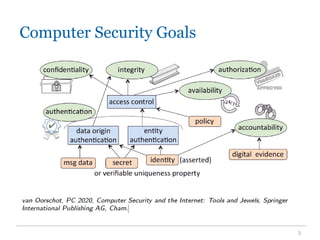
• Introduction to security goals
• Confidentiality, Integrity, and Availability (CIA)
• Authentication and Authorization
• Accountability
2
Computer Security Goals
3
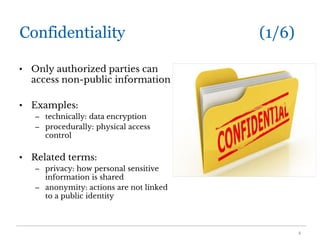
Confidentiality (1/6)
• Only authorized parties can
access non-public information
• Examples:
– technically: data encryption
– procedurally: physical access
control
• Related terms:
– privacy: how personal sensitive
information is shared
– anonymity: actions are not linked
to a public identity
4
Confidentiality (2/6)
• At large, the goal of confidentiality is to stop sensitive
data from getting into the wrong hands
• Before implementing security controls, group your
data into different categories according to how much
damage could be done if accessed by an authorized
entity
• The higher the negative impact, the stronger the
security controls need to be.
5
Confidentiality (3/6)
• Ensuring confidentiality is the responsibility of both
technologists and everyone else in the organization
• Everyone having access to information has a role in
preserving confidentiality
• Some ways to ensure data confidentiality
– Encryption
– Strong password
– Two-factor authentication
– Biometric verification
6
Confidentiality (4/6)
• Sometimes safeguarding data confidentiality involves special training
for those privy to sensitive documents
• Training can help familiarize authorized people with risk factors and
how to guard against them
• Further aspects of training may include strong passwords and
password-related best practices
• Users can take precautions to minimize the number of places where
information appears and the number of times it is actually transmitted
to complete a required transaction
7
Confidentiality (5/6)
Can you give an example of a
threat to data confidentiality and
explain how you would mitigate
it?
8
Confidentiality (6/6)
Can you explain how encryption
can be used to enhance the
confidentiality of data?
9
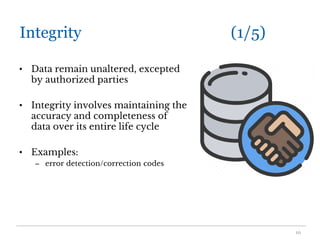
Integrity (1/5)
• Data remain unaltered, excepted
by authorized parties
• Integrity involves maintaining the
accuracy and completeness of
data over its entire life cycle
• Examples:
– error detection/correction codes
10
Integrity (2/5)
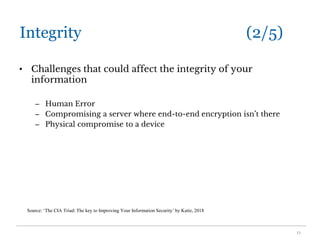
• Challenges that could affect the integrity of your
information
– Human Error
– Compromising a server where end-to-end encryption isn’t there
– Physical compromise to a device
11
Source: ‘The CIA Triad: The key to Improving Your Information Security’ by Katie, 2018
Integrity (3/5)
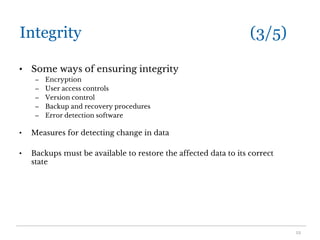
• Some ways of ensuring integrity
– Encryption
– User access controls
– Version control
– Backup and recovery procedures
– Error detection software
• Measures for detecting change in data
• Backups must be available to restore the affected data to its correct
state
12
Integrity (4/5)
How do you detect and respond to
a data integrity breach in your
organization?
13
Integrity (5/5)
Have you ever implemented
controls or procedures to ensure
the accuracy and completeness of
data in an organization?
14
Availability (1/5)
• Resources are accessible for
authorized use
• Example:
– protection against denial-of-
service attacks
15
Availability (2/5)
• Availability is typically associated with reliability and
system uptime.
• Availability can be impacted by
– Hardware failures
– Unscheduled software downtime
– Human error
– Cyber attacks like denial-of-service
16
Availability (3/5)
• Availability is ensured via
– Backups
– Redundancy
– Disaster recovery
– Proper monitoring
– Incident response plan
– Hardware repairs and maintenance
17
Availability (4/5)
How would you approach
planning for disaster recovery and
business continuity in the event of
a cyber attack or system failure?
18
Availability (5/5)
What are some common current
threats to the availability of
systems and services?
19
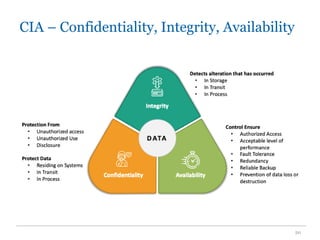
CIA – Confidentiality, Integrity, Availability
20
Challenges to ensure CIA
21
• The large volume of data
• The high variety of data
• The heterogenous sources of data
• Internet of things
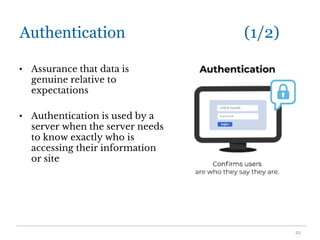
Authentication (1/2)
• Assurance that data is
genuine relative to
expectations
• Authentication is used by a
server when the server needs
to know exactly who is
accessing their information
or site
22
Authentication (2/2)
• Authentication does not determine what tasks the
individual can do or what files the individual can see.
• Authentication merely identifies and verifies who the
person or system is.
• In authentication, the user or computer has to prove
its identity to the server or client.
• Usually done before authorization
23
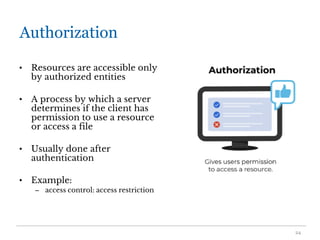
Authorization
• Resources are accessible only
by authorized entities
• A process by which a server
determines if the client has
permission to use a resource
or access a file
• Usually done after
authentication
• Example:
– access control: access restriction
24
Accountability (1/2)
• Every individual who works
with an information system
should have specific
responsibilities for information
assurance
• Ability to identify actors
responsible for past actions
25
Accountability (2/2)
• Example: Policy statement that all employees must
avoid installing outside software on a company-owned
information infrastructure
• The person in charge of information security should
perform periodic checks to be certain that the policy is
being followed.
• Individuals must be aware of what is expected of them
26
Source: https://www.computer-security-glossary.org/accountability.html
Summary
27
• The security policy of organizations are primarily
driven by security goals
• Confidentiality, integrity, and availability are the three
most important security requirements/goals
• Authentication and authorization are key measures for
ensuring confidentiality, integrity, and availability
• Accountability also plays a key role in ensuring
security of an organization
Extended Readings (1/2)
28
Articles
• "Confidentiality, Integrity, and Availability (CIA) Triad in Cybersecurity" by
SANS Institute
• "Balancing Confidentiality, Integrity, and Availability in Cybersecurity" by
ISACA
• "The Importance of Confidentiality, Integrity, and Availability in
Cybersecurity" by Dark Reading
• "Confidentiality, Integrity, and Availability (CIA) Triad: A Vital Component
of Cybersecurity" by InfoSec Institute
Extended Readings (2/2)
29
Research Papers
• "A Framework for Confidentiality, Integrity, and Availability in
Cybersecurity" by R. K. Jain and P. K. Sahu
• "Cybersecurity: A Study of Confidentiality, Integrity, and Availability" by R.
Jain and R. K. Jain
• "Cybersecurity Risks and Countermeasures: Confidentiality, Integrity, and
Availability" by D. C. Anderson and J. L. Brown
• "Confidentiality, Integrity, and Availability in Cybersecurity: A Review and
Future Directions" by A. P. Sahoo and S. Sahoo

Concepts of Cyber Security lecture notes.pdf

  • 1.
    Lecture 2 COMP SCI7328 Concepts in Cyber Security Security Goals Lecturer: Faheem Ullah (faheem.ullah@adelaide.edu.au)
  • 2.
    Outline • Introduction tosecurity goals • Confidentiality, Integrity, and Availability (CIA) • Authentication and Authorization • Accountability 2
  • 3.
  • 4.
    Confidentiality (1/6) • Onlyauthorized parties can access non-public information • Examples: – technically: data encryption – procedurally: physical access control • Related terms: – privacy: how personal sensitive information is shared – anonymity: actions are not linked to a public identity 4
  • 5.
    Confidentiality (2/6) • Atlarge, the goal of confidentiality is to stop sensitive data from getting into the wrong hands • Before implementing security controls, group your data into different categories according to how much damage could be done if accessed by an authorized entity • The higher the negative impact, the stronger the security controls need to be. 5
  • 6.
    Confidentiality (3/6) • Ensuringconfidentiality is the responsibility of both technologists and everyone else in the organization • Everyone having access to information has a role in preserving confidentiality • Some ways to ensure data confidentiality – Encryption – Strong password – Two-factor authentication – Biometric verification 6
  • 7.
    Confidentiality (4/6) • Sometimessafeguarding data confidentiality involves special training for those privy to sensitive documents • Training can help familiarize authorized people with risk factors and how to guard against them • Further aspects of training may include strong passwords and password-related best practices • Users can take precautions to minimize the number of places where information appears and the number of times it is actually transmitted to complete a required transaction 7
  • 8.
    Confidentiality (5/6) Can yougive an example of a threat to data confidentiality and explain how you would mitigate it? 8
  • 9.
    Confidentiality (6/6) Can youexplain how encryption can be used to enhance the confidentiality of data? 9
  • 10.
    Integrity (1/5) • Dataremain unaltered, excepted by authorized parties • Integrity involves maintaining the accuracy and completeness of data over its entire life cycle • Examples: – error detection/correction codes 10
  • 11.
    Integrity (2/5) • Challengesthat could affect the integrity of your information – Human Error – Compromising a server where end-to-end encryption isn’t there – Physical compromise to a device 11 Source: ‘The CIA Triad: The key to Improving Your Information Security’ by Katie, 2018
  • 12.
    Integrity (3/5) • Someways of ensuring integrity – Encryption – User access controls – Version control – Backup and recovery procedures – Error detection software • Measures for detecting change in data • Backups must be available to restore the affected data to its correct state 12
  • 13.
    Integrity (4/5) How doyou detect and respond to a data integrity breach in your organization? 13
  • 14.
    Integrity (5/5) Have youever implemented controls or procedures to ensure the accuracy and completeness of data in an organization? 14
  • 15.
    Availability (1/5) • Resourcesare accessible for authorized use • Example: – protection against denial-of- service attacks 15
  • 16.
    Availability (2/5) • Availabilityis typically associated with reliability and system uptime. • Availability can be impacted by – Hardware failures – Unscheduled software downtime – Human error – Cyber attacks like denial-of-service 16
  • 17.
    Availability (3/5) • Availabilityis ensured via – Backups – Redundancy – Disaster recovery – Proper monitoring – Incident response plan – Hardware repairs and maintenance 17
  • 18.
    Availability (4/5) How wouldyou approach planning for disaster recovery and business continuity in the event of a cyber attack or system failure? 18
  • 19.
    Availability (5/5) What aresome common current threats to the availability of systems and services? 19
  • 20.
    CIA – Confidentiality,Integrity, Availability 20
  • 21.
    Challenges to ensureCIA 21 • The large volume of data • The high variety of data • The heterogenous sources of data • Internet of things
  • 22.
    Authentication (1/2) • Assurancethat data is genuine relative to expectations • Authentication is used by a server when the server needs to know exactly who is accessing their information or site 22
  • 23.
    Authentication (2/2) • Authenticationdoes not determine what tasks the individual can do or what files the individual can see. • Authentication merely identifies and verifies who the person or system is. • In authentication, the user or computer has to prove its identity to the server or client. • Usually done before authorization 23
  • 24.
    Authorization • Resources areaccessible only by authorized entities • A process by which a server determines if the client has permission to use a resource or access a file • Usually done after authentication • Example: – access control: access restriction 24
  • 25.
    Accountability (1/2) • Everyindividual who works with an information system should have specific responsibilities for information assurance • Ability to identify actors responsible for past actions 25
  • 26.
    Accountability (2/2) • Example:Policy statement that all employees must avoid installing outside software on a company-owned information infrastructure • The person in charge of information security should perform periodic checks to be certain that the policy is being followed. • Individuals must be aware of what is expected of them 26 Source: https://www.computer-security-glossary.org/accountability.html
  • 27.
    Summary 27 • The securitypolicy of organizations are primarily driven by security goals • Confidentiality, integrity, and availability are the three most important security requirements/goals • Authentication and authorization are key measures for ensuring confidentiality, integrity, and availability • Accountability also plays a key role in ensuring security of an organization
  • 28.
    Extended Readings (1/2) 28 Articles •"Confidentiality, Integrity, and Availability (CIA) Triad in Cybersecurity" by SANS Institute • "Balancing Confidentiality, Integrity, and Availability in Cybersecurity" by ISACA • "The Importance of Confidentiality, Integrity, and Availability in Cybersecurity" by Dark Reading • "Confidentiality, Integrity, and Availability (CIA) Triad: A Vital Component of Cybersecurity" by InfoSec Institute
  • 29.
    Extended Readings (2/2) 29 ResearchPapers • "A Framework for Confidentiality, Integrity, and Availability in Cybersecurity" by R. K. Jain and P. K. Sahu • "Cybersecurity: A Study of Confidentiality, Integrity, and Availability" by R. Jain and R. K. Jain • "Cybersecurity Risks and Countermeasures: Confidentiality, Integrity, and Availability" by D. C. Anderson and J. L. Brown • "Confidentiality, Integrity, and Availability in Cybersecurity: A Review and Future Directions" by A. P. Sahoo and S. Sahoo