Micro Vs
Macro
Economics
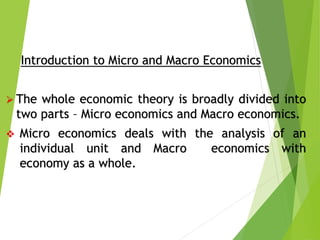
Introduction to Micro and Macro Economics
 The whole economic theory is broadly divided into
two parts – Micro economics and Macro economics.
 Micro economics deals with the analysis of an
individual unit and Macro economics with
economy as a whole.
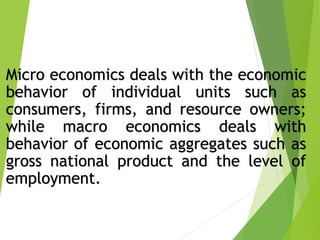
Micro economics deals with the economic
behavior of individual units such as
consumers, firms, and resource owners;
while macro economics deals with
behavior of economic aggregates such as
gross national product and the level of
employment.
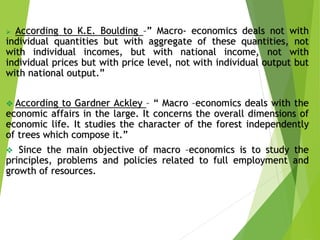
 According to K.E. Boulding –” Macro- economics deals not with
individual quantities but with aggregate of these quantities, not
with individual incomes, but with national income, not with
individual prices but with price level, not with individual output but
with national output.”
 According to Gardner Ackley – “ Macro –economics deals with the
economic affairs in the large. It concerns the overall dimensions of
economic life. It studies the character of the forest independently
of trees which compose it.”
 Since the main objective of macro –economics is to study the
principles, problems and policies related to full employment and
growth of resources.
Difference between microeconomics and macroeconomics
Micro and macroeconomics differ as follows
Nature of the study of Economic Units:
Microeconomics studies the individual or small economic variables of the economy
such as individuals consumption, saving investment and income, but
macroeconomics deals with aggregates like national income, full employment and
price level.
Objectives:
Microeconomics studies principles, problems and policies concerning the optimum
allocation of resources whereas macroeconomics studies the problems, policies and
principles relating to full employment and growth of resources.
Subject Matter:
The subject matter of microeconomics deals with the determination of price,
consumer’s equilibrium, distribution and welfare, etc, whereas the subject matter
of macroeconomics studies full employment, price level, national income, trade
cycles, etc.
Basic Microeconomic Issues:
Scarcity and Choice:
Scarcity and choice are the basic problems in economics. This concept was
introduced by Prof. Lionel Robins, a British economist in the decade of
1930s.
Scarcity
 The common meaning of scarcity refers to unavailability ( i.e. not easily
found) in the market of a certain commodity.
 The conceptual meaning of scarcity, in economics, is however different.
A commodity is scarce because it commands value. It commands price.
 We have to pay for any goods and services we want to consume. In
addition, the resources that we have are also always limited.
 A commodity is scarce, in economic sense, not because it is rare or
unavailable in the market, but because the means to have it are
limited.
 We have limited resources at our disposal, so there is a problem of
scarcity.
 Human wants are unlimited, but the means or resources to satisfy
them are always limited.
 Scarcity explains this relationship between limited resources and
unlimited wants and the problem therein.
 Economic problems arise because the goods we need are scarce.
These scarce goods have many uses.
 Again, these uses are tempting and competing with each other.
There is a problem of choice- choice between alternative uses.
 Therefore, scarcity and choice guide the whole course of economic
activities.
Problem of choosing production method:
 After the determination of the commodity to be produced, the problem
arises to choose the appropriate method of its production.
 Any of the methods between labor intensive and capital intensive
techniques can be used in the production process.
 But the choice is needed to determine the economic and useful method for
the available condition of resources in the economy.
Problem of distribution:
 The production of goods and services is the return of the factors of
production.
 So, the income derived from the sell of these commodities distributes
among these factors. When the problem of determining the remuneration of
the factors of production is created, then the economic problem arises.
 The choice is needed to solve this problem by providing remuneration
according to their contribution.
 Except this, the choice is needed to choose the sector of distribution of
income to decrease inequality for social welfare.
Problem of economic efficiency:
 Economic efficiency is the process of utilizing the resources in such a way
that the satisfaction or utility can be maximized.
 The choice is needed to determine how the limited resources should be
used in efficient sector among different areas of its use.
Problem of full utilization of resources:
 The availability of the factors of production is limited and its alternative use
is possible. Thus, choice is necessary to determine how and in which
sector these scarce resources must be used so that they are fully
employed.
Problem of economic growth:
 In developing countries, the level of economic
development is very low. The necessity of these
countries is to reach in high level by increasing the level
of development.
 But due to the scarcity of resources for development
works, the economic problem arises.
 To employ these limited resources in more return
providing sector, the choice is needed.
 In this way, the problem of scarcity of resources for
every sector of economic activities and to choose them
for optimum utilization is the basic economic problem.
THANK
YOU

Micro vs macro economics

  • 1.
  • 2.
    Introduction to Microand Macro Economics  The whole economic theory is broadly divided into two parts – Micro economics and Macro economics.  Micro economics deals with the analysis of an individual unit and Macro economics with economy as a whole.
  • 3.
    Micro economics dealswith the economic behavior of individual units such as consumers, firms, and resource owners; while macro economics deals with behavior of economic aggregates such as gross national product and the level of employment.
  • 4.
     According toK.E. Boulding –” Macro- economics deals not with individual quantities but with aggregate of these quantities, not with individual incomes, but with national income, not with individual prices but with price level, not with individual output but with national output.”  According to Gardner Ackley – “ Macro –economics deals with the economic affairs in the large. It concerns the overall dimensions of economic life. It studies the character of the forest independently of trees which compose it.”  Since the main objective of macro –economics is to study the principles, problems and policies related to full employment and growth of resources.
  • 5.
    Difference between microeconomicsand macroeconomics Micro and macroeconomics differ as follows Nature of the study of Economic Units: Microeconomics studies the individual or small economic variables of the economy such as individuals consumption, saving investment and income, but macroeconomics deals with aggregates like national income, full employment and price level. Objectives: Microeconomics studies principles, problems and policies concerning the optimum allocation of resources whereas macroeconomics studies the problems, policies and principles relating to full employment and growth of resources. Subject Matter: The subject matter of microeconomics deals with the determination of price, consumer’s equilibrium, distribution and welfare, etc, whereas the subject matter of macroeconomics studies full employment, price level, national income, trade cycles, etc.
  • 6.
    Basic Microeconomic Issues: Scarcityand Choice: Scarcity and choice are the basic problems in economics. This concept was introduced by Prof. Lionel Robins, a British economist in the decade of 1930s. Scarcity  The common meaning of scarcity refers to unavailability ( i.e. not easily found) in the market of a certain commodity.  The conceptual meaning of scarcity, in economics, is however different. A commodity is scarce because it commands value. It commands price.  We have to pay for any goods and services we want to consume. In addition, the resources that we have are also always limited.
  • 7.
     A commodityis scarce, in economic sense, not because it is rare or unavailable in the market, but because the means to have it are limited.  We have limited resources at our disposal, so there is a problem of scarcity.  Human wants are unlimited, but the means or resources to satisfy them are always limited.  Scarcity explains this relationship between limited resources and unlimited wants and the problem therein.  Economic problems arise because the goods we need are scarce. These scarce goods have many uses.  Again, these uses are tempting and competing with each other. There is a problem of choice- choice between alternative uses.  Therefore, scarcity and choice guide the whole course of economic activities.
  • 8.
    Problem of choosingproduction method:  After the determination of the commodity to be produced, the problem arises to choose the appropriate method of its production.  Any of the methods between labor intensive and capital intensive techniques can be used in the production process.  But the choice is needed to determine the economic and useful method for the available condition of resources in the economy. Problem of distribution:  The production of goods and services is the return of the factors of production.  So, the income derived from the sell of these commodities distributes among these factors. When the problem of determining the remuneration of the factors of production is created, then the economic problem arises.
  • 9.
     The choiceis needed to solve this problem by providing remuneration according to their contribution.  Except this, the choice is needed to choose the sector of distribution of income to decrease inequality for social welfare. Problem of economic efficiency:  Economic efficiency is the process of utilizing the resources in such a way that the satisfaction or utility can be maximized.  The choice is needed to determine how the limited resources should be used in efficient sector among different areas of its use. Problem of full utilization of resources:  The availability of the factors of production is limited and its alternative use is possible. Thus, choice is necessary to determine how and in which sector these scarce resources must be used so that they are fully employed.
  • 10.
    Problem of economicgrowth:  In developing countries, the level of economic development is very low. The necessity of these countries is to reach in high level by increasing the level of development.  But due to the scarcity of resources for development works, the economic problem arises.  To employ these limited resources in more return providing sector, the choice is needed.  In this way, the problem of scarcity of resources for every sector of economic activities and to choose them for optimum utilization is the basic economic problem.
  • 11.