Mechanics:
1. Players willpass the crumpled paper around.
2. When you receive the crumpled paper, you will
be guessing the pictures that we will provide and
flash on the screen.
3. If you didn’t want to answer you may choose
between, call a friend or dance.
4. Players will continue passing the crumpled paper
until everyone has had a turn answering a
questions.
5. Enjoy!
Learning objective:
At theend of this lesson, the student must
have to:
Describe the relationship among basics
components of refrigerants
11.
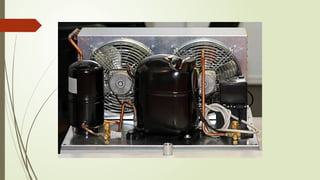
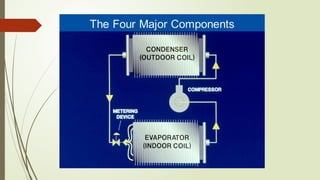
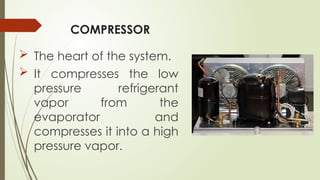
COMPRESSOR
The heartof the system.
It compresses the low
pressure refrigerant
vapor from the
evaporator and
compresses it into a high
pressure vapor.
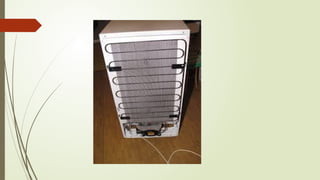
12.
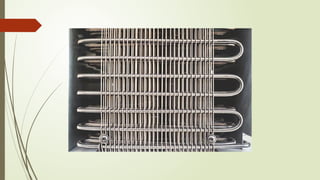
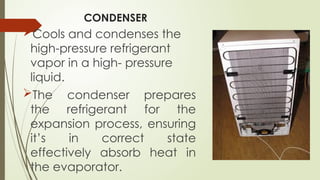
CONDENSER
Cools and condensesthe
high-pressure refrigerant
vapor in a high- pressure
liquid.
The condenser prepares
the refrigerant for the
expansion process, ensuring
it’s in correct state
effectively absorb heat in
the evaporator.
13.
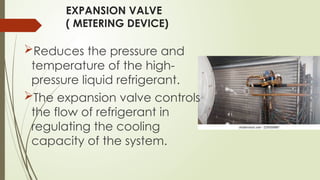
EXPANSION VALVE
( METERINGDEVICE)
Reduces the pressure and
temperature of the high-
pressure liquid refrigerant.
The expansion valve controls
the flow of refrigerant in
regulating the cooling
capacity of the system.
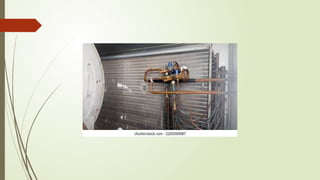
14.
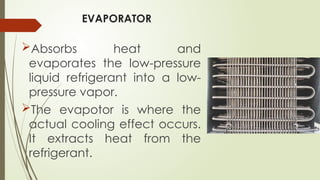
EVAPORATOR
Absorbs heat and
evaporatesthe low-pressure
liquid refrigerant into a low-
pressure vapor.
The evapotor is where the
actual cooling effect occurs.
It extracts heat from the
refrigerant.
15.
The relationship betweencomponents:
The four components work together in a
continuous cycle.
The key to the refrigeration cycle is the
controlled changes in pressure and
temperature of the refrigerant as it moves
through the system.
1. What isthe primary function of s compressor
in the refrigeration cycle?
a. to cool the refrigerant
b. to condense the refrigerant
c. to increase the pressure and temperature of
the refrigerant
d. to expand the refrigerant
18.
2. In whichcomponent does the refrigerant
release heat and change from gas to a liquid?
a. compressor
b. evaporator
c. expansion valve
d. condenser
19.
3. What isthe role of expansion valve or
metering device?
a. to compress the refrigerant
b. to control the flow of refrigerant into
evaporator
c. to condense the refrigerant
d. to evaporate the refrigerant
20.
4. Where doesthe refrigerant absorb heat and
change from liquid to gas?
a. condenser
b. compressor
c. expansion valve
d. evaporator
21.
5. What isthe purpose of the refrigerant in the
refrigeration system?
a. to lubricate the compressor
b. to transfer heat
c. to insulate the system
d. to control the temperature
22.
6. What typeof heat transfer occurs primarily in the
condenser?
a. conduction
b. convention
c. radiation
d. all of the above
23.
7. What happensto the refrigerant’s pressure as
it passes through the expansion valve?
a. it increases significantly
b. it remains constant
c. it decreases significantly
d. it fluctuates unpredictably
24.
8. In vapor-compression refrigeration cycle,
where does the greatest temperature occur?
a. compressor
b. condenser
c. expansion valve
d. evaporator
25.
9. The refrigerationcycle is a _____ process.
a. one-way
b. continuous
c. intermittent
d. static
26.
10. What isthe refrigerant’s state when it leaves the evaporator?
a. liquid
b. gas
c. solid
d. plasma






![Intern ppt ..kk [Autosaved].pptx](https://cdn.slidesharecdn.com/ss_thumbnails/internppt-231006135559-ff64c843-thumbnail.jpg?width=640&height=640&fit=bounds)


