COMPUTER
TYPES AND
GENERATIONS
COMPUTER………………
Introduction
Types of computer
Generations of computer
2
INTRODUCTION
COMPUTER……
• A computer is a machine that can be
programmed to automatically carry out
sequences of arithmetic or logical
operations (computation). Modern digital
electronic computers can perform generic
sets of operations known as programs.
These programs enable computers to
perform a wide range of tasks.
4
TYPES OF
COMPUTER……..
Types and details……..
6
TYPES…..
• Super computer
• Mainframe computer
• Mini computer
• Workstation computer
• Personal computer(PC)
• Server computer
• Analog computer
• Digital computer
• Hybrid computer
7
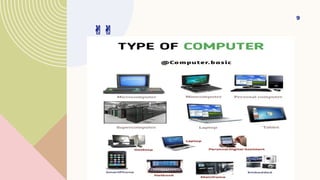
• Mainframe computers
• These computers have a lot of memory and processors, and can perform billions of transactions and
calculations in real time. They are used for applications that need high reliability, security, and speed
• Minicomputers
• These computers are portable, lightweight, and less expensive than other computers. They can
remain charged for a long time and function in environments without controlled operations
• Supercomputers
• These computers are extremely fast, and can execute hundreds of millions of instructions per
second. They are used for scientific and engineering operations where processing is difficul
• Analog computers
• These computers process analog data, which is continuous data that varies continuously. They are
used to measure physical units like voltage, electric current, pressure, and temperature, and convert
them into digits
• Hybrid computers
• These computers typically have a digital subsystem and an analog subsystem. The digital part
handles discrete data and complex calculations.
…
8
..
• Workstation
• A workstation is a computer that is used explicitly for engineering applications like
CAD/CAM. Workstations can also be used for software development, desktop publishing, and
developing other types of applications. All of these tasks require a moderate amount of
computing power and relatively high-quality graphics capabilities.
• Personal Computers (PC)
• A Personal computer or PC can be described as a small and somewhat inexpensive computer
that has been specifically designed for individual use. These devices are based on
microprocessor technology, enabling manufacturers to put an entire CPU on a single chip.
• Server computer
• A server is a computer program or device that provides a service to another computer program
and its user, also known as the client. In a data center, the physical computer that a server
program runs on is also frequently referred to as a server. That machine might be a dedicated
server or it might be used for other purposes
9
✌️
✌️
………….GENERATIONS OF
COMPUTER ………….
10
Up to 5th
generations….
11
GENERATIONS………..
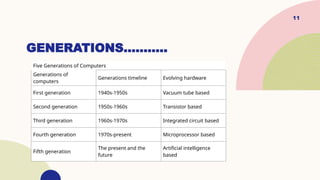
Five Generations of Computers
Generations of
computers
Generations timeline Evolving hardware
First generation 1940s-1950s Vacuum tube based
Second generation 1950s-1960s Transistor based
Third generation 1960s-1970s Integrated circuit based
Fourth generation 1970s-present Microprocessor based
Fifth generation
The present and the
future
Artificial intelligence
based
1ST
GENERTAION
1. First Generation Computers
The 1st Generation Computers were introduced using the technology of vacuum tubes which can
control the flow of electronics in a vacuum. These tubes are usually used in switches, amplifiers,
radios, televisions, etc. The First Generation of Computer was very heavy and large and were not
ideal for programming. They used basic programming and didn’t have an operating system,
which made it tough for users to do programming on them. The 1st Generation Computers
required a big room dedicated to them and also consumed a lot of electricity.
Some examples of main first-generation computers are-
ENIAC: Electronic Numerical Integrator and Computer, built by J. Presper Eckert and John V.
Mauchly which contained 18,000 vacuum tubes.
EDVAC: Electronic Discrete Variable Automatic Computer, designed by Von Neumann.
UNIVAC: Universal Automatic Computer, developed by Eckert and Mauchly in 1952.
Characteristics of 1st Generation Computers
These computers were designed using vacuum tubes.
Programming in these computers was done using machine languages.
The main memory of 1st Generation Computers consisted of magnetic tapes and magnetic
drums.
Paper tapes and Punched cards were used as input/output devices in these computers.
These computers were very huge but worked very slowly.
Examples of 1st Generation Computers are IBM 650, IBM 701, ENIAC, UNIVAC1, etc.
... Read more at: https://www.careerpower.in/school/computer/generation-of-computer
12
13
2ND
GENERATION
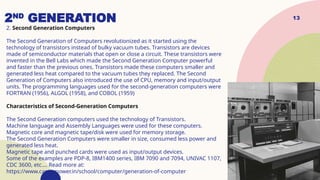
2. Second Generation Computers
The Second Generation of Computers revolutionized as it started using the
technology of transistors instead of bulky vacuum tubes. Transistors are devices
made of semiconductor materials that open or close a circuit. These transistors were
invented in the Bell Labs which made the Second Generation Computer powerful
and faster than the previous ones. Transistors made these computers smaller and
generated less heat compared to the vacuum tubes they replaced. The Second
Generation of Computers also introduced the use of CPU, memory and input/output
units. The programming languages used for the second-generation computers were
FORTRAN (1956), ALGOL (1958), and COBOL (1959)
Characteristics of Second-Generation Computers
The Second Generation computers used the technology of Transistors.
Machine language and Assembly Languages were used for these computers.
Magnetic core and magnetic tape/disk were used for memory storage.
The Second Generation Computers were smaller in size, consumed less power and
generated less heat.
Magnetic tape and punched cards were used as input/output devices.
Some of the examples are PDP-8, IBM1400 series, IBM 7090 and 7094, UNIVAC 1107,
CDC 3600, etc.... Read more at:
https://www.careerpower.in/school/computer/generation-of-computer
14
3RD
GENERATIONS
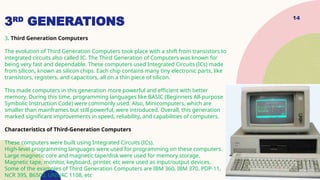
3. Third Generation Computers
The evolution of Third Generation Computers took place with a shift from transistors to
integrated circuits also called IC. The Third Generation of Computers was known for
being very fast and dependable. These computers used Integrated Circuits (ICs) made
from silicon, known as silicon chips. Each chip contains many tiny electronic parts, like
transistors, registers, and capacitors, all on a thin piece of silicon.
This made computers in this generation more powerful and efficient with better
memory. During this time, programming languages like BASIC (Beginners All-purpose
Symbolic Instruction Code) were commonly used. Also, Minicomputers, which are
smaller than mainframes but still powerful, were introduced. Overall, this generation
marked significant improvements in speed, reliability, and capabilities of computers.
Characteristics of Third-Generation Computers
These computers were built using Integrated Circuits (ICs).
High-level programming languages were used for programming on these computers.
Large magnetic core and magnetic tape/disk were used for memory storage.
Magnetic tape, monitor, keyboard, printer, etc were used as input/output devices.
Some of the examples of Third Generation Computers are IBM 360, IBM 370, PDP-11,
NCR 395, B6500, UNIVAC 1108, etc
15
4TH
GENERATIONS
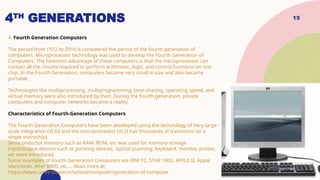
4. Fourth Generation Computers
The period from 1972 to 2010 is considered the period of the fourth generation of
computers. Microprocessor technology was used to develop the Fourth Generation of
Computers. The foremost advantage of these computers is that the microprocessor can
contain all the circuits required to perform arithmetic, logic, and control functions on one
chip. In the Fourth Generation, computers became very small in size and also became
portable.
Technologies like multiprocessing, multiprogramming, time-sharing, operating speed, and
virtual memory were also introduced by then. During the fourth generation, private
computers and computer networks became a reality.
Characteristics of Fourth-Generation Computers
The Fourth Generation Computers have been developed using the technology of Very-large-
scale integration (VLSI) and the microprocessor (VLSI has thousands of transistors on a
single microchip).
Semiconductor memory such as RAM, ROM, etc was used for memory storage.
Input/output devices such as pointing devices, optical scanning, keyboard, monitor, printer,
etc were introduced.
Some examples of Fourth Generation Computers are IBM PC, STAR 1000, APPLE II, Apple
Macintosh, Alter 8800, etc.... Read more at:
https://www.careerpower.in/school/computer/generation-of-computer
16
5TH
GENERATION
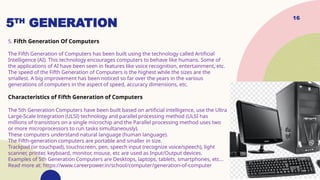
5. Fifth Generation Of Computers
The Fifth Generation of Computers has been built using the technology called Artificial
Intelligence (AI). This technology encourages computers to behave like humans. Some of
the applications of AI have been seen in features like voice recognition, entertainment, etc.
The speed of the Fifth Generation of Computers is the highest while the sizes are the
smallest. A big improvement has been noticed so far over the years in the various
generations of computers in the aspect of speed, accuracy dimensions, etc.
Characteristics of Fifth Generation of Computers
The 5th Generation Computers have been built based on artificial intelligence, use the Ultra
Large-Scale Integration (ULSI) technology and parallel processing method (ULSI has
millions of transistors on a single microchip and the Parallel processing method uses two
or more microprocessors to run tasks simultaneously).
These computers understand natural language (human language).
The Fifth-generation computers are portable and smaller in size.
Trackpad (or touchpad), touchscreen, pen, speech input (recognize voice/speech), light
scanner, printer, keyboard, monitor, mouse, etc are used as Input/Output devices.
Examples of 5th Generation Computers are Desktops, laptops, tablets, smartphones, etc...
Read more at: https://www.careerpower.in/school/computer/generation-of-computer
17
……….THANK YOU …………

Computer types and generations of computer.pptx

  • 1.
  • 2.
  • 3.
  • 4.
    COMPUTER…… • A computeris a machine that can be programmed to automatically carry out sequences of arithmetic or logical operations (computation). Modern digital electronic computers can perform generic sets of operations known as programs. These programs enable computers to perform a wide range of tasks. 4
  • 5.
  • 6.
    6 TYPES….. • Super computer •Mainframe computer • Mini computer • Workstation computer • Personal computer(PC) • Server computer • Analog computer • Digital computer • Hybrid computer
  • 7.
    7 • Mainframe computers •These computers have a lot of memory and processors, and can perform billions of transactions and calculations in real time. They are used for applications that need high reliability, security, and speed • Minicomputers • These computers are portable, lightweight, and less expensive than other computers. They can remain charged for a long time and function in environments without controlled operations • Supercomputers • These computers are extremely fast, and can execute hundreds of millions of instructions per second. They are used for scientific and engineering operations where processing is difficul • Analog computers • These computers process analog data, which is continuous data that varies continuously. They are used to measure physical units like voltage, electric current, pressure, and temperature, and convert them into digits • Hybrid computers • These computers typically have a digital subsystem and an analog subsystem. The digital part handles discrete data and complex calculations. …
  • 8.
    8 .. • Workstation • Aworkstation is a computer that is used explicitly for engineering applications like CAD/CAM. Workstations can also be used for software development, desktop publishing, and developing other types of applications. All of these tasks require a moderate amount of computing power and relatively high-quality graphics capabilities. • Personal Computers (PC) • A Personal computer or PC can be described as a small and somewhat inexpensive computer that has been specifically designed for individual use. These devices are based on microprocessor technology, enabling manufacturers to put an entire CPU on a single chip. • Server computer • A server is a computer program or device that provides a service to another computer program and its user, also known as the client. In a data center, the physical computer that a server program runs on is also frequently referred to as a server. That machine might be a dedicated server or it might be used for other purposes
  • 9.
  • 10.
  • 11.
    11 GENERATIONS……….. Five Generations ofComputers Generations of computers Generations timeline Evolving hardware First generation 1940s-1950s Vacuum tube based Second generation 1950s-1960s Transistor based Third generation 1960s-1970s Integrated circuit based Fourth generation 1970s-present Microprocessor based Fifth generation The present and the future Artificial intelligence based
  • 12.
    1ST GENERTAION 1. First GenerationComputers The 1st Generation Computers were introduced using the technology of vacuum tubes which can control the flow of electronics in a vacuum. These tubes are usually used in switches, amplifiers, radios, televisions, etc. The First Generation of Computer was very heavy and large and were not ideal for programming. They used basic programming and didn’t have an operating system, which made it tough for users to do programming on them. The 1st Generation Computers required a big room dedicated to them and also consumed a lot of electricity. Some examples of main first-generation computers are- ENIAC: Electronic Numerical Integrator and Computer, built by J. Presper Eckert and John V. Mauchly which contained 18,000 vacuum tubes. EDVAC: Electronic Discrete Variable Automatic Computer, designed by Von Neumann. UNIVAC: Universal Automatic Computer, developed by Eckert and Mauchly in 1952. Characteristics of 1st Generation Computers These computers were designed using vacuum tubes. Programming in these computers was done using machine languages. The main memory of 1st Generation Computers consisted of magnetic tapes and magnetic drums. Paper tapes and Punched cards were used as input/output devices in these computers. These computers were very huge but worked very slowly. Examples of 1st Generation Computers are IBM 650, IBM 701, ENIAC, UNIVAC1, etc. ... Read more at: https://www.careerpower.in/school/computer/generation-of-computer 12
  • 13.
    13 2ND GENERATION 2. Second GenerationComputers The Second Generation of Computers revolutionized as it started using the technology of transistors instead of bulky vacuum tubes. Transistors are devices made of semiconductor materials that open or close a circuit. These transistors were invented in the Bell Labs which made the Second Generation Computer powerful and faster than the previous ones. Transistors made these computers smaller and generated less heat compared to the vacuum tubes they replaced. The Second Generation of Computers also introduced the use of CPU, memory and input/output units. The programming languages used for the second-generation computers were FORTRAN (1956), ALGOL (1958), and COBOL (1959) Characteristics of Second-Generation Computers The Second Generation computers used the technology of Transistors. Machine language and Assembly Languages were used for these computers. Magnetic core and magnetic tape/disk were used for memory storage. The Second Generation Computers were smaller in size, consumed less power and generated less heat. Magnetic tape and punched cards were used as input/output devices. Some of the examples are PDP-8, IBM1400 series, IBM 7090 and 7094, UNIVAC 1107, CDC 3600, etc.... Read more at: https://www.careerpower.in/school/computer/generation-of-computer
  • 14.
    14 3RD GENERATIONS 3. Third GenerationComputers The evolution of Third Generation Computers took place with a shift from transistors to integrated circuits also called IC. The Third Generation of Computers was known for being very fast and dependable. These computers used Integrated Circuits (ICs) made from silicon, known as silicon chips. Each chip contains many tiny electronic parts, like transistors, registers, and capacitors, all on a thin piece of silicon. This made computers in this generation more powerful and efficient with better memory. During this time, programming languages like BASIC (Beginners All-purpose Symbolic Instruction Code) were commonly used. Also, Minicomputers, which are smaller than mainframes but still powerful, were introduced. Overall, this generation marked significant improvements in speed, reliability, and capabilities of computers. Characteristics of Third-Generation Computers These computers were built using Integrated Circuits (ICs). High-level programming languages were used for programming on these computers. Large magnetic core and magnetic tape/disk were used for memory storage. Magnetic tape, monitor, keyboard, printer, etc were used as input/output devices. Some of the examples of Third Generation Computers are IBM 360, IBM 370, PDP-11, NCR 395, B6500, UNIVAC 1108, etc
  • 15.
    15 4TH GENERATIONS 4. Fourth GenerationComputers The period from 1972 to 2010 is considered the period of the fourth generation of computers. Microprocessor technology was used to develop the Fourth Generation of Computers. The foremost advantage of these computers is that the microprocessor can contain all the circuits required to perform arithmetic, logic, and control functions on one chip. In the Fourth Generation, computers became very small in size and also became portable. Technologies like multiprocessing, multiprogramming, time-sharing, operating speed, and virtual memory were also introduced by then. During the fourth generation, private computers and computer networks became a reality. Characteristics of Fourth-Generation Computers The Fourth Generation Computers have been developed using the technology of Very-large- scale integration (VLSI) and the microprocessor (VLSI has thousands of transistors on a single microchip). Semiconductor memory such as RAM, ROM, etc was used for memory storage. Input/output devices such as pointing devices, optical scanning, keyboard, monitor, printer, etc were introduced. Some examples of Fourth Generation Computers are IBM PC, STAR 1000, APPLE II, Apple Macintosh, Alter 8800, etc.... Read more at: https://www.careerpower.in/school/computer/generation-of-computer
  • 16.
    16 5TH GENERATION 5. Fifth GenerationOf Computers The Fifth Generation of Computers has been built using the technology called Artificial Intelligence (AI). This technology encourages computers to behave like humans. Some of the applications of AI have been seen in features like voice recognition, entertainment, etc. The speed of the Fifth Generation of Computers is the highest while the sizes are the smallest. A big improvement has been noticed so far over the years in the various generations of computers in the aspect of speed, accuracy dimensions, etc. Characteristics of Fifth Generation of Computers The 5th Generation Computers have been built based on artificial intelligence, use the Ultra Large-Scale Integration (ULSI) technology and parallel processing method (ULSI has millions of transistors on a single microchip and the Parallel processing method uses two or more microprocessors to run tasks simultaneously). These computers understand natural language (human language). The Fifth-generation computers are portable and smaller in size. Trackpad (or touchpad), touchscreen, pen, speech input (recognize voice/speech), light scanner, printer, keyboard, monitor, mouse, etc are used as Input/Output devices. Examples of 5th Generation Computers are Desktops, laptops, tablets, smartphones, etc... Read more at: https://www.careerpower.in/school/computer/generation-of-computer
  • 17.