ADVANCED CERTIFICATE
IN COMPUTER SCIENCE
Module 03: Computer Systems & Software
Lesson 01: Computer Operation System
Certificate in Computer Application
Learning Objectives
 Identifying the computer operating system
 Look into the goals of a computer operating system
 Identifying the functions of a of a computer operating system
Learning Outcomes
1. Fundamentals of a computer operating systems
2. A brief history of operating systems
3. Different types of computer system and its functions
Certificate in Computer Application
01. Introduction to Operation System
Certificate in Computer Application
1.1 What do you mean by Computer OS
A program that acts as an intermediary between a user of a computer and the
computer hardware.
A set of programs that coordinates all activities among computer hardware
resources.
Operating system goals:
Execute user programs and make solving user problems easier.
Make the computer system convenient to use.
Use the computer hardware in an efficient manner
02. Operating System History
Certificate in Computer Application
1.2 Evolution of the different operational systems
Early History: The 1940s and 1950s
Operating systems evolved through several phases
1940s
Early computers did not include operating systems
1950s
Executed one job at a time
Included technologies to smooth job-to-job transitions
Single-stream batch-processing systems
Programs and data submitted consecutively on tape
Certificate in Computer Application
1960s
 Still batch-processing systems
 Process multiple jobs at once- Multiprogramming
 One job could use processor while other jobs used peripheral
devices
 Advanced operating systems developed to service multiple
interactive users
1964
IBM announced System/360 family of computers
02. Operating System History
Certificate in Computer Application
02. Operating System History
The 1970s
Primarily multimode timesharing systems
 Supported batch processing, timesharing and real-time applications
Department of Defense develops TCP/IP
 Standard communications protocol
 Widely used in military and university settings
 Security problems
 Growing volumes of information passed over vulnerable communications lines.
Certificate in Computer Application
02. Operating System History
The 1980s
Decade of personal computers and workstations
 Computing distributed to sites at which it was needed
 Personal computers proved relatively easy to learn and use
Graphical user interfaces (GUI)
 Transferring information between computers via networks
became more economical and practical
Client/server computing model became widespread
 Clients request various services
 Servers perform requested services
Certificate in Computer Application
02. Operating System History
The 1990s
Operating systems became increasingly user friendly
 GUI features pioneered by Apple widely used and improved.
“Plug-and-play” capabilities built into operating systems
 Enable users to add and remove hardware components
dynamically
 No need to manually reconfigure operating system
;,l
Certificate in Computer Application
02. Operating System History
2000 and Beyond
Middleware
 Links two separate applications
Often over a network and between incompatible machines
 Particularly important for Web services
Simplifies communication across multiple architectures
Web services
 Encompass set of related standards
 Ready-to-use pieces of software on the Internet
03. Functions of an Operating System
Certificate in Computer Application
3.1 Main functions of an operating system
 Start up the computer
 Administrator security
 Control network
 Access the web
 Monitor performance and provide housekeeping
services
 Schedule jobs and configure devices
 Manage memory
 manage programs
 Provide user interface
03. Functions of an Operating System
Certificate in Computer Application
3.2 Location of the operating system
 Operating System resides on ROM chip in handhelds devices like PDA,
Mobile Phone.
 Operating System resides on hard disk in most computer cases.
Cold Boot
Process of turning on a
computer after it has been
powered off completely.
Warm boot
Process of restarting a
computer
that is already powered on.
A . Startup the computer
 This is steps and process of starting or restarting a computer.
03. Functions of an Operating System
Certificate in Computer Application
Computer OS Booting
Step 1
 1-Power supply sends signal to components in system unit
 2-The processor accessed BIOS to start computer
Step 2
What messages display when you boot the computer?
 BIOS version and copyright notice
 total amount of memory
 devices detected and tested
 Windows message
 Sound card and CD-ROM drivers loaded
ROMBIOS Version 2.10 A05
Copyright notices
0065536KB
Keyboard .... Detected
Mouse.....Detected
Hard Disk Installed WCW AC4160011
Floppy A: Installed
Starting Windows
SoundUTIL TSR Version 1.20
Copyright SoundCard Technology 2001
IDE CD-RW Device Driver Ver .2.3
03. Functions of an Operating System
Certificate in Computer Application
Step 3
 BIOS checks components such as mouse, keyboard connectors and expansion cards
Step 4
 Results of POST are compared to data in the CMOS chip
Step 5
 BIOS looks for system files in drive A (Floppy disk drive) and then drive C (hard disk) and
then...
 Drive that contains operating system is called boot drive.
03. Functions of an Operating System
Certificate in Computer Application
Step 6
 Boot program loads kernel of operating system into
RAM from boot drive
 operating system in memory takes control of
computer
Step 7
 operating system loads configuration information and
displays desktop on screen
 operating system executes programs in startup folder
03. Functions of an Operating System
Certificate in Computer Application
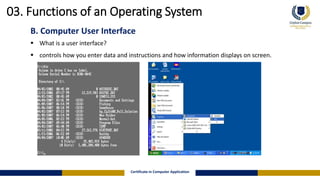
B. Computer User Interface
 What is a user interface?
 controls how you enter data and instructions and how information displays on screen.
03. Functions of an Operating System
Certificate in Computer Application
 User Interface is Multi Tasking
allows a single user to work on two or more applications that reside in memory at same time.
03. Functions of an Operating System
Certificate in Computer Application
C. Program management
 What are other program management features of OS?
Multiuser
Operating System enables
two or more
users to run a program
simultaneously
Multiprocessing
Operating System can
support two or
more processors running
programs at same time
Fault-Tolerant
Continues to operate even if
one of its components fails
03. Functions of an Operating System
Certificate in Computer Application
D. Memory management
What is Memory management?
 Optimizes the use of random access memory (RAM)
 allocates or resigns, data and instructions to area of memory while they are being
processed
 monitors contents of memory
 clears items from memory when processor no longer requires them
03. Functions of an Operating System
Certificate in Computer Application
Memory management
What is virtual memory (VM) management?
 Operating system allocates portion of hard disk to function like RAM
 Paging
RAM
Page
File
Virtual Disk
03. Functions of an Operating System
Certificate in Computer Application
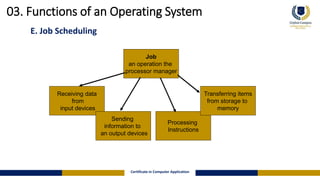
E. Job Scheduling
Job
an operation the
processor manager
Receiving data
from
input devices
Sending
information to
an output devices
Processing
Instructions
Transferring items
from storage to
memory
03. Functions of an Operating System
Certificate in Computer Application
F. Pooling Activity
What is spooling?
Print jobs sent to buffer instead of directly to printer, where print jobs wait their turn

Jobs to
be
printed
Disk Jobs being printed
03. Functions of an Operating System
Certificate in Computer Application
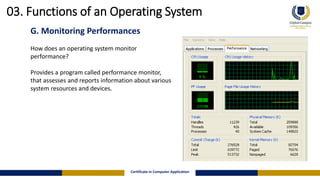
G. Monitoring Performances
How does an operating system monitor
performance?
Provides a program called performance monitor,
that assesses and reports information about various
system resources and devices.
03. Functions of an Operating System
Certificate in Computer Application
G. Managing Files
How does an operating system
manage files?
 Includes a program called file
manager, such as Windows Explorer.
 Commands Copy, Rename, Delete,
move ...
03. Functions of an Operating System
Certificate in Computer Application
Managing Files
What is a file allocation table (FAT)?
 a table of information
 that operating system
 uses to locate file on a disk.
03. Functions of an Operating System
Certificate in Computer Application
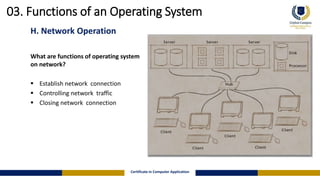
H. Network Operation
What are functions of operating system
on network?
 Establish network connection
 Controlling network traffic
 Closing network connection
04. Types of Operating Systems
Certificate in Computer Application
1. Desktop Operating System
 A program control activities in standalone computer.
 Such as MS-Windows 9X, MS-Windows NT workstation
 MS-Windows 2000 Professional, MS-Windows XP Professional
2. Network Operating System
 A program control activities both on local computer and other computer
on network.
 Such as MS-Windows NT Server, Windows 2000 Server, MS-Windows
2000 Advance Server, MS-Windows 2003 Server
05. Goals of an Operating Systems
Certificate in Computer Application
5.1 Users expect certain properties of operating systems
 Efficiency
 Robustness
 Scalability
 Extensibility
 Portability
 Security
 Protection
 Interactivity
 Usability
05. Goals of an Operating Systems
Certificate in Computer Application
5.2 Operating systems architectures
 Today’s operating systems tend to be complex
 Provide many services
 Support variety of hardware and software
 Operating system architectures help manage this complexity
In class- Activity
Certificate in Computer Application
Answer following questions
1. What are the main roles of operating system?
2. How many type of operating system?
3. Explain some of operating system goal.
4. Brief evolution of operating system

Computer Sytem.pptx

  • 1.
    ADVANCED CERTIFICATE IN COMPUTERSCIENCE Module 03: Computer Systems & Software Lesson 01: Computer Operation System Certificate in Computer Application
  • 2.
    Learning Objectives  Identifyingthe computer operating system  Look into the goals of a computer operating system  Identifying the functions of a of a computer operating system Learning Outcomes 1. Fundamentals of a computer operating systems 2. A brief history of operating systems 3. Different types of computer system and its functions Certificate in Computer Application
  • 3.
    01. Introduction toOperation System Certificate in Computer Application 1.1 What do you mean by Computer OS A program that acts as an intermediary between a user of a computer and the computer hardware. A set of programs that coordinates all activities among computer hardware resources. Operating system goals: Execute user programs and make solving user problems easier. Make the computer system convenient to use. Use the computer hardware in an efficient manner
  • 4.
    02. Operating SystemHistory Certificate in Computer Application 1.2 Evolution of the different operational systems Early History: The 1940s and 1950s Operating systems evolved through several phases 1940s Early computers did not include operating systems 1950s Executed one job at a time Included technologies to smooth job-to-job transitions Single-stream batch-processing systems Programs and data submitted consecutively on tape
  • 5.
    Certificate in ComputerApplication 1960s  Still batch-processing systems  Process multiple jobs at once- Multiprogramming  One job could use processor while other jobs used peripheral devices  Advanced operating systems developed to service multiple interactive users 1964 IBM announced System/360 family of computers 02. Operating System History
  • 6.
    Certificate in ComputerApplication 02. Operating System History The 1970s Primarily multimode timesharing systems  Supported batch processing, timesharing and real-time applications Department of Defense develops TCP/IP  Standard communications protocol  Widely used in military and university settings  Security problems  Growing volumes of information passed over vulnerable communications lines.
  • 7.
    Certificate in ComputerApplication 02. Operating System History The 1980s Decade of personal computers and workstations  Computing distributed to sites at which it was needed  Personal computers proved relatively easy to learn and use Graphical user interfaces (GUI)  Transferring information between computers via networks became more economical and practical Client/server computing model became widespread  Clients request various services  Servers perform requested services
  • 8.
    Certificate in ComputerApplication 02. Operating System History The 1990s Operating systems became increasingly user friendly  GUI features pioneered by Apple widely used and improved. “Plug-and-play” capabilities built into operating systems  Enable users to add and remove hardware components dynamically  No need to manually reconfigure operating system ;,l
  • 9.
    Certificate in ComputerApplication 02. Operating System History 2000 and Beyond Middleware  Links two separate applications Often over a network and between incompatible machines  Particularly important for Web services Simplifies communication across multiple architectures Web services  Encompass set of related standards  Ready-to-use pieces of software on the Internet
  • 10.
    03. Functions ofan Operating System Certificate in Computer Application 3.1 Main functions of an operating system  Start up the computer  Administrator security  Control network  Access the web  Monitor performance and provide housekeeping services  Schedule jobs and configure devices  Manage memory  manage programs  Provide user interface
  • 11.
    03. Functions ofan Operating System Certificate in Computer Application 3.2 Location of the operating system  Operating System resides on ROM chip in handhelds devices like PDA, Mobile Phone.  Operating System resides on hard disk in most computer cases. Cold Boot Process of turning on a computer after it has been powered off completely. Warm boot Process of restarting a computer that is already powered on. A . Startup the computer  This is steps and process of starting or restarting a computer.
  • 12.
    03. Functions ofan Operating System Certificate in Computer Application Computer OS Booting Step 1  1-Power supply sends signal to components in system unit  2-The processor accessed BIOS to start computer Step 2 What messages display when you boot the computer?  BIOS version and copyright notice  total amount of memory  devices detected and tested  Windows message  Sound card and CD-ROM drivers loaded ROMBIOS Version 2.10 A05 Copyright notices 0065536KB Keyboard .... Detected Mouse.....Detected Hard Disk Installed WCW AC4160011 Floppy A: Installed Starting Windows SoundUTIL TSR Version 1.20 Copyright SoundCard Technology 2001 IDE CD-RW Device Driver Ver .2.3
  • 13.
    03. Functions ofan Operating System Certificate in Computer Application Step 3  BIOS checks components such as mouse, keyboard connectors and expansion cards Step 4  Results of POST are compared to data in the CMOS chip Step 5  BIOS looks for system files in drive A (Floppy disk drive) and then drive C (hard disk) and then...  Drive that contains operating system is called boot drive.
  • 14.
    03. Functions ofan Operating System Certificate in Computer Application Step 6  Boot program loads kernel of operating system into RAM from boot drive  operating system in memory takes control of computer Step 7  operating system loads configuration information and displays desktop on screen  operating system executes programs in startup folder
  • 15.
    03. Functions ofan Operating System Certificate in Computer Application B. Computer User Interface  What is a user interface?  controls how you enter data and instructions and how information displays on screen.
  • 16.
    03. Functions ofan Operating System Certificate in Computer Application  User Interface is Multi Tasking allows a single user to work on two or more applications that reside in memory at same time.
  • 17.
    03. Functions ofan Operating System Certificate in Computer Application C. Program management  What are other program management features of OS? Multiuser Operating System enables two or more users to run a program simultaneously Multiprocessing Operating System can support two or more processors running programs at same time Fault-Tolerant Continues to operate even if one of its components fails
  • 18.
    03. Functions ofan Operating System Certificate in Computer Application D. Memory management What is Memory management?  Optimizes the use of random access memory (RAM)  allocates or resigns, data and instructions to area of memory while they are being processed  monitors contents of memory  clears items from memory when processor no longer requires them
  • 19.
    03. Functions ofan Operating System Certificate in Computer Application Memory management What is virtual memory (VM) management?  Operating system allocates portion of hard disk to function like RAM  Paging RAM Page File Virtual Disk
  • 20.
    03. Functions ofan Operating System Certificate in Computer Application E. Job Scheduling Job an operation the processor manager Receiving data from input devices Sending information to an output devices Processing Instructions Transferring items from storage to memory
  • 21.
    03. Functions ofan Operating System Certificate in Computer Application F. Pooling Activity What is spooling? Print jobs sent to buffer instead of directly to printer, where print jobs wait their turn  Jobs to be printed Disk Jobs being printed
  • 22.
    03. Functions ofan Operating System Certificate in Computer Application G. Monitoring Performances How does an operating system monitor performance? Provides a program called performance monitor, that assesses and reports information about various system resources and devices.
  • 23.
    03. Functions ofan Operating System Certificate in Computer Application G. Managing Files How does an operating system manage files?  Includes a program called file manager, such as Windows Explorer.  Commands Copy, Rename, Delete, move ...
  • 24.
    03. Functions ofan Operating System Certificate in Computer Application Managing Files What is a file allocation table (FAT)?  a table of information  that operating system  uses to locate file on a disk.
  • 25.
    03. Functions ofan Operating System Certificate in Computer Application H. Network Operation What are functions of operating system on network?  Establish network connection  Controlling network traffic  Closing network connection
  • 26.
    04. Types ofOperating Systems Certificate in Computer Application 1. Desktop Operating System  A program control activities in standalone computer.  Such as MS-Windows 9X, MS-Windows NT workstation  MS-Windows 2000 Professional, MS-Windows XP Professional 2. Network Operating System  A program control activities both on local computer and other computer on network.  Such as MS-Windows NT Server, Windows 2000 Server, MS-Windows 2000 Advance Server, MS-Windows 2003 Server
  • 27.
    05. Goals ofan Operating Systems Certificate in Computer Application 5.1 Users expect certain properties of operating systems  Efficiency  Robustness  Scalability  Extensibility  Portability  Security  Protection  Interactivity  Usability
  • 28.
    05. Goals ofan Operating Systems Certificate in Computer Application 5.2 Operating systems architectures  Today’s operating systems tend to be complex  Provide many services  Support variety of hardware and software  Operating system architectures help manage this complexity
  • 29.
    In class- Activity Certificatein Computer Application Answer following questions 1. What are the main roles of operating system? 2. How many type of operating system? 3. Explain some of operating system goal. 4. Brief evolution of operating system