WWW
FTP and HTTP
Vijaya priya p
I- Msc (cs)
by
www (world wide web)
Definition :
 Resources and the uses on the internet, using
HTTP – hyper text transfer protocal. Is the
universe of network accessible information.
 Way to exchanging information between
computers on the internet ,trying them together
Into a vast collection of interactive
Multimedia resources.
 The world wide web is a way of exchanging
Information between computers on the internet
 The world wide web is the network of pages of
Images ,texts , and sounds on the internet which
Can be viewed using browser software.
WHAT IS WORLD WIDE WEB ?
Evolution www
 Evolution world wide web was created by
Tim Berners lee in 1989 at CERN in Geneva.
 World wide web came into existence as a
Proposal by him, to allow researchers to work
Together effectively and efficiently at CERN
Eventually it became world wide web.
HISTORY OF WWW
Version of www
Web 1.0
 Static web pages
 Brochure ware
 Mostly publishing
 No communication
Web 2.0
 Social media
 Keyword research
 Rich user experience
 Tagging
Web 3.0
 Highly mobile
 Open ID
 Semantic search
 Micro blogging
www component
 Structural components
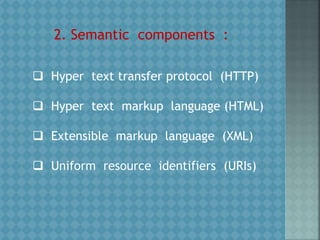
 Semantic components
1. Structural components :
 Clients / browsers – to dominant
implementations
 Servers - run on sophisticated hardware
 Caches - many interesting implementations
 Internet - the global infrastructure which
facilitates
2. Semantic components :
 Hyper text transfer protocol (HTTP)
 Hyper text markup language (HTML)
 Extensible markup language (XML)
 Uniform resource identifiers (URIs)
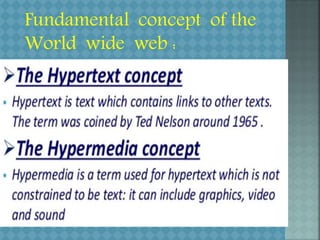
Fundamental concept of the
World wide web :
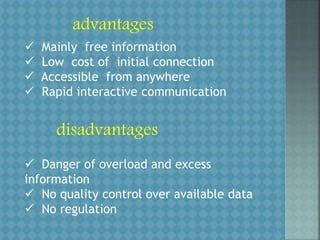
advantages
 Mainly free information
 Low cost of initial connection
 Accessible from anywhere
 Rapid interactive communication
disadvantages
 Danger of overload and excess
information
 No quality control over available data
 No regulation
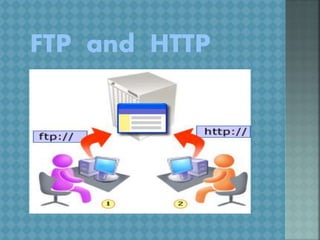
FTP and HTTP
FTP (file Transfer protocal)
The standard protocol is used to transfer
Files between computers and servers over a
network.
It is an internal standard that allows the
process of file downloading and uploading on
Different types of files (text, graphics, videos,
Images, etc..)
It was developed when security was not a big
issue. It is older and being replaced with new
Protocols.
Its stands for file transfer protocol.
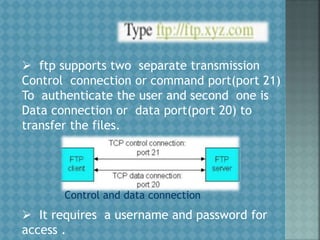
 ftp supports two separate transmission
Control connection or command port(port 21)
To authenticate the user and second one is
Data connection or data port(port 20) to
transfer the files.
 It requires a username and password for
access .
Control and data connection
 It is the set of rules that permit the downloading
And uploading the files on the computer over
The internet.
 The URL using FTP will start FTP.
 It is efficient in transferring large files.
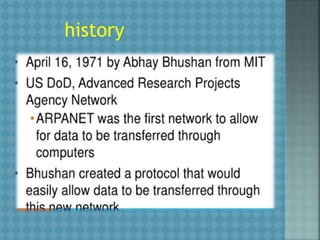
history
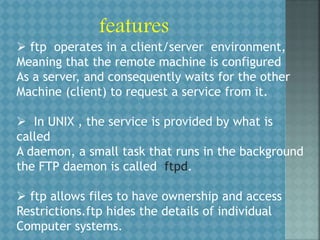
features
 ftp operates in a client/server environment,
Meaning that the remote machine is configured
As a server, and consequently waits for the other
Machine (client) to request a service from it.
 In UNIX , the service is provided by what is
called
A daemon, a small task that runs in the background
the FTP daemon is called ftpd.
 ftp allows files to have ownership and access
Restrictions.ftp hides the details of individual
Computer systems.
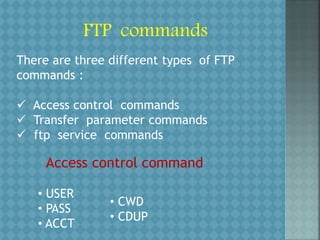
FTP commands
There are three different types of FTP
commands :
 Access control commands
 Transfer parameter commands
 ftp service commands
Access control command
• USER
• PASS
• ACCT
• CWD
• CDUP
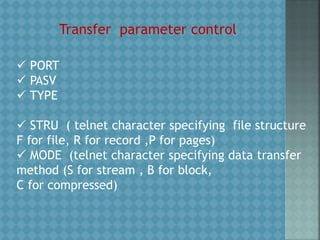
Transfer parameter control
 PORT
 PASV
 TYPE
 STRU ( telnet character specifying file structure
F for file, R for record ,P for pages)
 MODE (telnet character specifying data transfer
method (S for stream , B for block,
C for compressed)
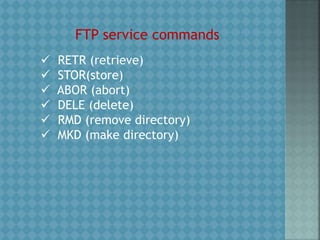
FTP service commands
 RETR (retrieve)
 STOR(store)
 ABOR (abort)
 DELE (delete)
 RMD (remove directory)
 MKD (make directory)
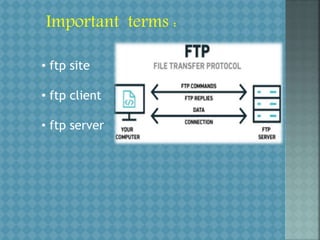
Important terms :
• ftp site
• ftp client
• ftp server
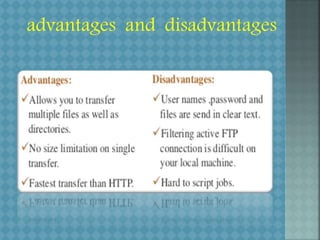
advantages and disadvantages
http (hyper text transfer
protocol)
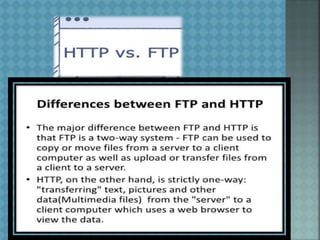
 http is the set of rules for transferring files (text,
graphic ,images ,sound ,video , and other multimedia
Files) on the world wide web.
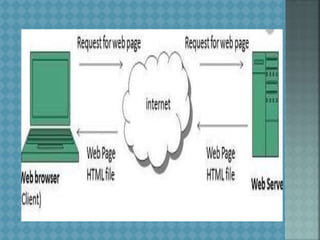
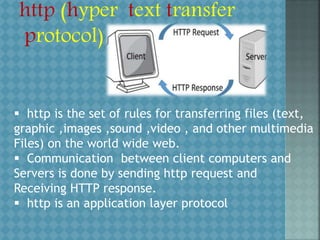
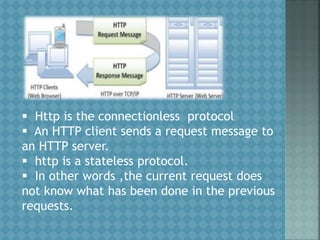
 Communication between client computers and
Servers is done by sending http request and
Receiving HTTP response.
 http is an application layer protocol
 Http is the connectionless protocol
 An HTTP client sends a request message to
an HTTP server.
 http is a stateless protocol.
 In other words ,the current request does
not know what has been done in the previous
requests.
http connections
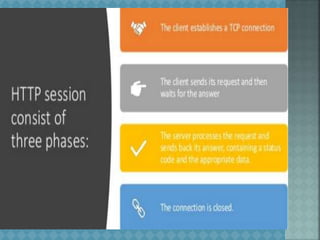
Non persistent HTTP
 At most one object is sent over a
TCP connection.
Persistent HTTP
 Multiple objects can be sent over single
TCP connection between client and server
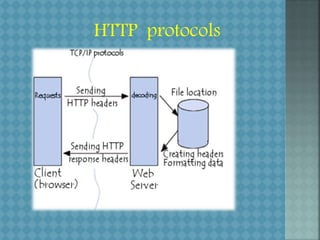
HTTP protocols
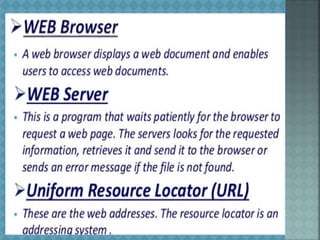
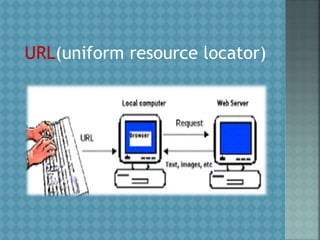
URL(uniform resource locator)
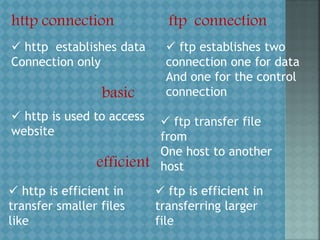
http connection
 http establishes data
Connection only
ftp connection
 ftp establishes two
connection one for data
And one for the control
connection
basic
 http is used to access
website
 ftp transfer file
from
One host to another
host
efficient
 http is efficient in
transfer smaller files
like
 ftp is efficient in
transferring larger
file
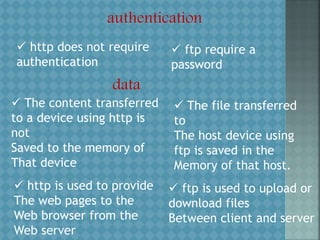
authentication
 http does not require
authentication
 ftp require a
password
data
 The content transferred
to a device using http is
not
Saved to the memory of
That device
 The file transferred
to
The host device using
ftp is saved in the
Memory of that host.
 http is used to provide
The web pages to the
Web browser from the
Web server
 ftp is used to upload or
download files
Between client and server
Computer Networking

Computer Networking

  • 1.
    WWW FTP and HTTP Vijayapriya p I- Msc (cs) by
  • 2.
    www (world wideweb) Definition :  Resources and the uses on the internet, using HTTP – hyper text transfer protocal. Is the universe of network accessible information.  Way to exchanging information between computers on the internet ,trying them together Into a vast collection of interactive Multimedia resources.
  • 3.
     The worldwide web is a way of exchanging Information between computers on the internet  The world wide web is the network of pages of Images ,texts , and sounds on the internet which Can be viewed using browser software. WHAT IS WORLD WIDE WEB ?
  • 5.
    Evolution www  Evolutionworld wide web was created by Tim Berners lee in 1989 at CERN in Geneva.  World wide web came into existence as a Proposal by him, to allow researchers to work Together effectively and efficiently at CERN Eventually it became world wide web.
  • 6.
  • 7.
    Version of www Web1.0  Static web pages  Brochure ware  Mostly publishing  No communication Web 2.0  Social media  Keyword research  Rich user experience  Tagging Web 3.0  Highly mobile  Open ID  Semantic search  Micro blogging
  • 8.
    www component  Structuralcomponents  Semantic components 1. Structural components :  Clients / browsers – to dominant implementations  Servers - run on sophisticated hardware  Caches - many interesting implementations  Internet - the global infrastructure which facilitates
  • 9.
    2. Semantic components:  Hyper text transfer protocol (HTTP)  Hyper text markup language (HTML)  Extensible markup language (XML)  Uniform resource identifiers (URIs)
  • 10.
    Fundamental concept ofthe World wide web :
  • 12.
    advantages  Mainly freeinformation  Low cost of initial connection  Accessible from anywhere  Rapid interactive communication disadvantages  Danger of overload and excess information  No quality control over available data  No regulation
  • 13.
  • 14.
    FTP (file Transferprotocal) The standard protocol is used to transfer Files between computers and servers over a network. It is an internal standard that allows the process of file downloading and uploading on Different types of files (text, graphics, videos, Images, etc..) It was developed when security was not a big issue. It is older and being replaced with new Protocols. Its stands for file transfer protocol.
  • 15.
     ftp supportstwo separate transmission Control connection or command port(port 21) To authenticate the user and second one is Data connection or data port(port 20) to transfer the files.  It requires a username and password for access . Control and data connection
  • 16.
     It isthe set of rules that permit the downloading And uploading the files on the computer over The internet.  The URL using FTP will start FTP.  It is efficient in transferring large files.
  • 17.
  • 18.
    features  ftp operatesin a client/server environment, Meaning that the remote machine is configured As a server, and consequently waits for the other Machine (client) to request a service from it.  In UNIX , the service is provided by what is called A daemon, a small task that runs in the background the FTP daemon is called ftpd.  ftp allows files to have ownership and access Restrictions.ftp hides the details of individual Computer systems.
  • 19.
    FTP commands There arethree different types of FTP commands :  Access control commands  Transfer parameter commands  ftp service commands Access control command • USER • PASS • ACCT • CWD • CDUP
  • 20.
    Transfer parameter control PORT  PASV  TYPE  STRU ( telnet character specifying file structure F for file, R for record ,P for pages)  MODE (telnet character specifying data transfer method (S for stream , B for block, C for compressed)
  • 21.
    FTP service commands RETR (retrieve)  STOR(store)  ABOR (abort)  DELE (delete)  RMD (remove directory)  MKD (make directory)
  • 22.
    Important terms : •ftp site • ftp client • ftp server
  • 23.
  • 24.
    http (hyper texttransfer protocol)  http is the set of rules for transferring files (text, graphic ,images ,sound ,video , and other multimedia Files) on the world wide web.  Communication between client computers and Servers is done by sending http request and Receiving HTTP response.  http is an application layer protocol
  • 25.
     Http isthe connectionless protocol  An HTTP client sends a request message to an HTTP server.  http is a stateless protocol.  In other words ,the current request does not know what has been done in the previous requests.
  • 26.
    http connections Non persistentHTTP  At most one object is sent over a TCP connection. Persistent HTTP  Multiple objects can be sent over single TCP connection between client and server
  • 28.
  • 30.
  • 32.
    http connection  httpestablishes data Connection only ftp connection  ftp establishes two connection one for data And one for the control connection basic  http is used to access website  ftp transfer file from One host to another host efficient  http is efficient in transfer smaller files like  ftp is efficient in transferring larger file
  • 33.
    authentication  http doesnot require authentication  ftp require a password data  The content transferred to a device using http is not Saved to the memory of That device  The file transferred to The host device using ftp is saved in the Memory of that host.  http is used to provide The web pages to the Web browser from the Web server  ftp is used to upload or download files Between client and server