The physical, touchable, electronic and mechanical
parts of a computer system.

a. Hardware
b. Software
c. Malware
d. Peopleware
It houses the motherboard, microprocessor,
memory chips, buses, ports expansion slots
and cards.
a. CPU
b. System Unit
c. Computer
d. Monitor
It is sometimes called as the “brain” or
“heart” of a computer system.
a. System Unit
b. Motherboard
c. CPU
d. Memory
The main circuit board of the computer is
called…
a. CPU
b. Memory
c. System Unit
d. Motherboard
A non-volatile memory that holds data even
when the power is ON or OFF.
a. Memory
b. RAM
c. ROM
d. DVD
It is a data pathway between several hardware
components inside or outside a computer.
a. Power Supply Unit
b. RAM
c. Expansion Bus
d. Adapters
It is sometimes called the “Interface Cards”.
a. Adapters
b. Optical Drive
c. PSU
d. Expansion Bus
Used as permanent storage device.
a. RAM
b. ROM
c. Hard Disk Drive
d. Memory
A storage device that uses lasers to read data on
the optical media.
a. Hard Disk Drive
b. Optical Drive
c. USB Drive
d. DVD Drive
Designed to optically access data stored on a
DVD.
a. USB
b. CD
c. Optical Drive
d. DVD
It accepts data and instructions from the uses or
from another computer system.

a. Input Devices
b. Output Devices
c. Storage Devices
d. A & B
Which is NOT an input devices?
a. Keyboard
b. Printer
c. Mouse
d. Light Pen
Which is the most common pointing device used
in PCs?
a. Light Pen
b. Mouse
c. Touch Screen
d. Digitizer Tablet
A device that can read text or illustrations printed
on paper and translates the information into a
form the computer can use.
a. Scanner
b. Bar Code Reader
c. Card Reader
d. Microphones
Displayed information in visual form, using text
and graphics.
a. Touch Screen
b. Digitizer Tablet
c. Monitor
d. Image Scanner
The only type of displays for use with desktop
PCs, relatively big 14” to 16” deep and heavy
over 15lbs.
a. Smart Board
b. CRT Monitor
c. LCD Monitor
d. LED Monitor
Recently been made commercially available as
monitors for desktop PCs & Laptops.
a. Monitor
b. CRT Monitor
c. LCD Monitor
d. LED Monitor
A type of display screen that has sensitive
transparent panel covering the screen, which is
similar to touch screen.
a. Smart Board
b. Touch Screen
c. LED Monitor
d. LCD Monitor
A device that prints text or illustrations on paper.
a. Scanner
b. Printer
c. Mouse
d. Digitizer Tablet
A type of printer that produced high quality text
and graphics.
a. Ink Jet Printer
b. Laser Printer
c. Line Printer
d. Thermal Printer
Used to play sound in a computer system.

a. Speaker
b. Motherboard
c. Sound System
d. Power Supply Unit
A set of instructions that guides the hardware to
operate effectively.
a. Hardware
b. Software
c. Malware
d. Peopleware
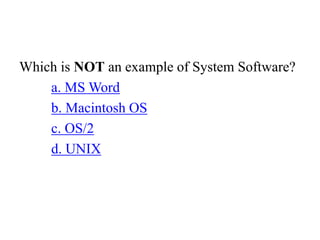
Which is NOT an example of System Software?
a. MS Word
b. Macintosh OS
c. OS/2
d. UNIX
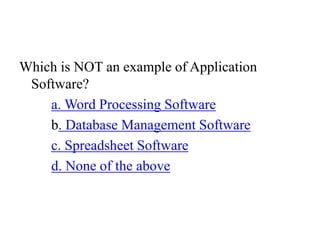
Which is NOT an example of Application
Software?
a. Word Processing Software
b. Database Management Software
c. Spreadsheet Software
d. None of the above
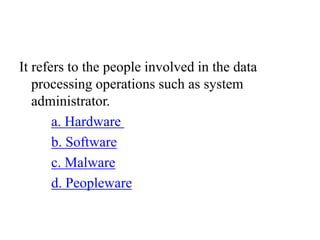
It refers to the people involved in the data
processing operations such as system
administrator.
a. Hardware
b. Software
c. Malware
d. Peopleware
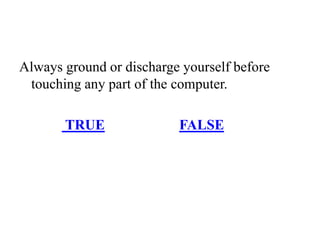
Always ground or discharge yourself before
touching any part of the computer.
TRUE FALSE
Always use the tools that can cause short circuit.
TRUE FALSE
Always power off and unplug the computer
before working.
TRUE FALSE
Read and follow instructions on the manual
carefully.
TRUE FALSE
Make sure that the pins are not properly aligned
when connecting.
TRUE FALSE
Do not work alone so that there is someone
who can take care of you in case of accident
and emergency.
TRUE FALSE
Find an escape route in case fire gets out of
control.
TRUE FALSE
Know how to contact emergency services
quickly.
TRUE FALSE
Do not take away any liquid such as mineral
water or soft drinks near your working area or
near computer.
TRUE FALSE
Hold the components by edges and do not touch
the IC’s or Integrated circuit.
TRUE FALSE
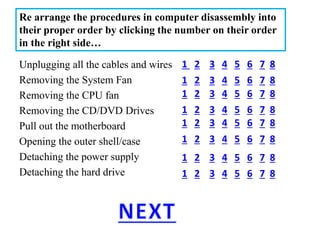
Unplugging all the cables and wires
Removing the System Fan
Removing the CPU fan
Removing the CD/DVD Drives
Pull out the motherboard
Opening the outer shell/case
Detaching the power supply
Detaching the hard drive
Re arrange the procedures in computer disassembly into
their proper order by clicking the number on their order
in the right side…
1 2 3 4 5 6 7 8
1 2 3 4 5 6 7 8
1 2 3 4 5 6 7 8
1 2 3 4 5 6 7 8
1 2 3 4 5 6 7 8
1 2 3 4 5 6 7 8
1 2 3 4 5 6 7 8
1 2 3 4 5 6 7 8
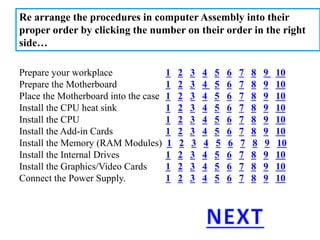
Re arrange the procedures in computer Assembly into their
proper order by clicking the number on their order in the right
side…
Prepare your workplace 1 2 3 4 5 6 7 8 9 10
Prepare the Motherboard 1 2 3 4 5 6 7 8 9 10
Place the Motherboard into the case 1 2 3 4 5 6 7 8 9 10
Install the CPU heat sink 1 2 3 4 5 6 7 8 9 10
Install the CPU 1 2 3 4 5 6 7 8 9 10
Install the Add-in Cards 1 2 3 4 5 6 7 8 9 10
Install the Memory (RAM Modules) 1 2 3 4 5 6 7 8 9 10
Install the Internal Drives 1 2 3 4 5 6 7 8 9 10
Install the Graphics/Video Cards 1 2 3 4 5 6 7 8 9 10
Connect the Power Supply. 1 2 3 4 5 6 7 8 9 10
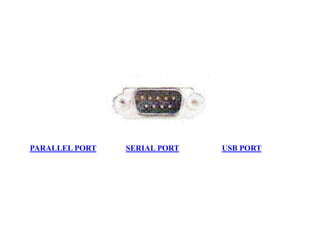
PARALLEL PORT SERIAL PORT USB PORT
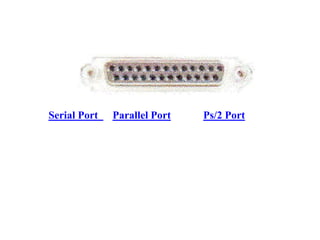
Serial Port Parallel Port Ps/2 Port
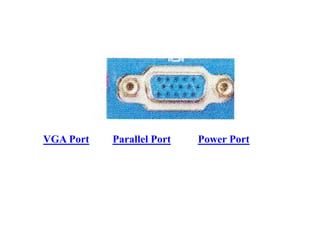
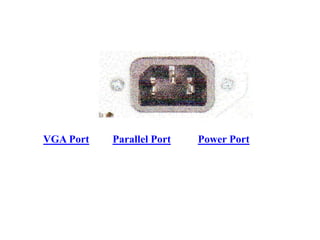
VGA Port Parallel Port Power Port
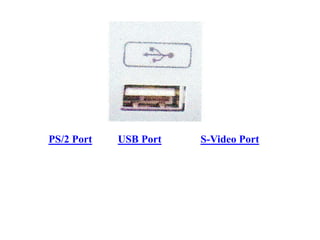
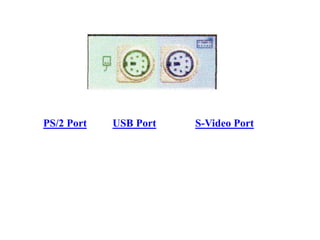
PS/2 Port USB Port S-Video Port
VGA Port Parallel Port Power Port
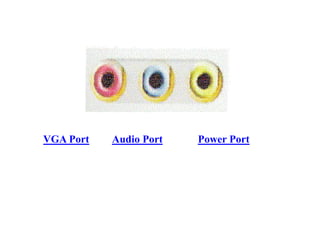
VGA Port Audio Port Power Port
Computer Hardware Servicing

Computer Hardware Servicing

  • 2.
    The physical, touchable,electronic and mechanical parts of a computer system. a. Hardware b. Software c. Malware d. Peopleware
  • 5.
    It houses themotherboard, microprocessor, memory chips, buses, ports expansion slots and cards. a. CPU b. System Unit c. Computer d. Monitor
  • 8.
    It is sometimescalled as the “brain” or “heart” of a computer system. a. System Unit b. Motherboard c. CPU d. Memory

  • 11.
    The main circuitboard of the computer is called… a. CPU b. Memory c. System Unit d. Motherboard
  • 14.
    A non-volatile memorythat holds data even when the power is ON or OFF. a. Memory b. RAM c. ROM d. DVD
  • 17.
    It is adata pathway between several hardware components inside or outside a computer. a. Power Supply Unit b. RAM c. Expansion Bus d. Adapters
  • 20.
    It is sometimescalled the “Interface Cards”. a. Adapters b. Optical Drive c. PSU d. Expansion Bus
  • 23.
    Used as permanentstorage device. a. RAM b. ROM c. Hard Disk Drive d. Memory
  • 26.
    A storage devicethat uses lasers to read data on the optical media. a. Hard Disk Drive b. Optical Drive c. USB Drive d. DVD Drive
  • 29.
    Designed to opticallyaccess data stored on a DVD. a. USB b. CD c. Optical Drive d. DVD
  • 32.
    It accepts dataand instructions from the uses or from another computer system. a. Input Devices b. Output Devices c. Storage Devices d. A & B

  • 35.
    Which is NOTan input devices? a. Keyboard b. Printer c. Mouse d. Light Pen
  • 38.
    Which is themost common pointing device used in PCs? a. Light Pen b. Mouse c. Touch Screen d. Digitizer Tablet
  • 41.
    A device thatcan read text or illustrations printed on paper and translates the information into a form the computer can use. a. Scanner b. Bar Code Reader c. Card Reader d. Microphones
  • 44.
    Displayed information invisual form, using text and graphics. a. Touch Screen b. Digitizer Tablet c. Monitor d. Image Scanner
  • 47.
    The only typeof displays for use with desktop PCs, relatively big 14” to 16” deep and heavy over 15lbs. a. Smart Board b. CRT Monitor c. LCD Monitor d. LED Monitor
  • 50.
    Recently been madecommercially available as monitors for desktop PCs & Laptops. a. Monitor b. CRT Monitor c. LCD Monitor d. LED Monitor
  • 53.
    A type ofdisplay screen that has sensitive transparent panel covering the screen, which is similar to touch screen. a. Smart Board b. Touch Screen c. LED Monitor d. LCD Monitor
  • 56.
    A device thatprints text or illustrations on paper. a. Scanner b. Printer c. Mouse d. Digitizer Tablet
  • 59.
    A type ofprinter that produced high quality text and graphics. a. Ink Jet Printer b. Laser Printer c. Line Printer d. Thermal Printer
  • 62.
    Used to playsound in a computer system. a. Speaker b. Motherboard c. Sound System d. Power Supply Unit

  • 65.
    A set ofinstructions that guides the hardware to operate effectively. a. Hardware b. Software c. Malware d. Peopleware
  • 68.
    Which is NOTan example of System Software? a. MS Word b. Macintosh OS c. OS/2 d. UNIX
  • 71.
    Which is NOTan example of Application Software? a. Word Processing Software b. Database Management Software c. Spreadsheet Software d. None of the above
  • 74.
    It refers tothe people involved in the data processing operations such as system administrator. a. Hardware b. Software c. Malware d. Peopleware
  • 78.
    Always ground ordischarge yourself before touching any part of the computer. TRUE FALSE
  • 81.
    Always use thetools that can cause short circuit. TRUE FALSE
  • 84.
    Always power offand unplug the computer before working. TRUE FALSE
  • 87.
    Read and followinstructions on the manual carefully. TRUE FALSE
  • 90.
    Make sure thatthe pins are not properly aligned when connecting. TRUE FALSE
  • 93.
    Do not workalone so that there is someone who can take care of you in case of accident and emergency. TRUE FALSE
  • 96.
    Find an escaperoute in case fire gets out of control. TRUE FALSE
  • 99.
    Know how tocontact emergency services quickly. TRUE FALSE
  • 102.
    Do not takeaway any liquid such as mineral water or soft drinks near your working area or near computer. TRUE FALSE
  • 105.
    Hold the componentsby edges and do not touch the IC’s or Integrated circuit. TRUE FALSE
  • 109.
    Unplugging all thecables and wires Removing the System Fan Removing the CPU fan Removing the CD/DVD Drives Pull out the motherboard Opening the outer shell/case Detaching the power supply Detaching the hard drive Re arrange the procedures in computer disassembly into their proper order by clicking the number on their order in the right side… 1 2 3 4 5 6 7 8 1 2 3 4 5 6 7 8 1 2 3 4 5 6 7 8 1 2 3 4 5 6 7 8 1 2 3 4 5 6 7 8 1 2 3 4 5 6 7 8 1 2 3 4 5 6 7 8 1 2 3 4 5 6 7 8
  • 112.
    Re arrange theprocedures in computer Assembly into their proper order by clicking the number on their order in the right side… Prepare your workplace 1 2 3 4 5 6 7 8 9 10 Prepare the Motherboard 1 2 3 4 5 6 7 8 9 10 Place the Motherboard into the case 1 2 3 4 5 6 7 8 9 10 Install the CPU heat sink 1 2 3 4 5 6 7 8 9 10 Install the CPU 1 2 3 4 5 6 7 8 9 10 Install the Add-in Cards 1 2 3 4 5 6 7 8 9 10 Install the Memory (RAM Modules) 1 2 3 4 5 6 7 8 9 10 Install the Internal Drives 1 2 3 4 5 6 7 8 9 10 Install the Graphics/Video Cards 1 2 3 4 5 6 7 8 9 10 Connect the Power Supply. 1 2 3 4 5 6 7 8 9 10
  • 116.
    PARALLEL PORT SERIALPORT USB PORT
  • 119.
    Serial Port ParallelPort Ps/2 Port
  • 122.
    VGA Port ParallelPort Power Port
  • 125.
    PS/2 Port USBPort S-Video Port
  • 128.
    PS/2 Port USBPort S-Video Port
  • 131.
    VGA Port ParallelPort Power Port
  • 134.
    VGA Port AudioPort Power Port