Computer Generated Watercolor

 Curtis, Anderson, Seims, Fleisher, Salesin
             SIGGRAPH 1997

                         Presented by
                        Yann SEMET
           Universite of Illinois at Urbana Champaign
            Universite de Technologie de Compiegne
Background

   NPR
   Purpose : aesthetic rather than
    technical
   Artificial art ?
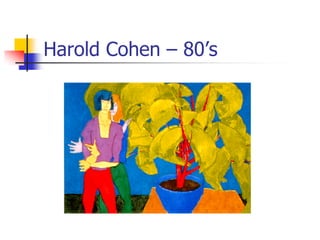
Harold Cohen – 80’s
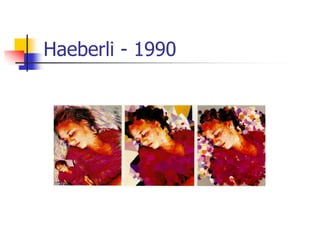
Haeberli - 1990
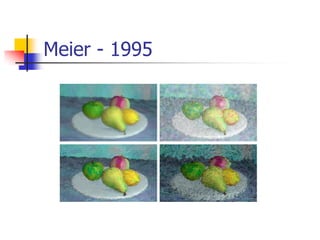
Meier - 1995
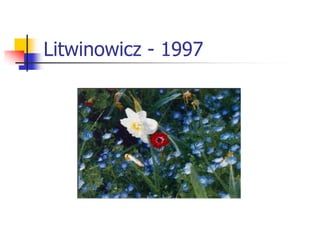
Litwinowicz - 1997
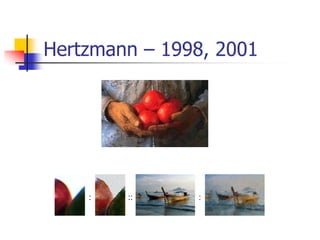
Hertzmann – 1998, 2001
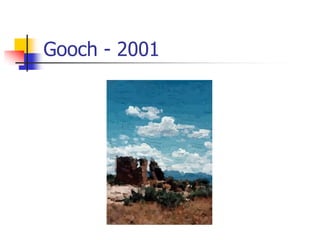
Gooch - 2001
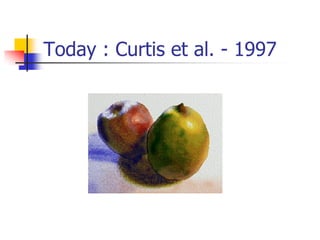
Today : Curtis et al. - 1997
Overview
   Particularities of Watercolor
   Computer simulation
       Fluid simulation
       Kubelka-Munk rendering
   Applications
   Discussion
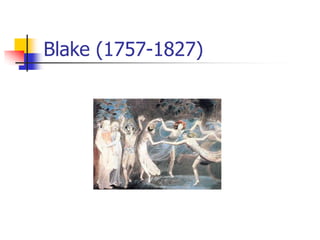
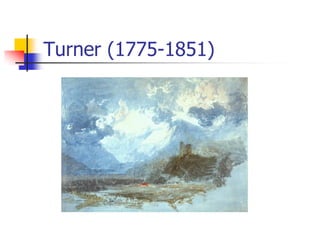
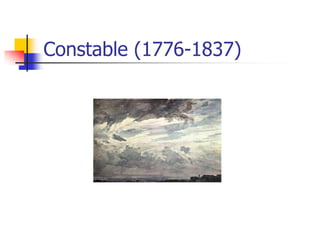
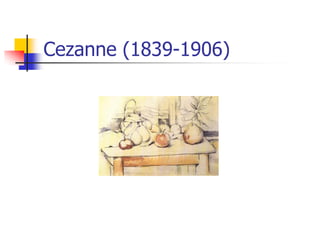
Like no other medium


   Beautiful textures and patterns
   Reveals the motion of water
   Luminous, glowing
Blake (1757-1827)
Turner (1775-1851)
Constable (1776-1837)
Cezanne (1839-1906)
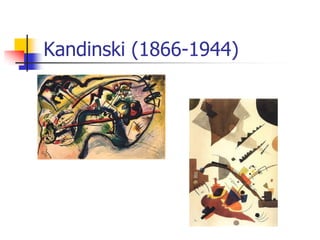
Kandinski (1866-1944)
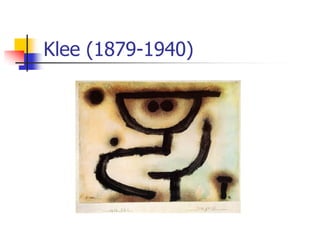
Klee (1879-1940)
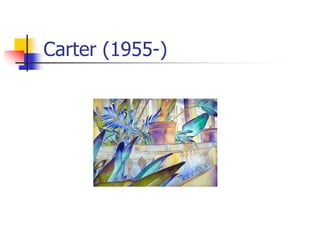
Carter (1955-)
Watercolor materials


   Paper
   Pigments
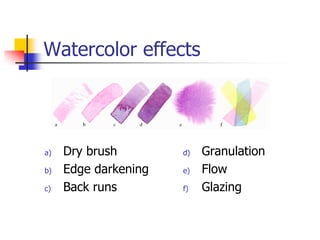
Watercolor effects


a)   Dry brush        d)   Granulation
b)   Edge darkening   e)   Flow
c)   Back runs        f)   Glazing
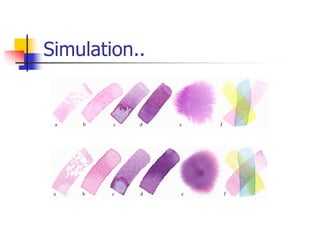
Simulation..
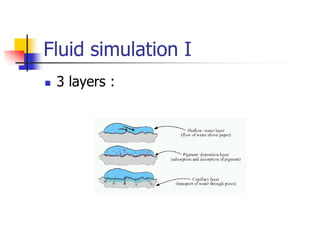
Fluid simulation I
   3 layers :
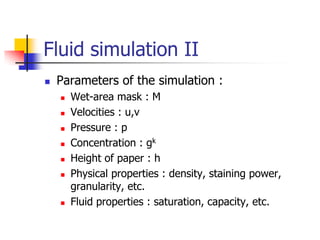
Fluid simulation II
   Parameters of the simulation :
       Wet-area mask : M
       Velocities : u,v
       Pressure : p
       Concentration : gk
       Height of paper : h
       Physical properties : density, staining power,
        granularity, etc.
       Fluid properties : saturation, capacity, etc.
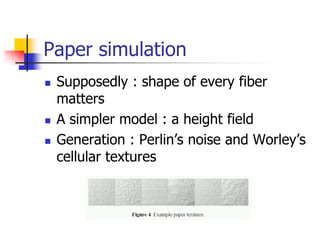
Paper simulation
   Supposedly : shape of every fiber
    matters
   A simpler model : a height field
   Generation : Perlin’s noise and Worley’s
    cellular textures
Main loop
   For each time step
       Move Water
            Update velocities
            Relax Divergence
            Flow Outward
       Move Pigment
       Transfer Pigment
       Simulate Capillary Flow
Conditions for realism
   Flow must be constrained so water
    remains within M
   Surplus of water causes flow outward
   Flow must be damped to minimize
    oscillating waves
   Flow is perturbed by texture of paper
   Local changes have global effects
   Outward flow to darken edges
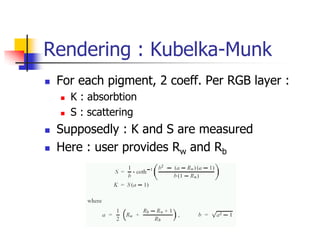
Rendering : Kubelka-Munk
   For each pigment, 2 coeff. Per RGB layer :
       K : absorbtion
       S : scattering
   Supposedly : K and S are measured
   Here : user provides Rw and Rb
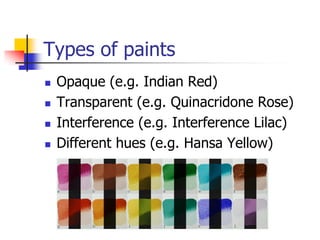
Types of paints
   Opaque (e.g. Indian Red)
   Transparent (e.g. Quinacridone Rose)
   Interference (e.g. Interference Lilac)
   Different hues (e.g. Hansa Yellow)
Optical compositing
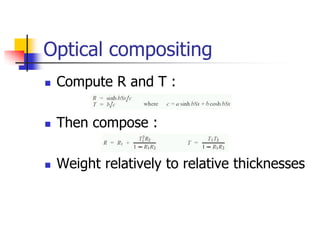
   Compute R and T :

   Then compose :

   Weight relatively to relative thicknesses
Discussion of the KM model
   Assumptions partially satisfied :
       Identical refractive indices
       Random orientation of pigments
       Diffuse illumination
       1 wavelength at a time
       No chemical interaction
   Works surprisingly well !
   OK, because we’re looking for appearance,
    not actual modeling
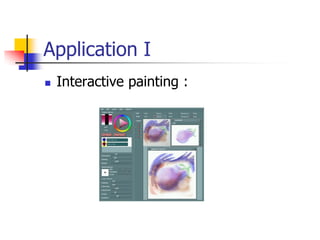
Application I
   Interactive painting :
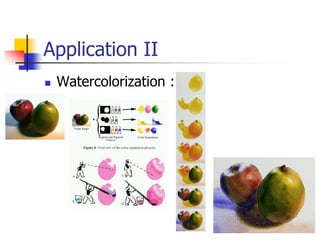
Application II
   Watercolorization :
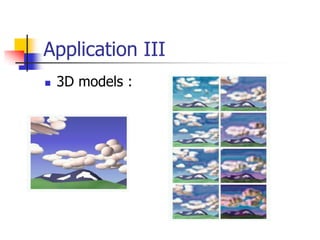
Application III
   3D models :
Future work

   Other effects
   Automatic rendering
   Generalization
   Animation
Summary

   A particular painting technique
   A physically based simulation
       Fluid motion
       Optical compositing
   Application and results
Conclusion and discussion


   Efficiency issues and long term interest
   Border between art, physics and
    computer science

Computer Generated Watercolor