COMPUTER GAMING
PRESENTED BY:
JOHN MICHAEL GUEVARRA SALAS
ST.YVES
1
PC GAMES
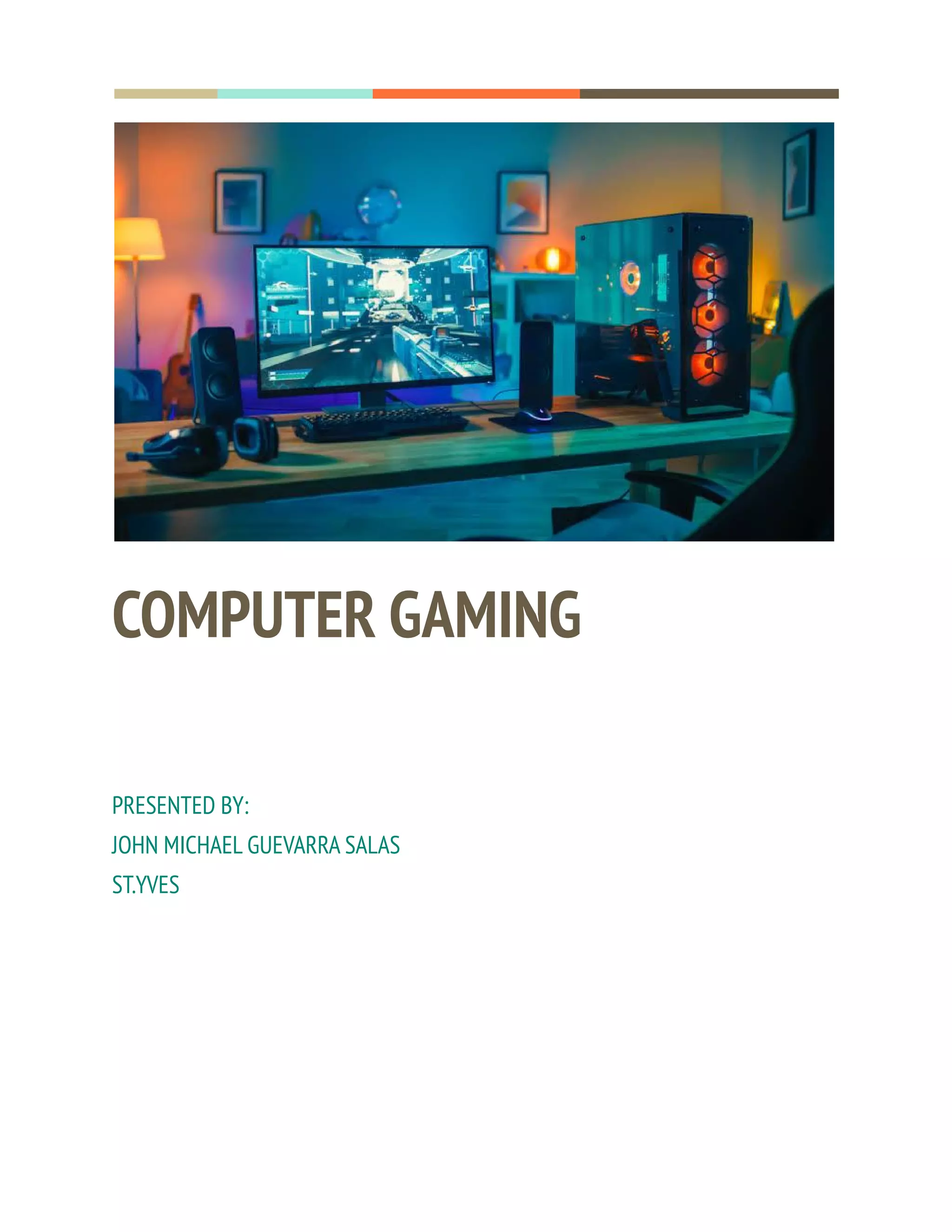
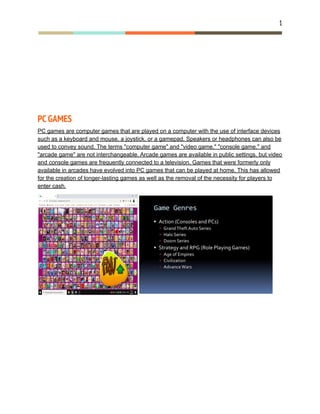
PC games are computer games that are played on a computer with the use of interface devices
such as a keyboard and mouse, a joystick, or a gamepad. Speakers or headphones can also be
used to convey sound. The terms "computer game" and "video game," "console game," and
"arcade game" are not interchangeable. Arcade games are available in public settings, but video
and console games are frequently connected to a television. Games that were formerly only
available in arcades have evolved into PC games that can be played at home. This has allowed
for the creation of longer-lasting games as well as the removal of the necessity for players to
enter cash.
2
Computer game
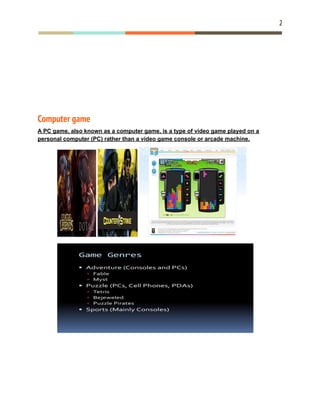
A PC game, also known as a computer game, is a type of video game played on a
personal computer (PC) rather than a video game console or arcade machine.
3
COMPUTER DEVELOPMENT
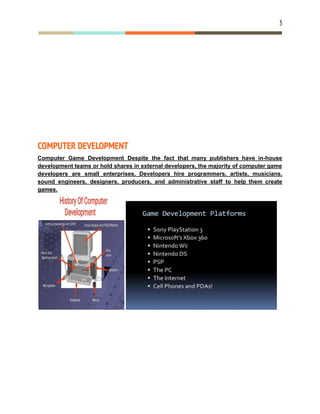
Computer Game Development Despite the fact that many publishers have in-house
development teams or hold shares in external developers, the majority of computer game
developers are small enterprises. Developers hire programmers, artists, musicians,
sound engineers, designers, producers, and administrative staff to help them create
games.
4
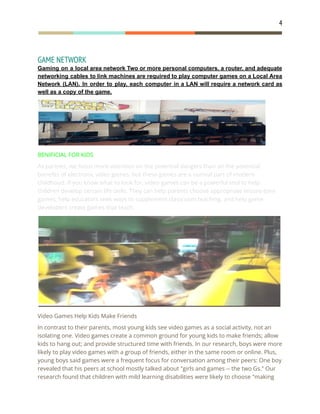
GAME NETWORK
Gaming on a local area network Two or more personal computers, a router, and adequate
networking cables to link machines are required to play computer games on a Local Area
Network (LAN). In order to play, each computer in a LAN will require a network card as
well as a copy of the game.
BENIFICIAL FOR KIDS
As parents, we focus more attention on the potential dangers than on the potential
benefits of electronic video games, but these games are a normal part of modern
childhood. If you know what to look for, video games can be a powerful tool to help
children develop certain life skills. They can help parents choose appropriate leisure-time
games, help educators seek ways to supplement classroom teaching, and help game
developers create games that teach.
Video Games Help Kids Make Friends
In contrast to their parents, most young kids see video games as a social activity, not an
isolating one. Video games create a common ground for young kids to make friends; allow
kids to hang out; and provide structured time with friends. In our research, boys were more
likely to play video games with a group of friends, either in the same room or online. Plus,
young boys said games were a frequent focus for conversation among their peers: One boy
revealed that his peers at school mostly talked about "girls and games -- the two Gs." Our
research found that children with mild learning disabilities were likely to choose "making
5
new friends" as a reason they played video games.research found that children with mild
learning disabilities were likely to choose "making new friends" as a reason they played
video games.
COMPUTER TEACH PROBLEM
Video Games Teach Problem-Solving Skills
Video games can help children's brain development.When my son was a young adolescent,I watched him play Legend of
Zelda games.He had to search,negotiate,plan,and try different approaches to advance.Many recent games,such as
Bakugan: Defenders of the Core,involve planning and problem-solving."Modding,"the process by which players customize
gamer characters'appearance and develop new game levels,also allows for creative self-expression,deep understanding of
game rules and structure,and new ways of highlighting personalities and interests.Video games don't have to be labeled
"educational"to help children learn to make decisions,use strategies,anticipate consequences and express their
personalities.

Computer gaming

  • 1.
    COMPUTER GAMING PRESENTED BY: JOHNMICHAEL GUEVARRA SALAS ST.YVES
  • 2.
    1 PC GAMES PC gamesare computer games that are played on a computer with the use of interface devices such as a keyboard and mouse, a joystick, or a gamepad. Speakers or headphones can also be used to convey sound. The terms "computer game" and "video game," "console game," and "arcade game" are not interchangeable. Arcade games are available in public settings, but video and console games are frequently connected to a television. Games that were formerly only available in arcades have evolved into PC games that can be played at home. This has allowed for the creation of longer-lasting games as well as the removal of the necessity for players to enter cash.
  • 3.
    2 Computer game A PCgame, also known as a computer game, is a type of video game played on a personal computer (PC) rather than a video game console or arcade machine.
  • 4.
    3 COMPUTER DEVELOPMENT Computer GameDevelopment Despite the fact that many publishers have in-house development teams or hold shares in external developers, the majority of computer game developers are small enterprises. Developers hire programmers, artists, musicians, sound engineers, designers, producers, and administrative staff to help them create games.
  • 5.
    4 GAME NETWORK Gaming ona local area network Two or more personal computers, a router, and adequate networking cables to link machines are required to play computer games on a Local Area Network (LAN). In order to play, each computer in a LAN will require a network card as well as a copy of the game. BENIFICIAL FOR KIDS As parents, we focus more attention on the potential dangers than on the potential benefits of electronic video games, but these games are a normal part of modern childhood. If you know what to look for, video games can be a powerful tool to help children develop certain life skills. They can help parents choose appropriate leisure-time games, help educators seek ways to supplement classroom teaching, and help game developers create games that teach. Video Games Help Kids Make Friends In contrast to their parents, most young kids see video games as a social activity, not an isolating one. Video games create a common ground for young kids to make friends; allow kids to hang out; and provide structured time with friends. In our research, boys were more likely to play video games with a group of friends, either in the same room or online. Plus, young boys said games were a frequent focus for conversation among their peers: One boy revealed that his peers at school mostly talked about "girls and games -- the two Gs." Our research found that children with mild learning disabilities were likely to choose "making
  • 6.
    5 new friends" asa reason they played video games.research found that children with mild learning disabilities were likely to choose "making new friends" as a reason they played video games. COMPUTER TEACH PROBLEM Video Games Teach Problem-Solving Skills Video games can help children's brain development.When my son was a young adolescent,I watched him play Legend of Zelda games.He had to search,negotiate,plan,and try different approaches to advance.Many recent games,such as Bakugan: Defenders of the Core,involve planning and problem-solving."Modding,"the process by which players customize gamer characters'appearance and develop new game levels,also allows for creative self-expression,deep understanding of game rules and structure,and new ways of highlighting personalities and interests.Video games don't have to be labeled "educational"to help children learn to make decisions,use strategies,anticipate consequences and express their personalities.