Unit 78: Digital Graphics for
     Computer Games
         By Jason Finch
Pixel and Resolution
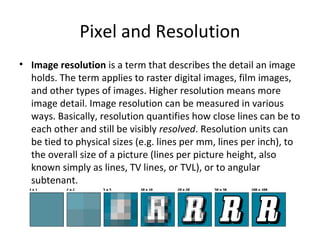
• Image resolution is a term that describes the detail an image
  holds. The term applies to raster digital images, film images,
  and other types of images. Higher resolution means more
  image detail. Image resolution can be measured in various
  ways. Basically, resolution quantifies how close lines can be to
  each other and still be visibly resolved. Resolution units can
  be tied to physical sizes (e.g. lines per mm, lines per inch), to
  the overall size of a picture (lines per picture height, also
  known simply as lines, TV lines, or TVL), or to angular
  subtenant.
Vector and Raster Images
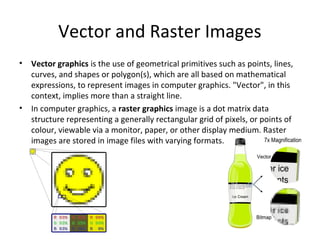
•   Vector graphics is the use of geometrical primitives such as points, lines,
    curves, and shapes or polygon(s), which are all based on mathematical
    expressions, to represent images in computer graphics. "Vector", in this
    context, implies more than a straight line.
•   In computer graphics, a raster graphics image is a dot matrix data
    structure representing a generally rectangular grid of pixels, or points of
    colour, viewable via a monitor, paper, or other display medium. Raster
    images are stored in image files with varying formats.
File Format and Uses
•   A file format is a standard way that information is encoded for storage in a computer file. A
    file format specifies how bits are used to encode information in a digital storage medium.
    File formats may be either proprietary or free and may be either unpublished or open.
•   Some file formats are designed for very particular types of data: PNG files, for example, store
    bitmapped images using lossless data compression. Other file formats, however, are
    designed for storage of several different types of data: the Ogg format can act as a container
    for different types of multimedia, including any combination of audio and video, with or
    without text (such as subtitles), and metadata. A text file can contain any stream of
    characters, including possible control characters, and is encoded in one of various character
    encoding schemes. Some file formats, such as HTML, scalable vector graphics, and the source
    code of computer software are text files with defined syntaxes that allow them to be used
    for specific purposes.
Compression
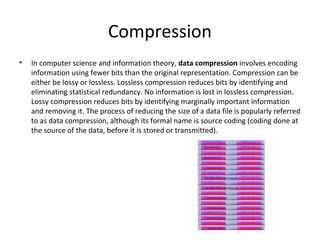
•   In computer science and information theory, data compression involves encoding
    information using fewer bits than the original representation. Compression can be
    either be lossy or lossless. Lossless compression reduces bits by identifying and
    eliminating statistical redundancy. No information is lost in lossless compression.
    Lossy compression reduces bits by identifying marginally important information
    and removing it. The process of reducing the size of a data file is popularly referred
    to as data compression, although its formal name is source coding (coding done at
    the source of the data, before it is stored or transmitted).
Image Capture Devices
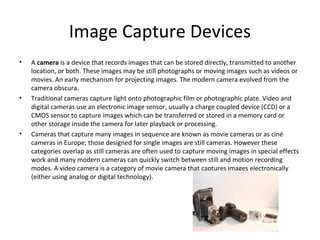
•   A camera is a device that records images that can be stored directly, transmitted to another
    location, or both. These images may be still photographs or moving images such as videos or
    movies. An early mechanism for projecting images. The modern camera evolved from the
    camera obscura.
•   Traditional cameras capture light onto photographic film or photographic plate. Video and
    digital cameras use an electronic image sensor, usually a charge coupled device (CCD) or a
    CMOS sensor to capture images which can be transferred or stored in a memory card or
    other storage inside the camera for later playback or processing.
•   Cameras that capture many images in sequence are known as movie cameras or as ciné
    cameras in Europe; those designed for single images are still cameras. However these
    categories overlap as still cameras are often used to capture moving images in special effects
    work and many modern cameras can quickly switch between still and motion recording
    modes. A video camera is a category of movie camera that captures images electronically
    (either using analog or digital technology).
Optimising
•   In computer science, program optimization or software optimization is
    the process of modifying a software system to make some aspect of it
    work more efficiently or use fewer resources. In general, a computer
    program may be optimized so that it executes more rapidly, or is capable
    of operating with less memory storage or other resources, or draw less
    power.
Storage and Asset Management
•   Memory management is the act of managing computer memory. The essential
    requirement of memory management is to provide ways to dynamically allocate
    portions of memory to programs at their request, and freeing it for reuse when no
    longer needed. This is critical to the computer system.
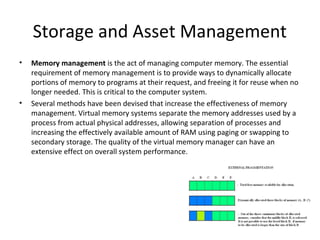
•   Several methods have been devised that increase the effectiveness of memory
    management. Virtual memory systems separate the memory addresses used by a
    process from actual physical addresses, allowing separation of processes and
    increasing the effectively available amount of RAM using paging or swapping to
    secondary storage. The quality of the virtual memory manager can have an
    extensive effect on overall system performance.
Sources used
• http://en.wikipedia.org/wiki/Image_resolution
• http://en.wikipedia.org/wiki/Vector_graphics
• http://en.wikipedia.org/wiki/Raster_graphics
• http://en.wikipedia.org/wiki/Camera
• http://
  www.promotionalmerchandise.co.uk/images/D/zoom_promotiona
• http://en.wikipedia.org/wiki/Data_compression
• http://en.wikipedia.org/wiki/Program_optimization
• http://en.wikipedia.org/wiki/Memory_management
Sources used
• http://en.wikipedia.org/wiki/Image_resolution
• http://en.wikipedia.org/wiki/Vector_graphics
• http://en.wikipedia.org/wiki/Raster_graphics
• http://en.wikipedia.org/wiki/Camera
• http://
  www.promotionalmerchandise.co.uk/images/D/zoom_promotiona
• http://en.wikipedia.org/wiki/Data_compression
• http://en.wikipedia.org/wiki/Program_optimization
• http://en.wikipedia.org/wiki/Memory_management

Digital graphics for computer games

  • 1.
    Unit 78: DigitalGraphics for Computer Games By Jason Finch
  • 2.
    Pixel and Resolution •Image resolution is a term that describes the detail an image holds. The term applies to raster digital images, film images, and other types of images. Higher resolution means more image detail. Image resolution can be measured in various ways. Basically, resolution quantifies how close lines can be to each other and still be visibly resolved. Resolution units can be tied to physical sizes (e.g. lines per mm, lines per inch), to the overall size of a picture (lines per picture height, also known simply as lines, TV lines, or TVL), or to angular subtenant.
  • 3.
    Vector and RasterImages • Vector graphics is the use of geometrical primitives such as points, lines, curves, and shapes or polygon(s), which are all based on mathematical expressions, to represent images in computer graphics. "Vector", in this context, implies more than a straight line. • In computer graphics, a raster graphics image is a dot matrix data structure representing a generally rectangular grid of pixels, or points of colour, viewable via a monitor, paper, or other display medium. Raster images are stored in image files with varying formats.
  • 4.
    File Format andUses • A file format is a standard way that information is encoded for storage in a computer file. A file format specifies how bits are used to encode information in a digital storage medium. File formats may be either proprietary or free and may be either unpublished or open. • Some file formats are designed for very particular types of data: PNG files, for example, store bitmapped images using lossless data compression. Other file formats, however, are designed for storage of several different types of data: the Ogg format can act as a container for different types of multimedia, including any combination of audio and video, with or without text (such as subtitles), and metadata. A text file can contain any stream of characters, including possible control characters, and is encoded in one of various character encoding schemes. Some file formats, such as HTML, scalable vector graphics, and the source code of computer software are text files with defined syntaxes that allow them to be used for specific purposes.
  • 5.
    Compression • In computer science and information theory, data compression involves encoding information using fewer bits than the original representation. Compression can be either be lossy or lossless. Lossless compression reduces bits by identifying and eliminating statistical redundancy. No information is lost in lossless compression. Lossy compression reduces bits by identifying marginally important information and removing it. The process of reducing the size of a data file is popularly referred to as data compression, although its formal name is source coding (coding done at the source of the data, before it is stored or transmitted).
  • 6.
    Image Capture Devices • A camera is a device that records images that can be stored directly, transmitted to another location, or both. These images may be still photographs or moving images such as videos or movies. An early mechanism for projecting images. The modern camera evolved from the camera obscura. • Traditional cameras capture light onto photographic film or photographic plate. Video and digital cameras use an electronic image sensor, usually a charge coupled device (CCD) or a CMOS sensor to capture images which can be transferred or stored in a memory card or other storage inside the camera for later playback or processing. • Cameras that capture many images in sequence are known as movie cameras or as ciné cameras in Europe; those designed for single images are still cameras. However these categories overlap as still cameras are often used to capture moving images in special effects work and many modern cameras can quickly switch between still and motion recording modes. A video camera is a category of movie camera that captures images electronically (either using analog or digital technology).
  • 7.
    Optimising • In computer science, program optimization or software optimization is the process of modifying a software system to make some aspect of it work more efficiently or use fewer resources. In general, a computer program may be optimized so that it executes more rapidly, or is capable of operating with less memory storage or other resources, or draw less power.
  • 8.
    Storage and AssetManagement • Memory management is the act of managing computer memory. The essential requirement of memory management is to provide ways to dynamically allocate portions of memory to programs at their request, and freeing it for reuse when no longer needed. This is critical to the computer system. • Several methods have been devised that increase the effectiveness of memory management. Virtual memory systems separate the memory addresses used by a process from actual physical addresses, allowing separation of processes and increasing the effectively available amount of RAM using paging or swapping to secondary storage. The quality of the virtual memory manager can have an extensive effect on overall system performance.
  • 9.
    Sources used • http://en.wikipedia.org/wiki/Image_resolution •http://en.wikipedia.org/wiki/Vector_graphics • http://en.wikipedia.org/wiki/Raster_graphics • http://en.wikipedia.org/wiki/Camera • http:// www.promotionalmerchandise.co.uk/images/D/zoom_promotiona • http://en.wikipedia.org/wiki/Data_compression • http://en.wikipedia.org/wiki/Program_optimization • http://en.wikipedia.org/wiki/Memory_management
  • 10.
    Sources used • http://en.wikipedia.org/wiki/Image_resolution •http://en.wikipedia.org/wiki/Vector_graphics • http://en.wikipedia.org/wiki/Raster_graphics • http://en.wikipedia.org/wiki/Camera • http:// www.promotionalmerchandise.co.uk/images/D/zoom_promotiona • http://en.wikipedia.org/wiki/Data_compression • http://en.wikipedia.org/wiki/Program_optimization • http://en.wikipedia.org/wiki/Memory_management