Computer Aided Engineering
Unit - I
Unit 1 Elemental Properties
Introduction to Computer Aided Engineering (CAE), Use of CAE
in Product development, Discretization methods Finite Element
Method (FEM), Finite Difference Method (FDM) and Finite Volume
Method (FVM), CAE Tools- Pre-processor, Solver and Post-
Processor.
Element Shapes 1D, 2D and 3D elements, Nodal Unknowns and
field variables, Coordinate Systems, Shape Functions- linear,
quadratic and cubic, Convergence Requirements of Shape
Functions, Derivation of Polynomial Shape Functions using
coordinate systems for Bar, Beam, Triangular, and rectangular
elements.
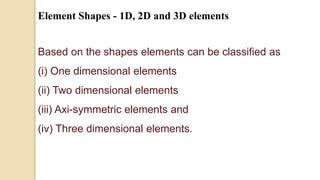
Element Shapes - 1D, 2D and 3D elements
Based on the shapes elements can be classified as
(i) One dimensional elements
(ii) Two dimensional elements
(iii) Axi-symmetric elements and
(iv) Three dimensional elements.
Axi-symmetric element
Lagrange Rectangle Element
Serendipity Rectangle Elements
Node
Basic unknowns may be displacements for stress
analysis, temperatures for heat flow problems and the
potentials for fluid flow or in the magnetic field
problems.
Nodal Unknowns
(i) Global coordinates
(ii) Local coordinates and
(iii) Natural coordinates.
Coordinate System
In the finite element analysis aim is to find the field variables
at nodal points by rigorous analysis, assuming at any point
inside the element basic variable is a function of values at
nodal points of the element. This function which relates the
field variable at any point within the element to the field
variables of nodal points is called shape function. This is also
called as interpolation function and approximating function.
Shape Function
Computer Aided Engineering abd fegh.pptx

Computer Aided Engineering abd fegh.pptx

  • 1.
  • 2.
    Unit 1 ElementalProperties Introduction to Computer Aided Engineering (CAE), Use of CAE in Product development, Discretization methods Finite Element Method (FEM), Finite Difference Method (FDM) and Finite Volume Method (FVM), CAE Tools- Pre-processor, Solver and Post- Processor. Element Shapes 1D, 2D and 3D elements, Nodal Unknowns and field variables, Coordinate Systems, Shape Functions- linear, quadratic and cubic, Convergence Requirements of Shape Functions, Derivation of Polynomial Shape Functions using coordinate systems for Bar, Beam, Triangular, and rectangular elements.
  • 3.
    Element Shapes -1D, 2D and 3D elements Based on the shapes elements can be classified as (i) One dimensional elements (ii) Two dimensional elements (iii) Axi-symmetric elements and (iv) Three dimensional elements.
  • 5.
  • 6.
  • 7.
  • 8.
    Basic unknowns maybe displacements for stress analysis, temperatures for heat flow problems and the potentials for fluid flow or in the magnetic field problems. Nodal Unknowns
  • 9.
    (i) Global coordinates (ii)Local coordinates and (iii) Natural coordinates. Coordinate System
  • 10.
    In the finiteelement analysis aim is to find the field variables at nodal points by rigorous analysis, assuming at any point inside the element basic variable is a function of values at nodal points of the element. This function which relates the field variable at any point within the element to the field variables of nodal points is called shape function. This is also called as interpolation function and approximating function. Shape Function