Interpolation
Interpolation and Shape Functions
Interpolation
To interpolate is to device a continuous function that
satisfies prescribed conditions at a finite number of
points.
In FEA, the interpolating function is almost always a
polynomial which provides a single-valued and
continuous field.
Interpolation and Shape Functions
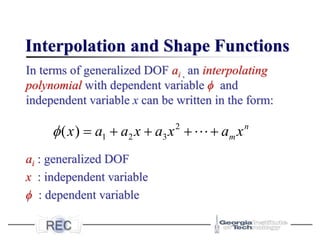
In terms of generalized DOF ai , an interpolating
polynomial with dependent variable ϕ and
independent variable x can be written in the form:
ai : generalized DOF
x : independent variable
ϕ : dependent variable
2
1 2 3
( ) n
m
x a a x a x a x
 = + + + +
Interpolation and Shape Functions
or
The ai can be expressed in terms of nodal values of 
at known values of x. The relation between nodal
values of {ϕe }and ai is given as
}
]{
[ a
x
=

]
1
[
]
[ 2 n
x
x
x
x 
=
1 2 3
{ } [ ]
T
m
a a a a a
=
}
]{
[
}
{ a
A
e =

Interpolation and Shape Functions
2
1 1
1 1 1
2
2 2
2 2 2
2
3 3
3 3 3
2
1
1
{ } 1
1
n
n
n
e
n
m m
m m m
a
x x x
a
x x x
a
x x x
a
x x x


 

 
   
 
   
 
   
   
 
= =
   
 
   
 
   
 
   
   
 
}
]{
[
}
{ a
A
e =

Interpolation and Shape Functions
Recalling
}
{
]
[
}
{ 1
e
A
a 
−
=
}
{
]
][
[ 1
e
A
x 
 −
=
}
]{
[ e
N 
 =
}
]{
[
}
{ a
A
e =

}
]{
[ a
x
=

Interpolation and Shape Functions
And
𝑁 = 𝑥 𝐴 −1 = 𝑁1 𝑁2 𝑁3 ⋯ 𝑁𝑚
An individual Ni in matrix [N] is called a shape
function. The name basis function sometimes used
instead.
}
]{
[ e
N 
 =
Interpolation and Shape Functions
In General
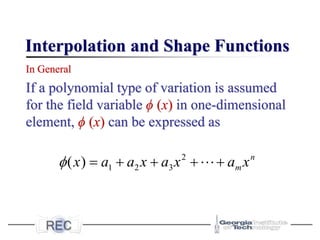
If a polynomial type of variation is assumed
for the field variable ϕ (x) in one-dimensional
element, ϕ (x) can be expressed as
2
1 2 3
( ) n
m
x a a x a x a x
 = + + + +
Interpolation and Shape Functions
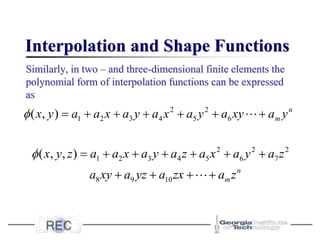
Similarly, in two – and three-dimensional finite elements the
polynomial form of interpolation functions can be expressed
as
2 2
1 2 3 4 5 6
( , ) n
m
x y a a x a y a x a y a xy a y
 = + + + + + +
2 2 2
1 2 3 4 5 6 7
8 9 10
( , , )
n
m
x y z a a x a y a z a x a y a z
a xy a yz a zx a z
 = + + + + + +
+ + + +
Interpolation and Shape Functions
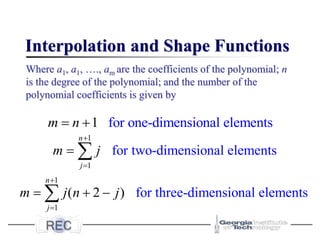
Where a1, a1, …., am are the coefficients of the polynomial; n
is the degree of the polynomial; and the number of the
polynomial coefficients is given by
for one-dimensional elements
1
m n
= +
1
1
for two-dimensional elements
n
j
m j
+
=
= 
1
1
for three-dimensional elements
( 2 )
n
j
m j n j
+
=
= + −

Interpolation and Shape Functions
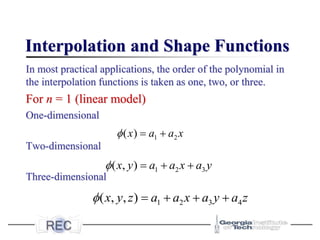
In most practical applications, the order of the polynomial in
the interpolation functions is taken as one, two, or three.
For n = 1 (linear model)
One-dimensional
Two-dimensional
Three-dimensional
1 2
( )
x a a x
 = +
1 2 3
( , )
x y a a x a y
 = + +
1 2 3 4
( , , )
x y z a a x a y a z
 = + + +
Interpolation and Shape Functions
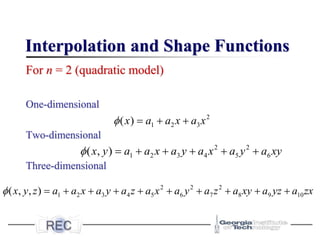
For n = 2 (quadratic model)
One-dimensional
Two-dimensional
Three-dimensional
2
1 2 3
( )
x a a x a x
 = + +
2 2
1 2 3 4 5 6
( , )
x y a a x a y a x a y a xy
 = + + + + +
2 2 2
1 2 3 4 5 6 7 8 9 10
( , , )
x y z a a x a y a z a x a y a z a xy a yz a zx
 = + + + + + + + + +
Interpolation and Shape Functions
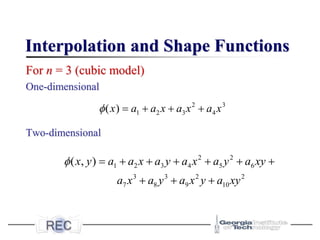
For n = 3 (cubic model)
One-dimensional
Two-dimensional
2 3
1 2 3 4
( )
x a a x a x a x
 = + + +
2 2
1 2 3 4 5 6
3 3 2 2
7 8 9 10
( , )
x y a a x a y a x a y a xy
a x a y a x y a xy
 = + + + + + +
+ + +
Interpolation and Shape Functions
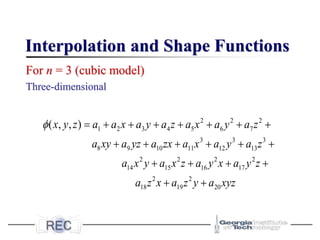
For n = 3 (cubic model)
Three-dimensional
2 2 2
1 2 3 4 5 6 7
3 3 3
8 9 10 11 12 13
2 2 2 2
14 15 16 17
2 2
18 19 20
( , , )
x y z a a x a y a z a x a y a z
a xy a yz a zx a x a y a z
a x y a x z a y x a y z
a z x a z y a x
 = + + + + + + +
+ + + + + +
+ + + +
+ + yz
Interpolation and Shape Functions
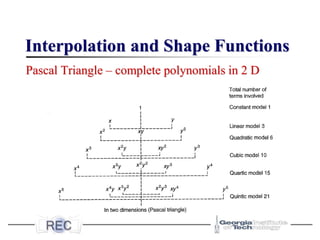
Pascal Triangle – complete polynomials in 2 D
Interpolation and Shape Functions
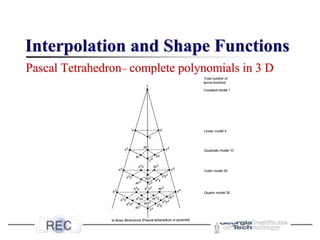
Pascal Tetrahedron– complete polynomials in 3 D
Interpolation and Shape Functions
Degree of Continuity
Field quantity ϕ is interpolated in piecewise fashion
over each element. So while ϕ can be guaranteed to
vary smoothly within each element, the transition
between elements may not be smooth. The symbol
Cm is used to describe the continuity of a piecewise
field between elements.
A field is Cm continuous if its derivatives up to and
including degree m are inter-element continuous.
Interpolation and Shape Functions
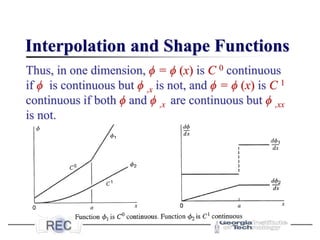
Thus, in one dimension, ϕ = ϕ (x) is C 0 continuous
if ϕ is continuous but ϕ ,x is not, and ϕ = ϕ (x) is C 1
continuous if both ϕ and ϕ ,x are continuous but ϕ ,xx
is not.
Interpolation and Shape Functions
The Cm terminology is also applied to element types.
For example, the bar element and the beam element
are called “C 0 element” and “C 1 element”,
respectively.
Usually, C 0 elements are used to model plane and
solid bodies. C 1 elements are used to model beams,
plates and shells, thus providing inter-element
continuity of the slope.
Interpolation and Shape Functions
Convergence Requirements
Since the finite element method is a numerical
technique, we obtain a sequence of approximate
solutions as the element size is reduced successively.
This sequence will converge to exact solution if the
interpolation polynomial satisfies the following
requirements:
Interpolation and Shape Functions
Convergence Requirements
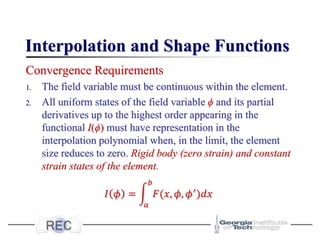
1. The field variable must be continuous within the element.
2. All uniform states of the field variable ϕ and its partial
derivatives up to the highest order appearing in the
functional I(ϕ) must have representation in the
interpolation polynomial when, in the limit, the element
size reduces to zero. Rigid body (zero strain) and constant
strain states of the element.
𝐼 𝜙 = න
𝑎
𝑏
𝐹(𝑥, 𝜙, 𝜙′
)𝑑𝑥
Interpolation and Shape Functions
Convergence Requirements
3. The field variable ϕ and its partial derivative up
to one order less the highest order derivative
appearing in the functional I(ϕ) must be
continuous at the element boundaries or
interfaces.
Interpolation and Shape Functions
Convergence Requirements
The elements whose interpolation polynomials satisfy
1 and 3 are called compatible or conforming elements and
those satisfying 2 are called complete.
If the r-th derivative of the field variable ϕ is continuous, then
ϕ is said to have C r continuity.
In terms of notation, the completeness requirement implies
that ϕ must have C r continuity within the element, whereas
the compatibility requirement implies that ϕ must have C r-1
continuity at element interface.
Interpolation and Shape Functions
A. Linear Interpolation
1. One-dimensional
In FEA, with ϕ = u, the displacement field in the
linear case can be given as
or the displacement field can be given in the form








=
2
1
2
1 ]
[


 N
N








=
2
1
2
1 ]
[
u
u
N
N
u
Interpolation and Shape Functions
We begin with linear interpolation between points (x1, ϕ1) and
(x2, ϕ2) for which [x] = [1 x]. Evaluating at points 1 and 2,
we obtain
Inverting [A] and using we obtain
]
[
]
][
[
]
[ 2
1
1
N
N
A
x
N =
= −
 
1 1
2 2
a
A
a


   
=
   
   
Interpolation and Shape Functions
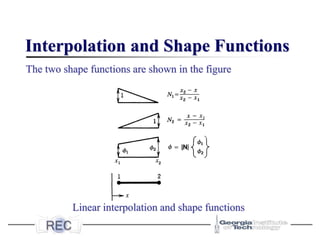
The two shape functions are shown in the figure
Linear interpolation and shape functions
Interpolation and Shape Functions
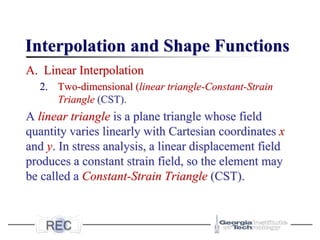
A. Linear Interpolation
2. Two-dimensional (linear triangle-Constant-Strain
Triangle (CST).
A linear triangle is a plane triangle whose field
quantity varies linearly with Cartesian coordinates x
and y. In stress analysis, a linear displacement field
produces a constant strain field, so the element may
be called a Constant-Strain Triangle (CST).
Interpolation and Shape Functions
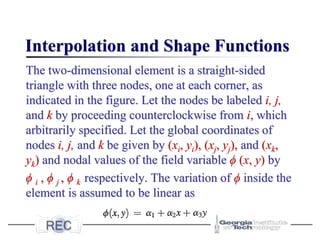
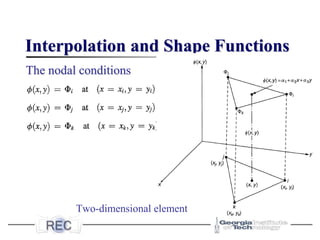
The two-dimensional element is a straight-sided
triangle with three nodes, one at each corner, as
indicated in the figure. Let the nodes be labeled i, j,
and k by proceeding counterclockwise from i, which
arbitrarily specified. Let the global coordinates of
nodes i, j, and k be given by (xi, yi), (xj, yj), and (xk,
yk) and nodal values of the field variable ϕ (x, y) by
ϕ i , ϕ j , ϕ k respectively. The variation of ϕ inside the
element is assumed to be linear as
Interpolation and Shape Functions
The nodal conditions
Two-dimensional element
Interpolation and Shape Functions
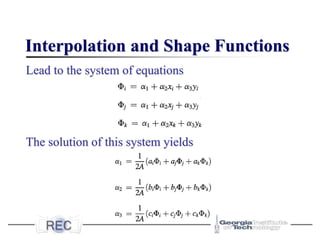
Lead to the system of equations
The solution of this system yields
Interpolation and Shape Functions
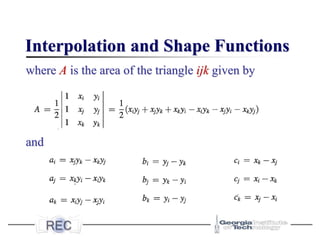
where A is the area of the triangle ijk given by
and
Interpolation and Shape Functions
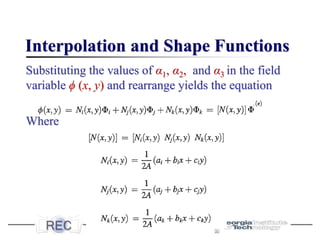
Substituting the values of α1, α2, and α3 in the field
variable ϕ (x, y) and rearrange yields the equation
Where
Interpolation and Shape Functions
Stress analysis Element
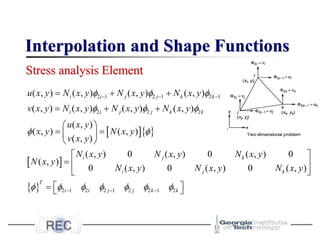
The DOF’s at each node for this element are u and v. The
same linear interpolation is used for both dependent variables.
CST element for 2-D stress
analysis










=
3
2
1
]
1
[
a
a
a
y
x
u










=
6
5
4
]
1
[
a
a
a
y
x
v
Interpolation and Shape Functions
Stress analysis Element
  
 
 
2 1 2 1 2 1
2 2 2
2 1 2 2 1 2 2
( , ) ( , ) ( , ) ( , )
( , ) ( , ) ( , ) ( , )
( , )
( , ) ( , )
( , )
( , ) 0 ( , ) 0 ( , ) 0
( , )
0 ( , ) 0 ( , ) 0 ( , )
i i j j k k
i i j j k k
i j k
i j k
T
i i j j k
u x y N x y N x y N x y
v x y N x y N x y N x y
u x y
x y N x y
v x y
N x y N x y N x y
N x y
N x y N x y N x y
  
  
 
     
− − −
− −
= + +
= + +
 
= =
 
 
 
=  
 
= 1 2k

−
 
 
Interpolation and Shape Functions
A. Linear Interpolation
3. Three-dimensional Element
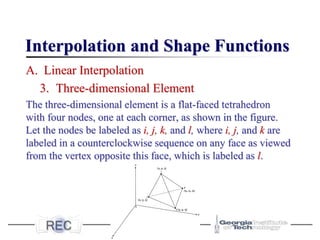
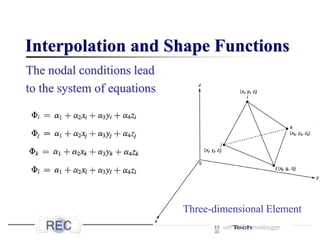
The three-dimensional element is a flat-faced tetrahedron
with four nodes, one at each corner, as shown in the figure.
Let the nodes be labeled as i, j, k, and l, where i, j, and k are
labeled in a counterclockwise sequence on any face as viewed
from the vertex opposite this face, which is labeled as l.
Interpolation and Shape Functions
Three-dimensional Element
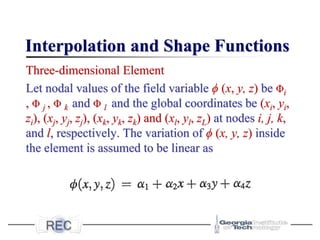
Let nodal values of the field variable ϕ (x, y, z) be Φi
, Φ j , Φ k and Φ l and the global coordinates be (xi, yi,
zi), (xj, yj, zj), (xk, yk, zk) and (xl, yl, zL) at nodes i, j, k,
and l, respectively. The variation of ϕ (x, y, z) inside
the element is assumed to be linear as
Interpolation and Shape Functions
The nodal conditions lead
to the system of equations
Three-dimensional Element
Interpolation and Shape Functions
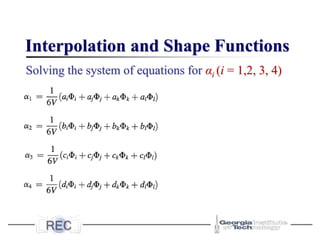
Solving the system of equations for αi (i = 1,2, 3, 4)
Interpolation and Shape Functions
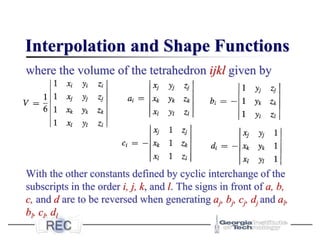
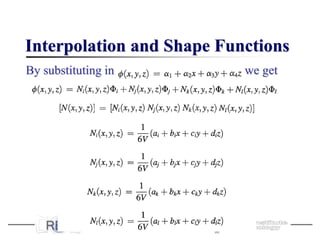
where the volume of the tetrahedron ijkl given by
With the other constants defined by cyclic interchange of the
subscripts in the order i, j, k, and l. The signs in front of a, b,
c, and d are to be reversed when generating aj, bj, cj, dj and al,
bl, cl, dl
Interpolation and Shape Functions
By substituting in we get
Interpolation and Shape Functions
B. Quadratic Interpolation
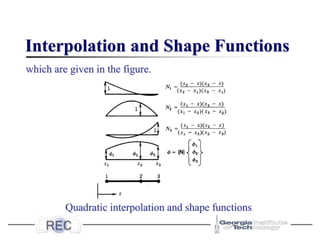
1. One-dimensional. Quadratic interpolation fits a parabola to
the points (x1, ϕ1), (x2, ϕ2), and (x3, ϕ3). These points need not
be equidistant. Matrix [x] = [1 x x2] and
This equation yields the shape
functions
]
[
]
][
[
]
[ 3
2
1
1
N
N
N
A
x
N =
= −
 
1 1
2 2
3 3
a
A a
a



   
   
=
   
   
   
Interpolation and Shape Functions
which are given in the figure.
Quadratic interpolation and shape functions
Interpolation and Shape Functions
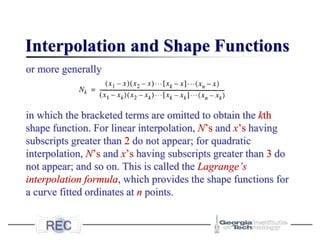
or more generally
in which the bracketed terms are omitted to obtain the kth
shape function. For linear interpolation, N’s and x’s having
subscripts greater than 2 do not appear; for quadratic
interpolation, N’s and x’s having subscripts greater than 3 do
not appear; and so on. This is called the Lagrange’s
interpolation formula, which provides the shape functions for
a curve fitted ordinates at n points.
Interpolation and Shape Functions
The foregoing shape functions have the following
characteristics:
◼ All shape functions Ni , along with function ϕ itself, are
polynomial of the same degree.
◼ For any shape function Ni , Ni = 1 when x = xi and Ni = 0
when x = xj for any integer j ≠ i. That is Ni is unity at its own
node but is zero at other nodes.
◼ C 0 shape functions sum to unity; that is, ∑ Ni = 1. This
conclusion is implied by ϕ = [N]{ϕe}, because we must obtain
ϕ = 1when {ϕe} is a column of 1’s.
Interpolation and Shape Functions
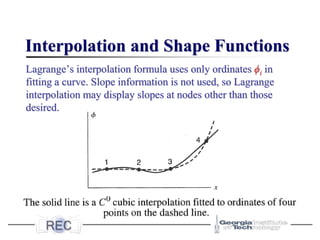
Lagrange’s interpolation formula uses only ordinates ϕi in
fitting a curve. Slope information is not used, so Lagrange
interpolation may display slopes at nodes other than those
desired.
Interpolation and Shape Functions
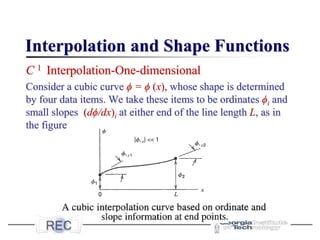
C 1 Interpolation-One-dimensional
Consider a cubic curve ϕ = ϕ (x), whose shape is determined
by four data items. We take these items to be ordinates ϕi and
small slopes (dϕ/dx)i at either end of the line length L, as in
the figure
Interpolation and Shape Functions
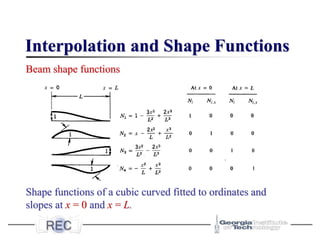
Now [x] = [1 x x2 x3], and upon evaluating ϕ and ϕ ,x at x
= 0 and x = L, the equation {ϕ e} = [A]{a} becomes
The obtained shape function are nothing but the four lateral
displacements and rotations of beam nodes.
 
1 1
, 1 2
2 3
, 2 4
x
x
a
a
A
a
a




   
   
   
=
   
   
   
 
 
Interpolation and Shape Functions
Beam shape functions
Shape functions of a cubic curved fitted to ordinates and
slopes at x = 0 and x = L.
Interpolation and Shape Functions
2-D and 3-D Interpolation
In two-or-three-dimensional problems, two or three
independent variables are needed. These interpolations are
extensions of one-dimensional interpolations. When there are
two or three dependent variables, such as displacements in 2-
D or 3-D problems, usually all components are interpolated
using the same shape functions.

FEM--Lecture 5 CEE6504-Interpolation.pdf

  • 1.
  • 2.
    Interpolation and ShapeFunctions Interpolation To interpolate is to device a continuous function that satisfies prescribed conditions at a finite number of points. In FEA, the interpolating function is almost always a polynomial which provides a single-valued and continuous field.
  • 3.
    Interpolation and ShapeFunctions In terms of generalized DOF ai , an interpolating polynomial with dependent variable ϕ and independent variable x can be written in the form: ai : generalized DOF x : independent variable ϕ : dependent variable 2 1 2 3 ( ) n m x a a x a x a x  = + + + +
  • 4.
    Interpolation and ShapeFunctions or The ai can be expressed in terms of nodal values of  at known values of x. The relation between nodal values of {ϕe }and ai is given as } ]{ [ a x =  ] 1 [ ] [ 2 n x x x x  = 1 2 3 { } [ ] T m a a a a a = } ]{ [ } { a A e = 
  • 5.
    Interpolation and ShapeFunctions 2 1 1 1 1 1 2 2 2 2 2 2 2 3 3 3 3 3 2 1 1 { } 1 1 n n n e n m m m m m a x x x a x x x a x x x a x x x                              = =                             } ]{ [ } { a A e = 
  • 6.
    Interpolation and ShapeFunctions Recalling } { ] [ } { 1 e A a  − = } { ] ][ [ 1 e A x   − = } ]{ [ e N   = } ]{ [ } { a A e =  } ]{ [ a x = 
  • 7.
    Interpolation and ShapeFunctions And 𝑁 = 𝑥 𝐴 −1 = 𝑁1 𝑁2 𝑁3 ⋯ 𝑁𝑚 An individual Ni in matrix [N] is called a shape function. The name basis function sometimes used instead. } ]{ [ e N   =
  • 8.
    Interpolation and ShapeFunctions In General If a polynomial type of variation is assumed for the field variable ϕ (x) in one-dimensional element, ϕ (x) can be expressed as 2 1 2 3 ( ) n m x a a x a x a x  = + + + +
  • 9.
    Interpolation and ShapeFunctions Similarly, in two – and three-dimensional finite elements the polynomial form of interpolation functions can be expressed as 2 2 1 2 3 4 5 6 ( , ) n m x y a a x a y a x a y a xy a y  = + + + + + + 2 2 2 1 2 3 4 5 6 7 8 9 10 ( , , ) n m x y z a a x a y a z a x a y a z a xy a yz a zx a z  = + + + + + + + + + +
  • 10.
    Interpolation and ShapeFunctions Where a1, a1, …., am are the coefficients of the polynomial; n is the degree of the polynomial; and the number of the polynomial coefficients is given by for one-dimensional elements 1 m n = + 1 1 for two-dimensional elements n j m j + = =  1 1 for three-dimensional elements ( 2 ) n j m j n j + = = + − 
  • 11.
    Interpolation and ShapeFunctions In most practical applications, the order of the polynomial in the interpolation functions is taken as one, two, or three. For n = 1 (linear model) One-dimensional Two-dimensional Three-dimensional 1 2 ( ) x a a x  = + 1 2 3 ( , ) x y a a x a y  = + + 1 2 3 4 ( , , ) x y z a a x a y a z  = + + +
  • 12.
    Interpolation and ShapeFunctions For n = 2 (quadratic model) One-dimensional Two-dimensional Three-dimensional 2 1 2 3 ( ) x a a x a x  = + + 2 2 1 2 3 4 5 6 ( , ) x y a a x a y a x a y a xy  = + + + + + 2 2 2 1 2 3 4 5 6 7 8 9 10 ( , , ) x y z a a x a y a z a x a y a z a xy a yz a zx  = + + + + + + + + +
  • 13.
    Interpolation and ShapeFunctions For n = 3 (cubic model) One-dimensional Two-dimensional 2 3 1 2 3 4 ( ) x a a x a x a x  = + + + 2 2 1 2 3 4 5 6 3 3 2 2 7 8 9 10 ( , ) x y a a x a y a x a y a xy a x a y a x y a xy  = + + + + + + + + +
  • 14.
    Interpolation and ShapeFunctions For n = 3 (cubic model) Three-dimensional 2 2 2 1 2 3 4 5 6 7 3 3 3 8 9 10 11 12 13 2 2 2 2 14 15 16 17 2 2 18 19 20 ( , , ) x y z a a x a y a z a x a y a z a xy a yz a zx a x a y a z a x y a x z a y x a y z a z x a z y a x  = + + + + + + + + + + + + + + + + + + + yz
  • 15.
    Interpolation and ShapeFunctions Pascal Triangle – complete polynomials in 2 D
  • 16.
    Interpolation and ShapeFunctions Pascal Tetrahedron– complete polynomials in 3 D
  • 17.
    Interpolation and ShapeFunctions Degree of Continuity Field quantity ϕ is interpolated in piecewise fashion over each element. So while ϕ can be guaranteed to vary smoothly within each element, the transition between elements may not be smooth. The symbol Cm is used to describe the continuity of a piecewise field between elements. A field is Cm continuous if its derivatives up to and including degree m are inter-element continuous.
  • 18.
    Interpolation and ShapeFunctions Thus, in one dimension, ϕ = ϕ (x) is C 0 continuous if ϕ is continuous but ϕ ,x is not, and ϕ = ϕ (x) is C 1 continuous if both ϕ and ϕ ,x are continuous but ϕ ,xx is not.
  • 19.
    Interpolation and ShapeFunctions The Cm terminology is also applied to element types. For example, the bar element and the beam element are called “C 0 element” and “C 1 element”, respectively. Usually, C 0 elements are used to model plane and solid bodies. C 1 elements are used to model beams, plates and shells, thus providing inter-element continuity of the slope.
  • 20.
    Interpolation and ShapeFunctions Convergence Requirements Since the finite element method is a numerical technique, we obtain a sequence of approximate solutions as the element size is reduced successively. This sequence will converge to exact solution if the interpolation polynomial satisfies the following requirements:
  • 21.
    Interpolation and ShapeFunctions Convergence Requirements 1. The field variable must be continuous within the element. 2. All uniform states of the field variable ϕ and its partial derivatives up to the highest order appearing in the functional I(ϕ) must have representation in the interpolation polynomial when, in the limit, the element size reduces to zero. Rigid body (zero strain) and constant strain states of the element. 𝐼 𝜙 = න 𝑎 𝑏 𝐹(𝑥, 𝜙, 𝜙′ )𝑑𝑥
  • 22.
    Interpolation and ShapeFunctions Convergence Requirements 3. The field variable ϕ and its partial derivative up to one order less the highest order derivative appearing in the functional I(ϕ) must be continuous at the element boundaries or interfaces.
  • 23.
    Interpolation and ShapeFunctions Convergence Requirements The elements whose interpolation polynomials satisfy 1 and 3 are called compatible or conforming elements and those satisfying 2 are called complete. If the r-th derivative of the field variable ϕ is continuous, then ϕ is said to have C r continuity. In terms of notation, the completeness requirement implies that ϕ must have C r continuity within the element, whereas the compatibility requirement implies that ϕ must have C r-1 continuity at element interface.
  • 24.
    Interpolation and ShapeFunctions A. Linear Interpolation 1. One-dimensional In FEA, with ϕ = u, the displacement field in the linear case can be given as or the displacement field can be given in the form         = 2 1 2 1 ] [    N N         = 2 1 2 1 ] [ u u N N u
  • 25.
    Interpolation and ShapeFunctions We begin with linear interpolation between points (x1, ϕ1) and (x2, ϕ2) for which [x] = [1 x]. Evaluating at points 1 and 2, we obtain Inverting [A] and using we obtain ] [ ] ][ [ ] [ 2 1 1 N N A x N = = −   1 1 2 2 a A a       =        
  • 26.
    Interpolation and ShapeFunctions The two shape functions are shown in the figure Linear interpolation and shape functions
  • 27.
    Interpolation and ShapeFunctions A. Linear Interpolation 2. Two-dimensional (linear triangle-Constant-Strain Triangle (CST). A linear triangle is a plane triangle whose field quantity varies linearly with Cartesian coordinates x and y. In stress analysis, a linear displacement field produces a constant strain field, so the element may be called a Constant-Strain Triangle (CST).
  • 28.
    Interpolation and ShapeFunctions The two-dimensional element is a straight-sided triangle with three nodes, one at each corner, as indicated in the figure. Let the nodes be labeled i, j, and k by proceeding counterclockwise from i, which arbitrarily specified. Let the global coordinates of nodes i, j, and k be given by (xi, yi), (xj, yj), and (xk, yk) and nodal values of the field variable ϕ (x, y) by ϕ i , ϕ j , ϕ k respectively. The variation of ϕ inside the element is assumed to be linear as
  • 29.
    Interpolation and ShapeFunctions The nodal conditions Two-dimensional element
  • 30.
    Interpolation and ShapeFunctions Lead to the system of equations The solution of this system yields
  • 31.
    Interpolation and ShapeFunctions where A is the area of the triangle ijk given by and
  • 32.
    Interpolation and ShapeFunctions Substituting the values of α1, α2, and α3 in the field variable ϕ (x, y) and rearrange yields the equation Where
  • 33.
    Interpolation and ShapeFunctions Stress analysis Element The DOF’s at each node for this element are u and v. The same linear interpolation is used for both dependent variables. CST element for 2-D stress analysis           = 3 2 1 ] 1 [ a a a y x u           = 6 5 4 ] 1 [ a a a y x v
  • 34.
    Interpolation and ShapeFunctions Stress analysis Element        2 1 2 1 2 1 2 2 2 2 1 2 2 1 2 2 ( , ) ( , ) ( , ) ( , ) ( , ) ( , ) ( , ) ( , ) ( , ) ( , ) ( , ) ( , ) ( , ) 0 ( , ) 0 ( , ) 0 ( , ) 0 ( , ) 0 ( , ) 0 ( , ) i i j j k k i i j j k k i j k i j k T i i j j k u x y N x y N x y N x y v x y N x y N x y N x y u x y x y N x y v x y N x y N x y N x y N x y N x y N x y N x y               − − − − − = + + = + +   = =       =     = 1 2k  −    
  • 35.
    Interpolation and ShapeFunctions A. Linear Interpolation 3. Three-dimensional Element The three-dimensional element is a flat-faced tetrahedron with four nodes, one at each corner, as shown in the figure. Let the nodes be labeled as i, j, k, and l, where i, j, and k are labeled in a counterclockwise sequence on any face as viewed from the vertex opposite this face, which is labeled as l.
  • 36.
    Interpolation and ShapeFunctions Three-dimensional Element Let nodal values of the field variable ϕ (x, y, z) be Φi , Φ j , Φ k and Φ l and the global coordinates be (xi, yi, zi), (xj, yj, zj), (xk, yk, zk) and (xl, yl, zL) at nodes i, j, k, and l, respectively. The variation of ϕ (x, y, z) inside the element is assumed to be linear as
  • 37.
    Interpolation and ShapeFunctions The nodal conditions lead to the system of equations Three-dimensional Element
  • 38.
    Interpolation and ShapeFunctions Solving the system of equations for αi (i = 1,2, 3, 4)
  • 39.
    Interpolation and ShapeFunctions where the volume of the tetrahedron ijkl given by With the other constants defined by cyclic interchange of the subscripts in the order i, j, k, and l. The signs in front of a, b, c, and d are to be reversed when generating aj, bj, cj, dj and al, bl, cl, dl
  • 40.
    Interpolation and ShapeFunctions By substituting in we get
  • 41.
    Interpolation and ShapeFunctions B. Quadratic Interpolation 1. One-dimensional. Quadratic interpolation fits a parabola to the points (x1, ϕ1), (x2, ϕ2), and (x3, ϕ3). These points need not be equidistant. Matrix [x] = [1 x x2] and This equation yields the shape functions ] [ ] ][ [ ] [ 3 2 1 1 N N N A x N = = −   1 1 2 2 3 3 a A a a            =            
  • 42.
    Interpolation and ShapeFunctions which are given in the figure. Quadratic interpolation and shape functions
  • 43.
    Interpolation and ShapeFunctions or more generally in which the bracketed terms are omitted to obtain the kth shape function. For linear interpolation, N’s and x’s having subscripts greater than 2 do not appear; for quadratic interpolation, N’s and x’s having subscripts greater than 3 do not appear; and so on. This is called the Lagrange’s interpolation formula, which provides the shape functions for a curve fitted ordinates at n points.
  • 44.
    Interpolation and ShapeFunctions The foregoing shape functions have the following characteristics: ◼ All shape functions Ni , along with function ϕ itself, are polynomial of the same degree. ◼ For any shape function Ni , Ni = 1 when x = xi and Ni = 0 when x = xj for any integer j ≠ i. That is Ni is unity at its own node but is zero at other nodes. ◼ C 0 shape functions sum to unity; that is, ∑ Ni = 1. This conclusion is implied by ϕ = [N]{ϕe}, because we must obtain ϕ = 1when {ϕe} is a column of 1’s.
  • 45.
    Interpolation and ShapeFunctions Lagrange’s interpolation formula uses only ordinates ϕi in fitting a curve. Slope information is not used, so Lagrange interpolation may display slopes at nodes other than those desired.
  • 46.
    Interpolation and ShapeFunctions C 1 Interpolation-One-dimensional Consider a cubic curve ϕ = ϕ (x), whose shape is determined by four data items. We take these items to be ordinates ϕi and small slopes (dϕ/dx)i at either end of the line length L, as in the figure
  • 47.
    Interpolation and ShapeFunctions Now [x] = [1 x x2 x3], and upon evaluating ϕ and ϕ ,x at x = 0 and x = L, the equation {ϕ e} = [A]{a} becomes The obtained shape function are nothing but the four lateral displacements and rotations of beam nodes.   1 1 , 1 2 2 3 , 2 4 x x a a A a a                 =                
  • 48.
    Interpolation and ShapeFunctions Beam shape functions Shape functions of a cubic curved fitted to ordinates and slopes at x = 0 and x = L.
  • 49.
    Interpolation and ShapeFunctions 2-D and 3-D Interpolation In two-or-three-dimensional problems, two or three independent variables are needed. These interpolations are extensions of one-dimensional interpolations. When there are two or three dependent variables, such as displacements in 2- D or 3-D problems, usually all components are interpolated using the same shape functions.