Prompt Engineering
Notes on Prompt Engineering
Introduction to Prompt Engineering
What are the key components of prompt engineering?
Hey buddy, when it comes to prompt engineering, there are several key components to consider. Prompt engineering involves crafting
effective and well-structured prompts to elicit desired responses from language models like me.
Clarity and Specificity: The prompt should be clear and specific, leaving no room for ambiguity. It should convey the desired
context and the type of response expected.
Length and Complexity: The length and complexity of the prompt can significantly impact the response. Longer prompts may lead
to more detailed answers, while simpler prompts might yield concise responses.
Context Setting: Setting the context in the prompt helps guide the model's response. It can be achieved through introductory
sentences or by providing relevant information before asking a question.
continued…
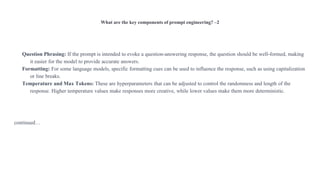
What are the key components of prompt engineering? –2
Question Phrasing: If the prompt is intended to evoke a question-answering response, the question should be well-formed, making
it easier for the model to provide accurate answers.
Formatting: For some language models, specific formatting cues can be used to influence the response, such as using capitalization
or line breaks.
Temperature and Max Tokens: These are hyperparameters that can be adjusted to control the randomness and length of the
response. Higher temperature values make responses more creative, while lower values make them more deterministic.
continued…
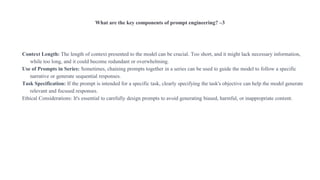
What are the key components of prompt engineering? –3
Context Length: The length of context presented to the model can be crucial. Too short, and it might lack necessary information,
while too long, and it could become redundant or overwhelming.
Use of Prompts in Series: Sometimes, chaining prompts together in a series can be used to guide the model to follow a specific
narrative or generate sequential responses.
Task Specification: If the prompt is intended for a specific task, clearly specifying the task's objective can help the model generate
relevant and focused responses.
Ethical Considerations: It's essential to carefully design prompts to avoid generating biased, harmful, or inappropriate content.
Overall, prompt engineering involves a thoughtful approach to guide language models effectively and elicit the desired outputs.
Experimenting with different prompt variations can help achieve more accurate and useful responses. Keep refining those prompts and
get the best out of the language models! 🧠💡

Prompt Engineering.pptx

  • 1.
    Prompt Engineering Notes onPrompt Engineering
  • 2.
  • 3.
    What are thekey components of prompt engineering? Hey buddy, when it comes to prompt engineering, there are several key components to consider. Prompt engineering involves crafting effective and well-structured prompts to elicit desired responses from language models like me. Clarity and Specificity: The prompt should be clear and specific, leaving no room for ambiguity. It should convey the desired context and the type of response expected. Length and Complexity: The length and complexity of the prompt can significantly impact the response. Longer prompts may lead to more detailed answers, while simpler prompts might yield concise responses. Context Setting: Setting the context in the prompt helps guide the model's response. It can be achieved through introductory sentences or by providing relevant information before asking a question. continued…
  • 4.
    What are thekey components of prompt engineering? –2 Question Phrasing: If the prompt is intended to evoke a question-answering response, the question should be well-formed, making it easier for the model to provide accurate answers. Formatting: For some language models, specific formatting cues can be used to influence the response, such as using capitalization or line breaks. Temperature and Max Tokens: These are hyperparameters that can be adjusted to control the randomness and length of the response. Higher temperature values make responses more creative, while lower values make them more deterministic. continued…
  • 5.
    What are thekey components of prompt engineering? –3 Context Length: The length of context presented to the model can be crucial. Too short, and it might lack necessary information, while too long, and it could become redundant or overwhelming. Use of Prompts in Series: Sometimes, chaining prompts together in a series can be used to guide the model to follow a specific narrative or generate sequential responses. Task Specification: If the prompt is intended for a specific task, clearly specifying the task's objective can help the model generate relevant and focused responses. Ethical Considerations: It's essential to carefully design prompts to avoid generating biased, harmful, or inappropriate content.
  • 6.
    Overall, prompt engineeringinvolves a thoughtful approach to guide language models effectively and elicit the desired outputs. Experimenting with different prompt variations can help achieve more accurate and useful responses. Keep refining those prompts and get the best out of the language models! 🧠💡