Computational Thinking (MIT Press Essential Knowledge series) Peter J. Denning
Computational Thinking (MIT Press Essential Knowledge series) Peter J. Denning
Computational Thinking (MIT Press Essential Knowledge series) Peter J. Denning
Computational Thinking (MIT Press Essential Knowledge series) Peter J. Denning
Computational Thinking (MIT Press Essential Knowledge series) Peter J. Denning
1.
Computational Thinking (MITPress Essential
Knowledge series) Peter J. Denning install
download
https://ebookmeta.com/product/computational-thinking-mit-press-
essential-knowledge-series-peter-j-denning/
Download more ebook from https://ebookmeta.com
Series Foreword vii
Prefaceix
Acknowledgments xvii
1 What Is Computational Thinking? 1
2 Computational Methods 23
3 Computing Machines 45
4 Computer Science 71
5 Software Engineering 95
6 Designing for Humans 127
7 Computational Science 149
8 Teaching Computational Thinking for All 175
9 Future Computation 193
Epilogue: Lessons Learned 213
Glossary 219
Notes 227
References and Further Reading 231
Index 237
CONTENTS
10.
The MIT PressEssential Knowledge series offers acces-
sible, concise, beautifully produced pocket-
size books on
topics of current interest. Written by leading thinkers, the
books in this series deliver expert overviews of subjects
that range from the cultural and the historical to the sci-
entific and the technical.
In today’s era of instant information gratification, we
have ready access to opinions, rationalizations, and super-
ficial descriptions. Much harder to come by is the founda-
tional knowledge that informs a principled understanding
of the world. Essential Knowledge books fill that need.
Synthesizing specialized subject matter for nonspecialists
and engaging critical topics through fundamentals, each
of these compact volumes offers readers a point of access
to complex ideas.
Bruce Tidor
Professor of Biological Engineering and Computer Science
Massachusetts Institute of Technology
SERIES FOREWORD
12.
A computer revolutionis in full swing. The invasion of
computing into every part of our lives has brought enor-
mous benefits including email, internet, World Wide Web,
Amazon’s e-commerce, Kahn Academy, Uber’s taxi hailing,
Google’s maps, trip navigators, smartphones, real-
time
translators, and apps by the millions. At the same time
it has also brought enormous concerns including possible
loss of jobs to automation, mass surveillance, collapse of
critical infrastructure, cyber war, mass sales of personal
data, invasions of advertising, loss of privacy, polarization
of politics, loss of civility and respectful listening, and ex-
acerbated income inequality.
A lot of people are having trouble coming to grips with
all this. Can they reap the benefits without the downside
costs? Can they lead a meaningful life if computerization
suddenly threatens to obsolete a lifetime of learning?
What should their children learn about computing to en-
able them to move and prosper in the new world?
Computational thinking is a new term that has re-
cently entered public discourse as people struggle with
these questions. It holds the hope that we can think clearly
aboutthepowersanddangersofmasscomputing,andthat
we can learn to design computers, software, and networks
to maximize the benefits and minimize the risks. Parents
PREFACE
13.
x PREFACE
are already amazedat how facile their children seem to be
in the digital world. Is computational thinking the recipe
for giving our children a proper education in this world?
We designed this book to be an edifying conversation
to help you understand what computational thinking is so
that you will be in a better position to answer these ques-
tions for yourself.
The first thing to understand is that a substantial part
of daily discourse is shaped by the wide adoption of com-
puters. This is nothing new; our ancestors’ ways of think-
ing about the world were shaped by the technologies of
previous revolutions. In the industrial age, for example,
people regularly used expressions like
“He blew a gasket,”
“I’m humming on all pistons,”
“It’s a high pressure environment,” and
“I had to blow off steam.”
Today we hear expressions like
“My DNA programs me to do it this way,”
“Our laws are algorithms for running our society,”
“My brain is hardware and my mind software,” and
“My brain crashed, I need to reboot.”
Just as in the industrial age, the new idioms of the com-
puter age reveal more about our popular culture than they
do about the technology.
Like the Greek god Janus, computational thinking has
two faces, one that looks behind and explains all that has
14.
PREFACE xi
happened, andone that looks ahead to what can be de-
signed. We invoke both faces when we want to get comput-
ers to do jobs for us. On the back-
facing side, we need to
understand the mechanics of how computers work, how
they are controlled by algorithms, how we can express
algorithms in a programming language, and how we can
combine many software modules into working systems.
On the forward-
facing side, we need sensibilities to un-
derstand the context in which users of our software are
working. We want our software to be valuable to them and
not to cause harm to them or their environment. Thus,
computational thinking guides us to understand the tech-
nology available to us and to design software to do a job or
solve a problem.
Computational thinking is not only something pro-
grammers must know, but it is also a thinking tool for
understanding our technology-
infused social world. It in-
creases our awareness of how our everyday digital tools
work, grounds our cyber ethics, and improves our resil-
ience against various threats such as algorithm-
driven at-
temptstoguideourbehavior,personallytailoredfakenews,
viral powers of social media, and massive, data-
intensive
analysis of our movements. What is more, computational
thinking has irrevocably changed the tools, methods, and
epistemology of science. Learning CT has many benefits
beyond programming.
15.
xii PREFACE
If you tryto understand what computational thinking
is from media accounts, you will hear a story of problem
solving with algorithms, along with the ability to think at
the many levels of abstraction needed to solve problems.
The story is flavored with images of joyous children having
fun programming and playing games in which they simu-
late algorithms. Indeed, our teachers have learned much
about computational thinking from teaching computing
to children, and they have developed superb ways of teach-
ing fundamental computing insights to newcomers. In
this book, we call this “CT for beginners.”
But the K–
12 education insights and debates barely
scratch the surface of computational thinking. At the
more advanced levels, computational thinking concerns
the design of hardware, networks, storage systems, oper-
ating systems, and the cloud. Its historical predecessors
have organized human teams to do large computations,
organized production lines in manufacturing, guided law-
makers, and specified the rules of bureaucracies. It has
developed styles attuned to major areas where comput-
ing plays a critical role, such as artificial intelligence, large
data analytics, software engineering, and computational
science. We will show you all this by examining the kinds
of computational thinking needed to deal with these dif-
ferent dimensions of computing. A much more advanced
kind of computational thinking is needed to deal with
these areas. We call it “CT for professionals.”
16.
PREFACE xiii
Computational thinkingis sometimes portrayed as
a universal approach to problem solving. Take a few pro-
gramming courses, the story in the popular media goes,
and you will be able to solve problems in any field. Would
that this were true! Your ability to solve a problem for
someone depends on your understanding of their con-
text in which the problem exists. For instance, you cannot
build simulations of aircraft in flight without under-
standing fluid dynamics. You cannot program searches
through genome databases without understanding the
biology of the genome and the methods of collecting
the data. Computational thinking is powerful, but not
universal.
Computational thinking illuminates a fundamental
difference in the ways that humans and machines process
information. Machines can process information at billions
or trillions of calculations per second, whereas humans do
well at one calculation per second. Machines process with
no understanding of the data they are processing, whereas
humans do and can correct errors on the fly. Machines can
transform a mistake in an algorithm into a costly disas-
ter before any human has a chance to react. Thinkers in
the philosophy of mind, neuropsychology, cognitive sci-
ence, and artificial intelligence have studied these differ-
ences and shown us how fundamentally dissimilar they
are. Although some human tasks like searching and sort-
ing can be eased by applying algorithms to them, most
17.
xiv PREFACE
computational thinking inthe big picture is concerned
with machine computation.
Think for a moment about the speed issue. A typi-
cal computer can, in 1 second, perform a billion calcula-
tions and draw a complex image on the screen. A human
would need 100 years to carry out the same steps at hu-
man speed. Humans obviously draw pictures much faster
than that, but machine designers have yet to imitate that
human capacity. If humans had no help from computers,
we would have no real time graphics. Nearly everything
we see software doing is made possible by the incredible
speeds of computers. These machines, not humans execut-
ing algorithms on their own, are the reason for the com-
puter revolution. Computing machines do the humanly
impossible.
While this may send a thrill up your neck, it ought
also to send a shiver down your spine. Modern aircraft are
controlled by networks of computers performing billions
of calculations per second. A mistake in an algorithm can
cause the control system to send the aircraft into a death
spiral long before the human pilot can react. Early Apollo
missions and more recent Mars missions were aborted
and lost due to errors in their software. Mistakes in algo-
rithms can be deadly and costly. How can we know that the
algorithms running critical systems can be trusted to work
properly, bringing benefits and low risk of harm? We need
clear thinking to help us find our way through this maze
18.
PREFACE xv
of complexity.This requires an advanced form of CT that
is not learned from children’s simulation games. “CT for
professionals” is deadly serious.
Our account of CT in this book encompasses all the fla-
vors of CT from beginners to professionals, and in major
subfields such as software engineering and computational
science. We aim to describe CT in all its richness, breadth,
and depth. We want to celebrate the work of expert profes-
sionalswhotakeonthehardchallengesofgettingcomplex
systems to perform reliably and safely, and the kinds of
thinking they bring that enables them to have achieved
such a good track record. We also want to celebrate the
work of expert educators who are working to ease the first
steps into computational thinking in K–12 schools and lay
the foundation to provide everyone the means for coping
in the digital world. Those two, basic CT for beginners and
advanced CT for professionals, work together to produce
a rich tapestry of computational thought.
Peter J. Denning
Salinas, California, August 2018
Matti Tedre
Joensuu, Finland, August 2018
20.
Peter: Many thanksto Dorothy Denning, my wife, who
listened to my many speeches about computing for nearly
50 years and kept me channeled in productive directions.
Much appreciation to my friend Fernando Flores, for
teaching me how to read history for the concerns that
emerge from it and thus discern different stages of com-
putational thinking over the centuries. To the founders of
computing and computing education whom I met through
ACM, including Eckert, Mauchly, Perlis, Newell, Simon,
Forsythe, Conte, Wilkes, Hamming, Knuth, and Dijkstra.
To my teachers at MIT who turned this electrical engi-
neer into one of the first holders of a computer science
degree, especially Fano, Corbato, Dennis, Saltzer, Scherr,
and Zadeh. To my many colleagues in computer science
and engineering over the years, too numerous to mention
by name here, who engaged me in edifying conversations
about computing.
Matti: I am grateful to all those who have helped me de-
velop my own computational thinking: my old teachers,
mentors, and past and present colleagues from all walks of
research. I feel privileged to have gained a wealth of com-
puting insights from working in universities in six coun-
tries on three continents. I am also thankful to my friends
ACKNOWLEDGMENTS
21.
xviii ACKNOWLEDGMENTS
and colleagues fromthe field of history and philosophy
of computer science—
too many to be listed here. I wish
to especially thank Maarten Bullynck, Edgar Daylight,
Liesbeth De Mol, Lauri Malmi, John Pajunen, Giuseppe
Primiero, and Simon (as well as ANR PROGRAMme ANR-
17-
CE38-
0003-
01 partners) for inspiring conversations,
feedback, and collaboration on material directly related to
this book. My work was partially supported by the Asso-
ciation of Finnish Non-
fiction Writers.
Acknowledgment of prior publishers: Parts of chapter 5
are adapted from the following sources: Great Principles of
Computing by Peter Denning and Craig Martell (MIT Press,
2015); “The Forgotten Engineer” by Peter Denning (Com-
munications of the ACM 60, 12 [December 2017]: 20–23),
and “Computing as Engineering” by Matti Tedre (Journal
of Universal Computer Science 15, 8: 1642–1658). Parts of
chapter 6 are adapted from: “Software Quality” by Peter
Denning (Communications of the ACM 59, 9 [September
2016]: 23–25; “Design Thinking” by Peter Denning (Com-
munications of the ACM 56, 12 [December 2013]: 29–31;
and Great Principles of Computing. Parts of chapter 7 have
been adapted from “Computational Thinking in Sci-
ence” by Peter Denning (American Scientist 105 [January–
February 2017): 13–17.
22.
1
WHAT IS COMPUTATIONAL
THINKING?
Analgorithm is a set of rules for getting a specific output
from a specific input. Each step must be so precisely
defined that it can be translated into computer language
and executed by machine.
—
Donald Knuth (1977)
What is a computer? Most people will answer it is an elec-
tronic black box that does amazing things by collecting,
storing, retrieving, and transforming data. Almost all
our devices and gadgets are computers: phones, tablets,
desktops, web pages, watches, navigators, thermometers,
medical devices, clocks, televisions, DVD players, WiFi
networks. Our services are software—
bookstores, retail
stores, banks, transportation, Uber, hotel reservations,
Airbnb, filmmaking, entertainment, Dropbox, online
courses, Google searches—
and almost all run by unseen
23.
2 chapter 1
computers acrossan unseen worldwide network called
“the cloud.” Computers have brought enormous benefits—
new jobs, access to information, economic development,
national defense, improvements in health, and much
more. They have brought, as well, worrying concerns—
job losses, globalization, privacy, surveillance, and more.
It looks like everything that can be digitized is being digi-
tized and computers are everywhere storing and trans-
forming that information. A computer revolution is truly
upon us.
How shall we think about all this? What do we need
to understand about computers? What must we do to put
a computer to work for us? How do computers shape the
way we see the world? What new do we see? What is the
role of programming? What are computers not good for?
The Power and Value of Computation
Computationalthinking(hereabbreviatedCT)offerssome
answers to these questions. Much of CT is specifically ori-
ented on figuring out how to get a computer to do a job for
us—how to control a complex electronic device to do a job
reliably without causing damage or harm. Algorithms are
the procedures that specify how the computer should do a
job. Although humans can carry out algorithms, they can-
not do so nearly as fast as a machine; modern computers
24.
What Is ComputationalThinking? 3
can do a trillion steps in the time it takes a human to do
one step. The magic is nothing more than a machine ex-
ecuting large numbers of very simple computations very
fast. Programs are the bridge: algorithms encoded in
special-
purpose languages that translate to machine in-
structions that control a computer.
But CT reaches further than automation. Information
and computational processes have become a way of under-
standing natural and social phenomena. Much of CT today
is oriented toward learning how the world works. A grow-
ing number of biologists, physicists, chemists, and other
scientists are looking at their subject matter through a
computational lens; professionals in the arts, humanities,
and social sciences are joining in. Computer simulation
enables previously impossible virtual experiments. The
“information interpretation” of the world offers concep-
tual and empirical tools that no other approach does.
CT also advises us about jobs that computers cannot
do in any reasonable amount of time. Or at all—some jobs
are impossible for computers. Many social, political, and
economic problems are beyond the pale of computers. By
understanding the limits of computing, we can avoid the
trap of looking to computing technology to solve such
problems.
Obviously, designing a program or a machine to do
so much in such a short time is a daunting design task
that demands its own way of thinking if we are to have
25.
4 chapter 1
any confidencethat the machine does the job without er-
ror. Indeed, understanding users, and designing systems
specifically for them, turns out to be one of the great chal-
lenges of modern computing. Design is one of the central
concerns of CT.
Defining Computational Thinking
Computational thinking has become a buzzword with a
multitude of definitions. We have distilled the spirit of the
multitude into this definition used throughout this book:
Computational thinking is the mental skills and prac-
tices for
• designing computations that get computers to do jobs
for us, and
• explaining and interpreting the world as a complex of
information processes.
The design aspect reflects the engineering tradition of
computing in which people build methods and machines
to help other people. The explanation aspect reflects the
science tradition of computing in which people seek to un-
derstand how computation works and how it shows up in
the world. Design features immersion in the community
26.
What Is ComputationalThinking? 5
being helped, explanation features being a dispassionate
external observer. In principle, it is possible to design
computations without explaining them, or explain com-
putations without designing them. In practice, these two
aspects go hand in hand.
Computations are complex series of numerical calcu-
lations and symbol manipulations. Examples of numeri-
cal calculations are the basic arithmetic operations (add,
subtract, multiply, divide) and the basic trigonometric
functions (sine, cosine, and tangent). Examples of sym-
bolic manipulations are logical comparison of numbers
or symbols, decisions of what instructions to do next, or
substitutions of one string of letters and numbers for an-
other. Amazing computations can be carried out when tril-
lions of such simple operations are arranged in the proper
order—
for example, forecasting tomorrow’s weather,
deciding where to drill for oil, designing the wings of an
aircraft with enough lift to fly, finding which physical
places are most likely to be visited by a person, calling
for a taxi, or figuring out which two people would make a
great couple.
Computers are agents that carry out the operations
of a computation. They follow programs of instructions
for doing arithmetic and logic operations. Computers can
be humans or machines. Humans can follow programs,
but are nowhere near as fast or as error-
free as machines.
27.
6 chapter 1
Machines canperform computational feats well beyond
human capabilities.
We use the word “job” to refer to any task that some-
one considers valuable. Today many people look to com-
puters (actually, computations performed by computers)
to get jobs done. They seek automation of jobs that could
not be done without the aid of a machine. Computers are
now getting good enough at some routine jobs so that loss
of employment to automation has become an important
social concern.
We do not equate “doing a job” with automation. Well-
defined, routine jobs can be automated, but ill-
defined
jobs such as “meeting a concern” cannot. CT can help with
jobs that cannot be automated. In the design chapter we
will discuss the kind of CT that does this.
There is clearly a special thinking skill required to
successfully design programs and machines capable of
enormous computations and to understand natural in-
formation processes through computation. This skill—
computational thinking, or CT—
is not a set of concepts
for programming. Instead, CT comprises ways of think-
ing and practicing that are sharpened and honed through
practice. CT is a very rich skill set: at the end of this chapter
we outline the six dimensions of computational thinking
that you will encounter in this book: machines, methods,
computing education, software engineering, design, and
computational science.
28.
What Is ComputationalThinking? 7
Wishful Thinking
In our enthusiasm for computational thinking, we need
to be careful to avoid wishful thinking. Perhaps the first
and most common wish is that we can get computers to
do any job we can conceive of. This wish cannot be real-
ized because there are many jobs that are impossible for
computers. For example, there is no algorithm that will
inspect another algorithm and tell us whether it termi-
nates or loops forever. Every programming student longs
for such an algorithm to help with debugging. It was logi-
cally impossible in 1936 when Alan Turing proved it so,
and it is still impossible today.
Even if we stick to logically possible jobs, there are
many that cannot be done in a reasonable time—
they are
intractable. One famous example is the traveling salesman
problem, which is to find the shortest tour on a map of
a country that visits each city just once. An algorithm to
compute this would be of great value in the package deliv-
ery industry. The simplest way to find the shortest tour
is to enumerate all possible tours and select the shortest.
For a small set of 100 cities, this would take 10130
years
on the world’s fastest supercomputer. For comparison
the age of the universe is on the order of 1010
years. Even
the “simplest way” can be impossible! Algorithms analysts
have identified thousands of common problems that are
intractable in this way.
29.
8 chapter 1
The picturegets even more confusing because in most
cases there are fast algorithms to find an approximate
answer. They are called heuristics. Take, for example, the
problem of finding the shortest tour connecting all 24,978
cities in Sweden. The enumeration algorithm for the trav-
eling salesman problem would take on the order of 10100,000
years! But in 2004 a team at the University of Waterloo
using heuristics for optimization found a shortest tour
and proved it to be correct. Their solution used 85 years
of processing time spread over a cluster of machines that
took several months to complete the job.
Computational thinkers need to develop enough ex-
perience and skill to know when jobs are impossible or
intractable, and look for good heuristics to solve them.
A second example of wishful thinking is to believe that
learning how to program in a computer science course or a
coding-
intensive workshop will enable you to solve prob-
lems in any field that uses computation. No, you will need
to learn something about the other field too. For example,
even if you have studied search algorithms in a program-
ming course, you are not likely to be able to be useful to a
genomics project until you have learned genome biology
and the significance of biological data.
A third example of wishful thinking is to believe that
computers are not essential to CT—
that we can think
about how to solve problems with algorithms and not be
concerned with the computers that run the algorithms.
30.
What Is ComputationalThinking? 9
But this is not so. When a computer does not have suf-
ficient memory to hold all your data, you will seek ways to
divide your problem into subsets that will fit. When a sin-
gle processor does not have sufficient processing power,
you will seek a computer with multiple parallel processors
and algorithms that divide the computation among them.
When the computer is too slow, you will look inside to
find a bottlenecked component and either upgrade it or
find a new algorithm that does not use that component.
Even if your computer has sufficient memory, adequate
processing power, and no bottlenecks, other aspects can
limit your problem-
solving progress, notably the speed of
the internal clock, which paces the machine to perform
computational steps in an orderly and predictable way.
But some new machines, notably quantum computers
and neural nets, have no clocks: How shall we think about
programming them?
A fourth example of wishful thinking is to believe
the computer is smart. If you are imprecise in translat-
ing human steps into program steps, your computation
will contain errors that could cause disasters. Computers
are incredibly dumb. They perform mindless, mechani-
cal steps extremely fast but they have no understanding
of what the steps mean. The only errors they can correct
are the ones you anticipate and provide with corrective
algorithms. You are the source of the intelligence; the
31.
10 chapter 1
computer amplifiesyour intelligence but has none of
its own.
We advise you to approach CT with humility. It is a
learned skill. Our brains do not naturally think compu-
tationally. Keep your perspective on the capabilities of
computers and algorithms to do jobs, on the need to learn
something about the application domain you want to de-
sign for, on the dependency of computation on computers,
and the abject lack of intelligence in the machine.
Emergence of CT over Millennia
It might seem that CT is a product of the electronic com-
puter age that began in the 1940s. Well, not really. Be-
fore the modern computer age there was a profession of
mathematically trained experts who performed complex
calculations as teams. They were called “computers.” They
were by no means the first: the term “computer,” mean-
ing “one who computes,” dates back to the early 1600s.
The first electronic computing machines were called au-
tomatic computers to distinguish them from the human
variety. Human computers and, even more so, the leaders
of human computing teams, obviously engaged in compu-
tational thinking. So, many aspects of CT existed before
electronic computers. Well before.
32.
What Is ComputationalThinking? 11
Primitive forms of CT as methods of calculation were
recorded from around 1800 to 1600 BCE among the Baby-
lonians, who wrote down general procedures for solving
mathematical problems. Their rule-
following procedures
have features that we, from today’s perspective, would la-
bel as forms of CT. Similarly, the Egyptian engineers who
built the pyramids beginning around 2700 BCE obviously
knew a lot about geometry and were able to calculate the
dimensions and angles of stones for each part of the pyra-
mid and of the leverage of ropes, pulleys, and rollers to
move the stones into position. Computing is an ancient
human practice.
Over the ages since ancient times, mathematicians
sought to spell out procedures for ever more advanced
calculations, moving beyond calculating merchant trans-
actions and the geometry of structures, to trigonometry,
astronomic predictions, celestial navigation, solving alge-
braic equations, and eventually computing with the cal-
culus of Newton and Leibniz. By formalizing computing
procedures, mathematicians made their expertise avail-
able to non-
experts who simply had to follow directions
of carrying out simple arithmetic operations in the proper
order. A special class of those directions is today called an
algorithm—akeyconceptinmoderncomputing.Theterm
“algorithm” comes to us from the Persian mathematician
Muhammad ibn Mūsā al-
Khwārizmī who, around 800 CE,
discussed how to formulate mathematical procedures and
33.
12 chapter 1
gave examplessuch as finding the greatest common divi-
sor of a set of numbers.
We humans have a penchant for automating routine
procedures. So it has been for computational procedures:
inventors sought machines that would automate compu-
tation for the purposes of greater speed and fewer errors.
Building machines to carry out these procedures turned
out to be much harder than specifying the procedures. Pas-
cal designed and built an arithmetic machine in the 1600s
that was able to add and subtract. It could multiply only in
the hands of a human operator who understood repeated
addition. It could not do division. Napier invented the log-
arithm, which became the principle of the slide rule—
an
aid for calculation that continued well into the second half
of the 1900s. It could not add or subtract. In 1819 Babbage
designed a machine of gears, shafts, and wheels that could
calculate tables of arithmetic numbers such as logarithms.
In the 1890 US census, Hollerith’s punched card machines
tabulated large amounts of data and, after its founding
in 1924, IBM became wealthy from selling tabulating ma-
chines. In the 1920s engineers designed analog computers
to calculate continuous functions by simulating them with
circuits and gears. Designers of mechanical analog and
digital computers were obviously computational thinkers.
But even the analog computer idea is ancient, dating back
to the Greek orrery, a mechanical device used to calculate
planetary positions in 100 BCE.
34.
What Is ComputationalThinking? 13
Computing throughout the ages required computa-
tional thinking to design computational procedures and
machines to automate them. The long quest for comput-
ing machines was driven not only by the need to speed
up computation, but to eliminate human errors, which
were common when easily bored or distracted humans
performed many repetitive calculations. The designers be-
lieved automated machines would overcome the sources
of error in calculations. Today we know better: while ma-
chines have eliminated some kinds of error, a whole ho-
rizon of new errors has appeared. Computing machines
have become so complex that we do not know how much
trust we can place on them.
Seeds of computational thinking advanced in sophis-
tication over those many centuries. But only when the
electronic computer became an industry in the 1950s did
computer designers and programmers find an impetus
to develop CT as a professional concern. These profession-
als gravitated to software because they could easily alter a
machine’s function by reprogramming the software. The
emerging computing industry sought programmers and
engineers schooled in computational thinking and prac-
tice. Educators inquired into how to teach them. The com-
puter science (CS) field that emerged by 1960 inherited
the responsibility for defining and teaching CT.
Throughout this book, we present many examples
from the history of computing to illustrate the needs to
35.
14 chapter 1
which CTresponded, the new possibilities for actions CT
enabled, and the dramatic mind shifts CT caused in how
we see automation, science, and the world. Although CT as
a way of thinking has existed for thousands of years, the
term “computational thinking” is relatively new: the first
occurrence we are aware of is from 1980.
Emergence of Education Movement for CT in
K–12 Schools
The first computer science (CS) department was founded
at Purdue in 1962. Academic computer science matured
along a bumpy and challenging path. Many universities
were initially skeptical whether the new field was really
new or scholarly enough; it looked rather like a branch of
electrical engineering or applied mathematics. Many com-
puter science departments were formed only after pitched
political battles in their universities. Despite the political
difficulties, the growth was steady. By 1980 there were
about 120 CS departments in the US alone. Today all ma-
jor and many smaller universities have one.
During the first 40 years, most of the concerns of
practitioners in computing were focused on getting the
technology to work. Everything we today consider a core
technology had to be invented, designed, tested, and
36.
What Is ComputationalThinking? 15
retested—
take, for example, programming languages, op-
erating systems, networks, graphics, databases, robotics,
and artificial intelligence. One of the central elements of
CT, designing reliable computing technologies, became a
standard during those times.
In the 1980s, computing experienced a dramatic
opening as scientists in all fields brought computation
and computational thinking into mainstream science. At
first, they used computation to simulate existing theo-
retical models or numerically tabulate and analyze data
from experiments. But they soon discovered that think-
ing in terms of computation opened a door to a whole
new way of organizing scientific investigation—
CT led
to Nobel Prizes for discoveries that had previously eluded
scientists. Many declared computation a third pillar of
science, alongside theory and experiment. CT was ex-
tended to designing computations throughout science,
especially in response to “grand challenge” questions
posed by leaders in the different fields. Every field of sci-
ence eventually declared it had a computational branch,
such as computational physics, bioinformatics, compu-
tational chemistry, digital humanities, or computational
sociology.
Computer scientists had mixed reactions to these
developments. Remembering their battle scars from
forming departments, some were quite sensitive to the
37.
16 chapter 1
public imageof computer science and wanted to con-
trol it. Some regarded the computational science move-
ment as a means to hijack computer science by scientists
who had previously expressed skepticism about computer
science. As a result, computer scientists had a strong mo-
tivation to help the public understand the technology
and theory of computing. Computer science educators
worked with K–
12 educators to define computer literacy
courses, but these were not very popular. Around the
year 2000 some educators proposed a more sophisticated
approach they called “fluency with information technol-
ogy”; high school teachers adopted a popular textbook in
that area. Even with the success of the fluency approach,
few high schools adopted a computer course. Com-
puter science educators continued to seek ways to pen-
etrate K–
12 school systems and expose every student to
computing.
A turning point came in 2006 when Jeannette Wing,
then starting as an assistant director at the US National
Science Foundation (NSF), reformulated the quest from
fluency to computational thinking. She proposed that CT
was a style of thinking that everyone needed to learn in
the computing age. At the NSF she mobilized significant
resources to train teachers, upgrade the Advanced Place-
ment test, design new “CS principles” first-
courses for
colleges, define CT for the K–
12 education sector, and is-
sue curriculum recommendations for K–
12 schools. This
38.
What Is ComputationalThinking? 17
“CS for all” movement has achieved much greater pen-
etration of computing into K–
12 schools than any of its
predecessors.
The definitions of CT that have emerged from the
post-
2006 CT movement have moved conspicuously into
the public view. But many public definitions, especially as
interpreted to us by policymakers, are quite narrow com-
pared to the notions of CT developed over the earlier cen-
turies of computing. Mainstream media occasionally give
a misinformed view of the scope and influence of com-
puting. They have led people unfamiliar with computing
to make inflated claims about the power of CT that will
mislead students and others into making promises about
computers they cannot deliver.
Our Objectives in This Book
Our objective in this book is to lay out the magnificent
fullness of computational thinking and its precepts about
computation and to dispel misunderstandings about the
strengths and limits of computing.
Computational thinking evolved from ancient origins
over 4,500 years ago to its present, highly developed, pro-
fessional state. The long quest for computing machines
throughout the ages was driven not only by the need to
speed up computation, but also to eliminate human errors,
39.
18 chapter 1
which werecommon when easily bored or distracted hu-
mans performed many repetitive calculations. A special
thinking skill evolved to accomplish this.
The development of computational thinking opened
six important dimensions that are characteristic of CT
today.
• Methods. Mathematicians and engineers developed
methods for computing and reasoning that non-
experts
could put to work simply by following directions.
• Machines. Inventors looked for machines to automate
computational procedures for the purpose of greater
speed of calculation and reduction of human errors
in carrying out computations. This led eventually to
the invention of the digital electronic computer that
harnesses the movement of electrons in circuits to carry
out computations.
• Computing Education. University educators formed
computer science to study and codify computation
and its ways of thinking and practicing for institutions,
businesses, science, and engineering.
• Software Engineering. Software developers formed
software engineering to overcome rampant problems
with errors and unreliability in software, especially
40.
What Is ComputationalThinking? 19
large software systems such as major applications and
operating systems.
• Design. Designers bring sensibilities and
responsiveness to concerns, interests, practices, and
history in user communities.
• Computational Science. Scientists formed computational
science to bring computing into science, not only to
support the traditions of theory and experiment, but also
to offer revolutionary new ways of interpreting natural
processes and conducting scientific investigations.
These six dimensions are like different windows look-
ing at CT. Each window offers a particular angle of looking.
Some aspects of CT may be visible through two windows,
but each in a different light.
In the next six chapters we will examine CT in relation
to each dimension above. We round out with a semifinal
chapter on CT in modern general education and a conclud-
ing chapter about the future of CT.
Chapter 2: CT related to algorithmic procedures to
automate processes
Chapter 3: CT related to computing machinery
Chapter 4: CT related to the theory of computing and
academic discipline
41.
20 chapter 1
Chapter 5:CT related to building large software systems
Chapter 6: CT related to designing for humans
Chapter 7: CT related to all the sciences
Chapter 8: Teaching CT for all
Chapter 9: The future of CT
We offer our stories of these dimensions to show you
the power of CT and the ways in which it might help you in
your work with computers and computation.
42.
Computational thinking
evolved fromancient
origins over 4,500 years
ago to its present, highly
developed, professional
state. The long quest for
computing machines
was driven not only by
the need for speed,
but also to eliminate
human errors.
44.
2
COMPUTATIONAL METHODS
If controversieswere to arise, there would be no more
need of disputation between two philosophers than
between two accountants. For it would suffice to take
their pencils in their hands, to sit down to their slates,
and to say to each other (with a friend as witness if they
liked): Let us calculate.
—
Leibniz, in Russell’s translation (1937)
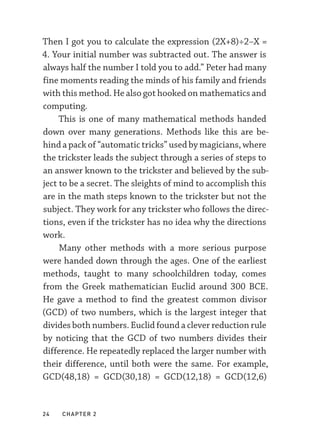
When Peter was age 10, his twinkly-
eyed math teacher
told him he could read minds. “How could you do that?”
Peter asked. The teacher said, “Here, I’ll show you. Think
of a number. Double it. Add 8. Divide by 2. Subtract your
original number. Now concentrate hard on the answer. ...
There, I see it. The answer is 4.” Peter was so astonished he
insisted that the teacher show him how to do this. “Well,”
said the teacher, “it’s just math. Let’s say X is your number.
45.
24 chapter 2
Then Igot you to calculate the expression (2X+8)÷2–
X =
4. Your initial number was subtracted out. The answer is
always half the number I told you to add.” Peter had many
fine moments reading the minds of his family and friends
with this method. He also got hooked on mathematics and
computing.
This is one of many mathematical methods handed
down over many generations. Methods like this are be-
hind a pack of “automatic tricks” used by magicians, where
the trickster leads the subject through a series of steps to
an answer known to the trickster and believed by the sub-
ject to be a secret. The sleights of mind to accomplish this
are in the math steps known to the trickster but not the
subject. They work for any trickster who follows the direc-
tions, even if the trickster has no idea why the directions
work.
Many other methods with a more serious purpose
were handed down through the ages. One of the earliest
methods, taught to many schoolchildren today, comes
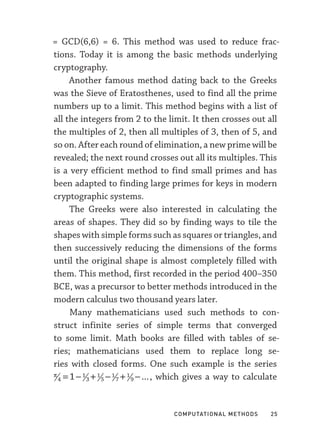
from the Greek mathematician Euclid around 300 BCE.
He gave a method to find the greatest common divisor
(GCD) of two numbers, which is the largest integer that
divides both numbers. Euclid found a clever reduction rule
by noticing that the GCD of two numbers divides their
difference. He repeatedly replaced the larger number with
their difference, until both were the same. For example,
GCD(48,18) = GCD(30,18) = GCD(12,18) = GCD(12,6)
46.
Computational Methods 25
=GCD(6,6) = 6. This method was used to reduce frac-
tions. Today it is among the basic methods underlying
cryptography.
Another famous method dating back to the Greeks
was the Sieve of Eratosthenes, used to find all the prime
numbers up to a limit. This method begins with a list of
all the integers from 2 to the limit. It then crosses out all
the multiples of 2, then all multiples of 3, then of 5, and
so on. After each round of elimination, a new prime will be
revealed; the next round crosses out all its multiples. This
is a very efficient method to find small primes and has
been adapted to finding large primes for keys in modern
cryptographic systems.
The Greeks were also interested in calculating the
areas of shapes. They did so by finding ways to tile the
shapes with simple forms such as squares or triangles, and
then successively reducing the dimensions of the forms
until the original shape is almost completely filled with
them. This method, first recorded in the period 400–
350
BCE, was a precursor to better methods introduced in the
modern calculus two thousand years later.
Many mathematicians used such methods to con-
struct infinite series of simple terms that converged
to some limit. Math books are filled with tables of se-
ries; mathematicians used them to replace long se-
ries with closed forms. One such example is the series
π
4
1
3
1
5
1
7
1
9
1
= − + − + − ..., which gives a way to calculate
toward the productionof good citizens and the development of a
feeling of respect and loyalty to the national government. It is true that
some of them have a standard which is not reached by the public
schools; such should not, of course, reduce their standard, but should
serve as a friendly example to the Government of what is reasonably
expected of schools of their grade. The proper treatment of this matter
calls for great tact and good spirit on both sides.
We have already called attention to the fact that in Vai and Mandingo
towns instruction is given to boys in Arabic and in the reading of the
Koran. These little village schools are interesting. The boys use smooth
boards with handles as slates; these are smeared over with a light
colored clay, and passages from the sacred writing are copied in black
upon the light surface; the little fellows are constantly drilled in reading
these passages aloud and in copying similar passages upon their
wooden tablets. Such schools as these form a nucleus which could be
utilized in the development of schools for broader instruction. We have
already called attention to the fact that the Vai have a phonetic system
of their own, developed among themselves. The ability to write and
read this phonetic script is rather widely spread, and when schools
come to be established in Vai towns this system might be widely utilized
for purposes of education.
Theoretically, and to some degree actually, Liberia College stands at
the summit of the Liberian system of education. It has had a checkered
history with ups and downs; most observers have been inclined to see
and emphasize the downs. In 1848 John Payne, of the Episcopal
mission, suggested to Simon Greenleaf, of Boston, that a school of
theology should be established in Liberia. Partly as the result of this
suggestion, in 1850 there was established in Massachusetts a Board of
Trustees of Donations for Education in Liberia. In 1851 the Liberian
legislature incorporated Liberia College, the outgrowth of the steps
already taken, although not in the exact direction suggested by John
Payne. In 1857 Ex-President J. J. Roberts was elected first president of
Liberia College, and superintended the erection of the building which
had been provided for. During the next few years further funds were
raised for the purpose of conducting the enterprise, and in 1861 the
endowment was vested in a Board of eighteen Trustees. In 1862 Liberia
College was opened for work. Since that time it has had a struggling
49.
existence, making periodicalappeals for financial assistance, receiving
donations of more or less magnitude, occasionally putting forth a spurt
of momentary vigor, then languishing almost to the point of death;
again and again this round of experiences has been run by the
institution. It is difficult to secure definite and connected information
regarding it; to prepare a fairly complete history would involve
considerable labor. It is interesting to notice that, among the expressed
purposes of the institution, was the providing of an opportunity for
American colored youth to receive an education, as they were then
debarred from educational institutions in our country. There were at
first three chairs in the institution:—Jurisprudence and International
Law, English Literature and Moral and Mental Philosophy, and the Fulton
Chair of Languages; in 1905 the faculty consisted of eight members,
including the president. In 1879 there was but a single teacher, who
was giving instruction in mathematics (to which chair he was originally
appointed) and also in languages. The largest donation at any time
received by the College was from Joseph Fulton, of New York, who left
$25,000, the income of which was to support the Fulton professor, who
was to be nominated by the New York Colonization Society; the Board
of Donations of Boston has had some $30,000 at interest for the benefit
of the institution; Albert Fearing at one time gave $5000 for library
purposes. In addition to these gifts and bequests from and in America
the institution has received and does receive some governmental aid;
1000 acres of land in each county have been set apart for its
advantage; certain sources of income are theoretically devoted to its
maintenance. At one time four scholarships had been established and
named; these scholarships were, the Gordon Memorial (in memory of
Midshipman Gordon, who died in 1822), the John Payne Scholarship,
the Simon Greenleaf Scholarship, and the George Briggs Scholarship. To
what degree these scholarships are still productive we do not know.
The institution had run down and was threatened with extinction when,
in 1898, under the national administration of President W. E. Coleman,
it received a new impulse, and in the year 1900 was re-organized. It is
unfortunate that the exact status of Liberia College is not more definite;
it is neither fish, flesh nor fowl; it is at once a private institution with a
directorate and management located across the seas, and a part of a
system of public education, receiving aid from national funds.
50.
Such is thecondition of education in the Republic. It leaves much to
be desired. Those who lead public thought are by no means ignorant of
its weak features; the national poverty, however, makes it difficult to
develop better things. If the nation is to advance, its education must be
greatly improved. This improvement must begin at the very foundation
with the primary public schools. These need reform in the matter of
buildings, equipment, and teachers’ salaries; if good teachers are to be
secured, and kept steadily at work to earn their salaries, they must be
promptly paid—prompt payment of any employees is a difficult matter
in Liberia. There should be a large increase in the number of public
schools; there are perhaps as many as are necessary within the civilized
settlements, but the native towns are almost without school
opportunities, except as these are offered by the missions. There is
crying need of the establishment of public schools in native towns. Such
should, however, be established only in towns where genuine promises
of self-support are given. There are, no doubt, many towns where, if
the matter were properly presented, the chiefs would readily build a
school-building, order the children to attend school, and support a
teacher. Such a teacher should be well acquainted with the native
tongue, and the bulk of the instruction should be given in it; to teach
elementary branches in a foreign language is poor policy; true, it has
been attempted—as on a wide scale in the Philippines, but mental and
moral imbecility are likely to be developed by such procedure; English
should be taught, but it should be taught as a subject in itself, and the
English language should not be used as the medium for conveying
elementary instruction in fundamental branches; after English has once
been learned, it is of course desirable to encourage the reading of
English books and the acquisition of general knowledge through such
reading. It will probably be suggested that it will be impossible to find
teachers acquainted with the native tongues and competent to teach
the various branches of primary education; such a difficulty ought not
to exist after nearly eighty years of mission schools which have by
preference sought to teach and raise the native population. It will be
claimed that such teachers in native towns will be in danger of relapse;
there is such danger, but it is far less than might be thought, provided
the Department of Public Instruction keeps in constant touch with such
teachers in native towns and properly emphasizes to the native chiefs
51.
the value ofschools and education. When we were in the Bassa
country, we found, at a native town quite in the interior, an intelligent
black man who spoke English well and who told us that he had been
sent out by the Lutheran mission at Muhlenburg to pick up and bring in
native boys for instruction at that famous school; he told us at that
time, that the chief of the village where we were, together with the
leading men, were very anxious that a local school should be
established in their midst, and promised land, a building, and
attendance. It would be easy if the matter were handled wisely, to
establish at once, in twenty native towns, carefully selected among the
different tribes, twenty local schools which would be supported with
considerable enthusiasm by the communities in which they were
situated. If the Government could at once equip these twenty schools
with good teachers who had graduated from the mission schools, there
would spring up a popular demand throughout the whole interior for
the establishment of village schools; it would be difficult to satisfy the
demand, but from the number of villages asking for the establishment
of schools, a reasonable number of the best might be selected, and the
work would grow. There would actually be little expense in such
development; if it is to be successful, and if it is worth while, it should
originate largely with the towns themselves, and every school should be
practically self-supporting. For a time of course there would be on the
part of chiefs a demand for some sort of bribe or “dash”; this ought to
be refused in every case.
To illustrate exactly what is meant, we quote a sample of the kind of
document which mission schools at one time regularly drew up with the
idea of getting children into school. It is presented in Hoyt’s Land of
Hope:—“Articles of agreement between Tweh, King of Dena, his head
men and people, and the Methodist Episcopal Mission:
Art. 1. The mission school is to have at all times at least ten boys;
and more if they should be wanted. Girls at all times are desirable.
Art. 2. The children of the school are at all times to be under the
entire control of Mr. Philip Gross and his successors in the teaching and
government of this station, without interruption on the part of their
parents or guardians until the time for which they are put in the mission
school shall have expired.
52.
Art. 3. Asgood substantial buildings may soon be required for
teachers to reside in, and more land will be constantly wanted for
manual labor purposes, the King, his head men and people, also agree
to protect the missionaries in occupying and using it, in the manner
they may think proper, without responsibility to any one beyond
themselves. The King, etc., agree to protect them in their persons and
property from either abuse or violence, and if anything is stolen from
them, the King, his head men and people, promise to see it returned or
paid for.
Art. 4. As long as the authorities of Dena continue to fulfill this
agreement, by giving the children for school instruction, and protecting
the mission and mission-premises from intrusion and disturbance, the
mission will give them annually, (about Christmas) one piece of blue
baft, two small kegs of powder, ten bars of tobacco, ten bars of pipes,
and fifty gun-flints; with the understanding, that this being done, they
are not to be teased for dash to any one.
Art. 5. But if the King and his head men fail to fulfill the conditions of
the above agreement, then they will be under no obligations as a
mission to give the above named articles.
Francis Burns, Preacher in Charge.
Philip Gross,
-
Tweh, his * mark,
Ney (his * mark), Toboto, his * mark,
John Banks, Twabo, his * mark,
Witnesses. Twaah, his * mark,
Ero-bawh, his * mark,
Nywah-wah, his * mark.”
Of course this document is many years old. No doubt, however, the
bad policy of paying chiefs for permission to establish schools in towns
and for children who shall receive instruction is continued by the
mission schools. Certainly, however, if the government develop its own
plans of dealing with native chiefs for the encouragement of trade, it
will be easy to do away with this idea of compensation for the tolerance
of schools. Such native village schools as we have recommended should
not attempt to do more than teach the elements of education; they
should correspond to the primary schools in the system of public
education for the nation; every teacher in charge of such schools
53.
should be expectedto encourage boys and girls of exceptional promise
and diligence, who do well in the village schools, to go up to the local
“feeder”.
When we were in Monrovia, we were asked more than once whether
it was best to remove Liberia College into the interior. It is the opinion
of many that such removal should take place. The answer to the
question depends entirely upon what is conceived to be the proper
function of Liberia College. If it is to be an institution of higher
education, if it is to aim at academic instruction and the development of
able men for the filling of public positions, for professional life, for
leadership, it would be a great mistake to move it. To remove such an
institution into the interior would make it difficult for students from the
settlements to attend the institution; if it were intended to meet the
needs of natives, its removal would sound the death knell of its hopes;
it could be located in the area of a single tribe only, and located in such
an area, it would receive the patronage of but a single tribe.
Recognizing the fact that the natives are actually tribesmen, if schools
of higher grade than primary village schools are to be developed, with
reference to them, there should be at least one school of higher
instruction in every tribal area; such schools should be of a grade
corresponding to our secondary or grammar schools. It is unlikely that
any one will, for many years, think of the establishment of such higher
schools in numbers sufficient for each tribal area to have one; while,
theoretically the idea may be attractive, practically it is out of question.
It would be entirely possible, however, for four good county schools of
grammar grade to be established—one in each county; these should be
in the country, not in the settlements. They should be open to both
natives and Liberians, but it is to be supposed that their attendance
would be largely, overwhelmingly indeed, native. These county schools
should be thoroughly practical—they should combine book-work and
manual-training; they should give instruction in trades and agriculture.
They should be as well equipped and as well managed as the resources
of the Republic will allow. They should be thorough and earnest, and
should not attempt to undertake more than the exact work here
suggested; they should be secondary—grammar—schools, and a part of
their aim should be to fully acquaint every student attending them with
the work and opportunities of the Higher Agricultural School, outside
54.
Monrovia, and LiberiaCollege at the capital. The teachers should not
attempt to force large numbers of their students to look for higher
education, but should make them thoroughly acquainted with the fact
that opportunities may be found in the Republic for it; the very few
students of real promise, who desire education of higher grade, the
teachers should encourage and direct toward the Higher Agricultural
School and Liberia College; certainly the larger number of the boys
should be directed toward the former—a select few of special promise
in the direction of leadership, toward the latter.
For the general uplift, there is no question that the most important
element in this scheme of education must be the Higher Agricultural
School. It should be situated upon an experimental farm; it should be
supplied with sufficient suitable buildings; it should combine literary and
manual instruction. It should carry boys far enough to infuse them with
ambition and vigor for an agricultural career. It should teach the
methods demanded by the peculiar surroundings. Tropical agriculture in
any country is still in its beginnings; scientific agriculture in Liberia is as
yet non-existent; as rapidly as possible, the school should, through
investigation and experiment, learn what is necessary for the locality. It
will start with the benefit of blind experiments conducted through a
period of almost a hundred years; it should, by twenty years of well-
directed effort, work out the fundamental principles of successful
agriculture. In such a school boys should be taught that hand labor is
respectable and necessary; they should be taught equally how to plan,
develop, and direct an enterprise. Coffee was at one time an important
article of shipment; Liberian coffee had an excellent reputation
throughout the world and commanded good prices; there were many
creditable plantations which brought in good returns to their
proprietors. Why has Liberian coffee ceased to pay? It is true that it has
had to meet keen competition from countries where labor was plenty
and under good control; it has had to meet in open market products
which had been raised through subsidies paid by nations far wealthier;
still, the chief reason why Liberian coffee no longer has the vogue
which it once had is because it was badly handled, badly packed, and
badly shipped. In the higher agricultural school one should be taught
not only how to establish coffee plantations, but how to properly treat,
prepare, and ship the produce. There was a time when many fields
55.
were planted withsugar-cane; there were many little local mills where
the cane was crushed and molasses and sugar made; to-day it may be
said that there is no cane industry in the Republic. Has the demand for
sugar ceased? Has the soil lost the capacity of growing cane? Is not the
decline in this industry due to time-losing, crude, and imperfect
methods of production? Liberia seems well adapted to various domestic
animals. Goats and sheep—the latter covered with hair, not wool—are
seen on the streets of the national capital; when one gets back into the
interior, cattle are found in native towns and in the district about Cape
Palmas cattle are met with in the coast settlements. Yet fresh meat is
difficult to secure in Monrovia; why? In the Higher Agricultural School
definite investigation should be made of all native plant and animal
possibilities; there are no doubt many forms of plant life which could be
improved under proper cultivation and made to yield desirable materials
for commerce or for national use; it is quite possible that some of the
native animals could be utilized if kept and bred; it is certain that
harmful animals can be controlled or totally destroyed. The
experimental station in connection with the agricultural school should
deal with all these matters. Of plants and animals which flourish in our
own and other countries, some prosper and succeed on the west coast
of Africa—others fail; many experiments have already been made in
introducing plants and animals from the outside world into Liberia;
much, however, still remains to be done in studying the possibilities. It
is time that the experiments in this direction were wisely made by
competent and educated investigators and that the period of blind and
wasteful experimentation cease.
Liberia College, however, should remain at the capital city. It must be
strengthened and developed. It should be a college, and if at present
below grade—and it is below grade—it should be gradually worked up
to a high standard. The nation will always need a higher institution of
liberal culture; there is as much reason why there should be a genuine
college in the black Republic, as there was why there should be a
Harvard College in Massachusetts at the date of its foundation; in fact,
there is more need of a college for Liberia than there was in
Massachusetts for Harvard—Liberia has more serious and broader
problems to deal with than the old colony of Massachusetts; she is an
independent nation; she must have men competent by training to
56.
control the “shipof state” and to deal with the representatives of all the
civilized nations on the globe.
One can easily understand, and to a degree sympathize with, the
statement of Thomas in his little book upon West Africa, published a
half century ago. He wrote shortly after the college was established. He
says: “I regret to say that a college has been lately established in
Liberia, the presidency of which has been conferred on President
Roberts. I regret it, because it will involve an outlay that might be
better used for common schools. It will send out, for years at least,
men imperfectly learned, with the idea that they are scholars, and
create a false standard of education. The present state of society has
no demand for such a thing, the high schools already in operation being
sufficient to supply teachers and professional men, and these are
sufficiently patronized. A couple of manual labor schools somewhere in
the interior would be vastly more useful. These things—academies
dubbed colleges—are getting to be an evil among us in the states, and
we are sorry to see our ebony off-shoot copying any of our defects.” We
are all familiar with such criticisms and this line of argument, and of
course they contain a germ of truth. But every young and developing
community must have higher education, and we have indicated why the
necessity in Liberia is urgent. From her population must come
presidents, congressmen, cabinet officers of ability, diplomatic and
political officials, and nothing below a college can produce the desirable
supply.
In contrast to the statement of Mr. Thomas, we may quote two
passages from Dr. Blyden—himself a negro, a Liberian, an official in
Liberia College. At the dedication of the Institution, he said: “Why, then,
should not Liberia, after forty years’ existence, having secured the
confidence and respect of the aboriginal tribes, enjoy the means of
superior education? The name College applied to this institution may
seem ambitious; but it is not too early in our history to aim at such
institutions. Of course we cannot expect that it will at once fulfill all the
conditions of colleges in advanced countries, but it may come in time,
as many American colleges have done, to grow into an institution of
respectability and extensive usefulness.” Again, in the same address, he
says: “Every country has its peculiar and particular characteristics. So
has Liberia. From this fact, it has often been argued, that we need a
57.
peculiar kind ofeducation; not so much colleges and high schools as
other means which are more immediately and obviously connected with
our progress. But to this we reply, ‘If we are a part of the human family,
we have the same intellectual needs that other people have, and they
must be supplied by the same means.’ It shows a painful ignorance of
history, to consider the present state of things in Liberia as new and
unprecedented in such a sense as to render dispensable those more
important and fundamental means of improvement, which other
countries have enjoyed. Mind is everywhere the same; and everywhere
it receives character and formation from the same elemental principles.
If it has been properly formed and has received a substantial character,
it will work out its own calling, solve its own problems, achieve its own
destiny.”
In other words, it is the old question between Tuskegee and Atlanta.
In any broad and wise view both are equally essential.
Liberia College and the Higher Agricultural School will do more to
develop a national spirit among the natives of the interior than any
other single agency. From the native village schools boys will go out to
the county “feeder”; there their ambition is stimulated; they come into
contact with boys of other tribes; acquaintance and a generous and
proper rivalry develops between them; each boy will feel that the credit
and reputation of his people rests in him—he will feel that he is not
inferior—he will strive to hold his own in legitimate fields of rivalry; from
the county “feeder” the brightest, most ambitious, and best of the
scholars will go up to the College or Agricultural School, both of which
are national. There, in contact with the selected and best from every
part of the Republic, from Liberians and natives alike, the native boys
will come to know the national spirit; they will learn what Liberia
means, they will comprehend its plans and hopes; they will be prepared
to assist in its development and to protect its rights.
We have said that Liberia College would be national; it can not and
ought not to be hampered by denominational or even by religious
demands; it would be better if the College were absolutely under the
control of the national government; the double control works badly. It is
not absolutely essential that such should be the case; if the American
Board, or Boards, interested in it would wake up to the idea of the
great opportunity within their hands, they would be willing to co-
58.
operate heartily withthe local authorities to develop a really great
institution. The difficulty of distance of course would ever interfere with
prompt and harmonious action; ignorance of local conditions and of the
inherent difficulties is another bar to effective and prompt co-operation.
If the double control of the Institution is to continue, there should be a
carefully worked out agreement between the two governing bodies
which should leave very considerable power with the resident authority
to deal with serious problems as they may arise. If the double control
must continue, it is cryingly necessary that more vigorous and liberal
assistance should be rendered. To put the College into proper condition,
and develop its field of action, needs money, in considerable quantity,
much more than the government would be warranted in supplying for
some time to come. There are various things in connection with the
conduct of the College which are bad and need re-adjustment. Thus,
there is a vicious system of student assistance, which undoubtedly
works more harm than benefit; attendance at the College is stimulated
by cash payments to students, for which apparently no return service is
rendered; any such mode of assistance should be completely stopped.
It is better that the College should have a half dozen students who are
attending because they wish to gain an education, than that its halls
should be filled with idlers who come simply because they receive pay
during their attendance. For every penny given to any student, actual
service, preferably hand-labor, should be demanded. This is particularly
important when we remember the general attitude towards the whole
subject of working with the hands.
The presidency of the College has always been, and still is, a
problem. The president should not be an autocrat, beyond control and
irresponsible, and he should be absolutely fitted for his high post. On
account of the uncertain status of the institution, it is possible for its
president to do what he pleases without check or hindrance. When it
suits his own convenience, he takes refuge behind the fact that it is a
chartered institution, responsible to a foreign board of managers to
whom alone he owes allegiance; he may thus refuse to recognize the
Superintendent of Public Instruction and to conduct the financial affairs
of the Institution as if he were without responsibility to the government
from which, however, the school receives financial aid. Again, this high
position has seemed, sometimes in the past, to be merely a political
59.
football. When aman has served a term of office, when he has been
defeated in an election, when for a moment he is without a job, he may
become the president of Liberia College. This is all wrong. That
presidency should be a position demanding a man’s full time, and filling
his whole horizon; it should be a position to which he willingly devotes
a lifetime, and through which he may justly hope to gain a lasting
reputation. It is true that great names in Liberia’s history have been
associated with it; Roberts, Gibson, Blyden, Barclay, Dossen, and others
have occupied it with credit to themselves, and no doubt with
advantage to the school; but the position should be a position for men
without other ambitions, men not in politics. Perhaps it is necessary at
this stage to import a head for the institution? If so, it is not for lack of
competent Liberians already in the Republic—but because there is no
competent man there but what has other ambitions.
Here we believe is an actual opportunity for wise American
philanthropy to exercise itself. Vast gifts of money could be properly
employed in these two institutions of higher learning—the Higher
Agricultural School and Liberia College. The one will have to be founded
and developed from foundation up; the other needs development, re-
organization, and continuous and wisely exercised interest and
sympathy. Suitable but flexible restrictions should justly be imposed in
connection with any gift, but the future ought not to be bound too
tightly. The absolutely different character of the two institutions should
be recognized and emphasized. If both were energized with gifts from
our country, it would be just that both should be headed by American
presidents. If so, Tuskegee might supply the president for the Higher
Agricultural School, Atlanta that for Liberia College. In any event, only
the best men that the institutions could furnish should be sent; they
should be men of ideals, ideas, and devotion; they should be teachable
men, who would recognize that much of good already exists in the
Republic, and who would aim to utilize everything helpful and hopeful
which is already there; they should be men who will co-operate, rather
than men who will eradicate; they must be wise men; theirs will be no
easy task; and they should realize that it is frequently best to “make
haste slowly”—if only progress is made surely.
60.
“I am anAfrican, and in this country, however unexceptional my conduct,
and respectable my character, I can not receive the credit due to either. I
wish to go to a country where I should be estimated by my merit, not by my
complexion, and I feel bound to labor for my suffering race.”—Lott Carey.
“There never has been an hour or a minute; no, not even when the balls
were flying around my head at Crown Hill, when I could wish myself in
America.”—Lott Carey.
IMMIGRATION.
The original settlers in Liberia were for the most part aided in their
immigration by the American Colonization Society. The whole business
of shipment, transportation, and reception soon became quite
thoroughly systematized. Those who had funds of their own made use
of these in getting to the “Land of Promise” and settling; but many
were quite without resources. Such were sent out passage free by the
Society; on arriving at Liberia, they were transferred to “receptacles”—
houses especially constructed for the purpose,—where, for six months,
they were provided with board and medical attendance. During these
six months the immigrants usually passed through the acclimating fever,
and were sufficiently restored to begin the serious task of establishing
themselves in their new homes. To each adult person a piece of land
was given, either in the town or country; the Society had already
supplied an outfit for farming and housekeeping purposes. With land
assigned and outfit ready, the newcomer proceeded to adjust himself as
well as possible to his new surroundings. In the very nature of things,
many of the early settlers were undesirables; it is true that much was
made of the care with which they were selected before they were
shipped to Africa; such claims, however, deserve little more belief than
might have been expected under the circumstances. It was not strange
that many weak, undesirable, even vicious, individuals were sent; the
remarkable fact is that the mass was as good as it actually was. While
much allowance must be made for partisanship, and the desire to make
a good showing, there is remarkable uniformity in the reports
concerning the decency, neatness, and progressive character of the
settlers. Among the newcomers there were indeed a number of
exceptional men, men who, in any time or place, would be recognized
61.
as superior; theywere men of ability who, in the old home, had felt
themselves subject to the most unjust discrimination; they had chafed
under the disadvantages and inequality of their situations; they felt that
in Liberia there was indeed a chance for black men. Such were Lott
Carey, Elijah Johnson, Hilary Teague, Amos Herring, and others. The
new colony owed much to the presence of a few such men. It has
always been so, it will always be so; there is no community where the
number of leaders is large; there is no community where the rank and
file are honest, respectable, ambitious, and progressive. It is
unreasonable to expect in Liberia what we could not find in any civilized
land of white men. An interesting fact regarding Liberia is that the
supply of leaders has never failed. The “fathers” died; the sons have
followed; the first settlers have gone to their reward; new settlers with
the qualifications of leadership have always come. When the colony
gave place to the Republic, it had leaders like Roberts, Hilary Johnson,
and Stephen A. Benson. To-day there are, all things considered, a
remarkable number of men of ability; the little land with Arthur Barclay,
Daniel E. Howard, J. J. Dossen, F. E. R. Johnson, T. McCants Stewart,
Bishop Ferguson,—and plenty more—is not badly equipped for
grappling with national problems.
In the early days every one had to suffer the acclimating fever; many
died. Such, however, has been the experience in the settlement of all
new countries, even outside the tropics. Our own pilgrim fathers lost
severely in taking possession of New England; mastery of the
Mississippi Valley was achieved only at a frightful loss in life; to the
outsider, who only reads the death list, Liberian settlement seems
horrible; but, to the one who knows the price eternally paid for
colonization, it appears less bad. After passing through the fever, and
settling down to work, the question of success was one for each man to
settle for himself. The two opportunities were trade and agriculture. We
have seen repeatedly that, on the whole, trade had the greater
attractiveness. Still, numbers went to farming and the development of
plantations. Opportunity was really large and success was not
infrequent. The number of early settlers who promptly secured comfort,
and even modest wealth, was great.
If there is to be immigration on any considerable scale, there must be
easy communication between the United States and Liberia. The
62.
original settlers weresent when opportunity offered; sometimes in
private sailing vessels, sometimes in government ships. There has been
very little direct sailing between the two countries since our Civil War.
For a long time it was necessary for passengers who desired to go from
the United States to Liberia, to go first to Liverpool, Hamburg,
Rotterdam, or Antwerp, and from there to take a steamer for the West
Coast; such an arrangement of course involved considerable expense
and much loss of time. There have been efforts at various times to
establish direct lines of communication. Thus, in 1838, Judge Wilkinson
submitted a project. He recommended that a vessel should be
purchased and sold to such free persons of color as would agree to
man her with colored seamen, and navigate her as a regular packet
between Liberia and the United States. Regular passenger rates would
be paid to the conductors of this enterprise for the conveyance of
emigrants sent out by the Society. The plan was approved and the
money promptly raised; $3000 was subscribed by the New York
Colonization Society, $1000 by the New Jersey Colonization Society, and
$400 by individuals. Judge Wilkinson, at once, on his own responsibility,
purchased the Saluda for $6000; she was a vessel of 384 tons; a fast
sailer; in good order; she had passenger accommodations for 150
persons.
A few years later, in 1846, a joint-stock trading company was
established by the Maryland Colonization Society under the name of the
Chesapeake and Liberian Trading Co. It was to maintain a line of
packets for taking out emigrants and bringing in produce; it was
expected that the colonists would invest in the shares; $20,000 was
considered necessary for the enterprise, and there was considerable
difficulty in raising it, only $16,000 having been subscribed when the
first vessel was completed and ready for sailing. The first voyage took
place in the month of December. The Liberian Packet, as it was called,
made many voyages. It was found necessary to increase the size of the
vessel employed, but the whole enterprise received a severe check with
the wreck of the Ralph Cross. It was in several respects a real success,
but there was considerable disappointment felt because of the little
interest taken in this line by the colonists themselves; it was hoped that
the bulk of the stock would be taken by them—as a matter of fact, only
about one-eighth was so purchased. Commodore Foote, in his
63.
interesting book, Africaand the American Flag, emphasizes the fact that
the one great advantage resulting from this line was the ease with
which Liberian settlers revisited the United States for short periods,
thus forming and keeping up connections with their mother country.
When Thomas was along the West Coast in 1857, direct
communication appears to have ceased. He says: “The day is not
distant when steam communication will be established between the
United States and Liberia, and her exhaustless fields be brought within
fourteen days of our shores. Already the interests of American
commerce demand the establishment of such a line, and the general
government should extend its aid in such an enterprise, before England
and France take the field from us. Already the steam-liners between
England and Fernando Po touch at Monrovia, and it is said that
arrangements are being made with the company to have them stop at
Cape Palmas also. Of the 125,000 gallons of palm oil annually exported
from this place, American producers get 50,000. The other exports are
pepper and camwood. The revenue of Maryland, the year previous to
its annexation to Liberia, was about $2000, derived from a light duty on
certain classes of imports.” In 1850 an effort was made in the American
Congress to establish and develop a trading line between the two
countries. Since that time there have been occasional suggestions
looking in this direction; thus, in 1904 a company was established
under the name of the New York and Liberian Steamship Co. with a
capital stock of $50,000; at about the same time, there was organized
the American and West African Steamship Co. with head-quarters at
New York, a capital of $600,000, and the apparent endorsement of
many of the most prominent colored men of the United States. Many
such schemes have been broached, some with brilliant promise; for one
reason or another, however, they have failed. There is no question that
such a company under conservative management might make a
success; the difficulty so far with most of them has been that they have
started with too high hopes of large, immediate returns and with
insufficient capital. In the long run, good returns might be expected;
but there should be anticipated a considerable period during which
there would be little, if any, income. Very recently an experimental
arrangement has been made by the two great steamship-lines of West
Africa to connect New York with Monrovia. At present a vessel sails
64.
once every twomonths from New York for the west coast of Africa. The
first stop is at Las Palmas, Canary Islands; the second, Monrovia; the
time from New York to Monrovia is nineteen days; the vessel then
proceeds south along the western coast of Africa, returning to Monrovia
at the end of about nine weeks; on the return the only point of call is
St. Vincent in the Cape Verde Islands. The return voyage occupies
eighteen or nineteen days. The vessels making these runs are
alternately German and English, of the Woermann and the Elder
Dempster Lines.
This arrangement is the best that has been offered for many years. It
is relatively easy by means of it for Americans to visit Liberia, and for
Liberians to see our country. It is to be hoped that the arrangement will
be continued—or even improved; if there is anything in this trade at all,
it should not be long before sailings will take place monthly instead of
one in two months.
Does Liberia wish immigration from America? Liberians say so, but
they usually qualify the statement by saying that it should be “of the
right kind”. They assert that they will welcome thousands. Presidential
messages, congressional action, local resolutions, all express one
sentiment; they want Americans, they will welcome them, they will give
them every opportunity. This is no doubt true theoretically and in the
abstract. As a matter of fact, however, they do not really want American
settlers. There are many reasons for this attitude, and all are natural.
The new-comer from America is apt to be supercilious and
condescending; he is critical and makes odious comparisons; he knows
little of the history of the country, has no sympathy with its
achievements, sees only its crudities and errors. He is full of grand
schemes for his own advancement; he is in Liberia for exploitation; a
man of some little prominence in his home community with us, he
expects to be a leader in the new surroundings; he wishes to be a new
broom, sweeping clean. He would brush away all that already exists,
and construct a totally new edifice; but when one brushes away what
already exists, the task before him is worse than that of “making bricks
without straw”. It is no wonder that the new-comer is promptly looked
upon with dislike.
Again, there are not many paying “jobs”; those that exist are already
occupied by native sons and old settlers; the coming of a considerable
65.
number of newimmigrants will not increase the number of these “jobs”
in proportion to the influx of population. The new-comers will crowd
those who are already located; lack of opportunity, scantness of
educational facilities, inability to secure a proper preparation—all things
which are in the nature of Liberian conditions and for which the
individual can not be held responsible,—give to those already in
possession a sense of inferiority and unpreparedness which makes
them fear the coming of the outsider who has had a wider training.
Whatever they may say to the contrary, however much they may
express the desire that highly trained and competent Americans should
come to the aid of the Republic, the whole official and governing body
will look with natural suspicion and jealousy upon intruders.
It is commonplace to be told by Liberians that there is plenty of work
in the Republic for carpenters, masons, blacksmiths, and wheelwrights.
This is said so readily that it sounds like a recitation learned for
repetition. That there may be room for carpenters and masons is
probable; but the need of blacksmiths in a country where there are no
real vehicles or horses is less evident; and exactly what a wheelwright
would do to fill his time is questionable. There are at present in Liberia
almost no manufactories; it will surely be some time before there is
need of such. There are in Liberia no opportunities for day labor for
American negroes; the “bush nigger” is there and will work for wages
which no American colored man could think of receiving if he were able
to work at such labor in that country. It has been suggested to me that
thousands of American negroes might be employed in road-building;
there is indeed much need for roads; but the work of road-building is
likely to continue to fall to the native. Newcomers are almost certain to
go into professional life, politics, trade, or agriculture. Professional life
and politics are already fairly full—trade and agriculture remain as
legitimate opportunities for the newcomer. The American negro who
comes to Liberia for trade must have capital, and he must realize that
he enters into competition with old established white trading houses as
well as with experienced Liberians who know the country and its needs.
If the newcomer goes into agriculture, he must expect to make some
outlay in securing land, constructing buildings, buying outfits; curiously
enough, even in this field, where it might be supposed that he would
meet with little, if any, opposition, he is quite sure to encounter hostility
66.
from neighbors. Intowhatever field of legitimate enterprise the
American immigrant may plan to enter, he should not come to Africa
unless he is healthy of body, young, of active mind, fairly educated, and
with money for tiding over a period of non-productiveness and
opposition more or less frank and open.
Yet many succeed. Conspicuous examples are not wanting. Three
recent cases may be considered typical. There is J. H. Green, who came
to Liberia from Little Rock, Arkansas, in 1902; a lawyer by trade, he had
been interested while still in the United States in the promotion of
Liberian immigration; he carried with him into the new region his paper,
The African League, which is a monthly periodical largely devoted to
the encouragement of Liberian immigration. At first in Monrovia, since
then at Buchanan, he has continued to print his paper which has the
longest continued existence of any genuine newspaper that has been
printed in Liberia for many years; he has encountered constant
opposition; he is a fighter from way back and has the courage of his
convictions. He has made good. He practices law, has been a local
judge, conducts a successful, influential, and outspoken paper, has his
printing-house, and conducts a shop for trade. Judge T. McCants
Stewart is justly respected as one of the leading men of the Republic.
He first went to Liberia thirty years ago, in connection with Liberia
College; he stayed but a short time, returning to the United States;
while in this country, he published an interesting and useful little book
upon Liberia; later he went to Honolulu, Hawaii; returning to America
from our newest territory, he closed out his affairs in this land and went
again to Liberia; as a newcomer, he necessarily had prejudice and
opposition to encounter; he has rooted there, however, and, respected
and influential, is now one of the associate justices of the Supreme
Court. One of the most interesting men in Liberia to-day is Jeff
Faulkner; he is active, enterprising, pushing, indefatigable; he is the
only handy, all-around mechanician in Monrovia; he is absolutely one of
the most useful men in the Republic; he is depended upon by the
government in many a time of need; when “the Lark” goes to the
bottom, Jeff Faulkner is the only man to raise her; he has a keen eye
for business, and develops every opportunity; he has recently
established an ice-factory, and his ice-cream parlor—a novelty in
Liberia’s capital—is popular. This very useful man, though well
67.
appreciated, has literallyhad to fight his way to success. These men are
well established, but they have succeeded only because they were men
of ideas, conviction, purpose, determination. Weak men in their
positions would have failed. Liberia is no place for weaklings; there is
no demand for immigrants who leave America because they have been
failures there.
For years Green has been agitating for “the negro city”. In the African
League, in 1903, he carried a page announcement regarding it. From it
we quote some extracts: “The negro city to be built in Liberia, Africa, by
1000 American negroes. Liberia City will be the name. Foundation to be
laid upon the arrival of the great colony early in 1904. Let all be ready
and fully prepared for the great corner-stone laying of a great negro
town in a HIGH AND HEALTHY PLACE. Stones wanted for the foundation. What
kind of stones? Stones in the form of men! Self-sacrificing, vigorous,
fearless, strong-hearted, self-supporting, brainy, brawny, God-fearing
men? Men fitted for the sub-stratum of the great town in the great
country where lynching is not known, and freedom reigns supreme!
Where your son may be a beggar or a ruler—at his own election. Come
and make him a ruler. . . . A city built in a day. The foundation of this
new settlement with the town as the centre, will be laid upon the arrival
of the colonists from America upon the ground. . . . A high and
beautiful location, too high for the coast fever that is so much dreaded
by the one who has heard about it—a location for work in a country
where gold and other precious metals abound. . . . This place is
especially inviting to the mining negro. The artisans are needed, too,
along with the farmers and other workmen, for all these are needed in
building up a great republic; only let them bring some capital. This is a
great place for merchants. . . . Let all who want to join this colony and
want a town lot and a farm in the section, free of charge, write.” So far
the great negro settlement does not actually exist. The idea has been
often ridiculed; but it deserves consideration. At the time in question,
Mr. Green made an extended journey in which he claimed to be looking
for the best site for his settlement. Such a city, with anywhere from
three hundred to one thousand inhabitants, would promise a more
speedy and durable success than the trickling in of the same number of
immigrants as individuals. There is strength in numbers; a common
interest would bind the newcomers to each other; if they really
68.
represented a varietyof trades and industries, the community might be
sufficient to itself; individual jealousies of old settlers would be reduced
to a minimum of harmfulness. There would naturally be, in case such a
settlement were established, strong jealousy between it as a whole and
longer established communities. Such has always been the case in
Liberian history. There has always been feeling between Monrovia,
Grand Bassa, Greenville, and Maryland. Such jealousies are natural and
unavoidable. The only way in which they can be reduced is by the
establishment of so many communities that the distance between them
would be small; close contact would develop at least a fair degree of
harmony.
There are prominent negroes in our own country who have urged an
exodus of black men from the United States. The difficulties of
transporting our millions of black men, women, and children to Africa, if
they care to go, are so great as to render the scheme actually
impracticable. Nor is the difficulty of transportation the only one. The
limited range of promising occupations makes it unlikely that great
numbers will ever go thither; more than that, pronounced success in
the United States,—and pronounced success to-day is by no means rare
among our colored population,—will hold the majority of colored people
in this country. There is, however, room in Liberia for many thousands
of settlers and opportunity for those among them who have no foolish
notions and who possess the qualities which Green demands from
those whom he invites to come. Bishop Turner and Dr. Heard urge
migration on the largest possible scale; Dr. Ernest Lyon who, at the time
when the excitement in regard to Liberia City was at its height,
represented our government as minister to Liberia, discourages
“indiscriminate immigration”. His report sent late in 1903 to Secretary
Hay, of our Department of State, was a dash to the high hopes of the
encouragers of immigration. His letter was called out by the proposed
large emigration from the United States in 1904. He says: “From my
knowledge of the conditions of affairs here, I beg to inform you that
Liberia is not prepared for indiscriminate immigration in 1904. If
immigrants come here who are unable to support themselves for at
least six months, they will die from starvation and the rigor of the
African climate—there are no houses here, even of a temporary
construction, to protect them until they can build for themselves.” As
69.
might be expected,this report of the resident Minister called forth a
vigorous reply from Mr. Green. He closes his answer with an actually
able burst of feeling. He says: “As to indiscriminate immigration, it was
that that planted the colony of Liberia; it was indiscriminate immigration
which gave birth to a Republic to which the Rev. Dr. Lyon might be
accredited United States Minister; it was this immigration scheme that
gave us a President Roberts, a Benson, a Gardner, a Coleman. It
reinforced, succored, perpetuated the Republic in its infancy. It was
indiscriminate immigration which gave Liberia the grave and
distinguished statesman, His Excellency, President A. Barclay, our
present and honored incumbent. Yes, and more than that, even
America is a child of indiscriminate immigration which yet constitutes
the greatest increase of American humanity. It made America great.
May it not make Liberia great?” Thousands of American black men
might no doubt move to Liberia with advantage and profit to
themselves and to their adopted country. The Republic offers a rich
field. But it needs no idlers, no paupers, no criminals. No one should go
without having clear ideas as to his plans; the questions of “receptacle”,
location, temporary support, must be looked into and provided for. And
the newcomer who is to be successful must be forceful, self-reliant, and
ready to meet with temporary prejudice. While the conditions of many
blacks might be improved by removal to Liberia, the black population in
this country would be advantaged by the elimination; if a considerable
number of emigrants were to go to Liberia, pressure here would be
relieved and conditions would be improved.
There will of course be a constant trickling of newcomers from this
country to Liberia; there may very well be a constant stream. Such a
stream indeed is necessary, if the vigor and vitality of Liberia is to be
maintained; new blood is desirable—whether welcome or not. Know-
nothing-ism is not confined to Liberia or to any one place. In the United
States we have a condition which is comparable to that which Liberia
presents. Here, too, the old population is barely holding its own, if it is
doing so; the old families of New England and the eastern seaboard
have largely run to seed; it is absolutely necessary that a great and
steady immigration of European whites pour in to maintain our life by
the infusion of new blood. Such immigration of course is not welcomed
by our “true Americans”. If rigid exclusion could be practiced, we should
70.
soon face acondition much like that of France. If we are to live and
occupy a significant place among the nations of the world, we must
accept this constant incoming of population from outside. The mixture
of these newcomers with our own people, fagged and worn out by new
and unfavorable conditions, produces a new stock with sufficient vigor
to carry on our national development. The hope of Liberia lies largely in
a considerable immigration of black people from our southern states.
One of the most serious dangers of Liberia lies in its isolation; it
needs contact; everything that tends toward an increase of contact with
the outside world is good. Liberia needs ideas, friends, interchange;
otherwise stagnation is inevitable—and death. She must receive these
aids either from Europe or from America; she will of course receive
them from both; but the source of the greater part of her inspiration
and ideals must be on this side of the Atlantic and from our people of
color. Immigration from America, whether small or great, must
necessarily be helpful. If great and constant, difficulties will be
lightened and helpful bonds strengthened.
If the temporary management in the hands of others of a part of our
governmental machinery will result in actual and permanent independence
and international respect, which I firmly believe will be the outcome, then it
becomes our imperative duty as patriotic citizens to make such a necessary
and noble sacrifice.—Daniel E. Howard.
THE FOREIGN DEBT OF THE REPUBLIC.
THE LOAN OF 1870.
On January 26, 1870, the Legislature authorized President Edward J.
Roye to negotiate a loan not exceeding £100,000, at not more than 7
per cent interest; the bonds were to run for fifteen years, and three
years’ interest advanced might be deducted. Of the sum to be received
upon this loan £20,000 was to be used in buying up all the checks,
scripts, currency debentures, and government paper of whatever kind
71.
then afloat; £20,000more was to be deposited securely as a basis for
the issue of a paper currency in what were to be known as Treasury
Notes; the balance of the proceeds of the loan was to be deposited in
some reliable bank as an emergency fund to be drawn upon at need by
special act of the Legislature.
At the time when this action of the Legislature was taken, President
Roye was about to go to England; it was supposed that he would
attend to the business while in London, and that considerable expense
would be saved to the nation by his personal attention to the details of
the arrangement; for some reason or other, he did not take up the
matter while he was absent. On his return to Monrovia, however, he
proceeded to secure the loan. He appointed David Chinery, at that time
consul for Liberia in London, Henry V. Johnson, Sr., and W. S. Anderson,
commissioners—the two latter being sent to London for the purpose—
to negotiate the loan. President Roye should of course have submitted
this whole matter to the Legislature; there was considerable objection
to the loan, and no serious steps should have been taken regarding it
without the authorization of the legislative body. The commissioners
succeeded in negotiating the loan for £100,000 at 7 per cent interest,
at 30 per cent below par; three years’ interest were deducted from the
£70,000, leaving a balance of £49,000 to be placed to the credit of the
commissioners. “Then followed,” to quote the words of President
Roberts, “a system of charges, speculations, and frauds unparalleled, I
presume, in any public loan transactions of modern times.” No sooner
had the news of the negotiation reached President Roye, than he
commenced to draw against it for himself and others, not waiting for
any part of it to be paid into the treasury of the Republic for the
purposes specified in the act, and before the Legislature had accepted
the loan or taken any action in regard to it. More than that, without
legislative authority, he sent an order drawn by the Secretary of the
Treasury—a member of his own family—approved by himself for
£10,000 value of merchandise, alleging that this was on account of the
government. Mr. Chinery, in filling this order, sent merchandise invoiced
at more than £14,000, including transportation, shipping-charges,
freight, insurance, etc., most of the articles being charged at amounts
in excess of their market value, many of them inferior in quality, and
some nearly, and others entirely, useless in Liberia. How much was
72.
actually realized ofthis loan no one knows; Sir Harry Johnston says
£27,000; Ferguson (from whom we draw most of the particulars
regarding this transaction) says £17,903. In return for it, at least
£80,000 in bonds were issued—Sir Harry Johnston says perhaps the
whole £100,000.
The moment was one of political disturbance. In 1869 there had
been an effort to amend the constitution so as to extend the office of
President from a term of two years to one of four; the effort failed. In
May, 1871, when his two years had elapsed, Roye attempted to
continue himself in power for two years longer; a shadow of an excuse
for this usurpation was found in this attempted passing of an
amendment. This bold coup, together with the dissatisfaction regarding
the loan, led to his being hurled from power. Notice of the disturbed
condition of the Republic was at once sent to the representative of
Liberia in London, and to the bondholders; the newly established
government ordered all drafts, etc., for money received on account of
the loan to be stopped, countermanded the orders for goods, and
demanded a statu quo until the Legislature should have a chance to
act; legal proceedings were taken against Commissioners Johnson and
Anderson; Chinery was discharged from his office as Liberian Consul in
London; Mr. John Jackson was appointed Consul-General in his place
and took charge of matters. So palpable was the mismanagement of
this whole transaction in London, and so extravagant had been the
charges and other outlays connected with it, that Consul Jackson took
legal proceedings to protect the interests of the Republic.
Through a period of almost thirty years, the matter of this loan was
constantly agitated, and it was only in 1898 that the Liberian Consul,
Henry Hayman, was able to bring about a final arrangement of the
unhappy affair. At that time the Liberian Government recognized its
responsibility to the amount of £80,000; it agreed to begin payment at
once upon the bonds—paying interest at the rate of 3 per cent the first
three years, 4 per cent for the following three years, and 5 per cent
thereafter until both the principal and interest be fully paid; after that,
the back interests would be assumed at 5 per cent. Since this
adjustment, the Liberian Government has regularly and honorably met
its interest payments. Sir Harry Johnston, in his great work on Liberia,
73.
speaks vigorously andfrankly regarding this loan of 1870, which was a
disgraceful operation for British financiers.
THE LOAN OF 1906.
It is curious that, in connection with the next financial undertaking of
the Republic, which was little, if any, more satisfactory than the loan of
1870, Sir Harry himself should have played a significant part. When
President Barclay and his companions were in London in 1906, they
made arrangements for a new loan, also of £100,000. An interview was
held at the office of Consul-General Hayman, at which were present Sir
Harry H. Johnston, chairman of the Liberian Development Co., Limited,
together with some of this company’s officers, Mr. Clark of the Foreign
Office, Emil Erlanger, and Consul Hayman. Mr. Erlanger represented the
brokers through whom the Liberian Development Co. were to secure a
loan of £100,000 for the benefit of Liberia. Excellent discussions of this
loan by Mr. Ellis, who was so long connected with our Legation at
Monrovia, and Mr. Scott, who was a member of the United States
Commission in 1909, have been printed. It is from these articles that
we draw our details.
The proceeds of the loan of 1906 were to be applied in the following
manner: (a) $25,000 was to be used for pressing Liberian obligations;
(b) $125,000 was to be employed in the payment of domestic debts;
(c) $35,000 was to be loaned to the Liberian Development Co.; (d) the
balance was to be devoted to the development of banking, and for road
schemes by the Liberian Development Co. in Liberia. As security for this
loan, two British officials, as chief and assistant inspectors of customs,
were to have charge of the Liberian customs revenue; the chief
inspector was to act also as financial adviser to the Republic; $30,000
annually (in semi-annual payments) was to be turned in as interest until
the whole loan was repaid; 10 per cent of any excess over $250,000 in
customs revenue per year was to be received by the Liberian
Development Co. The “company was charged with the responsibility of
returning the loan to Erlanger and Co. by the payment of 50 per cent of
the net profits derived from the exercise of the powers and privileges of
the charter of the former company, together with profits from the
banking and road schemes to be undertaken in Liberia.”
74.
The loan wasactually applied as follows: (a) to the extinguishment of
domestic debts, £30,000; (b) loaned to the Liberian Development Co.,
£7000; (c) in carrying out road schemes, £32,776.11.3; (d) obtained by
Liberia on ratification of tripartite agreement of 1908, £30,223.8.9;
total, £100,000.
Friction soon arose in the administration of the customs. The Liberian
Development Co. constructed fifteen miles of automobile road in the
Careysberg District, bought a small steam launch for the St. Paul’s
River, and purchased two automobiles; it then announced that its road
fund was completely exhausted, after having spent, on an ordinary dirt
road, about $163,882. Liberian dissatisfaction was great, and question
was raised regarding the “balance of the £70,000 which had been
entrusted without security to the management of the company.” In the
investigation which followed in an attempt to rearrange affairs,
considerable feeling appears to have been shown. Sir Harry Johnston
had repeatedly ignored the requests of President Barclay for an
accounting by his company; in the interview in which efforts at
adjustment were made, he is said to have conducted himself in a
supercilious manner and to have expressed his surprise “that the
President should have required the company to furnish him with a
statement of accounts, and disclaimed any responsibility for the manner
in which the money had been expended”. Under the tripartite
arrangement which was entered into between the Government of
Liberia, Erlanger and Co., and the Liberian Development Co., Chartered
and Limited, it was finally arranged that “Liberia assume direct
responsibility to Messrs. Erlanger and Co. for the loan of 1906, and,
aside from obtaining some advantages in the new Agreement, secured
from the Liberian Development Co. the residue of the loan, amounting
to £30,223.8.9, and practically dispensed with the future services of this
company in the solution of the new Liberian problems.”
Mr. Emmett Scott makes some pertinent observations in connection
with this affair. He says: “Sir Harry Johnston, in his book, quite
spiritedly criticizes the agreements under the loan of 1871. It is hard to
determine, however, how less one-sided they were than those of his
own benevolent corporation, even if his company had in perfect good
faith carried out their part of the bargain. The suggestion that the
customs should be collected by European experts, Englishmen being
75.
understood, introduced, ofcourse, the feature of external control into
the customs service . . . of the so-called experts sent to Liberia under
the agreement, the first one’s selection was, to say the least,
unfortunate. He all but confessed his utter failure after two or three
months to understand what he was about, although he had been
granted a salary of about $3500 a year, much more than he had
received in the British service in Sierra Leone. The second one
appointed has developed into a somewhat capable official, although his
chief claim to being called an expert was, it is said, that he had
successfully raised oranges in California. He was certainly no customs
expert, and, I learn, had probably never been inside of a customs
house. He received £500 a year. The present chief inspector of customs
is a wholly efficient man, but while doing similar service at Freetown,
Sierra Leone, the neighboring country, he received a salary of £300 or
$1500 a year, while the Liberians are called upon to pay him a salary of
£1000, or $5000 a year. This salary, perhaps I should state, is twice
that received by the President of the Republic. Efforts to reduce this
salary to £700 or $3500 have recently been made, but with what
success I cannot chronicle.”
Again: “The company’s high-handed manner of expending the money
on hand, however, engendered so much bad blood, that at last
President Barclay applied to Sir Harry Johnston, managing director of
the Liberian Development Co., for an accounting. The latter, it is said,
expressed the greatest surprise that such a demand should be made
upon him, and disclaimed any and all responsibility to the Liberian
Government for the way in which the money had been or was to be
expended. He persistently refused to render any accounts until he
found the position he maintained was so untenable that he could not
depend upon his government for support; he also found that President
Barclay was about to sever all relations with his company, maintaining,
in the absence of any accounting, that the Government of Liberia would
hold itself responsible only for the cash actually received. About
$200,000 of the amount raised on the credit of the government, it is
said, had been frittered away on badly managed schemes.”
And finally: “In dismissing this loan of 1906, may I say that no one
now contends that the Liberian Development Co. has, or has had, any
money aside from that raised on the Government’s credit; to-day it is
76.
practically bankrupt. Therelations between the Government and the
Company have been severed, and under the agreement of 1908 with
Messrs. Erlanger, London, the Liberian Government is responsible for
the whole loan.”
THE AMERICAN LOAN.
Conditions became desperate; there were now two obligations to
British creditors, each for a handsome sum, and both drawing interest;
more than that, there had grown up a considerable domestic debt; real
bankruptcy seemed to threaten the nation. As a result of the visit of the
American Commission to Liberia in 1909, the United States used its
good offices in favor of the Republic, and arrangements were perfected
whereby certain banking institutions of the United States, Germany,
France, and Great Britain furnished the Republic of Liberia with a loan
of $1,700,000; this loan was to be used in the payment of its domestic
and foreign debts. According to the official report of the Commission,
the public debt of Liberia in 1909 amounted to the sum of
$1,289,570.60. Mr. George W. Ellis has prepared an excellent paper
regarding this loan, and from it we abbreviate our own statement. In
order to secure the loan, the Liberian customs revenues are temporarily
to be placed in charge of a customs receivership, with a general
receiver appointed from the United States by the President, and holding
office during his pleasure, and three receivers, one each from Great
Britain, Germany, and France, appointed by, and holding office during
the pleasure of, their respective governments. As further security for
the loan, the revenues from exports and imports, duties on rubber, and
all head moneys are pledged. Five per cent gold bonds in
denominations of $1000, $500, and $100, for a period of forty years,
interest and principal payable in New York, are to be issued by the
Liberian Government. The Liberian revenues subject to the loan are
transferred for its service and are termed “assigned revenues”; these
assigned revenues are in charge of the receivership. The majority of the
receivers have the power to suspend customs officials, make temporary
appointments, make rules and regulations relative to the assigned
revenues; they have a right to adequate patrol for land and sea, and in
case such is not furnished, to supply it themselves. The general receiver











![xviii ACKNOWLEDGMENTS
and colleagues from the field of history and philosophy
of computer science—
too many to be listed here. I wish
to especially thank Maarten Bullynck, Edgar Daylight,
Liesbeth De Mol, Lauri Malmi, John Pajunen, Giuseppe
Primiero, and Simon (as well as ANR PROGRAMme ANR-
17-
CE38-
0003-
01 partners) for inspiring conversations,
feedback, and collaboration on material directly related to
this book. My work was partially supported by the Asso-
ciation of Finnish Non-
fiction Writers.
Acknowledgment of prior publishers: Parts of chapter 5
are adapted from the following sources: Great Principles of
Computing by Peter Denning and Craig Martell (MIT Press,
2015); “The Forgotten Engineer” by Peter Denning (Com-
munications of the ACM 60, 12 [December 2017]: 20–23),
and “Computing as Engineering” by Matti Tedre (Journal
of Universal Computer Science 15, 8: 1642–1658). Parts of
chapter 6 are adapted from: “Software Quality” by Peter
Denning (Communications of the ACM 59, 9 [September
2016]: 23–25; “Design Thinking” by Peter Denning (Com-
munications of the ACM 56, 12 [December 2013]: 29–31;
and Great Principles of Computing. Parts of chapter 7 have
been adapted from “Computational Thinking in Sci-
ence” by Peter Denning (American Scientist 105 [January–
February 2017): 13–17.](https://image.slidesharecdn.com/42742-250518190826-4fa5012f/85/Computational-Thinking-MIT-Press-Essential-Knowledge-series-Peter-J-Denning-21-320.jpg)