Experiment No. 7
Objective: To determine the cube strength of the concrete of given properties.
Apparatus: Moulds for the test cubes, tamping rod, metallic sheet, Compressive testing machine.
Material:Cement, sand, aggregate and water,grease
Procedure:
1. Calculate the material required for preparing the concrete of given proportions. In this case
the proportion used are 1:1.5:3 as per IS 456.
2. Mix them thoroughly on a GI Sheet and add water to dry ingredients, mix them until
uniform colour of concrete is obtained
3. Pour concrete in the lightly greased cube moulds.
4. Fill concrete in two layers each of approximately 75 mm and each layer is vibrated with
needle vibrator so that concrete evenly distributed over the surface of layer.
5. Struck off concrete flush with the top of the moulds.
6. Level the concrete at the top of the mould by means of trowel and give proper identification
mark of the specimen.
7. Immediately after being made, they should be covered with wet mats at temperature of 27+-
2.
8. Specimens are removed from the moulds after 24hrs and cured in water. Keep it for curing
up to 28 days.
Testing of concrete cubes:
9. Take the cube out of water at the end of three days with dry cloth. Measure the dimensions
of the surface in which the load is to be applied. Let be ‘L’ and ‘B’ respectively.
10. Place the cube in compressive testing machine and apply the load uniformly at the rate of
35N/mm2
.
11. Note the maximum load at which the cube fails or breaks . Let it be ‘P’. Also note the type
of failure and appearance cracks
12. Calculate the compressive strength of the cube by using formula P/A. Where A is the area
of loaded surface (i.e. L×B).
13. Repeat the same procedure (steps 9 to 12) for other two cubes.
14. Repeat the whole procedure (Step 9 to 13) to find the compressive strength of the cube at
the end of 28 days.
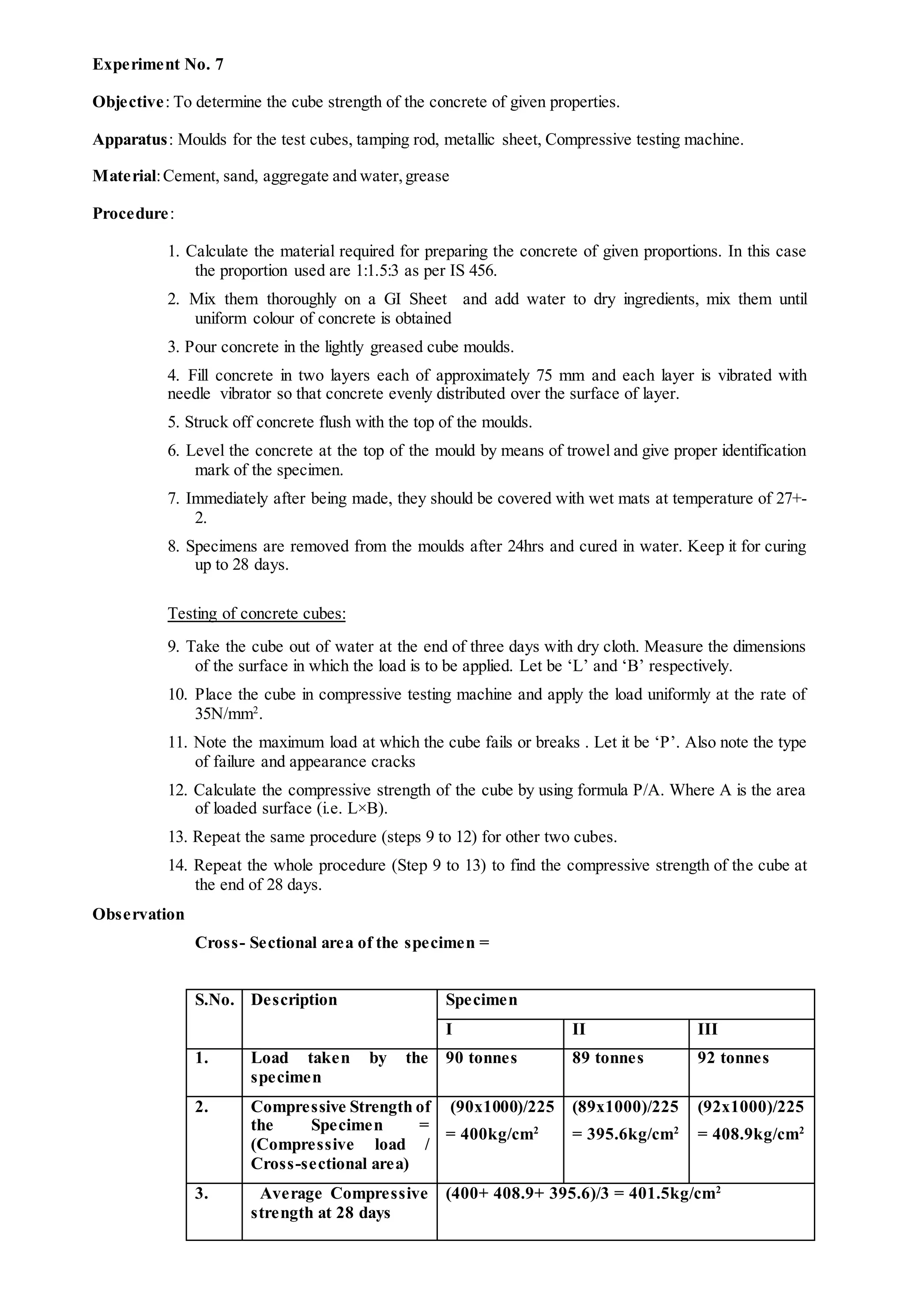
Observation
Cross- Sectional area of the specimen =
S.No. Description Specimen
I II III
1. Load taken by the
specimen
90 tonnes 89 tonnes 92 tonnes
2. Compressive Strength of
the Specimen =
(Compressive load /
Cross-sectional area)
(90x1000)/225
= 400kg/cm2
(89x1000)/225
= 395.6kg/cm2
(92x1000)/225
= 408.9kg/cm2
3. Average Compressive
strength at 28 days
(400+ 408.9+ 395.6)/3 = 401.5kg/cm2
Results:
The type and grade of concrete : M20 (1:1.5:3)
The compressive strength of cement ate the end of 28 days : 401.5 kg/cm2

Compressive strength of cement concrete cubes

  • 1.
    Experiment No. 7 Objective:To determine the cube strength of the concrete of given properties. Apparatus: Moulds for the test cubes, tamping rod, metallic sheet, Compressive testing machine. Material:Cement, sand, aggregate and water,grease Procedure: 1. Calculate the material required for preparing the concrete of given proportions. In this case the proportion used are 1:1.5:3 as per IS 456. 2. Mix them thoroughly on a GI Sheet and add water to dry ingredients, mix them until uniform colour of concrete is obtained 3. Pour concrete in the lightly greased cube moulds. 4. Fill concrete in two layers each of approximately 75 mm and each layer is vibrated with needle vibrator so that concrete evenly distributed over the surface of layer. 5. Struck off concrete flush with the top of the moulds. 6. Level the concrete at the top of the mould by means of trowel and give proper identification mark of the specimen. 7. Immediately after being made, they should be covered with wet mats at temperature of 27+- 2. 8. Specimens are removed from the moulds after 24hrs and cured in water. Keep it for curing up to 28 days. Testing of concrete cubes: 9. Take the cube out of water at the end of three days with dry cloth. Measure the dimensions of the surface in which the load is to be applied. Let be ‘L’ and ‘B’ respectively. 10. Place the cube in compressive testing machine and apply the load uniformly at the rate of 35N/mm2 . 11. Note the maximum load at which the cube fails or breaks . Let it be ‘P’. Also note the type of failure and appearance cracks 12. Calculate the compressive strength of the cube by using formula P/A. Where A is the area of loaded surface (i.e. L×B). 13. Repeat the same procedure (steps 9 to 12) for other two cubes. 14. Repeat the whole procedure (Step 9 to 13) to find the compressive strength of the cube at the end of 28 days. Observation Cross- Sectional area of the specimen = S.No. Description Specimen I II III 1. Load taken by the specimen 90 tonnes 89 tonnes 92 tonnes 2. Compressive Strength of the Specimen = (Compressive load / Cross-sectional area) (90x1000)/225 = 400kg/cm2 (89x1000)/225 = 395.6kg/cm2 (92x1000)/225 = 408.9kg/cm2 3. Average Compressive strength at 28 days (400+ 408.9+ 395.6)/3 = 401.5kg/cm2
  • 2.
    Results: The type andgrade of concrete : M20 (1:1.5:3) The compressive strength of cement ate the end of 28 days : 401.5 kg/cm2