Compressed Gases: The Orphan HazardNeal LangermanAdvanced Chemical SafetySan Diego, CA
Compressed Gas ConsiderationsBasic assumption: “Everyone knows how to handle CG correctly”Basic practice: “Secure the cylinder” and all is coolReality:  Neither of the above is correct.Purpose today: To remind you that compressed gases are chemicals too, which have a unique property (HP)Point out a few of the standard guidelines2Compressed Gas Safety
Compressed Gas ConsiderationsThe package side of a CG system is well engineeredHighly regulated in transit and useThe end-user side is at the mercy of the userEngineering is arbitraryOversight is limitedSystem failure rate is lowCompressed Gas Safety3
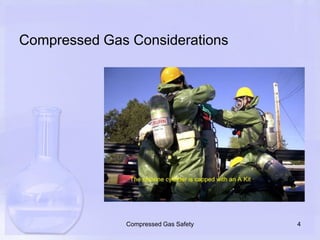
Compressed Gas Considerations4Compressed Gas Safety
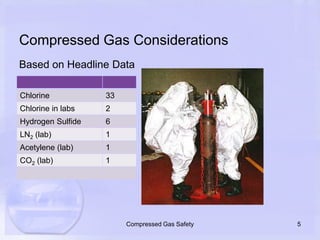
Compressed Gas ConsiderationsBased on Headline Data5Compressed Gas Safety
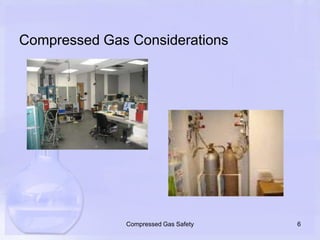
Compressed Gas Considerations6Compressed Gas Safety
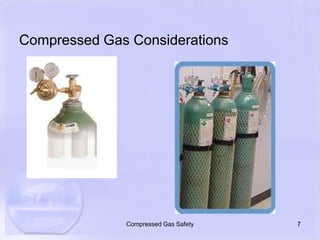
Compressed Gas Considerations7Compressed Gas Safety
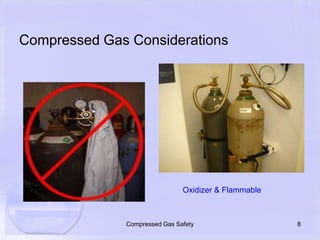
Compressed Gas Considerations8Compressed Gas SafetyOxidizer & Flammable
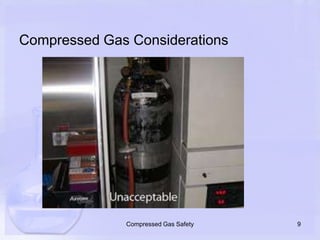
Compressed Gas Considerations9Compressed Gas Safety
Compressed Gas Handling GuidelinesCompressed Gas AssociationPublication Locatorhttp://www.cganet.com/customer/publication.aspx?AspxAutoDetectCookieSupport=1P-1	Safe Handling of Compressed Gases in ContainersP-12 Safe Handling of Cryogenic LiquidsHB	Handbook of Compressed Gaseshttp://www.scribd.com/doc/55730782/Nicollet-Compress-Gas-Plan (a very good CG Safety Plan)10Compressed Gas Safety
Compressed Gas Handling GuidelinesChemical HazardsCorrosiveFlammable, including pyrophoric (eg: silane)Toxic, including “super” toxic (eg: arsine)OxidizerCryogenic11Compressed Gas Safety
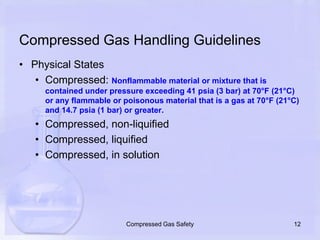
Compressed Gas Handling GuidelinesPhysical StatesCompressed: Nonflammable material or mixture that is contained under pressure exceeding 41 psia (3 bar) at 70°F (21°C) or any flammable or poisonous material that is a gas at 70°F (21°C) and 14.7 psia (1 bar) or greater. Compressed, non-liquifiedCompressed, liquifiedCompressed, in solution12Compressed Gas Safety
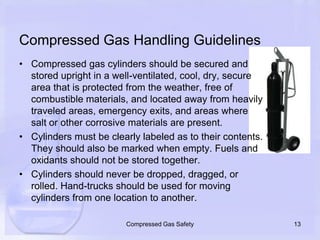
Compressed Gas Handling GuidelinesCompressed gas cylinders should be secured and stored upright in a well-ventilated, cool, dry, secure area that is protected from the weather, free of combustible materials, and located away from heavily traveled areas, emergency exits, and areas where salt or other corrosive materials are present. Cylinders must be clearly labeled as to their contents. They should also be marked when empty. Fuels and oxidants should not be stored together.Cylinders should never be dropped, dragged, or rolled. Hand-trucks should be used for moving cylinders from one location to another.13Compressed Gas Safety
Compressed Gas Handling GuidelinesEngineering Controls - each gas application will have it's own engineering controls depending on the types of hazards and application. Examples of engineering controls are:Fume hoodsGas CabinetsVentilation systemsSmoke detectorsSprinkler systemsFlow RestrictorsScrubbersLeak MonitorsGas cylinder storage areas14Compressed Gas Safety
Compressed Gas Handling GuidelinesAdministrative Controls - compressed gas program administrative controls include:Employee trainingSegregation of gas containersInspections and auditsSignsAssignment and use of PPEIdentification of authorized employeesProcedures for receipt, use and storageCompressed Gas Control BandsCylinders in labs or equivalentProcess Risk Assessment is performed15Compressed Gas Safety
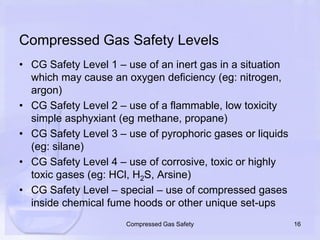
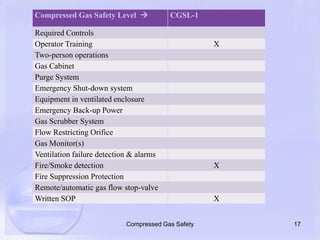
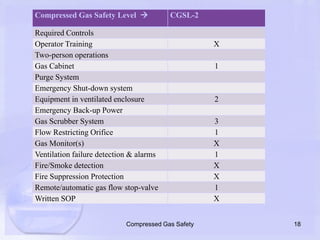
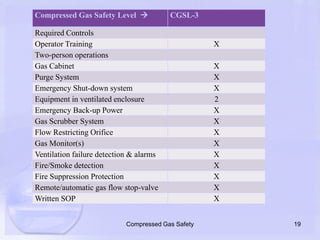
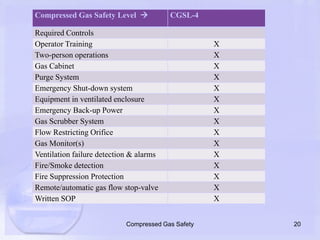
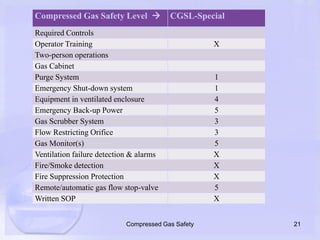
Compressed Gas Safety LevelsCG Safety Level 1 – use of an inert gas in a situation which may cause an oxygen deficiency (eg: nitrogen, argon)CG Safety Level 2 – use of a flammable, low toxicity simple asphyxiant (eg methane, propane)CG Safety Level 3 – use of pyrophoric gases or liquids (eg: silane)CG Safety Level 4 – use of corrosive, toxic or highly toxic gases (eg: HCl, H2S, Arsine)CG Safety Level – special – use of compressed gases inside chemical fume hoods or other unique set-ups16Compressed Gas Safety
17Compressed Gas Safety
18Compressed Gas Safety
19Compressed Gas Safety
20Compressed Gas Safety
21Compressed Gas Safety
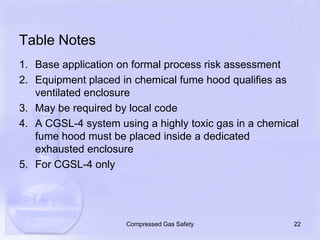
Table NotesBase application on formal process risk assessmentEquipment placed in chemical fume hood qualifies as ventilated enclosureMay be required by local codeA CGSL-4 system using a highly toxic gas in a chemical fume hood must be placed inside a dedicated exhausted enclosureFor CGSL-4 only22Compressed Gas Safety
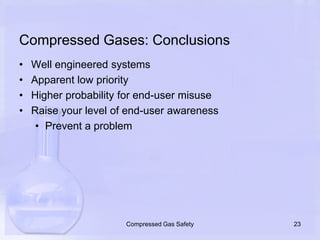
Compressed Gases: Conclusions	Well engineered systemsApparent low priorityHigher probability for end-user misuseRaise your level of end-user awarenessPrevent a problem23Compressed Gas Safety
Keep your pressure low …Questions???24Compressed Gas Safety

Compressed gases: An orphan hazard?

  • 1.
    Compressed Gases: TheOrphan HazardNeal LangermanAdvanced Chemical SafetySan Diego, CA
  • 2.
    Compressed Gas ConsiderationsBasicassumption: “Everyone knows how to handle CG correctly”Basic practice: “Secure the cylinder” and all is coolReality: Neither of the above is correct.Purpose today: To remind you that compressed gases are chemicals too, which have a unique property (HP)Point out a few of the standard guidelines2Compressed Gas Safety
  • 3.
    Compressed Gas ConsiderationsThepackage side of a CG system is well engineeredHighly regulated in transit and useThe end-user side is at the mercy of the userEngineering is arbitraryOversight is limitedSystem failure rate is lowCompressed Gas Safety3
  • 4.
  • 5.
    Compressed Gas ConsiderationsBasedon Headline Data5Compressed Gas Safety
  • 6.
  • 7.
  • 8.
    Compressed Gas Considerations8CompressedGas SafetyOxidizer & Flammable
  • 9.
  • 10.
    Compressed Gas HandlingGuidelinesCompressed Gas AssociationPublication Locatorhttp://www.cganet.com/customer/publication.aspx?AspxAutoDetectCookieSupport=1P-1 Safe Handling of Compressed Gases in ContainersP-12 Safe Handling of Cryogenic LiquidsHB Handbook of Compressed Gaseshttp://www.scribd.com/doc/55730782/Nicollet-Compress-Gas-Plan (a very good CG Safety Plan)10Compressed Gas Safety
  • 11.
    Compressed Gas HandlingGuidelinesChemical HazardsCorrosiveFlammable, including pyrophoric (eg: silane)Toxic, including “super” toxic (eg: arsine)OxidizerCryogenic11Compressed Gas Safety
  • 12.
    Compressed Gas HandlingGuidelinesPhysical StatesCompressed: Nonflammable material or mixture that is contained under pressure exceeding 41 psia (3 bar) at 70°F (21°C) or any flammable or poisonous material that is a gas at 70°F (21°C) and 14.7 psia (1 bar) or greater. Compressed, non-liquifiedCompressed, liquifiedCompressed, in solution12Compressed Gas Safety
  • 13.
    Compressed Gas HandlingGuidelinesCompressed gas cylinders should be secured and stored upright in a well-ventilated, cool, dry, secure area that is protected from the weather, free of combustible materials, and located away from heavily traveled areas, emergency exits, and areas where salt or other corrosive materials are present. Cylinders must be clearly labeled as to their contents. They should also be marked when empty. Fuels and oxidants should not be stored together.Cylinders should never be dropped, dragged, or rolled. Hand-trucks should be used for moving cylinders from one location to another.13Compressed Gas Safety
  • 14.
    Compressed Gas HandlingGuidelinesEngineering Controls - each gas application will have it's own engineering controls depending on the types of hazards and application. Examples of engineering controls are:Fume hoodsGas CabinetsVentilation systemsSmoke detectorsSprinkler systemsFlow RestrictorsScrubbersLeak MonitorsGas cylinder storage areas14Compressed Gas Safety
  • 15.
    Compressed Gas HandlingGuidelinesAdministrative Controls - compressed gas program administrative controls include:Employee trainingSegregation of gas containersInspections and auditsSignsAssignment and use of PPEIdentification of authorized employeesProcedures for receipt, use and storageCompressed Gas Control BandsCylinders in labs or equivalentProcess Risk Assessment is performed15Compressed Gas Safety
  • 16.
    Compressed Gas SafetyLevelsCG Safety Level 1 – use of an inert gas in a situation which may cause an oxygen deficiency (eg: nitrogen, argon)CG Safety Level 2 – use of a flammable, low toxicity simple asphyxiant (eg methane, propane)CG Safety Level 3 – use of pyrophoric gases or liquids (eg: silane)CG Safety Level 4 – use of corrosive, toxic or highly toxic gases (eg: HCl, H2S, Arsine)CG Safety Level – special – use of compressed gases inside chemical fume hoods or other unique set-ups16Compressed Gas Safety
  • 17.
  • 18.
  • 19.
  • 20.
  • 21.
  • 22.
    Table NotesBase applicationon formal process risk assessmentEquipment placed in chemical fume hood qualifies as ventilated enclosureMay be required by local codeA CGSL-4 system using a highly toxic gas in a chemical fume hood must be placed inside a dedicated exhausted enclosureFor CGSL-4 only22Compressed Gas Safety
  • 23.
    Compressed Gases: Conclusions Wellengineered systemsApparent low priorityHigher probability for end-user misuseRaise your level of end-user awarenessPrevent a problem23Compressed Gas Safety
  • 24.
    Keep your pressurelow …Questions???24Compressed Gas Safety