1
Compressed Gas Cylinder
Complies to the Guidelines of OSHAD Requirements
2023
Orient Management Consulting & Training
Ground Rules
• Fire alarm/exits
• Covid-19 protocols
• Smoking
• Drinks
• Breaks
• Lunch
• Questions
• Talking over others.
As a courtesy to others please set
your mobile phone to
SILENT MODE.
Housekeeping
COURSE OBJECTIVES
1. Properly use, handle, transport, store, dispose or, order,
receive, and maintain gas cylinders according to regulatory
standards and guidelines.
2. Identify the correct Personal Protection Equipment (PPE) to
wear when working with a gas cylinder.
3. Recognize the dangers associated with gas cylinders by
examining the labels on the gas cylinders and in the SDS.
4. Design an emergency plan and accurately describe what to
do in case an incident occurs with a gas cylinder.
 Gas Users
 Safety Committees
 Purchasing Agents
 Department Managers
 First Line Supervisors
 Maintenance Managers
 Shipping and Receiving Employees
 Accident Investigation Team Members
COURSE ATTENDEES
Compressed Gas Safety
• OSHAD SF – CoP - 49.0 - Compressed Gases and Air v3.0
English
• OSHAD SF – CoP - 1.0 - Hazardous Materials v3.1 English
• OSHA 29 CFR 1910.101 Compressed Gases (General
Requirements) &
• OSHA 29 CFR 1910.253 Oxygen-fuel gas Welding & cutting
• Safe Use, Handling and Storage
PPT043-01 1
What is Compressed Gas
The official definition from the Compressed Gas
Association’s (CGA) handbook is “Material or mixture
having the container an absolute pressure exceeding
40 PSI at 70°F (20°C) or, regardless of pressure at 70°F,
or having an absolute pressure exceeding 104 PSI at
130°F (54°C) or any liquid material having a vapor
pressure exceeding 40 PSI absolute at 100°F.”
7
Compressed Gases
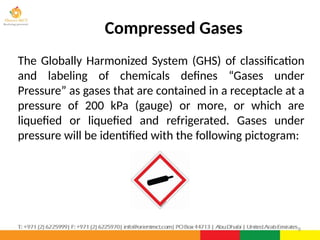
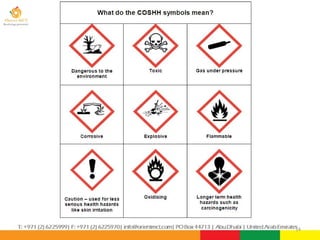
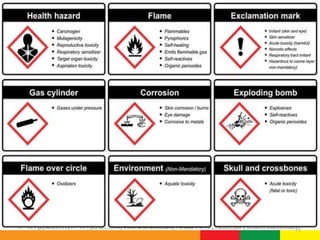
The Globally Harmonized System (GHS) of classification
and labeling of chemicals defines “Gases under
Pressure” as gases that are contained in a receptacle at a
pressure of 200 kPa (gauge) or more, or which are
liquefied or liquefied and refrigerated. Gases under
pressure will be identified with the following pictogram:
8
Types of Compressed Gas
The types of compressed gas can be divided into
three categories, each with unique characteristics.
• Non-Liquefied Gas
• Dissolved Gas
• Liquefied Gas
9
• Non-Liquefied Gas: is a compressed,
pressurized or permanent gas. These gases do
not become liquid when they are compressed
at normal temperatures or even very high
pressures. Common examples are oxygen,
nitrogen, helium, and argon.
10
Types of Compressed Gas
• Dissolved Gas: can also be compressed. A
common example of dissolved gas is
acetylene. Care should be taken when using
acetylene for applications such as welding.
Consult your supervisor before using
acetylene.
11
Types of Compressed Gas
• Liquefied Gas: can become liquid at normal
temperatures when inside a cylinder under
pressure. When gas is removed from the
cylinder, enough liquid evaporates to replace
it, keeping the pressure in the cylinder
constant. Common examples include
anhydrous ammonia, chlorine, propane,
nitrous oxide, and carbon dioxide.
12
Types of Compressed Gas
©Consultnet Limited
Common Industrial Gases
 Oxidants support combustion e.g. air & oxygen
 Inerts do not generally react with other materials, asphyxiants
(leak displace air) e.g. nitrogen, argon, helium
 Flammables when mixed with oxidant and ignition source will
burn e.g. acetylene, hydrogen, propane
 Toxics toxic in small concentrations e.g. ammonia, chlorine,
carbon dioxide
 Corrosives react with materials causing reactions e.g. chlorine,
sulfur dioxide
 Pyrophorics ignite spontaneously in air e.g. silane, phosphine
14
15
Specific Hazard Classes
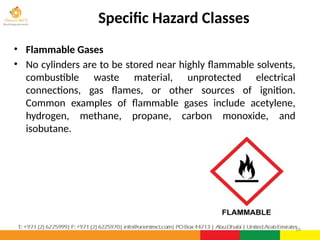
• Flammable Gases
• No cylinders are to be stored near highly flammable solvents,
combustible waste material, unprotected electrical
connections, gas flames, or other sources of ignition.
Common examples of flammable gases include acetylene,
hydrogen, methane, propane, carbon monoxide, and
isobutane.
16
Flammable Gases Precautions
• At no time shall a flame be used to detect a leak. A soapy
water solution or approved commercial leak detection solution
shall be used.
• Inside buildings, stored oxygen shall be separated from
flammable gas cylinders by a minimum of 20 feet or separated
by a fire-resistant partition with a height no less than that of
the cylinders.
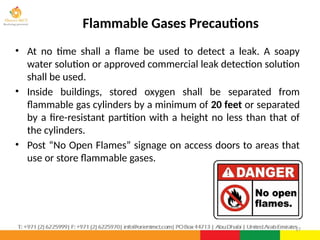
• Post “No Open Flames” signage on access doors to areas that
use or store flammable gases.
17
Poison Gases
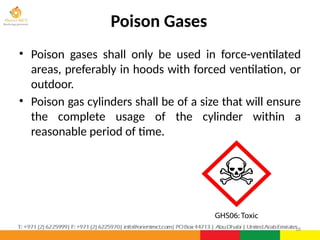
• Poison gases shall only be used in force-ventilated
areas, preferably in hoods with forced ventilation, or
outdoor.
• Poison gas cylinders shall be of a size that will ensure
the complete usage of the cylinder within a
reasonable period of time.
18
Corrosive Gases
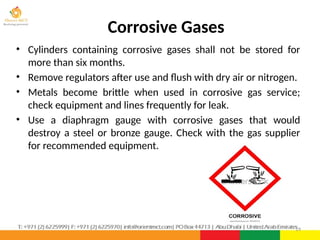
• Cylinders containing corrosive gases shall not be stored for
more than six months.
• Remove regulators after use and flush with dry air or nitrogen.
• Metals become brittle when used in corrosive gas service;
check equipment and lines frequently for leak.
• Use a diaphragm gauge with corrosive gases that would
destroy a steel or bronze gauge. Check with the gas supplier
for recommended equipment.
19
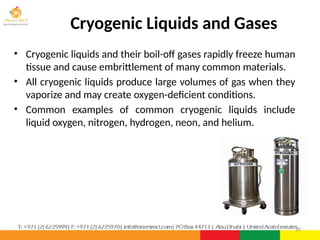
Cryogenic Liquids and Gases
• Cryogenic liquids and their boil-off gases rapidly freeze human
tissue and cause embrittlement of many common materials.
• All cryogenic liquids produce large volumes of gas when they
vaporize and may create oxygen-deficient conditions.
• Common examples of common cryogenic liquids include
liquid oxygen, nitrogen, hydrogen, neon, and helium.
20
• Use appropriate personal protective equipment, including
insulated gloves, lab coat, and eye protection (goggles and face
shield) during any transfer of cryogenic liquid.
• In the event of skin contact with a cryogenic liquid, do not rub
skin; place the affected part of the body in a warm water bath
(not to exceed 40°C [105°F]). If a burn is significant, seek medical
attention.
• Inspect containers for loss of insulating vacuum. If the outside
jacket on a container is cold or has frost, some vacuum has been
lost. Empty the contents into another cryogenic container and
remove the damaged unit from service. Repairs shall be made
by the manufacturer or an authorized company.
21
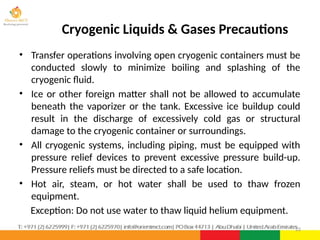
Cryogenic Liquids & Gases Precautions
• Transfer operations involving open cryogenic containers must be
conducted slowly to minimize boiling and splashing of the
cryogenic fluid.
• Ice or other foreign matter shall not be allowed to accumulate
beneath the vaporizer or the tank. Excessive ice buildup could
result in the discharge of excessively cold gas or structural
damage to the cryogenic container or surroundings.
• All cryogenic systems, including piping, must be equipped with
pressure relief devices to prevent excessive pressure build-up.
Pressure reliefs must be directed to a safe location.
• Hot air, steam, or hot water shall be used to thaw frozen
equipment.
Exception: Do not use water to thaw liquid helium equipment.
22
Cryogenic Liquids & Gases Precautions
High Pressure Fuel Gases
Fuel gases often use a combination of flammable and oxidizing
gases. Use of fuel gases must comply with applicable regulations
listed above.
High Pressure gases can be rated up to 3,000 pounds per square
inch (psi). Typical uses for high pressure gases include:
• Inert welding gas mixtures
• Cryogenics
• Non-toxic gas distribution
• Medical gas distribution
• Emergency oxygen services
23
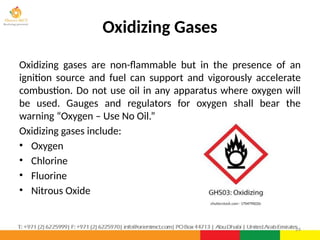
Oxidizing Gases
Oxidizing gases are non-flammable but in the presence of an
ignition source and fuel can support and vigorously accelerate
combustion. Do not use oil in any apparatus where oxygen will
be used. Gauges and regulators for oxygen shall bear the
warning “Oxygen – Use No Oil.”
Oxidizing gases include:
• Oxygen
• Chlorine
• Fluorine
• Nitrous Oxide
24
©Consultnet Limited
Recognition
Know the properties of the materials involved!
• Is the gas a health hazard? Is it toxic?
• Can it cause severe damage to the eyes, respiratory
system, skin, etc.?
• Is it carcinogenic?
• Is it an asphyxiant?
• Is it a physical hazard?
• Is it explosive, flammable, pyrophoric, corrosive, etc.?
27
Three people, including a firefighter, have been taken to hospital after a major gas
explosion caused an "inferno" at a block of 20 flats in Bedford. (Monday 4 July 2022
17:52, UK)
28
NOTE: For Education Purpose only
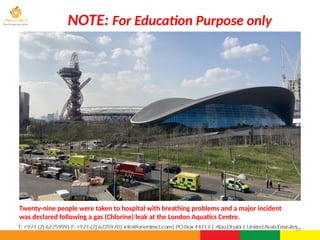
Twenty-nine people were taken to hospital with breathing problems and a major incident
was declared following a gas (Chlorine) leak at the London Aquatics Centre.
29
NOTE: For Education Purpose only
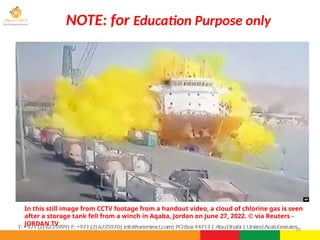
NOTE: for Education Purpose only
30
In this still image from CCTV footage from a handout video, a cloud of chlorine gas is seen
after a storage tank fell from a winch in Aqaba, Jordan on June 27, 2022. © via Reuters -
JORDAN TV
©Consultnet Limited
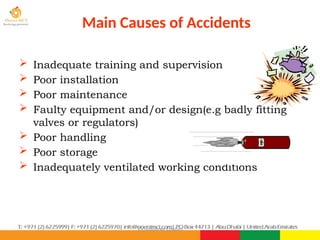
Main Causes of Accidents
 Inadequate training and supervision
 Poor installation
 Poor maintenance
 Faulty equipment and/or design(e.g badly fitting
valves or regulators)
 Poor handling
 Poor storage
 Inadequately ventilated working conditions
©Consultnet Limited
Main Hazards
 Impact from the blast of a gas cylinder explosion
or rapid release of compressed gas
 Impact from parts of gas cylinders that fail or
any flying debris
 Contact with the released gas or fluid (such as
chlorine)
 Fire resulting from the escape of flammable gas
or fluids such as LPG
 Impact from falling cylinder
Employers’ Duties
· Provide safe place, safe equipments and safe system
of work
· Carry out a suitable and sufficient risk assessment
· Take the necessary action to prevent exposure
· Ensure that equipment is being properly used by
having procedures in place
· Have maintenance systems which ensure plant and
equipment are in efficient repair
35
· Carry out a review of systems of work and
supervisory actions at regular intervals
· Monitor the workforce for exposure to hazardous
materials
· Provide adequate training, information and
instruction
· Arrange through planning actions to deal with
emergencies, accidents and other incidents.
Employers’ Duties
Employees’ Duties
• Cooperate with the employer to enable the employer
to be compliant with regulations
• Use fully and properly all control measures put in place
• Ensure equipment used is returned to proper storage
• Report any defects of equipment used
• Attend any medical examinations as required
• Report any incident which may have led to a release of
hazardous substances.
NEXT
©Consultnet Limited
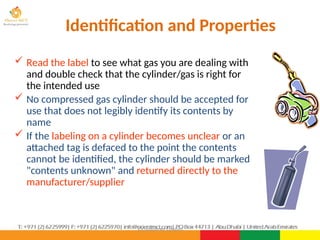
Identification and Properties
 Read the label to see what gas you are dealing with
and double check that the cylinder/gas is right for
the intended use
 No compressed gas cylinder should be accepted for
use that does not legibly identify its contents by
name
 If the labeling on a cylinder becomes unclear or an
attached tag is defaced to the point the contents
cannot be identified, the cylinder should be marked
"contents unknown" and returned directly to the
manufacturer/supplier
 Never rely on the color of the cylinder for identification.
Color coding is not reliable because cylinder colors may
vary with the supplier. Additionally, labels on caps have
little value because caps are interchangeable
 If there is a mismatch between the colour of a cylinder
and the label. Do not use, contact the supplier
immediately
 Know the properties of the gas (read Safety Data Sheets
available from your Supervisor)
 The cylinder’s contents should be identified at all times as
well as the cylinder status (full, empty or in service)
38
Identification and Properties
Understanding the
Safety Data Sheet (SDS)
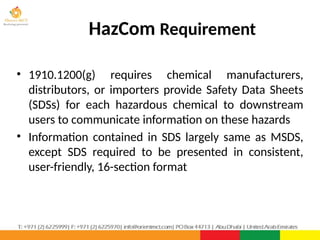
HazCom Requirement
• 1910.1200(g) requires chemical manufacturers,
distributors, or importers provide Safety Data Sheets
(SDSs) for each hazardous chemical to downstream
users to communicate information on these hazards
• Information contained in SDS largely same as MSDS,
except SDS required to be presented in consistent,
user-friendly, 16-section format
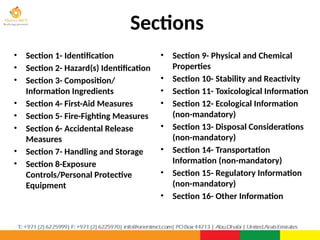
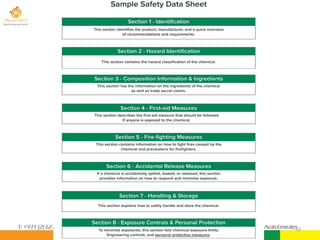
Sections
• Section 1- Identification
• Section 2- Hazard(s) Identification
• Section 3- Composition/
Information Ingredients
• Section 4- First-Aid Measures
• Section 5- Fire-Fighting Measures
• Section 6- Accidental Release
Measures
• Section 7- Handling and Storage
• Section 8-Exposure
Controls/Personal Protective
Equipment
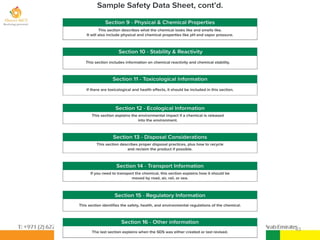
• Section 9- Physical and Chemical
Properties
• Section 10- Stability and Reactivity
• Section 11- Toxicological Information
• Section 12- Ecological Information
(non-mandatory)
• Section 13- Disposal Considerations
(non-mandatory)
• Section 14- Transportation
Information (non-mandatory)
• Section 15- Regulatory Information
(non-mandatory)
• Section 16- Other Information
42
43
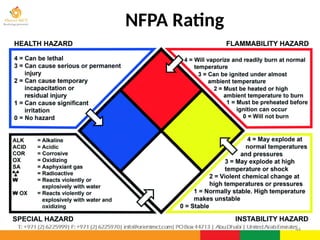
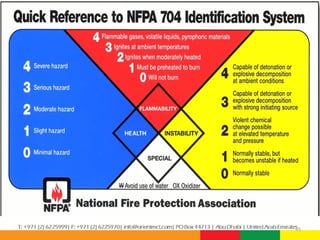
NFPA Rating
44
45
Labeling
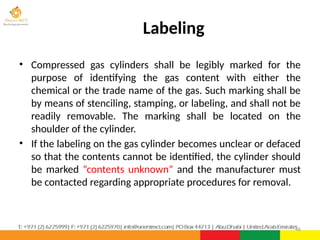
• Compressed gas cylinders shall be legibly marked for the
purpose of identifying the gas content with either the
chemical or the trade name of the gas. Such marking shall be
by means of stenciling, stamping, or labeling, and shall not be
readily removable. The marking shall be located on the
shoulder of the cylinder.
• If the labeling on the gas cylinder becomes unclear or defaced
so that the contents cannot be identified, the cylinder should
be marked “contents unknown” and the manufacturer must
be contacted regarding appropriate procedures for removal.
46
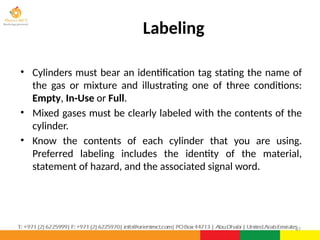
• Cylinders must bear an identification tag stating the name of
the gas or mixture and illustrating one of three conditions:
Empty, In-Use or Full.
• Mixed gases must be clearly labeled with the contents of the
cylinder.
• Know the contents of each cylinder that you are using.
Preferred labeling includes the identity of the material,
statement of hazard, and the associated signal word.
47
Labeling
48
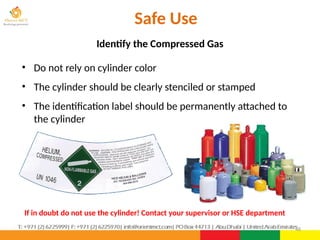
Safe Use
• Do not rely on cylinder color
• The cylinder should be clearly stenciled or stamped
• The identification label should be permanently attached to
the cylinder
If in doubt do not use the cylinder! Contact your supervisor or HSE department
Identify the Compressed Gas
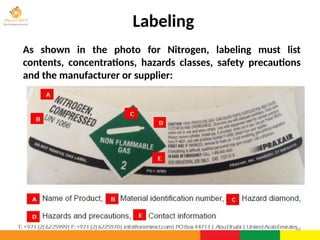
Labeling
As shown in the photo for Nitrogen, labeling must list
contents, concentrations, hazards classes, safety precautions
and the manufacturer or supplier:
49
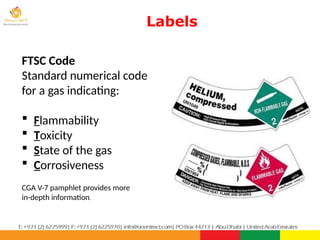
Labels
PPT-043-01 38
FTSC Code
Standard numerical code
for a gas indicating:
 Flammability
 Toxicity
 State of the gas
 Corrosiveness
CGA V-7 pamphlet provides more
in-depth information.
©Consultnet Limited
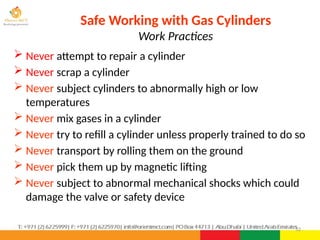
Safe Working with Gas Cylinders
Work Practices
 Securely restrain cylinders to prevent them falling over
 Close the cylinder valve and replace dust caps when cylinder not in use
 Before connecting a gas cylinder to equipment or pipework make sure
regulator and pipework are suitable for the gas and pressure being
used
 Never drop a gas cylinder
 Never tamper with cylinders or subject them to abnormal mechanical
shocks which could damage the valve or safety device
 Never re-paint, change markings or identification or interfere with
threads
 Never disguise damage to a cylinder or valve. Label as faulty and
contact the supplier
 Never attempt to repair a cylinder
 Never scrap a cylinder
 Never subject cylinders to abnormally high or low
temperatures
 Never mix gases in a cylinder
 Never try to refill a cylinder unless properly trained to do so
 Never transport by rolling them on the ground
 Never pick them up by magnetic lifting
 Never subject to abnormal mechanical shocks which could
damage the valve or safety device
52
Safe Working with Gas Cylinders
Work Practices
©Consultnet Limited
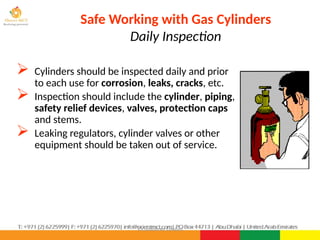
Safe Working with Gas Cylinders
Daily Inspection
 Cylinders should be inspected daily and prior
to each use for corrosion, leaks, cracks, etc.
 Inspection should include the cylinder, piping,
safety relief devices, valves, protection caps
and stems.
 Leaking regulators, cylinder valves or other
equipment should be taken out of service.
©Consultnet Limited
Safe Working with Gas Cylinders
 Maintenance of cylinders and their valves or relief devices shall be
performed only by trained personnel.
 An emergency response plan shall be developed and implemented
wherever compressed gas cylinders are used,
 Never smoke around compressed gas cylinders.
 Valve protection caps must remain in place at all times except when
cylinders are secured and connected to dispensing equipment
 Only wrenches or tools provided by the cylinder supplier should be
used to open or close a valve. At no time should pliers be used to
open a cylinder valve.
 Never apply tape, jointing compounds or any other sealing material to
the valve in an attempt to achieve a tight seal, if a gas tight seal
cannot be achieved metal to metal, replace the regulator or change
the cylinder
©Consultnet Limited
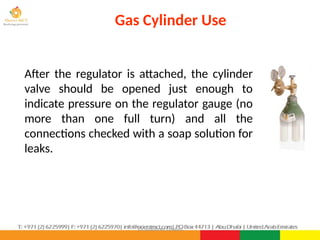
After the regulator is attached, the cylinder
valve should be opened just enough to
indicate pressure on the regulator gauge (no
more than one full turn) and all the
connections checked with a soap solution for
leaks.
Gas Cylinder Use
56
Never use oil or grease on the regulator of a cylinder valve.
 Before a regulator is removed from a cylinder, the cylinder
valve shall be closed and the regulator relieved of gas
pressure. The valve cap shall be replaced, the cylinder clearly
marked as "empty," and returned to a storage area for pickup
by the supplier
 Regulators, gauges, hoses and other apparatus shall not be
used on gas cylinders having different chemical
properties
 Valve outlet thread size is different for different products but
the same products from different gas suppliers will have
the same thread
Gas Cylinder Use
©Consultnet Limited
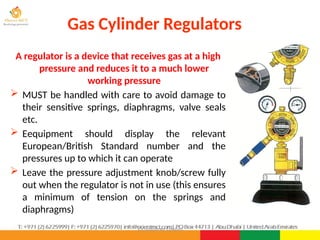
Gas Cylinder Regulators
A regulator is a device that receives gas at a high
pressure and reduces it to a much lower
working pressure
 MUST be handled with care to avoid damage to
their sensitive springs, diaphragms, valve seals
etc.
 Eequipment should display the relevant
European/British Standard number and the
pressures up to which it can operate
 Leave the pressure adjustment knob/screw fully
out when the regulator is not in use (this ensures
a minimum of tension on the springs and
diaphragms)
58
 Cylinders should be placed with the valve accessible at all
times. The main cylinder valve should be closed as soon
as it is no longer necessary that it be open, it should never
be left open when the equipment is unattended or not
operating
 This is necessary not only for safety when the cylinder is
under pressure, but also to prevent the corrosion and
contamination resulting from diffusion of air and moisture
into the cylinder after it has been emptied.
Gas Cylinder Regulators
©Consultnet Limited
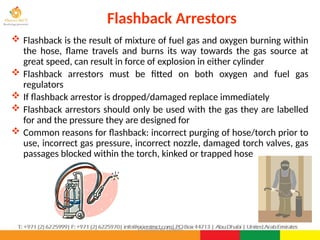
Flashback Arrestors
 Flashback is the result of mixture of fuel gas and oxygen burning within
the hose, flame travels and burns its way towards the gas source at
great speed, can result in force of explosion in either cylinder
 Flashback arrestors must be fitted on both oxygen and fuel gas
regulators
 If flashback arrestor is dropped/damaged replace immediately
 Flashback arrestors should only be used with the gas they are labelled
for and the pressure they are designed for
 Common reasons for flashback: incorrect purging of hose/torch prior to
use, incorrect gas pressure, incorrect nozzle, damaged torch valves, gas
passages blocked within the torch, kinked or trapped hose
©Consultnet Limited
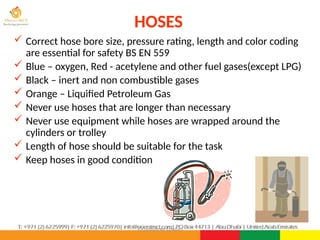
HOSES
 Correct hose bore size, pressure rating, length and color coding
are essential for safety BS EN 559
 Blue – oxygen, Red - acetylene and other fuel gases(except LPG)
 Black – inert and non combustible gases
 Orange – Liquified Petroleum Gas
 Never use hoses that are longer than necessary
 Never use equipment while hoses are wrapped around the
cylinders or trolley
 Length of hose should be suitable for the task
 Keep hoses in good condition
HOSES
Examine the hose for cracks, deterioration, damage
and test the hose for leaks before use
Do not repair hoses unless you have the skill and
means to test hem in accordance with BS En 1256
Purge hose thoroughly before lighting torch
Do not put wrapping tape around hosing as this
contains combustible hydrocarbons
Do not use copper piping with acetylene hoses as it is
potentially explosive
Pprotect hosing from heat, oil, grease or mechanical
damage
61
©Consultnet Limited
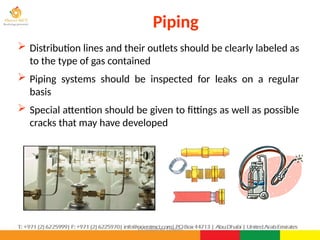
Piping
 Distribution lines and their outlets should be clearly labeled as
to the type of gas contained
 Piping systems should be inspected for leaks on a regular
basis
 Special attention should be given to fittings as well as possible
cracks that may have developed
©Consultnet Limited
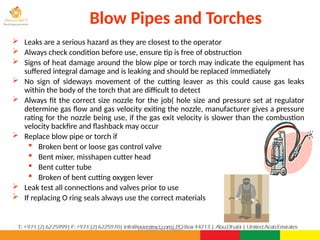
Blow Pipes and Torches
 Leaks are a serious hazard as they are closest to the operator
 Always check condition before use, ensure tip is free of obstruction
 Signs of heat damage around the blow pipe or torch may indicate the equipment has
suffered integral damage and is leaking and should be replaced immediately
 No sign of sideways movement of the cutting leaver as this could cause gas leaks
within the body of the torch that are difficult to detect
 Always fit the correct size nozzle for the job( hole size and pressure set at regulator
determine gas flow and gas velocity exiting the nozzle, manufacturer gives a pressure
rating for the nozzle being use, if the gas exit velocity is slower than the combustion
velocity backfire and flashback may occur
 Replace blow pipe or torch if
 Broken bent or loose gas control valve
 Bent mixer, misshapen cutter head
 Bent cutter tube
 Broken of bent cutting oxygen lever
 Leak test all connections and valves prior to use
 If replacing O ring seals always use the correct materials
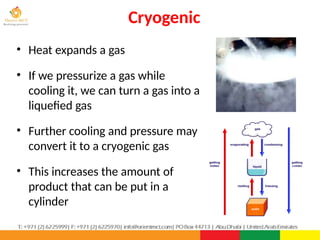
Cryogenic
PPT-043-01 30
• Heat expands a gas
• If we pressurize a gas while
cooling it, we can turn a gas into a
liquefied gas
• Further cooling and pressure may
convert it to a cryogenic gas
• This increases the amount of
product that can be put in a
cylinder
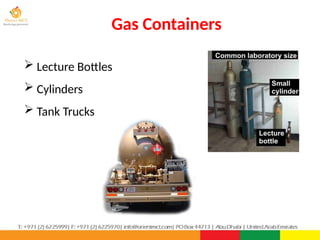
Gas Containers
PPT-043-01 31
 Lecture Bottles
 Cylinders
 Tank Trucks
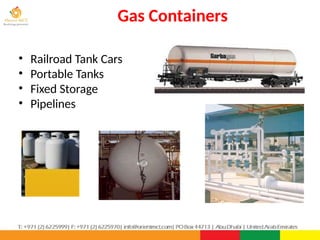
Gas Containers
PPT-043-01 32
• Railroad Tank Cars
• Portable Tanks
• Fixed Storage
• Pipelines
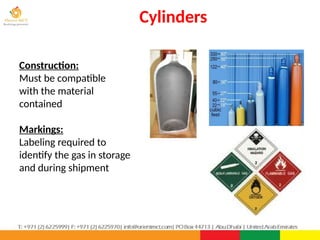
Cylinders
PPT-043-01 33
Construction:
Must be compatible
with the material
contained
Markings:
Labeling required to
identify the gas in storage
and during shipment
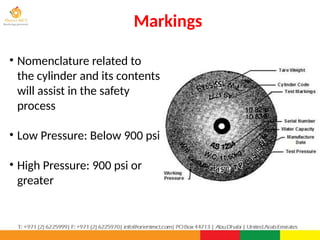
Markings
PPT-043-01 34
• Nomenclature related to
the cylinder and its contents
will assist in the safety
process
• Low Pressure: Below 900 psi
• High Pressure: 900 psi or
greater
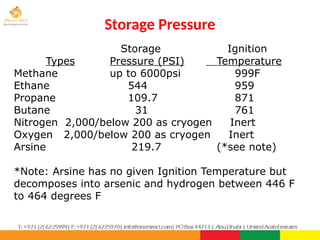
Storage Pressure
PPT-043-01 35
Storage Ignition
Types Pressure (PSI) Temperature
Methane up to 6000psi 999F
Ethane 544 959
Propane 109.7 871
Butane 31 761
Nitrogen 2,000/below 200 as cryogen Inert
Oxygen 2,000/below 200 as cryogen Inert
Arsine 219.7 (*see note)
*Note: Arsine has no given Ignition Temperature but
decomposes into arsenic and hydrogen between 446 F
to 464 degrees F
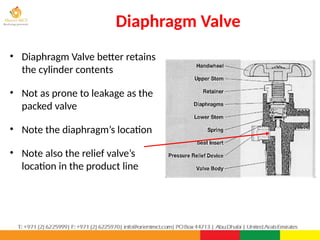
Diaphragm Valve
39
• Diaphragm Valve better retains
the cylinder contents
• Not as prone to leakage as the
packed valve
• Note the diaphragm’s location
• Note also the relief valve’s
location in the product line
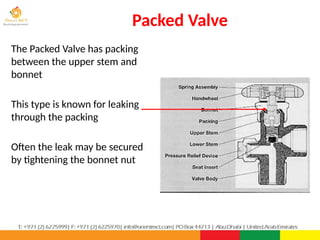
Packed Valve
40
The Packed Valve has packing
between the upper stem and
bonnet
This type is known for leaking
through the packing
Often the leak may be secured
by tightening the bonnet nut
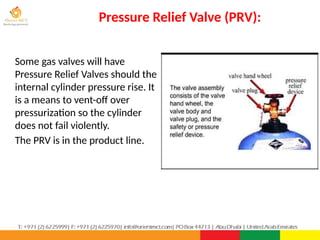
Pressure Relief Valve (PRV):
PPT-043-01 41
Some gas valves will have
Pressure Relief Valves should the
internal cylinder pressure rise. It
is a means to vent-off over
pressurization so the cylinder
does not fail violently.
The PRV is in the product line.
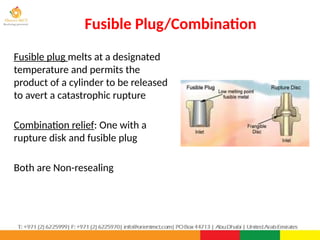
Fusible Plug/Combination
PPT-043-01 42
Fusible plug melts at a designated
temperature and permits the
product of a cylinder to be released
to avert a catastrophic rupture
Combination relief: One with a
rupture disk and fusible plug
Both are Non-resealing
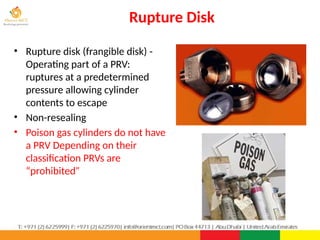
Rupture Disk
PPT-043-1 43
• Rupture disk (frangible disk) -
Operating part of a PRV:
ruptures at a predetermined
pressure allowing cylinder
contents to escape
• Non-resealing
• Poison gas cylinders do not have
a PRV Depending on their
classification PRVs are
“prohibited”
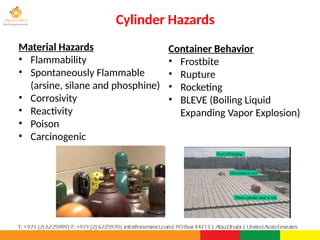
Cylinder Hazards
PPT-043-01 44
Material Hazards
• Flammability
• Spontaneously Flammable
(arsine, silane and phosphine)
• Corrosivity
• Reactivity
• Poison
• Carcinogenic
Container Behavior
• Frostbite
• Rupture
• Rocketing
• BLEVE (Boiling Liquid
Expanding Vapor Explosion)
©Consultnet Limited
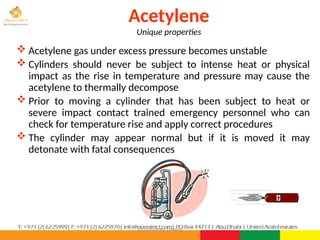
Acetylene
Unique properties
 Acetylene gas under excess pressure becomes unstable
 Cylinders should never be subject to intense heat or physical
impact as the rise in temperature and pressure may cause the
acetylene to thermally decompose
 Prior to moving a cylinder that has been subject to heat or
severe impact contact trained emergency personnel who can
check for temperature rise and apply correct procedures
 The cylinder may appear normal but if it is moved it may
detonate with fatal consequences
©Consultnet Limited
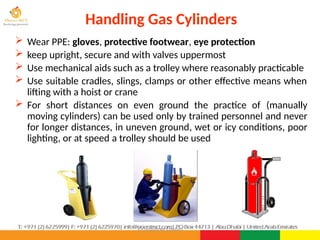
Handling Gas Cylinders
 Wear PPE: gloves, protective footwear, eye protection
 keep upright, secure and with valves uppermost
 Use mechanical aids such as a trolley where reasonably practicable
 Use suitable cradles, slings, clamps or other effective means when
lifting with a hoist or crane
 For short distances on even ground the practice of (manually
moving cylinders) can be used only by trained personnel and never
for longer distances, in uneven ground, wet or icy conditions, poor
lighting, or at speed a trolley should be used
78
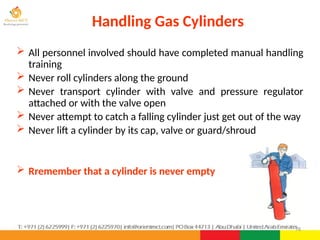
 All personnel involved should have completed manual handling
training
 Never roll cylinders along the ground
 Never transport cylinder with valve and pressure regulator
attached or with the valve open
 Never attempt to catch a falling cylinder just get out of the way
 Never lift a cylinder by its cap, valve or guard/shroud
 Rremember that a cylinder is never empty
Handling Gas Cylinders
79
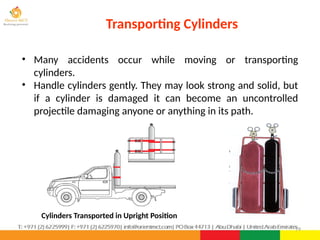
• Many accidents occur while moving or transporting
cylinders.
• Handle cylinders gently. They may look strong and solid, but
if a cylinder is damaged it can become an uncontrolled
projectile damaging anyone or anything in its path.
Transporting Cylinders
Cylinders Transported in Upright Position
©Consultnet Limited
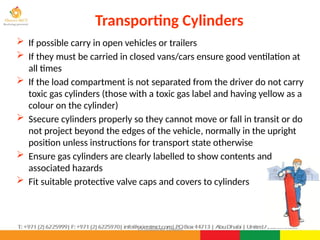
Transporting Cylinders
 If possible carry in open vehicles or trailers
 If they must be carried in closed vans/cars ensure good ventilation at
all times
 If the load compartment is not separated from the driver do not carry
toxic gas cylinders (those with a toxic gas label and having yellow as a
colour on the cylinder)
 Ssecure cylinders properly so they cannot move or fall in transit or do
not project beyond the edges of the vehicle, normally in the upright
position unless instructions for transport state otherwise
 Ensure gas cylinders are clearly labelled to show contents and
associated hazards
 Fit suitable protective valve caps and covers to cylinders
©Consultnet Limited
Transporting Cylinders
 Disconnect hoses and regulators from cylinders
 Carry propane cylinders upright and do not carry flammable
gas cylinders in the same compartment as toxic gas cylinders
 Do not smoke while carrying cylinders inside vans/cars
 Uunload the cylinders as soon as possible and move to a well
ventilated storage area
 If you suspect it is leaking, park the vehicle, investigate the
fault and contact the supplier
 If you are involved in an accident advise, any emergency
services involved what gas cylinders are being carried
Storage
• Proper storage is critical for the safe usage of compressed and
liquefied gases. Cylinder storage areas should be prominently
posted with hazard information regarding the gases stored.
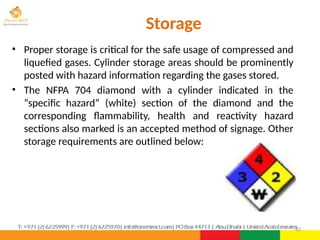
• The NFPA 704 diamond with a cylinder indicated in the
“specific hazard” (white) section of the diamond and the
corresponding flammability, health and reactivity hazard
sections also marked is an accepted method of signage. Other
storage requirements are outlined below:
82
©Consultnet Limited
Safe Storage
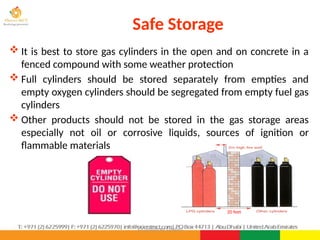
 It is best to store gas cylinders in the open and on concrete in a
fenced compound with some weather protection
 Full cylinders should be stored separately from empties and
empty oxygen cylinders should be segregated from empty fuel gas
cylinders
 Other products should not be stored in the gas storage areas
especially not oil or corrosive liquids, sources of ignition or
flammable materials
20 feet
84
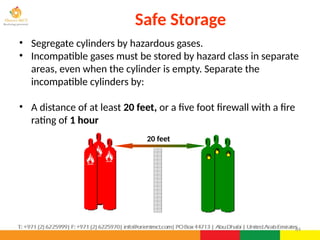
• Segregate cylinders by hazardous gases.
• Incompatible gases must be stored by hazard class in separate
areas, even when the cylinder is empty. Separate the
incompatible cylinders by:
• A distance of at least 20 feet, or a five foot firewall with a fire
rating of 1 hour
Safe Storage
20 feet
85
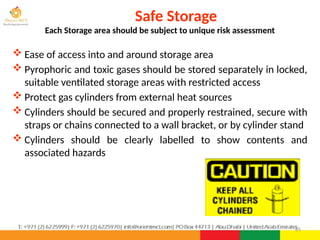
 Ease of access into and around storage area
 Pyrophoric and toxic gases should be stored separately in locked,
suitable ventilated storage areas with restricted access
 Protect gas cylinders from external heat sources
 Cylinders should be secured and properly restrained, secure with
straps or chains connected to a wall bracket, or by cylinder stand
 Cylinders should be clearly labelled to show contents and
associated hazards
Safe Storage
Each Storage area should be subject to unique risk assessment
©Consultnet Limited
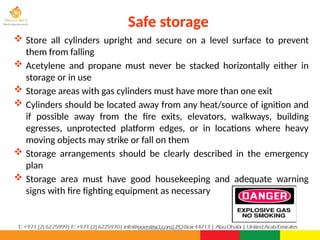
Safe storage
 Store all cylinders upright and secure on a level surface to prevent
them from falling
 Acetylene and propane must never be stacked horizontally either in
storage or in use
 Storage areas with gas cylinders must have more than one exit
 Cylinders should be located away from any heat/source of ignition and
if possible away from the fire exits, elevators, walkways, building
egresses, unprotected platform edges, or in locations where heavy
moving objects may strike or fall on them
 Storage arrangements should be clearly described in the emergency
plan
 Storage area must have good housekeeping and adequate warning
signs with fire fighting equipment as necessary
©Consultnet Limited
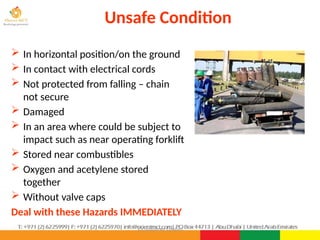
Unsafe Condition
 In horizontal position/on the ground
 In contact with electrical cords
 Not protected from falling – chain
not secure
 Damaged
 In an area where could be subject to
impact such as near operating forklift
 Stored near combustibles
 Oxygen and acetylene stored
together
 Without valve caps
Deal with these Hazards IMMEDIATELY
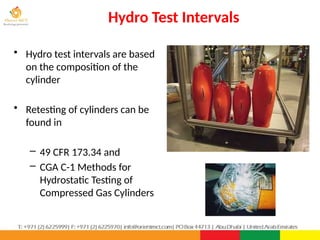
Hydro Test Intervals
75
• Hydro test intervals are based
on the composition of the
cylinder
• Retesting of cylinders can be
found in
– 49 CFR 173.34 and
– CGA C-1 Methods for
Hydrostatic Testing of
Compressed Gas Cylinders
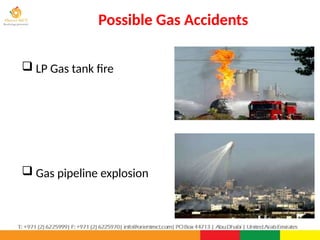
Possible Gas Accidents
PPT-043-01 77
 LP Gas tank fire
 Gas pipeline explosion
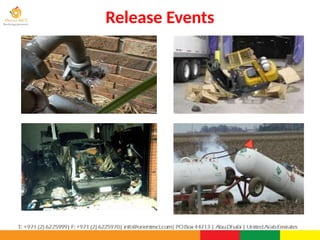
Release Events
PPT-043-01 78
©Consultnet Limited
Cylinder Incident Response
(Leakage)
If a cylinder is leaking but the leak has not ignited and it is safe to
do so having considered the gases specific properties:
 Eliminate all sources of ignition
 Ensure the valve is closed but do not over-tighten it
 Put the cylinder in a safe place that is well-ventilated – keep it
upright
 Mark the cylinder as faulty and not to be used
 Warn everyone in the area of the gas leak
 Inform the supplier
 Ensure the work area is thoroughly ventilated before
continuing with any work
 If a hydrogen cylinder is involved be aware that hydrogen
burns with an invisible flame so seek expert assistance
©Consultnet Limited
Cylinder Incident Response
Report any damaged/leaking cylinder to supplier
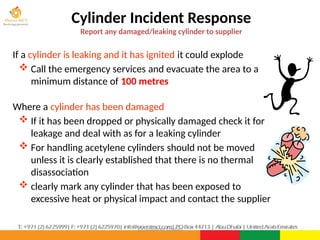
If a cylinder is leaking and it has ignited it could explode
 Call the emergency services and evacuate the area to a
minimum distance of 100 metres
Where a cylinder has been damaged
 If it has been dropped or physically damaged check it for
leakage and deal with as for a leaking cylinder
 For handling acetylene cylinders should not be moved
unless it is clearly established that there is no thermal
disassociation
 clearly mark any cylinder that has been exposed to
excessive heat or physical impact and contact the supplier
©Consultnet Limited
Cylinder Incident Response
If a flashback has occurred:
 Close both blowpipe valves oxygen first
 Close both cylinder valves
 Check the temperature of the acetylene cylinder for thermal
decomposition
 Check the blowpipe has not overheated
 Check the nozzle is not damaged
 Open both blowpipe valves oxygen first to vent the system
 Unwind the pressure adjustment screw on each pressure
regulator
 Before starting up again, check the integrity of the whole
system
©Consultnet Limited
Cylinder Incident Response
Gas Cylinders on Fire
Depends on the gas, whether the gas is alight at the cylinder valve or if the
cylinder has been subject to severe pressure as a result of the heat from the
fire. Nature of hazard will determine procedure to be applied
 If cylinder has been involved in fire do not approach, evacuate the area to
100m minimum to 300m
 Call fire brigade (997)
 Use large quantities of water to cool the cylinders if safe to do so from a
safe location and await the arrival of trained emergency personnel
(Emergency plan training should address)
 Remove any cylinders not involved in fire to safe place, ensure valves are
closed if safe to do so
 Inform gas supplier,
 If cylinder contents are unknown, treat as acetylene
Detection & Monitoring
PPT-043-01 79
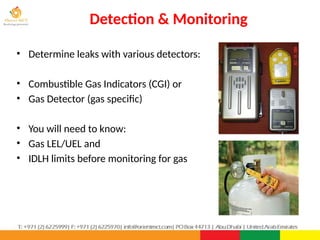
• Determine leaks with various detectors:
• Combustible Gas Indicators (CGI) or
• Gas Detector (gas specific)
• You will need to know:
• Gas LEL/UEL and
• IDLH limits before monitoring for gas
Detection
PPT-043-01 80
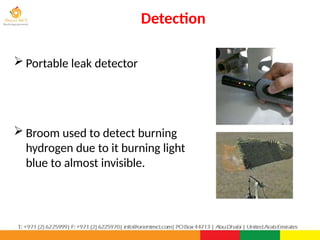
 Portable leak detector
 Broom used to detect burning
hydrogen due to it burning light
blue to almost invisible.
Detection
PPT-043-01 81
Similar “broom” method may also be used:
 If attempting to detect presence of Chlorine, wrap clean cloth
around broom
 Put ammonia on cloth and wave in suspected Chlorine cloud
 If cloth fumes, you’ve detected presence of Chlorine
 If looking for ammonia leaks, cloth treated with Chlorine
bleach may be wrapped around broom
 Waved in suspect area, if fuming occurs, ammonia present
Both methods rely on chemical reactions – you’ll need training
and PPE: USE CAUTION
Emergency Response Methods
PPT-043-01 82
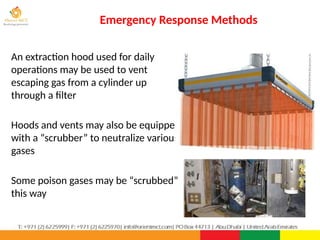
An extraction hood used for daily
operations may be used to vent
escaping gas from a cylinder up
through a filter
Hoods and vents may also be equipped
with a “scrubber” to neutralize various
gases
Some poison gases may be “scrubbed”
this way
Response
PPT-043-01 83
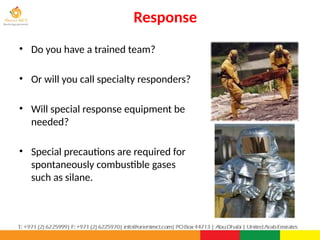
• Do you have a trained team?
• Or will you call specialty responders?
• Will special response equipment be
needed?
• Special precautions are required for
spontaneously combustible gases
such as silane.
Containment
PPT-043-01 85
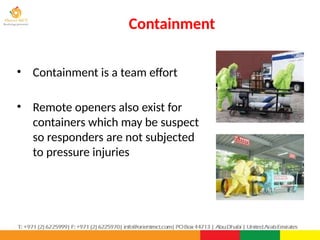
• Containment is a team effort
• Remote openers also exist for
containers which may be suspect
so responders are not subjected
to pressure injuries
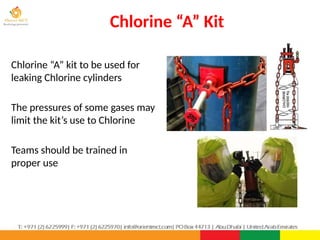
Chlorine “A” Kit
PPT-043-01 86
Chlorine “A” kit to be used for
leaking Chlorine cylinders
The pressures of some gases may
limit the kit’s use to Chlorine
Teams should be trained in
proper use
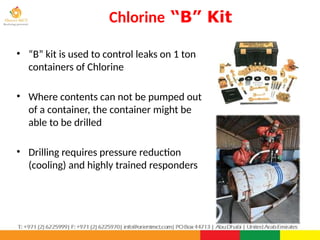
Chlorine “B” Kit
PPT-043-01 87
• “B” kit is used to control leaks on 1 ton
containers of Chlorine
• Where contents can not be pumped out
of a container, the container might be
able to be drilled
• Drilling requires pressure reduction
(cooling) and highly trained responders
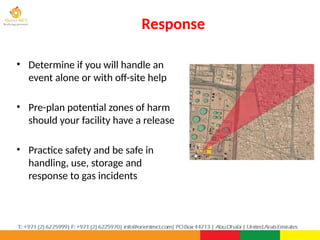
Response
PPT-043-01 88
• Determine if you will handle an
event alone or with off-site help
• Pre-plan potential zones of harm
should your facility have a release
• Practice safety and be safe in
handling, use, storage and
response to gas incidents
©Consultnet Limited
Conclusions
 Compressed gases present a unique hazard. Depending on the
particular gas, there is a potential for simultaneous exposure to
both Physical and chemical hazards
 Inadequate training and supervision, poor installation, poor
maintenance, faulty equipment and/or design (e.g badly fitting
valves or regulators), poor handling, poor storage, inadequately
ventilated working conditions
 When working with compressed gases you need to know the
properties of the gas, safe use procedures and what to do when
things go wrong
 For detailed use of individual gases you should now review the
relevant Safety Data Sheet (SDS) for each gas used on your site
Always Treat Gas Cylinders with Respect
The End

Compressed gas cylinder New presentation

  • 1.
    1 Compressed Gas Cylinder Compliesto the Guidelines of OSHAD Requirements 2023 Orient Management Consulting & Training
  • 2.
    Ground Rules • Firealarm/exits • Covid-19 protocols • Smoking • Drinks • Breaks • Lunch • Questions • Talking over others.
  • 3.
    As a courtesyto others please set your mobile phone to SILENT MODE. Housekeeping
  • 4.
    COURSE OBJECTIVES 1. Properlyuse, handle, transport, store, dispose or, order, receive, and maintain gas cylinders according to regulatory standards and guidelines. 2. Identify the correct Personal Protection Equipment (PPE) to wear when working with a gas cylinder. 3. Recognize the dangers associated with gas cylinders by examining the labels on the gas cylinders and in the SDS. 4. Design an emergency plan and accurately describe what to do in case an incident occurs with a gas cylinder.
  • 5.
     Gas Users Safety Committees  Purchasing Agents  Department Managers  First Line Supervisors  Maintenance Managers  Shipping and Receiving Employees  Accident Investigation Team Members COURSE ATTENDEES
  • 6.
    Compressed Gas Safety •OSHAD SF – CoP - 49.0 - Compressed Gases and Air v3.0 English • OSHAD SF – CoP - 1.0 - Hazardous Materials v3.1 English • OSHA 29 CFR 1910.101 Compressed Gases (General Requirements) & • OSHA 29 CFR 1910.253 Oxygen-fuel gas Welding & cutting • Safe Use, Handling and Storage PPT043-01 1
  • 7.
    What is CompressedGas The official definition from the Compressed Gas Association’s (CGA) handbook is “Material or mixture having the container an absolute pressure exceeding 40 PSI at 70°F (20°C) or, regardless of pressure at 70°F, or having an absolute pressure exceeding 104 PSI at 130°F (54°C) or any liquid material having a vapor pressure exceeding 40 PSI absolute at 100°F.” 7
  • 8.
    Compressed Gases The GloballyHarmonized System (GHS) of classification and labeling of chemicals defines “Gases under Pressure” as gases that are contained in a receptacle at a pressure of 200 kPa (gauge) or more, or which are liquefied or liquefied and refrigerated. Gases under pressure will be identified with the following pictogram: 8
  • 9.
    Types of CompressedGas The types of compressed gas can be divided into three categories, each with unique characteristics. • Non-Liquefied Gas • Dissolved Gas • Liquefied Gas 9
  • 10.
    • Non-Liquefied Gas:is a compressed, pressurized or permanent gas. These gases do not become liquid when they are compressed at normal temperatures or even very high pressures. Common examples are oxygen, nitrogen, helium, and argon. 10 Types of Compressed Gas
  • 11.
    • Dissolved Gas:can also be compressed. A common example of dissolved gas is acetylene. Care should be taken when using acetylene for applications such as welding. Consult your supervisor before using acetylene. 11 Types of Compressed Gas
  • 12.
    • Liquefied Gas:can become liquid at normal temperatures when inside a cylinder under pressure. When gas is removed from the cylinder, enough liquid evaporates to replace it, keeping the pressure in the cylinder constant. Common examples include anhydrous ammonia, chlorine, propane, nitrous oxide, and carbon dioxide. 12 Types of Compressed Gas
  • 13.
    ©Consultnet Limited Common IndustrialGases  Oxidants support combustion e.g. air & oxygen  Inerts do not generally react with other materials, asphyxiants (leak displace air) e.g. nitrogen, argon, helium  Flammables when mixed with oxidant and ignition source will burn e.g. acetylene, hydrogen, propane  Toxics toxic in small concentrations e.g. ammonia, chlorine, carbon dioxide  Corrosives react with materials causing reactions e.g. chlorine, sulfur dioxide  Pyrophorics ignite spontaneously in air e.g. silane, phosphine
  • 14.
  • 15.
  • 16.
    Specific Hazard Classes •Flammable Gases • No cylinders are to be stored near highly flammable solvents, combustible waste material, unprotected electrical connections, gas flames, or other sources of ignition. Common examples of flammable gases include acetylene, hydrogen, methane, propane, carbon monoxide, and isobutane. 16
  • 17.
    Flammable Gases Precautions •At no time shall a flame be used to detect a leak. A soapy water solution or approved commercial leak detection solution shall be used. • Inside buildings, stored oxygen shall be separated from flammable gas cylinders by a minimum of 20 feet or separated by a fire-resistant partition with a height no less than that of the cylinders. • Post “No Open Flames” signage on access doors to areas that use or store flammable gases. 17
  • 18.
    Poison Gases • Poisongases shall only be used in force-ventilated areas, preferably in hoods with forced ventilation, or outdoor. • Poison gas cylinders shall be of a size that will ensure the complete usage of the cylinder within a reasonable period of time. 18
  • 19.
    Corrosive Gases • Cylinderscontaining corrosive gases shall not be stored for more than six months. • Remove regulators after use and flush with dry air or nitrogen. • Metals become brittle when used in corrosive gas service; check equipment and lines frequently for leak. • Use a diaphragm gauge with corrosive gases that would destroy a steel or bronze gauge. Check with the gas supplier for recommended equipment. 19
  • 20.
    Cryogenic Liquids andGases • Cryogenic liquids and their boil-off gases rapidly freeze human tissue and cause embrittlement of many common materials. • All cryogenic liquids produce large volumes of gas when they vaporize and may create oxygen-deficient conditions. • Common examples of common cryogenic liquids include liquid oxygen, nitrogen, hydrogen, neon, and helium. 20
  • 21.
    • Use appropriatepersonal protective equipment, including insulated gloves, lab coat, and eye protection (goggles and face shield) during any transfer of cryogenic liquid. • In the event of skin contact with a cryogenic liquid, do not rub skin; place the affected part of the body in a warm water bath (not to exceed 40°C [105°F]). If a burn is significant, seek medical attention. • Inspect containers for loss of insulating vacuum. If the outside jacket on a container is cold or has frost, some vacuum has been lost. Empty the contents into another cryogenic container and remove the damaged unit from service. Repairs shall be made by the manufacturer or an authorized company. 21 Cryogenic Liquids & Gases Precautions
  • 22.
    • Transfer operationsinvolving open cryogenic containers must be conducted slowly to minimize boiling and splashing of the cryogenic fluid. • Ice or other foreign matter shall not be allowed to accumulate beneath the vaporizer or the tank. Excessive ice buildup could result in the discharge of excessively cold gas or structural damage to the cryogenic container or surroundings. • All cryogenic systems, including piping, must be equipped with pressure relief devices to prevent excessive pressure build-up. Pressure reliefs must be directed to a safe location. • Hot air, steam, or hot water shall be used to thaw frozen equipment. Exception: Do not use water to thaw liquid helium equipment. 22 Cryogenic Liquids & Gases Precautions
  • 23.
    High Pressure FuelGases Fuel gases often use a combination of flammable and oxidizing gases. Use of fuel gases must comply with applicable regulations listed above. High Pressure gases can be rated up to 3,000 pounds per square inch (psi). Typical uses for high pressure gases include: • Inert welding gas mixtures • Cryogenics • Non-toxic gas distribution • Medical gas distribution • Emergency oxygen services 23
  • 24.
    Oxidizing Gases Oxidizing gasesare non-flammable but in the presence of an ignition source and fuel can support and vigorously accelerate combustion. Do not use oil in any apparatus where oxygen will be used. Gauges and regulators for oxygen shall bear the warning “Oxygen – Use No Oil.” Oxidizing gases include: • Oxygen • Chlorine • Fluorine • Nitrous Oxide 24
  • 25.
  • 26.
    Recognition Know the propertiesof the materials involved! • Is the gas a health hazard? Is it toxic? • Can it cause severe damage to the eyes, respiratory system, skin, etc.? • Is it carcinogenic? • Is it an asphyxiant? • Is it a physical hazard? • Is it explosive, flammable, pyrophoric, corrosive, etc.? 27
  • 27.
    Three people, includinga firefighter, have been taken to hospital after a major gas explosion caused an "inferno" at a block of 20 flats in Bedford. (Monday 4 July 2022 17:52, UK) 28 NOTE: For Education Purpose only
  • 28.
    Twenty-nine people weretaken to hospital with breathing problems and a major incident was declared following a gas (Chlorine) leak at the London Aquatics Centre. 29 NOTE: For Education Purpose only
  • 29.
    NOTE: for EducationPurpose only 30 In this still image from CCTV footage from a handout video, a cloud of chlorine gas is seen after a storage tank fell from a winch in Aqaba, Jordan on June 27, 2022. © via Reuters - JORDAN TV
  • 30.
    ©Consultnet Limited Main Causesof Accidents  Inadequate training and supervision  Poor installation  Poor maintenance  Faulty equipment and/or design(e.g badly fitting valves or regulators)  Poor handling  Poor storage  Inadequately ventilated working conditions
  • 31.
    ©Consultnet Limited Main Hazards Impact from the blast of a gas cylinder explosion or rapid release of compressed gas  Impact from parts of gas cylinders that fail or any flying debris  Contact with the released gas or fluid (such as chlorine)  Fire resulting from the escape of flammable gas or fluids such as LPG  Impact from falling cylinder
  • 32.
    Employers’ Duties · Providesafe place, safe equipments and safe system of work · Carry out a suitable and sufficient risk assessment · Take the necessary action to prevent exposure · Ensure that equipment is being properly used by having procedures in place · Have maintenance systems which ensure plant and equipment are in efficient repair
  • 33.
    35 · Carry outa review of systems of work and supervisory actions at regular intervals · Monitor the workforce for exposure to hazardous materials · Provide adequate training, information and instruction · Arrange through planning actions to deal with emergencies, accidents and other incidents. Employers’ Duties
  • 34.
    Employees’ Duties • Cooperatewith the employer to enable the employer to be compliant with regulations • Use fully and properly all control measures put in place • Ensure equipment used is returned to proper storage • Report any defects of equipment used • Attend any medical examinations as required • Report any incident which may have led to a release of hazardous substances. NEXT
  • 35.
    ©Consultnet Limited Identification andProperties  Read the label to see what gas you are dealing with and double check that the cylinder/gas is right for the intended use  No compressed gas cylinder should be accepted for use that does not legibly identify its contents by name  If the labeling on a cylinder becomes unclear or an attached tag is defaced to the point the contents cannot be identified, the cylinder should be marked "contents unknown" and returned directly to the manufacturer/supplier
  • 36.
     Never relyon the color of the cylinder for identification. Color coding is not reliable because cylinder colors may vary with the supplier. Additionally, labels on caps have little value because caps are interchangeable  If there is a mismatch between the colour of a cylinder and the label. Do not use, contact the supplier immediately  Know the properties of the gas (read Safety Data Sheets available from your Supervisor)  The cylinder’s contents should be identified at all times as well as the cylinder status (full, empty or in service) 38 Identification and Properties
  • 37.
  • 38.
    HazCom Requirement • 1910.1200(g)requires chemical manufacturers, distributors, or importers provide Safety Data Sheets (SDSs) for each hazardous chemical to downstream users to communicate information on these hazards • Information contained in SDS largely same as MSDS, except SDS required to be presented in consistent, user-friendly, 16-section format
  • 39.
    Sections • Section 1-Identification • Section 2- Hazard(s) Identification • Section 3- Composition/ Information Ingredients • Section 4- First-Aid Measures • Section 5- Fire-Fighting Measures • Section 6- Accidental Release Measures • Section 7- Handling and Storage • Section 8-Exposure Controls/Personal Protective Equipment • Section 9- Physical and Chemical Properties • Section 10- Stability and Reactivity • Section 11- Toxicological Information • Section 12- Ecological Information (non-mandatory) • Section 13- Disposal Considerations (non-mandatory) • Section 14- Transportation Information (non-mandatory) • Section 15- Regulatory Information (non-mandatory) • Section 16- Other Information
  • 40.
  • 41.
  • 42.
  • 43.
  • 44.
    Labeling • Compressed gascylinders shall be legibly marked for the purpose of identifying the gas content with either the chemical or the trade name of the gas. Such marking shall be by means of stenciling, stamping, or labeling, and shall not be readily removable. The marking shall be located on the shoulder of the cylinder. • If the labeling on the gas cylinder becomes unclear or defaced so that the contents cannot be identified, the cylinder should be marked “contents unknown” and the manufacturer must be contacted regarding appropriate procedures for removal. 46
  • 45.
    • Cylinders mustbear an identification tag stating the name of the gas or mixture and illustrating one of three conditions: Empty, In-Use or Full. • Mixed gases must be clearly labeled with the contents of the cylinder. • Know the contents of each cylinder that you are using. Preferred labeling includes the identity of the material, statement of hazard, and the associated signal word. 47 Labeling
  • 46.
    48 Safe Use • Donot rely on cylinder color • The cylinder should be clearly stenciled or stamped • The identification label should be permanently attached to the cylinder If in doubt do not use the cylinder! Contact your supervisor or HSE department Identify the Compressed Gas
  • 47.
    Labeling As shown inthe photo for Nitrogen, labeling must list contents, concentrations, hazards classes, safety precautions and the manufacturer or supplier: 49
  • 48.
    Labels PPT-043-01 38 FTSC Code Standardnumerical code for a gas indicating:  Flammability  Toxicity  State of the gas  Corrosiveness CGA V-7 pamphlet provides more in-depth information.
  • 49.
    ©Consultnet Limited Safe Workingwith Gas Cylinders Work Practices  Securely restrain cylinders to prevent them falling over  Close the cylinder valve and replace dust caps when cylinder not in use  Before connecting a gas cylinder to equipment or pipework make sure regulator and pipework are suitable for the gas and pressure being used  Never drop a gas cylinder  Never tamper with cylinders or subject them to abnormal mechanical shocks which could damage the valve or safety device  Never re-paint, change markings or identification or interfere with threads  Never disguise damage to a cylinder or valve. Label as faulty and contact the supplier
  • 50.
     Never attemptto repair a cylinder  Never scrap a cylinder  Never subject cylinders to abnormally high or low temperatures  Never mix gases in a cylinder  Never try to refill a cylinder unless properly trained to do so  Never transport by rolling them on the ground  Never pick them up by magnetic lifting  Never subject to abnormal mechanical shocks which could damage the valve or safety device 52 Safe Working with Gas Cylinders Work Practices
  • 51.
    ©Consultnet Limited Safe Workingwith Gas Cylinders Daily Inspection  Cylinders should be inspected daily and prior to each use for corrosion, leaks, cracks, etc.  Inspection should include the cylinder, piping, safety relief devices, valves, protection caps and stems.  Leaking regulators, cylinder valves or other equipment should be taken out of service.
  • 52.
    ©Consultnet Limited Safe Workingwith Gas Cylinders  Maintenance of cylinders and their valves or relief devices shall be performed only by trained personnel.  An emergency response plan shall be developed and implemented wherever compressed gas cylinders are used,  Never smoke around compressed gas cylinders.  Valve protection caps must remain in place at all times except when cylinders are secured and connected to dispensing equipment  Only wrenches or tools provided by the cylinder supplier should be used to open or close a valve. At no time should pliers be used to open a cylinder valve.  Never apply tape, jointing compounds or any other sealing material to the valve in an attempt to achieve a tight seal, if a gas tight seal cannot be achieved metal to metal, replace the regulator or change the cylinder
  • 53.
    ©Consultnet Limited After theregulator is attached, the cylinder valve should be opened just enough to indicate pressure on the regulator gauge (no more than one full turn) and all the connections checked with a soap solution for leaks. Gas Cylinder Use
  • 54.
    56 Never use oilor grease on the regulator of a cylinder valve.  Before a regulator is removed from a cylinder, the cylinder valve shall be closed and the regulator relieved of gas pressure. The valve cap shall be replaced, the cylinder clearly marked as "empty," and returned to a storage area for pickup by the supplier  Regulators, gauges, hoses and other apparatus shall not be used on gas cylinders having different chemical properties  Valve outlet thread size is different for different products but the same products from different gas suppliers will have the same thread Gas Cylinder Use
  • 55.
    ©Consultnet Limited Gas CylinderRegulators A regulator is a device that receives gas at a high pressure and reduces it to a much lower working pressure  MUST be handled with care to avoid damage to their sensitive springs, diaphragms, valve seals etc.  Eequipment should display the relevant European/British Standard number and the pressures up to which it can operate  Leave the pressure adjustment knob/screw fully out when the regulator is not in use (this ensures a minimum of tension on the springs and diaphragms)
  • 56.
    58  Cylinders shouldbe placed with the valve accessible at all times. The main cylinder valve should be closed as soon as it is no longer necessary that it be open, it should never be left open when the equipment is unattended or not operating  This is necessary not only for safety when the cylinder is under pressure, but also to prevent the corrosion and contamination resulting from diffusion of air and moisture into the cylinder after it has been emptied. Gas Cylinder Regulators
  • 57.
    ©Consultnet Limited Flashback Arrestors Flashback is the result of mixture of fuel gas and oxygen burning within the hose, flame travels and burns its way towards the gas source at great speed, can result in force of explosion in either cylinder  Flashback arrestors must be fitted on both oxygen and fuel gas regulators  If flashback arrestor is dropped/damaged replace immediately  Flashback arrestors should only be used with the gas they are labelled for and the pressure they are designed for  Common reasons for flashback: incorrect purging of hose/torch prior to use, incorrect gas pressure, incorrect nozzle, damaged torch valves, gas passages blocked within the torch, kinked or trapped hose
  • 58.
    ©Consultnet Limited HOSES  Correcthose bore size, pressure rating, length and color coding are essential for safety BS EN 559  Blue – oxygen, Red - acetylene and other fuel gases(except LPG)  Black – inert and non combustible gases  Orange – Liquified Petroleum Gas  Never use hoses that are longer than necessary  Never use equipment while hoses are wrapped around the cylinders or trolley  Length of hose should be suitable for the task  Keep hoses in good condition
  • 59.
    HOSES Examine the hosefor cracks, deterioration, damage and test the hose for leaks before use Do not repair hoses unless you have the skill and means to test hem in accordance with BS En 1256 Purge hose thoroughly before lighting torch Do not put wrapping tape around hosing as this contains combustible hydrocarbons Do not use copper piping with acetylene hoses as it is potentially explosive Pprotect hosing from heat, oil, grease or mechanical damage 61
  • 60.
    ©Consultnet Limited Piping  Distributionlines and their outlets should be clearly labeled as to the type of gas contained  Piping systems should be inspected for leaks on a regular basis  Special attention should be given to fittings as well as possible cracks that may have developed
  • 61.
    ©Consultnet Limited Blow Pipesand Torches  Leaks are a serious hazard as they are closest to the operator  Always check condition before use, ensure tip is free of obstruction  Signs of heat damage around the blow pipe or torch may indicate the equipment has suffered integral damage and is leaking and should be replaced immediately  No sign of sideways movement of the cutting leaver as this could cause gas leaks within the body of the torch that are difficult to detect  Always fit the correct size nozzle for the job( hole size and pressure set at regulator determine gas flow and gas velocity exiting the nozzle, manufacturer gives a pressure rating for the nozzle being use, if the gas exit velocity is slower than the combustion velocity backfire and flashback may occur  Replace blow pipe or torch if  Broken bent or loose gas control valve  Bent mixer, misshapen cutter head  Bent cutter tube  Broken of bent cutting oxygen lever  Leak test all connections and valves prior to use  If replacing O ring seals always use the correct materials
  • 62.
    Cryogenic PPT-043-01 30 • Heatexpands a gas • If we pressurize a gas while cooling it, we can turn a gas into a liquefied gas • Further cooling and pressure may convert it to a cryogenic gas • This increases the amount of product that can be put in a cylinder
  • 63.
    Gas Containers PPT-043-01 31 Lecture Bottles  Cylinders  Tank Trucks
  • 64.
    Gas Containers PPT-043-01 32 •Railroad Tank Cars • Portable Tanks • Fixed Storage • Pipelines
  • 65.
    Cylinders PPT-043-01 33 Construction: Must becompatible with the material contained Markings: Labeling required to identify the gas in storage and during shipment
  • 66.
    Markings PPT-043-01 34 • Nomenclaturerelated to the cylinder and its contents will assist in the safety process • Low Pressure: Below 900 psi • High Pressure: 900 psi or greater
  • 67.
    Storage Pressure PPT-043-01 35 StorageIgnition Types Pressure (PSI) Temperature Methane up to 6000psi 999F Ethane 544 959 Propane 109.7 871 Butane 31 761 Nitrogen 2,000/below 200 as cryogen Inert Oxygen 2,000/below 200 as cryogen Inert Arsine 219.7 (*see note) *Note: Arsine has no given Ignition Temperature but decomposes into arsenic and hydrogen between 446 F to 464 degrees F
  • 68.
    Diaphragm Valve 39 • DiaphragmValve better retains the cylinder contents • Not as prone to leakage as the packed valve • Note the diaphragm’s location • Note also the relief valve’s location in the product line
  • 69.
    Packed Valve 40 The PackedValve has packing between the upper stem and bonnet This type is known for leaking through the packing Often the leak may be secured by tightening the bonnet nut
  • 70.
    Pressure Relief Valve(PRV): PPT-043-01 41 Some gas valves will have Pressure Relief Valves should the internal cylinder pressure rise. It is a means to vent-off over pressurization so the cylinder does not fail violently. The PRV is in the product line.
  • 71.
    Fusible Plug/Combination PPT-043-01 42 Fusibleplug melts at a designated temperature and permits the product of a cylinder to be released to avert a catastrophic rupture Combination relief: One with a rupture disk and fusible plug Both are Non-resealing
  • 72.
    Rupture Disk PPT-043-1 43 •Rupture disk (frangible disk) - Operating part of a PRV: ruptures at a predetermined pressure allowing cylinder contents to escape • Non-resealing • Poison gas cylinders do not have a PRV Depending on their classification PRVs are “prohibited”
  • 73.
    Cylinder Hazards PPT-043-01 44 MaterialHazards • Flammability • Spontaneously Flammable (arsine, silane and phosphine) • Corrosivity • Reactivity • Poison • Carcinogenic Container Behavior • Frostbite • Rupture • Rocketing • BLEVE (Boiling Liquid Expanding Vapor Explosion)
  • 74.
    ©Consultnet Limited Acetylene Unique properties Acetylene gas under excess pressure becomes unstable  Cylinders should never be subject to intense heat or physical impact as the rise in temperature and pressure may cause the acetylene to thermally decompose  Prior to moving a cylinder that has been subject to heat or severe impact contact trained emergency personnel who can check for temperature rise and apply correct procedures  The cylinder may appear normal but if it is moved it may detonate with fatal consequences
  • 75.
    ©Consultnet Limited Handling GasCylinders  Wear PPE: gloves, protective footwear, eye protection  keep upright, secure and with valves uppermost  Use mechanical aids such as a trolley where reasonably practicable  Use suitable cradles, slings, clamps or other effective means when lifting with a hoist or crane  For short distances on even ground the practice of (manually moving cylinders) can be used only by trained personnel and never for longer distances, in uneven ground, wet or icy conditions, poor lighting, or at speed a trolley should be used
  • 76.
    78  All personnelinvolved should have completed manual handling training  Never roll cylinders along the ground  Never transport cylinder with valve and pressure regulator attached or with the valve open  Never attempt to catch a falling cylinder just get out of the way  Never lift a cylinder by its cap, valve or guard/shroud  Rremember that a cylinder is never empty Handling Gas Cylinders
  • 77.
    79 • Many accidentsoccur while moving or transporting cylinders. • Handle cylinders gently. They may look strong and solid, but if a cylinder is damaged it can become an uncontrolled projectile damaging anyone or anything in its path. Transporting Cylinders Cylinders Transported in Upright Position
  • 78.
    ©Consultnet Limited Transporting Cylinders If possible carry in open vehicles or trailers  If they must be carried in closed vans/cars ensure good ventilation at all times  If the load compartment is not separated from the driver do not carry toxic gas cylinders (those with a toxic gas label and having yellow as a colour on the cylinder)  Ssecure cylinders properly so they cannot move or fall in transit or do not project beyond the edges of the vehicle, normally in the upright position unless instructions for transport state otherwise  Ensure gas cylinders are clearly labelled to show contents and associated hazards  Fit suitable protective valve caps and covers to cylinders
  • 79.
    ©Consultnet Limited Transporting Cylinders Disconnect hoses and regulators from cylinders  Carry propane cylinders upright and do not carry flammable gas cylinders in the same compartment as toxic gas cylinders  Do not smoke while carrying cylinders inside vans/cars  Uunload the cylinders as soon as possible and move to a well ventilated storage area  If you suspect it is leaking, park the vehicle, investigate the fault and contact the supplier  If you are involved in an accident advise, any emergency services involved what gas cylinders are being carried
  • 80.
    Storage • Proper storageis critical for the safe usage of compressed and liquefied gases. Cylinder storage areas should be prominently posted with hazard information regarding the gases stored. • The NFPA 704 diamond with a cylinder indicated in the “specific hazard” (white) section of the diamond and the corresponding flammability, health and reactivity hazard sections also marked is an accepted method of signage. Other storage requirements are outlined below: 82
  • 81.
    ©Consultnet Limited Safe Storage It is best to store gas cylinders in the open and on concrete in a fenced compound with some weather protection  Full cylinders should be stored separately from empties and empty oxygen cylinders should be segregated from empty fuel gas cylinders  Other products should not be stored in the gas storage areas especially not oil or corrosive liquids, sources of ignition or flammable materials 20 feet
  • 82.
    84 • Segregate cylindersby hazardous gases. • Incompatible gases must be stored by hazard class in separate areas, even when the cylinder is empty. Separate the incompatible cylinders by: • A distance of at least 20 feet, or a five foot firewall with a fire rating of 1 hour Safe Storage 20 feet
  • 83.
    85  Ease ofaccess into and around storage area  Pyrophoric and toxic gases should be stored separately in locked, suitable ventilated storage areas with restricted access  Protect gas cylinders from external heat sources  Cylinders should be secured and properly restrained, secure with straps or chains connected to a wall bracket, or by cylinder stand  Cylinders should be clearly labelled to show contents and associated hazards Safe Storage Each Storage area should be subject to unique risk assessment
  • 84.
    ©Consultnet Limited Safe storage Store all cylinders upright and secure on a level surface to prevent them from falling  Acetylene and propane must never be stacked horizontally either in storage or in use  Storage areas with gas cylinders must have more than one exit  Cylinders should be located away from any heat/source of ignition and if possible away from the fire exits, elevators, walkways, building egresses, unprotected platform edges, or in locations where heavy moving objects may strike or fall on them  Storage arrangements should be clearly described in the emergency plan  Storage area must have good housekeeping and adequate warning signs with fire fighting equipment as necessary
  • 85.
    ©Consultnet Limited Unsafe Condition In horizontal position/on the ground  In contact with electrical cords  Not protected from falling – chain not secure  Damaged  In an area where could be subject to impact such as near operating forklift  Stored near combustibles  Oxygen and acetylene stored together  Without valve caps Deal with these Hazards IMMEDIATELY
  • 86.
    Hydro Test Intervals 75 •Hydro test intervals are based on the composition of the cylinder • Retesting of cylinders can be found in – 49 CFR 173.34 and – CGA C-1 Methods for Hydrostatic Testing of Compressed Gas Cylinders
  • 87.
    Possible Gas Accidents PPT-043-0177  LP Gas tank fire  Gas pipeline explosion
  • 88.
  • 89.
    ©Consultnet Limited Cylinder IncidentResponse (Leakage) If a cylinder is leaking but the leak has not ignited and it is safe to do so having considered the gases specific properties:  Eliminate all sources of ignition  Ensure the valve is closed but do not over-tighten it  Put the cylinder in a safe place that is well-ventilated – keep it upright  Mark the cylinder as faulty and not to be used  Warn everyone in the area of the gas leak  Inform the supplier  Ensure the work area is thoroughly ventilated before continuing with any work  If a hydrogen cylinder is involved be aware that hydrogen burns with an invisible flame so seek expert assistance
  • 90.
    ©Consultnet Limited Cylinder IncidentResponse Report any damaged/leaking cylinder to supplier If a cylinder is leaking and it has ignited it could explode  Call the emergency services and evacuate the area to a minimum distance of 100 metres Where a cylinder has been damaged  If it has been dropped or physically damaged check it for leakage and deal with as for a leaking cylinder  For handling acetylene cylinders should not be moved unless it is clearly established that there is no thermal disassociation  clearly mark any cylinder that has been exposed to excessive heat or physical impact and contact the supplier
  • 91.
    ©Consultnet Limited Cylinder IncidentResponse If a flashback has occurred:  Close both blowpipe valves oxygen first  Close both cylinder valves  Check the temperature of the acetylene cylinder for thermal decomposition  Check the blowpipe has not overheated  Check the nozzle is not damaged  Open both blowpipe valves oxygen first to vent the system  Unwind the pressure adjustment screw on each pressure regulator  Before starting up again, check the integrity of the whole system
  • 92.
    ©Consultnet Limited Cylinder IncidentResponse Gas Cylinders on Fire Depends on the gas, whether the gas is alight at the cylinder valve or if the cylinder has been subject to severe pressure as a result of the heat from the fire. Nature of hazard will determine procedure to be applied  If cylinder has been involved in fire do not approach, evacuate the area to 100m minimum to 300m  Call fire brigade (997)  Use large quantities of water to cool the cylinders if safe to do so from a safe location and await the arrival of trained emergency personnel (Emergency plan training should address)  Remove any cylinders not involved in fire to safe place, ensure valves are closed if safe to do so  Inform gas supplier,  If cylinder contents are unknown, treat as acetylene
  • 93.
    Detection & Monitoring PPT-043-0179 • Determine leaks with various detectors: • Combustible Gas Indicators (CGI) or • Gas Detector (gas specific) • You will need to know: • Gas LEL/UEL and • IDLH limits before monitoring for gas
  • 94.
    Detection PPT-043-01 80  Portableleak detector  Broom used to detect burning hydrogen due to it burning light blue to almost invisible.
  • 95.
    Detection PPT-043-01 81 Similar “broom”method may also be used:  If attempting to detect presence of Chlorine, wrap clean cloth around broom  Put ammonia on cloth and wave in suspected Chlorine cloud  If cloth fumes, you’ve detected presence of Chlorine  If looking for ammonia leaks, cloth treated with Chlorine bleach may be wrapped around broom  Waved in suspect area, if fuming occurs, ammonia present Both methods rely on chemical reactions – you’ll need training and PPE: USE CAUTION
  • 96.
    Emergency Response Methods PPT-043-0182 An extraction hood used for daily operations may be used to vent escaping gas from a cylinder up through a filter Hoods and vents may also be equipped with a “scrubber” to neutralize various gases Some poison gases may be “scrubbed” this way
  • 97.
    Response PPT-043-01 83 • Doyou have a trained team? • Or will you call specialty responders? • Will special response equipment be needed? • Special precautions are required for spontaneously combustible gases such as silane.
  • 98.
    Containment PPT-043-01 85 • Containmentis a team effort • Remote openers also exist for containers which may be suspect so responders are not subjected to pressure injuries
  • 99.
    Chlorine “A” Kit PPT-043-0186 Chlorine “A” kit to be used for leaking Chlorine cylinders The pressures of some gases may limit the kit’s use to Chlorine Teams should be trained in proper use
  • 100.
    Chlorine “B” Kit PPT-043-0187 • “B” kit is used to control leaks on 1 ton containers of Chlorine • Where contents can not be pumped out of a container, the container might be able to be drilled • Drilling requires pressure reduction (cooling) and highly trained responders
  • 101.
    Response PPT-043-01 88 • Determineif you will handle an event alone or with off-site help • Pre-plan potential zones of harm should your facility have a release • Practice safety and be safe in handling, use, storage and response to gas incidents
  • 102.
    ©Consultnet Limited Conclusions  Compressedgases present a unique hazard. Depending on the particular gas, there is a potential for simultaneous exposure to both Physical and chemical hazards  Inadequate training and supervision, poor installation, poor maintenance, faulty equipment and/or design (e.g badly fitting valves or regulators), poor handling, poor storage, inadequately ventilated working conditions  When working with compressed gases you need to know the properties of the gas, safe use procedures and what to do when things go wrong  For detailed use of individual gases you should now review the relevant Safety Data Sheet (SDS) for each gas used on your site Always Treat Gas Cylinders with Respect
  • 103.

Editor's Notes

  • #2 Where possible, the Health & Safety briefing should be delivered by a local representative. If such a person is unavailable, the trainer should make themselves familiar with the client’s protocols, procedures and facilities in order to complete this briefing themselves. Point out the Fire Evacuation points and procedures as well as the location of the toilets and when/where people are allowed to smoke. Explain that breaks are provided in which people can smoke.
  • #3 As a courtesy ask learners to set their mobile phones to silent mode so as not to disturb other members of the group. Ask to see if anyone is on call and inform all learners that if they wish to take a call to simply leave the room, answer their call and return quietly back to their seat.
  • #6 The hazards of compressed gases are recognized by several professional organizations besides the Compressed Gas Association. OSHA regulations address the hazards and proper storage, handling and use of specific gases. These regulations serve as planning tools to better ensure safety in the workplace.
  • #7 The pressure of gas in a cylinder is usually measured in pounds per square inch (psi). Compressed gases have an absolute pressure above 40 psi at 70°F (20°C) or above 104 psi at 130°F (54.5°C).
  • #8 kPa (Kilopascal) is a unit of measure in Europe and other areas that use the metric system. BAR is a unit of measure in Europe and other areas that use the metric system and it is defined as 100 Kilopascals. It is about equal to the atmospheric pressure on Earth at sea level 1 kPa = 0.145038 PSI or 0.01 bar
  • #13 Pyrophoric materials are substances that ignite instantly upon exposure to oxygen. They can also be water-reactive, where heat and hydrogen (a flammable gas) are produced. metal hydrides (sodium hydride, germane, lithium aluminum hydride) alkyl metal hydrides (butyllithium, trimethylaluminum, triethylboron) metal carbonyls (nickel carbonyl, iron pentacarbonyl) gases (arsine, diborane, phosphine, silane)
  • #25 If the gas is flammable, flash points lower than room temperature compounded by high rates of diffusion present a danger of fire or explosion. Additional hazards of reactivity and toxicity of the gas, as well as asphyxiation, can be caused by high concentrations of even "harmless" gases such as nitrogen. Since the gases are contained in heavy, highly pressurized metal containers, the large amount of potential energy resulting from compression of the gas makes the cylinder a potential rocket or fragmentation bomb
  • #28 Two of them suffered smoke inhalation and were taken to Bedford Hospital South Wing, while a third sustained leg injuries and was airlifted to Addenbrooke's Hospital.
  • #29 About 200 people were evacuated from the venue at the Queen Elizabeth Olympic Park, Stratford, on Wednesday after a large amount of chlorine gas was released The London Fire Brigade said the gas leak had been caused by a chemical reaction, causing a "high quantity of chlorine gas" to be released.
  • #30 Thirteen people were killed when toxic chlorine gas escaped on the dockside in the Jordanian Red Sea port of Aqaba, officials said. More than 250 people were injured in the accident Monday, of whom 123 remained in hospital on Tuesday, according to the latest toll update.
  • #39 Slide Show Notes Today we’re going to tell you about the Globally Harmonized System (GHS) for Classification and Labeling of Chemicals. Primarily, though, we’re going to introduce you to the safety data sheet, or SDS, that has been created by the GHS to replace the existing material safety data sheet, which you probably know as the MSDS. We’ll go through the SDS section by section so that you can learn about all the safety, health, and environmental information addressed by this important document, and so that you’ll know where to find the specific information you need for any hazardous chemical product.
  • #50 The Compressed Gas Association has a code system for gases known as the FTSC Code. A standard numerical code for a gas indicates: Flammability Toxicity State of the gas Corrosiveness More information can be found in pamphlet CGA V-7 from the Compressed Gas Association
  • #60 Bs en 559: This European Standard specifies requirements for rubber hoses, including twin hoses and fluxed fuel gas hoses for welding, cutting and allied processes.
  • #61 BS EN 1256: This document specifies the maximum external gas leakage rates which are acceptable for equipment used for welding, cutting and allied processes and provides .
  • #64 With a Cryogenic, Heat expands a gas If we pressurize a gas while cooling it, we can turn a gas into a liquefied gas Further cooling and pressure may convert it to a cryogenic gas This increases the amount of product that can be put in a cylinder
  • #65 Gas containers come in a variety of sizes and styles. Lecture bottles containing small amounts of gas, Cylinders of differing sizes and Tank trucks
  • #66 More containers include: Tank cars for railroad shipments to move bulk product. Portable Tanks Fixed Storage Pipelines Transport vehicles may also be found at locations connected to building systems.
  • #67 Cylinders are usually the most readily found containers at a variety of locations. Construction Must be compatible with the material contained Markings Labeling required to identify the gas in storage and during shipment
  • #68 Nomenclature related to the cylinder and its contents will assist in the safety process Low Pressure: Below 900 psi High Pressure: 900 psi or greater
  • #69 Storage pressures at which gases may be found are shown on the slide above. Precautions need to be taken not only for the characteristics of a gas but the possibility of a pressure vessel rupture.
  • #70 Depending upon the valve on a cylinder, leaks of product may occur. Response to such situations should be known and trained on. Diaphragm Valve better retains the cylinder contents Not as prone to leakage as the packed valve Note the diaphragm’s location Note also the relief valve’s location in the product line
  • #71 The Packed Valve has packing between the upper stem and bonnet This type is known for leaking through the packing Often the leak may be secured by tightening the bonnet nut
  • #72 Some gas valves will have Pressure Relief Valves should the internal cylinder pressure rise. It is a means to vent-off over pressurization so the cylinder does not fail violently. A reading of CGA charts will indicate the type of relief valve which must be used or whether, based on the gas hazard, if no PRV is to be used. May be pressure, temperature or spring activated to permit container contents to escape thereby averting a container rupture The PRV is in the product line
  • #73 Fusible plug melts at a designated temperature and permits the product of a cylinder to be released to avert a catastrophic rupture Combination relief: One with a rupture disk and fusible plug Both are Non-resealing
  • #74 Rupture disk (frangible disk) - Operating part of a PRV: ruptures at a predetermined pressure allowing cylinder contents to escape Non-resealing Poison gas cylinders do not have a PRV Depending on their classification PRVs are “prohibited”
  • #75 Cylinder hazards can be the result of the gas characteristic as well as container behavior under varying impacting conditions.
  • #88 Hydro test intervals are determined by cylinder shell construction, i.e. whether of aluminum or steel material. Hydro test intervals are based on the composition of the cylinder Retesting of cylinders can be found in 49 CFR 173.34 and CGA C-1 Methods for Hydrostatic Testing of Compressed Gas Cylinders
  • #89 The above slide shows some possible gas accidents. An LP Gas tank fire, A Gas pipeline explosion.
  • #90 Other release events can be service connection leaks, forklift accidents, ammonia tank releases on farms or situations dealing with converted transportation.
  • #95 Detection and monitoring of containers and containment can establish if leaks have occurred for which actions must be taken. Determine leaks with various detectors: Combustible Gas Indicators (CGI) or Gas Detector (gas specific) You will need to know: Gas LEL/UEL and IDLH limits before monitoring for gas
  • #96 Portable leak detectors exist which are calibrated to a particular gas. A broom can be used to detect burning hydrogen due to it burning light blue to almost invisible. The broom is waved in the suspect area. Ignition will show you the hazard zone.
  • #97 Similar “broom” method may also be used: ◦ If attempting to detect presence of Chlorine, wrap clean cloth around broom ◦ Put ammonia on cloth and wave in suspected Chlorine cloud ◦ If cloth fumes, you’ve detected presence of Chlorine ◦ If looking for ammonia leaks, cloth treated with Chlorine bleach may be wrapped around broom ◦ Waved in suspect area, if fuming occurs, ammonia present Both methods rely on chemical reactions – you’ll need training and PPE: USE CAUTION The best and safest way is to use the appropriate detector.
  • #98 An extraction hood used for daily operations may be used to vent escaping gas from a cylinder up through a filter Hoods and vents may also be equipped with a “scrubber” to neutralize various gases Some poison gases may be “scrubbed” this way
  • #99 When considering your method of response, ask yourself, Do you have a trained team? Or will you call specialty responders? Will special response equipment be needed? Special precautions are required for spontaneously combustible gases such as silane.
  • #100 Containment is a team effort Remote openers also exist for containers which may be suspect so responders are not subjected to pressure injuries
  • #101 Chlorine “A” kit to be used for leaking Chlorine cylinders. The pressures of some gases may limit the kit’s use to Chlorine. Teams should be trained in proper use
  • #102 A chlorine “B” kit is used to control leaks on 1 ton containers of Chlorine. Where contents can not be pumped out of a container, the container might be able to be drilled Drilling requires pressure reduction (cooling) and highly trained responders
  • #103 Again, determine if you will handle an event alone or with off-site help Pre-plan potential zones of harm should your facility have a release Practice safety and be safe in handling, use, storage and response to gas incidents