Hindawi Publishing Corporation
International Journal of Corrosion
Volume 2012, Article ID 246013, 10 pages
doi:10.1155/2012/246013
Research Article
Inhibition of Mild Steel Corrosion by 3-Benzoylmethyl
Benzimidazolium Hexafluoroantimonate in Acidic Solution
Ayssar Nahl´e, Ideisan I. Abu-Abdoun, and Ibrahim Abdel-Rahman
Department of Chemistry, College of Sciences, University of Sharjah, P.O. Box 27272, Sharjah, UAE
Correspondence should be addressed to Ayssar Nahl´e, anahle@sharjah.ac.ae
Received 18 January 2012; Accepted 9 April 2012
Academic Editor: Flavio Deflorian
Copyright © 2012 Ayssar Nahl´e et al. This is an open access article distributed under the Creative Commons Attribution License,
which permits unrestricted use, distribution, and reproduction in any medium, provided the original work is properly cited.
The corrosion inhibition of mild steel in 1 M HCl solution by a synthesized compound (3-benzoylmethyl benzimidazolium
hexafluoroantimonate) was investigated electrochemically and by weight loss experiments. The concentration of this inhibitor
ranged from 5 × 10⁻⁷
M to 5 × 10⁻⁴
M. The effect of temperature (from 303 to 343 K) and concentrations (from 5 × 10⁻⁷
M
to 5 × 10⁻⁴
M) were investigated. The percentage inhibition increased with the increase of the concentration of the inhibitor
and reached about 98% at the concentration of 5 × 10⁻⁴
M at 303 K. The percentage inhibition decreased with the increase
of temperature. The thermodynamic parameters for the adsorption of this inhibitor on the metal surface were calculated. This
compound was found to be a very good corrosion inhibitor due to the presence of nitrogen in benzimidazole and phenyl ring.
1. Introduction
The corrosion of metals is a serious problem in many indus-
tries, installations, and civil services such as water and sewage
supplies. One of the most useful and practical methods that
used to control and protect metals against corrosion is the
use of inhibitors, especially in acidic media. Not only the
costs due to corrosion increase rapidly, but also the efficiency
of the plants and the quality of the products are also reduced.
Most inhibitors are organic compounds containing polar
groups strongly adsorbed on the metal surface [1, 2]. These
inhibitors, which include the organic N, P, S, and OH groups,
are known to be similar to catalytic poisons, as they decrease
the reaction rate at the metal/solution interface without, in
general, being involved in the reaction considered. It is gener-
ally accepted that most organic inhibitors act via adsorption
at the metal/solution interface. The mechanism by which
an inhibitor decreases the corrosion current is achieved by
interfering with some of the steps for the electrochemical
process.
The corrosion inhibition of mild steel in aggressive
acidic solutions has been widely investigated. In industries,
hydrochloric acid solutions are often used in order to remove
scale and salts from steel surfaces, and cleaning tanks and
pipelines. This treatment may be prerequisite for coating by
electroplating, galvanizing, or painting techniques. The acid
must be treated to prevent an extensive dissolution of the
underlying metal. This treatment involves the addition of
some organic inhibitors to the acid solution that adsorb at
the metal/solution interface by displacing water molecules on
the surface and forming a compact barrier film.
Nitrogen-containing compounds as metal corrosion
inhibitors have been studied thoroughly by many authors.
These compounds included benzimidazole and imidazole
derivatives [3–13], bipyrazole [14], stilbazole [15], qua-
ternary ammonium salts [16–23], polyaminobenzoquinone
polymers [24], substituted aniline-N-salicylidenes [25],
amides [26], heterocyclic compounds [27, 28], and cationic
surfactants [29, 30]. Other authors worked on phosphorous-
containing and sulfur-containing inhibitors [15, 31–39].
Other studies involved the effect of addition of some ions on
the inhibition efficiency of some organic compounds. These
ions included chromium [40], iodide [41–43], and chloride
[10, 44]. Structural effect of organic compounds as corrosion
inhibitors was also studied [8, 42, 43, 45–47]. In all these
studies, the nitrogen, phosphorous, and sulfur atom(s) in
the compounds as well as the unsaturated double bonds like
phenyl rings showed to be able to adsorb very well on the
2 International Journal of Corrosion
metal surface and form protective layer, which in turn
increased the corrosion inhibition with the increase in the
concentration of the inhibitor, in some cases reaching 99%
inhibition [15, 18, 36, 37].
No studies have been reported on 3-benzoylmethyl ben-
zimidazolium hexafluoroantimonate (BMBI) (Scheme 1), in
terms of studying both the electrochemical and the tempera-
ture effect on the corrosion inhibition of mild steel in 1.0 M
HCl solution. Mild steel was chosen in our studies since high
temperature aggressive acids are widely used in industries in
connection to mild and low alloy steels.
The aim of this work is
(i) to synthesize a high percentage yield of pure 3-ben-
zoylmethyl benzimidazolium hexafluoroantimonate
(BMBI);
(ii) to study, using potentiodynamic and weight loss
measurements, the effect of temperature on the cor-
rosion inhibition of mild steel in 1.0 M HCl solution
by BMBI and to calculate the thermodynamic param-
eters.
The output of this study is intended to be the building block
or the nucleus for a new family or group of imidazole onium
derivatives in all studies of corrosion inhibitors.
2. Experimental Details
2.1. Synthesis of 3-Benzoylmethyl Benzimidazolium Hexaflu-
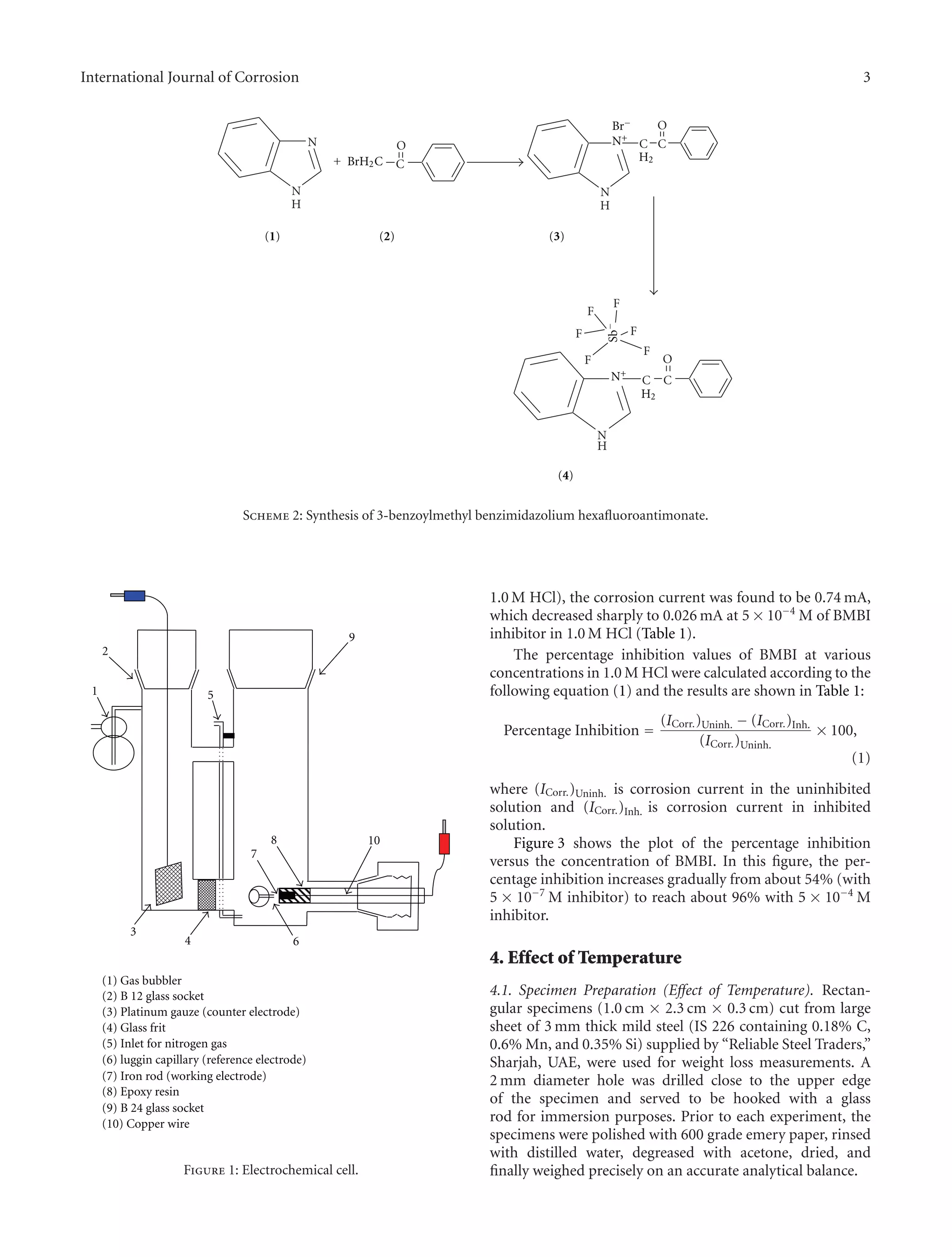
oroantimonate (BMBI). The 3-benzoylmethyl benzimida-
zolium bromide salt (3) was prepared by refluxing an
equimolar mixture of the 1-vinylmidazole and phenacyl
bromide (2) in acetone as follows.
2.50 grams (0.021 mol) from benzimidazole (1) and 4.20
grams from phenacyl bromide (0.023 mol) (2), in 100 mL
acetone, were refluxed for two hours. After cooling to room
temperature, a crystalline solid of salt (3) was collected by
filtration then washed with excess diethyl ether and dried.
The bromide salt (3) was converted to the hexafluoroan-
timonate salt (4) by treatment with potassium hexafluoroan-
timonate (KSbF6) in methanol/water mixture 70/30% by
volume. After stirring for 20 min, the reaction product was
filtered, washed several times with water then with diethyl
ether, and dried under vacuum at room temperature. Dis-
solution in chloroform and addition of excess diethyl ether
gave the pure hexafluoroantimonate salt in 80 yield percent
as shown in Scheme 2.
3. Electrochemistry
3.1. Electrode Preparation (Electrochemistry). A 5 mm diam-
eter piece cut from a mild steel rod (IS 226 containing
0.18% C, 0.6% Mn, and 0.35% Si) supplied by “Reliable Steel
Traders,” Sharjah, UAE, formed the working electrode and
was mounted, using Araldite epoxy resin, in a glass tube that
fits in the electrochemical cell. Prior to each experiment, the
working mild steel electrode was abraded using a series of
carborundum papers starting with 600 grades and ending
with 1200 grades. The electrode surface was then polished
F
F
FF
F
N
H
C C
O
F
Sb−
N+
H2
Scheme 1: 3-Benzoylmethyl benzimidazolium hexafluoroanti-
monate.
with 0.3 μm alumina on cloth, washed with deionized
distilled water, and rinsed with pure ethanol before being
transferred to the electrochemical cell that contained deaer-
ated fresh electrolyte.
3.2. Instrumentation (Electrochemistry). The electrochemical
cell (Figure 1) consisted of a mild steel working electrode
(WE), a saturated calomel electrode (SCE) as a reference
electrode (RE), and platinum gauze counter electrode (CE).
Prior to each experiment, the electrolyte was deaerated by
nitrogen bubbling. The cell was designed in a way that the
nitrogen was allowed to escape into the solution, precluding
its collection at the electrode surface.
In order to protect the working electrode from any
substance that may be produced at the counter electrode
during the electrochemical reactions, the counterelectrode
compartment was separated from the working-electrode
compartment with a glass frit. The following electro-
chemical instrument was used a PC controlled AUTO-
LAB PGSTAT128N Modular Potentiostat (electrochemical
workstation) (supplied from Metrohm) capable of driving
currents up to ±800 mA with an output potential across the
cell of up to ±10 V.
3.3. Measuring Procedure (Electrochemistry). Electrochemi-
cal corrosion measurements (Tafel plots) were carried out
on the mild steel electrode, prepared as described before,
in 1.0 M HCl and in 1.0 M HCl containing various concen-
trations of the prepared BMBI inhibitor. The concentration
of the inhibitor ranged from 5 × 10⁻⁷
M to 5 × 10⁻⁴
M.
Due to the restricted solubility of BMBI inhibitor, higher
concentrations could not be prepared.
The electrode potential was scanned between over poten-
tials of −100 mV to +100 mV versus SCE at a sweep rate of
1 mV·s−1.
3.4. Results and Discussions (Electrochemistry). Figure 2
shows the anodic and cathodic polarization curves (Tafel
plot) of the mild steel electrode in deaerated 1.0 M HCl solu-
tion with and without the addition of various concentrations
of 3-benzoylmethyl benzimidazolium hexafluoroantimonate
(BMBI). The presence of the inhibitor affected both the
anodic and cathodic branches of the curve as it can be
clearly seen in Figure 2. The corrosion current was found
to decrease with the increase of the concentration of BMBI
inhibitor as shown in Table 1. In the absence of inhibitor (in
International Journal of Corrosion 3
F
F
F
F
F
N
H
C C
O
F
+ C
ON
N
H
N
H
C C
O
BrH2C
Br−
N+
N+
(1) (2) (3)
(4)
Sb−
H2
H2
Scheme 2: Synthesis of 3-benzoylmethyl benzimidazolium hexafluoroantimonate.
1
9
2
5
8 10
6
3
4
7
(1) Gas bubbler
(2) B 12 glass socket
(3) Platinum gauze (counter electrode)
(4) Glass frit
(5) Inlet for nitrogen gas
(6) luggin capillary (reference electrode)
(7) Iron rod (working electrode)
(8) Epoxy resin
(9) B 24 glass socket
(10) Copper wire
Figure 1: Electrochemical cell.
1.0 M HCl), the corrosion current was found to be 0.74 mA,
which decreased sharply to 0.026 mA at 5 × 10⁻⁴
M of BMBI
inhibitor in 1.0 M HCl (Table 1).
The percentage inhibition values of BMBI at various
concentrations in 1.0 M HCl were calculated according to the
following equation (1) and the results are shown in Table 1:
Percentage Inhibition =
(ICorr.)Uninh. − (ICorr.)Inh.
(ICorr.)Uninh.
× 100,
(1)
where (ICorr.)Uninh. is corrosion current in the uninhibited
solution and (ICorr.)Inh. is corrosion current in inhibited
solution.
Figure 3 shows the plot of the percentage inhibition
versus the concentration of BMBI. In this figure, the per-
centage inhibition increases gradually from about 54% (with
5 × 10⁻⁷
M inhibitor) to reach about 96% with 5 × 10⁻⁴
M
inhibitor.
4. Effect of Temperature
4.1. Specimen Preparation (Effect of Temperature). Rectan-
gular specimens (1.0 cm × 2.3 cm × 0.3 cm) cut from large
sheet of 3 mm thick mild steel (IS 226 containing 0.18% C,
0.6% Mn, and 0.35% Si) supplied by “Reliable Steel Traders,”
Sharjah, UAE, were used for weight loss measurements. A
2 mm diameter hole was drilled close to the upper edge
of the specimen and served to be hooked with a glass
rod for immersion purposes. Prior to each experiment, the
specimens were polished with 600 grade emery paper, rinsed
with distilled water, degreased with acetone, dried, and
finally weighed precisely on an accurate analytical balance.
4 International Journal of Corrosion
Table 1: Tafel corrosion currents and percent inhibitions of 3-benzoylmethyl benzimidazolium hexafluoroantimonate (BMBI) at various
concentrations in 1.0 M HCl at room temperature.
1.0 M HCl
1.0 M HCl +
5 × 10⁻⁷
M BMBI
1.0 M HCl +
5 × 10⁻⁶
M BMBI
1.0 M HCl +
5 × 10⁻⁵
M BMBI
1.0 M HCl +
5 × 10⁻⁴
M BMBI
Erest/V versus SCE −0.459 −0.472 −0.472 −0.461 −0.583
I corrosion/mA 0.74 0.34 0.27 0.16 0.026
Percent Inhibition — 54.05 63.51 78.38 96.49
0.001
0.0001
1E−5
−0.55 −0.5 −0.45 −0.4 −0.35
Potential applied (V)
Y = 1M HCl
Y = 5 × 10⁻⁴
Y = 5 × 10⁻⁷
Y = 5 × 10⁻⁵
Y = 5 × 10⁻⁶
WE(1).current(A)
Figure 2: Anodic and cathodic polarization curves of mild steel
in an uninhibited 1.0 M HCl solution and in 1.0 M HCl contain-
ing various concentrations of 3-benzoylmethyl benzimidazolium
hexafluoroantimonate (BMBI) at ambient temperature. (1) 1.0 M
HCl; (2) 1.0 M HCl + 5.0 × 10⁻⁷
M inhibitor; (3) 1.0 M HCl +
5.0 × 10⁻⁶
M inhibitor; (4) 1.0 M HCl + 5.0 × 10⁻⁵
M inhibitor;
(5) 1.0 M HCl + 5.0 × 10⁻⁴
M inhibitor.
4.2. Instrumentation (Effect of Temperature). The experimen-
tal setup consisted of a 250 mL round bottom flask fitted
with a reflux condenser and a long glass rod on which the
specimen was hooked and in turn immersed in a thermally
controlled water bath.
4.3. Measuring Procedure (Effect of Temperature). The flask
was filled with 100 mL of 1.0 M HCl solution either with
or without BMBI of various concentrations, then placed in
water bath. As soon as the required working temperature
was reached, the precisely weighed mild steel specimen was
immersed in the solution and left there for exactly six hours,
after which the sample was removed, rinsed with distilled
deionized water, degreased with acetone, dried, and finally
weighed precisely on an accurate analytical balance. This
0
10
20
30
40
50
60
70
80
90
100
Inhibition(%)
Inhibitor concentration (M)
1E−06 1E−05 1E−04 1E−03
Figure 3: Percentage inhibition versus the concentration of 3-
benzoylmethyl benzimidazolium hexafluoroantimonate (BMBI) at
ambient temperature.
procedure was repeated with all the samples with a variety
of inhibitor concentrations ranging from 5 × 10⁻⁷
M up to
5 × 10⁻⁴
M and at temperatures ranging from 303 K to 343 K.
4.4. Results and Discussions (Effect of Temperature). Weight
loss corrosion tests were carried out on the mild steel in
1 M HCl in the absence and presence of (BMBI) over a
period of 6 hours. Table 2 represents the corrosion rates
[mg·cm−2·h−1], and the percentage efficiencies [%] for the
studied inhibitor with concentrations varying from 5 ×
10−7
M to 5×10⁻⁴
M at 303, 313, 323, 333, and 343 K, respec-
tively. The percentage efficiency was calculated according to
the following expression (2):
% Inhibition =
WUninh. − WInh.
WUninh.
× 100, (2)
where WUninh. is corrosion rate without inhibitor; and WInh.
is corrosion rate with inhibitor.
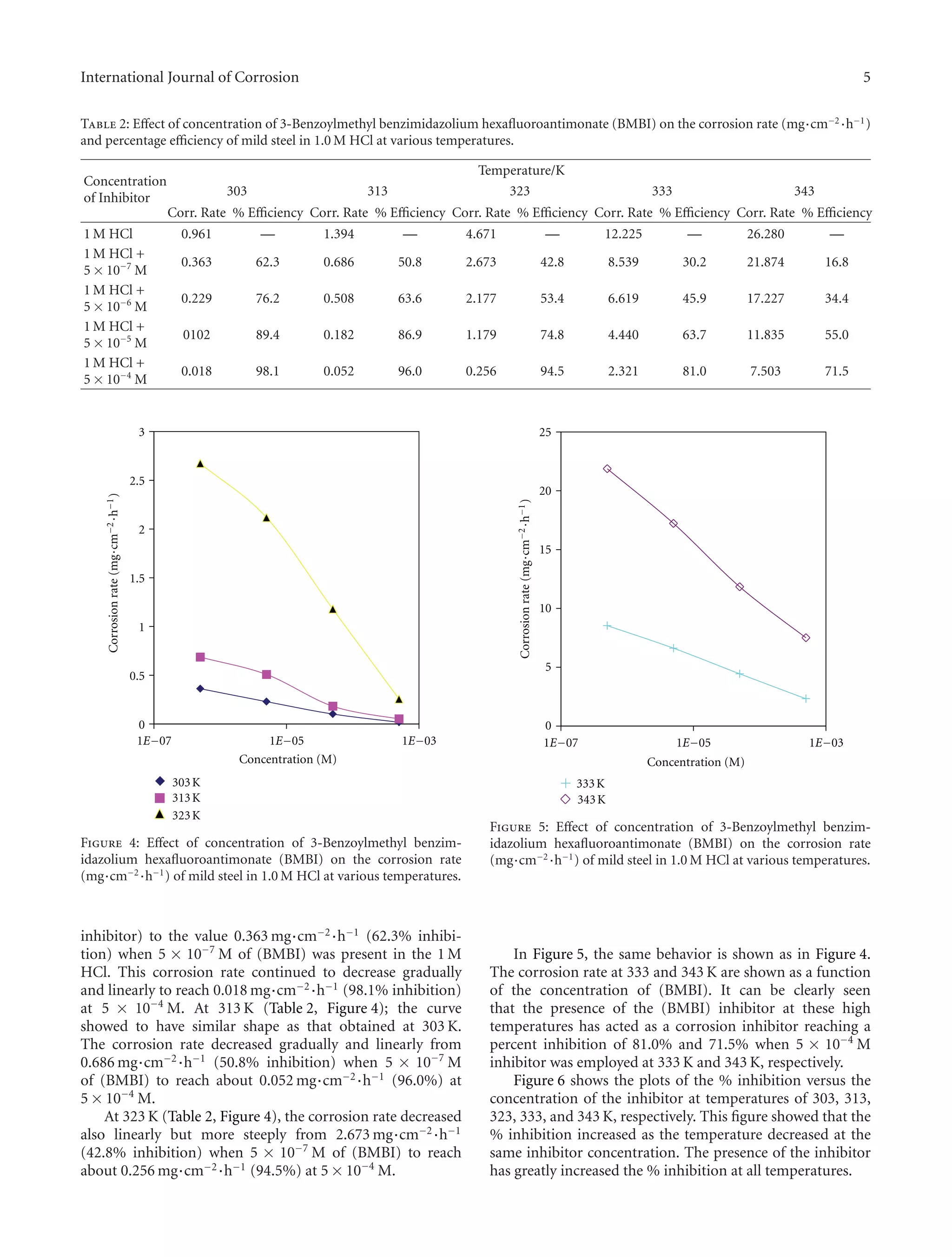
Figures 4 and 5 show the plots of the corrosion rate
of (BMBI) as a function of concentration at 303, 313, 323,
333, and 343 K extracted from Table 2. At 303 K (Table 2,
Figure 4), the corrosion rate dropped sharply from the
value 0.961 mg·cm−2·h−1 (1 M HCl in the absence of the
International Journal of Corrosion 5
Table 2: Effect of concentration of 3-Benzoylmethyl benzimidazolium hexafluoroantimonate (BMBI) on the corrosion rate (mg·cm−2·h−1)
and percentage efficiency of mild steel in 1.0 M HCl at various temperatures.
Concentration
of Inhibitor
Temperature/K
303 313 323 333 343
Corr. Rate % Efficiency Corr. Rate % Efficiency Corr. Rate % Efficiency Corr. Rate % Efficiency Corr. Rate % Efficiency
1 M HCl 0.961 — 1.394 — 4.671 — 12.225 — 26.280 —
1 M HCl +
5 × 10⁻⁷
M
0.363 62.3 0.686 50.8 2.673 42.8 8.539 30.2 21.874 16.8
1 M HCl +
5 × 10⁻⁶
M
0.229 76.2 0.508 63.6 2.177 53.4 6.619 45.9 17.227 34.4
1 M HCl +
5 × 10⁻⁵
M
0102 89.4 0.182 86.9 1.179 74.8 4.440 63.7 11.835 55.0
1 M HCl +
5 × 10⁻⁴
M
0.018 98.1 0.052 96.0 0.256 94.5 2.321 81.0 7.503 71.5
3
2.5
2
1.5
1
0.5
0
303K
313K
323K
Corrosionrate(mg·cm−2·h−1)
Concentration (M)
1E−07 1E−05 1E−03
Figure 4: Effect of concentration of 3-Benzoylmethyl benzim-
idazolium hexafluoroantimonate (BMBI) on the corrosion rate
(mg·cm−2·h−1) of mild steel in 1.0 M HCl at various temperatures.
inhibitor) to the value 0.363 mg·cm−2·h−1 (62.3% inhibi-
tion) when 5 × 10⁻⁷
M of (BMBI) was present in the 1 M
HCl. This corrosion rate continued to decrease gradually
and linearly to reach 0.018 mg·cm−2·h−1 (98.1% inhibition)
at 5 × 10⁻⁴
M. At 313 K (Table 2, Figure 4); the curve
showed to have similar shape as that obtained at 303 K.
The corrosion rate decreased gradually and linearly from
0.686 mg·cm−2·h−1 (50.8% inhibition) when 5 × 10⁻⁷
M
of (BMBI) to reach about 0.052 mg·cm−2·h−1 (96.0%) at
5 × 10⁻⁴
M.
At 323 K (Table 2, Figure 4), the corrosion rate decreased
also linearly but more steeply from 2.673 mg·cm−2·h−1
(42.8% inhibition) when 5 × 10⁻⁷
M of (BMBI) to reach
about 0.256 mg·cm−2·h−1 (94.5%) at 5 × 10⁻⁴
M.
333K
343K
Corrosionrate(mg·cm−2·h−1)
Concentration (M)
25
20
15
10
5
0
1E−07 1E−05 1E−03
Figure 5: Effect of concentration of 3-Benzoylmethyl benzim-
idazolium hexafluoroantimonate (BMBI) on the corrosion rate
(mg·cm−2·h−1) of mild steel in 1.0 M HCl at various temperatures.
In Figure 5, the same behavior is shown as in Figure 4.
The corrosion rate at 333 and 343 K are shown as a function
of the concentration of (BMBI). It can be clearly seen
that the presence of the (BMBI) inhibitor at these high
temperatures has acted as a corrosion inhibitor reaching a
percent inhibition of 81.0% and 71.5% when 5 × 10⁻⁴
M
inhibitor was employed at 333 K and 343 K, respectively.
Figure 6 shows the plots of the % inhibition versus the
concentration of the inhibitor at temperatures of 303, 313,
323, 333, and 343 K, respectively. This figure showed that the
% inhibition increased as the temperature decreased at the
same inhibitor concentration. The presence of the inhibitor
has greatly increased the % inhibition at all temperatures.
6 International Journal of Corrosion
Table 3: The data obtained from the weight loss measurements for Arrhenius equation: (I/T) against ln (corrosion rate).
(1/T) × 103
K−1 Ln corrosion rate (mg·cm−2·h−1)
1 M HCl 1 M HCl + 5 × 10⁻⁷
M 1 M HCl + 5 × 10⁻⁶
M 1 M HCl + 5 × 10⁻⁵
M 1 M HCl + 5 × 10⁻⁴
M
3.30 −0.03978 −1.01611 −1.47403 −2.28278 −4.01738
3.19 0.332177 −0.37688 −0.67727 −1.70375 −2.96423
3.10 1.541373 0.9832 0.77795 0.16467 −1.36258
3.00 2.503483 2.14464 1.88994 1.49065 0.842
2.92 3.268808 3.0853 2.84648 2.47106 2.0153
0
10
20
30
40
50
60
70
80
90
100
Inhibition(%)
Inhibitor concentration (M)
303K
313K
323K
333K
343K
1E−07 1E−05 1E−03
Figure 6: Effect of concentration of 3-Benzoylmethyl benzimi-
dazolium hexafluoroantimonate (BMBI) triphenyl phosphonium
bromide on the percent inhibition of mild steel in 1.0 M HCl at
various temperatures.
Table 4: The activation energy (Ea) for the corrosion of mild steel
in 1.0 M HCl with and without 3-benzoylmethyl benzimidazolium
hexafluoroantimonate inhibitor at various concentrations.
System
Activation energy, Ea (kcal·mol−1
)
5 × 10⁻⁴
M 5 × 10⁻⁵
M 5 × 10⁻⁶
M 5 × 10⁻⁷
M
1 M HCl 18.27 18.27 18.27 18.27
1 M HCl + BMBI 33.06 26.43 23.35 22.31
The data obtained from the weight loss measurements
(Table 3) were plotted in accordance to Arrhenius equation
(3):
lnrate = −
Ea
RT
+ const., (3)
where Ea is activation energy [kcal·mol−1], R is gas constant
[kcal·mol−1], T is absolute temperature [K], and const. is
constant.
3.5
2.5
1.5
0.5
−0.5
−1.5
−2.5
−3.5
−4.5
2.8 3 3.2 3.4
Lncorrosionrate(mg·cm−2·h−1)
1M HCl
5 × 10⁻⁷ M
5 × 10⁻⁶ M
5 × 10⁻⁵ M
5 × 10⁻⁴ M
1/T × 103 (K−1)
Figure 7: Effect of temperature on the corrosion rate of mild
steel in 1.0 M HCl solution with and without the presence
of various concentrations of 3-benzoylmethyl benzimidazolium
hexafluoroantimonate (BMBI).
Figure 7 represents the Arrhenius plot of the corrosion
of mild steel in 1 M HCl solution (Ln corrosion rate as a
function of 1/T) with and without the presence of (BMBI)
at concentrations ranging from 5 × 10⁻⁴
M to 5 × 10⁻⁷
M.
From this figure, the slope (−Ea/R) of each individual line
was determined and used to calculate the activation energy
according to (3) and taking R = 1.987 × 10⁻³
kcal·mol−1
(Table 4). The increase of concentration of (BMBI) (from
5 × 10⁻⁷
M to 5 × 10⁻⁴
M) increased the activation ener-
gies for the corrosion of mild steel in 1 M HCl (initially
18.27 kcal·mol−1) (Table 4). The increase in the activation
energies for the corrosion is attributed to a decrease in the
adsorption of the inhibitor on the metal surface as the
temperature increased; subsequently, an increase in the cor-
rosion rate will result due to the greater exposed area of the
metal surface to the acid.
The results in Table 4 show that the activation energy (Ea)
for the corrosion of mild steel in the presence of the inhibitor
is higher compared to the activation energy in the absence of
International Journal of Corrosion 7
Table 5: Effect of concentration of 3-benzoylmethyl benzimidazolium hexafluoroantimonate on surface coverage for mild steel in 1.0 M
HCl at various temperatures.
Concentration of inhibitor
Temperature/K
303 313 323 333 343
Surface coverage θ Surface coverage θ Surface coverage θ Surface coverage θ Surface coverage θ
1 M HCl + 5 × 10⁻⁷
M 0.623 0.508 0.428 0.302 0.168
1 M HCl + 5 × 10⁻⁶
M 0.762 0.636 0.534 0.459 0.344
1 M HCl + 5 × 10⁻⁵
M 0.894 0.869 0.748 0.637 0.550
1 M HCl + 5 × 10⁻⁴
M 0.981 0.960 0.945 0.810 0.715
0
0.2
0.4
0.6
0.8
1
Surfacecoverage
−18 −14 −10 −6
Ln concentration (M)
303K
313K
323K
333K
343K
Figure 8: Effect of concentration of 3-benzoylmethyl benzimida-
zolium hexafluoroantimonate (BMBI) on the surface coverage of
mild steel in 1.0M HCl at various temperatures.
inhibitor at all concentrations ranging from 5×10⁻⁴
M to 5×
10−7
M (from about 33 to about 22 kcal·mol−1, resp.). This
can be attributed to the fact that higher values of Ea in the
presence of inhibitor compared to its absence are generally
consistent with a physisorption, while unchanged or lower
values of Ea in inhibited solution suggest charge sharing or
transfer from the organic inhibitor to the metal surface to
form coordinate covalent bonds [42, 43].
Table 5 shows the surface coverage, θ, of various con-
centrations of (BMBI) (from 5 × 10⁻⁷
M to 5 × 10⁻⁴
M) on
mild steel surface as a function of temperature. These values
were extracted from the corresponding % efficiency values
reported earlier in Table 2. The plot of surface coverage
against the natural logarithm of the concentration, ln C, for
mild steel in the presence of the various inhibitor concen-
trations is shown in Figure 8. After examining the data and
adjusting them to different theoretical adsorption isotherms,
it was concluded that all inhibitors were adsorbed on the
mild steel surface according to Temkin isotherm:
−2aθ = lnKC, (4)
where a is molecular interaction constant, θ is degree of
coverage, K is equilibrium constant for the adsorption
reaction, and C is concentration of the inhibitor.
The equilibrium constant for the adsorption reaction, K,
is related to the standard free energy of adsorption via the
following equation given by Damaskin et al. [1]:
K =
1
55.5
exp −
ΔG
RT
, (5)
where K is equilibrium constant for the adsorption reaction,
55.5 is concentration of water [mol·L−1], ΔG is standard free
energy [kcal·mol−1], R is gas constant [kcal·mol−1], and T is
absolute temperature [K].
According to (4), the straight lines shown in Figure 8 will
have the following slopes and intercepts:
Slope = −
1
2a
, (6)
Intercept = −
1
2a
lnK. (7)
Combination of (6) and (7) leads to the following relation-
ship:
Intercept = Slope × (lnK), (8)
from which the equilibrium constant for the adsorption
reaction, K, can be calculated:
K = e(Intercept/slope)
. (9)
The standard free energy of adsorption of the inhibitor,
ΔG0, can be calculated from the results in Figure 8 used to
calculate the equilibrium constant, K, and (5) at various
temperatures (303 to 343 K).
The enthalpy of adsorption, ΔH0, for the inhibitor can be
calculated from the following equation:
ΔH0
= Ea − RT. (10)
The entropy, ΔS0, can be calculated at various temperatures
for the inhibitor using the following equation:
ΔG0
= ΔH0
− TΔS0
. (11)
8 International Journal of Corrosion
Table 6: The free energy of adsorption (ΔGads) for mild steel in
1.0 M HCl in the presence of 3-benzoylmethyl benzimidazolium
hexafluoroantimonate (BMBI) at various temperatures (303 K–
343 K).
ΔG, kcal·mol−1
303 K 313 K 323 K 333 K 343 K
−18.55 −16.07 −15.33 −15.06 −14.07
Table 7: The enthalpy of adsorption (ΔH) for mild steel in
1.0 M HCl in the presence of 2 × 10⁻⁵
M 3-benzoylmethyl ben-
zimidazolium hexafluoroantimonate (BMBI) inhibitor at various
temperatures (303 K–343 K).
ΔH, kcal·mol−1
303 K 313 K 323 K 333 K 343 K
32.46 32.44 32.42 32.40 32.38
Table 8: The change in entropy (ΔS) for mild steel in 1.0 M HCl in
the presence of 3-benzoylmethyl benzimidazolium hexafluoroanti-
monate (BMBI) inhibitor at various temperatures (303 K–343 K).
ΔS, kcal·K−1·mol−1
303 K 313 K 323 K 333 K 343 K
0.168 0.155 0.148 0.143 0.135
Tables 6, 7, and 8 show the thermodynamic data obtained
in the presence of the inhibitor at 5 × 10⁻⁴
M. These
thermodynamic quantities represent the algebraic sum of the
values for adsorption and desorption. The negative value
of ΔG0 indicates the spontaneous adsorption of inhibitor
on the surface of the mild steel. The standard free energy,
ΔG0, increases from about −19 kcal·mol−1·K−1 at 303 K
to about −14 kcal·mol−1·K−1 at 343 K. The adsorption
process is believed to be exothermic and associated with a
decrease in entropy (ΔS) of solute, while the opposite is
true for the solvent. The gain in entropy which accompanies
the substitutional adsorption process is attributed to the
increase in the solvent entropy. This agrees with the general
suggestion that the values of ΔG0 increase with the increase of
inhibition efficiency as the adsorption of organic compound
is accompanied by desorption of water molecules off the
surface [33, 45].
The high inhibition efficiency may be attributed to the
preferred flat orientation of this compound on the metal
surface. The interaction occurs between the delocalized π-
electrons of the benzimidazole and phenyl rings, the carbonyl
group (C=O), and the lone pair of electrons on N and O
atoms with the positively charged metal surface.
5. Conclusion
3-Benzoylmethyl benzimidazolium hexafluoroantimonate
was found to be a highly efficient inhibitor for mild steel
in 1.0 M HCl solution, reaching about 98% at 5.0 × 10⁻⁴
M
and room temperature, a concentration considered to be very
moderate.
3-Benzoylmethyl benzimidazolium hexafluoroantimo-
nate is a potential corrosion inhibitor since it contains not
only nitrogen atom, but also phenyl and benzimidazole ring
together with carbonyl group (C=O). It was apparent from
the molecular structure that this compound would be
adsorbed onto the metal surface through the lone pair of
electron of nitrogen and oxygen and pi electrons of the
aromatic rings (phenyl and benzimidazole) and the carbonyl
group.
The percentage of inhibition in the presence of this
inhibitor decreased as the temperature increased which indi-
cates that physical adsorption was the predominant inhibi-
tion mechanism, because the quantity of adsorbed inhibitor
decreases with increasing temperature.
Acknowledgment
The authors would like to thank the “College of Graduate
Studies and Research” at the University of Sharjah for
financially supporting this research.
References
[1] B. B. Damaskin, O. A. Pietrij, and W. W. Batrokov, “Adsorpcja
organiczeskich sojedinienij na electrodach,” Moskva, 1968.
[2] G. Okamoto, M. Nagayama, J. Kato, and T. Baba, “Effect of
organic inhibitors on the polarization characteristics of mild
steel in acid solution,” Corrosion Science, vol. 2, no. 1, pp. 21–
27, 1962.
[3] O. Benali, L. Larabi, M. Traisnel, L. Gengembre, and Y. Harek,
“Electrochemical, theoretical and XPS studies of 2-mercapto-
1-methylimidazole adsorption on carbon steel in 1 M HClO4
,” Applied Surface Science, vol. 253, no. 14, pp. 6130–6139,
2007.
[4] E. S. H. E. Ashry, A. E. Nemr, S. A. Essawy, and S. Ragab, “Cor-
rosion inhibitors part V: QSAR of benzimidazole and 2-
substituted derivatives as corrosion inhibitors by using the
quantum chemical parameters,” Progress in Organic Coatings,
vol. 61, no. 1, pp. 11–20, 2008.
[5] K. F. Khaled, “The inhibition of benzimidazole derivatives on
corrosion of iron in 1 M HCl solutions,” Electrochimica Acta,
vol. 48, no. 17, pp. 2493–2503, 2003.
[6] A. Popova, “Temperature effect on mild steel corrosion in acid
media in presence of azoles,” Corrosion Science, vol. 49, no. 5,
pp. 2144–2158, 2007.
[7] A. Popova, M. Christov, S. Raicheva, and E. Sokolova, “Ad-
sorption and inhibitive properties of benzimidazole deriva-
tives in acid mild steel corrosion,” Corrosion Science, vol. 46,
no. 6, pp. 1333–1350, 2004.
[8] A. Popova, M. Christov, and A. Zwetanova, “Effect of the mol-
ecular structure on the inhibitor properties of azoles on mild
steel corrosion in 1 M hydrochloric acid,” Corrosion Science,
vol. 49, no. 5, pp. 2131–2143, 2007.
[9] V. S. Sastri, J. R. Perumareddi, M. Lashgari, and M. Elbouj-
daini, “Application of ligand field theory in corrosion inhibi-
tion,” Corrosion, vol. 64, no. 4, pp. 283–288, 2008.
[10] M. Scendo and M. Hepel, “Inhibiting properties of benzimida-
zole films for Cu(II)/Cu(I) reduction in chloride media stud-
ied by RDE and EQCN techniques,” Journal of Electroanalytical
Chemistry, vol. 613, no. 1, pp. 35–50, 2008.
International Journal of Corrosion 9
[11] S. Vishwanatham and A. Kumar, “Corrosion inhibition of mild
steel in binary acid mixture,” Corrosion Reviews, vol. 23, no. 2-
3, pp. 181–194, 2005.
[12] D. Q. Zhang, L. X. Gao, and G. D. Zhou, “Inhibition of copper
corrosion in aerated hydrochloric acid solution by heterocyclic
compounds containing a mercapto group,” Corrosion Science,
vol. 46, no. 12, pp. 3031–3040, 2004.
[13] D. Q. Zhang, L. X. Gao, G. D. Zhou, and K. Y. Lee, “Undecyl
substitution in imidazole and its action on corrosion inhibi-
tion of copper in aerated acidic chloride media,” Journal of
Applied Electrochemistry, vol. 38, no. 1, pp. 71–76, 2008.
[14] K. Tebbji, A. Aouniti, A. Attayibat et al., “Inhibition efficiency
of two bipyrazole derivatives on steel corrosion in hydrochlo-
ric acid media,” Indian Journal of Chemical Technology, vol. 18,
pp. 244–253, 2011.
[15] A. Nahl´e, I. Abu-Abdoun, and I. Abdel-Rahman, “Electro-
chemical studies of the effect of trans-4-hydroxy-4’-stilbazole
on the corrosion inhibition of mild steel in HCl solution,”
Anti-Corrosion Methods and Materials, vol. 54, no. 4, pp. 244–
248, 2007.
[16] S. M. Beloglazov, Z. I. Dzhafarov, V. N. Polyakov, and N. N.
Demushia, “Quaternary ammonium salts as corrosion in-
hibitors of steel in the presence of sulfate-reducing bacteria,”
Protection of Metals USSR, vol. 27, no. 6, pp. 810–813, 1991.
[17] A. V. Fokin, M. V. Pospelov, and A. N. Levichev, “Structural
and protective capacities of organic corrosion inhibitors. 2.
Alkylethylene diamines and quaternary ammonium salts,”
Protection of Metals USSR, vol. 19, no. 2, pp. 242–244, 1983.
[18] A. H. Nahl´e, “Electrochemical studies of corrosion inhibition
of a series of quaternary ammonium salts on iron in HCl
solution,” Corrosion Prevention and Control, vol. 44, no. 4, pp.
99–105, 1997.
[19] A. H. Nahl´e, “Inhibition of iron in HCl using benzyl trimethyl-
and triethyl-ammonium chlorides,” Corrosion Prevention and
Control, vol. 45, no. 4, pp. 124–130, 1998.
[20] A. Nahle, “Effect of triethanolamine on the electrochemical
dissolution of solder in NaOH solution,” Bulletin of Electro-
chemistry, vol. 18, no. 3, pp. 105–110, 2002.
[21] A. Nahl´e and F. C. Walsh, “Electrochemical studies of two cor-
rosion inhibitors for iron in HCl: cetyltrimethyl ammonium
bromide and tetraphenyl phosphonium chloride,” Corrosion
Prevention and Control, vol. 42, no. 2, pp. 30–34, 1995.
[22] B. V. Savithri and S. M. Mayanna, “Tetrabutyl ammonium
iodide, cetyl pyridinium bromide and cetyl trimethyl ammo-
nium bromide as corrosion inhibitors for mild steel in
sulphuric acid,” Indian Journal of Chemical Technology, vol. 3,
no. 5, pp. 256–258, 1996.
[23] T. Vasudevan, S. Muralidharan, S. Alwarappan, and S. V. K.
Iyer, “The influence of N-hexadecyl benzyl dimethyl ammo-
nium chloride on the corrosion of mild steel in acids,”
Corrosion Science, vol. 37, no. 8, pp. 1235–1244, 1995.
[24] S. Muralidharan, K. L. N. Phani, S. Pitchumani, S. Ravichan-
dran, and S. V. K. Iyer, “Polyamino-benzoquinone polymers: a
new class of corrosion inhibitors for mild steel,” Journal of the
Electrochemical Society, vol. 142, no. 5, pp. 1478–1483, 1995.
[25] J. D. Talati, M. N. Desai, and N. K. Shah, “Meta-Substituted
aniline-N-salicylidenes as corrosion inhibitors of zinc in
sulphuric acid,” Materials Chemistry and Physics, vol. 93, no.
1, pp. 54–64, 2005.
[26] T. T¨uken, B. Yazici, and M. Erbil, “The effect of nicotinamide
on iron corrosion in chloride solutions,” Turkish Journal of
Chemistry, vol. 26, no. 5, pp. 735–742, 2002.
[27] A. A. A. Fattah, E. M. Mabrouk, R. M. A. Elgalil, and M. M.
Ghoneim, “N-heterocyclic compounds as corrosion inhibitors
for Zn in HCl acid solutions,” Bulletin de la Societ´e Chimique
de France, vol. 1, pp. 48–53, 1991.
[28] S. L. Granese, B. M. Rosales, C. Oviedo, and J. O. Zerbino,
“The inhibition action of heterocyclic nitrogen organic com-
pounds on Fe and steel in HCl media,” Corrosion Science, vol.
33, no. 9, pp. 1439–1453, 1992.
[29] H. A. Al-Lohedan, E. Khamis, and Z. A. Issa, “Studies on the
influence of temperature on the adsorption of some cationic
surfactants on to steel,” Adsorption Science and Technology, vol.
13, no. 3, pp. 137–152, 1996.
[30] L. G. Qiu, A. J. Xie, and Y. H. Shen, “A novel triazole-based
cationic gemini surfactant: synthesis and effect on corrosion
inhibition of carbon steel in hydrochloric acid,” Materials
Chemistry and Physics, vol. 91, no. 2-3, pp. 269–273, 2005.
[31] B. G. Ateya, B. E. El-Anadouli, and F. M. El-Nizamy, “The
effect of thiourea on the corrosion kinetics of mild steel in
H2SO4 ,” Corrosion Science, vol. 24, no. 6, pp. 497–507, 1984.
[32] B. G. Ateya, B. E. El-Anadouli, and F. M. El-Nizamy, “The ad-
sorption of thiourea on mild steel,” Corrosion Science, vol. 24,
no. 6, pp. 509–515, 1984.
[33] A. S. Fouda, M. N. Moussa, F. I. Taha, and A. I. Elneanaa, “The
role of some thiosemicarbazide derivatives in the corrosion
inhibition of aluminium in hydrochloric acid,” Corrosion
Science, vol. 26, no. 9, pp. 719–726, 1986.
[34] A. Nahle, “Effect of temperature on the corrosion inhibition
of carbon steel in HCl solutions,” Bulletin of Electrochemistry,
vol. 17, no. 5, pp. 221–226, 2001.
[35] A. Nahl´e, I. Abdel-Rahman, and M. Alfarouk, “Effect of
temperature on the inhibition of corrosion of carbon steels
by semicarbazides and thiosemicarbazides,” Bulletin of Electro-
chemistry, vol. 21, no. 8, pp. 353–361, 2005.
[36] A. Nahl´e, I. Abu-Abdoun, and I. Abdel-Rahman, “Corrosion
Inhibition by (Anthraquinone-2-ylmethyl) triphenyl phos-
phonium bromide,” Bulletin of Electrochemistry, vol. 23, pp.
201–209, 2007.
[37] A. Nahl´e, I. Abu-Abdoun, and I. Abdel-Rahman, “Inhibition
of carbon steel corrosion by 4-vinylbenzyl triphenyl phospho-
nium chloride in HCl solution,” Anti-Corrosion Methods and
Materials, vol. 55, no. 4, pp. 217–224, 2008.
[38] S. N. Raicheva, B. V. Aleksiev, and E. I. Sokolova, “The effect
of the chemical structure of some nitrogen- and sulphur-
containing organic compounds on their corrosion inhibiting
action,” Corrosion Science, vol. 34, no. 2, pp. 343–350, 1993.
[39] S. H. Sanad, A. A. Ismail, and A. A. El-Meligi, “The effect
of temperature on the corrosion and corrosion inhibition
of steel alloys in hydrochloric acid solutions,” Bulletin of
Electrochemistry, vol. 11, no. 10, pp. 462–469, 1995.
[40] F. Zucchi, G. Trabanelli, and G. Brunoro, “The influence of the
chromium content on the inhibitive efficiency of some organic
compounds,” Corrosion Science, vol. 33, no. 7, pp. 1135–1139,
1992.
[41] Y. L. Huang, C. N. Cao, M. Lu, and H. C. Lin, “Inhibition
effects of I−
and I2 on stress corrosion cracking of stainless
steel in acidic chloride solutions,” Corrosion, vol. 49, no. 8, pp.
644–649, 1993.
[42] A. Popova, M. Christov, and T. Deligeorgiev, “Influence
of the molecular structure on the inhibitor properties of
benzimidazole derivatives on mild steel corrosion in 1 M
hydrochloric acid,” Corrosion, vol. 59, no. 9, pp. 756–764,
2003.
[43] A. Popova, E. Sokolova, S. Raicheva, and M. Christov, “AC and
DC study of the temperature effect on mild steel corrosion
in acid media in the presence of benzimidazole derivatives,”
Corrosion Science, vol. 45, no. 1, pp. 33–58, 2003.
10 International Journal of Corrosion
[44] M. Yamaguchi and H. Nishihara, “The inhibitive effect of or-
ganic cations on passive film breakdown of iron in a chloride-
containing borate buffer solution,” Corrosion Science, vol. 36,
no. 7, pp. 1133–1141, 1994.
[45] A. S. Fouda, A. Abd El-Aal, and A. B. Kandil, “The effect of
some phthalimide derivatives on the corrosion behaviour of
copper in nitric acid,” Anti-Corrosion Methods and Materials,
vol. 52, no. 2, pp. 96–101, 2005.
[46] K. Kobayashi, K. Shimizu, and M. Iida, “Structural effects of
organic compounds as corrosion inhibitors for hydrogen entry
into iron in sulphuric acid,” Corrosion Science, vol. 35, no. 5-8,
pp. 1431–1435, 1993.
[47] L. D. Skryler, E. A. Streltsova, and T. L. Skryleva, “Hydrocar-
bon chain length and their effect on corrosion inhibition by
alkylammonium chlorides,” Protection of Metals USSR, vol. 27,
no. 6, pp. 755–758, 1991.

Compound I (BMBI)-246013-Published Paper-2012

  • 1.
    Hindawi Publishing Corporation InternationalJournal of Corrosion Volume 2012, Article ID 246013, 10 pages doi:10.1155/2012/246013 Research Article Inhibition of Mild Steel Corrosion by 3-Benzoylmethyl Benzimidazolium Hexafluoroantimonate in Acidic Solution Ayssar Nahl´e, Ideisan I. Abu-Abdoun, and Ibrahim Abdel-Rahman Department of Chemistry, College of Sciences, University of Sharjah, P.O. Box 27272, Sharjah, UAE Correspondence should be addressed to Ayssar Nahl´e, anahle@sharjah.ac.ae Received 18 January 2012; Accepted 9 April 2012 Academic Editor: Flavio Deflorian Copyright © 2012 Ayssar Nahl´e et al. This is an open access article distributed under the Creative Commons Attribution License, which permits unrestricted use, distribution, and reproduction in any medium, provided the original work is properly cited. The corrosion inhibition of mild steel in 1 M HCl solution by a synthesized compound (3-benzoylmethyl benzimidazolium hexafluoroantimonate) was investigated electrochemically and by weight loss experiments. The concentration of this inhibitor ranged from 5 × 10⁻⁷ M to 5 × 10⁻⁴ M. The effect of temperature (from 303 to 343 K) and concentrations (from 5 × 10⁻⁷ M to 5 × 10⁻⁴ M) were investigated. The percentage inhibition increased with the increase of the concentration of the inhibitor and reached about 98% at the concentration of 5 × 10⁻⁴ M at 303 K. The percentage inhibition decreased with the increase of temperature. The thermodynamic parameters for the adsorption of this inhibitor on the metal surface were calculated. This compound was found to be a very good corrosion inhibitor due to the presence of nitrogen in benzimidazole and phenyl ring. 1. Introduction The corrosion of metals is a serious problem in many indus- tries, installations, and civil services such as water and sewage supplies. One of the most useful and practical methods that used to control and protect metals against corrosion is the use of inhibitors, especially in acidic media. Not only the costs due to corrosion increase rapidly, but also the efficiency of the plants and the quality of the products are also reduced. Most inhibitors are organic compounds containing polar groups strongly adsorbed on the metal surface [1, 2]. These inhibitors, which include the organic N, P, S, and OH groups, are known to be similar to catalytic poisons, as they decrease the reaction rate at the metal/solution interface without, in general, being involved in the reaction considered. It is gener- ally accepted that most organic inhibitors act via adsorption at the metal/solution interface. The mechanism by which an inhibitor decreases the corrosion current is achieved by interfering with some of the steps for the electrochemical process. The corrosion inhibition of mild steel in aggressive acidic solutions has been widely investigated. In industries, hydrochloric acid solutions are often used in order to remove scale and salts from steel surfaces, and cleaning tanks and pipelines. This treatment may be prerequisite for coating by electroplating, galvanizing, or painting techniques. The acid must be treated to prevent an extensive dissolution of the underlying metal. This treatment involves the addition of some organic inhibitors to the acid solution that adsorb at the metal/solution interface by displacing water molecules on the surface and forming a compact barrier film. Nitrogen-containing compounds as metal corrosion inhibitors have been studied thoroughly by many authors. These compounds included benzimidazole and imidazole derivatives [3–13], bipyrazole [14], stilbazole [15], qua- ternary ammonium salts [16–23], polyaminobenzoquinone polymers [24], substituted aniline-N-salicylidenes [25], amides [26], heterocyclic compounds [27, 28], and cationic surfactants [29, 30]. Other authors worked on phosphorous- containing and sulfur-containing inhibitors [15, 31–39]. Other studies involved the effect of addition of some ions on the inhibition efficiency of some organic compounds. These ions included chromium [40], iodide [41–43], and chloride [10, 44]. Structural effect of organic compounds as corrosion inhibitors was also studied [8, 42, 43, 45–47]. In all these studies, the nitrogen, phosphorous, and sulfur atom(s) in the compounds as well as the unsaturated double bonds like phenyl rings showed to be able to adsorb very well on the
  • 2.
    2 International Journalof Corrosion metal surface and form protective layer, which in turn increased the corrosion inhibition with the increase in the concentration of the inhibitor, in some cases reaching 99% inhibition [15, 18, 36, 37]. No studies have been reported on 3-benzoylmethyl ben- zimidazolium hexafluoroantimonate (BMBI) (Scheme 1), in terms of studying both the electrochemical and the tempera- ture effect on the corrosion inhibition of mild steel in 1.0 M HCl solution. Mild steel was chosen in our studies since high temperature aggressive acids are widely used in industries in connection to mild and low alloy steels. The aim of this work is (i) to synthesize a high percentage yield of pure 3-ben- zoylmethyl benzimidazolium hexafluoroantimonate (BMBI); (ii) to study, using potentiodynamic and weight loss measurements, the effect of temperature on the cor- rosion inhibition of mild steel in 1.0 M HCl solution by BMBI and to calculate the thermodynamic param- eters. The output of this study is intended to be the building block or the nucleus for a new family or group of imidazole onium derivatives in all studies of corrosion inhibitors. 2. Experimental Details 2.1. Synthesis of 3-Benzoylmethyl Benzimidazolium Hexaflu- oroantimonate (BMBI). The 3-benzoylmethyl benzimida- zolium bromide salt (3) was prepared by refluxing an equimolar mixture of the 1-vinylmidazole and phenacyl bromide (2) in acetone as follows. 2.50 grams (0.021 mol) from benzimidazole (1) and 4.20 grams from phenacyl bromide (0.023 mol) (2), in 100 mL acetone, were refluxed for two hours. After cooling to room temperature, a crystalline solid of salt (3) was collected by filtration then washed with excess diethyl ether and dried. The bromide salt (3) was converted to the hexafluoroan- timonate salt (4) by treatment with potassium hexafluoroan- timonate (KSbF6) in methanol/water mixture 70/30% by volume. After stirring for 20 min, the reaction product was filtered, washed several times with water then with diethyl ether, and dried under vacuum at room temperature. Dis- solution in chloroform and addition of excess diethyl ether gave the pure hexafluoroantimonate salt in 80 yield percent as shown in Scheme 2. 3. Electrochemistry 3.1. Electrode Preparation (Electrochemistry). A 5 mm diam- eter piece cut from a mild steel rod (IS 226 containing 0.18% C, 0.6% Mn, and 0.35% Si) supplied by “Reliable Steel Traders,” Sharjah, UAE, formed the working electrode and was mounted, using Araldite epoxy resin, in a glass tube that fits in the electrochemical cell. Prior to each experiment, the working mild steel electrode was abraded using a series of carborundum papers starting with 600 grades and ending with 1200 grades. The electrode surface was then polished F F FF F N H C C O F Sb− N+ H2 Scheme 1: 3-Benzoylmethyl benzimidazolium hexafluoroanti- monate. with 0.3 μm alumina on cloth, washed with deionized distilled water, and rinsed with pure ethanol before being transferred to the electrochemical cell that contained deaer- ated fresh electrolyte. 3.2. Instrumentation (Electrochemistry). The electrochemical cell (Figure 1) consisted of a mild steel working electrode (WE), a saturated calomel electrode (SCE) as a reference electrode (RE), and platinum gauze counter electrode (CE). Prior to each experiment, the electrolyte was deaerated by nitrogen bubbling. The cell was designed in a way that the nitrogen was allowed to escape into the solution, precluding its collection at the electrode surface. In order to protect the working electrode from any substance that may be produced at the counter electrode during the electrochemical reactions, the counterelectrode compartment was separated from the working-electrode compartment with a glass frit. The following electro- chemical instrument was used a PC controlled AUTO- LAB PGSTAT128N Modular Potentiostat (electrochemical workstation) (supplied from Metrohm) capable of driving currents up to ±800 mA with an output potential across the cell of up to ±10 V. 3.3. Measuring Procedure (Electrochemistry). Electrochemi- cal corrosion measurements (Tafel plots) were carried out on the mild steel electrode, prepared as described before, in 1.0 M HCl and in 1.0 M HCl containing various concen- trations of the prepared BMBI inhibitor. The concentration of the inhibitor ranged from 5 × 10⁻⁷ M to 5 × 10⁻⁴ M. Due to the restricted solubility of BMBI inhibitor, higher concentrations could not be prepared. The electrode potential was scanned between over poten- tials of −100 mV to +100 mV versus SCE at a sweep rate of 1 mV·s−1. 3.4. Results and Discussions (Electrochemistry). Figure 2 shows the anodic and cathodic polarization curves (Tafel plot) of the mild steel electrode in deaerated 1.0 M HCl solu- tion with and without the addition of various concentrations of 3-benzoylmethyl benzimidazolium hexafluoroantimonate (BMBI). The presence of the inhibitor affected both the anodic and cathodic branches of the curve as it can be clearly seen in Figure 2. The corrosion current was found to decrease with the increase of the concentration of BMBI inhibitor as shown in Table 1. In the absence of inhibitor (in
  • 3.
    International Journal ofCorrosion 3 F F F F F N H C C O F + C ON N H N H C C O BrH2C Br− N+ N+ (1) (2) (3) (4) Sb− H2 H2 Scheme 2: Synthesis of 3-benzoylmethyl benzimidazolium hexafluoroantimonate. 1 9 2 5 8 10 6 3 4 7 (1) Gas bubbler (2) B 12 glass socket (3) Platinum gauze (counter electrode) (4) Glass frit (5) Inlet for nitrogen gas (6) luggin capillary (reference electrode) (7) Iron rod (working electrode) (8) Epoxy resin (9) B 24 glass socket (10) Copper wire Figure 1: Electrochemical cell. 1.0 M HCl), the corrosion current was found to be 0.74 mA, which decreased sharply to 0.026 mA at 5 × 10⁻⁴ M of BMBI inhibitor in 1.0 M HCl (Table 1). The percentage inhibition values of BMBI at various concentrations in 1.0 M HCl were calculated according to the following equation (1) and the results are shown in Table 1: Percentage Inhibition = (ICorr.)Uninh. − (ICorr.)Inh. (ICorr.)Uninh. × 100, (1) where (ICorr.)Uninh. is corrosion current in the uninhibited solution and (ICorr.)Inh. is corrosion current in inhibited solution. Figure 3 shows the plot of the percentage inhibition versus the concentration of BMBI. In this figure, the per- centage inhibition increases gradually from about 54% (with 5 × 10⁻⁷ M inhibitor) to reach about 96% with 5 × 10⁻⁴ M inhibitor. 4. Effect of Temperature 4.1. Specimen Preparation (Effect of Temperature). Rectan- gular specimens (1.0 cm × 2.3 cm × 0.3 cm) cut from large sheet of 3 mm thick mild steel (IS 226 containing 0.18% C, 0.6% Mn, and 0.35% Si) supplied by “Reliable Steel Traders,” Sharjah, UAE, were used for weight loss measurements. A 2 mm diameter hole was drilled close to the upper edge of the specimen and served to be hooked with a glass rod for immersion purposes. Prior to each experiment, the specimens were polished with 600 grade emery paper, rinsed with distilled water, degreased with acetone, dried, and finally weighed precisely on an accurate analytical balance.
  • 4.
    4 International Journalof Corrosion Table 1: Tafel corrosion currents and percent inhibitions of 3-benzoylmethyl benzimidazolium hexafluoroantimonate (BMBI) at various concentrations in 1.0 M HCl at room temperature. 1.0 M HCl 1.0 M HCl + 5 × 10⁻⁷ M BMBI 1.0 M HCl + 5 × 10⁻⁶ M BMBI 1.0 M HCl + 5 × 10⁻⁵ M BMBI 1.0 M HCl + 5 × 10⁻⁴ M BMBI Erest/V versus SCE −0.459 −0.472 −0.472 −0.461 −0.583 I corrosion/mA 0.74 0.34 0.27 0.16 0.026 Percent Inhibition — 54.05 63.51 78.38 96.49 0.001 0.0001 1E−5 −0.55 −0.5 −0.45 −0.4 −0.35 Potential applied (V) Y = 1M HCl Y = 5 × 10⁻⁴ Y = 5 × 10⁻⁷ Y = 5 × 10⁻⁵ Y = 5 × 10⁻⁶ WE(1).current(A) Figure 2: Anodic and cathodic polarization curves of mild steel in an uninhibited 1.0 M HCl solution and in 1.0 M HCl contain- ing various concentrations of 3-benzoylmethyl benzimidazolium hexafluoroantimonate (BMBI) at ambient temperature. (1) 1.0 M HCl; (2) 1.0 M HCl + 5.0 × 10⁻⁷ M inhibitor; (3) 1.0 M HCl + 5.0 × 10⁻⁶ M inhibitor; (4) 1.0 M HCl + 5.0 × 10⁻⁵ M inhibitor; (5) 1.0 M HCl + 5.0 × 10⁻⁴ M inhibitor. 4.2. Instrumentation (Effect of Temperature). The experimen- tal setup consisted of a 250 mL round bottom flask fitted with a reflux condenser and a long glass rod on which the specimen was hooked and in turn immersed in a thermally controlled water bath. 4.3. Measuring Procedure (Effect of Temperature). The flask was filled with 100 mL of 1.0 M HCl solution either with or without BMBI of various concentrations, then placed in water bath. As soon as the required working temperature was reached, the precisely weighed mild steel specimen was immersed in the solution and left there for exactly six hours, after which the sample was removed, rinsed with distilled deionized water, degreased with acetone, dried, and finally weighed precisely on an accurate analytical balance. This 0 10 20 30 40 50 60 70 80 90 100 Inhibition(%) Inhibitor concentration (M) 1E−06 1E−05 1E−04 1E−03 Figure 3: Percentage inhibition versus the concentration of 3- benzoylmethyl benzimidazolium hexafluoroantimonate (BMBI) at ambient temperature. procedure was repeated with all the samples with a variety of inhibitor concentrations ranging from 5 × 10⁻⁷ M up to 5 × 10⁻⁴ M and at temperatures ranging from 303 K to 343 K. 4.4. Results and Discussions (Effect of Temperature). Weight loss corrosion tests were carried out on the mild steel in 1 M HCl in the absence and presence of (BMBI) over a period of 6 hours. Table 2 represents the corrosion rates [mg·cm−2·h−1], and the percentage efficiencies [%] for the studied inhibitor with concentrations varying from 5 × 10⁻⁷ M to 5×10⁻⁴ M at 303, 313, 323, 333, and 343 K, respec- tively. The percentage efficiency was calculated according to the following expression (2): % Inhibition = WUninh. − WInh. WUninh. × 100, (2) where WUninh. is corrosion rate without inhibitor; and WInh. is corrosion rate with inhibitor. Figures 4 and 5 show the plots of the corrosion rate of (BMBI) as a function of concentration at 303, 313, 323, 333, and 343 K extracted from Table 2. At 303 K (Table 2, Figure 4), the corrosion rate dropped sharply from the value 0.961 mg·cm−2·h−1 (1 M HCl in the absence of the
  • 5.
    International Journal ofCorrosion 5 Table 2: Effect of concentration of 3-Benzoylmethyl benzimidazolium hexafluoroantimonate (BMBI) on the corrosion rate (mg·cm−2·h−1) and percentage efficiency of mild steel in 1.0 M HCl at various temperatures. Concentration of Inhibitor Temperature/K 303 313 323 333 343 Corr. Rate % Efficiency Corr. Rate % Efficiency Corr. Rate % Efficiency Corr. Rate % Efficiency Corr. Rate % Efficiency 1 M HCl 0.961 — 1.394 — 4.671 — 12.225 — 26.280 — 1 M HCl + 5 × 10⁻⁷ M 0.363 62.3 0.686 50.8 2.673 42.8 8.539 30.2 21.874 16.8 1 M HCl + 5 × 10⁻⁶ M 0.229 76.2 0.508 63.6 2.177 53.4 6.619 45.9 17.227 34.4 1 M HCl + 5 × 10⁻⁵ M 0102 89.4 0.182 86.9 1.179 74.8 4.440 63.7 11.835 55.0 1 M HCl + 5 × 10⁻⁴ M 0.018 98.1 0.052 96.0 0.256 94.5 2.321 81.0 7.503 71.5 3 2.5 2 1.5 1 0.5 0 303K 313K 323K Corrosionrate(mg·cm−2·h−1) Concentration (M) 1E−07 1E−05 1E−03 Figure 4: Effect of concentration of 3-Benzoylmethyl benzim- idazolium hexafluoroantimonate (BMBI) on the corrosion rate (mg·cm−2·h−1) of mild steel in 1.0 M HCl at various temperatures. inhibitor) to the value 0.363 mg·cm−2·h−1 (62.3% inhibi- tion) when 5 × 10⁻⁷ M of (BMBI) was present in the 1 M HCl. This corrosion rate continued to decrease gradually and linearly to reach 0.018 mg·cm−2·h−1 (98.1% inhibition) at 5 × 10⁻⁴ M. At 313 K (Table 2, Figure 4); the curve showed to have similar shape as that obtained at 303 K. The corrosion rate decreased gradually and linearly from 0.686 mg·cm−2·h−1 (50.8% inhibition) when 5 × 10⁻⁷ M of (BMBI) to reach about 0.052 mg·cm−2·h−1 (96.0%) at 5 × 10⁻⁴ M. At 323 K (Table 2, Figure 4), the corrosion rate decreased also linearly but more steeply from 2.673 mg·cm−2·h−1 (42.8% inhibition) when 5 × 10⁻⁷ M of (BMBI) to reach about 0.256 mg·cm−2·h−1 (94.5%) at 5 × 10⁻⁴ M. 333K 343K Corrosionrate(mg·cm−2·h−1) Concentration (M) 25 20 15 10 5 0 1E−07 1E−05 1E−03 Figure 5: Effect of concentration of 3-Benzoylmethyl benzim- idazolium hexafluoroantimonate (BMBI) on the corrosion rate (mg·cm−2·h−1) of mild steel in 1.0 M HCl at various temperatures. In Figure 5, the same behavior is shown as in Figure 4. The corrosion rate at 333 and 343 K are shown as a function of the concentration of (BMBI). It can be clearly seen that the presence of the (BMBI) inhibitor at these high temperatures has acted as a corrosion inhibitor reaching a percent inhibition of 81.0% and 71.5% when 5 × 10⁻⁴ M inhibitor was employed at 333 K and 343 K, respectively. Figure 6 shows the plots of the % inhibition versus the concentration of the inhibitor at temperatures of 303, 313, 323, 333, and 343 K, respectively. This figure showed that the % inhibition increased as the temperature decreased at the same inhibitor concentration. The presence of the inhibitor has greatly increased the % inhibition at all temperatures.
  • 6.
    6 International Journalof Corrosion Table 3: The data obtained from the weight loss measurements for Arrhenius equation: (I/T) against ln (corrosion rate). (1/T) × 103 K−1 Ln corrosion rate (mg·cm−2·h−1) 1 M HCl 1 M HCl + 5 × 10⁻⁷ M 1 M HCl + 5 × 10⁻⁶ M 1 M HCl + 5 × 10⁻⁵ M 1 M HCl + 5 × 10⁻⁴ M 3.30 −0.03978 −1.01611 −1.47403 −2.28278 −4.01738 3.19 0.332177 −0.37688 −0.67727 −1.70375 −2.96423 3.10 1.541373 0.9832 0.77795 0.16467 −1.36258 3.00 2.503483 2.14464 1.88994 1.49065 0.842 2.92 3.268808 3.0853 2.84648 2.47106 2.0153 0 10 20 30 40 50 60 70 80 90 100 Inhibition(%) Inhibitor concentration (M) 303K 313K 323K 333K 343K 1E−07 1E−05 1E−03 Figure 6: Effect of concentration of 3-Benzoylmethyl benzimi- dazolium hexafluoroantimonate (BMBI) triphenyl phosphonium bromide on the percent inhibition of mild steel in 1.0 M HCl at various temperatures. Table 4: The activation energy (Ea) for the corrosion of mild steel in 1.0 M HCl with and without 3-benzoylmethyl benzimidazolium hexafluoroantimonate inhibitor at various concentrations. System Activation energy, Ea (kcal·mol−1 ) 5 × 10⁻⁴ M 5 × 10⁻⁵ M 5 × 10⁻⁶ M 5 × 10⁻⁷ M 1 M HCl 18.27 18.27 18.27 18.27 1 M HCl + BMBI 33.06 26.43 23.35 22.31 The data obtained from the weight loss measurements (Table 3) were plotted in accordance to Arrhenius equation (3): lnrate = − Ea RT + const., (3) where Ea is activation energy [kcal·mol−1], R is gas constant [kcal·mol−1], T is absolute temperature [K], and const. is constant. 3.5 2.5 1.5 0.5 −0.5 −1.5 −2.5 −3.5 −4.5 2.8 3 3.2 3.4 Lncorrosionrate(mg·cm−2·h−1) 1M HCl 5 × 10⁻⁷ M 5 × 10⁻⁶ M 5 × 10⁻⁵ M 5 × 10⁻⁴ M 1/T × 103 (K−1) Figure 7: Effect of temperature on the corrosion rate of mild steel in 1.0 M HCl solution with and without the presence of various concentrations of 3-benzoylmethyl benzimidazolium hexafluoroantimonate (BMBI). Figure 7 represents the Arrhenius plot of the corrosion of mild steel in 1 M HCl solution (Ln corrosion rate as a function of 1/T) with and without the presence of (BMBI) at concentrations ranging from 5 × 10⁻⁴ M to 5 × 10⁻⁷ M. From this figure, the slope (−Ea/R) of each individual line was determined and used to calculate the activation energy according to (3) and taking R = 1.987 × 10⁻³ kcal·mol−1 (Table 4). The increase of concentration of (BMBI) (from 5 × 10⁻⁷ M to 5 × 10⁻⁴ M) increased the activation ener- gies for the corrosion of mild steel in 1 M HCl (initially 18.27 kcal·mol−1) (Table 4). The increase in the activation energies for the corrosion is attributed to a decrease in the adsorption of the inhibitor on the metal surface as the temperature increased; subsequently, an increase in the cor- rosion rate will result due to the greater exposed area of the metal surface to the acid. The results in Table 4 show that the activation energy (Ea) for the corrosion of mild steel in the presence of the inhibitor is higher compared to the activation energy in the absence of
  • 7.
    International Journal ofCorrosion 7 Table 5: Effect of concentration of 3-benzoylmethyl benzimidazolium hexafluoroantimonate on surface coverage for mild steel in 1.0 M HCl at various temperatures. Concentration of inhibitor Temperature/K 303 313 323 333 343 Surface coverage θ Surface coverage θ Surface coverage θ Surface coverage θ Surface coverage θ 1 M HCl + 5 × 10⁻⁷ M 0.623 0.508 0.428 0.302 0.168 1 M HCl + 5 × 10⁻⁶ M 0.762 0.636 0.534 0.459 0.344 1 M HCl + 5 × 10⁻⁵ M 0.894 0.869 0.748 0.637 0.550 1 M HCl + 5 × 10⁻⁴ M 0.981 0.960 0.945 0.810 0.715 0 0.2 0.4 0.6 0.8 1 Surfacecoverage −18 −14 −10 −6 Ln concentration (M) 303K 313K 323K 333K 343K Figure 8: Effect of concentration of 3-benzoylmethyl benzimida- zolium hexafluoroantimonate (BMBI) on the surface coverage of mild steel in 1.0M HCl at various temperatures. inhibitor at all concentrations ranging from 5×10⁻⁴ M to 5× 10⁻⁷ M (from about 33 to about 22 kcal·mol−1, resp.). This can be attributed to the fact that higher values of Ea in the presence of inhibitor compared to its absence are generally consistent with a physisorption, while unchanged or lower values of Ea in inhibited solution suggest charge sharing or transfer from the organic inhibitor to the metal surface to form coordinate covalent bonds [42, 43]. Table 5 shows the surface coverage, θ, of various con- centrations of (BMBI) (from 5 × 10⁻⁷ M to 5 × 10⁻⁴ M) on mild steel surface as a function of temperature. These values were extracted from the corresponding % efficiency values reported earlier in Table 2. The plot of surface coverage against the natural logarithm of the concentration, ln C, for mild steel in the presence of the various inhibitor concen- trations is shown in Figure 8. After examining the data and adjusting them to different theoretical adsorption isotherms, it was concluded that all inhibitors were adsorbed on the mild steel surface according to Temkin isotherm: −2aθ = lnKC, (4) where a is molecular interaction constant, θ is degree of coverage, K is equilibrium constant for the adsorption reaction, and C is concentration of the inhibitor. The equilibrium constant for the adsorption reaction, K, is related to the standard free energy of adsorption via the following equation given by Damaskin et al. [1]: K = 1 55.5 exp − ΔG RT , (5) where K is equilibrium constant for the adsorption reaction, 55.5 is concentration of water [mol·L−1], ΔG is standard free energy [kcal·mol−1], R is gas constant [kcal·mol−1], and T is absolute temperature [K]. According to (4), the straight lines shown in Figure 8 will have the following slopes and intercepts: Slope = − 1 2a , (6) Intercept = − 1 2a lnK. (7) Combination of (6) and (7) leads to the following relation- ship: Intercept = Slope × (lnK), (8) from which the equilibrium constant for the adsorption reaction, K, can be calculated: K = e(Intercept/slope) . (9) The standard free energy of adsorption of the inhibitor, ΔG0, can be calculated from the results in Figure 8 used to calculate the equilibrium constant, K, and (5) at various temperatures (303 to 343 K). The enthalpy of adsorption, ΔH0, for the inhibitor can be calculated from the following equation: ΔH0 = Ea − RT. (10) The entropy, ΔS0, can be calculated at various temperatures for the inhibitor using the following equation: ΔG0 = ΔH0 − TΔS0 . (11)
  • 8.
    8 International Journalof Corrosion Table 6: The free energy of adsorption (ΔGads) for mild steel in 1.0 M HCl in the presence of 3-benzoylmethyl benzimidazolium hexafluoroantimonate (BMBI) at various temperatures (303 K– 343 K). ΔG, kcal·mol−1 303 K 313 K 323 K 333 K 343 K −18.55 −16.07 −15.33 −15.06 −14.07 Table 7: The enthalpy of adsorption (ΔH) for mild steel in 1.0 M HCl in the presence of 2 × 10⁻⁵ M 3-benzoylmethyl ben- zimidazolium hexafluoroantimonate (BMBI) inhibitor at various temperatures (303 K–343 K). ΔH, kcal·mol−1 303 K 313 K 323 K 333 K 343 K 32.46 32.44 32.42 32.40 32.38 Table 8: The change in entropy (ΔS) for mild steel in 1.0 M HCl in the presence of 3-benzoylmethyl benzimidazolium hexafluoroanti- monate (BMBI) inhibitor at various temperatures (303 K–343 K). ΔS, kcal·K−1·mol−1 303 K 313 K 323 K 333 K 343 K 0.168 0.155 0.148 0.143 0.135 Tables 6, 7, and 8 show the thermodynamic data obtained in the presence of the inhibitor at 5 × 10⁻⁴ M. These thermodynamic quantities represent the algebraic sum of the values for adsorption and desorption. The negative value of ΔG0 indicates the spontaneous adsorption of inhibitor on the surface of the mild steel. The standard free energy, ΔG0, increases from about −19 kcal·mol−1·K−1 at 303 K to about −14 kcal·mol−1·K−1 at 343 K. The adsorption process is believed to be exothermic and associated with a decrease in entropy (ΔS) of solute, while the opposite is true for the solvent. The gain in entropy which accompanies the substitutional adsorption process is attributed to the increase in the solvent entropy. This agrees with the general suggestion that the values of ΔG0 increase with the increase of inhibition efficiency as the adsorption of organic compound is accompanied by desorption of water molecules off the surface [33, 45]. The high inhibition efficiency may be attributed to the preferred flat orientation of this compound on the metal surface. The interaction occurs between the delocalized π- electrons of the benzimidazole and phenyl rings, the carbonyl group (C=O), and the lone pair of electrons on N and O atoms with the positively charged metal surface. 5. Conclusion 3-Benzoylmethyl benzimidazolium hexafluoroantimonate was found to be a highly efficient inhibitor for mild steel in 1.0 M HCl solution, reaching about 98% at 5.0 × 10⁻⁴ M and room temperature, a concentration considered to be very moderate. 3-Benzoylmethyl benzimidazolium hexafluoroantimo- nate is a potential corrosion inhibitor since it contains not only nitrogen atom, but also phenyl and benzimidazole ring together with carbonyl group (C=O). It was apparent from the molecular structure that this compound would be adsorbed onto the metal surface through the lone pair of electron of nitrogen and oxygen and pi electrons of the aromatic rings (phenyl and benzimidazole) and the carbonyl group. The percentage of inhibition in the presence of this inhibitor decreased as the temperature increased which indi- cates that physical adsorption was the predominant inhibi- tion mechanism, because the quantity of adsorbed inhibitor decreases with increasing temperature. Acknowledgment The authors would like to thank the “College of Graduate Studies and Research” at the University of Sharjah for financially supporting this research. References [1] B. B. Damaskin, O. A. Pietrij, and W. W. Batrokov, “Adsorpcja organiczeskich sojedinienij na electrodach,” Moskva, 1968. [2] G. Okamoto, M. Nagayama, J. Kato, and T. Baba, “Effect of organic inhibitors on the polarization characteristics of mild steel in acid solution,” Corrosion Science, vol. 2, no. 1, pp. 21– 27, 1962. [3] O. Benali, L. Larabi, M. Traisnel, L. Gengembre, and Y. Harek, “Electrochemical, theoretical and XPS studies of 2-mercapto- 1-methylimidazole adsorption on carbon steel in 1 M HClO4 ,” Applied Surface Science, vol. 253, no. 14, pp. 6130–6139, 2007. [4] E. S. H. E. Ashry, A. E. Nemr, S. A. Essawy, and S. Ragab, “Cor- rosion inhibitors part V: QSAR of benzimidazole and 2- substituted derivatives as corrosion inhibitors by using the quantum chemical parameters,” Progress in Organic Coatings, vol. 61, no. 1, pp. 11–20, 2008. [5] K. F. Khaled, “The inhibition of benzimidazole derivatives on corrosion of iron in 1 M HCl solutions,” Electrochimica Acta, vol. 48, no. 17, pp. 2493–2503, 2003. [6] A. Popova, “Temperature effect on mild steel corrosion in acid media in presence of azoles,” Corrosion Science, vol. 49, no. 5, pp. 2144–2158, 2007. [7] A. Popova, M. Christov, S. Raicheva, and E. Sokolova, “Ad- sorption and inhibitive properties of benzimidazole deriva- tives in acid mild steel corrosion,” Corrosion Science, vol. 46, no. 6, pp. 1333–1350, 2004. [8] A. Popova, M. Christov, and A. Zwetanova, “Effect of the mol- ecular structure on the inhibitor properties of azoles on mild steel corrosion in 1 M hydrochloric acid,” Corrosion Science, vol. 49, no. 5, pp. 2131–2143, 2007. [9] V. S. Sastri, J. R. Perumareddi, M. Lashgari, and M. Elbouj- daini, “Application of ligand field theory in corrosion inhibi- tion,” Corrosion, vol. 64, no. 4, pp. 283–288, 2008. [10] M. Scendo and M. Hepel, “Inhibiting properties of benzimida- zole films for Cu(II)/Cu(I) reduction in chloride media stud- ied by RDE and EQCN techniques,” Journal of Electroanalytical Chemistry, vol. 613, no. 1, pp. 35–50, 2008.
  • 9.
    International Journal ofCorrosion 9 [11] S. Vishwanatham and A. Kumar, “Corrosion inhibition of mild steel in binary acid mixture,” Corrosion Reviews, vol. 23, no. 2- 3, pp. 181–194, 2005. [12] D. Q. Zhang, L. X. Gao, and G. D. Zhou, “Inhibition of copper corrosion in aerated hydrochloric acid solution by heterocyclic compounds containing a mercapto group,” Corrosion Science, vol. 46, no. 12, pp. 3031–3040, 2004. [13] D. Q. Zhang, L. X. Gao, G. D. Zhou, and K. Y. Lee, “Undecyl substitution in imidazole and its action on corrosion inhibi- tion of copper in aerated acidic chloride media,” Journal of Applied Electrochemistry, vol. 38, no. 1, pp. 71–76, 2008. [14] K. Tebbji, A. Aouniti, A. Attayibat et al., “Inhibition efficiency of two bipyrazole derivatives on steel corrosion in hydrochlo- ric acid media,” Indian Journal of Chemical Technology, vol. 18, pp. 244–253, 2011. [15] A. Nahl´e, I. Abu-Abdoun, and I. Abdel-Rahman, “Electro- chemical studies of the effect of trans-4-hydroxy-4’-stilbazole on the corrosion inhibition of mild steel in HCl solution,” Anti-Corrosion Methods and Materials, vol. 54, no. 4, pp. 244– 248, 2007. [16] S. M. Beloglazov, Z. I. Dzhafarov, V. N. Polyakov, and N. N. Demushia, “Quaternary ammonium salts as corrosion in- hibitors of steel in the presence of sulfate-reducing bacteria,” Protection of Metals USSR, vol. 27, no. 6, pp. 810–813, 1991. [17] A. V. Fokin, M. V. Pospelov, and A. N. Levichev, “Structural and protective capacities of organic corrosion inhibitors. 2. Alkylethylene diamines and quaternary ammonium salts,” Protection of Metals USSR, vol. 19, no. 2, pp. 242–244, 1983. [18] A. H. Nahl´e, “Electrochemical studies of corrosion inhibition of a series of quaternary ammonium salts on iron in HCl solution,” Corrosion Prevention and Control, vol. 44, no. 4, pp. 99–105, 1997. [19] A. H. Nahl´e, “Inhibition of iron in HCl using benzyl trimethyl- and triethyl-ammonium chlorides,” Corrosion Prevention and Control, vol. 45, no. 4, pp. 124–130, 1998. [20] A. Nahle, “Effect of triethanolamine on the electrochemical dissolution of solder in NaOH solution,” Bulletin of Electro- chemistry, vol. 18, no. 3, pp. 105–110, 2002. [21] A. Nahl´e and F. C. Walsh, “Electrochemical studies of two cor- rosion inhibitors for iron in HCl: cetyltrimethyl ammonium bromide and tetraphenyl phosphonium chloride,” Corrosion Prevention and Control, vol. 42, no. 2, pp. 30–34, 1995. [22] B. V. Savithri and S. M. Mayanna, “Tetrabutyl ammonium iodide, cetyl pyridinium bromide and cetyl trimethyl ammo- nium bromide as corrosion inhibitors for mild steel in sulphuric acid,” Indian Journal of Chemical Technology, vol. 3, no. 5, pp. 256–258, 1996. [23] T. Vasudevan, S. Muralidharan, S. Alwarappan, and S. V. K. Iyer, “The influence of N-hexadecyl benzyl dimethyl ammo- nium chloride on the corrosion of mild steel in acids,” Corrosion Science, vol. 37, no. 8, pp. 1235–1244, 1995. [24] S. Muralidharan, K. L. N. Phani, S. Pitchumani, S. Ravichan- dran, and S. V. K. Iyer, “Polyamino-benzoquinone polymers: a new class of corrosion inhibitors for mild steel,” Journal of the Electrochemical Society, vol. 142, no. 5, pp. 1478–1483, 1995. [25] J. D. Talati, M. N. Desai, and N. K. Shah, “Meta-Substituted aniline-N-salicylidenes as corrosion inhibitors of zinc in sulphuric acid,” Materials Chemistry and Physics, vol. 93, no. 1, pp. 54–64, 2005. [26] T. T¨uken, B. Yazici, and M. Erbil, “The effect of nicotinamide on iron corrosion in chloride solutions,” Turkish Journal of Chemistry, vol. 26, no. 5, pp. 735–742, 2002. [27] A. A. A. Fattah, E. M. Mabrouk, R. M. A. Elgalil, and M. M. Ghoneim, “N-heterocyclic compounds as corrosion inhibitors for Zn in HCl acid solutions,” Bulletin de la Societ´e Chimique de France, vol. 1, pp. 48–53, 1991. [28] S. L. Granese, B. M. Rosales, C. Oviedo, and J. O. Zerbino, “The inhibition action of heterocyclic nitrogen organic com- pounds on Fe and steel in HCl media,” Corrosion Science, vol. 33, no. 9, pp. 1439–1453, 1992. [29] H. A. Al-Lohedan, E. Khamis, and Z. A. Issa, “Studies on the influence of temperature on the adsorption of some cationic surfactants on to steel,” Adsorption Science and Technology, vol. 13, no. 3, pp. 137–152, 1996. [30] L. G. Qiu, A. J. Xie, and Y. H. Shen, “A novel triazole-based cationic gemini surfactant: synthesis and effect on corrosion inhibition of carbon steel in hydrochloric acid,” Materials Chemistry and Physics, vol. 91, no. 2-3, pp. 269–273, 2005. [31] B. G. Ateya, B. E. El-Anadouli, and F. M. El-Nizamy, “The effect of thiourea on the corrosion kinetics of mild steel in H2SO4 ,” Corrosion Science, vol. 24, no. 6, pp. 497–507, 1984. [32] B. G. Ateya, B. E. El-Anadouli, and F. M. El-Nizamy, “The ad- sorption of thiourea on mild steel,” Corrosion Science, vol. 24, no. 6, pp. 509–515, 1984. [33] A. S. Fouda, M. N. Moussa, F. I. Taha, and A. I. Elneanaa, “The role of some thiosemicarbazide derivatives in the corrosion inhibition of aluminium in hydrochloric acid,” Corrosion Science, vol. 26, no. 9, pp. 719–726, 1986. [34] A. Nahle, “Effect of temperature on the corrosion inhibition of carbon steel in HCl solutions,” Bulletin of Electrochemistry, vol. 17, no. 5, pp. 221–226, 2001. [35] A. Nahl´e, I. Abdel-Rahman, and M. Alfarouk, “Effect of temperature on the inhibition of corrosion of carbon steels by semicarbazides and thiosemicarbazides,” Bulletin of Electro- chemistry, vol. 21, no. 8, pp. 353–361, 2005. [36] A. Nahl´e, I. Abu-Abdoun, and I. Abdel-Rahman, “Corrosion Inhibition by (Anthraquinone-2-ylmethyl) triphenyl phos- phonium bromide,” Bulletin of Electrochemistry, vol. 23, pp. 201–209, 2007. [37] A. Nahl´e, I. Abu-Abdoun, and I. Abdel-Rahman, “Inhibition of carbon steel corrosion by 4-vinylbenzyl triphenyl phospho- nium chloride in HCl solution,” Anti-Corrosion Methods and Materials, vol. 55, no. 4, pp. 217–224, 2008. [38] S. N. Raicheva, B. V. Aleksiev, and E. I. Sokolova, “The effect of the chemical structure of some nitrogen- and sulphur- containing organic compounds on their corrosion inhibiting action,” Corrosion Science, vol. 34, no. 2, pp. 343–350, 1993. [39] S. H. Sanad, A. A. Ismail, and A. A. El-Meligi, “The effect of temperature on the corrosion and corrosion inhibition of steel alloys in hydrochloric acid solutions,” Bulletin of Electrochemistry, vol. 11, no. 10, pp. 462–469, 1995. [40] F. Zucchi, G. Trabanelli, and G. Brunoro, “The influence of the chromium content on the inhibitive efficiency of some organic compounds,” Corrosion Science, vol. 33, no. 7, pp. 1135–1139, 1992. [41] Y. L. Huang, C. N. Cao, M. Lu, and H. C. Lin, “Inhibition effects of I− and I2 on stress corrosion cracking of stainless steel in acidic chloride solutions,” Corrosion, vol. 49, no. 8, pp. 644–649, 1993. [42] A. Popova, M. Christov, and T. Deligeorgiev, “Influence of the molecular structure on the inhibitor properties of benzimidazole derivatives on mild steel corrosion in 1 M hydrochloric acid,” Corrosion, vol. 59, no. 9, pp. 756–764, 2003. [43] A. Popova, E. Sokolova, S. Raicheva, and M. Christov, “AC and DC study of the temperature effect on mild steel corrosion in acid media in the presence of benzimidazole derivatives,” Corrosion Science, vol. 45, no. 1, pp. 33–58, 2003.
  • 10.
    10 International Journalof Corrosion [44] M. Yamaguchi and H. Nishihara, “The inhibitive effect of or- ganic cations on passive film breakdown of iron in a chloride- containing borate buffer solution,” Corrosion Science, vol. 36, no. 7, pp. 1133–1141, 1994. [45] A. S. Fouda, A. Abd El-Aal, and A. B. Kandil, “The effect of some phthalimide derivatives on the corrosion behaviour of copper in nitric acid,” Anti-Corrosion Methods and Materials, vol. 52, no. 2, pp. 96–101, 2005. [46] K. Kobayashi, K. Shimizu, and M. Iida, “Structural effects of organic compounds as corrosion inhibitors for hydrogen entry into iron in sulphuric acid,” Corrosion Science, vol. 35, no. 5-8, pp. 1431–1435, 1993. [47] L. D. Skryler, E. A. Streltsova, and T. L. Skryleva, “Hydrocar- bon chain length and their effect on corrosion inhibition by alkylammonium chlorides,” Protection of Metals USSR, vol. 27, no. 6, pp. 755–758, 1991.