Pre- Assessment Activity
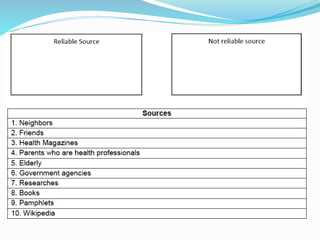
Directions: The following are
sources of information on
consumer health. Write the item
number of the statement in the
appropriate box. The left box should
contain the reliable source while the
right box should contain those which
are not.
Reliable or Unreliable
Neighbors
Reliable or Unreliable
Friends
Reliable or Unreliable
Health Magazine
Reliable or Unreliable
Parents who are
Health
Professionals
Reliable or Unreliable
Elderly
Reliable or Unreliable
Government
Agencies
Reliable or Unreliable
Researches
Reliable or Unreliable
Books
Reliable or Unreliable
Health Pamphlets
Reliable or Unreliable
Wikipedia
What is consumer health?
Consumer health is not just
about buying health products
and services. It is also about
making decisions and having a
clear and deeper understanding
to make wise choices.
Consumer health has three
components: health information,
health products, and health
services.
Health information plays a
big role in the life of
individuals. It gives details that
people can use to make
informed decisions about their
health and of others.
What is Health Information?
 Health information is any concept, step, or
advice that various sources give to aid the
health status of an individual. The type of
information varies depending on various
considerations such as but not limited to
health history, drugs and alcohol
consumption, and eating disorders.
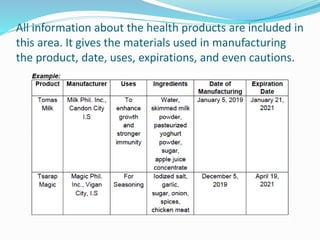
All information about the health products are included in
this area. It gives the materials used in manufacturing
the product, date, uses, expirations, and even cautions.
People acquire health information
and products from various sources
such as authorized person, media,
and technology. It is important to
identify the reliability of these
sources.
Some Reliable Sources of
information
1. Medical and health professionals
(Family and school doctors,
dentists, nurses,
health science educators)
2. Government agencies like
Department of Health (DOH),
Food and Drug Administration
(FDA), Bureau of Food and Drugs
(BFAD), Department of Trade and
Industry (DTI)
3. Websites ending in gov, edu, and
org.
4. Local health officials
5. Educational institutions
Some Unreliable Sources of Health
Information
1. Outdated customs, practices, and
superstitions without scientific
basis
2. Information based on ignorance
and prejudice
3. Commercialized health
information
4. Personal options and
incomplete information
5. Quack or pseudo healers
Guide Questions or criteria in
Assessing Health Information
The following questions are the things
to consider before buying health
products or availing health services.
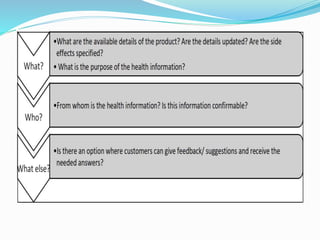
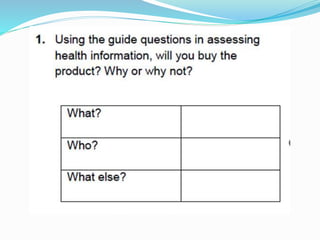
What?
What are the details of the
product? Are the details
updated? Are the side effects
specified
What are the purpose of the
health information?
Who?
From whom is the information?
Is This information
confirmable?
What Else?
Is there an option where
customers can give feedback?
Suggestions and receive
answers?
What are Health Products?
Health products are food, drugs,
cosmetics, devices, biologicals,
vaccines, in-vitro diagnostic
reagents, and household/urban
hazardous substances and/or a
combination of and/or a derivative
thereof (FDA Act, 2009).
These products may be purchased
from various places like
supermarkets, pharmacies, and
hospitals.
Examples: eyeglasses, appliances,
medicines, grooming aids, car, etc.
What is a Healthcare Service?
Healthcare services refer to the
furnishing of medicines, medical or
surgical treatments, nursing,
hospital service, dental service,
optometric service, and
complementary health services.
These are often connected to
healthcare. These programs aim to
appraise the health conditions of
individuals through screening and
examinations, cure and treat
disorders, prevent and control the
spread of diseases, provide safety,
emergency care, and first aid, and
ensure a follow-up program for
individuals who have undergone
treatments.
Examples: medical and dental
consultation and treatment,
services from beauty parlors and
barber shops, etc.
Guidelines on the Purchase of
Goods and Services
1. Evaluate which products and
services will be beneficial, harmful
or useless.
2. Know the local laws and
regulations that protect consumers.
3. Locate dependable medical,
dental and nursing services.
4. Apply knowledge acquired with
respect to personal and
environmental health in the
purchase of personal goods and
services
Some Tips on how to be a Wise
Consumer
1. Gather correct and sufficient
information–get as much
information by reading critically
the details on the nutritional
quality of the food. Be aware that
being knowledgeable of the laws
will protect you as a consumer.
2. Compare and contrast details
of available products – compare
and contrast the products and
services available before you
purchase. Judge for yourself which
among the products are most
effective. You can use the questions
in assessing the health information
as your initial guide.
3. Inquire for more and review if
possible – ask direct questions
from sales personnel if there are
things about the product that are
not clear to you before buying it.
Clarifying things will make you
more confident as a consumer. You
can also get some information from
other consumers regarding the
product.
Health services are usually
offered by healthcare providers.
“A healthcare provider is a
trained professional who provides
people with healthcare”. Health
services are offered by health
service providers. There are three
types, as follows:
I. Health Professionals. These
are individuals who are licensed to
practice medicine and other allied
health programs and work in the
medical profession.
Examples: doctor, nurse,
nutritionist, etc.
Examples: hospitals, walk-in
surgery center, health center,
extended healthcare facility.
II. Healthcare Facilities – These
are places or institutions that offer
healthcare services.
III. Health Insurance - It is a
financial agreement between an
insurance company and an
individual or group for the
payment of healthcare costs.
Philippine Insurance
Corporation (PhilHealth) is a
government-owned and
controlled corporation (GOCC)
created through Republic act 7875
also known as the National Health
Insurance (NHI) Act of 1995.
It aims to provide health insurance
coverage for all Filipinos and
ensure affordable, acceptable,
available, and accessible health
care services for all citizens of the
Philippines (Learner's Material on
the Philippine Health Insurance
Corporation (PhilHealth) - Grade
10 2017).
The vision statement of PhilHealth
“Bawat Pilipino Miyembro,
Bawat Miyembro Protektado,
Kalusugan ng Lahat
Protektado”
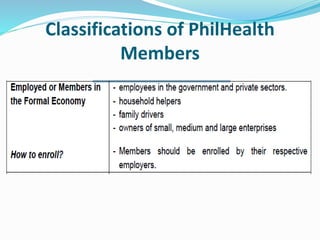
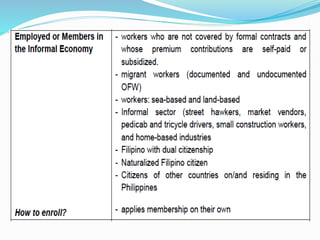
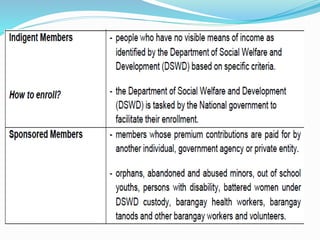
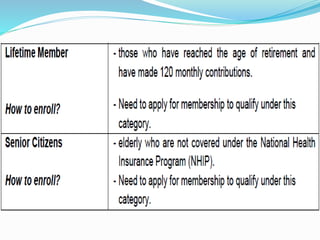
PhilHealth ensures that every
Filipino is a member by covering
them under different membership
programs which are categorized
according to various sectors of our
society.
Classifications of PhilHealth
Members
Question and Answer
Do you have any questions?
None?
I will ask questions then.
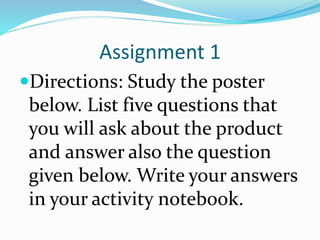
Assignment 1
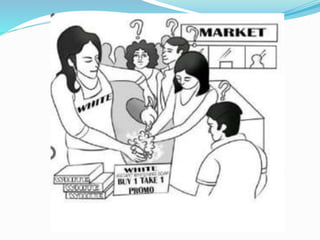
Directions: Study the poster
below. List five questions that
you will ask about the product
and answer also the question
given below. Write your answers
in your activity notebook.
Activity: Assignment:
Each group will bring 5
products next week. Any health
products. They will discuss why
the health products that they
will bring is either a good or a
bad product.
Rubrics:
 Information: 5 points
 Participation of Members: 5 points
 Presentation: 5 points
 Impact of Information: 5 points
Components-of-Consumer-Health.pptx

Components-of-Consumer-Health.pptx

  • 2.
    Pre- Assessment Activity Directions:The following are sources of information on consumer health. Write the item number of the statement in the appropriate box. The left box should contain the reliable source while the right box should contain those which are not.
  • 4.
  • 5.
  • 6.
  • 7.
    Reliable or Unreliable Parentswho are Health Professionals
  • 8.
  • 9.
  • 10.
  • 11.
  • 12.
  • 13.
  • 14.
    What is consumerhealth? Consumer health is not just about buying health products and services. It is also about making decisions and having a clear and deeper understanding to make wise choices.
  • 15.
    Consumer health hasthree components: health information, health products, and health services.
  • 16.
    Health information playsa big role in the life of individuals. It gives details that people can use to make informed decisions about their health and of others.
  • 17.
    What is HealthInformation?  Health information is any concept, step, or advice that various sources give to aid the health status of an individual. The type of information varies depending on various considerations such as but not limited to health history, drugs and alcohol consumption, and eating disorders.
  • 18.
    All information aboutthe health products are included in this area. It gives the materials used in manufacturing the product, date, uses, expirations, and even cautions.
  • 19.
    People acquire healthinformation and products from various sources such as authorized person, media, and technology. It is important to identify the reliability of these sources.
  • 20.
    Some Reliable Sourcesof information 1. Medical and health professionals (Family and school doctors, dentists, nurses, health science educators) 2. Government agencies like Department of Health (DOH),
  • 21.
    Food and DrugAdministration (FDA), Bureau of Food and Drugs (BFAD), Department of Trade and Industry (DTI) 3. Websites ending in gov, edu, and org.
  • 22.
    4. Local healthofficials 5. Educational institutions
  • 23.
    Some Unreliable Sourcesof Health Information 1. Outdated customs, practices, and superstitions without scientific basis 2. Information based on ignorance and prejudice
  • 24.
    3. Commercialized health information 4.Personal options and incomplete information 5. Quack or pseudo healers
  • 25.
    Guide Questions orcriteria in Assessing Health Information The following questions are the things to consider before buying health products or availing health services.
  • 27.
    What? What are thedetails of the product? Are the details updated? Are the side effects specified What are the purpose of the health information?
  • 28.
    Who? From whom isthe information? Is This information confirmable?
  • 29.
    What Else? Is therean option where customers can give feedback? Suggestions and receive answers?
  • 30.
    What are HealthProducts? Health products are food, drugs, cosmetics, devices, biologicals, vaccines, in-vitro diagnostic reagents, and household/urban hazardous substances and/or a combination of and/or a derivative thereof (FDA Act, 2009).
  • 31.
    These products maybe purchased from various places like supermarkets, pharmacies, and hospitals. Examples: eyeglasses, appliances, medicines, grooming aids, car, etc.
  • 32.
    What is aHealthcare Service? Healthcare services refer to the furnishing of medicines, medical or surgical treatments, nursing, hospital service, dental service, optometric service, and complementary health services.
  • 33.
    These are oftenconnected to healthcare. These programs aim to appraise the health conditions of individuals through screening and examinations, cure and treat disorders, prevent and control the spread of diseases, provide safety, emergency care, and first aid, and ensure a follow-up program for individuals who have undergone treatments.
  • 34.
    Examples: medical anddental consultation and treatment, services from beauty parlors and barber shops, etc.
  • 35.
    Guidelines on thePurchase of Goods and Services 1. Evaluate which products and services will be beneficial, harmful or useless. 2. Know the local laws and regulations that protect consumers.
  • 36.
    3. Locate dependablemedical, dental and nursing services. 4. Apply knowledge acquired with respect to personal and environmental health in the purchase of personal goods and services
  • 37.
    Some Tips onhow to be a Wise Consumer 1. Gather correct and sufficient information–get as much information by reading critically the details on the nutritional quality of the food. Be aware that being knowledgeable of the laws will protect you as a consumer.
  • 38.
    2. Compare andcontrast details of available products – compare and contrast the products and services available before you purchase. Judge for yourself which among the products are most effective. You can use the questions in assessing the health information as your initial guide.
  • 39.
    3. Inquire formore and review if possible – ask direct questions from sales personnel if there are things about the product that are not clear to you before buying it. Clarifying things will make you more confident as a consumer. You can also get some information from other consumers regarding the product.
  • 40.
    Health services areusually offered by healthcare providers. “A healthcare provider is a trained professional who provides people with healthcare”. Health services are offered by health service providers. There are three types, as follows:
  • 41.
    I. Health Professionals.These are individuals who are licensed to practice medicine and other allied health programs and work in the medical profession. Examples: doctor, nurse, nutritionist, etc. Examples: hospitals, walk-in surgery center, health center, extended healthcare facility.
  • 42.
    II. Healthcare Facilities– These are places or institutions that offer healthcare services. III. Health Insurance - It is a financial agreement between an insurance company and an individual or group for the payment of healthcare costs.
  • 43.
    Philippine Insurance Corporation (PhilHealth)is a government-owned and controlled corporation (GOCC) created through Republic act 7875 also known as the National Health Insurance (NHI) Act of 1995.
  • 44.
    It aims toprovide health insurance coverage for all Filipinos and ensure affordable, acceptable, available, and accessible health care services for all citizens of the Philippines (Learner's Material on the Philippine Health Insurance Corporation (PhilHealth) - Grade 10 2017).
  • 45.
    The vision statementof PhilHealth “Bawat Pilipino Miyembro, Bawat Miyembro Protektado, Kalusugan ng Lahat Protektado”
  • 46.
    PhilHealth ensures thatevery Filipino is a member by covering them under different membership programs which are categorized according to various sectors of our society.
  • 47.
  • 51.
    Question and Answer Doyou have any questions? None? I will ask questions then.
  • 52.
    Assignment 1 Directions: Studythe poster below. List five questions that you will ask about the product and answer also the question given below. Write your answers in your activity notebook.
  • 55.
    Activity: Assignment: Each groupwill bring 5 products next week. Any health products. They will discuss why the health products that they will bring is either a good or a bad product.
  • 56.
    Rubrics:  Information: 5points  Participation of Members: 5 points  Presentation: 5 points  Impact of Information: 5 points