REPORTER :DORIS J. SANTOS
Date : January 24, 2015
DR. TERESA DIEZ SOLERO
PROFESSOR
*Assessment is a process of analyzing critically so
as to determine the importance, amount , size, value
of significance of the change in the individual or in
the group as a result of learning.
*Assessment is a process by which information is
obtained relative to some known objective or goal.
Assessment is a broad term that includes testing. A
test is a special form of assessment.
Knowledge
Skills
Values
Attitudes
 Components of comprehensive
evaluations and educational assessments
target children, youth, young adults,
parents and educators. The standard
components include genetic, biological,
physical, psychological, intellectual,
social, emotional and mental
development.
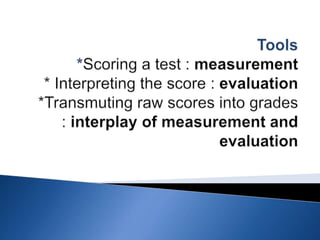
 *Measurement - refers to the process of
determining the quantity of achievement of
learners by means of appropriate measuring
instruments ( Calderon and Gonzales, 1993 ).
 It is assigning quantities or scores to present the
extent of measurable traits or skills acquired by
the individual.
 Evaluation - refers to the quality
or worth of achievements in
terms of certain standards .
( Calderon and Gonzales, 1993 )
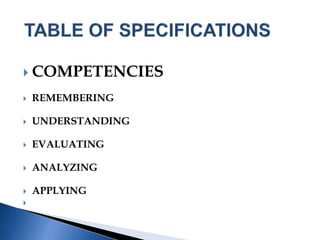
 COMPETENCIES
 REMEMBERING
 UNDERSTANDING
 EVALUATING
 ANALYZING
 APPLYING

Formative Assessment
*Formative: tells us how well the student is doing
as work progresses.
Formative assessment is a term for any type of
assessment used to gather student feedback and
improve instruction.
Formative assessments occur during the learning
process, often while students are engaged in other
activities.
 It tells us how well the student did at
the end of a unit/task
 Summative assessment occurs at the
end of a unit of study in order to
measure the amount of information
the students have learned.
 Teachers can circulate the room to monitor
students' progress. If students are working
independently or in groups, teachers should
intervene when the students are not
understanding the material.
 Teachers can also take note of students' comments
and participation levels during class discussions
to gauge their learning.
 Selected response assessments are any
type of objective exam where there is only
one correct answer for each question.
 Multiple choice, fill-in-the-blank,
matching and true/false questions are all
types of selected response assessments.
 Performance assessments require students to
perform as a means of showing they understand
class material.
 These assessments evaluate complex cognitive
processes as well as attitude and social skills, and
students often find them engaging.
 Portfolio assessments evaluate a student's
progress over the course of the semester. It is
more than a one-time picture of what a learner
has accomplished.
 Portfolios offer teachers a review of each
student's progress over the course of a year, or,
as in continuous comprehensive evaluation,
over the course of one's educational training.
 Grading is an assessment tool that truly needs no
introduction.
 Teachers use grading as a method to score
students' performance on individual projects.
 It reflects how well a student has learned a subject
and where he continues to struggle in the learning
process.
References :Theories and Principles of Educational Technology, 2008
ed. By Candelaria D. Garo
Educational Technology, 2008 ed.by Brenda B. Corpuz, et.al
THANK YOU
GOD BLESS -

Components of assesment dr. solero

  • 1.
    REPORTER :DORIS J.SANTOS Date : January 24, 2015 DR. TERESA DIEZ SOLERO PROFESSOR
  • 2.
    *Assessment is aprocess of analyzing critically so as to determine the importance, amount , size, value of significance of the change in the individual or in the group as a result of learning. *Assessment is a process by which information is obtained relative to some known objective or goal. Assessment is a broad term that includes testing. A test is a special form of assessment.
  • 3.
  • 4.
     Components ofcomprehensive evaluations and educational assessments target children, youth, young adults, parents and educators. The standard components include genetic, biological, physical, psychological, intellectual, social, emotional and mental development.
  • 5.
     *Measurement -refers to the process of determining the quantity of achievement of learners by means of appropriate measuring instruments ( Calderon and Gonzales, 1993 ).  It is assigning quantities or scores to present the extent of measurable traits or skills acquired by the individual.
  • 6.
     Evaluation -refers to the quality or worth of achievements in terms of certain standards . ( Calderon and Gonzales, 1993 )
  • 7.
     COMPETENCIES  REMEMBERING UNDERSTANDING  EVALUATING  ANALYZING  APPLYING 
  • 8.
    Formative Assessment *Formative: tellsus how well the student is doing as work progresses. Formative assessment is a term for any type of assessment used to gather student feedback and improve instruction. Formative assessments occur during the learning process, often while students are engaged in other activities.
  • 9.
     It tellsus how well the student did at the end of a unit/task  Summative assessment occurs at the end of a unit of study in order to measure the amount of information the students have learned.
  • 10.
     Teachers cancirculate the room to monitor students' progress. If students are working independently or in groups, teachers should intervene when the students are not understanding the material.  Teachers can also take note of students' comments and participation levels during class discussions to gauge their learning.
  • 11.
     Selected responseassessments are any type of objective exam where there is only one correct answer for each question.  Multiple choice, fill-in-the-blank, matching and true/false questions are all types of selected response assessments.
  • 12.
     Performance assessmentsrequire students to perform as a means of showing they understand class material.  These assessments evaluate complex cognitive processes as well as attitude and social skills, and students often find them engaging.
  • 13.
     Portfolio assessmentsevaluate a student's progress over the course of the semester. It is more than a one-time picture of what a learner has accomplished.  Portfolios offer teachers a review of each student's progress over the course of a year, or, as in continuous comprehensive evaluation, over the course of one's educational training.
  • 15.
     Grading isan assessment tool that truly needs no introduction.  Teachers use grading as a method to score students' performance on individual projects.  It reflects how well a student has learned a subject and where he continues to struggle in the learning process. References :Theories and Principles of Educational Technology, 2008 ed. By Candelaria D. Garo Educational Technology, 2008 ed.by Brenda B. Corpuz, et.al
  • 16.