© Boardworks Ltd 20061 of 30
The Effects of Exercise
© Boardworks Ltd 20061 of 30
These icons indicate that teacher’s notes or useful web addresses are available in the Notes Page.
This icon indicates that the slide contains activities created in Flash. These activities are not editable.
For more detailed instructions, see the Getting Started presentation.
KS4 Physical
Education
© Boardworks Ltd 20062 of 30
Learning objectives
What we will learn in this presentation:
Learningobjectives
© Boardworks Ltd 20062 of 30
The immediate effects of exercise on the
respiratory system
The immediate effects of exercise on the
circulatory system
How levels of lactic acid, water and heat are
affected by exercise
How the body recovers from exercise
Recovery rates
The long term effects of exercise on the heart,
lungs, skeleton and muscles
How different components of fitness can be
tested.
© Boardworks Ltd 20063 of 30
The immediate effects of exercise
© Boardworks Ltd 20064 of 30
Immediate effects on the respiratory system
Exercise causes the muscles to use more oxygen.
This means that the lungs must work harder and faster to
keep the body supplied with oxygen and also to exhale the
carbon dioxide that is produced. This is why exercise
makes you out-of-breath.
Breathing rate increases from around 18 breaths per
minute to up to 80!
The amount of air inhaled and exhaled in each breath also
increases from around 0.5 litres to up to 4.5 litres.
During aerobic exercise, the lungs are able to work
fast enough to supply the muscles with oxygen.
During anaerobic exercise, the lungs can’t supply
enough oxygen. Once the exercise is over,
breathing remains fast to repay the ‘oxygen debt’.
© Boardworks Ltd 20065 of 30
Immediate effects on the circulatory system
During exercise, the circulatory system’s most important
function is transportation.
The heart and blood vessels work to transport the oxygen
from the lungs to the muscles where it is needed. Glucose
and other substances needed by the muscles are
transported in the blood too.
The by-products of respiration, including carbon dioxide
and lactic acid, are also carried away from the muscles.
If these by-products build up in the muscles,
they can cause them to stop working.
glucose + oxygen energy
carbon
dioxide
+ + water
glucose energy + lactic acid
© Boardworks Ltd 20066 of 30
Immediate effects on the circulatory system
Write a paragraph explaining how the roles of the
heart and lungs in supporting exercise are connected.
In response to exercise, the heart beats not only faster,
but stronger.
Heart rate increases from around 70 bpm to up to 200 bpm.
Stroke volume (the volume of blood pumped per beat)
increases from around 50 ml to around 120 ml. In highly
trained athletes, stroke volume can reach 200 ml.
The arteries respond to the body’s increased demands by
widening slightly to allow more blood to pass through them.
Blood is also diverted away from systems that are not
involved in the activity, for example, the digestive system.
© Boardworks Ltd 20067 of 30
The immediate effects: lactic acid
Lactic acid is produced during anaerobic respiration.
This happens when there is not enough oxygen for
normal aerobic respiration to take place.
Lactic acid is a mild toxin. It is responsible
for the pain you feel in your muscles when
they get tired.
When too much of it builds up in a muscle,
it can prevent the muscle contracting. At
this point, the performer’s muscles will
cramp and they will be forced to stop.
glucose energy + lactic acid
© Boardworks Ltd 20068 of 30
The immediate effects: heat loss
The body has two main ways of getting rid of the extra
heat produced by muscles during exercise.
1. Vasodilation
The capillaries close to the surface of the
skin dilate, allowing more blood to flow into
them. Because the blood is closer to the
skin, more heat is lost to the environment.
2. Sweating
Sweat glands in the skin excrete
sweat – a mixture of water, salts and
urea. As the sweat evaporates, it
takes heat away with it.
© Boardworks Ltd 20069 of 30
The immediate effects: water loss
When you sweat, water is lost from the
body. Water is vital to maintaining proper
body functions.
The body produces less urine to
compensate, but during prolonged exercise
or in hot weather, this is often not enough.
Extra water must also be consumed.
The body does not only lose water – it also loses important
salts called electrolytes. These are necessary in many
areas of the body, including the nervous system.
Salts can be replaced during exercise by drinking isotonic
drinks, or eating foods rich in these minerals.
Severe salt depletion can lead to cramps,
fainting and, in extreme cases, death.
© Boardworks Ltd 200610 of 30
Immediate effects of exercise
© Boardworks Ltd 200611 of 30
Recovery rates
Muscles
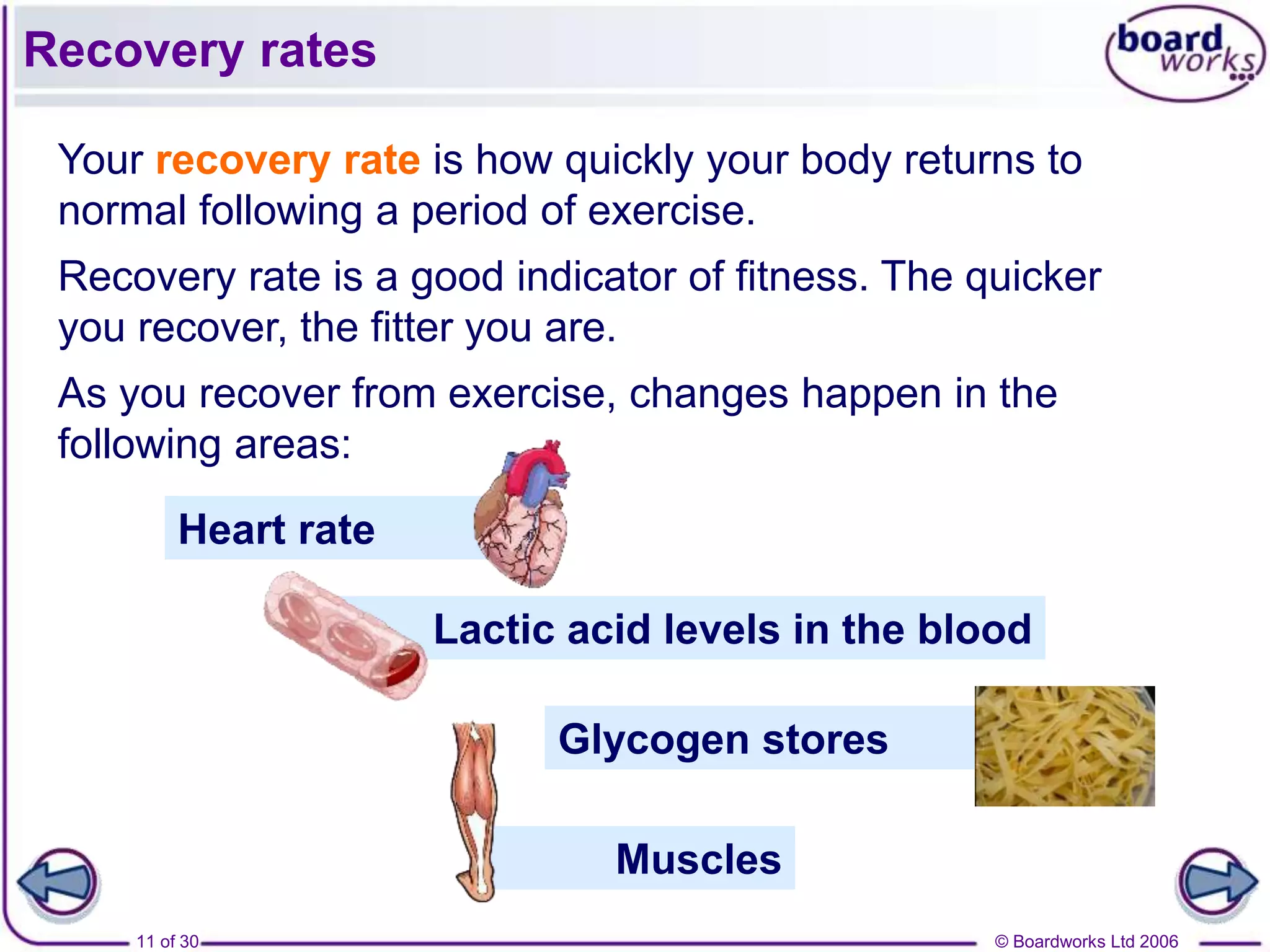
Your recovery rate is how quickly your body returns to
normal following a period of exercise.
Recovery rate is a good indicator of fitness. The quicker
you recover, the fitter you are.
As you recover from exercise, changes happen in the
following areas:
Heart rate
Lactic acid levels in the blood
Glycogen stores
© Boardworks Ltd 200612 of 30
Heart rate
© Boardworks Ltd 200613 of 30
Muscles
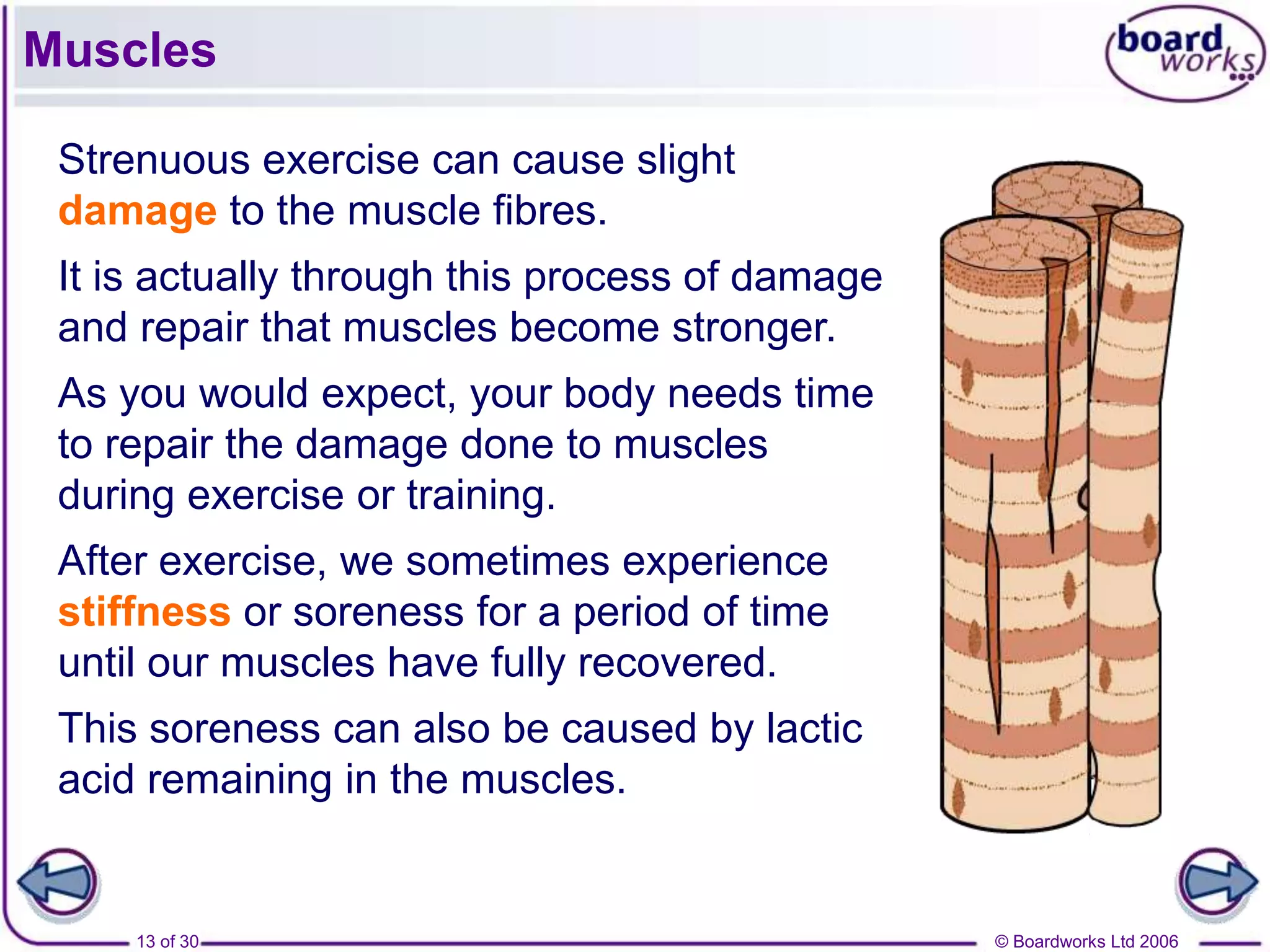
Strenuous exercise can cause slight
damage to the muscle fibres.
It is actually through this process of damage
and repair that muscles become stronger.
As you would expect, your body needs time
to repair the damage done to muscles
during exercise or training.
After exercise, we sometimes experience
stiffness or soreness for a period of time
until our muscles have fully recovered.
This soreness can also be caused by lactic
acid remaining in the muscles.
© Boardworks Ltd 200614 of 30
Recovery time
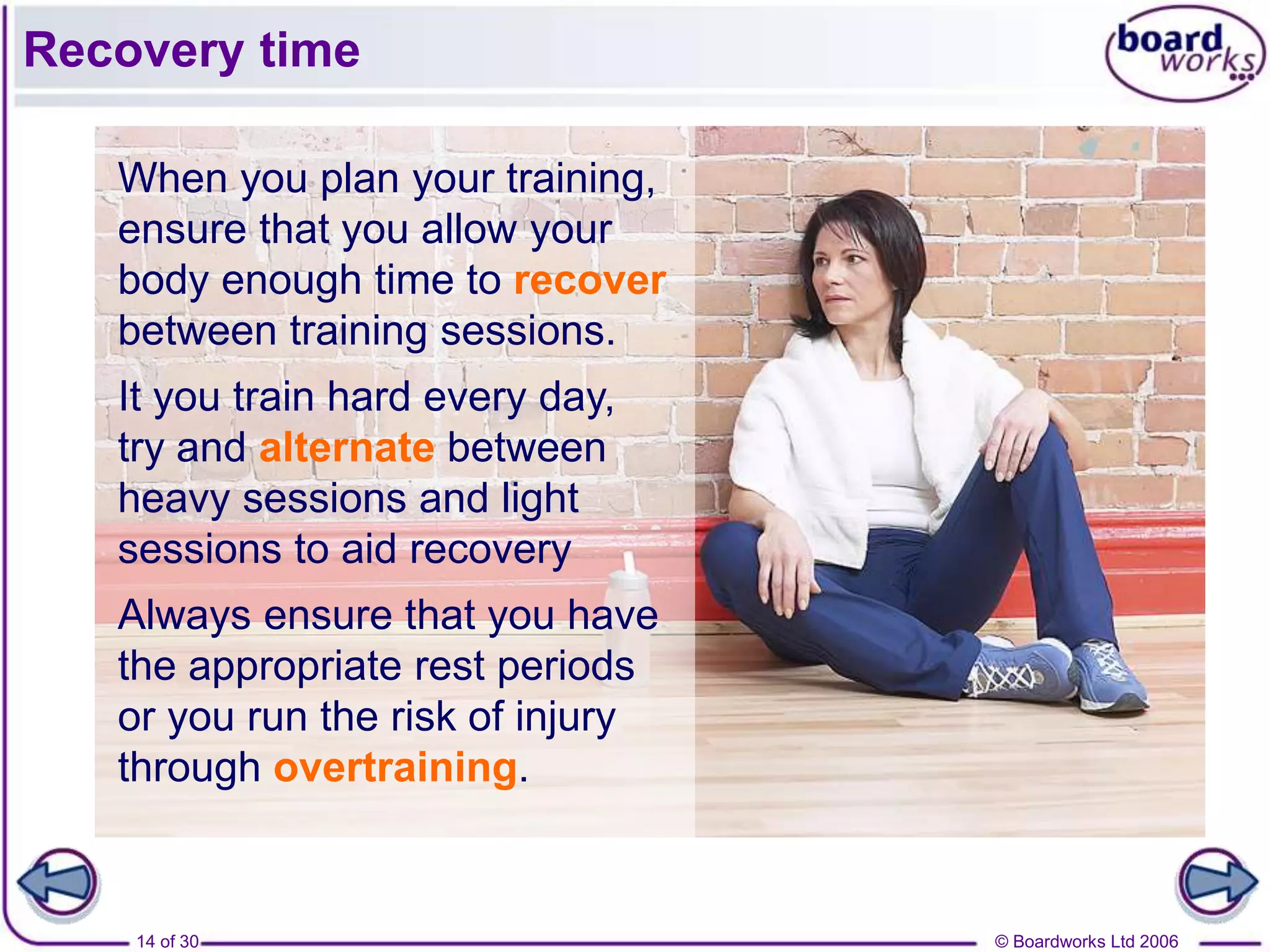
When you plan your training,
ensure that you allow your
body enough time to recover
between training sessions.
It you train hard every day,
try and alternate between
heavy sessions and light
sessions to aid recovery
Always ensure that you have
the appropriate rest periods
or you run the risk of injury
through overtraining.
© Boardworks Ltd 200615 of 30
Recovery
© Boardworks Ltd 200616 of 30
The long term effect of exercise
As you would expect, training causes the body to adapt
and grow stronger.
The following areas are particularly affected:
the heart
the lungs
the skeleton
the muscles.
© Boardworks Ltd 200617 of 30
The long term effect of exercise – the heart
Aerobic exercise strengthens the heart.
The heart becomes bigger.
The walls become thicker and
stronger.
The stroke volume increases.
Your resting heart rate gets slower as you get fitter, because
the heart needs fewer beats to pump blood round the body.
Training also results in new capillaries growing to improve
the supply of blood to the muscles.
The result is that the heart
becomes a more efficient pump.
© Boardworks Ltd 200618 of 30
The long term effect of exercise – the lungs
Training makes the lungs more effective
at supplying the body with oxygen.
New capillaries
grow around the
alveoli, making
gas exchange
more efficient.
The muscles involved in
breathing in and out become
stronger and can work for longer.
Vital capacity (the maximum
amount of air that can be inhaled
in one breath) increases.
© Boardworks Ltd 200619 of 30
The long term effect of exercise – the skeleton
Exercise has been shown to increase
bone density and strength.
Stronger, denser bones are better
at carrying weight and more
resistant to injury.
The increase in bone density is
specific to the activity – walking
will strengthen your leg bones,
but not your arm bones.
Both aerobic exercise and weight
training are effective in increasing
bone strength, but the activity must
be weight-bearing.
© Boardworks Ltd 200620 of 30
The long term effect of exercise – the muscles
Training obviously has a large effect on the muscles.
The other effects will depend on the type of training.
Weight and power training
increases the strength of muscles.
The number of fast twitch fibres
increase. Muscles increase in size.
New capillaries grow in and around the
muscles to supply them with blood.
Endurance training makes
muscles able to work for
longer. The number of slow
twitch fibres increase.
© EMPICS Ltd
© EMPICS Ltd
© Boardworks Ltd 200621 of 30
The effects of exercise

components

  • 1.
    © Boardworks Ltd20061 of 30 The Effects of Exercise © Boardworks Ltd 20061 of 30 These icons indicate that teacher’s notes or useful web addresses are available in the Notes Page. This icon indicates that the slide contains activities created in Flash. These activities are not editable. For more detailed instructions, see the Getting Started presentation. KS4 Physical Education
  • 2.
    © Boardworks Ltd20062 of 30 Learning objectives What we will learn in this presentation: Learningobjectives © Boardworks Ltd 20062 of 30 The immediate effects of exercise on the respiratory system The immediate effects of exercise on the circulatory system How levels of lactic acid, water and heat are affected by exercise How the body recovers from exercise Recovery rates The long term effects of exercise on the heart, lungs, skeleton and muscles How different components of fitness can be tested.
  • 3.
    © Boardworks Ltd20063 of 30 The immediate effects of exercise
  • 4.
    © Boardworks Ltd20064 of 30 Immediate effects on the respiratory system Exercise causes the muscles to use more oxygen. This means that the lungs must work harder and faster to keep the body supplied with oxygen and also to exhale the carbon dioxide that is produced. This is why exercise makes you out-of-breath. Breathing rate increases from around 18 breaths per minute to up to 80! The amount of air inhaled and exhaled in each breath also increases from around 0.5 litres to up to 4.5 litres. During aerobic exercise, the lungs are able to work fast enough to supply the muscles with oxygen. During anaerobic exercise, the lungs can’t supply enough oxygen. Once the exercise is over, breathing remains fast to repay the ‘oxygen debt’.
  • 5.
    © Boardworks Ltd20065 of 30 Immediate effects on the circulatory system During exercise, the circulatory system’s most important function is transportation. The heart and blood vessels work to transport the oxygen from the lungs to the muscles where it is needed. Glucose and other substances needed by the muscles are transported in the blood too. The by-products of respiration, including carbon dioxide and lactic acid, are also carried away from the muscles. If these by-products build up in the muscles, they can cause them to stop working. glucose + oxygen energy carbon dioxide + + water glucose energy + lactic acid
  • 6.
    © Boardworks Ltd20066 of 30 Immediate effects on the circulatory system Write a paragraph explaining how the roles of the heart and lungs in supporting exercise are connected. In response to exercise, the heart beats not only faster, but stronger. Heart rate increases from around 70 bpm to up to 200 bpm. Stroke volume (the volume of blood pumped per beat) increases from around 50 ml to around 120 ml. In highly trained athletes, stroke volume can reach 200 ml. The arteries respond to the body’s increased demands by widening slightly to allow more blood to pass through them. Blood is also diverted away from systems that are not involved in the activity, for example, the digestive system.
  • 7.
    © Boardworks Ltd20067 of 30 The immediate effects: lactic acid Lactic acid is produced during anaerobic respiration. This happens when there is not enough oxygen for normal aerobic respiration to take place. Lactic acid is a mild toxin. It is responsible for the pain you feel in your muscles when they get tired. When too much of it builds up in a muscle, it can prevent the muscle contracting. At this point, the performer’s muscles will cramp and they will be forced to stop. glucose energy + lactic acid
  • 8.
    © Boardworks Ltd20068 of 30 The immediate effects: heat loss The body has two main ways of getting rid of the extra heat produced by muscles during exercise. 1. Vasodilation The capillaries close to the surface of the skin dilate, allowing more blood to flow into them. Because the blood is closer to the skin, more heat is lost to the environment. 2. Sweating Sweat glands in the skin excrete sweat – a mixture of water, salts and urea. As the sweat evaporates, it takes heat away with it.
  • 9.
    © Boardworks Ltd20069 of 30 The immediate effects: water loss When you sweat, water is lost from the body. Water is vital to maintaining proper body functions. The body produces less urine to compensate, but during prolonged exercise or in hot weather, this is often not enough. Extra water must also be consumed. The body does not only lose water – it also loses important salts called electrolytes. These are necessary in many areas of the body, including the nervous system. Salts can be replaced during exercise by drinking isotonic drinks, or eating foods rich in these minerals. Severe salt depletion can lead to cramps, fainting and, in extreme cases, death.
  • 10.
    © Boardworks Ltd200610 of 30 Immediate effects of exercise
  • 11.
    © Boardworks Ltd200611 of 30 Recovery rates Muscles Your recovery rate is how quickly your body returns to normal following a period of exercise. Recovery rate is a good indicator of fitness. The quicker you recover, the fitter you are. As you recover from exercise, changes happen in the following areas: Heart rate Lactic acid levels in the blood Glycogen stores
  • 12.
    © Boardworks Ltd200612 of 30 Heart rate
  • 13.
    © Boardworks Ltd200613 of 30 Muscles Strenuous exercise can cause slight damage to the muscle fibres. It is actually through this process of damage and repair that muscles become stronger. As you would expect, your body needs time to repair the damage done to muscles during exercise or training. After exercise, we sometimes experience stiffness or soreness for a period of time until our muscles have fully recovered. This soreness can also be caused by lactic acid remaining in the muscles.
  • 14.
    © Boardworks Ltd200614 of 30 Recovery time When you plan your training, ensure that you allow your body enough time to recover between training sessions. It you train hard every day, try and alternate between heavy sessions and light sessions to aid recovery Always ensure that you have the appropriate rest periods or you run the risk of injury through overtraining.
  • 15.
    © Boardworks Ltd200615 of 30 Recovery
  • 16.
    © Boardworks Ltd200616 of 30 The long term effect of exercise As you would expect, training causes the body to adapt and grow stronger. The following areas are particularly affected: the heart the lungs the skeleton the muscles.
  • 17.
    © Boardworks Ltd200617 of 30 The long term effect of exercise – the heart Aerobic exercise strengthens the heart. The heart becomes bigger. The walls become thicker and stronger. The stroke volume increases. Your resting heart rate gets slower as you get fitter, because the heart needs fewer beats to pump blood round the body. Training also results in new capillaries growing to improve the supply of blood to the muscles. The result is that the heart becomes a more efficient pump.
  • 18.
    © Boardworks Ltd200618 of 30 The long term effect of exercise – the lungs Training makes the lungs more effective at supplying the body with oxygen. New capillaries grow around the alveoli, making gas exchange more efficient. The muscles involved in breathing in and out become stronger and can work for longer. Vital capacity (the maximum amount of air that can be inhaled in one breath) increases.
  • 19.
    © Boardworks Ltd200619 of 30 The long term effect of exercise – the skeleton Exercise has been shown to increase bone density and strength. Stronger, denser bones are better at carrying weight and more resistant to injury. The increase in bone density is specific to the activity – walking will strengthen your leg bones, but not your arm bones. Both aerobic exercise and weight training are effective in increasing bone strength, but the activity must be weight-bearing.
  • 20.
    © Boardworks Ltd200620 of 30 The long term effect of exercise – the muscles Training obviously has a large effect on the muscles. The other effects will depend on the type of training. Weight and power training increases the strength of muscles. The number of fast twitch fibres increase. Muscles increase in size. New capillaries grow in and around the muscles to supply them with blood. Endurance training makes muscles able to work for longer. The number of slow twitch fibres increase. © EMPICS Ltd © EMPICS Ltd
  • 21.
    © Boardworks Ltd200621 of 30 The effects of exercise