COMPLICATIONS OF BLOOD
TRANSFUSION
Dr H.O Olawumi
FWACP
Introduction
• Each blood product transfused carries a risk of
an adverse effect
• Medical officers prescribing transfusion should
carefully select patients who will benefit from
transfusion therapy according to established
criteria.
• The indication for transfusion should be
documented in the medical record.
• Where possible the patient should be
informed of the possible adverse effects that
may occur.
• Patients should be monitored closely
especially at the beginning of a transfusion.
• Any adverse reaction to the transfusion of
blood or blood products should be reported to
the blood bank as soon as possible.
COMPLICATIONS
• IMMUNOLOGICAL
• NON-IMMUNOLOGICAL
IMMUNOLOGICAL
• REACTIONS DUE TO RED CELL ANTIBODIES
1. Sensitization to red cell antigens
2. Haemolytic transfusion reaction
immediate
delayed
• REACTIONS DUE TO PLATELET ANTIBODIES
3. Post transfusion purpura
• REACTIONS DUE TO WHITE CELL ANTIBODIES.
4. Febrile non-haemolytic transfusion reaction
5. Transfusion related acute lung injury(TRALI)
6. Transfusion associated graft-versus-host
disease(TA-GvHD)
• REACTION DUE TO PLASMA PROTEIN Abs.
7. Urticaria
8. Anaphylaxis
NON-IMMUNOLOGICAL
1. Transmission of diseases
2. Reactions due to bacteria contamination
3. Circulation overload
4. Thrombophlebitis
5. Air embolism
6. Transfusion Haemosiderosis
7. Complications of massive transfusion
SENSITIZATION TO RED CELL Ags.
Only ABO and Rhesus antigens are routinely
matched in Blood transfusion.
So there is possibility of sensitization to other
red cell antigens (e.g. Kell & Kidd) leading to:
Haemolytic disease of the newborn
Difficulty in compatibility testing
Delayed haemolytic transfusion reaction
IMMEDIATE HBTR
• Most dangerous transfusion reaction
• Usually due to clerical or Admin. Errors
 failure to confirm patient’s identity
 mislabelling of sample bottles
 failure to perform proper checks before
transfusing blood
Not usually due to laboratory error
Immediate HBTR
• Destruction of donor RBC by Abs. in the recipient
• ABO incompatibility is the most common cause
• Haemolysis may be Intravascular or Extravascular
Intravascular haemolysis by complement
activating Abs. of IgM or IgG class e.g. ABO Abs.
Extravascular haemolysis by Abs unable to
activate complements e.g. Rhesus Abs.
Clinical features of IHBTR
• SYMPTOMS INCLUDE
 heat in the vein
 headache
 chest tightness
 nausea
 lumber pain
Clinical features of IHBTR
• SIGNS INCLUDE
 tachycardia
 hypotension
 rigors
 fever
 jaundice
 DIC
Renal complications: Renal tubular necrosis and
acute renal failure
MANAGEMENT OF IHBTR
• Discontinue the transfusion
• Commence iv normal saline infusion
• Monitor urine output/catheterise
• Maintain urine output at 100ml/hr
• Give frusemide if urine output falls/absent
• Treat any DIC with appropriate blood
components
• Return donor unit and giving set to blood bank
• Inform hospital transfusion department
immediately
INVESTIGATION OF IHBTR
• Check for haemolysis
• Check for incompatibility
• Check for DIC
• Check for bacterial infection
CHECK FOR INCOMPATIBILITY
• Clerical check: detects identification error
• Serological tests
 repeat ABO and Rhesus grouping of recipient’s
pre and post transfusion sample and donor
sample
 screening of patient(pre and post) and donor
sample for atypical antibodies
 repeat CXM with pre and post serum of patient
 DCT on pre and post sample of patient
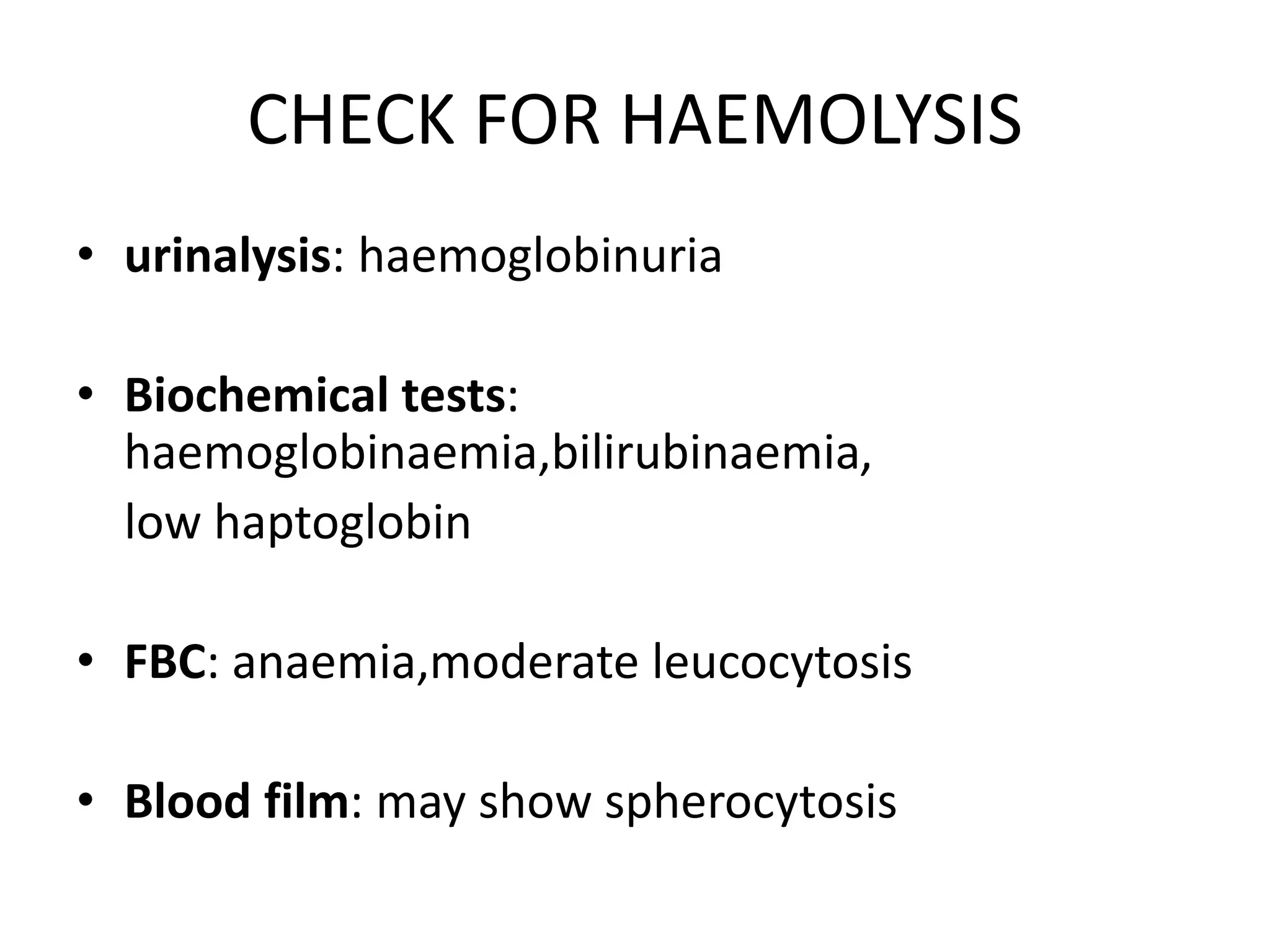
CHECK FOR HAEMOLYSIS
• urinalysis: haemoglobinuria
• Biochemical tests:
haemoglobinaemia,bilirubinaemia,
low haptoglobin
• FBC: anaemia,moderate leucocytosis
• Blood film: may show spherocytosis
CHECK FOR DIC
Platelet count: thrombocytopaenia
Blood film: red cell fragmentation
Coagulation screening tests
PT is prolonged
PTTK is prolonged
TT is prolonged etc
CHECK FOR BACTERIAL INFECTION
• Examine the blood pack for discoloration and smell
• Gram stain
• Culture
Organisms associated with contamination include
Staph. aureus
Staph. epidermidis
Group B Streptococci
E. coli
Pseudomonas species
Other gram negative organisms
DELAYED HBTR
• Occurs in previously sensitized patients
• Secondary immune response
• Features include
 History of previous pregnancy or transfusion
 manifests 7-10 days after transfusion
 Triad of fever, hyperbilirubinaemia and anaemia
 positive Direct Coomb’s test
 spherocytosis and reticulocytosis
MANAGEMENT OF DELAYED HBTR
• Specific treatment is rarely required
• However further transfusion may be needed
POST TRANSFUSION PURPURA
• Rare complication of blood transfusion
• More often seen in female patients
• Caused by platelet specific alloantibodies in the
recipient
• Patient develops low platelet count 7-10 days
post transfusion
• Usually self limiting
• IVIgG and plasma exchange are effective
management options
• Platelet transfusion is not effective
FEBRILE NON-HAEMOLYTIC
TRANSFUSION REACTIONS
• Most common transfusion reaction
• Occurs in multitransfused of previously pregnant
patients
• caused by recipient HLA antibodies reacting with white
cell antigens in the donor blood.
• Features are fever(>1.50C above baseline) with rigors
and chills
• Symptoms start towards the end of transfusion or up
to 2 hrs after transfusion
• No associated Hypotension, lumber pain or chest
discomfort.
MANAGEMENT OF FNHBTR
• Slow the rate of transfusion
• Symptomatic, paracetamol
• Antihistamines are of no benefit
• Prevention: leucocytes depleted blood
TRALI
• 2nd most common cause of transfusion-related
death after ABO incompatibility
• anti-HLA and /or anti-granulocyte antibodies in
donor plasma agglutinate and degranulate
recipient granulocytes within the lungs.
• Acute respiratory symptoms develop
• Most of the donors are multiparous women
Symptoms and signs of TRALI
• Breathlessness and dry cough within 6hrs of
transfusion
• May be associated with hypotension, fever and
chills
• Monocytopaenia and neutropaenia may be seen
• CXR shows bilateral nodular infiltrates with
batwing pattern typical of acute respiratory
distress syndrome
MANAGEMENT OF TRALI
• Treatment is that of ARDS
• Implicated donor should be identified and
taken off the donor panel
TRANSFUSION ASSOCIATED GRAFT
VERSUS HOST DISEASE
• Rare but serious complication, usually fatal
• Caused by transfusion of products containing
immunocompetent lymphocytes to
immunocompromised patient
• The donor lymphocytes attack and damage
recipient’s tissues that carry HLA antigens
• Skin ,gut, liver, spleen and bone marrow are
affected
• Causing fever, skin rash and hepatitis
TA-GvHD
• Immunocompromised and those receiving
transfusion from relatives are at risk(due to
sharing of an HLA haplotype)
• GVHD occurs 4-30 days after transfusion
• Diagnosis is based on clinical suspicion and
skin and bone marrow biopsies
• Mortality is high because there is no specific
treatment available
PREVENTION OF TA-GvHD
• Patients at risk should receive blood
components that have been irradiated to
inactivate any donor lymphocyte
URTICARIA
• Common with components including large volumes of
plasma
• Mild fever and urticaria rash or itching
Management
• If urticaria occurs in isolation (without fever and other
signs), slow the rate or temporarily stop transfusion.
• If symptoms are bothersome, consider administering an
antihistamine before restarting the transfusion. e.g
chlorpheniramine10mg by slow iv injection.
• Saline washed blood components can also be used
• If associated with other symptoms, cease the transfusion
and proceed with investigation.
ANAPHYLAXIS
• Rare but life-threatening
• Occurs in early part of a transfusion
• Patients with IgA deficiency pre-sensitizedt
produce anti-IgA antibodies can have these
reactions
• Symptoms include chest pain, dyspnoea,
abdominal pain and nausea
• Signs include hypotension, bronchospasm,
periorbital and laryngeal oedema,vomiting,
erythema, urticaria and conjuntivitis
MANAGEMENT OF ANAPHYLAXIS
• Stop transfusion
• Return donor unit to the blood bank
• Give chlopheniramine 10mg slow iv
• Commence oxygen
• Give salbutamol nebuliser
• Give adrenaline in severe hypotension
• washed red blood cells and plasma products
prepared from IgA deficient donors in future
transfusions
MICROBIAL AGENTS TRANSMISSIBLE
BY TRANSFUSION
• Viruses
 Hepatitis A,B,C and D
 HIV I and II
 HTLV I andII
 CMV
 EBV
 Human herpesvirus 8(HHV-8)
 Parvovirus B19
Bacteria
 Treponema pallidum(syphylis)
 Borrelia burgdorferi(Lyme dx)
 Brucella melitensis(Brucellosis)
 Yersinia enterocolitical/salmonella spp.
 Rickettsia rickettsii(rocky mountain spotted
fever)
 Coxiella burnettii(Q fever) etc
 Plasmodium spp(malaria)
 Trypanosoma cruzi(Chagas disease)
 Babesia microti(Babesiosis)
 Leishmania spp.(leishmaniasis)
Protozoa
Reactions due to Bacterial
Contamination
• Bacteria may be introduced into the pack at the
time of blood collection from sources such as
donor skin, donor bacteraemia or equipment
used during blood collection or processing.
• Bacteria may multiply during storage. Gram
positive and Gram negative organisms have been
implicated.
• Platelets are more frequently implicated than red
cells.
• Symptom include very high fever, rigors, profound
hypotension, nausea and/or diarrhoea.
Management of reactions due to
bacterial contamination
• Immediately stop the transfusion and notify
the hospital blood bank.
• blood cultures
• broad-spectrum antimicrobials.
• culture of the blood pack.
Prevention of reactions due to
bacterial contamination
• Inspect blood products prior to transfusion.
Some but not all bacterially contaminated
products can be recognised (clots, clumps, or
abnormal colour).
• Maintaining appropriate cold storage of red
cells in a monitored blood bank refrigerator.
• Transfusions should not proceed beyond the
recommended infusion time (4 hours)
CIRCULATORY OVERLOAD
• Occurs when too much fluid is transfused
• Also when transfusion is too rapid
• Features include Acute LVF , dyspnoea,
tachycardia, non-productive cough, raised JVP,
basal lung crepitations,hypertension and
tachycardia
Management
• Stop transfusion
• Give diuretics and oxygen
TRANSFUSION HAEMOSIDERISIS
• Due to repeated red cell transfusion
• After 50 units in an adult
• Deposition of iron in the tissues
• Damage to the liver, myocardium and
endocrine glands
COMPLICATIONS OF MASSIVE
TRANSFUSION
Massive transfusion is transfusion of a volume of
stored blood greater than or equal to an
individuals total blood volume in 24hours.
(e.g. 10 units in a 70kg adult)
 Volume related complications
 Rate related complications
Volume related complications
Dilutional thrombocytopaenia
Dilution of procoagulant factors
(factors v and viii)
Rate related complications
Hypocalcemia
Hypomagnesemia
Hyperkalemia
acidosis
hypothermia

COMPLICATIONS OF BLOOD TRANSFUSION 2016.pptx

  • 1.
  • 2.
    Introduction • Each bloodproduct transfused carries a risk of an adverse effect • Medical officers prescribing transfusion should carefully select patients who will benefit from transfusion therapy according to established criteria. • The indication for transfusion should be documented in the medical record.
  • 3.
    • Where possiblethe patient should be informed of the possible adverse effects that may occur. • Patients should be monitored closely especially at the beginning of a transfusion. • Any adverse reaction to the transfusion of blood or blood products should be reported to the blood bank as soon as possible.
  • 4.
  • 5.
    IMMUNOLOGICAL • REACTIONS DUETO RED CELL ANTIBODIES 1. Sensitization to red cell antigens 2. Haemolytic transfusion reaction immediate delayed • REACTIONS DUE TO PLATELET ANTIBODIES 3. Post transfusion purpura
  • 6.
    • REACTIONS DUETO WHITE CELL ANTIBODIES. 4. Febrile non-haemolytic transfusion reaction 5. Transfusion related acute lung injury(TRALI) 6. Transfusion associated graft-versus-host disease(TA-GvHD) • REACTION DUE TO PLASMA PROTEIN Abs. 7. Urticaria 8. Anaphylaxis
  • 7.
    NON-IMMUNOLOGICAL 1. Transmission ofdiseases 2. Reactions due to bacteria contamination 3. Circulation overload 4. Thrombophlebitis 5. Air embolism 6. Transfusion Haemosiderosis 7. Complications of massive transfusion
  • 8.
    SENSITIZATION TO REDCELL Ags. Only ABO and Rhesus antigens are routinely matched in Blood transfusion. So there is possibility of sensitization to other red cell antigens (e.g. Kell & Kidd) leading to: Haemolytic disease of the newborn Difficulty in compatibility testing Delayed haemolytic transfusion reaction
  • 9.
    IMMEDIATE HBTR • Mostdangerous transfusion reaction • Usually due to clerical or Admin. Errors  failure to confirm patient’s identity  mislabelling of sample bottles  failure to perform proper checks before transfusing blood Not usually due to laboratory error
  • 10.
    Immediate HBTR • Destructionof donor RBC by Abs. in the recipient • ABO incompatibility is the most common cause • Haemolysis may be Intravascular or Extravascular Intravascular haemolysis by complement activating Abs. of IgM or IgG class e.g. ABO Abs. Extravascular haemolysis by Abs unable to activate complements e.g. Rhesus Abs.
  • 11.
    Clinical features ofIHBTR • SYMPTOMS INCLUDE  heat in the vein  headache  chest tightness  nausea  lumber pain
  • 12.
    Clinical features ofIHBTR • SIGNS INCLUDE  tachycardia  hypotension  rigors  fever  jaundice  DIC Renal complications: Renal tubular necrosis and acute renal failure
  • 13.
    MANAGEMENT OF IHBTR •Discontinue the transfusion • Commence iv normal saline infusion • Monitor urine output/catheterise • Maintain urine output at 100ml/hr • Give frusemide if urine output falls/absent • Treat any DIC with appropriate blood components • Return donor unit and giving set to blood bank • Inform hospital transfusion department immediately
  • 14.
    INVESTIGATION OF IHBTR •Check for haemolysis • Check for incompatibility • Check for DIC • Check for bacterial infection
  • 15.
    CHECK FOR INCOMPATIBILITY •Clerical check: detects identification error • Serological tests  repeat ABO and Rhesus grouping of recipient’s pre and post transfusion sample and donor sample  screening of patient(pre and post) and donor sample for atypical antibodies  repeat CXM with pre and post serum of patient  DCT on pre and post sample of patient
  • 16.
    CHECK FOR HAEMOLYSIS •urinalysis: haemoglobinuria • Biochemical tests: haemoglobinaemia,bilirubinaemia, low haptoglobin • FBC: anaemia,moderate leucocytosis • Blood film: may show spherocytosis
  • 17.
    CHECK FOR DIC Plateletcount: thrombocytopaenia Blood film: red cell fragmentation Coagulation screening tests PT is prolonged PTTK is prolonged TT is prolonged etc
  • 18.
    CHECK FOR BACTERIALINFECTION • Examine the blood pack for discoloration and smell • Gram stain • Culture Organisms associated with contamination include Staph. aureus Staph. epidermidis Group B Streptococci E. coli Pseudomonas species Other gram negative organisms
  • 19.
    DELAYED HBTR • Occursin previously sensitized patients • Secondary immune response • Features include  History of previous pregnancy or transfusion  manifests 7-10 days after transfusion  Triad of fever, hyperbilirubinaemia and anaemia  positive Direct Coomb’s test  spherocytosis and reticulocytosis
  • 20.
    MANAGEMENT OF DELAYEDHBTR • Specific treatment is rarely required • However further transfusion may be needed
  • 21.
    POST TRANSFUSION PURPURA •Rare complication of blood transfusion • More often seen in female patients • Caused by platelet specific alloantibodies in the recipient • Patient develops low platelet count 7-10 days post transfusion • Usually self limiting • IVIgG and plasma exchange are effective management options • Platelet transfusion is not effective
  • 22.
    FEBRILE NON-HAEMOLYTIC TRANSFUSION REACTIONS •Most common transfusion reaction • Occurs in multitransfused of previously pregnant patients • caused by recipient HLA antibodies reacting with white cell antigens in the donor blood. • Features are fever(>1.50C above baseline) with rigors and chills • Symptoms start towards the end of transfusion or up to 2 hrs after transfusion • No associated Hypotension, lumber pain or chest discomfort.
  • 23.
    MANAGEMENT OF FNHBTR •Slow the rate of transfusion • Symptomatic, paracetamol • Antihistamines are of no benefit • Prevention: leucocytes depleted blood
  • 24.
    TRALI • 2nd mostcommon cause of transfusion-related death after ABO incompatibility • anti-HLA and /or anti-granulocyte antibodies in donor plasma agglutinate and degranulate recipient granulocytes within the lungs. • Acute respiratory symptoms develop • Most of the donors are multiparous women
  • 25.
    Symptoms and signsof TRALI • Breathlessness and dry cough within 6hrs of transfusion • May be associated with hypotension, fever and chills • Monocytopaenia and neutropaenia may be seen • CXR shows bilateral nodular infiltrates with batwing pattern typical of acute respiratory distress syndrome
  • 26.
    MANAGEMENT OF TRALI •Treatment is that of ARDS • Implicated donor should be identified and taken off the donor panel
  • 27.
    TRANSFUSION ASSOCIATED GRAFT VERSUSHOST DISEASE • Rare but serious complication, usually fatal • Caused by transfusion of products containing immunocompetent lymphocytes to immunocompromised patient • The donor lymphocytes attack and damage recipient’s tissues that carry HLA antigens • Skin ,gut, liver, spleen and bone marrow are affected • Causing fever, skin rash and hepatitis
  • 28.
    TA-GvHD • Immunocompromised andthose receiving transfusion from relatives are at risk(due to sharing of an HLA haplotype) • GVHD occurs 4-30 days after transfusion • Diagnosis is based on clinical suspicion and skin and bone marrow biopsies • Mortality is high because there is no specific treatment available
  • 29.
    PREVENTION OF TA-GvHD •Patients at risk should receive blood components that have been irradiated to inactivate any donor lymphocyte
  • 30.
    URTICARIA • Common withcomponents including large volumes of plasma • Mild fever and urticaria rash or itching Management • If urticaria occurs in isolation (without fever and other signs), slow the rate or temporarily stop transfusion. • If symptoms are bothersome, consider administering an antihistamine before restarting the transfusion. e.g chlorpheniramine10mg by slow iv injection. • Saline washed blood components can also be used • If associated with other symptoms, cease the transfusion and proceed with investigation.
  • 31.
    ANAPHYLAXIS • Rare butlife-threatening • Occurs in early part of a transfusion • Patients with IgA deficiency pre-sensitizedt produce anti-IgA antibodies can have these reactions • Symptoms include chest pain, dyspnoea, abdominal pain and nausea • Signs include hypotension, bronchospasm, periorbital and laryngeal oedema,vomiting, erythema, urticaria and conjuntivitis
  • 32.
    MANAGEMENT OF ANAPHYLAXIS •Stop transfusion • Return donor unit to the blood bank • Give chlopheniramine 10mg slow iv • Commence oxygen • Give salbutamol nebuliser • Give adrenaline in severe hypotension • washed red blood cells and plasma products prepared from IgA deficient donors in future transfusions
  • 33.
    MICROBIAL AGENTS TRANSMISSIBLE BYTRANSFUSION • Viruses  Hepatitis A,B,C and D  HIV I and II  HTLV I andII  CMV  EBV  Human herpesvirus 8(HHV-8)  Parvovirus B19
  • 34.
    Bacteria  Treponema pallidum(syphylis) Borrelia burgdorferi(Lyme dx)  Brucella melitensis(Brucellosis)  Yersinia enterocolitical/salmonella spp.  Rickettsia rickettsii(rocky mountain spotted fever)  Coxiella burnettii(Q fever) etc
  • 35.
     Plasmodium spp(malaria) Trypanosoma cruzi(Chagas disease)  Babesia microti(Babesiosis)  Leishmania spp.(leishmaniasis) Protozoa
  • 36.
    Reactions due toBacterial Contamination • Bacteria may be introduced into the pack at the time of blood collection from sources such as donor skin, donor bacteraemia or equipment used during blood collection or processing. • Bacteria may multiply during storage. Gram positive and Gram negative organisms have been implicated. • Platelets are more frequently implicated than red cells. • Symptom include very high fever, rigors, profound hypotension, nausea and/or diarrhoea.
  • 37.
    Management of reactionsdue to bacterial contamination • Immediately stop the transfusion and notify the hospital blood bank. • blood cultures • broad-spectrum antimicrobials. • culture of the blood pack.
  • 38.
    Prevention of reactionsdue to bacterial contamination • Inspect blood products prior to transfusion. Some but not all bacterially contaminated products can be recognised (clots, clumps, or abnormal colour). • Maintaining appropriate cold storage of red cells in a monitored blood bank refrigerator. • Transfusions should not proceed beyond the recommended infusion time (4 hours)
  • 39.
    CIRCULATORY OVERLOAD • Occurswhen too much fluid is transfused • Also when transfusion is too rapid • Features include Acute LVF , dyspnoea, tachycardia, non-productive cough, raised JVP, basal lung crepitations,hypertension and tachycardia Management • Stop transfusion • Give diuretics and oxygen
  • 40.
    TRANSFUSION HAEMOSIDERISIS • Dueto repeated red cell transfusion • After 50 units in an adult • Deposition of iron in the tissues • Damage to the liver, myocardium and endocrine glands
  • 41.
    COMPLICATIONS OF MASSIVE TRANSFUSION Massivetransfusion is transfusion of a volume of stored blood greater than or equal to an individuals total blood volume in 24hours. (e.g. 10 units in a 70kg adult)  Volume related complications  Rate related complications
  • 42.
    Volume related complications Dilutionalthrombocytopaenia Dilution of procoagulant factors (factors v and viii)
  • 43.