Complexities of Separating
Data in an ERP Environment
3 ©2021 eprentise. All rights reserved.
Webinar Mechanics
 The Audio Options menu is in the lower-left portion of the window.
 Please submit all presentation-related questions in the Q&A panel. Time-permitting,
questions received will be answered at the end of the session. All Q&A will be posted on
our LinkedIn page, EBS Answers, after the event.
 Please submit all support/other questions in the Chat panel.
 Polling questions will be presented during the session. Receipt of CPE credit for today’s
session requires that all polling questions be answered.
 After the event, a follow-up email will be sent including a link to the recording of today’s
session and Q&A.
4 ©2021 eprentise. All rights reserved.
After completion of this presentation, you will be able to:
 Objective 1: Discover the reasons for data separation.
 Objective 2: Understand data architecture in an
Enterprise Resource Planning (ERP) System.
 Objective 3: Explain how to effectively separate the
data.
Learning Objectives
5 ©2021 eprentise. All rights reserved.
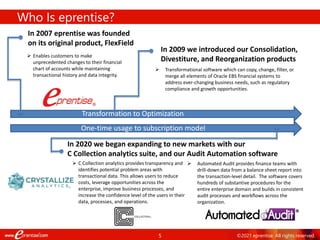
Who Is eprentise?
In 2007 eprentise was founded
on its original product, FlexField
 Enables customers to make
unprecedented changes to their financial
chart of accounts while maintaining
transactional history and data integrity.
In 2009 we introduced our Consolidation,
Divestiture, and Reorganization products
 Transformational software which can copy, change, filter, or
merge all elements of Oracle EBS financial systems to
address ever-changing business needs, such as regulatory
compliance and growth opportunities.
In 2020 we began expanding to new markets with our
C Collection analytics suite, and our Audit Automation software
 Automated Audit provides finance teams with
drill-down data from a balance sheet report into
the transaction-level detail. The software covers
hundreds of substantive procedures for the
entire enterprise domain and builds in consistent
audit processes and workflows across the
organization.
 C Collection analytics provides transparency and
identifies potential problem areas with
transactional data. This allows users to reduce
costs, leverage opportunities across the
enterprise, improve business processes, and
increase the confidence level of the users in their
data, processes, and operations.
Transformation to Optimization
One-time usage to subscription model
6 ©2021 eprentise. All rights reserved.
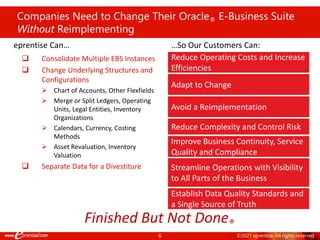
Companies Need to Change Their Oracle® E-Business Suite
Without Reimplementing
 Consolidate Multiple EBS Instances
 Change Underlying Structures and
Configurations
 Chart of Accounts, Other Flexfields
 Merge or Split Ledgers, Operating
Units, Legal Entities, Inventory
Organizations
 Calendars, Currency, Costing
Methods
 Asset Revaluation, Inventory
Valuation
 Separate Data for a Divestiture
Reduce Operating Costs and Increase
Efficiencies
eprentise Can… …So Our Customers Can:
Adapt to Change
Avoid a Reimplementation
Reduce Complexity and Control Risk
Improve Business Continuity, Service
Quality and Compliance
Streamline Operations with Visibility
to All Parts of the Business
Establish Data Quality Standards and
a Single Source of Truth
Finished But Not Done®
7 ©2021 eprentise. All rights reserved.
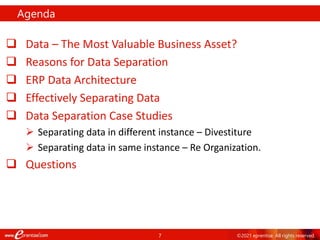
 Data – The Most Valuable Business Asset?
 Reasons for Data Separation
 ERP Data Architecture
 Effectively Separating Data
 Data Separation Case Studies
 Separating data in different instance – Divestiture
 Separating data in same instance – Re Organization.
 Questions
Agenda
8 ©2021 eprentise. All rights reserved.
Objective 1
Discover the reasons for data separation.
9 ©2021 eprentise. All rights reserved.
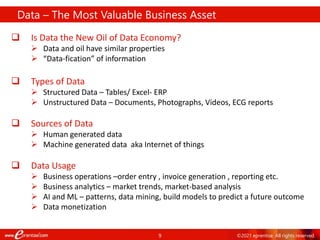
 Is Data the New Oil of Data Economy?
 Data and oil have similar properties
 “Data-fication” of information
 Types of Data
 Structured Data – Tables/ Excel- ERP
 Unstructured Data – Documents, Photographs, Videos, ECG reports
 Sources of Data
 Human generated data
 Machine generated data aka Internet of things
 Data Usage
 Business operations –order entry , invoice generation , reporting etc.
 Business analytics – market trends, market-based analysis
 AI and ML – patterns, data mining, build models to predict a future outcome
 Data monetization
Data – The Most Valuable Business Asset
10 ©2021 eprentise. All rights reserved.
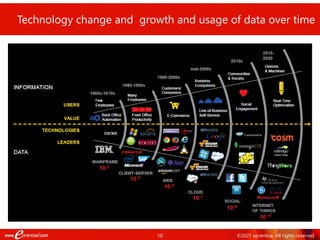
Technology change and growth and usage of data over time
11 ©2021 eprentise. All rights reserved.
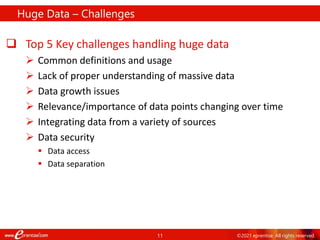
Huge Data – Challenges
 Top 5 Key challenges handling huge data
 Common definitions and usage
 Lack of proper understanding of massive data
 Data growth issues
 Relevance/importance of data points changing over time
 Integrating data from a variety of sources
 Data security
 Data access
 Data separation
12 ©2021 eprentise. All rights reserved.
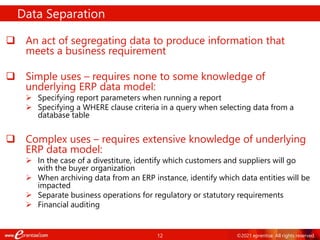
 An act of segregating data to produce information that
meets a business requirement
 Simple uses – requires none to some knowledge of
underlying ERP data model:
 Specifying report parameters when running a report
 Specifying a WHERE clause criteria in a query when selecting data from a
database table
 Complex uses – requires extensive knowledge of underlying
ERP data model:
 In the case of a divestiture, identify which customers and suppliers will go
with the buyer organization
 When archiving data from an ERP instance, identify which data entities will be
impacted
 Separate business operations for regulatory or statutory requirements
 Financial auditing
Data Separation
14 ©2021 eprentise. All rights reserved.
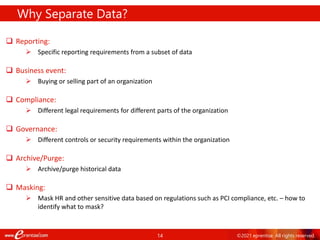
 Reporting:
 Specific reporting requirements from a subset of data
 Business event:
 Buying or selling part of an organization
 Compliance:
 Different legal requirements for different parts of the organization
 Governance:
 Different controls or security requirements within the organization
 Archive/Purge:
 Archive/purge historical data
 Masking:
 Mask HR and other sensitive data based on regulations such as PCI compliance, etc. – how to
identify what to mask?
Why Separate Data?
15 ©2021 eprentise. All rights reserved.
Interesting Data Fact
On average, every human
created at least 1.7 MB of
data per second in 2020.[1]
[1] https://techjury.net/blog/how-much-data-is-created-every-day/#gref
17 ©2021 eprentise. All rights reserved.
Objective 2
Understand data architecture in an ERP system
18 ©2021 eprentise. All rights reserved.
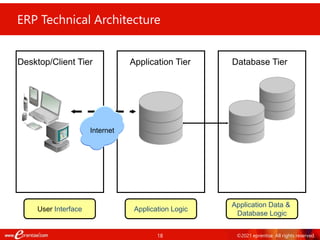
ERP Technical Architecture
User Interface
Desktop/Client Tier
Application Logic
Application Tier
Application Data &
Database Logic
Internet
Database Tier
19 ©2021 eprentise. All rights reserved.
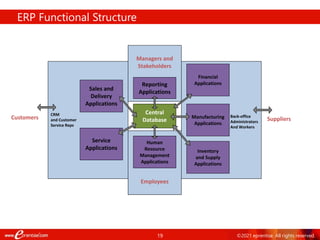
ERP Functional Structure
Employees
Managers and
Stakeholders
Central
Database
Reporting
Applications
Human
Resource
Management
Applications
Financial
Applications
Manufacturing
Applications
Inventory
and Supply
Applications
Human
Resource
Management
Applications
Service
Applications
Sales and
Delivery
Applications
CRM
and Customer
Service Reps
Customers Back-office
Administrators
And Workers
Suppliers
20 ©2021 eprentise. All rights reserved.
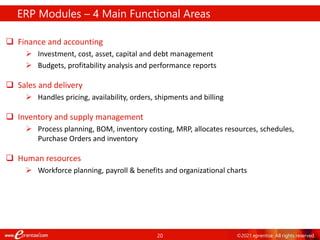
 Finance and accounting
 Investment, cost, asset, capital and debt management
 Budgets, profitability analysis and performance reports
 Sales and delivery
 Handles pricing, availability, orders, shipments and billing
 Inventory and supply management
 Process planning, BOM, inventory costing, MRP, allocates resources, schedules,
Purchase Orders and inventory
 Human resources
 Workforce planning, payroll & benefits and organizational charts
ERP Modules – 4 Main Functional Areas
21 ©2021 eprentise. All rights reserved.
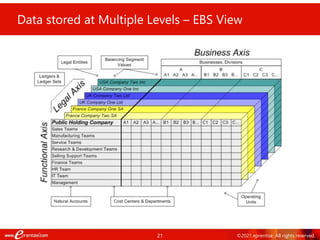
Data stored at Multiple Levels – EBS View
22 ©2021 eprentise. All rights reserved.
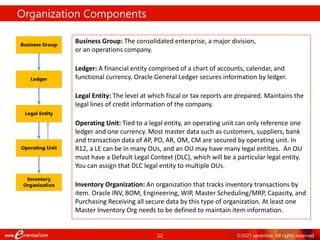
Organization Components
Business Group: The consolidated enterprise, a major division,
or an operations company.
Ledger: A financial entity comprised of a chart of accounts, calendar, and
functional currency. Oracle General Ledger secures information by ledger.
Legal Entity: The level at which fiscal or tax reports are prepared. Maintains the
legal lines of credit information of the company.
Operating Unit: Tied to a legal entity, an operating unit can only reference one
ledger and one currency. Most master data such as customers, suppliers, bank
and transaction data of AP, PO, AR, OM, CM are secured by operating unit. In
R12, a LE can be in many OUs, and an OU may have many legal entities. An OU
must have a Default Legal Context (DLC), which will be a particular legal entity.
You can assign that DLC legal entity to multiple OUs.
Inventory Organization: An organization that tracks inventory transactions by
item. Oracle INV, BOM, Engineering, WIP, Master Scheduling/MRP, Capacity, and
Purchasing Receiving all secure data by this type of organization. At least one
Master Inventory Org needs to be defined to maintain item information.
23 ©2021 eprentise. All rights reserved.
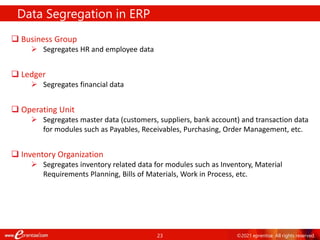
Data Segregation in ERP
 Business Group
 Segregates HR and employee data
 Ledger
 Segregates financial data
 Operating Unit
 Segregates master data (customers, suppliers, bank account) and transaction data
for modules such as Payables, Receivables, Purchasing, Order Management, etc.
 Inventory Organization
 Segregates inventory related data for modules such as Inventory, Material
Requirements Planning, Bills of Materials, Work in Process, etc.
24 ©2021 eprentise. All rights reserved.
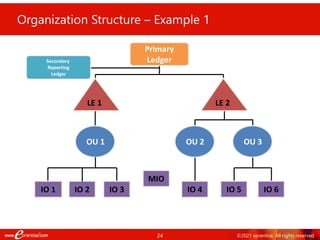
Organization Structure – Example 1
LE 2
LE 1
Primary
Ledger
IO 4
OU 1
IO 1 IO 5 IO 6
IO 2 IO 3
MIO
OU 2 OU 3
Secondary
Reporting
Ledger
25 ©2021 eprentise. All rights reserved.
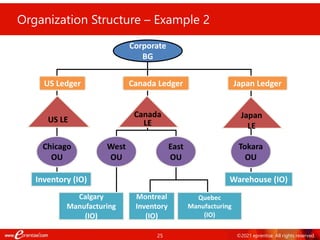
Organization Structure – Example 2
US Ledger
US LE
Chicago
OU
Japan Ledger
Japan
LE
Corporate
BG
Canada Ledger
Canada
LE
East
OU
Tokara
OU
Inventory (IO)
Calgary
Manufacturing
(IO)
Warehouse (IO)
West
OU
Quebec
Manufacturing
(IO)
Montreal
Inventory
(IO)
26 ©2021 eprentise. All rights reserved.
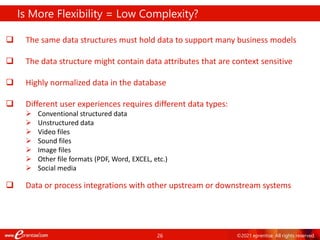
 The same data structures must hold data to support many business models
 The data structure might contain data attributes that are context sensitive
 Highly normalized data in the database
 Different user experiences requires different data types:
 Conventional structured data
 Unstructured data
 Video files
 Sound files
 Image files
 Other file formats (PDF, Word, EXCEL, etc.)
 Social media
 Data or process integrations with other upstream or downstream systems
Is More Flexibility = Low Complexity?
27 ©2021 eprentise. All rights reserved.
Interesting Data Fact
The majority of the
world’s data has come
about in only the past two
years as indicated by data
growth statistics.
[1]
[1] https://techjury.net/blog/how-much-data-is-created-every-day/#gref
29 ©2021 eprentise. All rights reserved.
Objective 3
Explain how to effectively separate the data
30 ©2021 eprentise. All rights reserved.
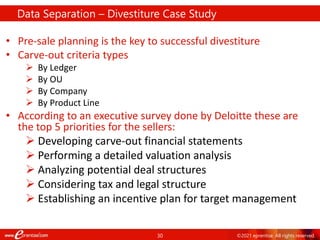
Data Separation – Divestiture Case Study
• Pre-sale planning is the key to successful divestiture
• Carve-out criteria types
 By Ledger
 By OU
 By Company
 By Product Line
• According to an executive survey done by Deloitte these are
the top 5 priorities for the sellers:
 Developing carve-out financial statements
 Performing a detailed valuation analysis
 Analyzing potential deal structures
 Considering tax and legal structure
 Establishing an incentive plan for target management
31 ©2021 eprentise. All rights reserved.
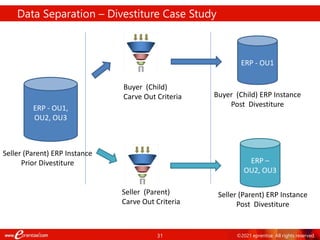
Data Separation – Divestiture Case Study
ERP - OU1,
OU2, OU3
ERP - OU1
Buyer (Child)
Carve Out Criteria
ERP –
OU2, OU3
Seller (Parent) ERP Instance
Prior Divestiture
Buyer (Child) ERP Instance
Post Divestiture
Seller (Parent) ERP Instance
Post Divestiture
Seller (Parent)
Carve Out Criteria
32 ©2021 eprentise. All rights reserved.
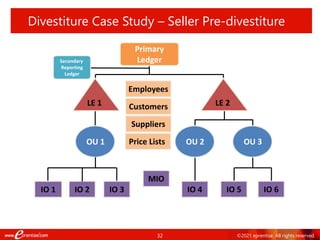
Divestiture Case Study – Seller Pre-divestiture
LE 2
LE 1
Primary
Ledger
IO 4
OU 1
IO 1 IO 5 IO 6
IO 2 IO 3
MIO
OU 2 OU 3
Secondary
Reporting
Ledger
Customers
Suppliers
Price Lists
Employees
33 ©2021 eprentise. All rights reserved.
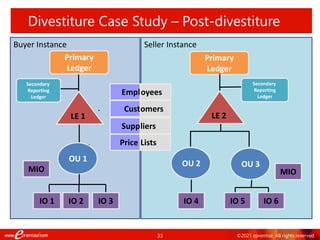
Divestiture Case Study – Post-divestiture
Buyer Instance
LE 1
Primary
Ledger
OU 1
IO 1 IO 2 IO 3
MIO
Secondary
Reporting
Ledger
Cust
Supp
Price
Empl
Seller Instance
LE 2
IO 4 IO 5 IO 6
OU 2 OU 3
MIO
Primary
Ledger
Secondary
Reporting
Ledger
omers
liers
Lists
oyees
34 ©2021 eprentise. All rights reserved.
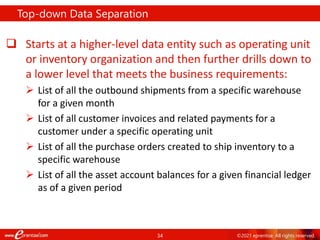
 Starts at a higher-level data entity such as operating unit
or inventory organization and then further drills down to
a lower level that meets the business requirements:
 List of all the outbound shipments from a specific warehouse
for a given month
 List of all customer invoices and related payments for a
customer under a specific operating unit
 List of all the purchase orders created to ship inventory to a
specific warehouse
 List of all the asset account balances for a given financial ledger
as of a given period
Top-down Data Separation
35 ©2021 eprentise. All rights reserved.
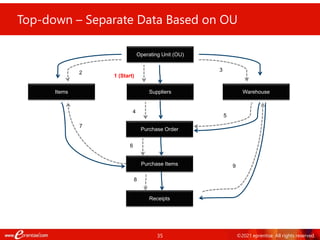
Top-down – Separate Data Based on OU
Operating Unit (OU)
Items Suppliers Warehouse
Purchase Order
Purchase Items
Receipts
7
8
6
4
1 (Start)
5
2
3
9
36 ©2021 eprentise. All rights reserved.
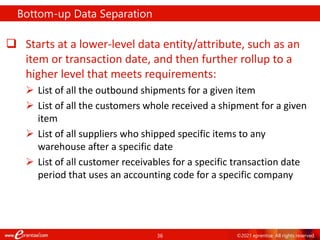
 Starts at a lower-level data entity/attribute, such as an
item or transaction date, and then further rollup to a
higher level that meets requirements:
 List of all the outbound shipments for a given item
 List of all the customers whole received a shipment for a given
item
 List of all suppliers who shipped specific items to any
warehouse after a specific date
 List of all customer receivables for a specific transaction date
period that uses an accounting code for a specific company
Bottom-up Data Separation
37 ©2021 eprentise. All rights reserved.
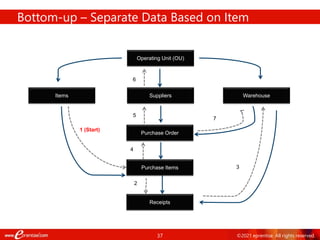
Bottom-up – Separate Data Based on Item
Operating Unit (OU)
Items Suppliers Warehouse
Purchase Order
Purchase Items
Receipts
1 (Start)
2
4
5
6
7
3
38 ©2021 eprentise. All rights reserved.
Interesting Data Fact
In 2024, the number of
emails will be about 361
billion every day.[1]
[1] https://techjury.net/blog/how-much-data-is-created-every-day/#gref
40 ©2021 eprentise. All rights reserved.
 Understanding of data entities, using:
 Published data dictionary
 ER diagrams
 Metadata from the database
 Other available sources such as custom documentation, internal
knowledgebase, etc.
 Techno-Functional knowledge of the data - how different
business functions relate to the data
 For example, understand purchasing and its connection with
payables and financial accounting
 Understanding of the tools available in the market
Pre-requisites for Making Good Decisions with Data
Separation
41 ©2021 eprentise. All rights reserved.
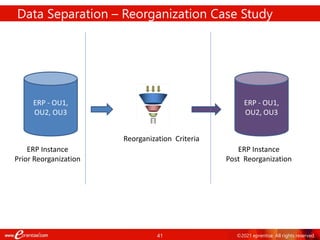
Data Separation – Reorganization Case Study
ERP - OU1,
OU2, OU3
Reorganization Criteria
ERP Instance
Prior Reorganization
ERP Instance
Post Reorganization
ERP - OU1,
OU2, OU3
42 ©2021 eprentise. All rights reserved.
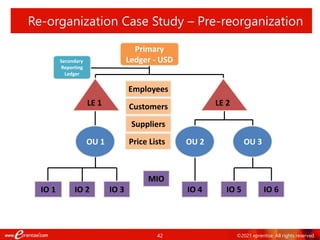
Re-organization Case Study – Pre-reorganization
LE 2
LE 1
Primary
Ledger - USD
IO 4
OU 1
IO 1 IO 5 IO 6
IO 2 IO 3
MIO
OU 2 OU 3
Secondary
Reporting
Ledger
Customers
Suppliers
Price Lists
Employees
43 ©2021 eprentise. All rights reserved.
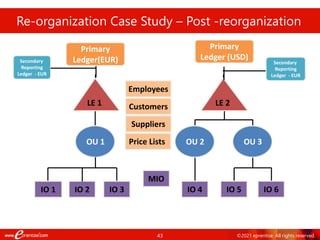
Re-organization Case Study – Post -reorganization
LE 2
LE 1
Primary
Ledger(EUR)
IO 4
OU 1
IO 1 IO 5 IO 6
IO 2 IO 3
MIO
OU 2 OU 3
Secondary
Reporting
Ledger - EUR
Customers
Suppliers
Price Lists
Employees
Primary
Ledger (USD)
Secondary
Reporting
Ledger - EUR
44 ©2021 eprentise. All rights reserved.
 Cloud Solutions: SaaS, PaaS, IaaS
 Single functional domain SaaS tools have been in the market
for 10+ years now and are very mature (Salesforce.com)
 PaaS and IaaS are very mature now
 Multiple functional domain SaaS tools such as ERP are fairly
new to the market and are increasingly being adopted by
customers and the product offering is also being constantly
enhanced by the customer
 Customer can utilize APIs to extract data from Cloud ERP but
have limited ability to directly access the data using external
SQL/data integration tools
Data Separation in the Cloud
45 ©2021 eprentise. All rights reserved.
Questions?
46 ©2021 eprentise. All rights reserved.
Thank You!
- One World, One System, A Single Source of Truth -
Anil Kukreja
Managing Director, eprentise India
Chief Technology Officer, eprentise
Hosted by eprentise®
Questions and Responses shared on EBS Answers:
linkedin.com/groups/4683349/
www.eprentise.com | www.CrystallizeAnalytics.com

Complexities of Separating Data in an ERP Environment

  • 1.
    Complexities of Separating Datain an ERP Environment
  • 2.
    3 ©2021 eprentise.All rights reserved. Webinar Mechanics  The Audio Options menu is in the lower-left portion of the window.  Please submit all presentation-related questions in the Q&A panel. Time-permitting, questions received will be answered at the end of the session. All Q&A will be posted on our LinkedIn page, EBS Answers, after the event.  Please submit all support/other questions in the Chat panel.  Polling questions will be presented during the session. Receipt of CPE credit for today’s session requires that all polling questions be answered.  After the event, a follow-up email will be sent including a link to the recording of today’s session and Q&A.
  • 3.
    4 ©2021 eprentise.All rights reserved. After completion of this presentation, you will be able to:  Objective 1: Discover the reasons for data separation.  Objective 2: Understand data architecture in an Enterprise Resource Planning (ERP) System.  Objective 3: Explain how to effectively separate the data. Learning Objectives
  • 4.
    5 ©2021 eprentise.All rights reserved. Who Is eprentise? In 2007 eprentise was founded on its original product, FlexField  Enables customers to make unprecedented changes to their financial chart of accounts while maintaining transactional history and data integrity. In 2009 we introduced our Consolidation, Divestiture, and Reorganization products  Transformational software which can copy, change, filter, or merge all elements of Oracle EBS financial systems to address ever-changing business needs, such as regulatory compliance and growth opportunities. In 2020 we began expanding to new markets with our C Collection analytics suite, and our Audit Automation software  Automated Audit provides finance teams with drill-down data from a balance sheet report into the transaction-level detail. The software covers hundreds of substantive procedures for the entire enterprise domain and builds in consistent audit processes and workflows across the organization.  C Collection analytics provides transparency and identifies potential problem areas with transactional data. This allows users to reduce costs, leverage opportunities across the enterprise, improve business processes, and increase the confidence level of the users in their data, processes, and operations. Transformation to Optimization One-time usage to subscription model
  • 5.
    6 ©2021 eprentise.All rights reserved. Companies Need to Change Their Oracle® E-Business Suite Without Reimplementing  Consolidate Multiple EBS Instances  Change Underlying Structures and Configurations  Chart of Accounts, Other Flexfields  Merge or Split Ledgers, Operating Units, Legal Entities, Inventory Organizations  Calendars, Currency, Costing Methods  Asset Revaluation, Inventory Valuation  Separate Data for a Divestiture Reduce Operating Costs and Increase Efficiencies eprentise Can… …So Our Customers Can: Adapt to Change Avoid a Reimplementation Reduce Complexity and Control Risk Improve Business Continuity, Service Quality and Compliance Streamline Operations with Visibility to All Parts of the Business Establish Data Quality Standards and a Single Source of Truth Finished But Not Done®
  • 6.
    7 ©2021 eprentise.All rights reserved.  Data – The Most Valuable Business Asset?  Reasons for Data Separation  ERP Data Architecture  Effectively Separating Data  Data Separation Case Studies  Separating data in different instance – Divestiture  Separating data in same instance – Re Organization.  Questions Agenda
  • 7.
    8 ©2021 eprentise.All rights reserved. Objective 1 Discover the reasons for data separation.
  • 8.
    9 ©2021 eprentise.All rights reserved.  Is Data the New Oil of Data Economy?  Data and oil have similar properties  “Data-fication” of information  Types of Data  Structured Data – Tables/ Excel- ERP  Unstructured Data – Documents, Photographs, Videos, ECG reports  Sources of Data  Human generated data  Machine generated data aka Internet of things  Data Usage  Business operations –order entry , invoice generation , reporting etc.  Business analytics – market trends, market-based analysis  AI and ML – patterns, data mining, build models to predict a future outcome  Data monetization Data – The Most Valuable Business Asset
  • 9.
    10 ©2021 eprentise.All rights reserved. Technology change and growth and usage of data over time
  • 10.
    11 ©2021 eprentise.All rights reserved. Huge Data – Challenges  Top 5 Key challenges handling huge data  Common definitions and usage  Lack of proper understanding of massive data  Data growth issues  Relevance/importance of data points changing over time  Integrating data from a variety of sources  Data security  Data access  Data separation
  • 11.
    12 ©2021 eprentise.All rights reserved.  An act of segregating data to produce information that meets a business requirement  Simple uses – requires none to some knowledge of underlying ERP data model:  Specifying report parameters when running a report  Specifying a WHERE clause criteria in a query when selecting data from a database table  Complex uses – requires extensive knowledge of underlying ERP data model:  In the case of a divestiture, identify which customers and suppliers will go with the buyer organization  When archiving data from an ERP instance, identify which data entities will be impacted  Separate business operations for regulatory or statutory requirements  Financial auditing Data Separation
  • 12.
    14 ©2021 eprentise.All rights reserved.  Reporting:  Specific reporting requirements from a subset of data  Business event:  Buying or selling part of an organization  Compliance:  Different legal requirements for different parts of the organization  Governance:  Different controls or security requirements within the organization  Archive/Purge:  Archive/purge historical data  Masking:  Mask HR and other sensitive data based on regulations such as PCI compliance, etc. – how to identify what to mask? Why Separate Data?
  • 13.
    15 ©2021 eprentise.All rights reserved. Interesting Data Fact On average, every human created at least 1.7 MB of data per second in 2020.[1] [1] https://techjury.net/blog/how-much-data-is-created-every-day/#gref
  • 14.
    17 ©2021 eprentise.All rights reserved. Objective 2 Understand data architecture in an ERP system
  • 15.
    18 ©2021 eprentise.All rights reserved. ERP Technical Architecture User Interface Desktop/Client Tier Application Logic Application Tier Application Data & Database Logic Internet Database Tier
  • 16.
    19 ©2021 eprentise.All rights reserved. ERP Functional Structure Employees Managers and Stakeholders Central Database Reporting Applications Human Resource Management Applications Financial Applications Manufacturing Applications Inventory and Supply Applications Human Resource Management Applications Service Applications Sales and Delivery Applications CRM and Customer Service Reps Customers Back-office Administrators And Workers Suppliers
  • 17.
    20 ©2021 eprentise.All rights reserved.  Finance and accounting  Investment, cost, asset, capital and debt management  Budgets, profitability analysis and performance reports  Sales and delivery  Handles pricing, availability, orders, shipments and billing  Inventory and supply management  Process planning, BOM, inventory costing, MRP, allocates resources, schedules, Purchase Orders and inventory  Human resources  Workforce planning, payroll & benefits and organizational charts ERP Modules – 4 Main Functional Areas
  • 18.
    21 ©2021 eprentise.All rights reserved. Data stored at Multiple Levels – EBS View
  • 19.
    22 ©2021 eprentise.All rights reserved. Organization Components Business Group: The consolidated enterprise, a major division, or an operations company. Ledger: A financial entity comprised of a chart of accounts, calendar, and functional currency. Oracle General Ledger secures information by ledger. Legal Entity: The level at which fiscal or tax reports are prepared. Maintains the legal lines of credit information of the company. Operating Unit: Tied to a legal entity, an operating unit can only reference one ledger and one currency. Most master data such as customers, suppliers, bank and transaction data of AP, PO, AR, OM, CM are secured by operating unit. In R12, a LE can be in many OUs, and an OU may have many legal entities. An OU must have a Default Legal Context (DLC), which will be a particular legal entity. You can assign that DLC legal entity to multiple OUs. Inventory Organization: An organization that tracks inventory transactions by item. Oracle INV, BOM, Engineering, WIP, Master Scheduling/MRP, Capacity, and Purchasing Receiving all secure data by this type of organization. At least one Master Inventory Org needs to be defined to maintain item information.
  • 20.
    23 ©2021 eprentise.All rights reserved. Data Segregation in ERP  Business Group  Segregates HR and employee data  Ledger  Segregates financial data  Operating Unit  Segregates master data (customers, suppliers, bank account) and transaction data for modules such as Payables, Receivables, Purchasing, Order Management, etc.  Inventory Organization  Segregates inventory related data for modules such as Inventory, Material Requirements Planning, Bills of Materials, Work in Process, etc.
  • 21.
    24 ©2021 eprentise.All rights reserved. Organization Structure – Example 1 LE 2 LE 1 Primary Ledger IO 4 OU 1 IO 1 IO 5 IO 6 IO 2 IO 3 MIO OU 2 OU 3 Secondary Reporting Ledger
  • 22.
    25 ©2021 eprentise.All rights reserved. Organization Structure – Example 2 US Ledger US LE Chicago OU Japan Ledger Japan LE Corporate BG Canada Ledger Canada LE East OU Tokara OU Inventory (IO) Calgary Manufacturing (IO) Warehouse (IO) West OU Quebec Manufacturing (IO) Montreal Inventory (IO)
  • 23.
    26 ©2021 eprentise.All rights reserved.  The same data structures must hold data to support many business models  The data structure might contain data attributes that are context sensitive  Highly normalized data in the database  Different user experiences requires different data types:  Conventional structured data  Unstructured data  Video files  Sound files  Image files  Other file formats (PDF, Word, EXCEL, etc.)  Social media  Data or process integrations with other upstream or downstream systems Is More Flexibility = Low Complexity?
  • 24.
    27 ©2021 eprentise.All rights reserved. Interesting Data Fact The majority of the world’s data has come about in only the past two years as indicated by data growth statistics. [1] [1] https://techjury.net/blog/how-much-data-is-created-every-day/#gref
  • 25.
    29 ©2021 eprentise.All rights reserved. Objective 3 Explain how to effectively separate the data
  • 26.
    30 ©2021 eprentise.All rights reserved. Data Separation – Divestiture Case Study • Pre-sale planning is the key to successful divestiture • Carve-out criteria types  By Ledger  By OU  By Company  By Product Line • According to an executive survey done by Deloitte these are the top 5 priorities for the sellers:  Developing carve-out financial statements  Performing a detailed valuation analysis  Analyzing potential deal structures  Considering tax and legal structure  Establishing an incentive plan for target management
  • 27.
    31 ©2021 eprentise.All rights reserved. Data Separation – Divestiture Case Study ERP - OU1, OU2, OU3 ERP - OU1 Buyer (Child) Carve Out Criteria ERP – OU2, OU3 Seller (Parent) ERP Instance Prior Divestiture Buyer (Child) ERP Instance Post Divestiture Seller (Parent) ERP Instance Post Divestiture Seller (Parent) Carve Out Criteria
  • 28.
    32 ©2021 eprentise.All rights reserved. Divestiture Case Study – Seller Pre-divestiture LE 2 LE 1 Primary Ledger IO 4 OU 1 IO 1 IO 5 IO 6 IO 2 IO 3 MIO OU 2 OU 3 Secondary Reporting Ledger Customers Suppliers Price Lists Employees
  • 29.
    33 ©2021 eprentise.All rights reserved. Divestiture Case Study – Post-divestiture Buyer Instance LE 1 Primary Ledger OU 1 IO 1 IO 2 IO 3 MIO Secondary Reporting Ledger Cust Supp Price Empl Seller Instance LE 2 IO 4 IO 5 IO 6 OU 2 OU 3 MIO Primary Ledger Secondary Reporting Ledger omers liers Lists oyees
  • 30.
    34 ©2021 eprentise.All rights reserved.  Starts at a higher-level data entity such as operating unit or inventory organization and then further drills down to a lower level that meets the business requirements:  List of all the outbound shipments from a specific warehouse for a given month  List of all customer invoices and related payments for a customer under a specific operating unit  List of all the purchase orders created to ship inventory to a specific warehouse  List of all the asset account balances for a given financial ledger as of a given period Top-down Data Separation
  • 31.
    35 ©2021 eprentise.All rights reserved. Top-down – Separate Data Based on OU Operating Unit (OU) Items Suppliers Warehouse Purchase Order Purchase Items Receipts 7 8 6 4 1 (Start) 5 2 3 9
  • 32.
    36 ©2021 eprentise.All rights reserved.  Starts at a lower-level data entity/attribute, such as an item or transaction date, and then further rollup to a higher level that meets requirements:  List of all the outbound shipments for a given item  List of all the customers whole received a shipment for a given item  List of all suppliers who shipped specific items to any warehouse after a specific date  List of all customer receivables for a specific transaction date period that uses an accounting code for a specific company Bottom-up Data Separation
  • 33.
    37 ©2021 eprentise.All rights reserved. Bottom-up – Separate Data Based on Item Operating Unit (OU) Items Suppliers Warehouse Purchase Order Purchase Items Receipts 1 (Start) 2 4 5 6 7 3
  • 34.
    38 ©2021 eprentise.All rights reserved. Interesting Data Fact In 2024, the number of emails will be about 361 billion every day.[1] [1] https://techjury.net/blog/how-much-data-is-created-every-day/#gref
  • 35.
    40 ©2021 eprentise.All rights reserved.  Understanding of data entities, using:  Published data dictionary  ER diagrams  Metadata from the database  Other available sources such as custom documentation, internal knowledgebase, etc.  Techno-Functional knowledge of the data - how different business functions relate to the data  For example, understand purchasing and its connection with payables and financial accounting  Understanding of the tools available in the market Pre-requisites for Making Good Decisions with Data Separation
  • 36.
    41 ©2021 eprentise.All rights reserved. Data Separation – Reorganization Case Study ERP - OU1, OU2, OU3 Reorganization Criteria ERP Instance Prior Reorganization ERP Instance Post Reorganization ERP - OU1, OU2, OU3
  • 37.
    42 ©2021 eprentise.All rights reserved. Re-organization Case Study – Pre-reorganization LE 2 LE 1 Primary Ledger - USD IO 4 OU 1 IO 1 IO 5 IO 6 IO 2 IO 3 MIO OU 2 OU 3 Secondary Reporting Ledger Customers Suppliers Price Lists Employees
  • 38.
    43 ©2021 eprentise.All rights reserved. Re-organization Case Study – Post -reorganization LE 2 LE 1 Primary Ledger(EUR) IO 4 OU 1 IO 1 IO 5 IO 6 IO 2 IO 3 MIO OU 2 OU 3 Secondary Reporting Ledger - EUR Customers Suppliers Price Lists Employees Primary Ledger (USD) Secondary Reporting Ledger - EUR
  • 39.
    44 ©2021 eprentise.All rights reserved.  Cloud Solutions: SaaS, PaaS, IaaS  Single functional domain SaaS tools have been in the market for 10+ years now and are very mature (Salesforce.com)  PaaS and IaaS are very mature now  Multiple functional domain SaaS tools such as ERP are fairly new to the market and are increasingly being adopted by customers and the product offering is also being constantly enhanced by the customer  Customer can utilize APIs to extract data from Cloud ERP but have limited ability to directly access the data using external SQL/data integration tools Data Separation in the Cloud
  • 40.
    45 ©2021 eprentise.All rights reserved. Questions?
  • 41.
    46 ©2021 eprentise.All rights reserved. Thank You! - One World, One System, A Single Source of Truth - Anil Kukreja Managing Director, eprentise India Chief Technology Officer, eprentise Hosted by eprentise® Questions and Responses shared on EBS Answers: linkedin.com/groups/4683349/ www.eprentise.com | www.CrystallizeAnalytics.com