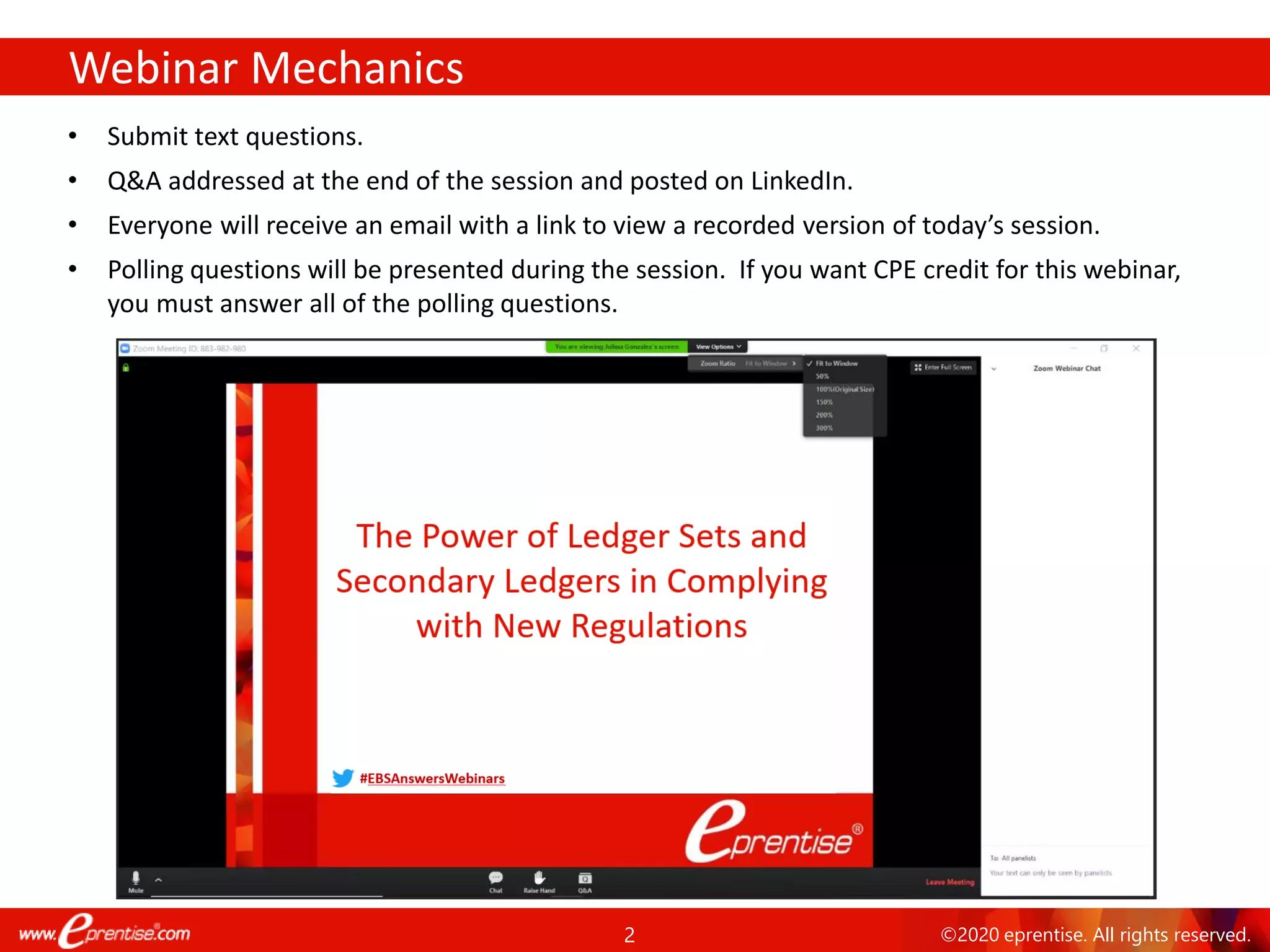
The Power of Ledger Sets and
Secondary Ledgers in Complying
with New Regulations
#EBSAnswersWebinars
2 ©2020 eprentise. All rights reserved.
Webinar Mechanics
• Submit text questions.
• Q&A addressed at the end of the session and posted on LinkedIn.
• Everyone will receive an email with a link to view a recorded version of today’s session.
• Polling questions will be presented during the session. If you want CPE credit for this webinar,
you must answer all of the polling questions.
3 ©2020 eprentise. All rights reserved.
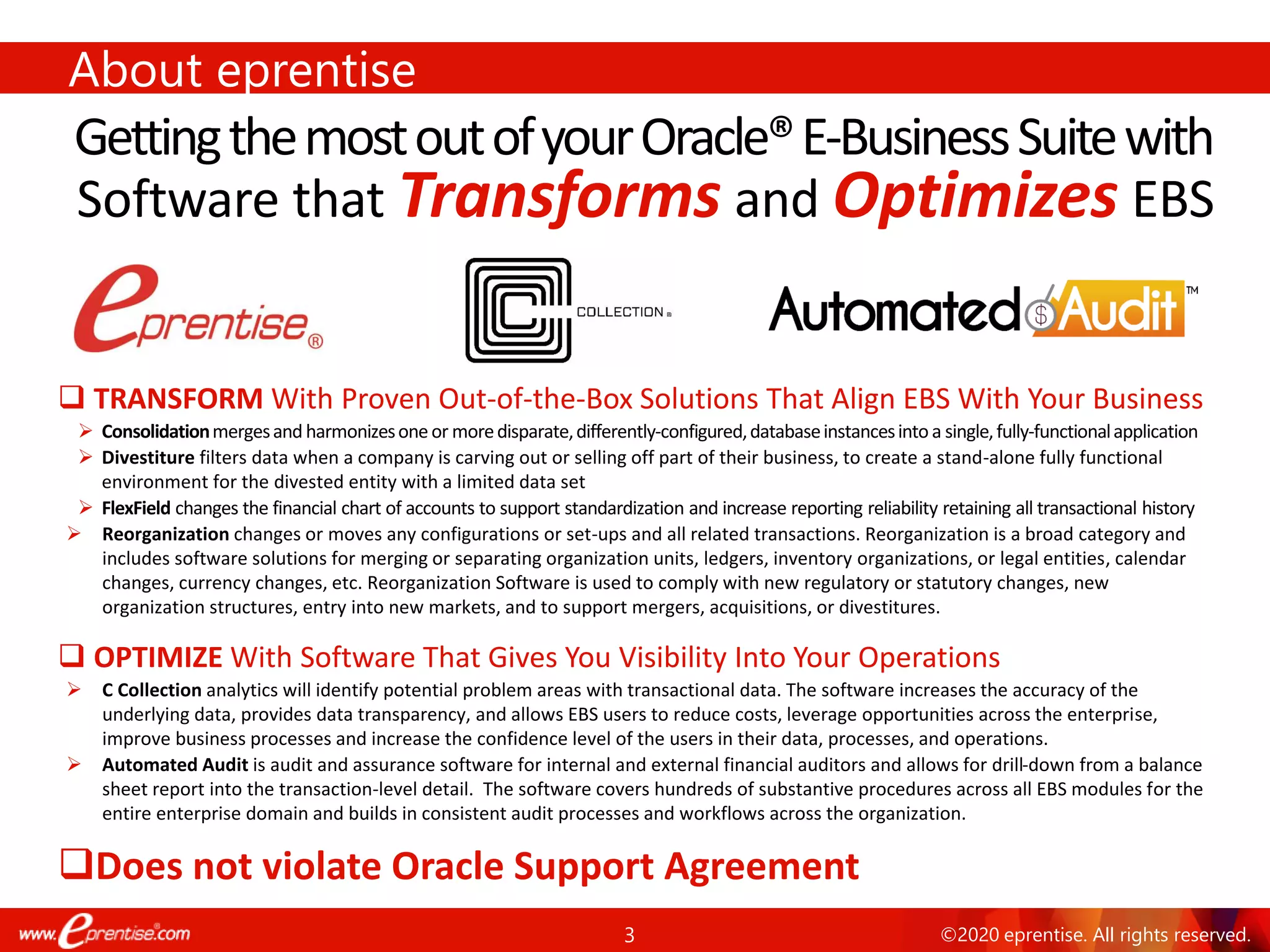
About eprentise
GettingthemostoutofyourOracle®E-BusinessSuitewith
❑ TRANSFORM With Proven Out-of-the-Box Solutions That Align EBS With Your Business
➢ Consolidationmergesand harmonizesoneor moredisparate,differently-configured,databaseinstancesintoa single,fully-functionalapplication
➢ Divestiture filters data when a company is carving out or selling off part of their business, to create a stand-alone fully functional
environment for the divested entity with a limited data set
➢ FlexField changes the financial chart of accounts to support standardization and increase reporting reliability retaining all transactional history
➢ Reorganization changes or moves any configurations or set-ups and all related transactions. Reorganization is a broad category and
includes software solutions for merging or separating organization units, ledgers, inventory organizations, or legal entities, calendar
changes, currency changes, etc. Reorganization Software is used to comply with new regulatory or statutory changes, new
organization structures, entry into new markets, and to support mergers, acquisitions, or divestitures.
❑ OPTIMIZE With Software That Gives You Visibility Into Your Operations
➢ C Collection analytics will identify potential problem areas with transactional data. The software increases the accuracy of the
underlying data, provides data transparency, and allows EBS users to reduce costs, leverage opportunities across the enterprise,
improve business processes and increase the confidence level of the users in their data, processes, and operations.
➢ Automated Audit is audit and assurance software for internal and external financial auditors and allows for drill-down from a balance
sheet report into the transaction-level detail. The software covers hundreds of substantive procedures across all EBS modules for the
entire enterprise domain and builds in consistent audit processes and workflows across the organization.
❑Does not violate Oracle Support Agreement
Software that Transforms and Optimizes EBS
4 ©2020 eprentise. All rights reserved.
Learning Objectives
Objective 1: Discuss significant changes in financial reporting requirements
from regulatory agencies.
Objective 2: Demonstrate the basic mechanics of using Secondary Ledgers to
address regulatory requirements.
Objective 3: Calculate the cost savings from using Secondary Ledgers to
replace reporting spreadsheets.
Objective 4: Identify the EBS configuration requirements for effective use of
Secondary Ledgers in R12.
5 ©2020 eprentise. All rights reserved.
Agenda
❑ The Challenges of Adjusting Entries for Reporting and
Compliance
➢ The Solution: Ledger Sets and Secondary Ledgers
❑ An Overview of Ledger Sets and Secondary Ledgers In
R12
➢ The Mechanics of Setting Up Secondary Ledgers
➢ Ledger Sets
❑ Solving the Problems of Adjusting Journal Entries
❑ Streamlining Local and Statutory Reporting
Requirements
6 ©2020 eprentise. All rights reserved.
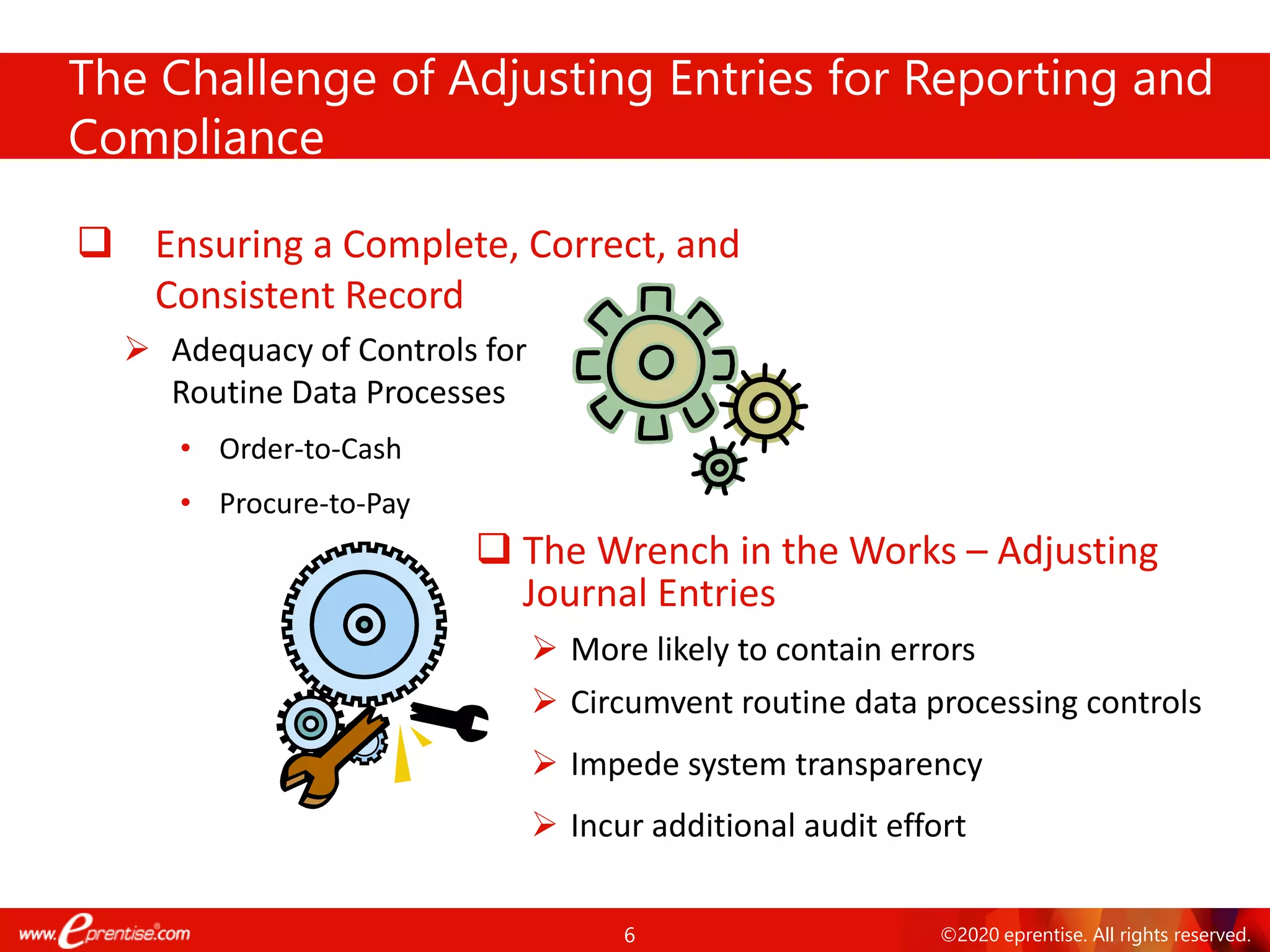
The Challenge of Adjusting Entries for Reporting and
Compliance
❑ Ensuring a Complete, Correct, and
Consistent Record
➢ Adequacy of Controls for
Routine Data Processes
• Order-to-Cash
• Procure-to-Pay
❑ The Wrench in the Works – Adjusting
Journal Entries
➢ More likely to contain errors
➢ Circumvent routine data processing controls
➢ Impede system transparency
➢ Incur additional audit effort
7 ©2020 eprentise. All rights reserved.
Traditional Options Before R12
Prior to the introduction of Release 12, the only real options for
adjusting journal entries were to:
❑ Make the entries directly to the primary ledger,
requiring the ledger period be left open until all
adjustments were made
❑ If a company had defined adjusting periods on their
calendar, then the normal period could be closed and
with the adjusting entries being made to the primary
ledger in a discrete period
➢ Still doesn’t solve many of the problems associated with
adjusting journal entries
8 ©2020 eprentise. All rights reserved.
The Solution:
Ledger Sets and
Secondary Ledgers
9 ©2020 eprentise. All rights reserved.
Secondary Ledgers Can Be Maintained at One of Four
Different Levels of Detail
1. Balance Level
2. Journal Level
3. Subledger Level
4. Adjustments-Only Level
10 ©2020 eprentise. All rights reserved.
Balance Level Secondary Ledger
IFRS/GAAP Example
❑ Account balances only in another accounting
representation.
➢ No drill-down to journal entries or subledgers
❑ Balances exist at reporting period dates only.
❑ G/L Consolidation.
11 ©2020 eprentise. All rights reserved.
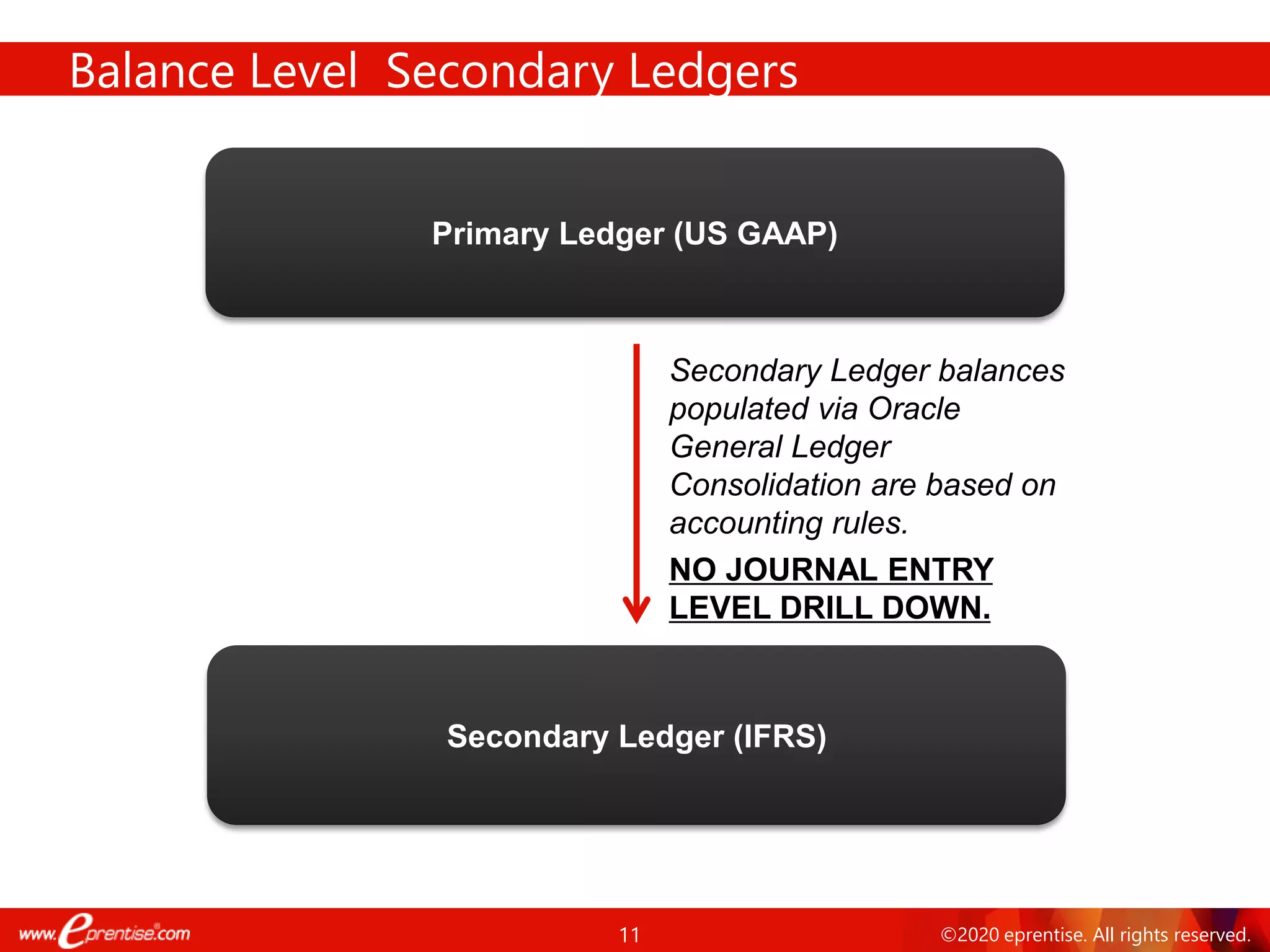
Balance Level Secondary Ledgers
Secondary Ledger (IFRS)
Primary Ledger (US GAAP)
Secondary Ledger balances
populated via Oracle
General Ledger
Consolidation are based on
accounting rules.
NO JOURNAL ENTRY
LEVEL DRILL DOWN.
13 ©2020 eprentise. All rights reserved.
Journal Level Secondary Ledger
❑ Balance Level Secondary Ledger
❑ Journal Level Secondary Ledger
(affected through General Ledger Posting)
➢ Account Balances
➢ (Manual) Journal Entries
14 ©2020 eprentise. All rights reserved.
Secondary Ledgers – Subledger Level
❑ Prior to R12: limited options available for companies
requiring different regulatory chart of accounts
❑ Could have created a GL Consolidation that allowed you to
map to a different chart of accounts, but the GL financial
consolidation would not have included the transaction
detail of the subledgers
➢ Reconciliation was a time-consuming process
15 ©2020 eprentise. All rights reserved.
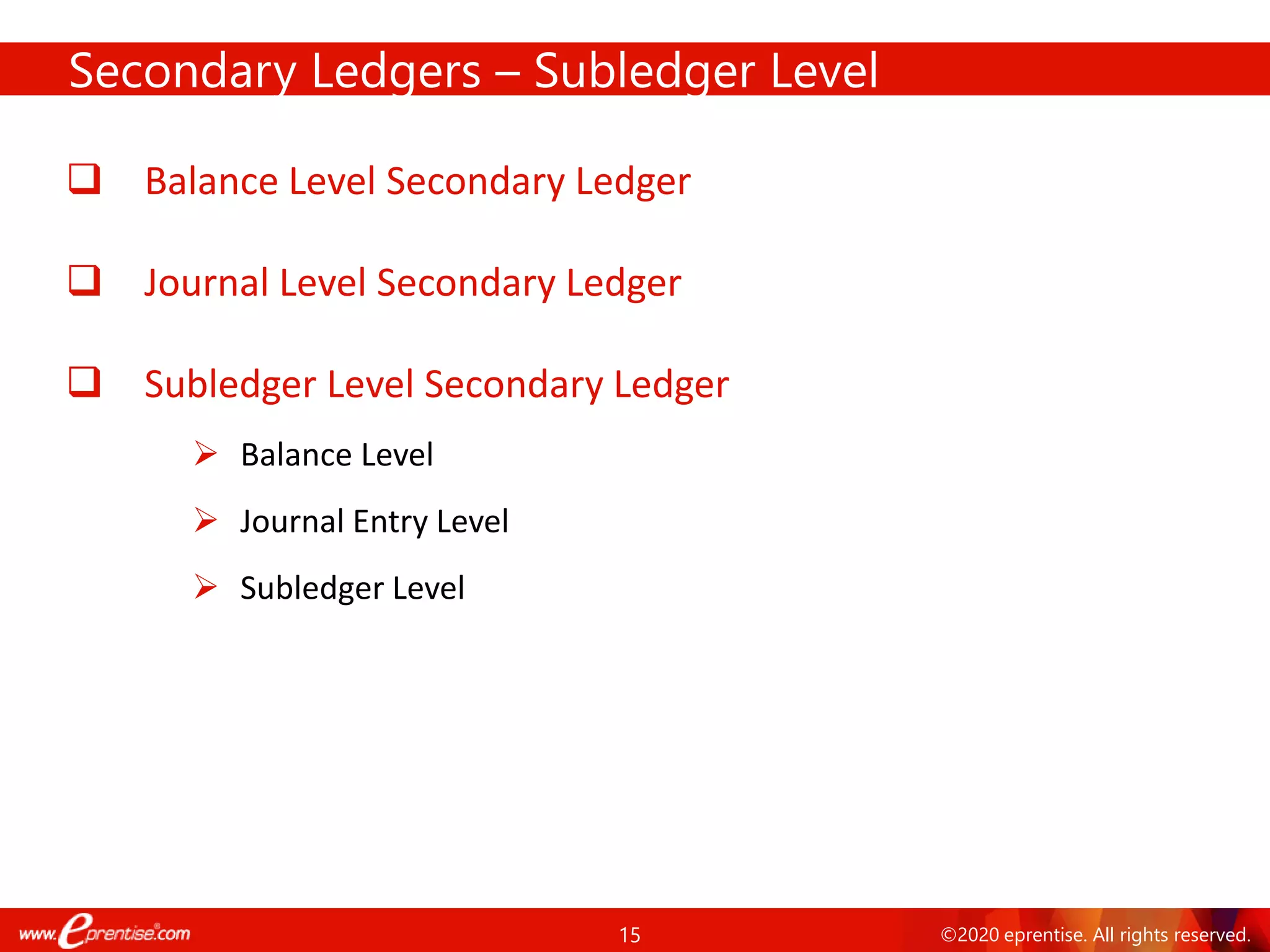
Secondary Ledgers – Subledger Level
❑ Balance Level Secondary Ledger
❑ Journal Level Secondary Ledger
❑ Subledger Level Secondary Ledger
➢ Balance Level
➢ Journal Entry Level
➢ Subledger Level
16 ©2020 eprentise. All rights reserved.
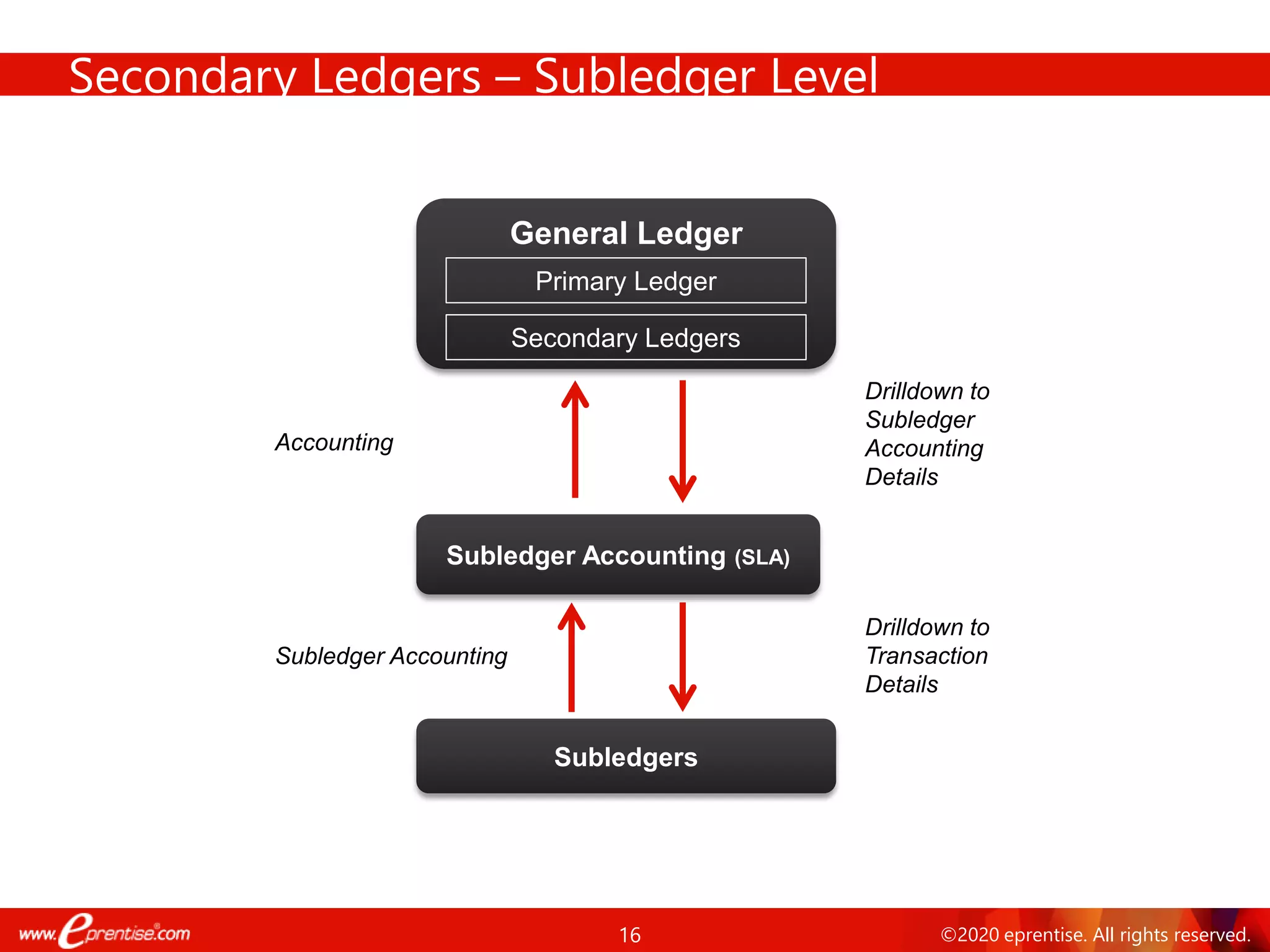
General Ledger
Primary Ledger
Secondary Ledgers
Subledgers
Subledger Accounting (SLA)
Drilldown to
Subledger
Accounting
Details
Drilldown to
Transaction
Details
Accounting
Subledger Accounting
Secondary Ledgers – Subledger Level
17 ©2020 eprentise. All rights reserved.
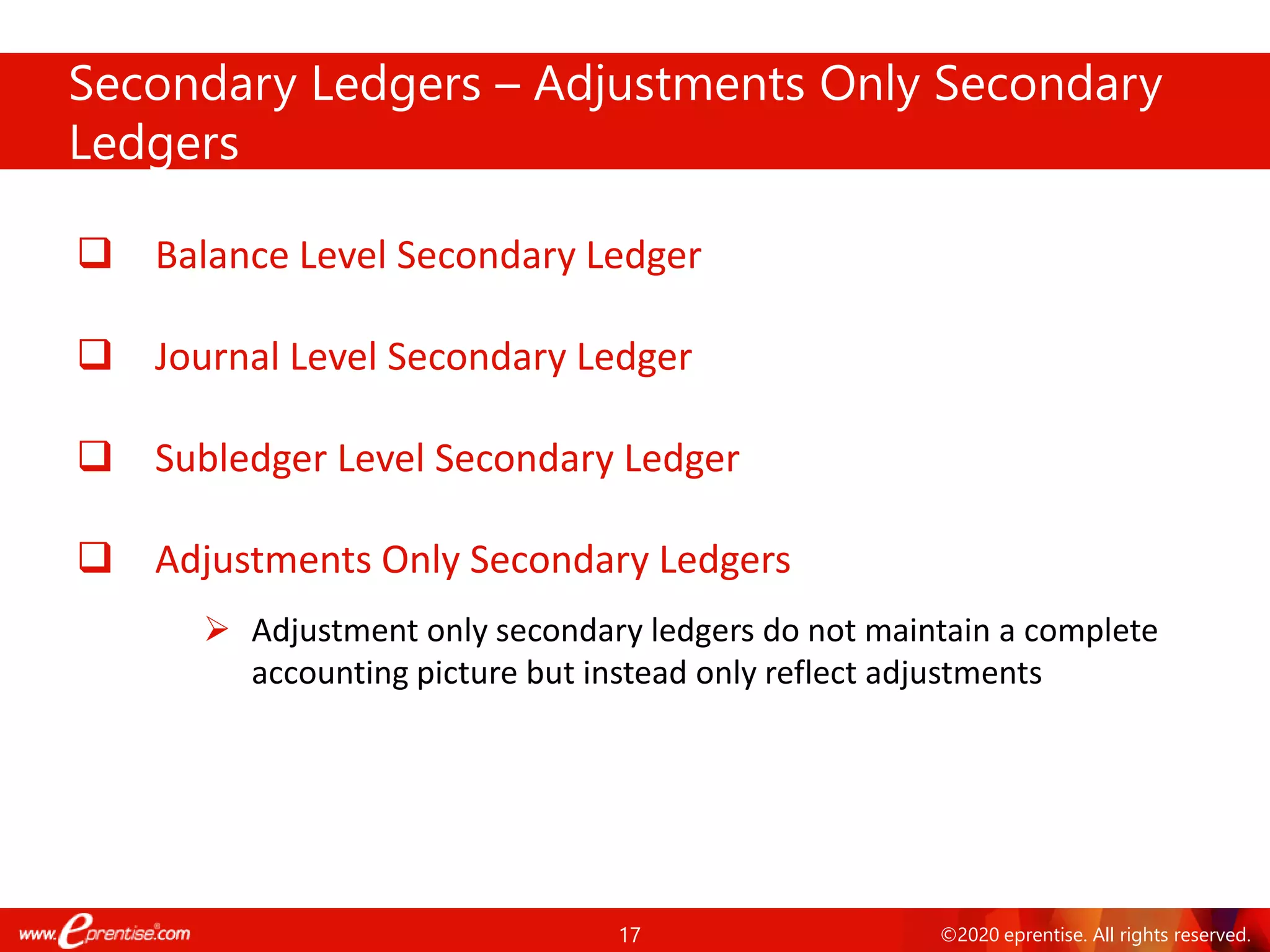
❑ Balance Level Secondary Ledger
❑ Journal Level Secondary Ledger
❑ Subledger Level Secondary Ledger
❑ Adjustments Only Secondary Ledgers
➢ Adjustment only secondary ledgers do not maintain a complete
accounting picture but instead only reflect adjustments
Secondary Ledgers – Adjustments Only Secondary
Ledgers
18 ©2020 eprentise. All rights reserved.
❑ Balance Level Secondary Ledger
❑ Journal Level Secondary Ledger
❑ Subledger Level Secondary Ledger
❑ Adjustments Only Secondary Ledgers
➢ Adjustment only secondary ledgers do not maintain a complete
accounting picture but instead only reflect adjustments
Secondary Ledgers – Adjustments Only Secondary
Ledgers
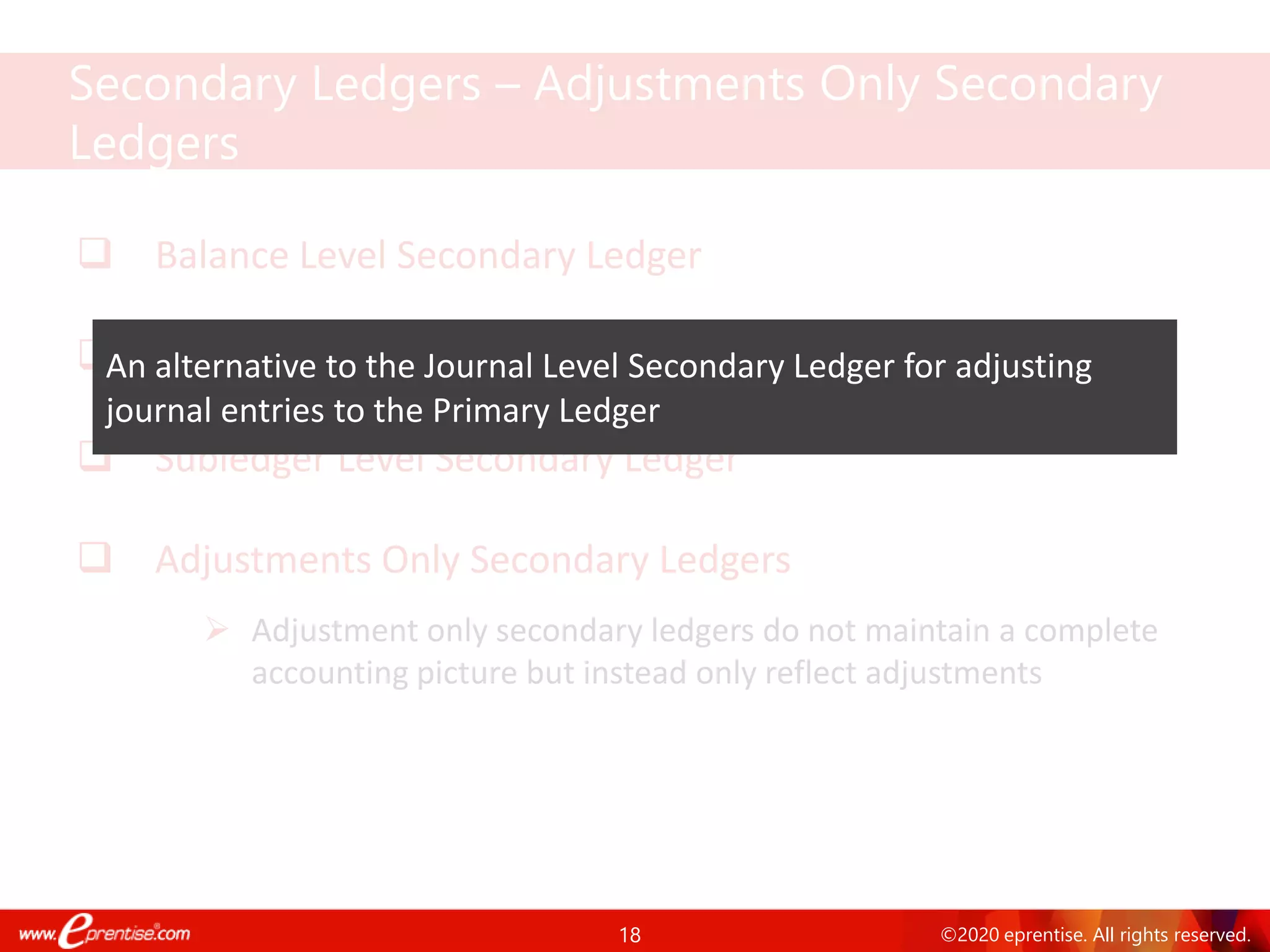
An alternative to the Journal Level Secondary Ledger for adjusting
journal entries to the Primary Ledger
19 ©2020 eprentise. All rights reserved.
Ledger Sets
❑ Allow you to group multiple ledgers together to achieve
processing efficiencies
❑ For example, you can:
➢ Open or close periods for multiple ledgers simultaneously
➢ Translate balances for all ledgers in a ledger set
➢ Run recurring journals that update balances for multiple ledgers
➢ Run consolidated financial reports that summarize balances
across multiple ledgers in a ledger set
❑ Note: All ledgers in a ledger set must have the same chart of
accounts and accounting calendar/period type combination
➢ Every ledger operating with a different chart of accounts or
calendar cannot be included in a ledger set
➢ Further, ledger sets will not work across multiple instances
20 ©2020 eprentise. All rights reserved.
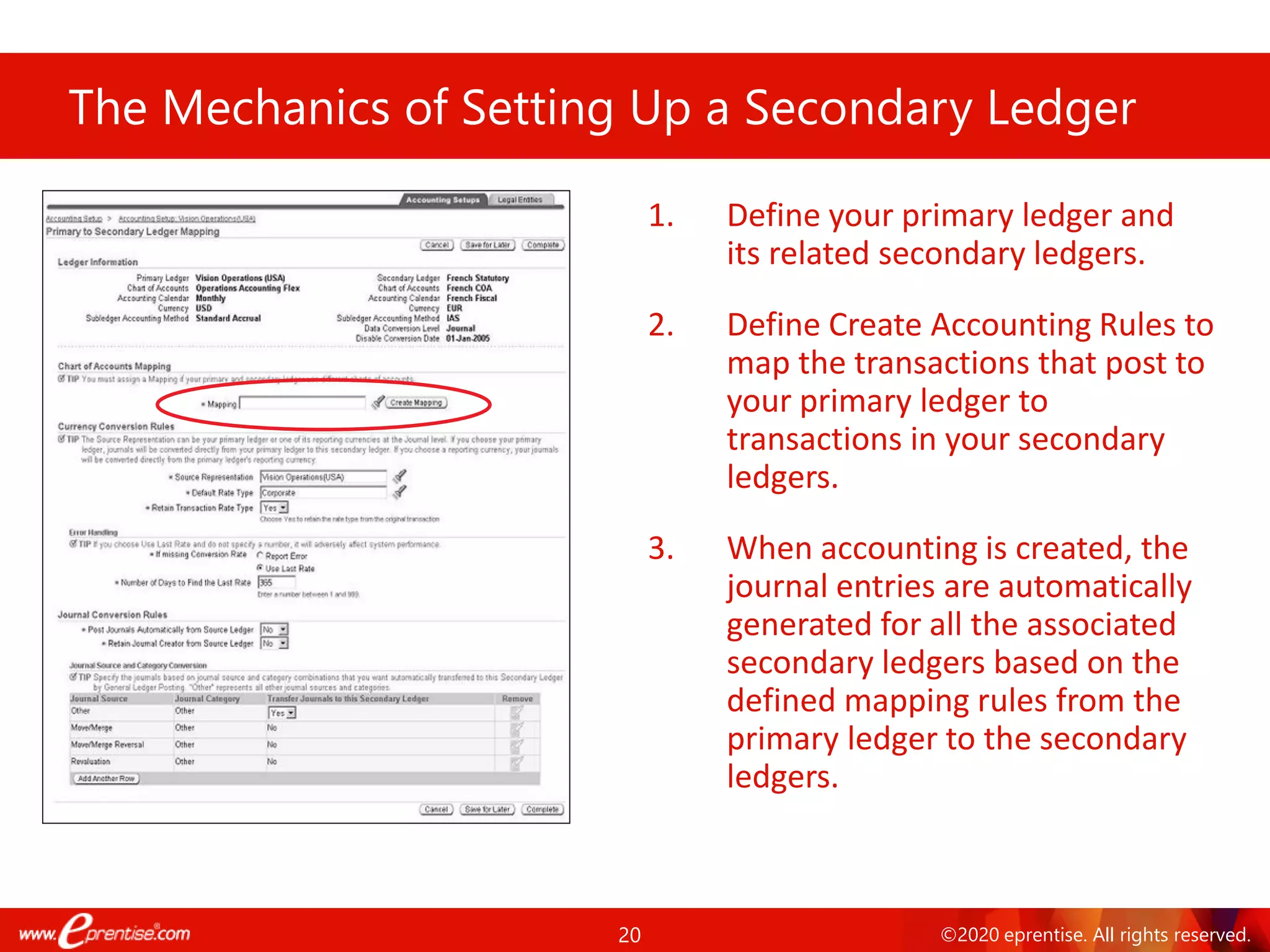
The Mechanics of Setting Up a Secondary Ledger
1. Define your primary ledger and
its related secondary ledgers.
2. Define Create Accounting Rules to
map the transactions that post to
your primary ledger to
transactions in your secondary
ledgers.
3. When accounting is created, the
journal entries are automatically
generated for all the associated
secondary ledgers based on the
defined mapping rules from the
primary ledger to the secondary
ledgers.
21 ©2020 eprentise. All rights reserved.
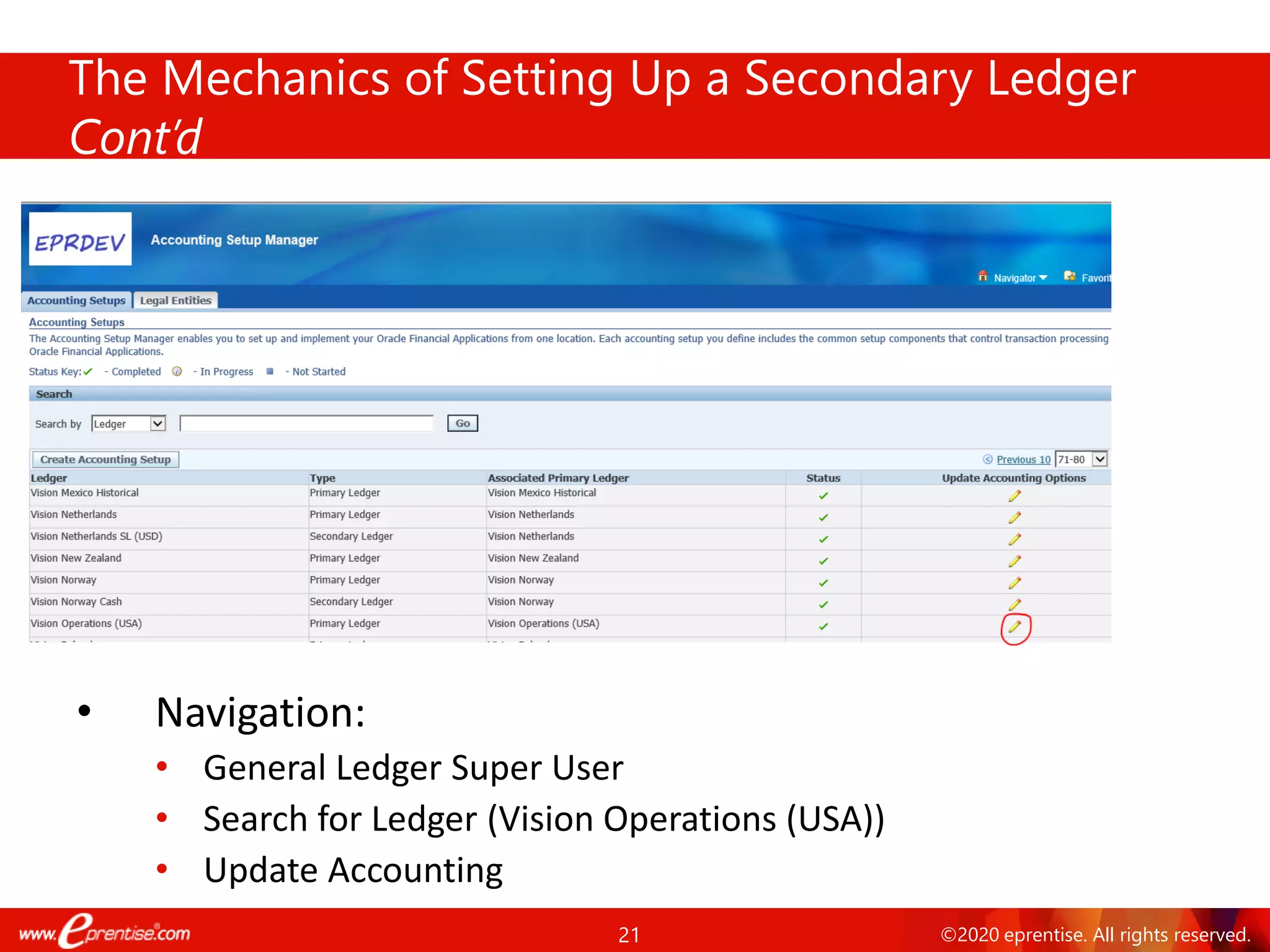
The Mechanics of Setting Up a Secondary Ledger
Cont’d
• Navigation:
• General Ledger Super User
• Search for Ledger (Vision Operations (USA))
• Update Accounting
22 ©2020 eprentise. All rights reserved.
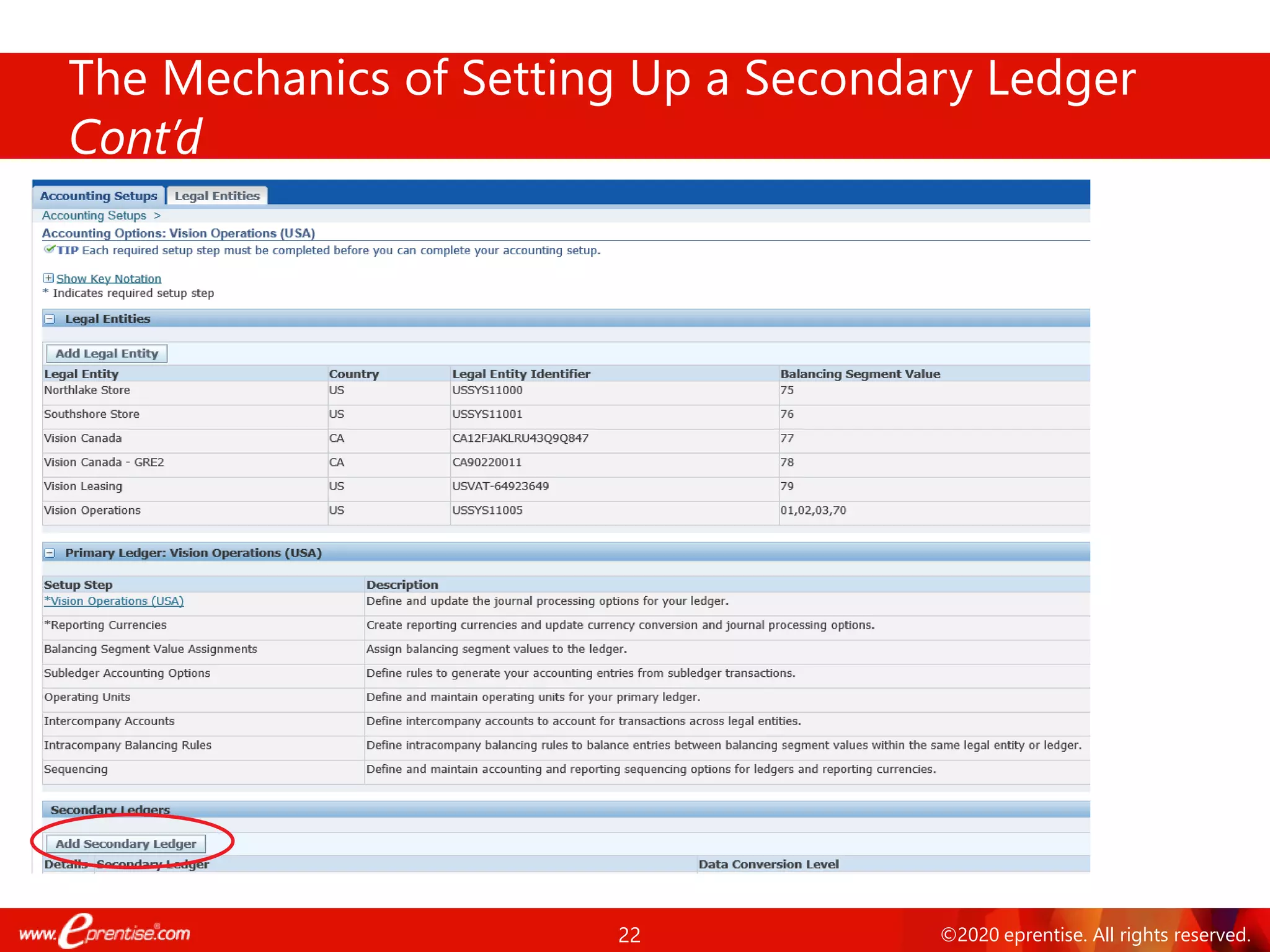
The Mechanics of Setting Up a Secondary Ledger
Cont’d
23 ©2020 eprentise. All rights reserved.
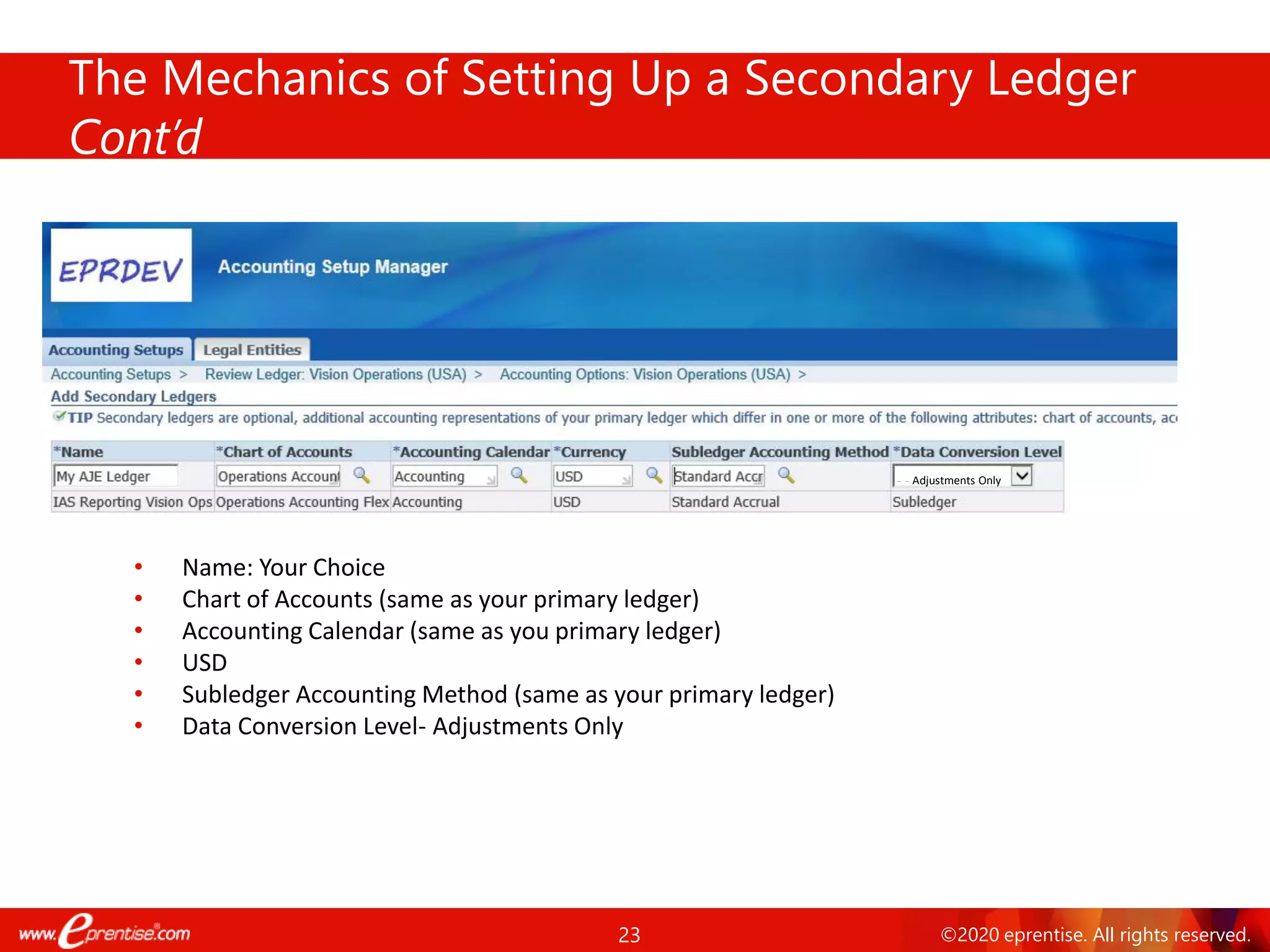
The Mechanics of Setting Up a Secondary Ledger
Cont’d
• Name: Your Choice
• Chart of Accounts (same as your primary ledger)
• Accounting Calendar (same as you primary ledger)
• USD
• Subledger Accounting Method (same as your primary ledger)
• Data Conversion Level- Adjustments Only
Adjustments Only
24 ©2020 eprentise. All rights reserved.
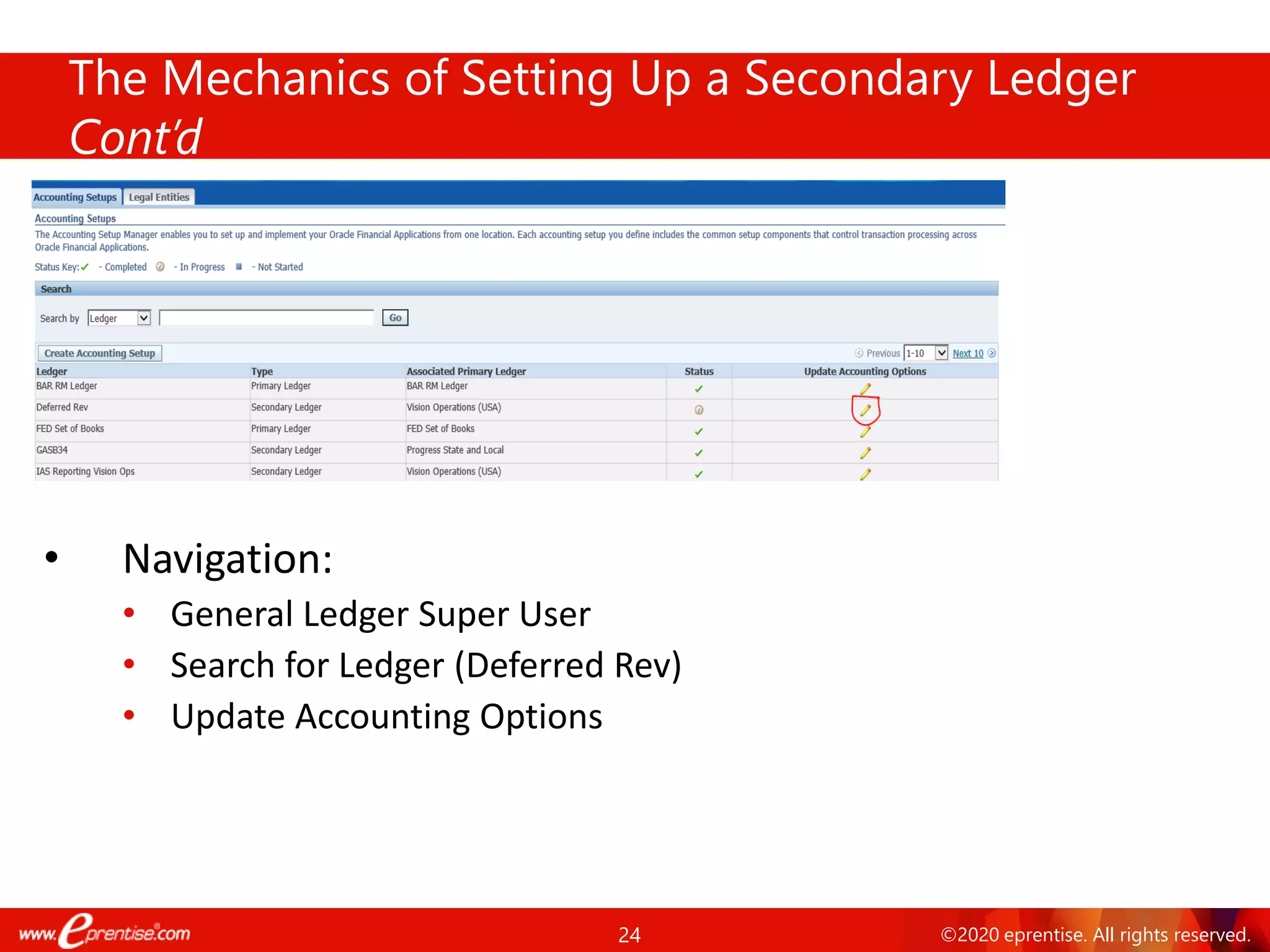
The Mechanics of Setting Up a Secondary Ledger
Cont’d
• Navigation:
• General Ledger Super User
• Search for Ledger (Deferred Rev)
• Update Accounting Options
25 ©2020 eprentise. All rights reserved.
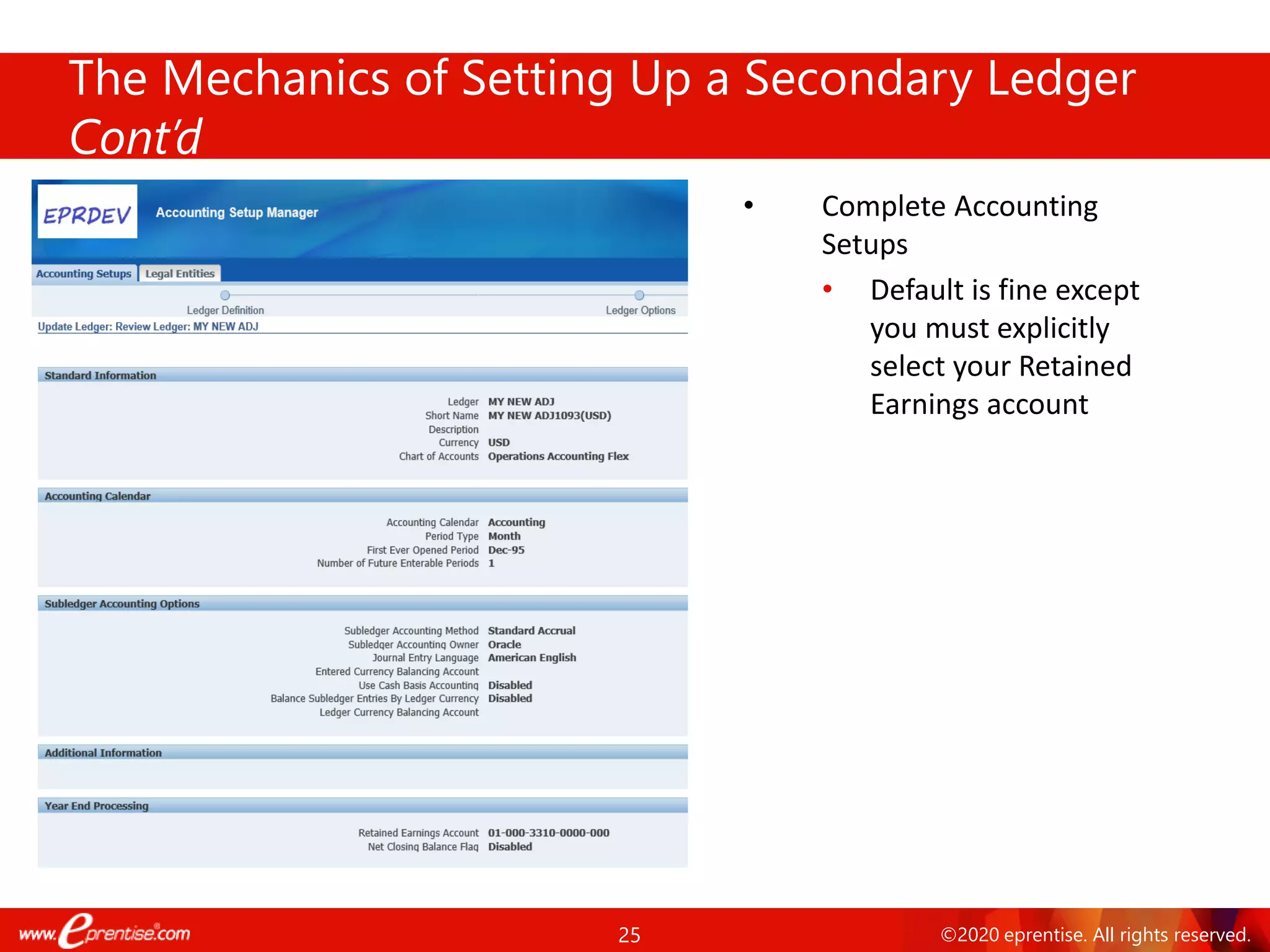
The Mechanics of Setting Up a Secondary Ledger
Cont’d
• Complete Accounting
Setups
• Default is fine except
you must explicitly
select your Retained
Earnings account
26 ©2020 eprentise. All rights reserved.
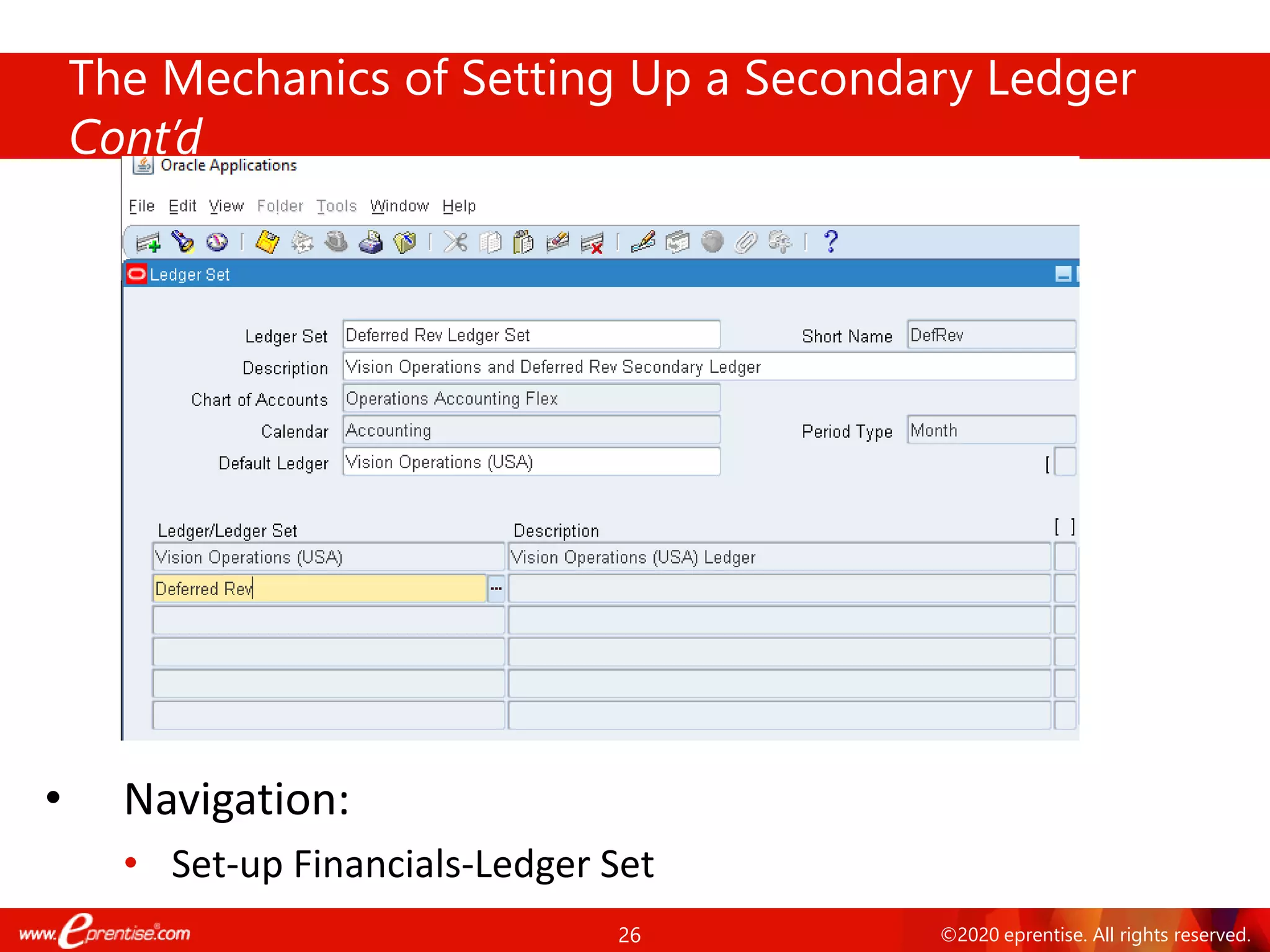
The Mechanics of Setting Up a Secondary Ledger
Cont’d
• Navigation:
• Set-up Financials-Ledger Set
27 ©2020 eprentise. All rights reserved.
The Mechanics of Setting Up a Secondary Ledger
Cont’d
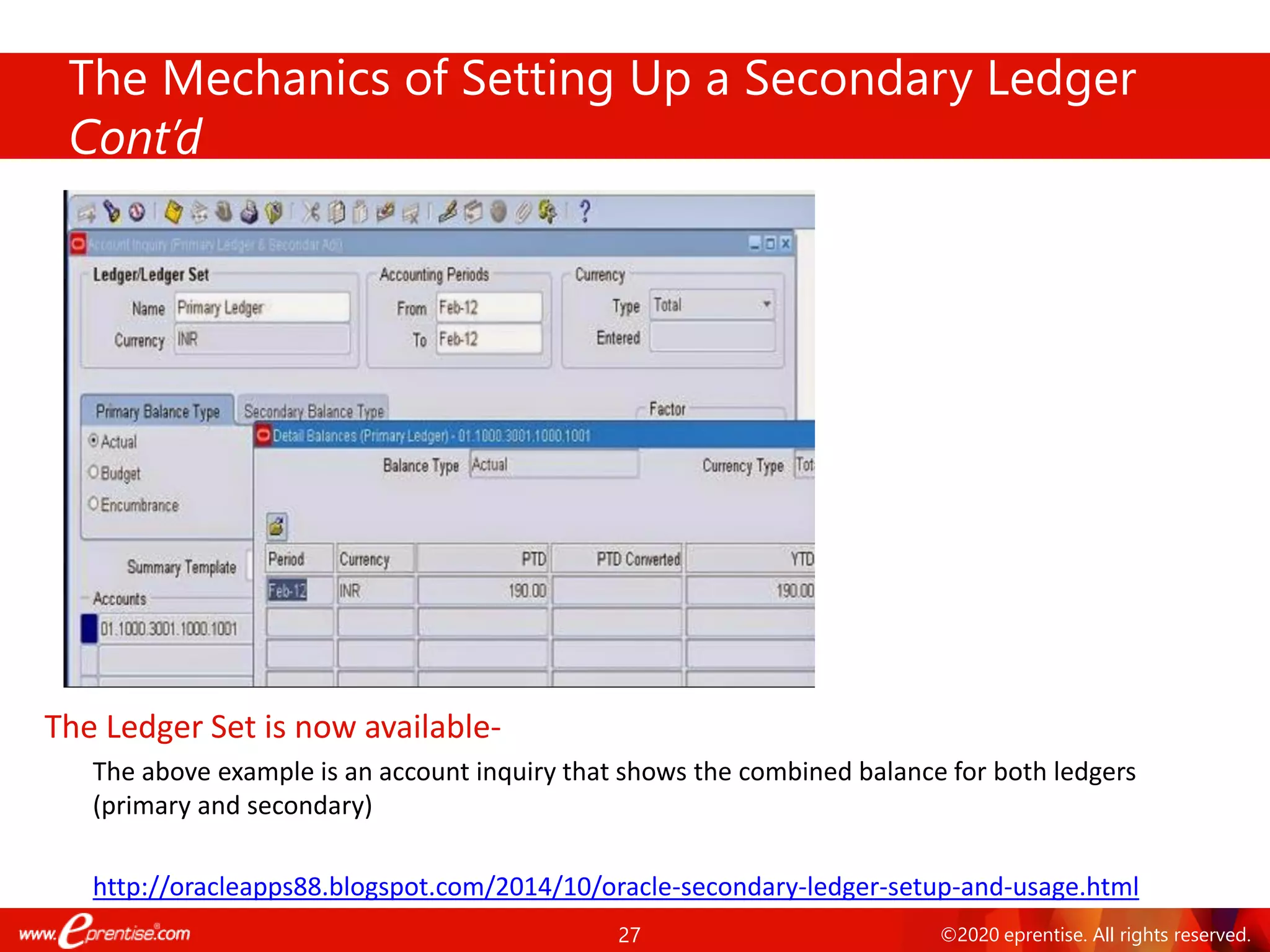
The Ledger Set is now available-
The above example is an account inquiry that shows the combined balance for both ledgers
(primary and secondary)
http://oracleapps88.blogspot.com/2014/10/oracle-secondary-ledger-setup-and-usage.html
32 ©2020 eprentise. All rights reserved.
Solving the
Problems of
Adjusting Journal
Entries Using
Adjustments Only
Secondary Ledgers
and Ledger Sets
33 ©2020 eprentise. All rights reserved.
Adjustment Journal Entries
❑ Best Practices Proscribe Making AJEs Directly to the Primary
Ledger
❑ Primary Ledger Should Only Contain:
➢ Transactions and balances from routine data processes
➢ Correcting entries
➢ Automatically generated allocations
➢ One time write-offs
❑ The Related Adjustments Ledger Should Contain:
➢ Adjusting entries for accruals
➢ Adjusting entries for deferrals
❑ Reversing entries are generally not needed
34 ©2020 eprentise. All rights reserved.
Types of Adjusting Journal Entries
❑ Accruals
➢ Amounts for either expenses incurred for which the vendor has not
invoiced or
➢ In rare cases, can be revenue earned that has not been billed
❑ Deferrals
➢ Entries made to ensure that revenue is not recognized before it is
earned
▪ Example: a full annual membership payment received in January must be
deferred and then recognized over the year
➢ Also ensure that expenditures are not recognized early
▪ Example: an annual insurance premium that is paid at the beginning of
the year should be recognized evenly over the year
35 ©2020 eprentise. All rights reserved.
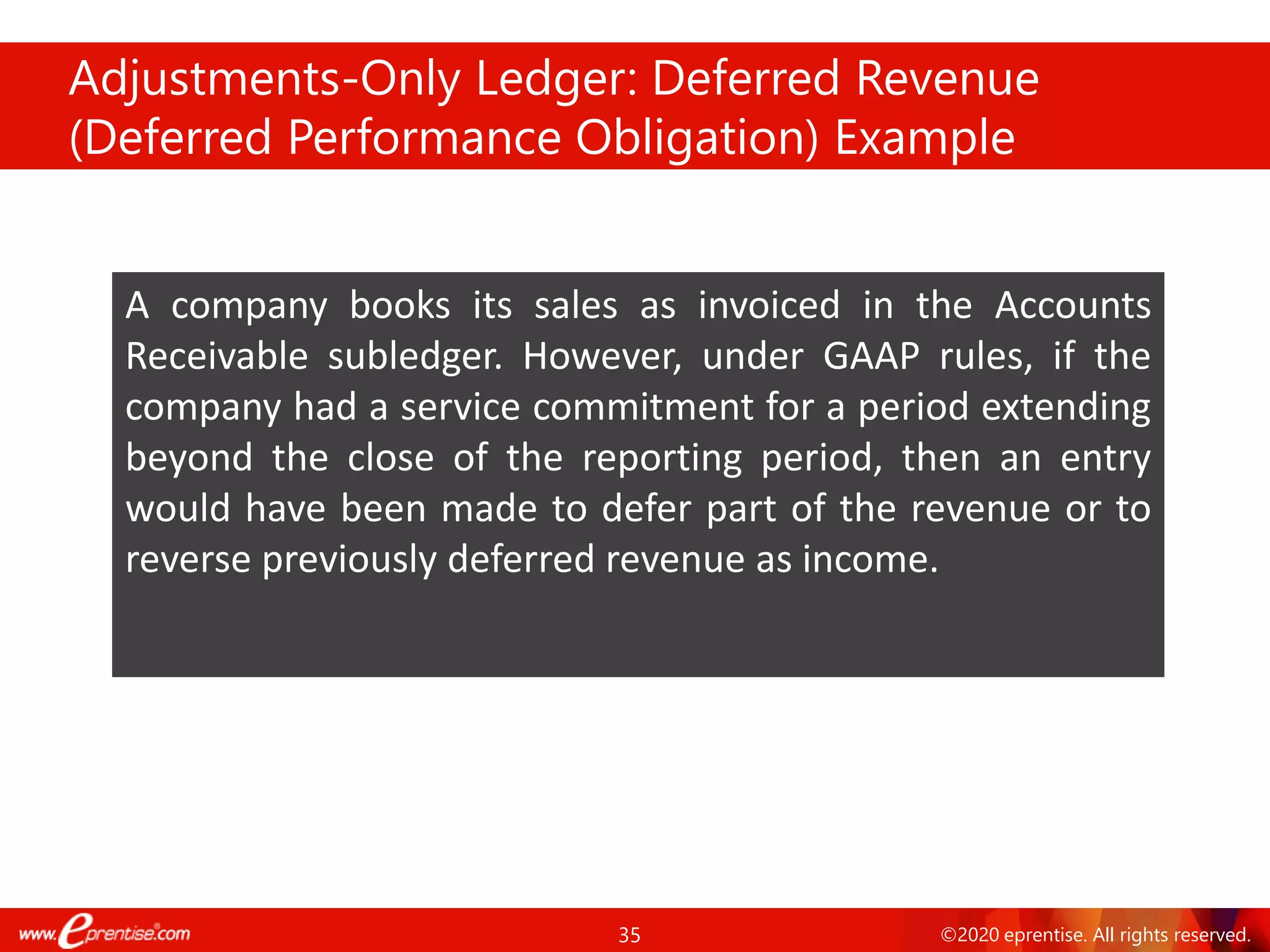
A company books its sales as invoiced in the Accounts
Receivable subledger. However, under GAAP rules, if the
company had a service commitment for a period extending
beyond the close of the reporting period, then an entry
would have been made to defer part of the revenue or to
reverse previously deferred revenue as income.
Adjustments-Only Ledger: Deferred Revenue
(Deferred Performance Obligation) Example
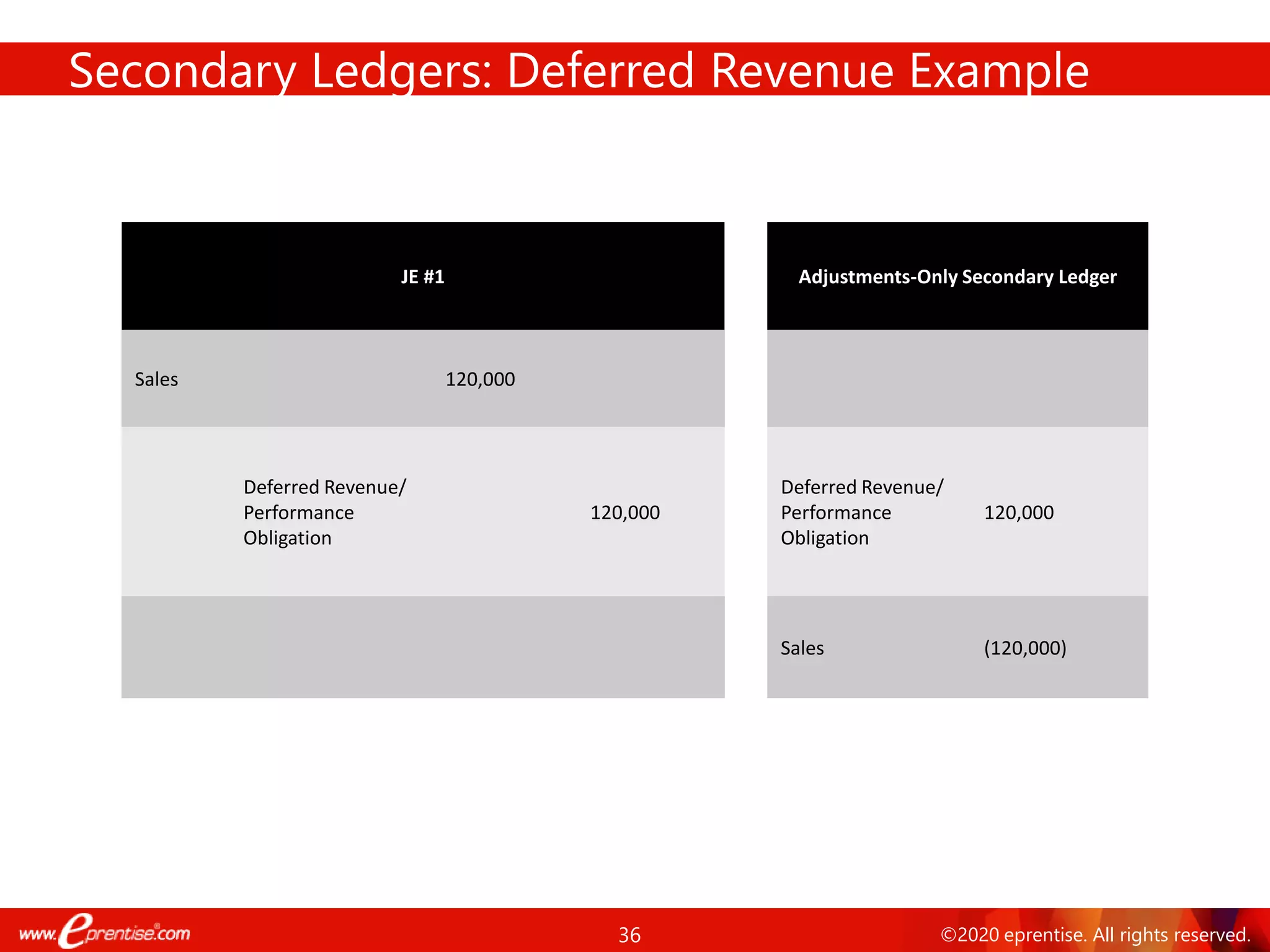
36 ©2020 eprentise. All rights reserved.
JE #1 Adjustments-Only Secondary Ledger
Sales 120,000
Deferred Revenue/
Performance
Obligation
120,000
Deferred Revenue/
Performance
Obligation
120,000
Sales (120,000)
Secondary Ledgers: Deferred Revenue Example
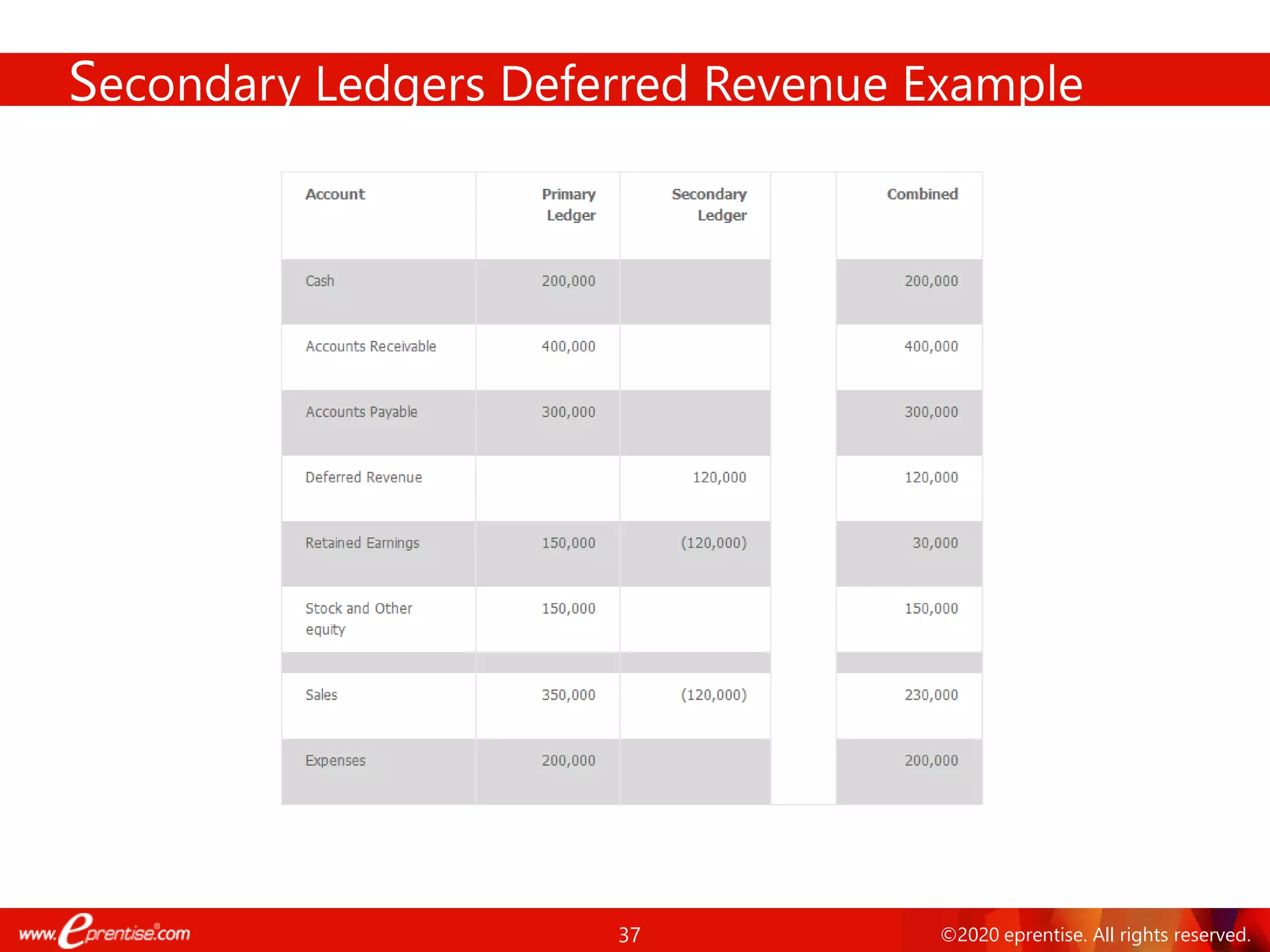
37 ©2020 eprentise. All rights reserved.
Secondary Ledgers Deferred Revenue Example
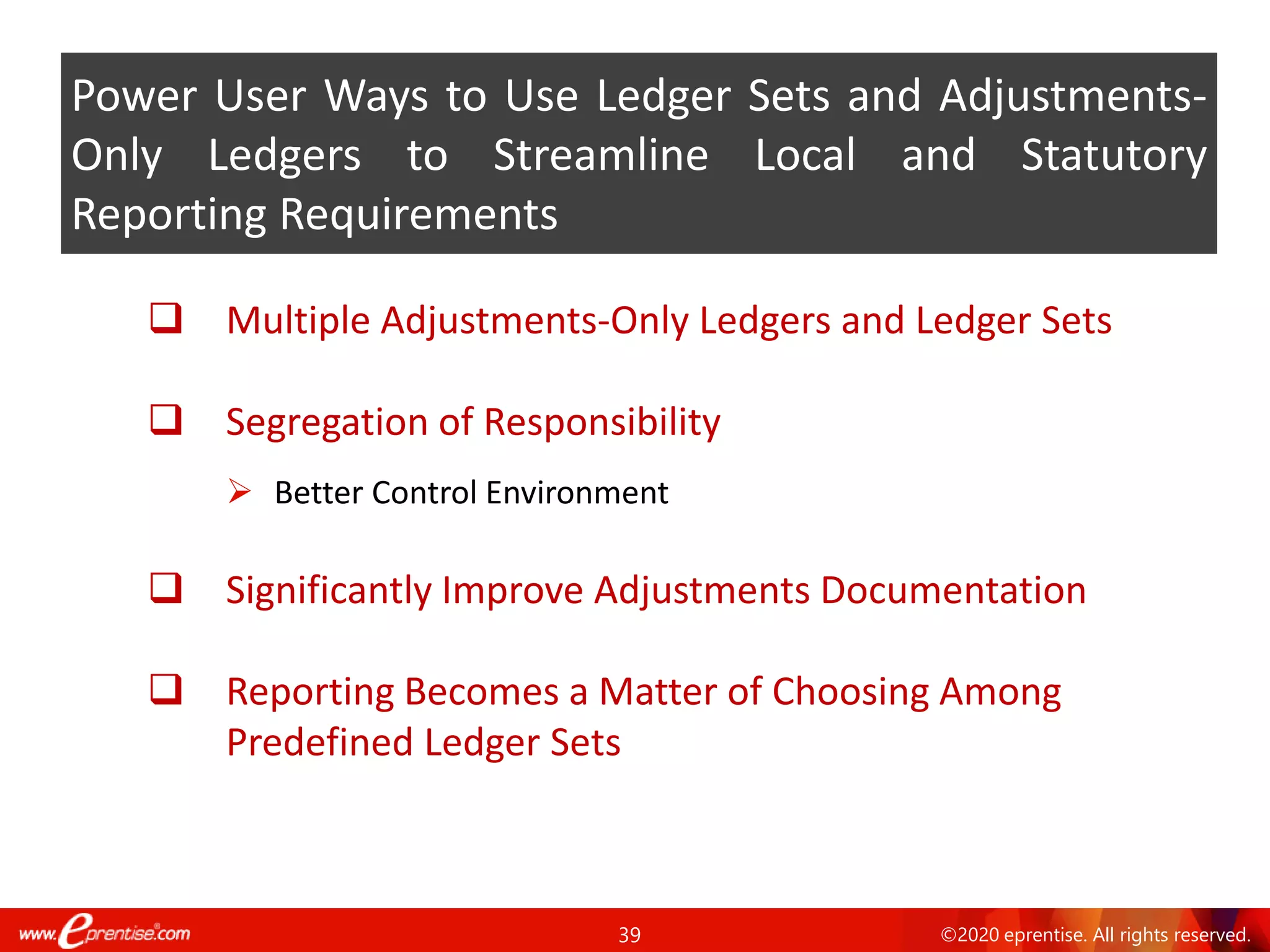
39 ©2020 eprentise. All rights reserved.
❑ Multiple Adjustments-Only Ledgers and Ledger Sets
❑ Segregation of Responsibility
➢ Better Control Environment
❑ Significantly Improve Adjustments Documentation
❑ Reporting Becomes a Matter of Choosing Among
Predefined Ledger Sets
Power User Ways to Use Ledger Sets and Adjustments-
Only Ledgers to Streamline Local and Statutory
Reporting Requirements
40 ©2020 eprentise. All rights reserved.
Conclusion
❑ Of the new features in Oracle® E-Business Suite R12, the
most powerful are ledger sets and secondary ledgers
❑ When taken together, these features have the capability
of eliminating the tedium and reducing the cost of
ledger adjustments while improving internal control
41 ©2020 eprentise. All rights reserved.
Questions?
Contact
- One World, One System, A Single Source of Truth -
Brian Lewis, CPA
Corporate Controller and VP of
Finance
blewis@eprentise.com
www.eprentise.com
www.AgilityByDesign.com
www.crystallizeanalytics.com
eprentise, LLC
Accelerating the time for change in
Oracle® E-Business Suite
#EBSAnswersWebinars
42 ©2020 eprentise. All rights reserved.
Automated Audit Software for Oracle EBS
43 ©2020 eprentise. All rights reserved.
Thank You!
Contact
- One World, One System, A Single Source of Truth -
Harrison Figura
Product Manager
hfigura@eprentise.com
www.eprentise.com
www.AgilityByDesign.com
www.crystallizeanalytics.com
eprentise, LLC
Accelerating the time for change in
Oracle® E-Business Suite
#EBSAnswersWebinars

EBS Answers Webinar Series - The Power of Ledger Sets and Secondary Ledgers in Complying with New Regulations

  • 1.
    The Power ofLedger Sets and Secondary Ledgers in Complying with New Regulations #EBSAnswersWebinars
  • 2.
    2 ©2020 eprentise.All rights reserved. Webinar Mechanics • Submit text questions. • Q&A addressed at the end of the session and posted on LinkedIn. • Everyone will receive an email with a link to view a recorded version of today’s session. • Polling questions will be presented during the session. If you want CPE credit for this webinar, you must answer all of the polling questions.
  • 3.
    3 ©2020 eprentise.All rights reserved. About eprentise GettingthemostoutofyourOracle®E-BusinessSuitewith ❑ TRANSFORM With Proven Out-of-the-Box Solutions That Align EBS With Your Business ➢ Consolidationmergesand harmonizesoneor moredisparate,differently-configured,databaseinstancesintoa single,fully-functionalapplication ➢ Divestiture filters data when a company is carving out or selling off part of their business, to create a stand-alone fully functional environment for the divested entity with a limited data set ➢ FlexField changes the financial chart of accounts to support standardization and increase reporting reliability retaining all transactional history ➢ Reorganization changes or moves any configurations or set-ups and all related transactions. Reorganization is a broad category and includes software solutions for merging or separating organization units, ledgers, inventory organizations, or legal entities, calendar changes, currency changes, etc. Reorganization Software is used to comply with new regulatory or statutory changes, new organization structures, entry into new markets, and to support mergers, acquisitions, or divestitures. ❑ OPTIMIZE With Software That Gives You Visibility Into Your Operations ➢ C Collection analytics will identify potential problem areas with transactional data. The software increases the accuracy of the underlying data, provides data transparency, and allows EBS users to reduce costs, leverage opportunities across the enterprise, improve business processes and increase the confidence level of the users in their data, processes, and operations. ➢ Automated Audit is audit and assurance software for internal and external financial auditors and allows for drill-down from a balance sheet report into the transaction-level detail. The software covers hundreds of substantive procedures across all EBS modules for the entire enterprise domain and builds in consistent audit processes and workflows across the organization. ❑Does not violate Oracle Support Agreement Software that Transforms and Optimizes EBS
  • 4.
    4 ©2020 eprentise.All rights reserved. Learning Objectives Objective 1: Discuss significant changes in financial reporting requirements from regulatory agencies. Objective 2: Demonstrate the basic mechanics of using Secondary Ledgers to address regulatory requirements. Objective 3: Calculate the cost savings from using Secondary Ledgers to replace reporting spreadsheets. Objective 4: Identify the EBS configuration requirements for effective use of Secondary Ledgers in R12.
  • 5.
    5 ©2020 eprentise.All rights reserved. Agenda ❑ The Challenges of Adjusting Entries for Reporting and Compliance ➢ The Solution: Ledger Sets and Secondary Ledgers ❑ An Overview of Ledger Sets and Secondary Ledgers In R12 ➢ The Mechanics of Setting Up Secondary Ledgers ➢ Ledger Sets ❑ Solving the Problems of Adjusting Journal Entries ❑ Streamlining Local and Statutory Reporting Requirements
  • 6.
    6 ©2020 eprentise.All rights reserved. The Challenge of Adjusting Entries for Reporting and Compliance ❑ Ensuring a Complete, Correct, and Consistent Record ➢ Adequacy of Controls for Routine Data Processes • Order-to-Cash • Procure-to-Pay ❑ The Wrench in the Works – Adjusting Journal Entries ➢ More likely to contain errors ➢ Circumvent routine data processing controls ➢ Impede system transparency ➢ Incur additional audit effort
  • 7.
    7 ©2020 eprentise.All rights reserved. Traditional Options Before R12 Prior to the introduction of Release 12, the only real options for adjusting journal entries were to: ❑ Make the entries directly to the primary ledger, requiring the ledger period be left open until all adjustments were made ❑ If a company had defined adjusting periods on their calendar, then the normal period could be closed and with the adjusting entries being made to the primary ledger in a discrete period ➢ Still doesn’t solve many of the problems associated with adjusting journal entries
  • 8.
    8 ©2020 eprentise.All rights reserved. The Solution: Ledger Sets and Secondary Ledgers
  • 9.
    9 ©2020 eprentise.All rights reserved. Secondary Ledgers Can Be Maintained at One of Four Different Levels of Detail 1. Balance Level 2. Journal Level 3. Subledger Level 4. Adjustments-Only Level
  • 10.
    10 ©2020 eprentise.All rights reserved. Balance Level Secondary Ledger IFRS/GAAP Example ❑ Account balances only in another accounting representation. ➢ No drill-down to journal entries or subledgers ❑ Balances exist at reporting period dates only. ❑ G/L Consolidation.
  • 11.
    11 ©2020 eprentise.All rights reserved. Balance Level Secondary Ledgers Secondary Ledger (IFRS) Primary Ledger (US GAAP) Secondary Ledger balances populated via Oracle General Ledger Consolidation are based on accounting rules. NO JOURNAL ENTRY LEVEL DRILL DOWN.
  • 12.
    13 ©2020 eprentise.All rights reserved. Journal Level Secondary Ledger ❑ Balance Level Secondary Ledger ❑ Journal Level Secondary Ledger (affected through General Ledger Posting) ➢ Account Balances ➢ (Manual) Journal Entries
  • 13.
    14 ©2020 eprentise.All rights reserved. Secondary Ledgers – Subledger Level ❑ Prior to R12: limited options available for companies requiring different regulatory chart of accounts ❑ Could have created a GL Consolidation that allowed you to map to a different chart of accounts, but the GL financial consolidation would not have included the transaction detail of the subledgers ➢ Reconciliation was a time-consuming process
  • 14.
    15 ©2020 eprentise.All rights reserved. Secondary Ledgers – Subledger Level ❑ Balance Level Secondary Ledger ❑ Journal Level Secondary Ledger ❑ Subledger Level Secondary Ledger ➢ Balance Level ➢ Journal Entry Level ➢ Subledger Level
  • 15.
    16 ©2020 eprentise.All rights reserved. General Ledger Primary Ledger Secondary Ledgers Subledgers Subledger Accounting (SLA) Drilldown to Subledger Accounting Details Drilldown to Transaction Details Accounting Subledger Accounting Secondary Ledgers – Subledger Level
  • 16.
    17 ©2020 eprentise.All rights reserved. ❑ Balance Level Secondary Ledger ❑ Journal Level Secondary Ledger ❑ Subledger Level Secondary Ledger ❑ Adjustments Only Secondary Ledgers ➢ Adjustment only secondary ledgers do not maintain a complete accounting picture but instead only reflect adjustments Secondary Ledgers – Adjustments Only Secondary Ledgers
  • 17.
    18 ©2020 eprentise.All rights reserved. ❑ Balance Level Secondary Ledger ❑ Journal Level Secondary Ledger ❑ Subledger Level Secondary Ledger ❑ Adjustments Only Secondary Ledgers ➢ Adjustment only secondary ledgers do not maintain a complete accounting picture but instead only reflect adjustments Secondary Ledgers – Adjustments Only Secondary Ledgers An alternative to the Journal Level Secondary Ledger for adjusting journal entries to the Primary Ledger
  • 18.
    19 ©2020 eprentise.All rights reserved. Ledger Sets ❑ Allow you to group multiple ledgers together to achieve processing efficiencies ❑ For example, you can: ➢ Open or close periods for multiple ledgers simultaneously ➢ Translate balances for all ledgers in a ledger set ➢ Run recurring journals that update balances for multiple ledgers ➢ Run consolidated financial reports that summarize balances across multiple ledgers in a ledger set ❑ Note: All ledgers in a ledger set must have the same chart of accounts and accounting calendar/period type combination ➢ Every ledger operating with a different chart of accounts or calendar cannot be included in a ledger set ➢ Further, ledger sets will not work across multiple instances
  • 19.
    20 ©2020 eprentise.All rights reserved. The Mechanics of Setting Up a Secondary Ledger 1. Define your primary ledger and its related secondary ledgers. 2. Define Create Accounting Rules to map the transactions that post to your primary ledger to transactions in your secondary ledgers. 3. When accounting is created, the journal entries are automatically generated for all the associated secondary ledgers based on the defined mapping rules from the primary ledger to the secondary ledgers.
  • 20.
    21 ©2020 eprentise.All rights reserved. The Mechanics of Setting Up a Secondary Ledger Cont’d • Navigation: • General Ledger Super User • Search for Ledger (Vision Operations (USA)) • Update Accounting
  • 21.
    22 ©2020 eprentise.All rights reserved. The Mechanics of Setting Up a Secondary Ledger Cont’d
  • 22.
    23 ©2020 eprentise.All rights reserved. The Mechanics of Setting Up a Secondary Ledger Cont’d • Name: Your Choice • Chart of Accounts (same as your primary ledger) • Accounting Calendar (same as you primary ledger) • USD • Subledger Accounting Method (same as your primary ledger) • Data Conversion Level- Adjustments Only Adjustments Only
  • 23.
    24 ©2020 eprentise.All rights reserved. The Mechanics of Setting Up a Secondary Ledger Cont’d • Navigation: • General Ledger Super User • Search for Ledger (Deferred Rev) • Update Accounting Options
  • 24.
    25 ©2020 eprentise.All rights reserved. The Mechanics of Setting Up a Secondary Ledger Cont’d • Complete Accounting Setups • Default is fine except you must explicitly select your Retained Earnings account
  • 25.
    26 ©2020 eprentise.All rights reserved. The Mechanics of Setting Up a Secondary Ledger Cont’d • Navigation: • Set-up Financials-Ledger Set
  • 26.
    27 ©2020 eprentise.All rights reserved. The Mechanics of Setting Up a Secondary Ledger Cont’d The Ledger Set is now available- The above example is an account inquiry that shows the combined balance for both ledgers (primary and secondary) http://oracleapps88.blogspot.com/2014/10/oracle-secondary-ledger-setup-and-usage.html
  • 27.
    32 ©2020 eprentise.All rights reserved. Solving the Problems of Adjusting Journal Entries Using Adjustments Only Secondary Ledgers and Ledger Sets
  • 28.
    33 ©2020 eprentise.All rights reserved. Adjustment Journal Entries ❑ Best Practices Proscribe Making AJEs Directly to the Primary Ledger ❑ Primary Ledger Should Only Contain: ➢ Transactions and balances from routine data processes ➢ Correcting entries ➢ Automatically generated allocations ➢ One time write-offs ❑ The Related Adjustments Ledger Should Contain: ➢ Adjusting entries for accruals ➢ Adjusting entries for deferrals ❑ Reversing entries are generally not needed
  • 29.
    34 ©2020 eprentise.All rights reserved. Types of Adjusting Journal Entries ❑ Accruals ➢ Amounts for either expenses incurred for which the vendor has not invoiced or ➢ In rare cases, can be revenue earned that has not been billed ❑ Deferrals ➢ Entries made to ensure that revenue is not recognized before it is earned ▪ Example: a full annual membership payment received in January must be deferred and then recognized over the year ➢ Also ensure that expenditures are not recognized early ▪ Example: an annual insurance premium that is paid at the beginning of the year should be recognized evenly over the year
  • 30.
    35 ©2020 eprentise.All rights reserved. A company books its sales as invoiced in the Accounts Receivable subledger. However, under GAAP rules, if the company had a service commitment for a period extending beyond the close of the reporting period, then an entry would have been made to defer part of the revenue or to reverse previously deferred revenue as income. Adjustments-Only Ledger: Deferred Revenue (Deferred Performance Obligation) Example
  • 31.
    36 ©2020 eprentise.All rights reserved. JE #1 Adjustments-Only Secondary Ledger Sales 120,000 Deferred Revenue/ Performance Obligation 120,000 Deferred Revenue/ Performance Obligation 120,000 Sales (120,000) Secondary Ledgers: Deferred Revenue Example
  • 32.
    37 ©2020 eprentise.All rights reserved. Secondary Ledgers Deferred Revenue Example
  • 33.
    39 ©2020 eprentise.All rights reserved. ❑ Multiple Adjustments-Only Ledgers and Ledger Sets ❑ Segregation of Responsibility ➢ Better Control Environment ❑ Significantly Improve Adjustments Documentation ❑ Reporting Becomes a Matter of Choosing Among Predefined Ledger Sets Power User Ways to Use Ledger Sets and Adjustments- Only Ledgers to Streamline Local and Statutory Reporting Requirements
  • 34.
    40 ©2020 eprentise.All rights reserved. Conclusion ❑ Of the new features in Oracle® E-Business Suite R12, the most powerful are ledger sets and secondary ledgers ❑ When taken together, these features have the capability of eliminating the tedium and reducing the cost of ledger adjustments while improving internal control
  • 35.
    41 ©2020 eprentise.All rights reserved. Questions? Contact - One World, One System, A Single Source of Truth - Brian Lewis, CPA Corporate Controller and VP of Finance blewis@eprentise.com www.eprentise.com www.AgilityByDesign.com www.crystallizeanalytics.com eprentise, LLC Accelerating the time for change in Oracle® E-Business Suite #EBSAnswersWebinars
  • 36.
    42 ©2020 eprentise.All rights reserved. Automated Audit Software for Oracle EBS
  • 37.
    43 ©2020 eprentise.All rights reserved. Thank You! Contact - One World, One System, A Single Source of Truth - Harrison Figura Product Manager hfigura@eprentise.com www.eprentise.com www.AgilityByDesign.com www.crystallizeanalytics.com eprentise, LLC Accelerating the time for change in Oracle® E-Business Suite #EBSAnswersWebinars