GENE EXPRESSION 1:
Genetics
Robin D. Seamon
INHERITANCE
something we receive from each of our parents
Heredity- the delivery of characteristics from
parent to offspring
Genetics- science of the study of heredity
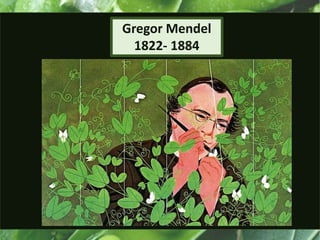
Gregor Mendel- 1822 Austrian monk; studied
science and math at University of Vienna after
becoming a priest
• Worked at the monastery & teaching high
school
• In charge of the monastery garden
• Scientifically inclined, he studied garden peas:
• Small, easy to grow & study hundreds of
offspring in a short period of time
• Short generations made easier
observance of patterns
Gregor Mendel
1822- 1884
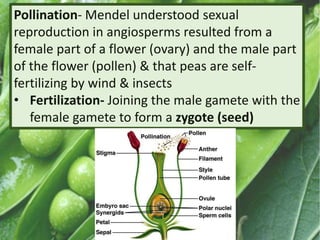
Pollination- Mendel understood sexual
reproduction in angiosperms resulted from a
female part of a flower (ovary) and the male part
of the flower (pollen) & that peas are self-
fertilizing by wind & insects
• Fertilization- Joining the male gamete with the
female gamete to form a zygote (seed)
True-breeding- organisms that produce offspring
that are identical to the one parent; same traits
Trait- specific characteristic (seed color, plant
height, seed shape) of an individual
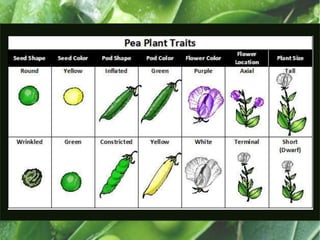
SEVEN Observable Traits of Pea Plants:
plant Long or short stems
Flower position on stem Axial, terminal
Pod color Green or yellow
Pod appearance Inflated or constricted
Seed texture Smooth or wrinkled
Flower color Purple or white
Seed color Yellow or green
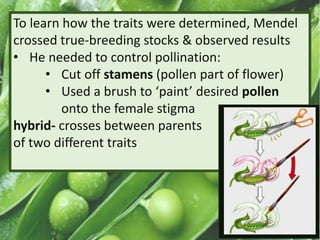
To learn how the traits were determined, Mendel
crossed true-breeding stocks & observed results
• He needed to control pollination:
• Cut off stamens (pollen part of flower)
• Used a brush to ‘paint’ desired pollen
onto the female stigma
hybrid- crosses between parents
of two different traits
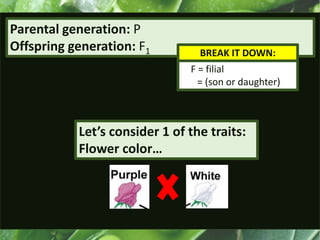
Parental generation: P
Offspring generation: F1 BREAK IT DOWN:
F = filial
= (son or daughter)
Let’s consider 1 of the traits:
Flower color…
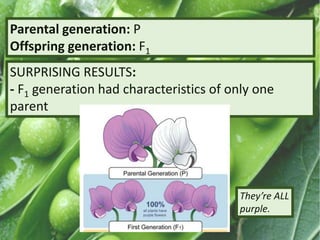
Parental generation: P
Offspring generation: F1
SURPRISING RESULTS:
- F1 generation had characteristics of only one
parent
They’re ALL
purple.
MENDEL’S CONCLUSIONS:
Heredity = genes: An individual’s characteristics are
determined by factors that are passed from one
parental generation to the next (genes)
• Each trait was determined by a single gene that
occurred in one of two ways (alleles)
• Purple flower or white flower
• Green or yellow
• Wrinkled or smooth
• Tall or short
• etc.
Principle of dominance – some alleles are
dominant over other (recessive) ones
• Organisms with at least one dominant allele will
express that gene
• Organisms with the recessive allele will only
express it if a dominant allele is NOT present
Dominant: trait that appears in the F1 generation
Recessive: trait that did not appear in the F1
generation
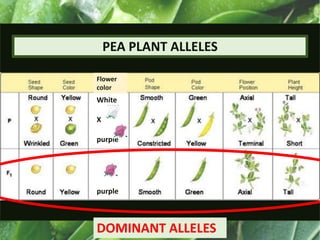
PEA PLANT ALLELES
DOMINANT ALLELES
White
X
purple
purple
Flower
color
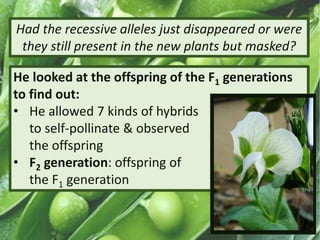
He looked at the offspring of the F1 generations
to find out:
• He allowed 7 kinds of hybrids
to self-pollinate & observed
the offspring
• F2 generation: offspring of
the F1 generation
Had the recessive alleles just disappeared or were
they still present in the new plants but masked?
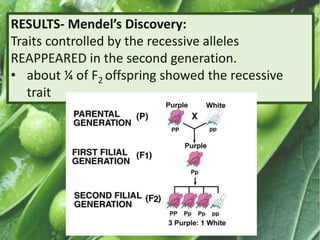
RESULTS- Mendel’s Discovery:
Traits controlled by the recessive alleles
REAPPEARED in the second generation.
• about ¼ of F2 offspring showed the recessive
trait
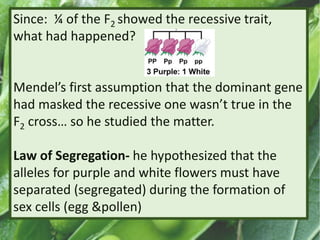
Since: ¼ of the F2 showed the recessive trait,
what had happened?
Mendel’s first assumption that the dominant gene
had masked the recessive one wasn’t true in the
F2 cross… so he studied the matter.
Law of Segregation- he hypothesized that the
alleles for purple and white flowers must have
separated (segregated) during the formation of
sex cells (egg &pollen)
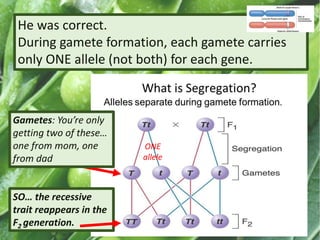
He was correct.
During gamete formation, each gamete carries
only ONE allele (not both) for each gene.
SO… the recessive
trait reappears in the
F2 generation.
ONE
allele
Gametes: You’re only
getting two of these…
one from mom, one
from dad
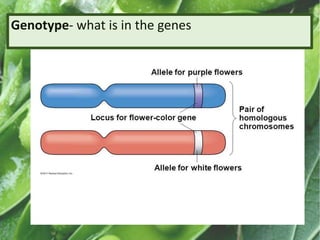
Genotype- what is in the genes
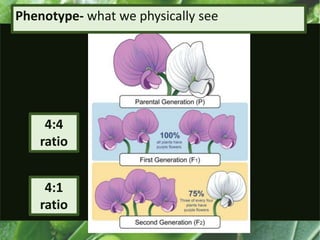
4:1
ratio
4:4
ratio
Phenotype- what we physically see
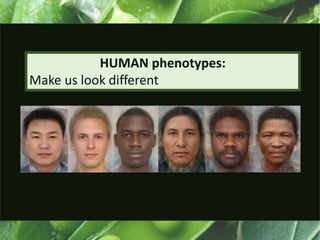
HUMAN phenotypes:
Make us look different
Predicting
Probability
A Good Scientist:
Mendel was a good scientist since he made careful
observations, collected accurate data & was able to
draw correct conclusions.
Probability- likelihood a particular event will occur
• The way that alleles segregate during meiosis is
random… how can we predict the likelihood of
gene expression?
• We can use a Punnett Square to determine
probability
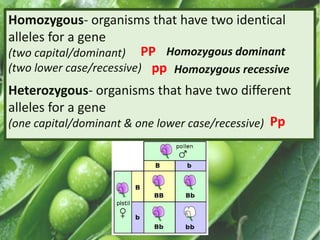
Homozygous- organisms that have two identical
alleles for a gene
(two capital/dominant)
(two lower case/recessive)
Heterozygous- organisms that have two different
alleles for a gene
(one capital/dominant & one lower case/recessive)
PP
pp
Pp
Homozygous recessive
Homozygous dominant
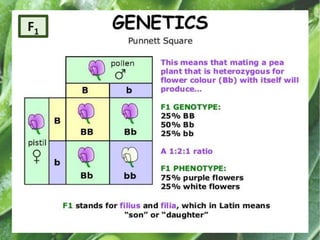
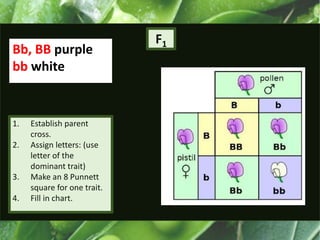
F1
F1
1. Establish parent
cross.
2. Assign letters: (use
letter of the
dominant trait)
3. Make an 8 Punnett
square for one trait.
4. Fill in chart.
Bb, BB purple
bb white
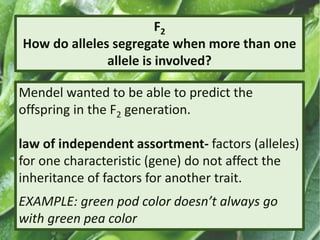
F2
How do alleles segregate when more than one
allele is involved?
Mendel wanted to be able to predict the
offspring in the F2 generation.
law of independent assortment- factors (alleles)
for one characteristic (gene) do not affect the
inheritance of factors for another trait.
EXAMPLE: green pod color doesn’t always go
with green pea color
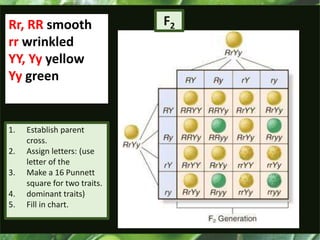
Rr, RR smooth
rr wrinkled
YY, Yy yellow
Yy green
1. Establish parent
cross.
2. Assign letters: (use
letter of the
3. Make a 16 Punnett
square for two traits.
4. dominant traits)
5. Fill in chart.
F2
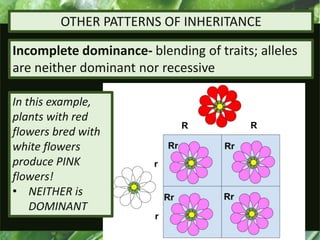
OTHER PATTERNS OF INHERITANCE
Incomplete dominance- blending of traits; alleles
are neither dominant nor recessive
In this example,
plants with red
flowers bred with
white flowers
produce PINK
flowers!
• NEITHER is
DOMINANT
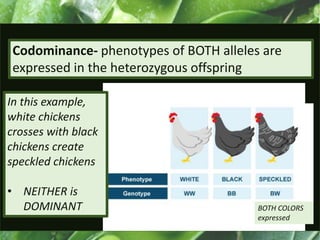
Codominance- phenotypes of BOTH alleles are
expressed in the heterozygous offspring
In this example,
white chickens
crosses with black
chickens create
speckled chickens
• NEITHER is
DOMINANT BOTH COLORS
expressed
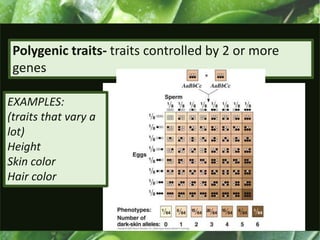
Polygenic traits- traits controlled by 2 or more
genes
EXAMPLES:
(traits that vary a
lot)
Height
Skin color
Hair color
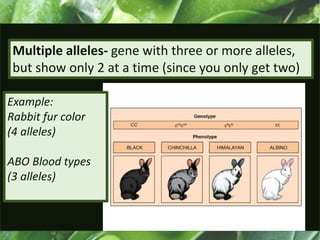
Multiple alleles- gene with three or more alleles,
but show only 2 at a time (since you only get two)
Example:
Rabbit fur color
(4 alleles)
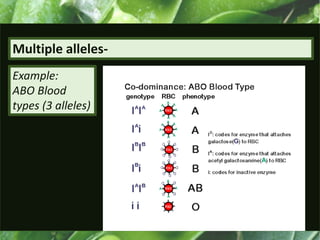
ABO Blood types
(3 alleles)
Multiple alleles-
Example:
ABO Blood
types (3 alleles)
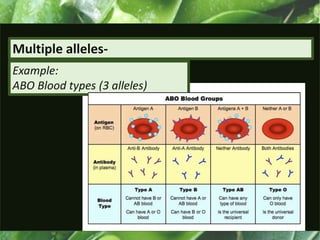
Multiple alleles-
Example:
ABO Blood types (3 alleles)
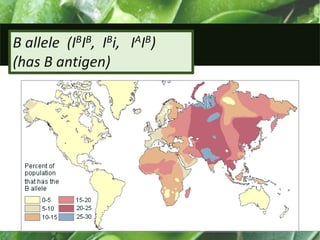
B allele (IBIB, IBi, IAIB)
(has B antigen)
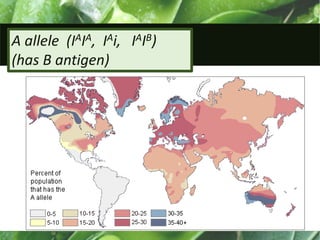
A allele (IAIA, IAi, IAIB)
(has B antigen)
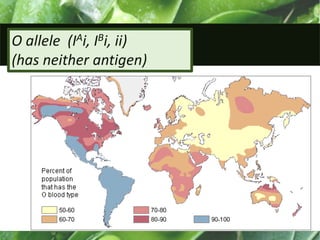
O allele (IAi, IBi, ii)
(has neither antigen)
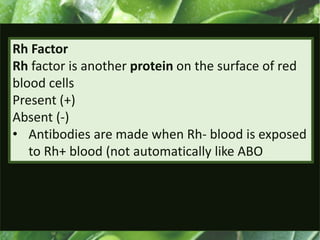
Rh Factor
Rh factor is another protein on the surface of red
blood cells
Present (+)
Absent (-)
• Antibodies are made when Rh- blood is exposed
to Rh+ blood (not automatically like ABO
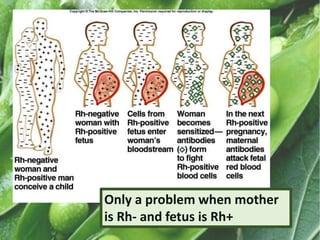
Only a problem when mother
is Rh- and fetus is Rh+
Gene Expression 1 Genetics

Gene Expression 1 Genetics

  • 1.
  • 2.
    INHERITANCE something we receivefrom each of our parents Heredity- the delivery of characteristics from parent to offspring Genetics- science of the study of heredity
  • 3.
    Gregor Mendel- 1822Austrian monk; studied science and math at University of Vienna after becoming a priest • Worked at the monastery & teaching high school • In charge of the monastery garden • Scientifically inclined, he studied garden peas: • Small, easy to grow & study hundreds of offspring in a short period of time • Short generations made easier observance of patterns
  • 4.
  • 5.
    Pollination- Mendel understoodsexual reproduction in angiosperms resulted from a female part of a flower (ovary) and the male part of the flower (pollen) & that peas are self- fertilizing by wind & insects • Fertilization- Joining the male gamete with the female gamete to form a zygote (seed)
  • 6.
    True-breeding- organisms thatproduce offspring that are identical to the one parent; same traits Trait- specific characteristic (seed color, plant height, seed shape) of an individual SEVEN Observable Traits of Pea Plants: plant Long or short stems Flower position on stem Axial, terminal Pod color Green or yellow Pod appearance Inflated or constricted Seed texture Smooth or wrinkled Flower color Purple or white Seed color Yellow or green
  • 8.
    To learn howthe traits were determined, Mendel crossed true-breeding stocks & observed results • He needed to control pollination: • Cut off stamens (pollen part of flower) • Used a brush to ‘paint’ desired pollen onto the female stigma hybrid- crosses between parents of two different traits
  • 9.
    Parental generation: P Offspringgeneration: F1 BREAK IT DOWN: F = filial = (son or daughter) Let’s consider 1 of the traits: Flower color…
  • 10.
    Parental generation: P Offspringgeneration: F1 SURPRISING RESULTS: - F1 generation had characteristics of only one parent They’re ALL purple.
  • 11.
    MENDEL’S CONCLUSIONS: Heredity =genes: An individual’s characteristics are determined by factors that are passed from one parental generation to the next (genes) • Each trait was determined by a single gene that occurred in one of two ways (alleles) • Purple flower or white flower • Green or yellow • Wrinkled or smooth • Tall or short • etc.
  • 12.
    Principle of dominance– some alleles are dominant over other (recessive) ones • Organisms with at least one dominant allele will express that gene • Organisms with the recessive allele will only express it if a dominant allele is NOT present Dominant: trait that appears in the F1 generation Recessive: trait that did not appear in the F1 generation
  • 13.
    PEA PLANT ALLELES DOMINANTALLELES White X purple purple Flower color
  • 14.
    He looked atthe offspring of the F1 generations to find out: • He allowed 7 kinds of hybrids to self-pollinate & observed the offspring • F2 generation: offspring of the F1 generation Had the recessive alleles just disappeared or were they still present in the new plants but masked?
  • 15.
    RESULTS- Mendel’s Discovery: Traitscontrolled by the recessive alleles REAPPEARED in the second generation. • about ¼ of F2 offspring showed the recessive trait
  • 16.
    Since: ¼ ofthe F2 showed the recessive trait, what had happened? Mendel’s first assumption that the dominant gene had masked the recessive one wasn’t true in the F2 cross… so he studied the matter. Law of Segregation- he hypothesized that the alleles for purple and white flowers must have separated (segregated) during the formation of sex cells (egg &pollen)
  • 17.
    He was correct. Duringgamete formation, each gamete carries only ONE allele (not both) for each gene. SO… the recessive trait reappears in the F2 generation. ONE allele Gametes: You’re only getting two of these… one from mom, one from dad
  • 18.
    Genotype- what isin the genes
  • 19.
  • 20.
  • 21.
  • 22.
    A Good Scientist: Mendelwas a good scientist since he made careful observations, collected accurate data & was able to draw correct conclusions. Probability- likelihood a particular event will occur • The way that alleles segregate during meiosis is random… how can we predict the likelihood of gene expression? • We can use a Punnett Square to determine probability
  • 23.
    Homozygous- organisms thathave two identical alleles for a gene (two capital/dominant) (two lower case/recessive) Heterozygous- organisms that have two different alleles for a gene (one capital/dominant & one lower case/recessive) PP pp Pp Homozygous recessive Homozygous dominant
  • 24.
  • 25.
    F1 1. Establish parent cross. 2.Assign letters: (use letter of the dominant trait) 3. Make an 8 Punnett square for one trait. 4. Fill in chart. Bb, BB purple bb white
  • 26.
    F2 How do allelessegregate when more than one allele is involved? Mendel wanted to be able to predict the offspring in the F2 generation. law of independent assortment- factors (alleles) for one characteristic (gene) do not affect the inheritance of factors for another trait. EXAMPLE: green pod color doesn’t always go with green pea color
  • 27.
    Rr, RR smooth rrwrinkled YY, Yy yellow Yy green 1. Establish parent cross. 2. Assign letters: (use letter of the 3. Make a 16 Punnett square for two traits. 4. dominant traits) 5. Fill in chart. F2
  • 28.
    OTHER PATTERNS OFINHERITANCE Incomplete dominance- blending of traits; alleles are neither dominant nor recessive In this example, plants with red flowers bred with white flowers produce PINK flowers! • NEITHER is DOMINANT
  • 29.
    Codominance- phenotypes ofBOTH alleles are expressed in the heterozygous offspring In this example, white chickens crosses with black chickens create speckled chickens • NEITHER is DOMINANT BOTH COLORS expressed
  • 30.
    Polygenic traits- traitscontrolled by 2 or more genes EXAMPLES: (traits that vary a lot) Height Skin color Hair color
  • 31.
    Multiple alleles- genewith three or more alleles, but show only 2 at a time (since you only get two) Example: Rabbit fur color (4 alleles) ABO Blood types (3 alleles)
  • 32.
  • 33.
  • 34.
    B allele (IBIB,IBi, IAIB) (has B antigen)
  • 35.
    A allele (IAIA,IAi, IAIB) (has B antigen)
  • 36.
    O allele (IAi,IBi, ii) (has neither antigen)
  • 37.
    Rh Factor Rh factoris another protein on the surface of red blood cells Present (+) Absent (-) • Antibodies are made when Rh- blood is exposed to Rh+ blood (not automatically like ABO
  • 38.
    Only a problemwhen mother is Rh- and fetus is Rh+