THE COMPLETELY
RANDOMIZED DESIGN
(CRD)
LAB # 1
DEFINITION

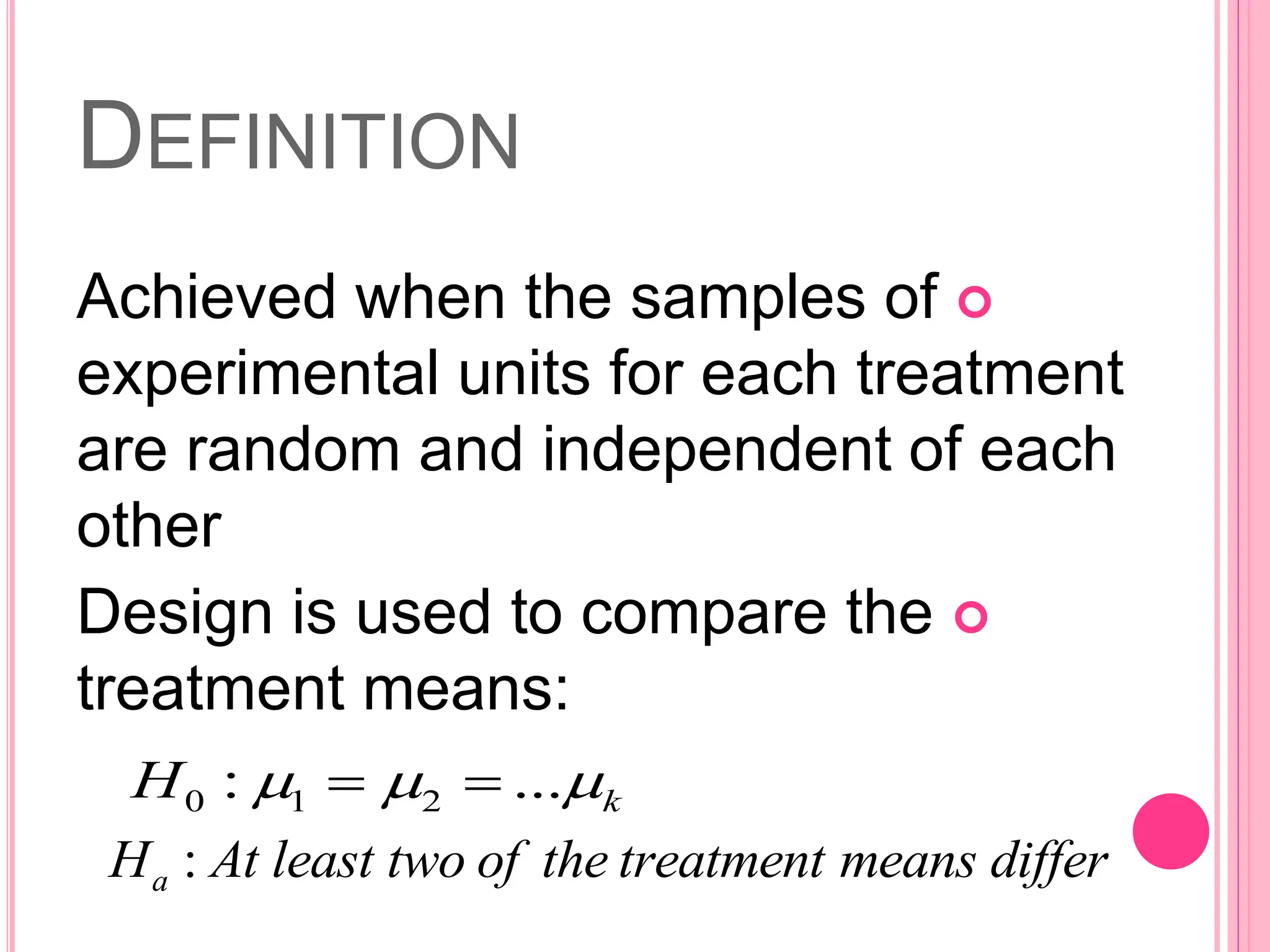
Achieved when the samples of
experimental units for each treatment
are random and independent of each
other

Design is used to compare the
treatment means:
0 1 2
: ... k
H   
 
:
a
H At least two of the treatment means differ
•
The hypotheses are tested by
comparing the differences
between the treatment means.
•
Test statistic is calculated using
measures of variability within
treatment groups and measures
of variability between treatment
groups
STEPS FOR CONDUCTING AN ANALYSIS OF VARIANCE (ANOVA)
FOR A COMPLETELY RANDOMIZED DESIGN:
•
1- Assure randomness of design, and
independence, randomness of samples
•
2- Check normality, equal variance
assumptions
•
3- Create ANOVA summary table
•
4- Conduct multiple comparisons for pairs of
means as necessary/desired
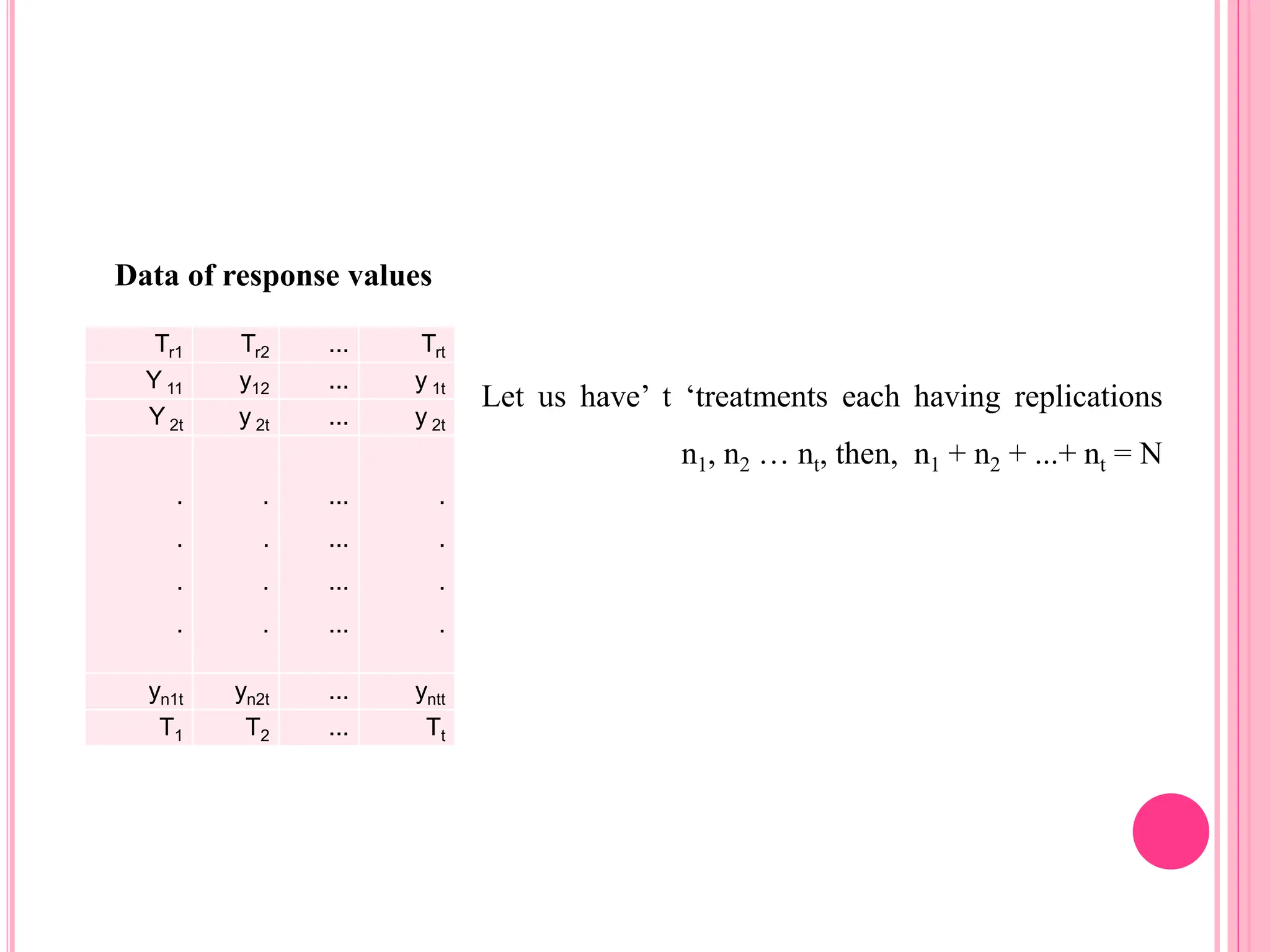
Tr1 Tr2 ... Trt
Y 11 y12 ... y 1t
Y 2t y 2t ... y 2t
.
.
.
.
.
.
.
.
...
...
...
...
.
.
.
.
yn1t yn2t ... yntt
T1 T2 ... Tt
Data of response values
Let us have’ t ‘treatments each having replications
n1, n2 … nt, then, n1 + n2 + ...+ nt = N
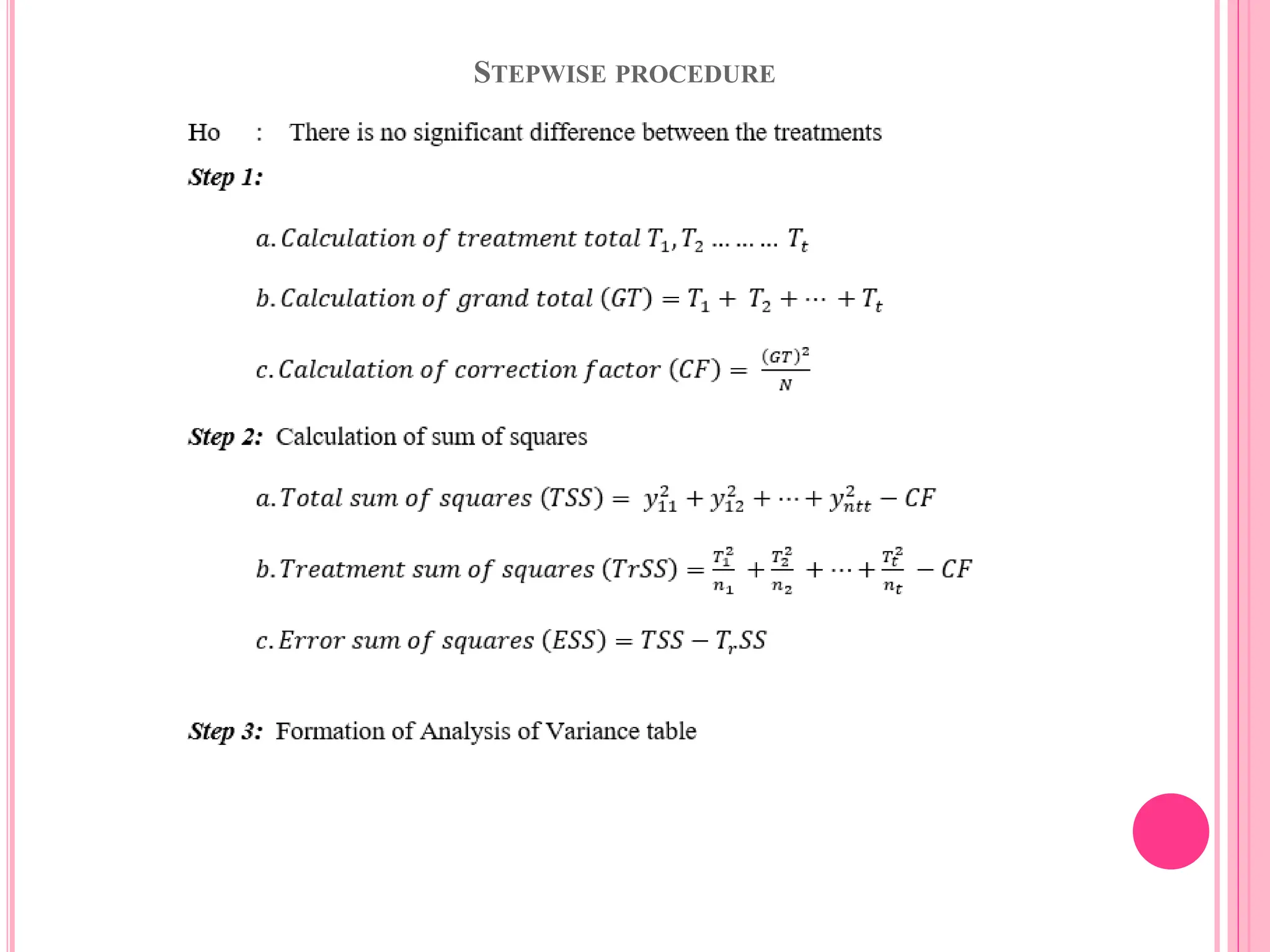
STEPWISE PROCEDURE
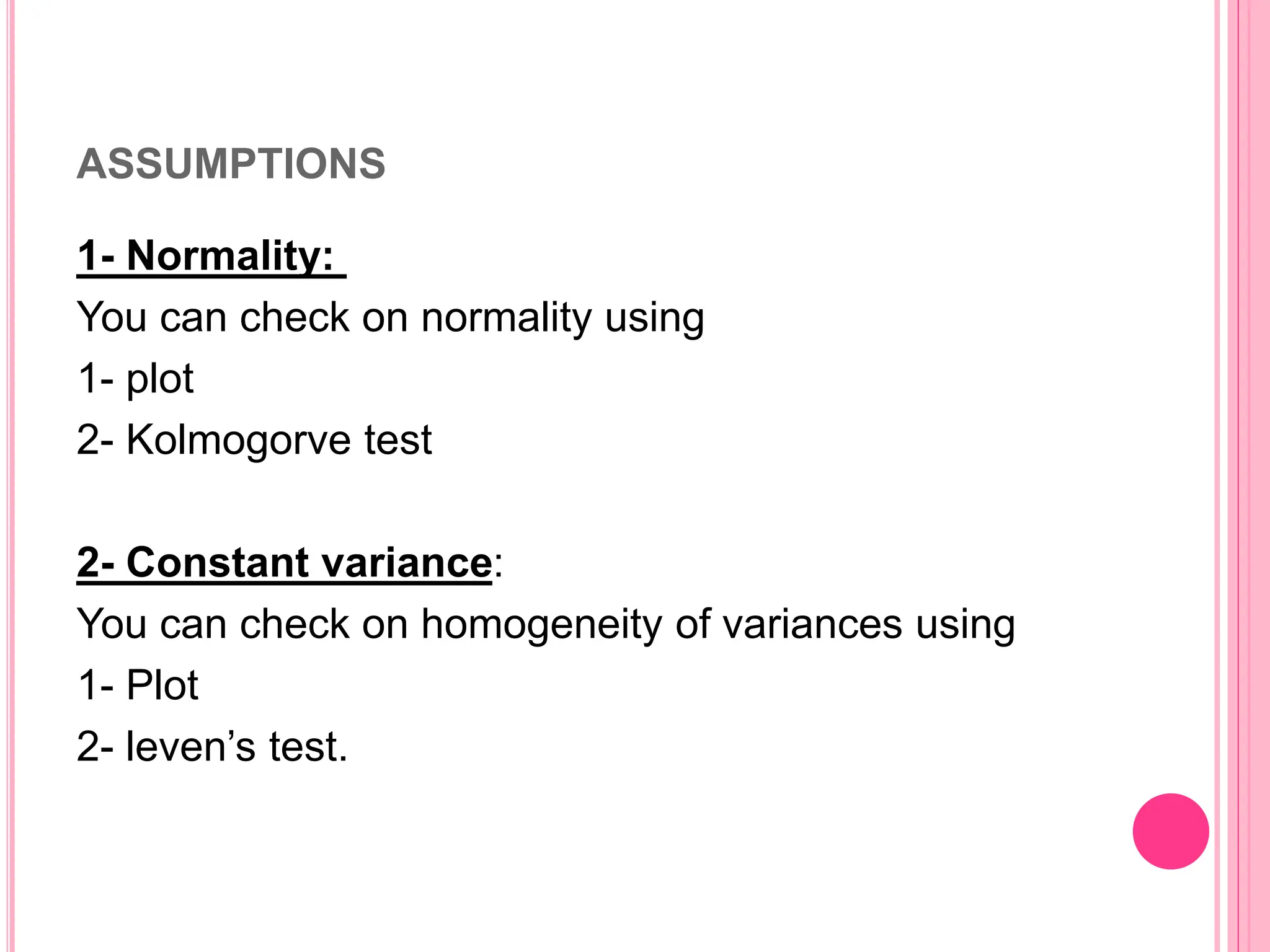
ASSUMPTIONS
1- Normality:
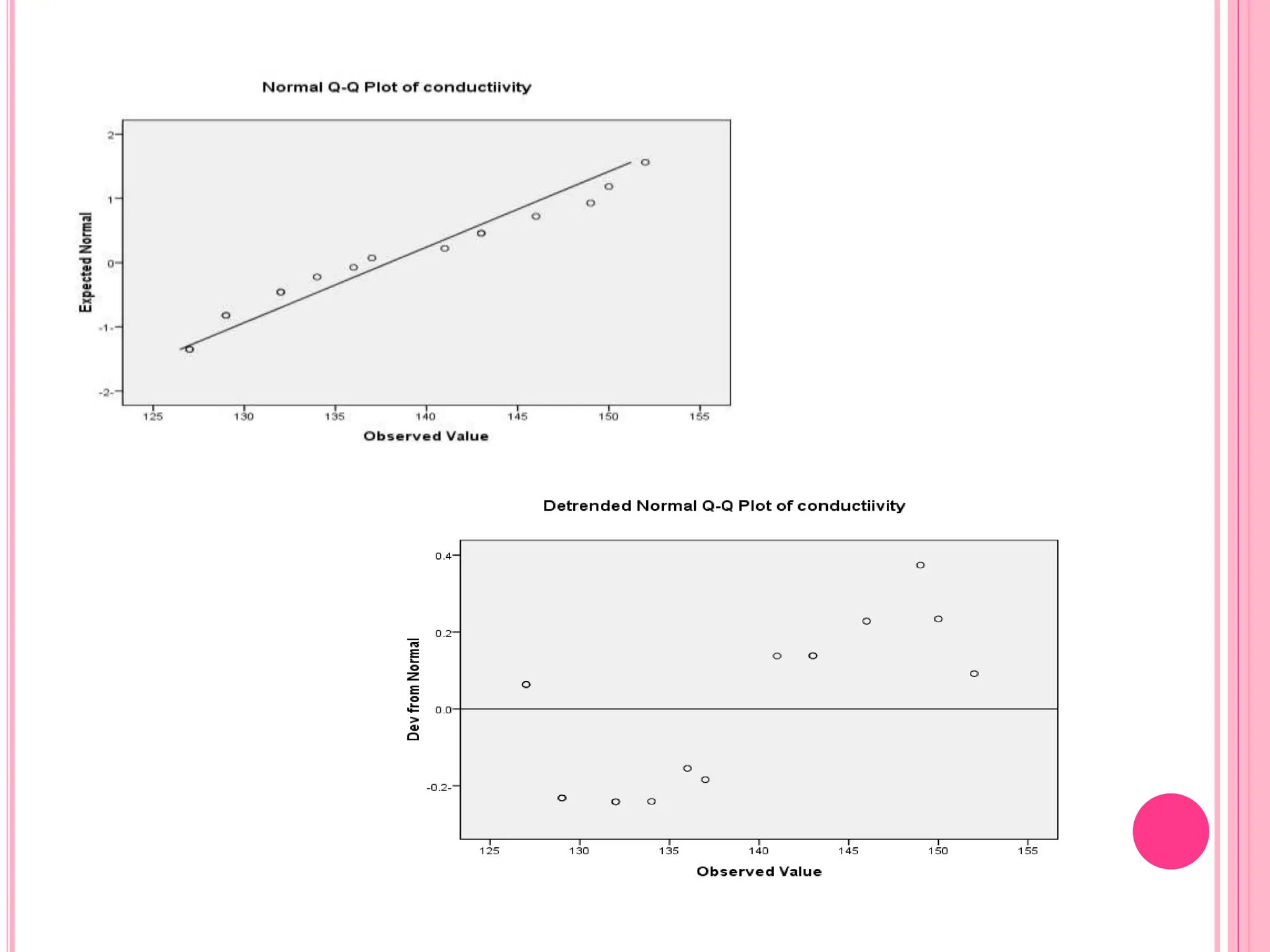
You can check on normality using
1- plot
2- Kolmogorve test
2- Constant variance:
You can check on homogeneity of variances using
1- Plot
2- leven’s test.
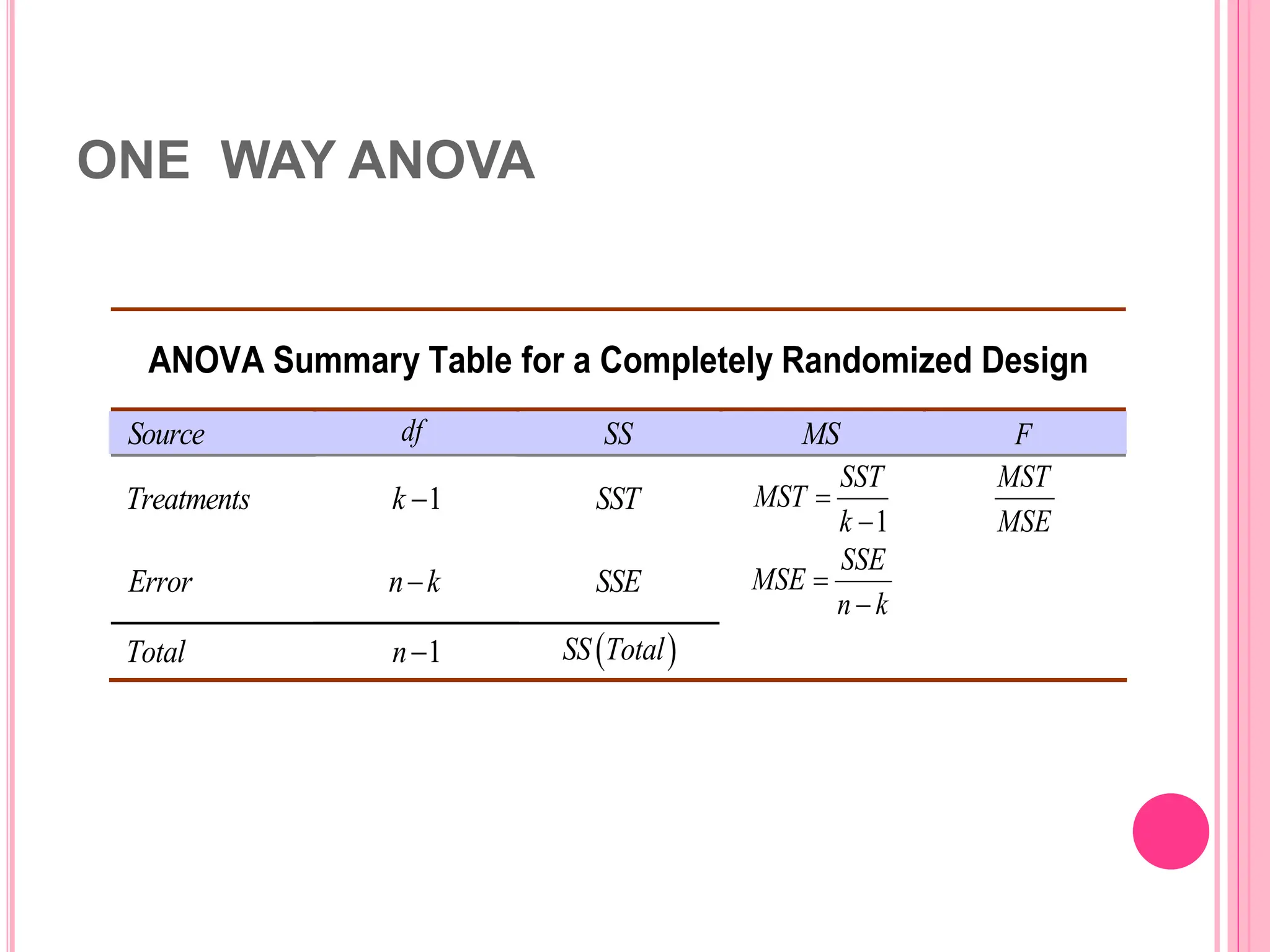
ONE WAY ANOVA
ANOVA Summary Table for a Completely Randomized Design
Source df SS MS F
Treatments 1
k  SST
1
SST
MST
k


MST
MSE
Error n k
 SSE
SSE
MSE
n k


Total 1
n  
SS Total
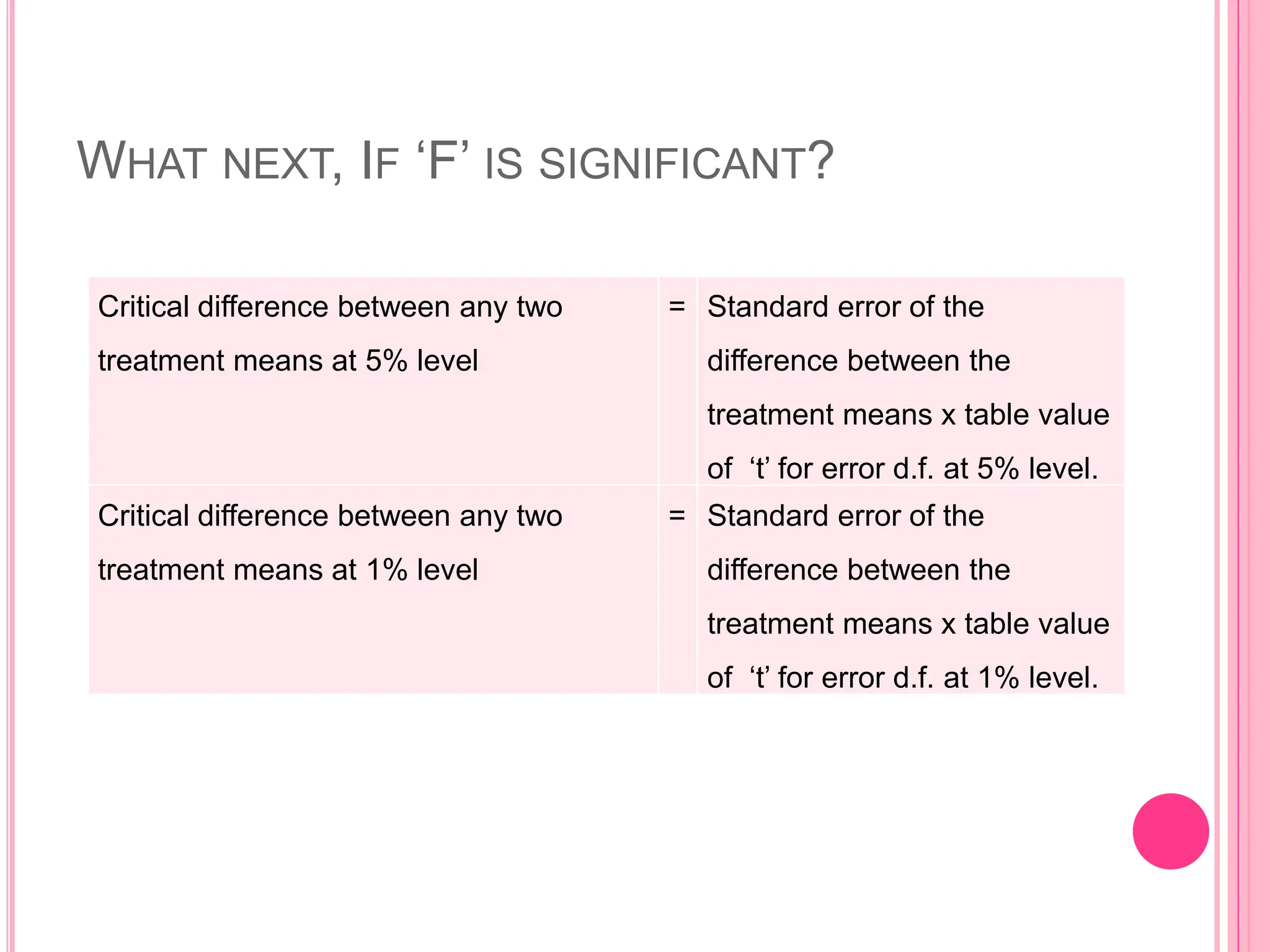
WHAT NEXT, IF ‘F’ IS SIGNIFICANT?
Critical difference between any two
treatment means at 5% level
= Standard error of the
difference between the
treatment means x table value
of ‘t’ for error d.f. at 5% level.
Critical difference between any two
treatment means at 1% level
= Standard error of the
difference between the
treatment means x table value
of ‘t’ for error d.f. at 1% level.
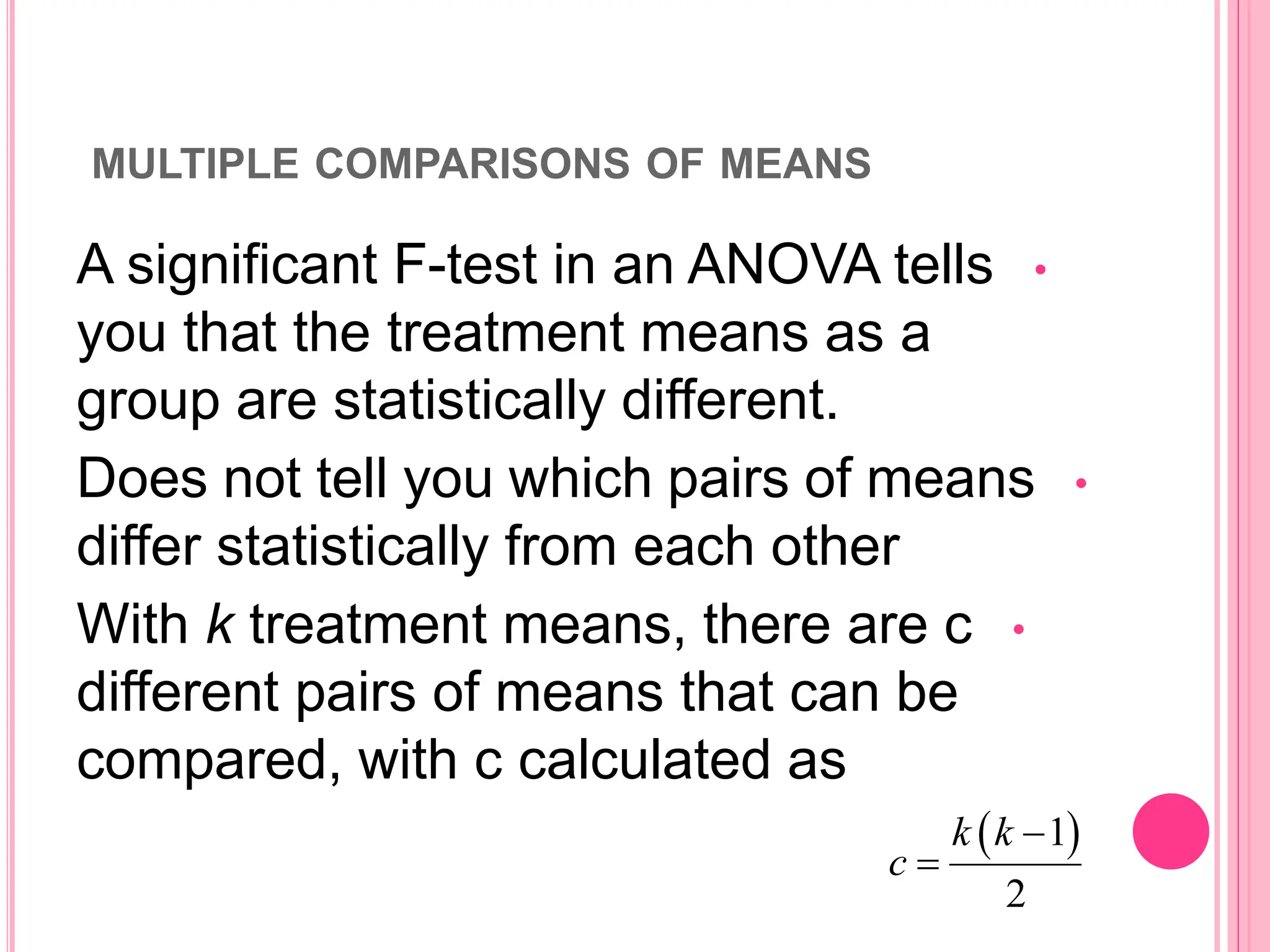
MULTIPLE COMPARISONS OF MEANS
•
A significant F-test in an ANOVA tells
you that the treatment means as a
group are statistically different.
•
Does not tell you which pairs of means
differ statistically from each other
•
With k treatment means, there are c
different pairs of means that can be
compared, with c calculated as
 
1
2
k k
c


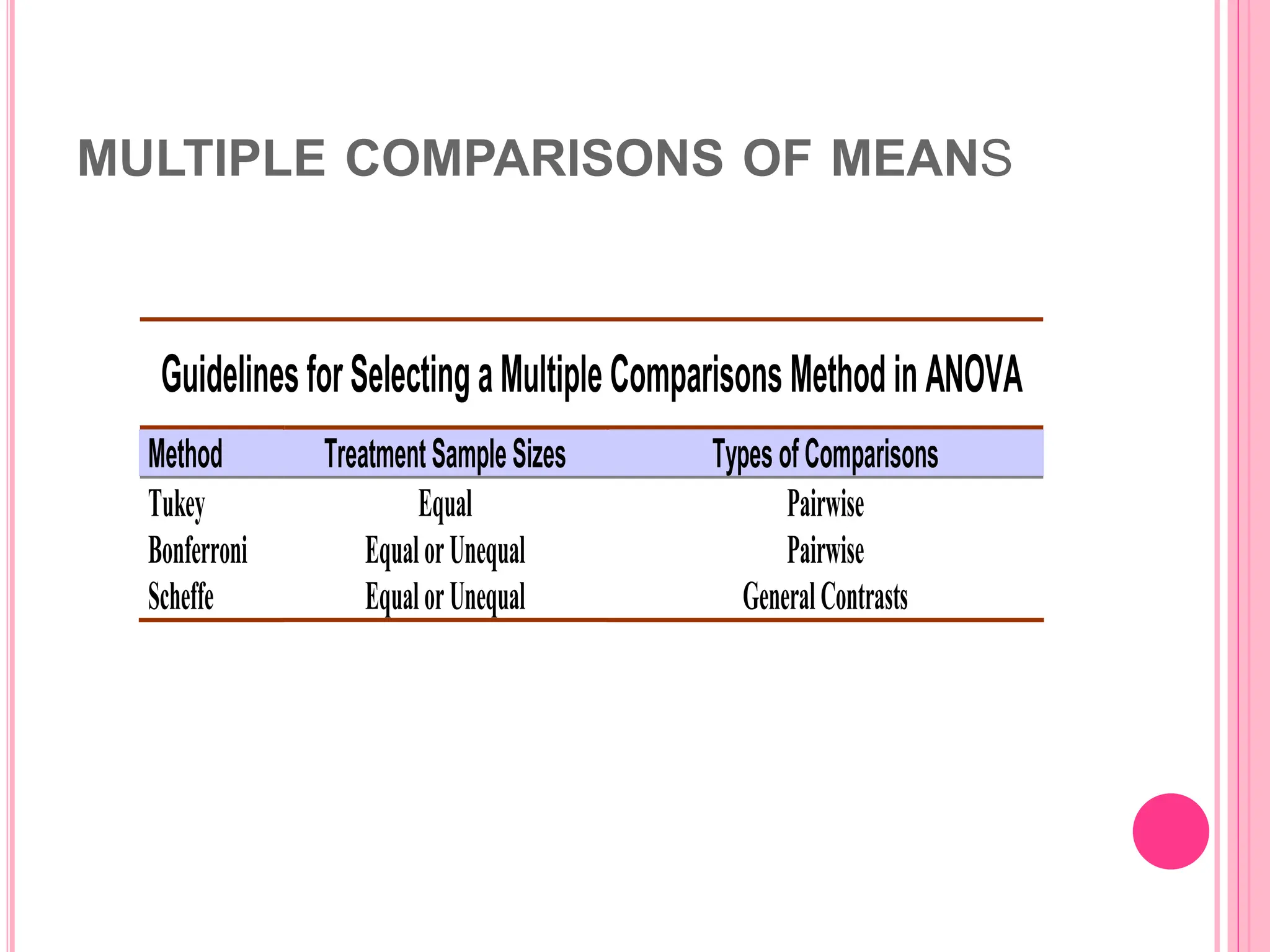
MULTIPLE COMPARISONS OF MEANS
GuidelinesforSelectingaMultipleComparisonsMethodin ANOVA
Method TreatmentSampleSizes TypesofComparisons
Tukey Equal Pairwise
Bonferroni EqualorUnequal Pairwise
Scheffe EqualorUnequal GeneralContrasts
EXAMPLE 1

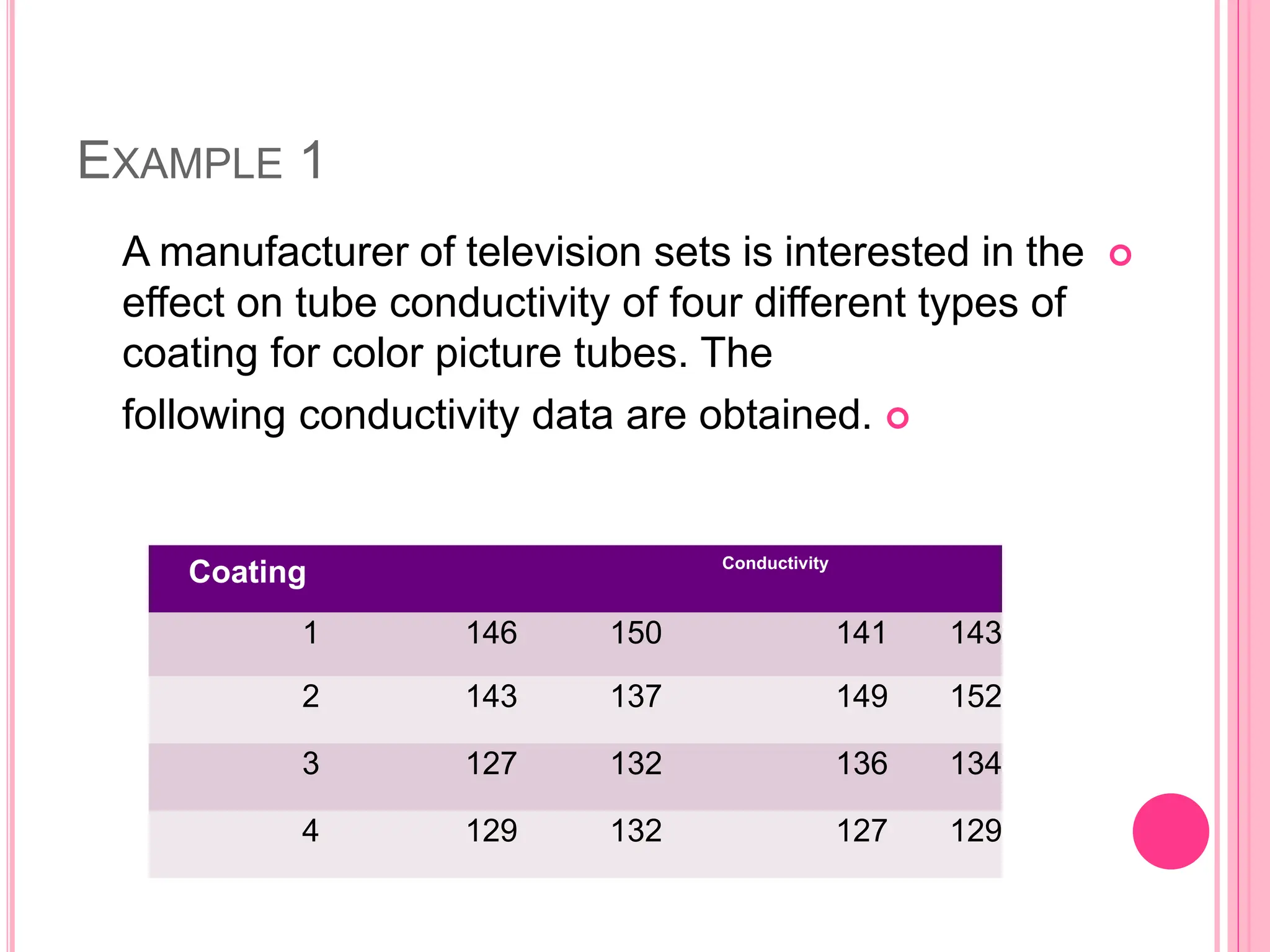
A manufacturer of television sets is interested in the
effect on tube conductivity of four different types of
coating for color picture tubes. The

following conductivity data are obtained.
Conductivity
Coating
143
141
150
146
1
152
149
137
143
2
134
136
132
127
3
129
127
132
129
4
SOLUTION

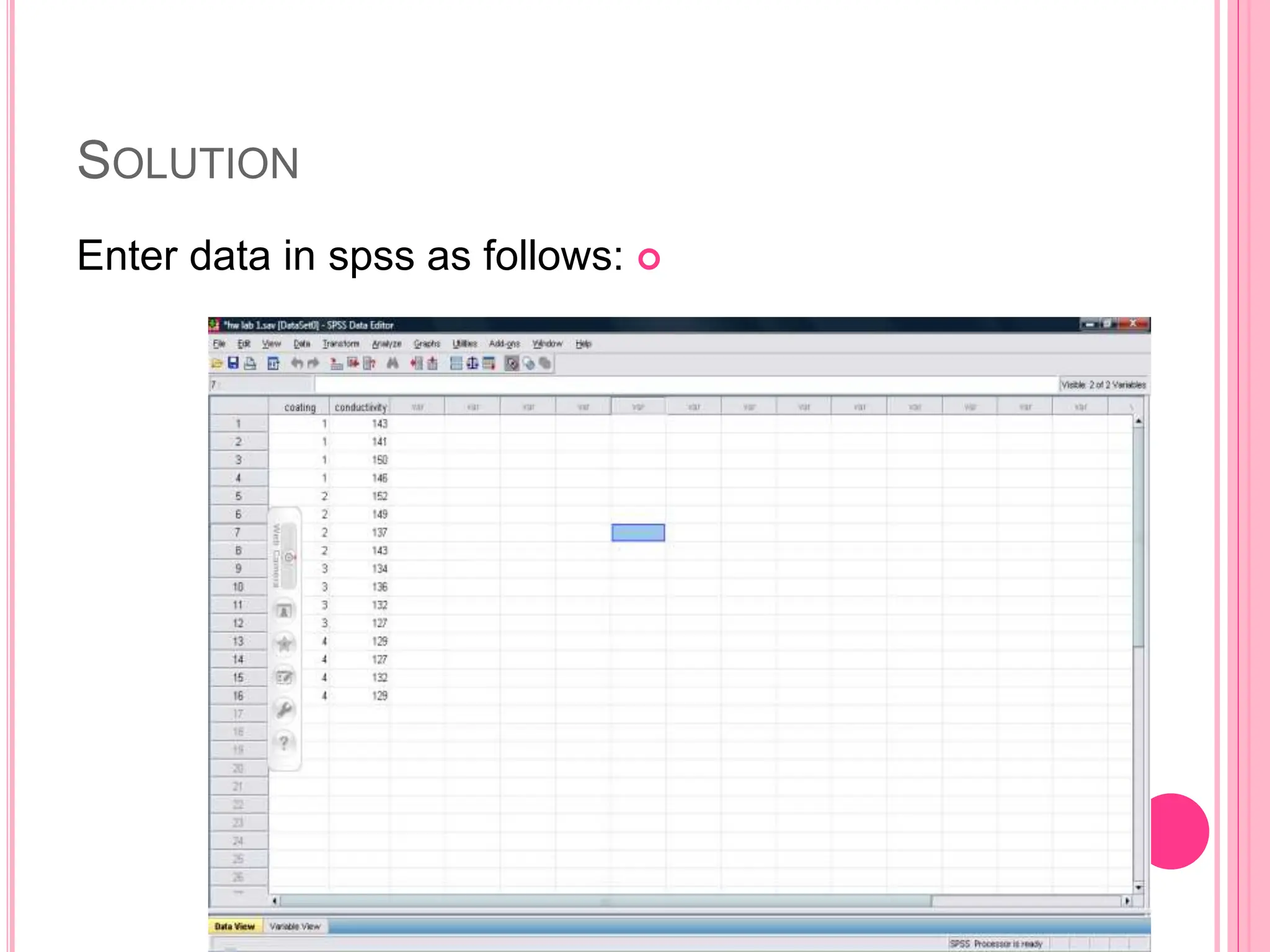
Enter data in spss as follows:
ANALYSIS
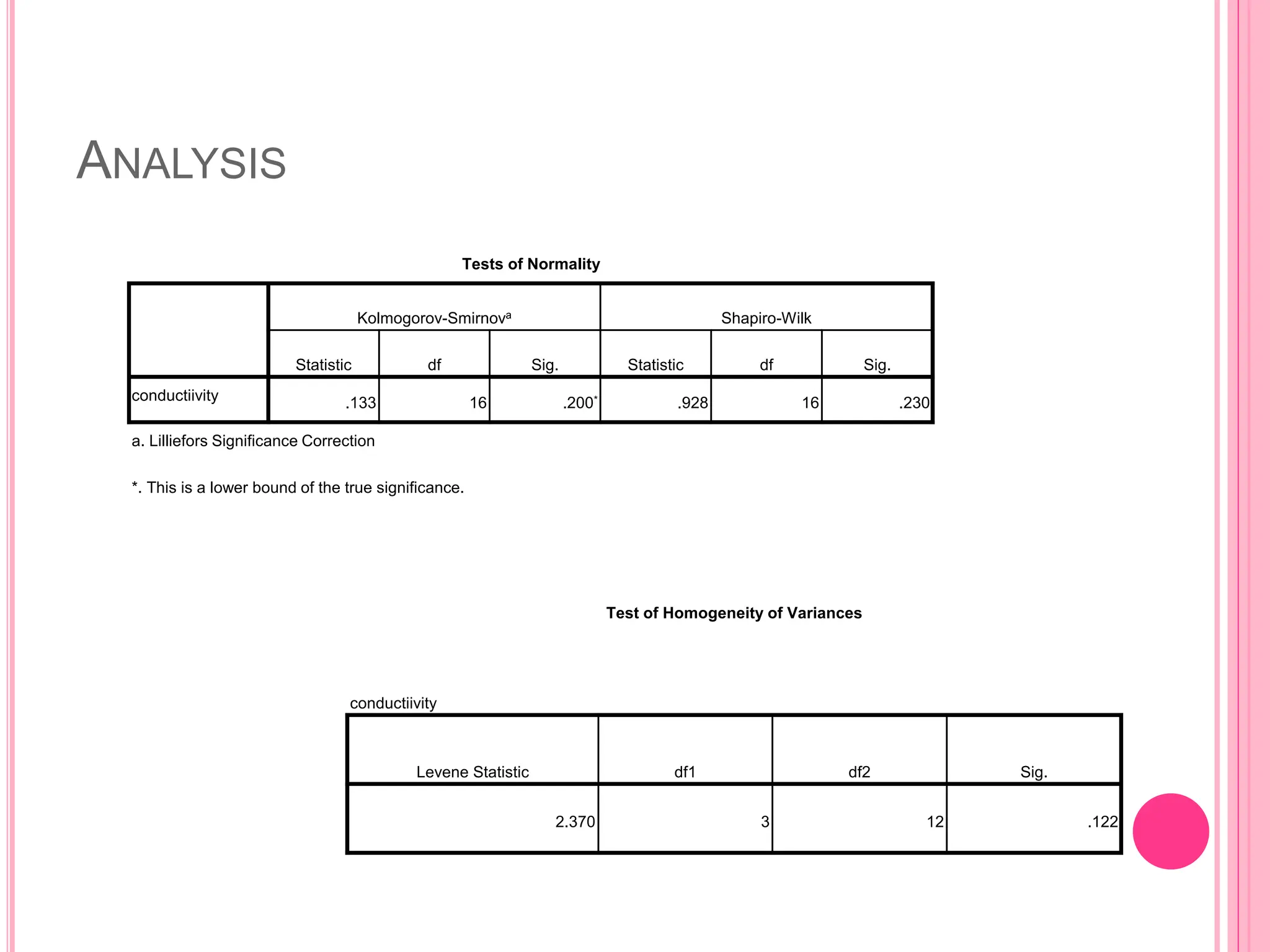
Test of Homogeneity of Variances
conductiivity
Levene Statistic df1 df2 Sig.
2.370 3 12 .122
Tests of Normality
Kolmogorov-Smirnova Shapiro-Wilk
Statistic df Sig. Statistic df Sig.
conductiivity .133 16 .200* .928 16 .230
a. Lilliefors Significance Correction
*. This is a lower bound of the true significance.
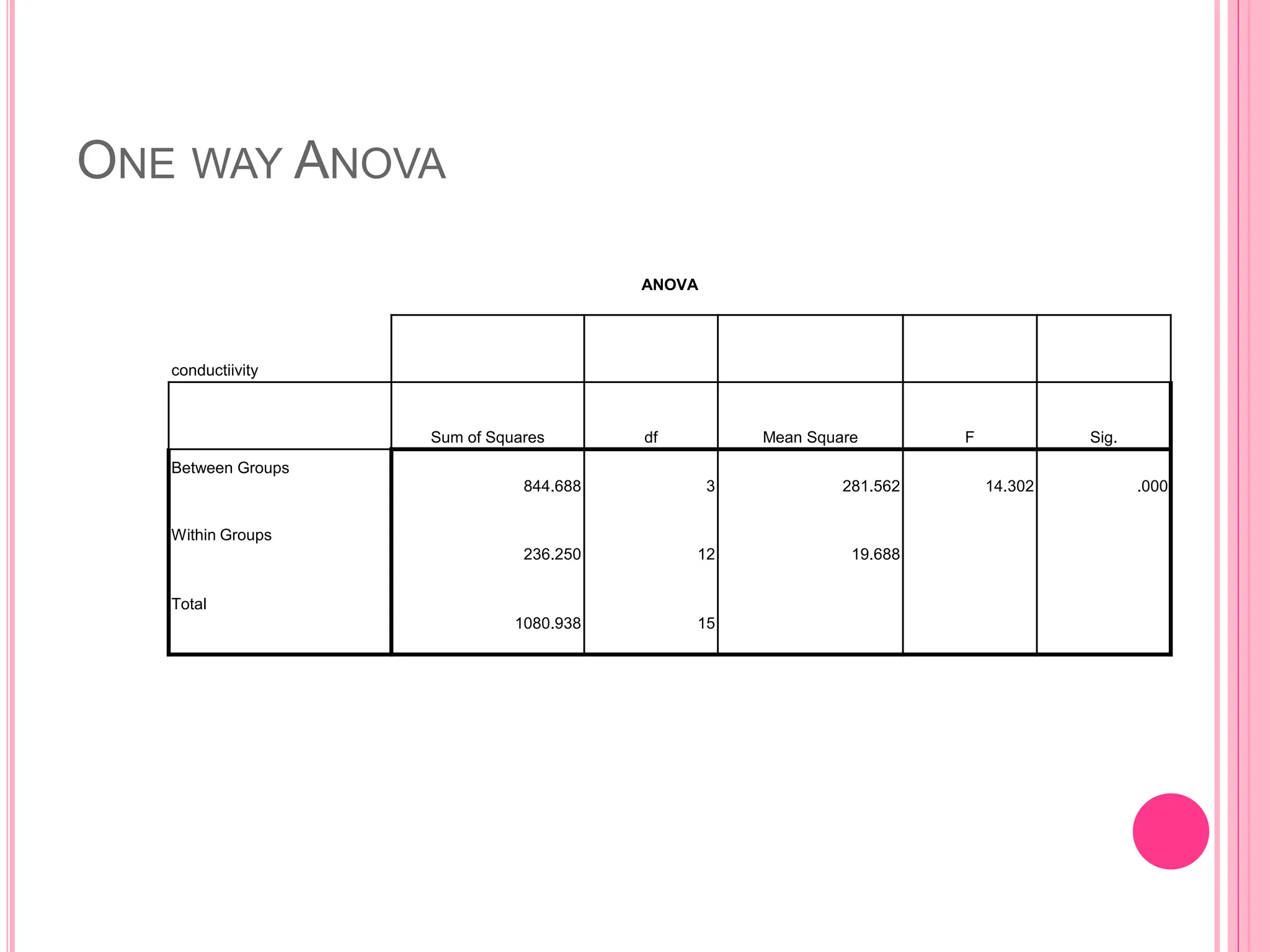
ONE WAY ANOVA
ANOVA
conductiivity
Sum of Squares df Mean Square F Sig.
Between Groups
844.688 3 281.562 14.302 .000
Within Groups
236.250 12 19.688
Total
1080.938 15
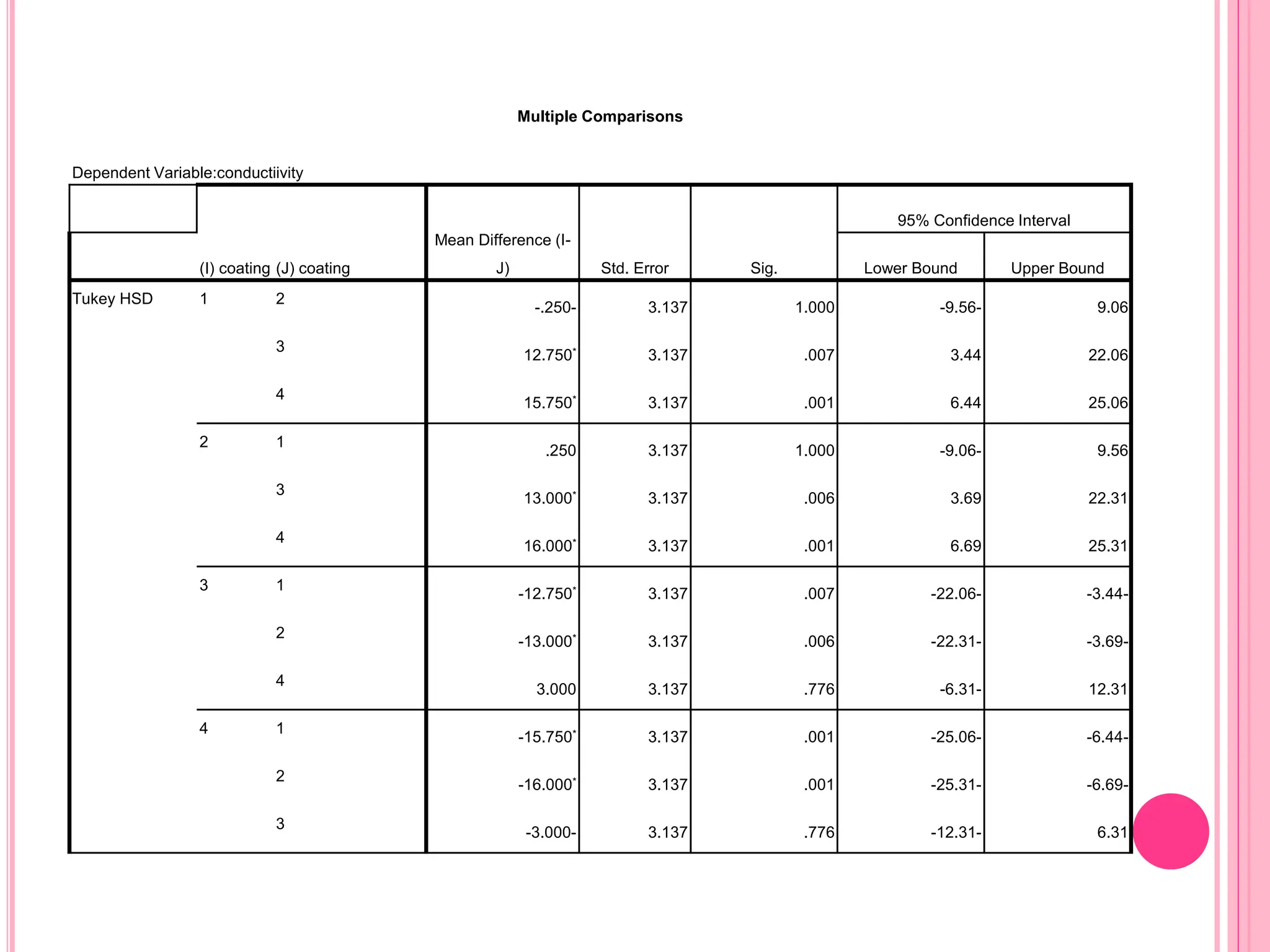
Multiple Comparisons
Dependent Variable:conductiivity
(I) coating (J) coating
Mean Difference (I-
J) Std. Error Sig.
95% Confidence Interval
Lower Bound Upper Bound
Tukey HSD 1 2
-.250- 3.137 1.000 -9.56- 9.06
3
12.750* 3.137 .007 3.44 22.06
4
15.750* 3.137 .001 6.44 25.06
2 1
.250 3.137 1.000 -9.06- 9.56
3
13.000* 3.137 .006 3.69 22.31
4
16.000* 3.137 .001 6.69 25.31
3 1
-12.750* 3.137 .007 -22.06- -3.44-
2
-13.000* 3.137 .006 -22.31- -3.69-
4
3.000 3.137 .776 -6.31- 12.31
4 1
-15.750* 3.137 .001 -25.06- -6.44-
2
-16.000* 3.137 .001 -25.31- -6.69-
3
-3.000- 3.137 .776 -12.31- 6.31
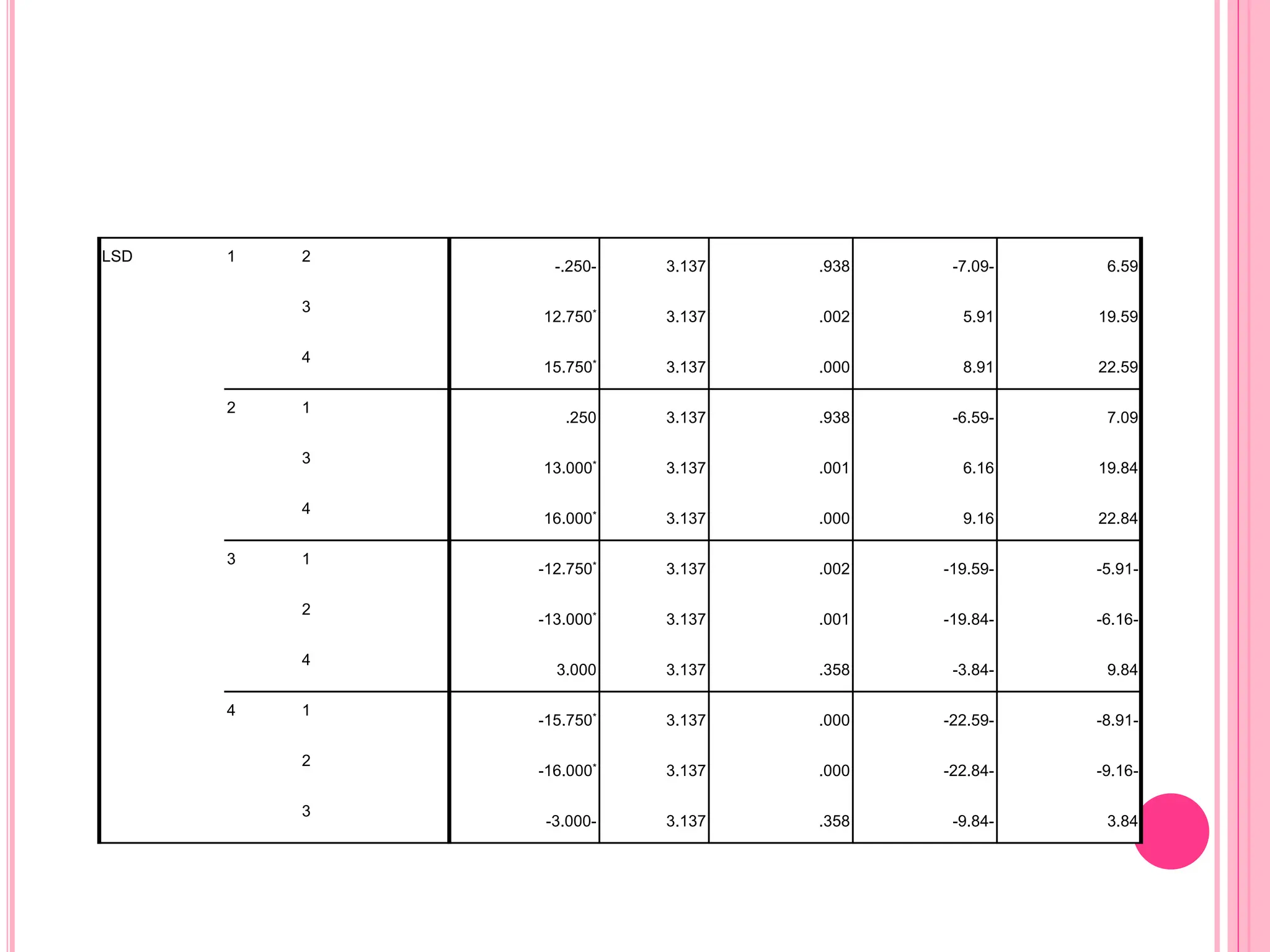
LSD 1 2
-.250- 3.137 .938 -7.09- 6.59
3
12.750* 3.137 .002 5.91 19.59
4
15.750* 3.137 .000 8.91 22.59
2 1
.250 3.137 .938 -6.59- 7.09
3
13.000* 3.137 .001 6.16 19.84
4
16.000* 3.137 .000 9.16 22.84
3 1
-12.750* 3.137 .002 -19.59- -5.91-
2
-13.000* 3.137 .001 -19.84- -6.16-
4
3.000 3.137 .358 -3.84- 9.84
4 1
-15.750* 3.137 .000 -22.59- -8.91-
2
-16.000* 3.137 .000 -22.84- -9.16-
3
-3.000- 3.137 .358 -9.84- 3.84
Thanks for all

The Completely Randomized Design (CRD).ppt

  • 1.
  • 2.
    DEFINITION  Achieved when thesamples of experimental units for each treatment are random and independent of each other  Design is used to compare the treatment means: 0 1 2 : ... k H      : a H At least two of the treatment means differ
  • 3.
    • The hypotheses aretested by comparing the differences between the treatment means. • Test statistic is calculated using measures of variability within treatment groups and measures of variability between treatment groups
  • 4.
    STEPS FOR CONDUCTINGAN ANALYSIS OF VARIANCE (ANOVA) FOR A COMPLETELY RANDOMIZED DESIGN: • 1- Assure randomness of design, and independence, randomness of samples • 2- Check normality, equal variance assumptions • 3- Create ANOVA summary table • 4- Conduct multiple comparisons for pairs of means as necessary/desired
  • 5.
    Tr1 Tr2 ...Trt Y 11 y12 ... y 1t Y 2t y 2t ... y 2t . . . . . . . . ... ... ... ... . . . . yn1t yn2t ... yntt T1 T2 ... Tt Data of response values Let us have’ t ‘treatments each having replications n1, n2 … nt, then, n1 + n2 + ...+ nt = N
  • 6.
  • 7.
    ASSUMPTIONS 1- Normality: You cancheck on normality using 1- plot 2- Kolmogorve test 2- Constant variance: You can check on homogeneity of variances using 1- Plot 2- leven’s test.
  • 8.
    ONE WAY ANOVA ANOVASummary Table for a Completely Randomized Design Source df SS MS F Treatments 1 k  SST 1 SST MST k   MST MSE Error n k  SSE SSE MSE n k   Total 1 n   SS Total
  • 9.
    WHAT NEXT, IF‘F’ IS SIGNIFICANT? Critical difference between any two treatment means at 5% level = Standard error of the difference between the treatment means x table value of ‘t’ for error d.f. at 5% level. Critical difference between any two treatment means at 1% level = Standard error of the difference between the treatment means x table value of ‘t’ for error d.f. at 1% level.
  • 11.
    MULTIPLE COMPARISONS OFMEANS • A significant F-test in an ANOVA tells you that the treatment means as a group are statistically different. • Does not tell you which pairs of means differ statistically from each other • With k treatment means, there are c different pairs of means that can be compared, with c calculated as   1 2 k k c  
  • 12.
    MULTIPLE COMPARISONS OFMEANS GuidelinesforSelectingaMultipleComparisonsMethodin ANOVA Method TreatmentSampleSizes TypesofComparisons Tukey Equal Pairwise Bonferroni EqualorUnequal Pairwise Scheffe EqualorUnequal GeneralContrasts
  • 13.
    EXAMPLE 1  A manufacturerof television sets is interested in the effect on tube conductivity of four different types of coating for color picture tubes. The  following conductivity data are obtained. Conductivity Coating 143 141 150 146 1 152 149 137 143 2 134 136 132 127 3 129 127 132 129 4
  • 14.
  • 15.
    ANALYSIS Test of Homogeneityof Variances conductiivity Levene Statistic df1 df2 Sig. 2.370 3 12 .122 Tests of Normality Kolmogorov-Smirnova Shapiro-Wilk Statistic df Sig. Statistic df Sig. conductiivity .133 16 .200* .928 16 .230 a. Lilliefors Significance Correction *. This is a lower bound of the true significance.
  • 17.
    ONE WAY ANOVA ANOVA conductiivity Sumof Squares df Mean Square F Sig. Between Groups 844.688 3 281.562 14.302 .000 Within Groups 236.250 12 19.688 Total 1080.938 15
  • 18.
    Multiple Comparisons Dependent Variable:conductiivity (I)coating (J) coating Mean Difference (I- J) Std. Error Sig. 95% Confidence Interval Lower Bound Upper Bound Tukey HSD 1 2 -.250- 3.137 1.000 -9.56- 9.06 3 12.750* 3.137 .007 3.44 22.06 4 15.750* 3.137 .001 6.44 25.06 2 1 .250 3.137 1.000 -9.06- 9.56 3 13.000* 3.137 .006 3.69 22.31 4 16.000* 3.137 .001 6.69 25.31 3 1 -12.750* 3.137 .007 -22.06- -3.44- 2 -13.000* 3.137 .006 -22.31- -3.69- 4 3.000 3.137 .776 -6.31- 12.31 4 1 -15.750* 3.137 .001 -25.06- -6.44- 2 -16.000* 3.137 .001 -25.31- -6.69- 3 -3.000- 3.137 .776 -12.31- 6.31
  • 19.
    LSD 1 2 -.250-3.137 .938 -7.09- 6.59 3 12.750* 3.137 .002 5.91 19.59 4 15.750* 3.137 .000 8.91 22.59 2 1 .250 3.137 .938 -6.59- 7.09 3 13.000* 3.137 .001 6.16 19.84 4 16.000* 3.137 .000 9.16 22.84 3 1 -12.750* 3.137 .002 -19.59- -5.91- 2 -13.000* 3.137 .001 -19.84- -6.16- 4 3.000 3.137 .358 -3.84- 9.84 4 1 -15.750* 3.137 .000 -22.59- -8.91- 2 -16.000* 3.137 .000 -22.84- -9.16- 3 -3.000- 3.137 .358 -9.84- 3.84
  • 20.