Estimation of The Minimum
Compensation to Savar
Garments Factory Victims
Syed Galib Sultan
Dept. of Economics
UW Seattle
What happened in Savar
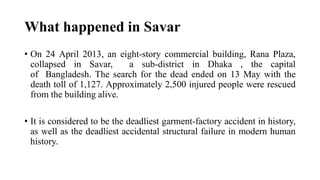
• On 24 April 2013, an eight-story commercial building, Rana Plaza,
collapsed in Savar, a sub-district in Dhaka , the capital
of Bangladesh. The search for the dead ended on 13 May with the
death toll of 1,127. Approximately 2,500 injured people were rescued
from the building alive.
• It is considered to be the deadliest garment-factory accident in history,
as well as the deadliest accidental structural failure in modern human
history.
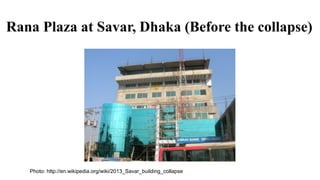
Rana Plaza at Savar, Dhaka (Before the collapse)
Photo: http://en.wikipedia.org/wiki/2013_Savar_building_collapse
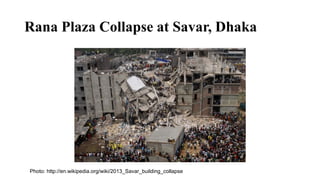
Rana Plaza Collapse at Savar, Dhaka
Photo: http://en.wikipedia.org/wiki/2013_Savar_building_collapse
A little bit about the Garment Industry in
Bangladesh
• Ready-made Garment Industry’s product is a major source of Export
income of Bangladesh since 1980s.
• This sector has experienced an exponential growth over the last two
decades due to different trade agreements with US and EU and
availability of cheap labor (mainly women).
• RMG sector has also become the single most prolific source of female
labor force employment in Bangladesh.
• Bangladesh compete favorably in exporting RMG with China, India,
Vietnam etc. The buyers include Walmart, Adidas, Target and all the
big brands in US, Canada and Europe.
Motivation for the op-ed article
• In developed countries, when a worker dies in a work-related accident,
usually the insurance company and employer firms take the
responsibility of compensating the victim. Sometimes, the amount of
compensation is decided in the court (specially when the victim’s
family challenge the amount of the compensation).
• However, in a less developed country like Bangladesh, this practice is
not very standard. Due to the lack of proper institutional structure, the
Government of the country takes responsibility of providing
compensation to the victim’s family. Most of the time this
compensation amount is decided at random.
Motivation for the op-ed article
• After the tragic incident in Savar, the Bangladesh government
announced that it will give an compensation amount equal to Take 1
Million ($12,825) to each victim.
• In a recent accident in another Garment Factory (Tazreen Garments),
the Government has announced to give a compensation of Taka .7
million ($ 8977) to each victim.
• We wanted to provide a scientific method of calculating this
compensation amount. In the process, we showed that even the
minimum number you can calculate is higher in most cases than the
amount the government has proposed.
The Basic Idea
• Whenever a worker suffers from a workplace injury, the first
monetarily measurable loss incurred is the loss of wages resulting
from the injury. In order to determine this loss, we first have to know
the age of the worker at the time of the injury and the average age of
retirement for workers in Bangladesh.
• We have calculated an approximate compensation amount by
considering the income that the worker would have brought in if alive
till the age of retirement, further adjusted to the current market wage,
inflation and interest rates.
The Basic Idea
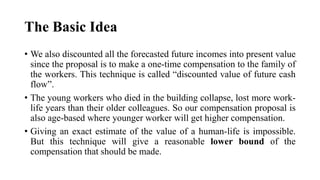
• We also discounted all the forecasted future incomes into present value
since the proposal is to make a one-time compensation to the family of
the workers. This technique is called “discounted value of future cash
flow”.
• The young workers who died in the building collapse, lost more work-
life years than their older colleagues. So our compensation proposal is
also age-based where younger worker will get higher compensation.
• Giving an exact estimate of the value of a human-life is impossible.
But this technique will give a reasonable lower bound of the
compensation that should be made.
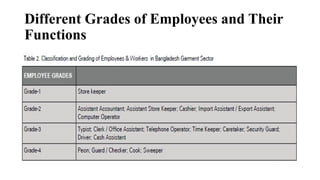
Different Grades of Employees and Their
Functions
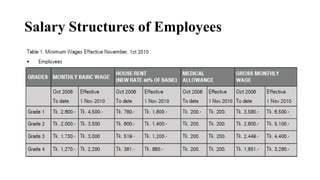
Salary Structures of Employees
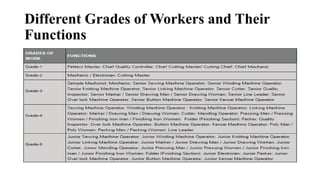
Different Grades of Workers and Their
Functions
Continued……..
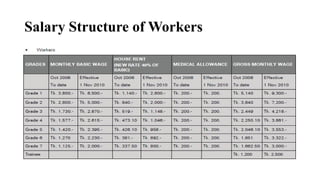
Salary Structure of Workers
Assumptions
• The salaries of workers and employees increase every year at a rate
equal to the Consumer Price Index (CPI) inflation rate.
• Average retirement year for garment workers and employees is 45-50
years.
• The workers and employees will get promoted to the next level of
salary-grade after every 5 years. And once promoted to the highest
level of salary-grade (grade 1 in each case), he or she will remain at
that grade until the day of retirement.
• There is no labor mobility/movement from one industry to another.
That is, the workers and employees are assumed to work only in the
garments sector for ever.
Assumptions
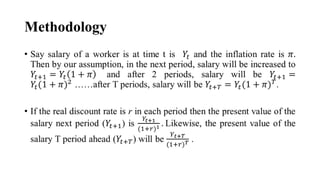
• The average inflation (CPI) rates for the next 30 years are assumed
(forecasted) to be equal to the average of last 25 years of inflation
(6.28%). The real discount rate for the next 30 years are assumed
(forecasted) to be equal to the average of last 25 years of discount rate
(2.72%). The real discounted rate is calculated as deposit interest rate
minus the CPI inflation rate.
Assumptions
• The salary is assumed to be equal to be the basic salary (without the
bonus). However, the bonus salary usually makes up for more than
50% of the workers’ annual salary. In reality, wage is sticky (i.e. it
doesn’t get adjusted every year). Our first assumption regarding the
regular annual increment of salary is a proxy for the missing bonuses
from our calculation.
• We divided the entire work-force into 5 age categories. Below 20, 21-
25, 26-30,31-35 and above 35. Deceased workers in the 20 and below
age group should be compensated with 30 years, 21-25 years age
group with 25 years, 26-30 years group with 20 years, 31-35 years
group with 15 years, and lastly, 35 and above group with 10 years
equivalent of wages.
Methodology
Methodology
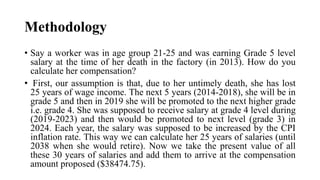
• Say a worker was in age group 21-25 and was earning Grade 5 level
salary at the time of her death in the factory (in 2013). How do you
calculate her compensation?
• First, our assumption is that, due to her untimely death, she has lost
25 years of wage income. The next 5 years (2014-2018), she will be in
grade 5 and then in 2019 she will be promoted to the next higher grade
i.e. grade 4. She was supposed to receive salary at grade 4 level during
(2019-2023) and then would be promoted to next level (grade 3) in
2024. Each year, the salary was supposed to be increased by the CPI
inflation rate. This way we can calculate her 25 years of salaries (until
2038 when she would retire). Now we take the present value of all
these 30 years of salaries and add them to arrive at the compensation
amount proposed ($38474.75).
A small digression on Present Value
Calculation
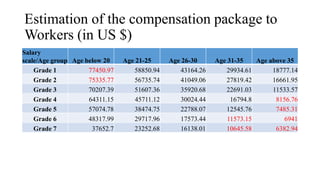
Estimation of the compensation package to
Workers (in US $)
Salary
scale/Age group Age below 20 Age 21-25 Age 26-30 Age 31-35 Age above 35
Grade 1 77450.97 58850.94 43164.26 29934.61 18777.14
Grade 2 75335.77 56735.74 41049.06 27819.42 16661.95
Grade 3 70207.39 51607.36 35920.68 22691.03 11533.57
Grade 4 64311.15 45711.12 30024.44 16794.8 8156.76
Grade 5 57074.78 38474.75 22788.07 12545.76 7485.31
Grade 6 48317.99 29717.96 17573.44 11573.15 6941
Grade 7 37652.7 23252.68 16138.01 10645.58 6382.94
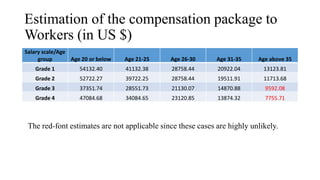
Estimation of the compensation package to
Workers (in US $)
Salary scale/Age
group Age 20 or below Age 21-25 Age 26-30 Age 31-35 Age above 35
Grade 1 54132.40 41132.38 28758.44 20922.04 13123.81
Grade 2 52722.27 39722.25 28758.44 19511.91 11713.68
Grade 3 37351.74 28551.73 21130.07 14870.88 9592.08
Grade 4 47084.68 34084.65 23120.85 13874.32 7755.71
The red-font estimates are not applicable since these cases are highly unlikely.
Some Recent Developments
• Buyers from different countries are trying to impose condition of
work-place environment improvement on the factories.
• Few buyers and Bangladesh Garment Manufactures & Exporters
Association (BGMEA) have promised to give some amount of
compensation to the victims’ families.
• There is political pressure from US and EU on Bangladesh to
introduce Labor Union RMG sectors.
Visit our website and read the op-ed
• Website: http://savartragedy.wordpress.com/
• The English op-ed article in The Daily Star:
http://www.thedailystar.net/beta2/news/the-value-of-a-garment-
workers-life/
• The Bangla op-ed article in Prothom Alo: http://www.prothom-
alo.com/detail/date/2013-05-27/news/355350
Co-Authors
• Ayesha Sania, Doctor of Science (Epidemiology), Harvard University.
MBBS, Dhaka Medical College
• Fahim Hassan, M.A (Economics),University of Alberta
• Nisha Noor, Master of Arts (Political Science), Saint Louis
University, Missouri; Master of Arts (Economics), University of
Dhaka.
• Rumana Jesmin Khan, PhD (Epidemiology), University of
California, Davis.
• Nafis Hasan, Research Assistant (Pharmaceutical Sciences) Thomas
Jefferson University, BS (Biology), Lafayette College.

Compensation Package for Savar Victims

  • 1.
    Estimation of TheMinimum Compensation to Savar Garments Factory Victims Syed Galib Sultan Dept. of Economics UW Seattle
  • 2.
    What happened inSavar • On 24 April 2013, an eight-story commercial building, Rana Plaza, collapsed in Savar, a sub-district in Dhaka , the capital of Bangladesh. The search for the dead ended on 13 May with the death toll of 1,127. Approximately 2,500 injured people were rescued from the building alive. • It is considered to be the deadliest garment-factory accident in history, as well as the deadliest accidental structural failure in modern human history.
  • 3.
    Rana Plaza atSavar, Dhaka (Before the collapse) Photo: http://en.wikipedia.org/wiki/2013_Savar_building_collapse
  • 4.
    Rana Plaza Collapseat Savar, Dhaka Photo: http://en.wikipedia.org/wiki/2013_Savar_building_collapse
  • 5.
    A little bitabout the Garment Industry in Bangladesh • Ready-made Garment Industry’s product is a major source of Export income of Bangladesh since 1980s. • This sector has experienced an exponential growth over the last two decades due to different trade agreements with US and EU and availability of cheap labor (mainly women). • RMG sector has also become the single most prolific source of female labor force employment in Bangladesh. • Bangladesh compete favorably in exporting RMG with China, India, Vietnam etc. The buyers include Walmart, Adidas, Target and all the big brands in US, Canada and Europe.
  • 6.
    Motivation for theop-ed article • In developed countries, when a worker dies in a work-related accident, usually the insurance company and employer firms take the responsibility of compensating the victim. Sometimes, the amount of compensation is decided in the court (specially when the victim’s family challenge the amount of the compensation). • However, in a less developed country like Bangladesh, this practice is not very standard. Due to the lack of proper institutional structure, the Government of the country takes responsibility of providing compensation to the victim’s family. Most of the time this compensation amount is decided at random.
  • 7.
    Motivation for theop-ed article • After the tragic incident in Savar, the Bangladesh government announced that it will give an compensation amount equal to Take 1 Million ($12,825) to each victim. • In a recent accident in another Garment Factory (Tazreen Garments), the Government has announced to give a compensation of Taka .7 million ($ 8977) to each victim. • We wanted to provide a scientific method of calculating this compensation amount. In the process, we showed that even the minimum number you can calculate is higher in most cases than the amount the government has proposed.
  • 8.
    The Basic Idea •Whenever a worker suffers from a workplace injury, the first monetarily measurable loss incurred is the loss of wages resulting from the injury. In order to determine this loss, we first have to know the age of the worker at the time of the injury and the average age of retirement for workers in Bangladesh. • We have calculated an approximate compensation amount by considering the income that the worker would have brought in if alive till the age of retirement, further adjusted to the current market wage, inflation and interest rates.
  • 9.
    The Basic Idea •We also discounted all the forecasted future incomes into present value since the proposal is to make a one-time compensation to the family of the workers. This technique is called “discounted value of future cash flow”. • The young workers who died in the building collapse, lost more work- life years than their older colleagues. So our compensation proposal is also age-based where younger worker will get higher compensation. • Giving an exact estimate of the value of a human-life is impossible. But this technique will give a reasonable lower bound of the compensation that should be made.
  • 10.
    Different Grades ofEmployees and Their Functions
  • 11.
  • 12.
    Different Grades ofWorkers and Their Functions
  • 13.
  • 14.
  • 15.
    Assumptions • The salariesof workers and employees increase every year at a rate equal to the Consumer Price Index (CPI) inflation rate. • Average retirement year for garment workers and employees is 45-50 years. • The workers and employees will get promoted to the next level of salary-grade after every 5 years. And once promoted to the highest level of salary-grade (grade 1 in each case), he or she will remain at that grade until the day of retirement. • There is no labor mobility/movement from one industry to another. That is, the workers and employees are assumed to work only in the garments sector for ever.
  • 16.
    Assumptions • The averageinflation (CPI) rates for the next 30 years are assumed (forecasted) to be equal to the average of last 25 years of inflation (6.28%). The real discount rate for the next 30 years are assumed (forecasted) to be equal to the average of last 25 years of discount rate (2.72%). The real discounted rate is calculated as deposit interest rate minus the CPI inflation rate.
  • 17.
    Assumptions • The salaryis assumed to be equal to be the basic salary (without the bonus). However, the bonus salary usually makes up for more than 50% of the workers’ annual salary. In reality, wage is sticky (i.e. it doesn’t get adjusted every year). Our first assumption regarding the regular annual increment of salary is a proxy for the missing bonuses from our calculation. • We divided the entire work-force into 5 age categories. Below 20, 21- 25, 26-30,31-35 and above 35. Deceased workers in the 20 and below age group should be compensated with 30 years, 21-25 years age group with 25 years, 26-30 years group with 20 years, 31-35 years group with 15 years, and lastly, 35 and above group with 10 years equivalent of wages.
  • 18.
  • 19.
    Methodology • Say aworker was in age group 21-25 and was earning Grade 5 level salary at the time of her death in the factory (in 2013). How do you calculate her compensation? • First, our assumption is that, due to her untimely death, she has lost 25 years of wage income. The next 5 years (2014-2018), she will be in grade 5 and then in 2019 she will be promoted to the next higher grade i.e. grade 4. She was supposed to receive salary at grade 4 level during (2019-2023) and then would be promoted to next level (grade 3) in 2024. Each year, the salary was supposed to be increased by the CPI inflation rate. This way we can calculate her 25 years of salaries (until 2038 when she would retire). Now we take the present value of all these 30 years of salaries and add them to arrive at the compensation amount proposed ($38474.75).
  • 20.
    A small digressionon Present Value Calculation
  • 21.
    Estimation of thecompensation package to Workers (in US $) Salary scale/Age group Age below 20 Age 21-25 Age 26-30 Age 31-35 Age above 35 Grade 1 77450.97 58850.94 43164.26 29934.61 18777.14 Grade 2 75335.77 56735.74 41049.06 27819.42 16661.95 Grade 3 70207.39 51607.36 35920.68 22691.03 11533.57 Grade 4 64311.15 45711.12 30024.44 16794.8 8156.76 Grade 5 57074.78 38474.75 22788.07 12545.76 7485.31 Grade 6 48317.99 29717.96 17573.44 11573.15 6941 Grade 7 37652.7 23252.68 16138.01 10645.58 6382.94
  • 22.
    Estimation of thecompensation package to Workers (in US $) Salary scale/Age group Age 20 or below Age 21-25 Age 26-30 Age 31-35 Age above 35 Grade 1 54132.40 41132.38 28758.44 20922.04 13123.81 Grade 2 52722.27 39722.25 28758.44 19511.91 11713.68 Grade 3 37351.74 28551.73 21130.07 14870.88 9592.08 Grade 4 47084.68 34084.65 23120.85 13874.32 7755.71 The red-font estimates are not applicable since these cases are highly unlikely.
  • 23.
    Some Recent Developments •Buyers from different countries are trying to impose condition of work-place environment improvement on the factories. • Few buyers and Bangladesh Garment Manufactures & Exporters Association (BGMEA) have promised to give some amount of compensation to the victims’ families. • There is political pressure from US and EU on Bangladesh to introduce Labor Union RMG sectors.
  • 24.
    Visit our websiteand read the op-ed • Website: http://savartragedy.wordpress.com/ • The English op-ed article in The Daily Star: http://www.thedailystar.net/beta2/news/the-value-of-a-garment- workers-life/ • The Bangla op-ed article in Prothom Alo: http://www.prothom- alo.com/detail/date/2013-05-27/news/355350
  • 25.
    Co-Authors • Ayesha Sania,Doctor of Science (Epidemiology), Harvard University. MBBS, Dhaka Medical College • Fahim Hassan, M.A (Economics),University of Alberta • Nisha Noor, Master of Arts (Political Science), Saint Louis University, Missouri; Master of Arts (Economics), University of Dhaka. • Rumana Jesmin Khan, PhD (Epidemiology), University of California, Davis. • Nafis Hasan, Research Assistant (Pharmaceutical Sciences) Thomas Jefferson University, BS (Biology), Lafayette College.