2
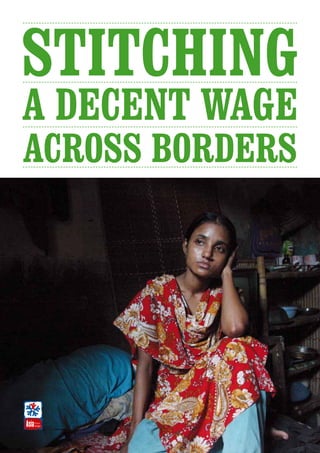
Photo front page: Garment worker Nurun Nahar, 21, is married but was left by her husband because
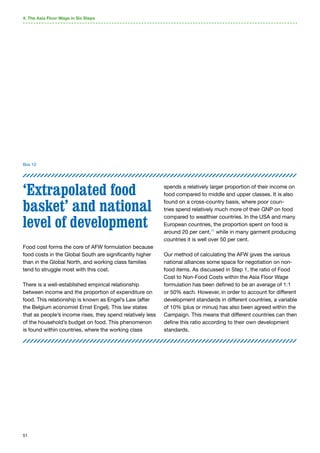
there was not enough money to pay for the dowry. Dhaka, Bangladesh, 31 August 2009.
© Taslima Akhter/ Clean Clothes Campaign.
3
Stitching a Decent Wage across
Borders: the Asia Floor Wage
Proposal 2009
Written by: Jeroen Merk of the
Clean Clothes Campaign on behalf
of the Asia Floor Wage Campaign.
We would especially like to thank
the following people for their
contributions on which this booklet
is based: Anannya Bhattacharjee,
Suvechha Adhikari, Marieke
Eyskoot, Dela Feby, Stephanie
Luce, Ashim Roy, William Stafford,
Kalani Subasinghe, Surya Tjandra,
Saleena P, May Wong, Irene Xavier,
and Ineke Zeldenrust.
Sincere thanks to all the above, and
anyone else whom we may have
inadvertently missed out.
Edited by: Celia Mather
Designed by: Saar Manders
© Asia Floor Wage campaign 2009
All rights reserved. This publication is
copyright, but may be reproduced by any
method without fee for advocacy,
campaigning and teaching purposes,
but not for resale.
Contact:
Asia Floor Wage Alliance
International Secretariat
c/o Society for Labour and
Development
C-23, 1st Floor (Back Side),
Hauz Khas
New Delhi-110016,
India
+91 11 2652 5806
asiafloorwage@gmail.com
the Asia Floor Wage Proposal
4
Contents
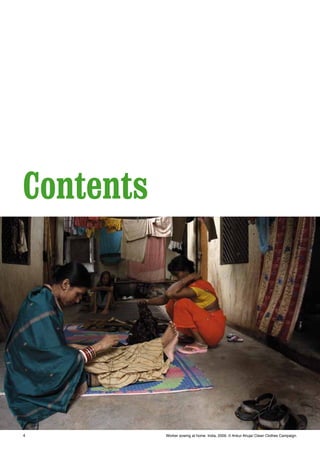
Worker sowing at home. India, 2009. © Ankur Ahuja/ Clean Clothes Campaign.
5
Introduction / summary 	
1. Poverty wages in the global garment industry	
	Legal minimum wages set too low
	 Barriers to collective bargaining	
	Gender impact on wages
	Inflation	
	 Wage defaulting	
	 Consequences of poverty wages	
	 Conclusion	
2. An unsustainable economic model	
	The threat of capital relocation	
	 Falling prices	
	 Declining terms of trade
	 A lack of global demand
	 Conclusion	
3. The Asia Floor Wage proposal	
	 A regional collective bargaining strategy	
	 A wage-led growth scenario	
	Towards a redistributive corporate accountability agenda	
	 Conclusion	
4. The Asia Floor Wage in Six Steps	
	Step 1. Define a formula for the Asia Floor Wage	
	Step 2. Calculate floor wage in local currencies	
	Step 3. Compare AFW figures across countries	
	Step 4. Decide on a level for the AFW	
	Step 5. Convert the AFW back into local currencies	
	Step 6. Campaign for the AFW to be implemented	
References
6
12
14
18
20
21
22
24
27
28
30
32
33
34
35
36
39
41
42
45
46
48
52
54
56
57
59
62
Contents
6
Introduction /
summary
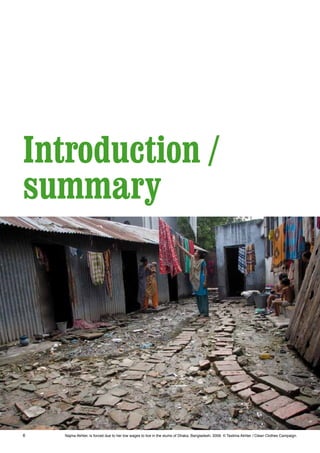
Najma Akhter, is forced due to her low wages to live in the slums of Dhaka. Bangladesh, 2009. © Taslima Akhter / Clean Clothes Campaign.
7
The garment industry around the
world is renowned for low wages,
excessive overtime and poor
working conditions. In many cases,
even the legal minimum wages set
for workers in the apparel industry
fail to provide enough income to
maintain a family of four above the
nationally defined poverty level.
The consequences of poverty
wages are most clearly seen in
excessive working hours and
disrupted family life. Poverty wages
push many workers into debt,
lead to malnutrition, cause health
problems, and make workers and
their dependents extremely
vulnerable to unemployment,
disability, and faster decline in
old age. What is more, growing
inequality within a country can
reduce social cohesion and result
in unrest.
Labour rights’ advocates have
always argued that a minimum
living wage is a cornerstone of
decent working conditions,
because sufficient wages are
essential to workers’ well-being.
Insufficient wages imply that
individuals, families and communi-
ties who depend upon wage labour
for their well-being cannot lead a
dignified life.1
This demand is in line
with the United Nations Universal
Declaration of Human Rights.
Article 23(3) states:
“Everyone who works
has the right to just and
favourable remuneration
ensuring for himself and
his family an existence
worthy of human dignity,
and supplemented,
if necessary, by other
means of social
protection.”
The International Labour Organisa-
tion (ILO), which is the United
Nations’ body that sets labour
standards, also endorses a living
wage standard. The Preamble to
the ILO Constitution notes that
peace and harmony in the world
require “the provision of an
adequate living wage”. The ILO
Constitution mentions the need
to develop:
“policies in regard to wages
and earnings, hours and
other conditions of work,
designed to ensure a
just share of the fruits
of progress to all and a
minimum living wage to
all employed and in need
of such protection.” 2
The reality of working conditions
in the garment industry is far re-
moved from the international goal
of ‘decent work’ for all women and
men in the world. ‘Decent work’ is
the phrase used by the ILO, and
it means the right of all to work in
conditions of freedom, equity,
security and human dignity.
In the global garment industry of
today, it is the brand-named com-
panies and giant retailers who wield
most power. They have profited
hugely from outsourcing production
to low-wage countries, capitalising
on poverty wages and benefiting
from weak enforcement of laws that
govern wages, working conditions,
and labour rights.
What is more, workers’ efforts to
increase their wages often lead
garment brands and retailers to
relocate production elsewhere.
so workers are often afraid to fight
for better wages for fear of losing
their jobs.
For these reasons, union leaders
and labour activists in Asia have
come together to explore a strategy
for workers in the global garment
industry. Asia is a major hub for
garment production in the global
economy, accounting for 60% of
global garment production, and
employing millions of workers
across the continent, most of
whom are women.
Introduction / summary
8
It accounts for the cost of a fair
amount of food per day, plus
other essential living costs such
as healthcare, housing, clothing,
childcare, transportation, fuel, edu-
cation, etc. By then expressing it in
a single convertible sum - what we
are calling ‘purchasing power parity
in US$’ or PPP$ for short – we can
achieve a wage demand that is
applicable in each country and
across borders.
At the Campaign’s third interna-
tional planning meeting in Hong
Kong in October 2008, we took
into account our countries’ different
economies, politics, and debates,
plus wage survey data collected
from various Asian countries, and
set the Asia Floor Wage for 2009
at 475 PPP$. 4
The Asia Floor Wage Alliance
brings together a wide range of
labour organisations from India,
Bangladesh, Cambodia, Indone-
sia, Sri Lanka, Thailand, China,
and Hong Kong. Also involved are
trade unions, labour NGOs, anti-
sweatshop movements, solidarity
groups, and scholars from Northern
countries in Europe and the United
States of America (see box 1).3
Together we have come up with a
way of establishing a floor on the
race to the bottom and preventing
wage competition between Asian
garment-exporting countries.
We are calling it the ‘Asia Floor
Wage Campaign’.
By uniting together and adopting
a common Asia-wide bargaining
strategy, garment workers and their
representatives and supporters in
Asia and the North can campaign
for improved pay and conditions
without the fear of causing job
losses. Instead of workers compet-
ing with each other, pressing wages
down even more, we have formulat-
ed a unified, regional demand, with
a global echo, for a wage which is
decent and fair.
The Asia Floor Wage (AFW) is a
demand for a minimum living wage,
but one that can be standardised
and compared between countries.
Chapter 4 gives the details of how
we arrive at our AFW: it is based
on the income required for a single
earner to support a family of four
(2 adults and 2 children) by working
a legal maximum working week (but
no longer than 48 hour), excluding
any payment for overtime or other
bonuses/allowances.
Introduction / summary
“The Asia Floor Wage is an industrial level collective bargaining
strategy, targeting the garment global supply chain and combating
the threat of relocation.”
Ashim Roy, Secretary General of the New Trade Union Initiative, India
9
Box 1
The Asia Floor Wage Alliance brings together a wide range of labour organisations in Asia and beyond.
Partners include:
Bangladesh: SBGKSF; NGWF; BIGUF; BCWS; Karmojibi Nari; Action Aid-Bangladesh; INCIDIN; Bangladesh
Institute for Development Studies; Bangladesh Institute for Labour Studies; Canada: Maquiladora Solidarity
Network; Europe: Clean Clothes Campaign; Action Aid UK; Hong Kong: HKCIC; Globalisation Monitor; Students
& Scholars Against Corporate Misbehaviour; India: All India Trade Union Congress; Hind Mazdoor Sabha;
Indian National Trade Union Congress; New Trade Union Initiative; Garment and Textile Workers Union; Garment
Workers’ Union; Mazdoor Ekta Manch; Cividep; Save; Fedina; Society for Labour & Development; Indonesia:
SPN; GSBI; Trade Union Rights Centre; Malaysia: TIE-Asia: Pakistan: All Pakistan Trade Union Federation;
Pakistan National Textile Leather Garments & General Workers Federation; PILER; Sri Lanka: ALaRM; JSS;
Dabindu Collective; Thailand: Committee on Asian Women; USA: United Food and Commercial Workers;
Teamsters; Workers United; Jobs with Justice; International Labor Rights Forum.
Introduction / summary
“The AFW is indeed a good initiative. It gives us opportunities
to negotiate wages with the manufacturer, as well as with
the brands.”
Joko Hariyono from the Indonesian trade union federation Serikat Pekerja Nasional
(SPN, National Industrial Workers’ Union)
10
We believe that a common wage
demand can bolster union organ-
ising, which in turn will help to
achieve other gains. An Asia Floor
Wage for the garment industry
will help us fight poverty, develop
economically with decent labour
standards, and improve the lives
of workers who are mostly women.
The AFW proposal can contribute
towards achieving a more sustain-
able global garment industry, and
be a concrete way of implementing
the ILO’s Decent Work Agenda.
The AFW Alliance will target major
retailers and global brands to sign
agreements committing them to
incorporate the Floor Wage formula
into their price negotiations with
suppliers. These companies control
the global garment production
chain and have the capacity to
deliver the Asia Floor Wage to
workers.
Meanwhile, Alliance members in
producer countries will apply pres-
sure on the major manufacturers
to ensure that price increases they
get from the brands and retailers
with whom they have contracts are
passed on to workers in the form of
higher wages.
We hope you will add your voice
and energy to this campaign for
decent wages in the garment
industry in Asia, as a contribution
towards combating poverty
and promoting sustainable
development everywhere.
www.asiafloorwage.org
Introduction / summary
“The AFW campaign should pressure global brands and retailers
to pay a fair price for the product and ensure that the workers’
right to trade unions is respected, which most codes of conduct
recognise as an important right anyway”
Shamima Nasrin,President of the Bangladeshi Shadhin Bangla Garments Sramik-Karamchari Federation (SBGSKF)
“Women workers in the garment industry make up almost
80 percent of the export manufacturing workforce in the
developing world. Yet they lack the ability to improve their
wages, working conditions or to bargain for more secure
jobs. A strategy like Asia Floor Wage will be a solution in
attenuating women’s unequal bargaining power, gender
wage gaps and in improving their well being”
Committee for Asian Women
11
Summary of each chapter
Chapter 1 outlines the key reasons
why poverty wages have come
to characterise the garment
industry in Asia:
> Governments fail to set a decent
minimum wage level;
 Low levels of unionisation make
it difficult to raise wages through
collective bargaining between
workers and employers;
 Widespread gender discrimina-
tion leads to the employment of
relatively more women at lower
wages than would be paid to
men for the same work;
 Legal minimum wages are not
regularly adjusted to reflect the
rising cost of living;
 Weak enforcement of minimum
wage and other labour regula-
tions gives employers more
opportunities to cheat workers
out of their legal rights.
Chapter 2 discusses why,
in a globalised industry like the
garment one, the existence of
poverty wages cannot be under-
stood without understanding the
role of the big garment brands and
retailers in orchestrating global
production and trade. On top of
that, deregulation, flexibilisation
and export-led policies have left
many workforces around the world
without protection, and widened
the gap between rich and poor,
both within countries and between
countries,5
resulting in a low road
path to economic development.
Chapter 3 outlines the proposals of
the Asia Floor Wage Alliance, aimed
at replacing this race to the bottom
with something that will lift the
position of all the workers of the
world at the same time.
We discuss how our proposal
would not only raise the wages
of workers at the bottom, but
strengthen workers’ bargaining
power throughout the international
supply chains of giant retailers and
brands and across borders, thereby
increasing all garment workers’
capacity to raise wage levels.
We outline the three strategic
pillars on which the AFW
campaign is based:
 Building a regional collective
bargaining strategy against
capital mobility;
 Promoting a wage-led growth
and economic development
scenario;
 Pushing for a redistributive
corporate accountability agenda.
Chapter 4 provides a detailed
discussion on how the AFW
Alliance defines and calculates
the Asia Floor Wage. As with any
other living wage definition,
we address: how to define
‘basic needs’, the number of
dependents to be covered, and the
length of the working day/week.
We then outline the six steps we
use to define a locally appropriate
living wage – one that is country
specific – as well as a common
Asian wage level – one that sets an
Asian floor to stop the ‘race to the
bottom’.
We discuss how the AFW can
be calculated in national terms
and how, by using the formula of
purchasing power parity in US$
(PPP$), wages can be compared
across nations. The chapter ends
with a number of strategic consid-
erations on how to implement the
AFW and briefly discusses the three
main campaign targets: brands and
retailers, large manufacturers, and
governments.
Introduction / summary
12
1.
Poverty wages
in the global
garment industry
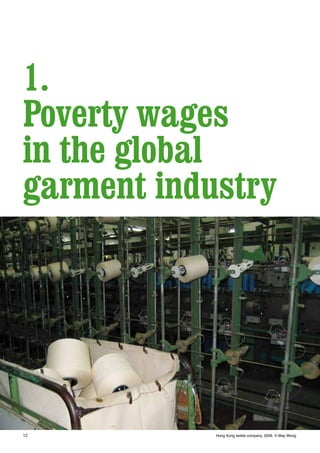
Hong Kong textile company, 2009. © May Wong.
13
Across Asia, wages of garment
workers are low because:
 Governments fail to
set a decent minimum
wage level;
 Low levels of unionisation
make it difficult to raise
wages through collective
bargaining between
workers and employers;
 Widespread gender
discrimination leads to
the employment of
relatively more women
at lower wages than
would be paid to men for
the same work;
 Legal minimum wages
are not regularly adjusted
to reflect the rising cost
of living;
 Weak enforcement of
minimum wage and
other labour regulations
gives employers more
opportunities to cheat
workers out of their
legal rights.
In a globalised industry, the
existence of poverty wages also
cannot be understood without
understanding the role of major
brands and retailers in orchestrating
global production and supply.
There is always the threat that they
will relocate when workers organise
to demand higher wages, which
keeps workers in fear of losing
their jobs. What is more, neo-liberal
inspired economic policies drive
wages down. These topics are
discussed more in chapter 2.
The reality of working conditions in the garment industry is far removed from the international goal
of ‘decent work’ for all women and men in the world. ‘Decent work’ is the phrase used by the International
Labour Organisation (ILO), and it means the right of all to work in conditions of freedom, equity, security and
human dignity. But the wages that garment workers receive today are almost never enough to guarantee a
decent and dignified existence for them and their families.
1. Poverty wages in the global garment industry
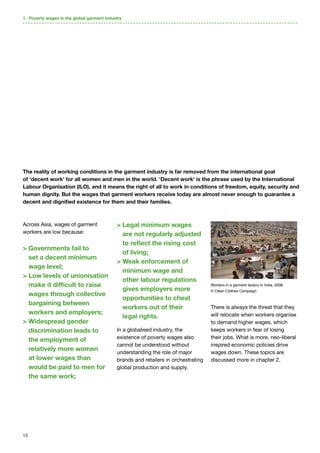
Workers in a garment factory in India, 2008.
© Clean Clothes Campaign.
14
The purpose of legal minimum
wages should be to provide social
protection to vulnerable and
unorganised categories of workers.
The International Labour Organisa-
tion (ILO), which is the United
Nations’ body that sets labour
standards, writes: “minimum
wage fixing should constitute one
element in a policy designed to
overcome poverty and to ensure
the needs of all workers and their
families”.6
These basic needs are typically
defined in terms of food, housing,
clothing, and public services, like
education, healthcare and transport
(see also chapter 4).7
While most
Asian governments set minimum
wages, these typically fail to
provide enough income to maintain
a family of four above the nationally
defined poverty level.8
In order
to attract investment, many
governments set legal minimum
wages below the subsistence level.
Minimum wages that meet a living
wage standard are seen as a
possible barrier to investment.
In some countries the legal
minimum wage even fails to meet
internationally-defined poverty
standards. In Bangladesh, the
monthly minimum wage of 1662
Taka (16.60 Euros or US$24.30) is
even less than the absolute poverty
level of US$1 a day. A Bangladeshi
worker says:
“The Government is
indifferent to our plight.
The low wages have been
the outcome of continuous
lobbying by the leaders of
trade bodies and business-
men-turned-politicians in
the corridors of power.
Taking 2007 as a base year,
it should be easily said,
without any dispute, that
prices of essentials have
risen by up to 50%.” 9
In countries like India, Sri Lanka,
Vietnam, Pakistan and Cambodia,
the minimum wage is below or
around the UN-defined poverty line
of US$2 a day. In China, Indonesia,
and Thailand wages are marginally
higher – US$2-4 a day – but the
cost of living in these countries is
higher.
Siagawati, a member of the Serikat
Pekerja Nasional (SPN, National
Industrial Workers’ Union),
Indonesia, says:
“All my basic living needs
are supposed to be solved
with what I earn. But
because my wages
are always not enough,
the only solution is to live
very economically.” 10
Poverty wages always have deep
individual/personal consequences,
as shown in Boxes 2, 3 and 4.
Legal minimum
wages set too low
1. Poverty wages in the global garment industry
15
Meet Krishanthi
from Sri Lanka 11
I’m Krishanthi. It’s been six years since I came to the
Katunayake Free Trade Zone in Sri Lanka, as I soon as
I finished my Ordinary Level examination. From the
day I came, I was doing night shifts, trying to earn the
maximum in order to give some economic stability
to my family.
At present my current basic salary is Rs.7,900
(49.15 Euros or 71,8 US$). However much I do
overtime, at the end of the month I get about
Rs.12.000 (74.66 Euros or 109 US$). I have never
earned any more than that.
I have to pay Rs.2.300 (14.31 Euros or 20.9 US$)
in rent. Rs.2.000 (12.44 Euros or 18.1 US$) for
groceries. Medicine each month costs about
Rs.300-400 (1.86–2.40 Euros or 2.7 -3.5 US$).
I don’t spend a lot on clothing, about Rs.300
(1.86 Euros or 2.7 US$). Since it’s a long distance,
I travel home only twice a year. I spend my free
time in my boarding room, and so I don’t spend
any money on entertainment. Education is only a
dream. I contribute to a lottery scheme (“seettu”),
and I save Rs.1.000 (6.22 Euros or 9 US$).
There is no possibility of consuming a nutritious
meal, to dress well and survive from this salary.
During these six years the only thing I have done
is send some money home. We work for about
12-14 hours a day. We work on Sundays and
holidays. Yet, we don’t get a wage that could fulfill
our basic needs.
We don’t earn a salary according to the sacrifices that
we make. I’m now very thin. Even when I suffer from a
small sickness I get really ill. I got married 2 years ago
but still haven’t had a baby. Many medical tests were
done, but in the end the doctors just told me to eat a
healthy meal and take rest. But in order to take rest, I
would have to resign from my job. Now, I cannot even
bear the sounds in the workplace; my head is also like
spinning mill.
At times like that I feel like going back home. Yet, I
don’t have the economic stability to face the future.
Note: about half of the output of the factory where Krishanthi
works is for Gap.
1. Poverty wages in the global garment industry
Box 2
Krishanthi gives a speech at youth camp. Sri-Lanka, 2009. © Dabindu Collective.
16
Meet Liuxia
from China
My name is Liuxia, and I am a
garment worker in the city of
Guangzhou, in Guangdong
province, China. I left Hubei
province to become a garment
worker at 17 years old after finish-
ing junior high school. Today, I
am 30 years old, married, and the
mother of a 9 year old son who
lives with my parents-in-law in
Hubei province.
In the factory where I have been
working for the past four years,
there are 1000 workers.
My basic working hours are 8am to
5pm (with a 1 hour break for lunch)
Monday to Saturday, for which I am
paid 30 Yuan (3.14 Euros or
4.5 US$) per day. But the factory
often demands overtime, and my
family needs more money, and so
I work overtime from 6pm to at
least 10pm, Monday to Saturday,
to earn 2.6 Yuan (0.27 Euros or 0.39
US$) per hour extra. Sometimes
I have to work on Sunday if the
factory has an urgent order.
On average, I earn about 1200 Yuan
(126.67 Euros or 185 US$) a month.
Even workers with over ten years’
experience get a similar amount.
We get unpaid annual holiday of
three weeks (including the three-
day Chinese New Year); there is
no paid sick leave, and no other
benefits. So, if I want to get my
‘full’ monthly wage, I can’t take any
kind of leave, even if I am sick.
Like many other workers, I have
constant back pain from the repeti-
tive work. Our employer provides
no medical support and we are
not covered by health insurance.
Everyone just has to get used to it.
I live together with my husband and
we pay 400 Yuan (41.89 Euros or
61.2 US$) a month to rent a small
apartment. We always eat at home,
spending 10 Yuan (1.04 Euros or
1.51 US$) on food a day. I always
try to buy food at discount prices.
We eat 0.5kg rice a day, which
costs 1.9 Yuan (0.19 Euros or 0.27
US$), and we can only afford the
cheapest fish. Sometimes on Sun-
day, I try to cook a little bit extra.
All my monthly salary goes to our
daily living costs. We use my
husband’s salary mainly to support
our son’s education and my
parents-in-law in Hubei province.
Note: This interview was done at 11pm after
Liuxia had finished her overtime.
Box 3
1. Poverty wages in the global garment industry
17
Meet Neelam
from India 12
I am Neelam. I am 40 years old
and I have worked in the garment
Industry for the last 14 years.
I came to the national capital Delhi
in 1994, from the Bhagalpur district
of Bihar state.
I am married, and I have four
daughters and one son.
My husband is security guard in a
private security company. We live
in a small room in Kapashera,
a neighbourhood of industrial
workers. Our family shares a toilet
and bathroom with 20 other
families.
I have worked in many factories
over these 14 years. I started out
as a thread cutter and that is what
I still do. I’ve never had any promo-
tion to a higher grade, even after
these long 14 years! After three
years working for sub-contractors,
I got a job with Modelama, where I
worked for 8 years. It is one of the
top exporters of garments, based in
Udyog Vihar, Gurgaon,
a well-known industrial centre in the
country. Modelama mainly supplies
to brands like GAP, Diesel, Next,
and Monsoon.
For the first three years, the factory
kept me as a casual worker, to
deny me the facilities I should be
getting. After that, they made me
permanent, and started taking
deductions from my wages for the
Provident Fund (PF). But it was only
with much difficulty that I could get
my PF account number. It was the
same with ESI (the social insurance
scheme).
Then, in 2005, I was illegally termi-
nated from the factory. They did
this to deny me the bonus to which
a worker is entitled when you have
worked five years continuously
in a factory. You are supposed to
be paid a bonus according to the
number of years you have worked
there. But companies often termi-
nate a worker a few months before
the five years are up, and then ask
the worker back after a week.
I wasn’t prepared to let manage-
ment get away with this. So I filed
a case with the Labour Conciliation
Officer. In fact, management never
showed up before the Officer,
and now the case is with the
Labour Court. I have been fighting
Modelama on this for the past
four years.
Now I am working in another small
factory in Udyog Vihar, still as a
thread cutter, on a contract basis.
I am earning just the minimum
wage set by the Haryana State
Government for ‘helpers’, which is
Rs.3840 (56.21 Euros or 82.1 US$))
per month.
After paying out Rs.1200 (17.56
Euros or 26.6 US$) in rent, it is
nearly impossible to manage
with this amount. I have to spend
Rs.4000-Rs.4500 (58.55–65.87
Euros or 85.5 - 96.1 US$) for food
each month, and spending on
health and the children’s education
comes to about another Rs.1200
(17.56 Euros or 26.6 US$).
Note: The minimum wage rate in Haryana
State came into effect from January 2009,
but Neelam’s factory only started paying
it from May. However, so far the workers
are too scared to demand the arrears due
to them.
Box 4
1. Poverty wages in the global garment industry
18
A second important reason for
poverty wages in the world’s cloth-
ing industry is the very low level of
unionisation and the near absence
of collective bargaining between
workers and employers. Freedom
of association and collective bar-
gaining are two of the fundamental
rights of all workers in the world, as
agreed within the ILO. They are of-
ten referred to as ‘enabling rights’.
This means that, when workers
have these rights respected, they
can use them to make sure that
other labour standards, including
a living wage, are upheld.
The best way to set wages would
be through collective bargaining
between workers and employers.
“The contribution of trade unions to
the reduction in wage inequality is a
well-established empirical finding”,
the ILO writes in its Global Wage
Report.13
In contrast, countries in
which collective bargaining is
not a significant tool for wage
determination – which is the case
in most developing countries –
the wage disparity increases,
including the gender pay gap.14
A World Bank study arrived at a
similar conclusion:
“Countries with highly-
coordinated collective bargaining
tend to be associated with lower
and less persistent unemploy-
ment, lower earnings inequality,
and fewer and shorter strikes
than uncoordinated ones. ” 15
However, few workplaces are
covered by collective bargaining
agreements. Even if unions are
present, they often lack the
bargaining power to negotiate
adequate wages and benefits.
As a result, statutory minimum
wages tend to act as a ceiling
rather than a floor for the majority of
workers. Garment workers usually
face many difficulties if they want
to join or form a trade union. Many
governments restrict, undermine,
obstruct, or even outlaw independ-
ent trade union and collective
bargaining rights.
Employers, for their part, often have
a hostile attitude towards trade
unions. Instead of seeing repre-
sentative trade unions as a useful
mechanism for negotiating so as
to keep their workforce happy and
productive, they frequently use a
range of tactics to prevent unions
from emerging, including intimida-
tion, discrimination, firing, blacklist-
ing, and even physical violence. As
a result, workers often fear joining
trade unions. A female worker from
Bangladesh comments:
“If they (management) see any
activities related to any union,
you can be sure that you would
be terminated within few days for
sure. They have their own
informer that’s why we do not
even discuss about this.” 17
Long working days leave little time
for union meetings. This is true
especially for women workers who
often have to take care of house-
hold responsibilities after returning
home from a day’s work. Migrant
(women) workers in particular face
restrictions and difficulties when
they seek to assemble.
In Thailand, registered migrants
theoretically have the same rights
as Thai nationals. In practice,
however, they are not permitted to
change jobs without their current
employer’s written permission. This
gives employers a lot of power to
impede migrant workers’ freedom
of association. Workers who dare
to protest are faced with being fired
by the employer and handed over
to the Immigration Department.18
Despite these barriers, workers do
try to organise, in numerous and
courageous ways, often involving
a long struggle. The International
1. Poverty wages in the global garment industry
Barriers to
collective
bargaining
19
Textile Garment Leather Workers
Federation (ITGLWF) has some 217
organisations from 110 countries
affiliated to it, and this is not the
sum total of all garment workers’
associations that exist around the
world. Where freedom of associa-
tion is restricted, workers often find
alternative forms of organisation to
protect their rights.
However, union power to win higher
wages through collective bargaining
with garment employers remains
very limited. With no or little collec-
tive bargaining, the statutory mini-
mum wage becomes the dominant
reference point for wage setting at
the factory level, though even this
as we will show, is often weakly
enforced.19
Because many employers operate
on very thin margins and they
themselves often lack the power to
negotiate a higher price from the
buyers, they argue that any wage
increase would be detrimental to
business and they may have to
close their business or move
production to anther region or
country. We return to these topics
in chapter 2.
Workers locked out
in India 20
I am 43 years old, and my name is Birendra, from the
Gorakhpur district in Uttar Pradesh, India. I have been
working in the garment industry since 1985. For a long
time I worked at a factory 21
that produces for inter-
national brands like Himalaya, Eisenhans (Germany),
Joma (Spain), and Ambas (Italy).
For years, the company violated the regulations on
provident payments and ESI, the social insurance
scheme, that give some protection to workers
(and their families) at times of sickness, maternity,
physical disablement, injury or death at work. Many
companies do this, and so workers started thinking
there is no way they can change these violations.
However, in September 2008, after several months
when our wages were not paid, we started protesting
and approached Mazdoor Ekta Manch, a local labour
platform of workers. We continued to work at the
factory, expecting to be paid soon, but we also filed a
complaint with the Labour Office about this non-
payment of wages. Eventually, after many protests,
we were paid what we were owed. Soon, however,
management retaliated by sacking me.
By then, however, we had gained some experience of
unionisation and this made fourteen other workers in
the factory protest against my illegal termination.
Then they too were locked out of the factory.
The lock-out case is still under consideration by the
Labour Court. Factory management tried many other
ways to shatter these workers’ struggle, such as filing
false police cases against them. But nothing yet has
discouraged them from fighting their case.
I am now working at a small garment factory, and
spending part of my time to unionise workers in
Gurgaon. I am now the President of a union here,
the Utpadan Kaamgaar Sangathan (Manufacturing
Workers’ Union). I still get threatening phone calls
from the side of management even now. But I am
determined to fight against exploitation of the
working class!
1. Poverty wages in the global garment industry
Box 5
“The time-honoured manner of improving pay and working conditions is through
collective bargaining between unions and employers. But collective bargaining
cannot take place in a void. The right to organise and to bargain collectively must
be respected but almost nowhere is that happening.” 16
The International Textile, Garment and Leather Workers Federation (ITGLWF).
Union leader gives speech, India, 2009.
© Ankur Ahuja / Clean Clothes Campaign.
20
Wages are low also because em-
ployers take advantage of cultural
stereotypes that depict women as
passive, flexible, and less likely
to challenge management. In an
industry that is dominated by
women workers, often over 80 per
cent of the workforce, this can have
a significant downward impact on
wage levels. This is no coincidence
but a result of gender discrimina-
tion prevalent in garment producing
countries, as in many other places.
There are a number of gender-relat-
ed factors that play a role in keep-
ing wages low.
First, women are typically paid less
than men because their income is
seen as complementary to those
of male breadwinners. In reality,
however, women workers often
represent the sole income provid-
ers for the household. This form of
inequality is most clearly observed
in the difference between men’s
wages and women’s wages, often
referred to as the “gender pay
gap”.22
Women are often paid less
than men in the clothing industry,
even if they do the same tasks.
One ILO study on gender wage
differentials in Bangladesh found
that women earn an average of
23.2 per cent less per hour
than men.23
In Cambodia, ”women’s incomes
may be up to 40 per cent lower
than those of men”.24
Second, gender discrimination
means that women workers – when
they do have a permanent work
contract - have fewer chances of
promotion.
Third, women workers are over-
represented in insecure jobs –
causal, seasonal, subcontracted,
and home-based. For employers,
women workers often represent
a ‘flexible’ layer and “serve as a
buffer to accommodate just-in-time
ordering, fluctuations in orders and
prices, and stiff competition among
suppliers”.25
During economic
downturns and recessions, women
workers are most likely to be the
first to lose their jobs.26
Finally, another but related reason
why wages are low is that without
a regular contract or any form of
job security it is far more difficult
for workers to participate in trade
union activities to promote wage
increases. And this is especially
true for women workers, where
cultural constraints can create
obstacles for women workers to be
active or have their voice heard in
trade unions, or to have the confi-
dence or opportunity to speak out
against (male-dominated) manage-
ment. Gender-based harassment in
factories is all too often an effective
tool to keep women workers afraid
and submissive.
1. Poverty wages in the global garment industry
Gender
impact on
wages
21
A fourth reason why minimum
wages are too low is because
authorities fail to adjust the wage
rate sufficiently to maintain the
workers’ purchasing power.
“The nominal minimum wage in
the context of increasing prices is,”
the ILO writes, “as important as
the setting of the initial rate for a
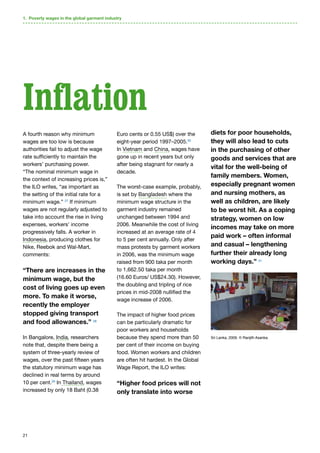
minimum wage.” 27
If minimum
wages are not regularly adjusted to
take into account the rise in living
expenses, workers’ income
progressively falls. A worker in
Indonesia, producing clothes for
Nike, Reebok and Wal-Mart,
comments:
“There are increases in the
minimum wage, but the
cost of living goes up even
more. To make it worse,
recently the employer
stopped giving transport
and food allowances.” 28
In Bangalore, India, researchers
note that, despite there being a
system of three-yearly review of
wages, over the past fifteen years
the statutory minimum wage has
declined in real terms by around
10 per cent.29
In Thailand, wages
increased by only 18 Baht (0.38
Euro cents or 0.55 US$) over the
eight-year period 1997–2005.30
In Vietnam and China, wages have
gone up in recent years but only
after being stagnant for nearly a
decade.
The worst-case example, probably,
is set by Bangladesh where the
minimum wage structure in the
garment industry remained
unchanged between 1994 and
2006. Meanwhile the cost of living
increased at an average rate of 4
to 5 per cent annually. Only after
mass protests by garment workers
in 2006, was the minimum wage
raised from 900 taka per month
to 1,662.50 taka per month
(16.60 Euros/ US$24.30). However,
the doubling and tripling of rice
prices in mid-2008 nullified the
wage increase of 2006.
The impact of higher food prices
can be particularly dramatic for
poor workers and households
because they spend more than 50
per cent of their income on buying
food. Women workers and children
are often hit hardest. In the Global
Wage Report, the ILO writes:
“Higher food prices will not
only translate into worse
diets for poor households,
they will also lead to cuts
in the purchasing of other
goods and services that are
vital for the well-being of
family members. Women,
especially pregnant women
and nursing mothers, as
well as children, are likely
to be worst hit. As a coping
strategy, women on low
incomes may take on more
paid work – often informal
and casual – lengthening
further their already long
working days.” 31
1. Poverty wages in the global garment industry
Inflation
Sri Lanka, 2009. © Ranjith Asanka.
22
Legal minimum wages already fail
to meet living wage standards. On
top of this, widespread disregard
for the wage regulations that
exist deprives workers of their legal
entitlements and further reduces
take-home pay. The ILO writes:
“Minimum wage policies,
to be useful, need to be well
enforced… Unfortunately,
in many countries, labour
inspection services are
understaffed and penalties
are too weak. As a result,
minimum wages too often
remain a ‘paper tiger’
rather than an effective
policy.” 32
The spread of informal and precari-
ous labour practices has deepened
these practices.
Sometimes, wage irregularities and
underpayment occur because the
employers are in financial difficulty.
This can be caused by global
buyers paying late or cancelling
orders. All too often, though, it is
simply fraudulent, manipulative or
criminal conduct on the part of
the employers.33
Wage defaulting has many faces:
workers are being cheated on their
minimum wages; tricked on over-
time pay; denied benefits like travel
and food allowances; dismissed
because the employer refuses to
respect legal rights to maternity
leave; or robbed of severance
payments when plants shut down
(see Box 6 and 7).
A lack of clear information about
their wages makes it difficult for
many workers to raise formal
complaints. Employers some-
times fabricate fake pay slips
and timesheets to mislead labour
inspectors or social auditors
sent in by global buyers.34
Box 6
Wage defaulting in China
a chronic problem
In China, the Guangzhou Municipal Labour and Social Security Bureau
handled a total of 36,408 complaints of non-payment of wages in the
first nine months of 2005.35
These are only the cases in which a formal
complaint was issued, and the total number is likely to be many times
higher. Jingyi Ye, a Chinese professor from the Law School of Peking
University, comments: “Underpaying or not paying is the most obvious
way of abuse. It is among the most common labour abuses, affecting
many millions of workers.” 36
Factory management in China often uses delayed payment as a means
of holding on to workers who might otherwise walk away from the factory
floor. If a worker decides to leave, the employer keeps her wage.37
Chinese
government officials warn that the “chronic problem of wage defaulting
encroaches upon the property rights of rural labourers and is prone to
triggering desperate actions and social unrest”.38
1. Poverty wages in the global garment industry
Wage
defaulting
23
Box 7
Wage fraud in
Indonesia 39
Researchers in Indonesia found that export-oriented
manufacturers increasingly use a so-called ‘all-in’
wage, also known as ‘upah mati’ which literally means
‘dead wage’. This wage includes everything: benefits,
bonusses, and overtime (regardless of the hours
worked). Normally the calculation of this ‘all-in’ wage
is higher than the monthly average wage, but so is the
burden of work carried out.
One company that uses this ‘all-in’ wage system is
Manufacturer X40
located in Gunung Putri, Bogor, about
60 km east of the capital city Jakarta. The company
produces bras and panties for global buyers like JC
Penny, VS Mast, and Wal-Mart. It is a large company,
with 3000 employees, of whom 1200 are permanent
and 1800 are contract workers.
This factory uses the all-in wage particularly for
contract workers in ‘non-skilled’ production. On their
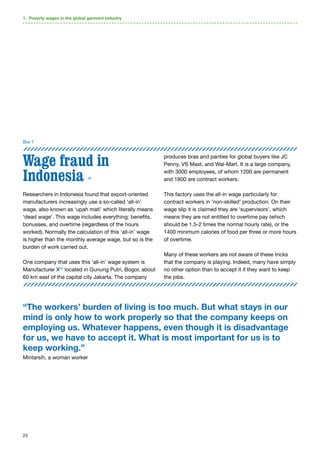
wage slip it is claimed they are ‘supervisors’, which
means they are not entitled to overtime pay (which
should be 1.5-2 times the normal hourly rate), or the
1400 minimum calories of food per three or more hours
of overtime.
Many of these workers are not aware of these tricks
that the company is playing. Indeed, many have simply
no other option than to accept it if they want to keep
the jobs.
1. Poverty wages in the global garment industry
“The workers’ burden of living is too much. But what stays in our
mind is only how to work properly so that the company keeps on
employing us. Whatever happens, even though it is disadvantage
for us, we have to accept it. What is most important for us is to
keep working.”
Mintarsih, a woman worker
24
Long working days
Employers try to extend the
working days as long as possible:
many employees report a work-
ing day of 12 or 14 hours. Some
manufacturers even try to make
two working days out of one, for
example by making workers do
back-to-back shifts.
While much excessive overtime is
often forced upon workers, it is also
linked to poverty wages. Workers
often have no choice but to endure
long working hours because the
basic rate of pay within a normal
working day of eight hours is
insufficient to meet their basic
needs and to sustain a family.
Workers accept overtime work as
it is the only way to survive.
But long working hours leave no
time for education, for household
activities, for raising children,
for play or other social activities.
Excessive overtime has a nega-
tive impact on health as it reduces
the time available for sleep and
deprives workers of fresh air and
sunlight. So it prevents them from
recovering after their working day.
Long working hours also affect
job satisfaction, and increase the
effects of stress-related problems
as well as mental health problems.
Years of working in hot and crowd-
ed rooms with poor ventilation and
lighting; exposed to dust and toxic
chemicals, overwork, and poor
ergonomics inevitably take their toll
in the form of “eye strain, fatigue
and debilitating overuse injuries”.42
Workers who can no longer keep
up the pace, or are forced to leave
due to work-related accidents and
diseases, all too often find them-
selves without health insurance,
compensation or sick pay.
1. Poverty wages in the global garment industry
Current wages in the garment industry fail to provide
for an income that would allow a household a
comfortable and decent standard of living.
The consequences of poverty wages are most clearly
seen in excessive working hours and disrupted family
life. But poverty wages also push many workers into
debt, lead to malnutrition, cause health problems and
make workers and dependents extremely vulnerable to
unemployment, disability, and faster decline in old age.
Furthermore, growing inequality within a country can
reduce social cohesion and result in unrest.
Consequences of
poverty wages
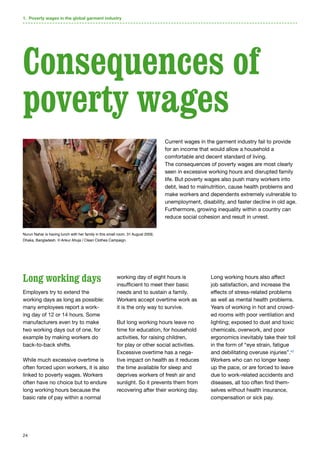
Nurun Nahar is having lunch with her family in this small room. 31 August 2009,
Dhaka, Bangladesh. © Ankur Ahuja / Clean Clothes Campaign.
25
Forced
overtime in
Bangladesh
In 2009, a research on twelve
garment factories in Bangladesh
producing for Dutch brands found
forced overtime work a common
characteristic. After interviewing
292 workers, of whom 209 were
women, the researcher writes43
:
“On an average of 76.4% work-
ers said that they were given a
production target which compels
them to work for extra period.
Forced overtime and excessive
production targets constitute
the major hurdles for the female
workers to go back to home
before dinner. A majority of the
workers leave between 8pm
-10pm. Setting excessive targets
has been commonly reported by
all the workers. […]
The production target is set so
high that they are forced to work
overtime. Pertinent to mention
that calculation of overtime starts
only after the fixed production
target is met. Engagement of the
workers with overtime works
reduces their time for child
bearing and household chores.
However, after reaching home
around 10pm workers start
cooking and taking care of
their children.”
1. Poverty wages in the global garment industry
Box 8
“We work until 2 or 3am during the peak season. We always have
to work a double shift. Although we are very exhausted,
we have no choice. We cannot refuse overtime work, because
our standard wages are so low.” 41
A Thai woman worker
Nurun Nahar is preparing to go to work. Dhaka, Bangladesh, 2009.
© Taslima Akhter / Clean Clothes Campaign.
26
Disrupted family life
Excessive hours interfere with
family life.44
Women workers often
struggle to combine long working
days with household responsibili-
ties and looking after their families.
As one researcher states:
“Juggling time and money to
ensure the well-being of families,
especially where there are children,
is physically and emotionally
stressful. The breaking point is
reached when due to the physical
demand on their bodies they get
sick and are fired”.45
This results in
dysfunctional family life.
In other cases, children are sent
to relatives far away, and are only
seen a few times a year. Or children
are taken out of school because
the parents cannot pay school fees,
because the children need to work
to contribute to the family income,
or they are needed to take care of
younger siblings.
“I leave home at six in the morning and come back home at nine
in the evening. I leave when my daughter is still in her dreams and
come back home to see her gone to sleep again. She sees my face
only one day of the week.” 46
Amanthi, a women worker from Sri Lanka who sews clothes for Tesco
1. Poverty wages in the global garment industry
27
Garment production is an important
industry for most Asian countries.
However, legal minimum wages
in many countries fail to meet even
government set poverty bench-
marks. And, when governments
then also fail to adjust these
minimum wages to account for
inflation, this further depresses
their purchasing power.
Then there is the question how well
governments implement their own
minimum wage regulations. Where,
as is often the case, they are only
weakly enforced, this gives
employers the opportunity to
defraud workers out of the wages
they should be getting. This is
very common – one could say
systematic – across Asia.
At the same, workers face many
hurdles when they seek to organise
trade unions and enter into collec-
tive bargaining with their employ-
ers. The very low level of unionisa-
tion and consequent absence of
any form of collective bargaining
are important reasons why the
statutory minimum wage has
become the sole norm for wage
setting. Meanwhile, on-going
gender discrimination also keeps
wages low.
No government should accept a
minimum wage policy that results
in unacceptable poverty. However,
local economic and political fac-
tors only provide a partial picture of
why wages are low. In a globalised
industry, the excesses of capitalism
are increasingly difficult to tackle
at a national level. The next chap-
ter turns to questions of the global
nature of garment production and
its impact on wage levels.
Conclusion
1. Poverty wages in the global garment industry
28
2.
An unsustainable
economic model
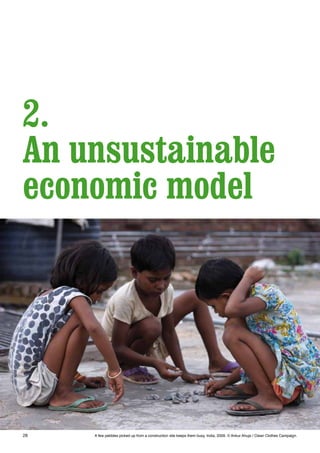
A few pebbles picked up from a construction site keeps them busy, India, 2009. © Ankur Ahuja / Clean Clothes Campaign.
29
Governments should play a crucial role in addressing poverty wages
by adopting minimum wage policies. So too should trade unions
through collective bargaining. But, in a globalised industry like the
garment one, it is increasingly difficult for trade unions to
achieve wage increases.
Global buyers, large transnational corporations mostly from Europe
and the US, dominate the global garment supply chain and make it
increasingly difficult to achieve wage increases at a national level.
Four trends in particular play an important role:
the threat of capital relocation
falling prices
declining terms of trade
a lack of global demand
2. An unsustainable economic model
30
As already discussed, garment
workers usually face many difficul-
ties if they want to join or form a
trade union. Many governments
restrict, undermine, obstruct,
or even outlaw independent trade
union and collective bargaining
rights. But when workers do
succeed in setting up a trade union
and seek collective bargaining,
they then often face another hurdle:
the threat of plant closure and
capital flight. The persistent threat
of relocation has become a power-
ful tool to prevent workers from
organising unions and demanding
decent wages.
It is not only workers who are afraid
that insisting on higher wages will
result in factory closures. Govern-
ments too fear that wage increases
or stronger labour laws will result
in global buyers pulling out of the
country, taking thousands of jobs
with them. So, statutory minimum
wages that would meet living wage
standards are perceived as a
possible barrier to attracting orders
from global buyers.47
As a result,
governments seek to lure business
by offering tax reductions, exemp-
tions from national labour laws,
or freezes in the legal minimum
wage. The enormous growth in
export processing zones since
the 1960s is testimony to this
policy.
This process, decried by critics
as the ‘race to the bottom’, is
exploited by global buyers who
proceed to pick and choose among
countries to find the most
‘favourable’ location.48
In this way, global buyers directly
and indirectly spur competition
among producing countries to
attract trade and investment by
means of violating labour and
social protection standards.
Indeed, any government consider-
ing raising legal minimum wage
levels can expect to receive a
warning from business associations
about how this would undermine
the ‘business climate’ or that the
country risks ‘pricing itself out
of the market’.
In 2008, a session of the
regional Wage Council in
Central Java, Indonesia,
received ‘a special visit’
from a representative of
Korean investors in the
area. The representative
explained that they did not
wish to see a big increase
in the minimum wage
levels of the region; other-
wise they would close down
and move elsewhere.49
The threat of
capital relocation
2. An unsustainable economic model
31
The impact
of the Giant
Retailers 50
Playing an increasingly important
role in the global garment industry
are the giant retailers of the world –
also referred to as supermarkets or
big box retailers. Many will recog-
nise their names, notably Wal-Mart,
Tesco, Carrefour, Lidl, and Aldi.
They are known for their low prices,
large shares of the retail market,
and the huge volumes in which they
sell products.
In the UK, more than quarter of all
clothing is bought from chain stores
that also sell groceries. The French
supermarket chain Carrefour is
Europe’s fourth-largest clothing
retailer. US-based Wal-Mart, the
world’s largest company, is visited
every week by 175 million people;
the company accounts for one-third
of all US retail apparel sales.
Thirty-nine retailers are found
among the world’s 500 largest cor-
porations. Their combined revenues
totaled US$1.7 trillion in 2006, with
Wal-Mart topping the list at US$351
billion – fully a fifth of the total for
the top thirty-nine corporations.
This huge concentration of eco-
nomic power impacts negatively on
working conditions and wages.
The giant retailers’ requirements
on cost and lead time make it
impossible for suppliers to pay a
living wage, send their workers
home at 5 pm, and still turn a profit.
The giant retailers have a reputation
among suppliers for pushing harder
on price than other buyers because
low costs are fundamental to their
business models. Because they
compete on price, selling with low
profit margins, the pressure to cut
costs is huge, and is passed on to
suppliers.
These retailers all have huge market
shares and exercise enormous
buying power – they are truly giants
in the field of retail. Although they
sell many different products from a
range of sectors, they have pro-
found and ever-increasing power in
the garment retail market.
In 2009, the Clean Clothes
Campaign in Europe started a
Better Bargain campaign that
focuses on the policies and
practices of the giant retailers.
Consumers should be able to
do their shopping in stores where
they can be sure that every effort
is being made to ensure that no
human rights have been violated in
the production of their clothing.
Better Bargain campaign:
www.cleanclothes.org/campaigns
2. An unsustainable economic model
Box 9
32
A second problem is that in the
major consuming countries in
Europe and the US, the retail price
of garments has been falling for
some twenty years now. Consum-
ers have become used to paying
unrealistically little for their clothing.
Nearly all companies aiming to sell
to ordinary consumers are now in
a highly competitive market that
is driven by the cut-rate strategies
of some powerful global buyers.
The enormous size and reach of
these retailers gives them tremen-
dous purchasing power over their
suppliers, and they use this power
to source their goods at very low
prices.
This in turn lets them drive down
prices in the shops – offering jeans
for just US$4, – in order to win a
greater market share from their
competitors. Their competitors
are then forced to pursue a similar
low-cost strategy – or get out of
the business. Suppliers too have to
accept lower prices if they are to
survive. The world’s largest multi-
product retailer, Wal-Mart, plays a
particularly important role because
its strategy is based on ‘always low
pricing’.
Their enormous size affords these
retailers a tremendous amount of
purchasing power over suppliers
which they apply toward low-cost
sourcing. We can summarise this
dynamic as the survival of the
cheapest.
It is not something restricted to the
big ‘prizefighters’; it is the global
trend for the majority of retail. The
large buyers from Europe and USA
are consequently able to dictate
trade terms, and ensure that
purchase prices for garments from
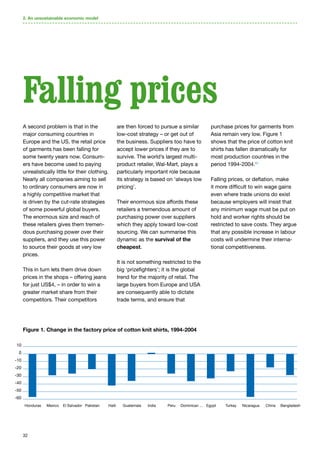
Asia remain very low. Figure 1
shows that the price of cotton knit
shirts has fallen dramatically for
most production countries in the
period 1994-2004.51
Falling prices, or deflation, make
it more difficult to win wage gains
even where trade unions do exist
because employers will insist that
any minimum wage must be put on
hold and worker rights should be
restricted to save costs. They argue
that any possible increase in labour
costs will undermine their interna-
tional competitiveness.
2. An unsustainable economic model
Falling prices
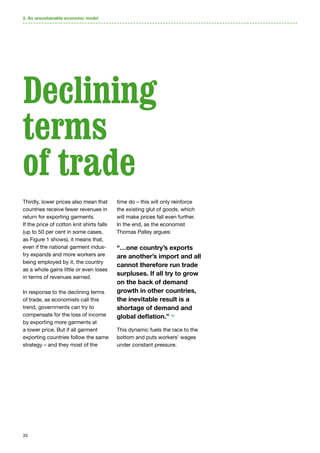
Figure 1. Change in the factory price of cotton knit shirts, 1994-2004
Honduras Mexico El Salvador Pakistan Haiti Guatemala India Peru Dominican ... Egypt Turkey Nicaragua China Bangladesh
10
0
-10
-20
-30
-40
-50
-60
33
Thirdly, lower prices also mean that
countries receive fewer revenues in
return for exporting garments.
If the price of cotton knit shirts falls
(up to 50 per cent in some cases,
as Figure 1 shows), it means that,
even if the national garment indus-
try expands and more workers are
being employed by it, the country
as a whole gains little or even loses
in terms of revenues earned.
In response to the declining terms
of trade, as economists call this
trend, governments can try to
compensate for the loss of income
by exporting more garments at
a lower price. But if all garment
exporting countries follow the same
strategy – and they most of the
time do – this will only reinforce
the existing glut of goods, which
will make prices fall even further.
In the end, as the economist
Thomas Palley argues:
“…one country’s exports
are another’s import and all
cannot therefore run trade
surpluses. If all try to grow
on the back of demand
growth in other countries,
the inevitable result is a
shortage of demand and
global deflation.” 52
This dynamic fuels the race to the
bottom and puts workers’ wages
under constant pressure.
2. An unsustainable economic model
Declining
terms
of trade
34
2. An unsustainable economic model
The underlying problem is that
the global garment industry can-
not sustain itself indefinitely on the
demand for garments by Northern
consumers. It creates a system in
which more and more goods are
being produced by Southern work-
ers who cannot themselves afford
to buy them.53
As Mala, a worker in
Bangladesh, recognises:
“We make clothes for
others. We don’t have
the ability to buy clothes.
Our (extended) families
living in the village wait
for our money.
We are in distress.
The market price is so
high that we cannot afford
even rice and pulses.” 54
Millions of impoverished workers –
and not just in garments – lack the
means to purchase the things they
produce. More products are being
produced, but too few people can
afford to buy them simply because
their wages are too low. A system-
atic shortage of effective demand
for consumer goods explains why
the price of garments has been
declining so dramatically over the
past twenty years.
A lack of
global
demand
35
2. An unsustainable economic model
The export-led growth model
traps Southern garment workers
in precarious, unsafe, and poorly
paid jobs. It has created a low road
path of economic development
that delivers few developmental
benefits. It has turned poverty
wages into a persistent, or even
systemic, characteristic of the
garment industry.55
Global buyers are not lifting
workers out of poverty; instead
they are cashing in on it.56
Governments must take up their
responsibility to ensure that work
takes place in conditions of
freedom, equity, security and
human dignity. But, while crucially
important, national legislation alone
won’t be enough to counter this
‘race to the bottom’ dynamic,
where one country’s workers
are pitted against another’s as cor-
porations try to wring higher
and higher profits.
The way that the global garment
industry is organised doesn’t raise
the standard of living of developing
countries; it keeps workers impov-
erished. The economic model itself
is flawed as it is based on a funda-
mental contradiction of exporting
more garments to already oversup-
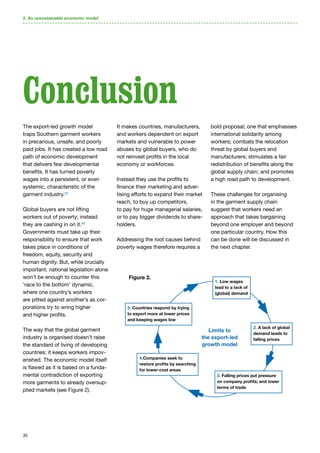
plied markets (see Figure 2).
It makes countries, manufacturers,
and workers dependent on export
markets and vulnerable to power
abuses by global buyers, who do
not reinvest profits in the local
economy or workforces.
Instead they use the profits to
finance their marketing and adver-
tising efforts to expand their market
reach, to buy up competitors,
to pay for huge managerial salaries,
or to pay bigger dividends to share-
holders.
Addressing the root causes behind
poverty wages therefore requires a
bold proposal; one that emphasises
international solidarity among
workers; combats the relocation
threat by global buyers and
manufacturers; stimulates a fair
redistribution of benefits along the
global supply chain; and promotes
a high road path to development.
These challenges for organising
in the garment supply chain
suggest that workers need an
approach that takes bargaining
beyond one employer and beyond
one particular country. How this
can be done will be discussed in
the next chapter.
Conclusion
1. Low wages
lead to a lack of
(global) demand
2. A lack of global
demand leads to
falling prices
3. Falling prices put pressure
on company profits; and lower
terms of trade
4.Companies seek to
restore profits by searching
for lower-cost areas
5. Countries respond by trying
to export more at lower prices
and keeping wages low
Limits to
the export-led
growth model
Figure 2.
36
3.
The Asia Floor
Wage proposal
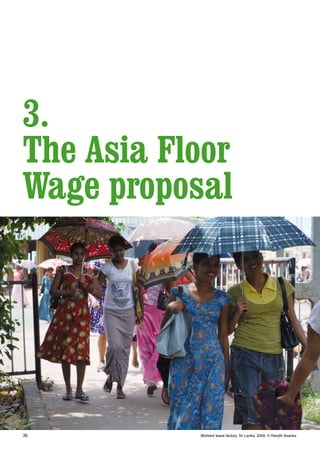
Workers leave factory. Sri Lanka, 2009. © Ranjith Asanka.
37
So far we have seen that wages
are failing to meet living wage
standards. We have also seen
that the current economic model
gives much power to global
buyers but fails to distribute the
benefits of global production in
a fair way. This model makes
workers anywhere vulnerable to
capital relocation, concession-
ary bargaining, and a progressive
ratcheting down of labour con-
ditions and wages. Yet workers
everywhere need a living wage.
Rather than continuing this race
to the bottom dynamic, where one
country’s workers are pitted against
another, we – the Asia Floor Wage
(AFW) Alliance – instead propose
something that will lift all the work-
ers of the world at the same time.
We argue that a minimum living
wage – in combination with better
working conditions – for garment
workers is not only ethically the
right course of action (see Box 10);
it would also be economically the
right one.57
A higher wage for garment workers
would help to redistribute the ben-
efits of global production, stimulate
local as well as global demand for
garments, and encourage a more
sustainable production process.
This would help fight poverty,
stimulate economic development
with decent labour standards, and
improve the lives of millions of
garment workers and their families.
Instead of competing against each
other to drive wages further down,
we have formulated a unified,
regional demand, with a global
echo, for a wage which is decent
and fair. The AFW is different in
each country, but has the power
to buy the same set of goods and
services in all countries. In chapter
4, we detail the six steps by which
we define and calculate this
common wage figure.
In this chapter, we outline the
three strategic pillars on which the
campaign is based:
 building a regional
collective bargaining
strategy against capital
mobility;
 promoting a wage-led
growth and economic
development scenario;
 pushing for a redistri-
butive corporate
accountability agenda.
3. The Asia Floor Wage proposal
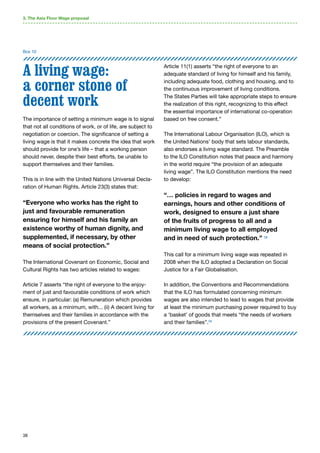
Demonstration for a decent wage in Jakarta, 2006.
Indonesia. © TURC.
38
A living wage:
a corner stone of
decent work
The importance of setting a minimum wage is to signal
that not all conditions of work, or of life, are subject to
negotiation or coercion. The significance of setting a
living wage is that it makes concrete the idea that work
should provide for one’s life – that a working person
should never, despite their best efforts, be unable to
support themselves and their families.
This is in line with the United Nations Universal Decla-
ration of Human Rights. Article 23(3) states that:
“Everyone who works has the right to
just and favourable remuneration
ensuring for himself and his family an
existence worthy of human dignity, and
supplemented, if necessary, by other
means of social protection.”
The International Covenant on Economic, Social and
Cultural Rights has two articles related to wages:
Article 7 asserts “the right of everyone to the enjoy-
ment of just and favourable conditions of work which
ensure, in particular: (a) Remuneration which provides
all workers, as a minimum, with... (ii) A decent living for
themselves and their families in accordance with the
provisions of the present Covenant.”
Article 11(1) asserts “the right of everyone to an
adequate standard of living for himself and his family,
including adequate food, clothing and housing, and to
the continuous improvement of living conditions.
The States Parties will take appropriate steps to ensure
the realization of this right, recognizing to this effect
the essential importance of international co-operation
based on free consent.”
The International Labour Organisation (ILO), which is
the United Nations’ body that sets labour standards,
also endorses a living wage standard. The Preamble
to the ILO Constitution notes that peace and harmony
in the world require “the provision of an adequate
living wage”. The ILO Constitution mentions the need
to develop:
“… policies in regard to wages and
earnings, hours and other conditions of
work, designed to ensure a just share
of the fruits of progress to all and a
minimum living wage to all employed
and in need of such protection.” 58
This call for a minimum living wage was repeated in
2008 when the ILO adopted a Declaration on Social
Justice for a Fair Globalisation.
In addition, the Conventions and Recommendations
that the ILO has formulated concerning minimum
wages are also intended to lead to wages that provide
at least the minimum purchasing power required to buy
a ‘basket’ of goods that meets “the needs of workers
and their families”.59
Box 10
3. The Asia Floor Wage proposal
39
The Asian Floor Wage (AFW)
campaign proposes a regional
collective bargaining strategy in
an industry dominated by global
buyers. This is necessary to
counter the threat of capital
mobility. The basic idea is to
prevent competition based on wage
levels between Asian garment ex-
porters and to make sure that gains
are shared along the supply chain.
The campaign unites workers and
their allies from different Asian
countries on a common wage
issue. The goal is to win Asia Floor
Wage through negotiations
between garment industry employ-
ers and workers’ representative
organisations, with the mediation
and support of governments,
inter-governmental organisations
and social movement organisations.
Ashim Roy, Secretary General of
the Indian-based New Trade Union
Initiative, puts it as follows:
“The Asia Floor Wage is an indus-
trial level collective bargaining
strategy, targeting the garment
global supply chain and combat-
ing the relocation threat.”
The National Worker Congress from
Sri-Lanka states that they
“… believe that the Asia
Floor Wage Campaign is
an innovative regional
initiative for higher wages
in a global industry.”
At a wage workshop in Indonesia,
a worker expresses the hope
“that there is a support
from the Indonesian
Government for the AFW,
so that our wages in
Indonesia become the
same as other workers
in Asia.” 60
A regional strategy makes sense
because garment production in
Asia already accounts for the
majority of the total global trade of
readymade garments. Not only
do Asian workers constitute the
majority of the world’s garment
workers; their wages are at the
bottom of the global manufacturing
workforce. This provides ground
for a collective strategy across Asia.
But a higher wage floor in Asia
would also benefit workers else-
where, in Central America, Africa
or Eastern Europe, as it reduces
global competition on wage.
Finally, the AFW Alliance brings
together allies in the Global North
to work strategically and collabora-
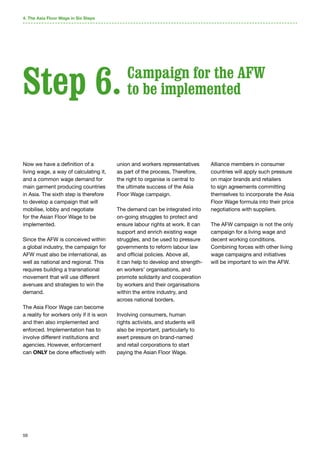
tively with allies in the Global South
on a historic initiative led by labour
organisations in Asia.61
This broad
coalition of unions, labour NGOs,
women’s organisations, consumer
organisations, and students will
exert pressure on the different
points in the global supply chain
– including the home ground of
multinationals – to implement
the AFW and to influence govern-
ments to regulate transnational
corporations.
A regional collective
bargaining
strategy
3. The Asia Floor Wage proposal
40
Tier1 Manufacturers
The AFW campaign will especially focus on the large
Tier1 manufacturers. These are large producers who
have direct supply relations with major brands and
retailers. They are themselves sometimes transnational
corporations and often directly employ thousands of
workers in different countries. They also play a key
role in distributing work to smaller production units,
to labour contractors (Tier2) and to little-known
subcontracted factories and workshops (Tier3),
which in turn often subcontract out to hard-to-track
home-based workers (Tier4).
Tier1 firms combine design, fabrication, as well as
delivery to the sales point; they are the ones that hold
together the supply chains for brands like Nike, Gap
or HM, and retailers like Wal-Mart, Tesco,
or Carrefour with whom they have built close
relations. What is more, their own large-scale
production makes it expensive for Tier1
companies to close down and relocate when
confronted with a union organising drive.
The growing interconnection and more stable
relationships between giant retailers/brands and
Tier1 companies provide us with an opportunity
to increase accountability in the global supply chain.
Tier1 companies are vulnerable to pressure from
their buyers on labour standards, and we can and
should use this to support union organisation and
collective bargaining in these factories.62
3. The Asia Floor Wage proposal
Box 11
Figure 3. The Global Supply Chain
Global Buyer
Tier 2, 3 and 4 small factories and home workers
India
Tier 1 Tier 1 Tier 1 Tier 1 Tier 1 Tier 1 Tier 1
Indonesia Sri Lanka China Thailand
41
A living wage is a goal in itself
because workers have a moral right
to decent life which allows them to
meet their basic needs and improve
their standards of living. A living
wage is also a means to wider
economic and social development.
Poverty wages mean that too many
workers lack the financial means
to buy the commodities they need.
The export-driven model is built on
the idea that demand for consumer
goods comes from elsewhere,
mostly established consumer
markets in the North.
What is more, the unequal distribu-
tion of gains from global production
is now understood by many as
a key factor behind the current
financial and economic crisis.63
Therefore, one response to the
crisis is through measures that
ensure a more balanced distribution
of the gains from economic growth.
Increasing wages for the millions
of garment workers in Asia would
be a start.
The introduction of a floor wage
would boost global demand and
hence help “to speed the world out
of recession”, as George Wehrfritz
argues in Newsweek.64
Others have
pointed out that governments in
developing countries should
stimulate household consump-
tion to compensate for the loss in
external demand as a result of the
economic crisis.65
The introduction of a floor wage
would pave the way for a better
and more sustainable pattern of
development. It would make local
economies less vulnerable to exter-
nal economic shocks – like a fall in
demand elsewhere – and stimulate
local economic activity. As Oxfam
formulates it in Trading Away
Our Rights:
“When women [and men
workers] are better paid
and protected in their jobs,
they can invest in their
families, sending their
children to school rather
than into the factory or
fields to work. It helps to
build a more productive
and skilled workforce –
and that does attract
investors. All this could help
to stimulate domestic and
regional sources of
consumer demand. In other
words, shared prosperity
is good for investment –
poverty is not.” 66
Finally, a wage-led growth strat-
egy, or ‘trickle up’ strategy, would
help to stimulate an upgrading of
the production process. Instead
of competing purely on low-cost
wages, the incentive for companies
would be to compete in areas other
than substandard wages and poor
working conditions. This would
open up avenues to improving
productivity and creating a more
skilled and empowered workforce.67
3. The Asia Floor Wage proposal
A wage-led
growth scenario
42
The AFW proposal is part of a
redistributive corporate account-
ability agenda. We have discussed
how, in a globalised industry like
the garments one, wage increases
are increasingly difficult to achieve
within a national context. For this
reason, global buyers, in collabora-
tion with factory management or
national governments, must play
a role in working to improve the
wages of the workers that make
their merchandise.
As leading companies in complex
global supply chains, brands and
retailers exercise a lot of influ-
ence over the way that production
is organised. They set prices and
determine how production takes
place. As long as these global
buyers refuse to absorb the cost of
increased wages by paying higher
prices to their suppliers, it will be
very difficult to improve wages.
A living wage is a corner stone of
decent working conditions. A living
wage must be an inherent and in-
extricable core element of any truly
sustainable corporate accountabil-
ity framework. So, even if a com-
pany behaves in an environmentally
responsible manner or takes steps
to ensure that worker rights are
respected in certain areas, for ex-
ample by promoting strong health
and safety procedures, this is not
enough to claim responsible corpo-
rate behaviour.
“A factory may be clean,
well organised and moni-
tored, but unless the work-
ers are paid a living wage,
it is still a sweatshop.” 68
The bottom line is fairly simple:
insufficient wages mean that work-
ers, families and communities who
depend upon wage labour for their
well-being cannot lead a dignified
life. Hence, the living wage issue is
a crucial test for global buyers to
effect improvements in the working
conditions throughout their garment
production chains.69
Exposed to public criticism of
poor working conditions, most
global buyers have responded by
adopting codes of conduct. These
codes state minimum standards
on worker rights. But while among
large brands and retailers there is
a growing consensus to support
minimum standards on ‘decent
work’ as set by the ILO, the idea of
a ‘living wage’ remains one of the
main stumbling blocks between
3. The Asia Floor Wage proposal
Towards a
redistributive
corporate
accountability
agenda
43
them and labour rights advocates.
As Peter Utting of UNRISD
(the United Nations Research Insti-
tute for Social Development) puts it:
“(P)erhaps the weakest
aspect of both CSR [Cor-
porate Social Responsibil-
ity] discourse and practice
relates to redistribution”. 70
Most global buyers reject calls for
a ‘living wage’ standard and insist
instead that wages set at the legal
minimum wage level are accept-
able. Most company codes commit
to paying either the minimum wage
or the prevailing industry wage,
not a living wage. A standard
formulation goes like this:
Employers shall pay employees,
as a floor, at least the minimum
wage required by local law or the
prevailing industry wage, whichever
is higher, and shall provide legally
mandated benefits.
This is simply not good enough.
Legal minimum wages typically
fail in their objective of protecting
workers and their dependents in
low-pay occupations (see chapter
1). The same counts for prevailing
wages which, in the garment
industry, can be higher than the
legal minimum level but typically
still fall short of a living wage.
Such standards in company codes
are basically saying that suppli-
ers should abide by the local law
- which they should anyway – but
they fail to recognise that minimum
wages still leave workers and their
families in poverty.
A much smaller group of global
buyers has subscribed to a living
wage standard. Most are compa-
nies that have joined a multi-stake-
holder initiative. For example, the
members of the UK-based Ethical
Trading Initiative (ETI), which in-
clude Tesco, Asda, Gap, and Marks
and Spencer, have signed up to the
following in the ETI Base Code:
“Wages and benefits paid for a
standard working week meet, at a
minimum, national legal standards
or industry benchmark standards,
whichever is higher. In any event
wages should always be enough to
meet basic needs and to provide
some discretionary income.” 71
3. The Asia Floor Wage proposal
Factory in the Philippines. © Clean Clothes Campaign.
44
3. The Asia Floor Wage proposal
While adopting a living wage
provision is an important first step,
progress in terms of actually
implementing a living wage in
supplier factories lags well behind
the rhetoric. A comprehensive
study commissioned by the ETI
on whether workers were actually
benefiting from codes of conduct
looked at the impact of eleven
ETI companies, and arrived at a
sobering conclusion:
“In general codes had had
almost no impact in terms
of ensuring workers receive
a living wage, although at
nine of the 25 sites they
had encouraged payment
of at least the national
minimum wage for certain
workers.” 72
“What is clear is that codes
have not led to a substan-
tial increase in income,
especially in terms of guar-
anteeing a living wage.” 73
Almost two decades of debate on
living wage standards in codes of
conduct have had little practical
result. In the absence of a yard-
stick for a living wage, most global
buyers have taken legal minimum
wages as the only benchmark for
monitoring pay levels at their
suppliers. Some global buyers have
argued that wages should be set
by local market forces or by collec-
tive bargaining. As we have seen
both methods are failing precisely
because of the threat of relocation,
unstable buyer-supplier relations,
and the many barriers that
workers face when they seek to
organise. This is precisely why
the AFW Alliance is proposing a
process of regional bargaining to
complement local strategies to
gain wage increases.
Others say that a living wage is
difficult to define and calculate.
As we show in the next chapter,
the AFW has developed a clear
definition and methodology that
operationalises a minimum living
wage demand.
Shamima Nasrin, President of the Bangladeshi Shadhin Bangla Garments
Sramik-Karamchari Federation (SBGSKF) states:
“The AFW campaign will pressure global
brands and retailers to pay a fair price for
the product and ensure that the workers’
right to trade unions is respected, which
most codes of conduct recognize as an
important right anyway”
Box 11
45
3. The Asia Floor Wage proposal
A common wage demand prevents
divide-and-rule strategies from
the side of business. It requires
a collaborative approach from
manufacturers, global buyers, and
governments that would allow a
wage increase across Asia without
the danger of driving producers out
of business. While collective bar-
gaining would be the best route to
establish a decent wage level, the
nature of the global supply chain is
a barrier to both organising and
effective negotiation. This indicates
a growing need to construct an
additional approach towards
achieving a living wage.
The proposal for an AFW defines
and calculates a living wage for a
range of Asian countries. It also
puts workers and their organisa-
tions in the vanguard of a global
movement to demand better wages
and working conditions. An Asia
Floor Wage will raise the wages
of workers at the bottom, but also
increase workers’ bargaining
power throughout the chain,
allowing them to exercise that
power and raise wage levels.
It will reduce the power of
retailers to pit workers against
one another across countries.
And the campaigns required to
establish the AFW will stimulate
workers to strengthen cross-
border alliances against common
employers, such as large retailers
like Wal-Mart that employ tens of
thousands of workers around
the world.
Conclusion
Worker ironing fabric in large factory in India,
August 2008. © Clean Clothes Campaign.
46
4.
The Asia Floor
Wage in Six Steps
For those who can afford it: evening tuition on the terrace, India, 2009. © Ankur Ahuja / Clean Clothes Campaign.
47
In the previous chapter, we
argued that an Asia Floor Wage
would be both ethically and
economically the right course of
action. Also by proposing and
campaigning for a minimum
living wage, expressed as a
common sum in purchasing pow-
er parity (PPP), for garment work-
ers across the Asian garment
producing countries, we address
the issue of capital relocation.
Step 1 discusses how the AFW is defined
Step 2 shows how to calculate the AFW in local currencies
Step 3 shows how to compare these calculations across countries
Step 4 discusses how to decide on a level for the AFW
Step 5 shows how to convert the AFW back into local currencies
Step 6 briefly discusses the strategy for the AFW campaign
4. The Asia Floor Wage in Six Steps
For 2009, the Asia Floor Wage
Campaign agreed a PPP of 475$.
So far we have not discussed how
we arrived at such a wage figure,
what definition and methodology
lie beneath it, how we have
calculated it at both a country level
and on an international level.
In this chapter, we outline step-
by-step how the Asia Floor Wage
(AFW) is formulated:
48
The first step is to develop and adopt a definition of an Asian Floor
Wage (AFW) based on a concept of a ‘living wage’ (LW). Like any other
LW definition, this requires addressing the following questions:
 How to define ‘basic needs’
 The number of dependents to be covered, and
 The length of the working day/week involved.
How to define ‘basic needs’?
What amount of food, non-food items, and discretionary income
is ‘adequate’? The AFW distinguishes between food costs (FC) and
non-food costs (NFC).
Food Costs
Food items to include in a ‘food
basket’ of course vary according to
the usual diet of each community.
Common items in Asia include rice,
wheat, pulses, meat, fish, milk,
vegetables, water and fruit.
What all food items have in com-
mon is that they can be measured
in calories. This means that differ-
ent food baskets can be represent-
ed by their calorific content (e.g. a
meal of 700 calories).
So, instead of defining the various
types and quantities of food items
that are to comprise the food
basket, the AFW Alliance proposes
a basket of items representing a
particular nutritional threshold – and
one that is based on a ‘normal’
working class diet, i.e. food items
bought in street markets or local
shops and prepared at home.
Step 1.
4. The Asia Floor Wage in Six Steps
Define a formula for
the Asia Floor Wage
Workers at a local food store, Delhi, India, 2009.
© Ankur Ahuja / Clean Clothes Campaign.
49
Some garment producing countries
do already use nutritional thresh-
olds to define their legal minimum
wages:
Bangladesh has set its standard
very low at 1700 calories, even
though this is insufficient to pro-
duce the human energy needed
for the hard work carried out in
garment production. Indonesia
has set – with the support of the
ILO – the highest standard at
3000 calories.
The AFW Alliance has agreed to a
figure of 3000 calories for the level
of basic food required on a daily
basis.74
Adopting such a nutritional
threshold means that local groups
can then define how their own
basket is filled. It is a variable food
basket that takes into account dif-
ferences in local food habits.
This enables us to sidestep an
important difficulty associated with
other Living Wage calculations –
how to agree on the specific items
and quantities to go in the food
basket needed for a living wage.
At the same time, this nutritional
threshold can be standardised
across countries, and this is impor-
tant for reaching a common Asian
Floor Wage figure.
Non-Food Costs
Besides food items, a living wage
should also cover important
non-food items such as housing,
clothing, healthcare including
maternity care, childcare,
education, fuel, transportation,
savings, and so on.
Like the food-basket, the bundle
of non-food commodities varies
across space and time. How much
of the wage is spent on clothing,
fuel and housing may differ
according to the climate, or to
the amount of non-wage subsidies
provided by the State – on fuel or
housing, for example. It also varies
according to the habits and culture
of the working class in each
location, for instance relating to
activities such as births, weddings,
and funerals. So it is difficult to
come up with a universal basket
of non-food goods and services to
cover the needs of garment work-
ers in different countries.
But here too, we find a commonal-
ity: how much a worker spends
on non-food items can actually
be estimated as a certain
percentage of how much is spent
on food items.
Garment workers from Indonesia,
India, Bangladesh and elsewhere
spend a great deal – often around
half – of their income just on food
items.75
In India the Ministry for Labour 
Employment found that workers
spend at average 47.8 per cent of
their income on food items.
In Thailand, food consumption
is assumed to account for 60%
of total consumption at poverty
lines.76
This means that non-food costs
can be estimated by multiplying
food costs by a non-food
“multiplier”. No price surveys
are needed to account for
expenditure on health, housing,
education, transport, savings,
and so on.
Instead, the food consumption
standard of 3000 calories can be
multiplied by a factor representing
the extent to which food is related
to overall living costs. In principle,
the ratio between the cost of food
and of other basic needs is 1:1.
This method is known as the
‘extrapolated food basket
approach’ (see Box 12).
4. The Asia Floor Wage in Six Steps
50
How many
dependents to
include?
Should the AFW be calculated for the needs of just one
worker or for his/her family too?
Living wage definitions normally include the notion that
wages should support more people than just the indi-
vidual worker. Minimum wage regulations, by contrast,
often do not. The AFW Campaign has decided that a
wage should cover three ‘consumption units’ - that is
two adults and two children. As a child consumes less
than an adult, each is calculated as half an (adult) con-
sumption unit. Thus, the ratio of earner to dependents
is set at 1:3.
The length of the
working day/week
How many hours does a worker have to work in
order to earn a living wage? This question is crucially
important for garment workers because the industry is
notorious for long working weeks of even 70-80 hours,
with devastating consequences for workers’ health
and family lives.
Excessive overtime is done not only because of
pressure from employers. Workers often need to do it
because they cannot meet their families’ basic needs
out of the wages they get from regular hours of work.
This means that the struggle for a living wage cannot
be separated from the struggle to limit the length of
the working day. Therefore, the AFW must be earned
during each country’s legal maximum working week,
though not above 48 hours, in line with ILO standards.
Summary: Basis for
the Asia Floor Wage
 The cost of food is based on a standard
calorific intake - 3000 calories per (adult)
consumption unit.
 The ratio between the cost of food
and of other basic needs - such as
clothing, housing and utilities, healthcare
(including reproductive care), social
security, education, and savings - is 1:1.
 The wage should provide enough for a
standard family of 2 adults and 2 children
= 3 consumption units.
 The wage is earned during each
country’s legal maximum working week,
though not above 48 hours.
4. The Asia Floor Wage in Six Steps
51
‘Extrapolated food
basket’ and national
level of development
Food cost forms the core of AFW formulation because
food costs in the Global South are significantly higher
than in the Global North, and working class families
tend to struggle most with this cost.
There is a well-established empirical relationship
between income and the proportion of expenditure on
food. This relationship is known as Engel’s Law (after
the Belgium economist Ernst Engel). This law states
that as people’s income rises, they spend relatively less
of the household’s budget on food. This phenomenon
is found within countries, where the working class
spends a relatively larger proportion of their income on
food compared to middle and upper classes. It is also
found on a cross-country basis, where poor coun-
tries spend relatively much more of their GNP on food
compared to wealthier countries. In the USA and many
European countries, the proportion spent on food is
around 20 per cent,77
while in many garment producing
countries it is well over 50 per cent.
Our method of calculating the AFW gives the various
national alliances some space for negotiation on non-
food items. As discussed in Step 1, the ratio of Food
Cost to Non-Food Costs within the Asia Floor Wage
formulation has been defined to be an average of 1:1
or 50% each. However, in order to account for different
development standards in different countries, a variable
of 10% (plus or minus) has also been agreed within the
Campaign. This means that different countries can then
define this ratio according to their own development
standards.
4. The Asia Floor Wage in Six Steps
Box 12
52
Now that we have defined the vari-
ous components on which an AFW
should be based, we can use this
definition to calculate floor wage
levels for garment workers in dif-
ferent countries. This goes in four
steps:
1. Collect information on a daily
food basket of 3000 calories,
in each country. This should be
based on reasonable and aver-
age market costs. For example:
In Bangladesh, the women’s
rights organization Karmojibi
Nari took eleven main items that
workers consume daily. In May
2008, this basket cost an indi-
vidual worker 52.50 taka.
2. Multiply this by three ‘con-
sumption units’ (see Step 1).
In the Bangladeshi example, this
would be 52.50 x 3 = 1575 taka.
3.Multiply this by 30 days to
arrive at a monthly cost.
In the Bangladeshi example, this
would be 1575 x 30 = 4725 taka.
4. Finally, double it to cover
non-food costs.
In Bangladesh, this gives a floor
wage of 4725 x 2 = 9450 taka.
Similar calculations in other Asian
garment producing countries give
the following national wage figures:
India: 7695 rupees
Indonesia: 2335200 rupiah
Sri Lanka: 15000 rupees
Now we can compare the differ-
ence between the legal minimum
wage and the floor wage in each
local currency (see Table 1).
Table 1. Legal minimum wages compared to AFW calculations
(2008, in local currencies)
	 Currency	 Legal minimum	 Minimum wage based 	
		 wage	 on the AFW definition
Bangladesh 	 Taka	 1662.50 	 9450
China	 Yuan	 687 	 1158
India	 Rupee	 4238 	 7695
Indonesia	 Rupiah	 972604 	 2335200
Sri Lanka	 Rupee	 6750 	 15000
Thailand	 Bath	 4368 	 7566.75
4. The Asia Floor Wage in Six Steps
Step 2. Calculate the floor wage
in local currencies
53
Time and place
Food prices are always related to a particular time and place. As most
people will have experienced, over time the price of food tends to go up.
It is therefore necessary to repeat this calculation annually to account for
inflation. Food prices can also vary significantly between different places
within a country at the same moment.
In Indonesia, a food basket of 3000 calories costs more in Jakarta than in
Central Java – both important garment producing regions.
Regional differences need not be a problem, however. An AFW can be as
easily calculated for different regions within a country as it can for different
countries.
4. The Asia Floor Wage in Six Steps
Worker at a food market in Delhi, India, 2009.
© Ankur Ahuja / Clean Clothes Campaign.
Food market Indonesia, Jakarta, Indonesia, 2009.
© ITUC.
54
4. The Asia Floor Wage in Six Steps
Now we have defined the AFW, and
collected information on the cor-
responding wage levels in several
Asian countries. Since our aim is to
formulate an Asia Floor Wage de-
mand that will buy a similar basket
of goods and services across Asian
countries, we need to find a credi-
ble way to compare the results from
the different country surveys. It is,
after all, on the basis of this com-
parison that an Asia Floor Wage
can be formulated.
Since wage surveys take place in
local currencies, we need to ad-
dress two main problems:
Fluctuating
exchange rates
We can only compare the different
Asian wage levels by converting
them into another currency, such as
the Euro or the US dollar.
For example, the Bangladeshi floor
wage of 9450 taka converts into
108 Euros or 140.4 US$ (exchange
rate March 2009), while 7695 Indian
rupees could be converted into 117
Euros or 152.1 US$.
The problem is that, for various rea-
sons, the exchange rate between
currencies can strongly fluctuate in
a short period of time. This move-
ment in exchange rates could have
a distorting impact on our aim of
setting an Asia Floor Wage. Another
problem is that currencies can be
overvalued or undervalued. This
makes it difficult to use exchange
rates between countries as a way
of comparing wage levels.
Different price
levels
Between countries, the price levels
of goods and services vary. Each
currency has a unique purchasing
power. For example:
52 taka buys a Bangladeshi worker
a 3000 calorie meal on a street
market (see Step 2). But when you
convert this amount into Euros –
giving 59 cents – it is obvious that
this would fail to buy a 3000 calorie
meal in any European market.
Although the difference in price
levels between Asian countries is
generally much smaller, here too
the amount of commodities that
different currencies buy can vary
significantly.
Purchasing Power
Parity (PPP)
A meaningful comparison of the
national wage surveys must there-
fore take into account the different
costs of living and, thus, equalise
the spending power of different
currencies.
A possible solution to these prob-
lems comes from the notion of
‘purchasing power parity’ (PPP).
This is defined as:
“the number of currency units
required to purchase the amount of
goods and services equivalent to
what can be bought with one unit
of the currency of the base country,
for example the US dollar.” 79
In other words, PPP can be used
to calculate how much money is
needed by a person outside the
USA to buy the same basket of
goods that a person in the USA
can buy.
Step 3. Compare AFW figures
across countries
55
4. The Asia Floor Wage in Six Steps
Table 2 shows that 1 US dollar has
a similar buying power to 22.64
taka or 3.45 yuan, for example.
Table 2. PPP$ conversion factor
Country	 PPP factor (2005)
Bangladesh	 22.64
China	 3.45
India	 14.67
Indonesia	 3934
Sri Lanka	 35.17
Thailand	 15.93
Table 3 also shows what happens
when we convert the national wage
based on the AFW definition into
US dollars, and how much this
would be in PPP$. For example:
In India, US$160.98 buys a basket
of goods worth US$524.2.
It is on the basis of the second PPP
figure (the final column of Table 3)
that a common Asia Floor Wage is
to be formulated.
Table 3. Steps 2 and 3: Calculate and compare AFW wage levels between different countries
	 Step 2 calculate AFW in local currencies	 Step 3 Compare wage figures
	 Food basket for	 3 consumption	 Food cost +	 Converted	 Food cost +
	 3000 calories	 units/ month	 non-food cost	 into US$*	 non-food cost
	 (one adult)		 (50% each)		 in PPP$
				
Bangladesh	 1575	 4725	 9450	 137.2	 417.4
China	 193	 579	 1158	 169.6	 584.7
Indonesia	 389200	 1167600	 2335200	 235.3	 593.6
India	 1282,50	 3847,50	 7695	 158.7	 524.2
Sri Lanka	 2500	 7500	 15000	 130.7	 426.5
Thailand	 1250	 3750	 7500	 220.3	 470.8
*Conversion rate at October 8, 2009.
56
Now we have defined a floor wage
formula – one that is based on a
living wage concept – and calculat-
ed how much the monetary value is
in local currencies, plus discussed
ways to compare these values
between different Asian countries.
The next step is to establish a
common Asia wage figure, based
on PPP$, which can be used in
campaigning, lobbying and
negotiation.
We start with comparing the infor-
mation gathered in Step 3. If the
calculation takes place on the basis
of a living wage formula (see Step
1), one always ends up with a range
of national wage figures. Here we
found a range of monetary values
ranging from 417.4 PPP$ in Bang-
ladesh to 593.6 PPP$ in Indonesia
(see final column in Table 3).
This means that a single wage
figure necessarily falls within a
spectrum of ideal wage demands in
the different countries. There is no
magic spell with which to decide on
a figure from this range to take as
the Asia Floor Wage. This can only
be decided through a political
process of deliberation, discussion
and consensus-building between
the different national alliances.
If the AFW Campaign decides on
a wage level at the lower end, for
example 425 PPP$, then organisa-
tions from a number of countries
may consider it too low to count as
a living wage. By contrast, opting
for an AFW at the higher end, for
example 575 PPP$, may mean that
some trade unions will consider it
too high to use in real negotiations
with employers or government
officials.
It is important to remember, how-
ever, that any wage figure within
this band does represent a major
step forward when compared to the
legal minimum or prevailing wages
in any of the participating countries.
AFW for 2009 = 475 PPP$
At the third international planning
meeting in Hong Kong, the AFW
Steering Committee decided to
set the Asia Floor Wage for 2009
at 475 PPP$. 80
The participants
discussed this in depth, to reflect
their countries’ different economies
and politics, the debates already
held on the AFW proposal within
their countries, and wage survey
data collected from various Asian
countries.
This process of setting a common
pan-Asian wage demand needs to
be repeated annually in order to
adjust for inflation.
4. The Asia Floor Wage in Six Steps
Step 4. Decide on a level
for the AFW
57
Step 5 is simple one: to convert
the common Asia wage figure of
475 PPP$ (for 2009) back into
national wage figures. For example
(see Table 4):
In Bangladesh, the AFW of 475
PPP$ represents 10754 taka
(475 x 22.64)
In India, it represents a monetary
value of 6968.25 rupees
(475 x 14.67)
Now we have formulated both a
regional (Asian) and differentiated
(national) wage demands.
The local wage figure provides a
clear benchmark, one that is based
on the provision of a living wage
to workers. It can be used to
compare with minimum,
prevailing, negotiated and
best-practice wages,
as well as other possible ‘living
wage’ calculations.
For example, the proposed 475
PPP$ is actually higher than recent
living wage proposals in Bangla-
desh, Indonesia, Sri-Lanka and
India.
In 2006, the Bangladeshi Institute
for Labour Studies calculated a
living wage of 4800 taka.
In Sri-Lanka, a survey in 2005
conducted by ALaRM found that
the minimum monthly salary of a
garment worker in the Free Trade
Zones should actually be 12,504
rupees to have a decent life.
The study found that a worker
outside the zone required a
salary of 10,183 rupees. Note
that an AFW of 475 PPP$ would
represent 16,705 rupees.
The Indonesian newspaper
“Investor Daily” of 26 December
2005 quoted a number of investiga-
tions according to which a living
wage should be raised to the level
of Rp. 1,400,000 million.
In India, labour rights organisations
in Bangalore estimated that a
minimum living wage for a family of
4.4 should be at least 4364 rupees.
The differences found can be used
in negotiations with local employers
and the governments, to reinforce
demands for a realistic minimum
wage. The discrepancy between
what is being paid to workers
and what actually is a living wage
can also be used in campaigns
to bring more pressure on global
brands and retailers about their
responsibility for decent wages.
4. The Asia Floor Wage in Six Steps
Step 5. Convert the AFW back
into local currencies
Table 4. AFW at 475 PPP$ converted into local currencies
Country	 AFW (2009)	 PPP$	 AFW in
		 conversion	 local currencies
Bangladesh 	 475 PPP$ 	 x 22.64 =	 10754 taka
Cambodia	 475 PPP$	 x 1279 =	 607525 riel
China 	 475 PPP$	 x 3.45 =	 1638.75 yuan
India 	 475 PPP$	 x 14.67 =	 6968,25 rupees
Indonesia 	 475 PPP$	 x 3934 =	 1868650 rupiah
Sri Lanka 	 475 PPP$	 x 35.17 =	 16705.75 rupees
Thailand 	 475 PPP$	 x 15.93 =	 7566.75 baht
58
What about
other regions
and industries?
Garment production is obviously not limited to Asian
countries. In many African, Central American, Middle
Eastern, and Eastern European countries, wages are
appallingly low. Garment workers here face problems
similar to those of workers in Asia: wages that fail to
meet basic needs, employers who disrespect trade
union rights, unhealthy working conditions, and women
workers who suffer the most. What is more, they are
often producing for the same brands and retailers.
The concept of the Asia Floor Wage campaign is repli-
cable in these other regions. Workers there are encour-
aged to put their heads together to define, propose,
and campaign for a regional floor wage based upon
living wage standards.
Of course, the idea can also be endorsed by work-
ers outside the garment industry. Together, this might,
eventually, help to build strategies for wage bargaining
at an industrial level on a global scale.
4. The Asia Floor Wage in Six Steps
Box 13
59
4. The Asia Floor Wage in Six Steps
Now we have a definition of a
living wage, a way of calculating it,
and a common wage demand for
main garment producing countries
in Asia. The sixth step is therefore
to develop a campaign that will
mobilise, lobby and negotiate
for the Asian Floor Wage to be
implemented.
Since the AFW is conceived within
a global industry, the campaign for
AFW must also be international, as
well as national and regional. This
requires building a transnational
movement that will use different
avenues and strategies to win the
demand.
The Asia Floor Wage can become
a reality for workers only if it is won
and then also implemented and
enforced. Implementation has to
involve different institutions and
agencies. However, enforcement
can ONLY be done effectively with
union and workers representatives
as part of the process, Therefore,
the right to organise is central to
the ultimate success of the Asia
Floor Wage campaign.
The demand can be integrated into
on-going struggles to protect and
ensure labour rights at work. It can
support and enrich existing wage
struggles, and be used to pressure
governments to reform labour law
and official policies. Above all,
it can help to develop and strength-
en workers’ organisations, and
promote solidarity and cooperation
by workers and their organisations
within the entire industry, and
across national borders.
Involving consumers, human
rights activists, and students will
also be important, particularly to
exert pressure on brand-named
and retail corporations to start
paying the Asian Floor Wage.
Alliance members in consumer
countries will apply such pressure
on major brands and retailers
to sign agreements committing
themselves to incorporate the Asia
Floor Wage formula into their price
negotiations with suppliers.
The AFW campaign is not the only
campaign for a living wage and
decent working conditions.
Combining forces with other living
wage campaigns and initiatives
will be important to win the AFW.
Step 6. Campaign for the AFW
to be implemented
60
Pressuring brands
and retailers
It is crucial that the entire industry
plays a role in raising labour stand-
ards across the board, in particular
the brands and retailers that play
such a dominant role in global
garment production chains.
Therefore, global brands and retail-
ers should come under pressure
to factor the AFW into their price
negotiations with manufacturers.
This is linked to the issue of fair
pricing by sourcing companies.
Since wages represent only a small
percentage of the retail price
– normally 0.5 - 1.5 per cent –
the AFW Alliance believes that the
supply chain has the capacity to
absorb such wage increases
without too much difficulty.
The AFW alliance will campaign
brands and retailers to sign a
wage agreement. Brands and
retailers will be asked to enter
into dialogue with local alliance
partners to discuss concrete steps
towards implementing the AFW.
The Alliance will also ask brands
and retailer to commit themselves
to buying from unionised factories.
Pressuring Tier1
manufacturers
As we have seen (box 11), large
manufacturers, or Tier1 companies,
have emerged that often employ
thousands of workers and have
direct supply relations with major
brands and retailers, often playing
a key role to integrate the supply
chain on their behalf.
These companies have made large
investments not only in factories,
warehouses and dormitories,
but also in acquiring specific
knowledge on the recruitment of
labour, and in establishing relations
with local authorities.
Because of their close (direct)
relations with branded companies
and retailers, Tier 1 companies are
more vulnerable to pressure on
labour standards from those buyers
on labour standards, and this can
further aid the process of collec-
tivisation and union organisation in
these factories.
Alliance members in producer
countries will apply pressure on the
major ‘Tier1’ supplier companies to
ensure price increases are passed
on to workers in the form of
higher wages.
Lobbying
governments
Governments should ensure that
minimum wages are set at a level
that provides for a living wage, and
also regularly reviewed to account
for inflation. Governments have a
duty too to ensure that minimum
wage and other labour legislation is
implemented so that companies do
not cheat workers out of their legal
entitlements, which only contrib-
utes to the international race to the
bottom. Currently, however, many
governments deliberately continue
to keep wages low in order to
attract business, failing in their duty
to foster sustainable development.
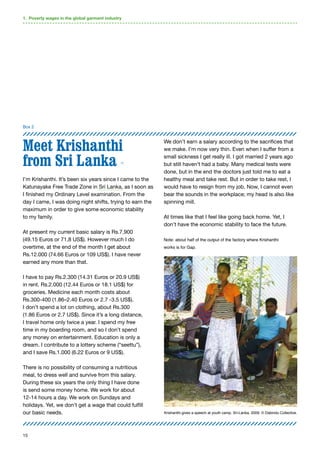
The campaign will lobby govern-
ments to enact legislation that
gives AFW legal backing, and then
that any such legislation is actually
implemented.
4. The Asia Floor Wage in Six Steps
Campaign Targets
61
4. The Asia Floor Wage in Six Steps
Step 1
Define the AFW
Step 4
Decide on an Asia Floor Wage
for the region: 475 PPP$ (2009)
Step 5
Convert the AFW
back into local
currencies
Step 6
Global campaign for the AFW to be implemented!
Step 2
Calculate Floor Wage in
local currencies
Step 3
Compare Floor Wages
across countries
AFW definition includes
four main items:
(a) Food basket, based
on 3000 calories;
(b) Cost of food basket,
approximately 50 per cent
of wages;
(c) Three consumption
units (which equals a
family of two adults and
two children);
(d) Wages earned in a
standard working week of
no longer than 48 hours.
Convert national
AFW figures into
international
currency by
using Purchasing
Power Parity
(PPP$).
Purchasing Power
Parity makes it
possible to make
cross-country
comparisons.
Bangladesh
Bangladesh
Taka 9450
Taka 10754
PPP$ 417.4
China
China
Yuan 1158
Yuan 1638,75
PPP$ 584.7
India
India
Rupee 7695
Rupee 6968,25
PPP$ 524.2
Indonesia
Indonesia
Rupiah 2335200
Rupiah 1868650
PPP$ 593.6
Sri Lanka
Sri Lanka
Rupee 15000
Rupee 16705,75
PPP$ 426.5
Thailand
Thailand
Bath 75000
Baht 7566,75
PPP$ 470.8
62
References
Worker home, Delhi, India. 2009. © Ankur Ahuja / Clean Clothes Campaign.
63
1 
Castree, N., N. Coe, K. Ward, and M
Samers (2004), “Spaces of Work; Global
Capitalism and Geographies of Labour”,
Sage Publications, London, p.244
2 
ILO (2008), “The Global Wage Report
2008-9: Minimum wages and collective
bargaining: Towards policy coherence”,
p.41, document available at: http://www2.
ilo.org/wcmsp5/groups/public/---dgreports/-
--dcomm/documents/publication/
wcms_100786.pdf
3 
See here for a full list: www.asiafloorwage.
org/asiafloorwage-Structure.htm
4 
See: Asia Floor Wage Public Launch Deci-
sion Statement, Hong Kong, October 2008,
http://www.asiafloorwage.org/Documents/
General/AFW-HKG_DECISION_STATE-
MENT_8-08.pdf
5 
ILO. (2009) High-level Tripartite Meeting on
the Current Global Financial and Economic
Crisis (Geneva, 23 March 2009) http://www.
ilo.org/wcmsp5/groups/public/---ed_norm/-
--relconf/documents/meetingdocument/
wcms_103580.pdf
6 
ILO (1996), p.439, cited in Anker, R. (2005),
“A new methodology for estimating inter-
nationally comparable poverty lines and
living wage rates”, Working Paper No. 72,
International Labour Office, Geneva, July
7 
For a discussion, see: ILO (1977), “Meeting
Basic Needs. Strategies for Eradicating
Mass Poverty and Unemployment”, Geneva
8 
Setrini G., and R. Locke (2005), “Wages in
the Apparel Industry: What Constitutes A
Decent Standard?”, conference paper: “Ex-
ploring Common Approaches to Corporate
Accountability and Workers’ Rights” at the
Massachusetts Institute of Technology, July
10-11, 2005; see also: U.S. Department of
Labor (2000), “Wages, Benefits, Poverty
Line, and Meeting Workers’ Needs in the
Apparel and Footwear Industries of Se-
lected Countries”, Bureau of International
Labor Affairs
9 
CCC and AMRF (2009), “Study on a Living
Wage in the Export-Oriented Garment
Sector in Bangladesh, (final draft), April 5,
2009, p. 24, unpublished document on file.
10 
Quote has been provided by TURC
11 
Case study provided by Apparel-industry
Labour Rights Movement (ALaRM), July
2009
12 
Case study provided by the Society for
Labour and Development, New Delhi, July
2009
13 
ILO (2008), op cit. p.44
14 
Ibid., p.41
15 
World Bank (2003) “Economies Perform
Better In Coordinated Labor Markets:
Impact of globalization spurs interest in
labor standards around the world”, Press
Release No:2003/211/S, available at: http://
web.worldbank.org/WBSITE/EXTERNAL/
NEWS/0,,contentMDK:20091655~menuPK
:34463~pagePK:34370~piPK:34424~theSit
ePK:4607,00.html
16 
ITGLWF (October 7, 2008), “Bargaining
for a Living Wage: a Trade Union Guide”,
Brussels.
17 
CCC and AMRF. op.cit., p.50
18 
See for an overview: FWF/ETI Norway
(April 2007), “Background Study Thailand”,
available at: http://www.fairwear.nl/imag-
es%20site/File/Bibliotheek/Background%20
studies/BS%20Thailand%20ENGLISH.pdf
19 
ILO (2008), op.cit., p.51
20 
Case study provided by the Society for
Labour and Development, New Delhi, July
2009
21 
In order to protect the identity of the worker
we have concealed the name of the factory.
22 
For a more general ILO discussion on
this topic see: Haspels, N. and E. Majurin
(2008) “Work, Income and Gender Equality
in East Asia: Action Guide”, ILO. Document
available at: http://www.ilo.org/wcmsp5/
groups/public/---asia/---ro-bangkok/docu-
ments/publication/wcms_101719.pdf
23 
Kapsos, S. (2008), “The Gender Wage Gap
in Bangladesh”, ILO Asia-Pacific Working
Paper Series, May, document available at:
http://www.ilo.org/wcmsp5/groups/public/--
-asia/---ro-bangkok/documents/publication/
wcms_098063.pdf
24 
Mahmood, M. (April 2005), “Generat-
ing Decent Work for Poverty Reduction
in Cambodia”, Working Paper No. 48,
Policy Integration Department National
Policy Group, International Labour Office,
Geneva.
25 
Dejardin, Amelita King  Jessica Owens
(2009) “Asia in the Global Economic Crisis:
Impacts and Responses from a Gender
Perspective”, ILO Regional Office for Asia
and the Pacific, Bangkok document avail-
able at: http://www.ilo.org/wcmsp5/groups/
public/---asia/---ro-bangkok/documents/
meetingdocument/wcms_101737.pdf
26 
ibid., p.4
27 
ILO (2008), op.cit., p.49
28 
Case study provided by Trade Union Rights
Centre, Jakarta, June 2009.
29 
AFW (2006) “Towards an Asian Floor Level
Wage Campaign in the Garment Export
Sector – an analysis of labour and the
supply chain in the garment export sector”,
draft paper on file
30 
Yimprasert, J., and P. Hveem (2005),
“The Race to the Bottom: Exploitation of
Workers in the Global Garment Industry”,
Norwegian Church Aid, Occasional Paper
Series, 01/2005
31 
ILO (2008), op.cit., p.19
References
64
32 
Ibid, p.52
33 
See: Chan, A. (1998), “Labor Standards
and Human Rights: the Case of Chinese
Workers under Market Socialism”, Human
Rights Quarterly, 886, p.891-893.
34 
See, for example, CCC (2005), “Looking
for a Quick Fix: How weak social auditing
is keeping workers in sweatshops”, Clean
Clothes Campaign, Amsterdam. Document
available at: http://www.cleanclothes.org/
ftp/05-quick_fix.pdf
35 
China Labour Bulletin (2008), “Wages in
China”, document available at: http://www.
clb.org.hk/en/node/100206#6a
36 
Ye, J., quoted in L. Li (2007), “Floor Wage
Situation in China”, Law School of Peking
University, document on file.
37 
For example see, e.g.: SÜDWIND Institut
für Ökonomie und Ökumene (2007),
“Aldi‘s Clothing Bargains – Discount buys
discounting standards? Working conditions
in Aldi‘s suppliers in China and Indonesia:
Suggestions for consumer and trade union
action”, document available at: http://www.
suedwind-institut.de/downloads/ALDI-publ_
engl_2007-08.pdf
38 
Cited in: Xinhua News Agency, March 8,
2005, available at: http://www.china.org.cn/
english/null/122105.htm
39 
This section has been provided by TURC,
who conducted a survey for the AFW
campaign on wages in the area of Jakarta,
Indonesia, in which 81 informants partici-
pated from 54 export companies.
40 
In order to protect the identity of the worker
we have concealed the name of the factory.
41 
Cited in: Labour Behind the Label (2006),
“Let’s Clean Up Fashion: the state of pay
behind the UK high street”, document avail-
able at: http://www.labourbehindthelabel.
org/images/pdf/letscleanupfashion.pdf
42 
Robbins, M., and K. Vickery (2005), “Sick
and Tired: The Impact of Gender Roles
on Garment Workers’ Health”. In CCC,
ed. “Made by Women: Gender, the global
garment industry and the movement for
women workers’ rights”, Amsterdam, p.40
43 
CCC and AMRF, 2009. op. cit. p. 14
44 
For a wider discussion, see: Anker, R. et
al., (October 2002), “Measuring Decent
Work with Statistical Indicators”, Working
Paper No. 2, Policy Integration Depart-
ment, Statistical Development and Analysis
Group, International Labour Office, Ge-
neva, p.29
45 
Robbins, M. and K. Vickery, op.cit., p15
46 
CCC (August 2008), field research report,
Sri Lanka, Unpublished document
on file. p.42
47 
Chang-Hee, L. (2002), “The Minimum
Wage”, Asian Labour Update, Issue No. 42,
January-March 2002, document available
at: http://www.amrc.org.hk/4207.htm
48 
For a discussion, see: Yimprasert and
Hveem (2005), op.cit.
49 
TURC (2008), “Wage survey for AFW”,
document on file.
50 
This section relies heavily on Clean
Clothes Campaign, (2009), Cashing in:
Giant retailers, purchasing practices, and
working conditions in the garment industry”,
available at: http://www.cleanclothes.org/
campaigns/1270-ccc-cashing-in-research-
report-launched
51 
Source figure 1: Doug Miller, presentation
Amsterdam, April 23, 2009
52 
Palley, T. (2004), “The Economic Case for
International Labour Standards”, Cam-
bridge Journal of Economics, 28, pp.21-36
53 
For a longer discussion, see: Palley, T.
(2001), “The Economic Case for Labor
Standards: A Layman’s Guide”, Journal
of Global Law and Business, 2, (Fall),
p.183–195
54 
CCC and AMRF, op,cit., p.27
55 
Scherrer, C. (2007), “International Work-
ers’ Rights and Competitiveness”, Labour,
Capital and Society, 40:12, pp.135-159
56 
See for an extensive discussion on how
retailers profit from substandard working
conditions, CCC (2009), op.cit.
57 
See Palley, T. (2004) op.cit.
58 
ILO (2008), op cit.
59 
Jo-In Code Briefing, FLA Office, Geneva
10-11 April 2008, document on file.
60 
Worker at PT Sungin-tex, Narogong,
Bekasi, participant at a Wage Advocacy
Workshop, TURC, Jakarta, June 2009.
61 
Bhattacharjee, A., S. Gupta and S. Luce
(2009), “Asia Floor Wage: Labour rights are
good for development”, draft paper on file.
62 
See: Appelbaum, R. (2008), “Giant
References
65
Transnational Contractors in East Asia:
Emergent Trends in Global Supply Chains”,
Competition  Change, Vol.12, No.1,
March, pp.69–87.
63 
ILO. (2009) High-level Tripartite Meeting on
the Current Global Financial and Economic
Crisis (Geneva, 23 March 2009)
64 
Newsweek, January 26, 2009.
65 
Financial Times, April 6, 2009.
66 
Oxfam (2005), “Trading Away Our Rights:
Women Working in Global Supply Chains”,
document available at: http://www.maketra-
defair.com/en/assets/english/taor.pdf
67 
Palley, T. (2004), op.cit. : See also: Sen-
genberger, W., (2005), “Globalisation and
Social Progress: The Role and Impact of
International Labour Standards”, a report
prepared for the Friedrich-Ebert-Stiftung,
2nd revised and extended revision, Bonn,
July, document available at: https://www.
gtz.de/de/dokumente/en-FES-Intern-
labour-standards.pdf
68 
David Schilling cited in Maquila Network
Update, December 1998, Vol.3, No.4
69 
Miller, D., and P. Williams (2009), “What
Price a Living Wage? Implementation
Issues in the Quest for Decent Wages in
the Global Apparel Sector”, Global Social
Policy, Vol. 9, pp. 99-125
70 
Utting, P. (2007), “CSR and Equality”, Third
World Quarterly, Vol.28, No.4, pp.697–712
71 
The ETI Base Code can be found at:
http://www.ethicaltrade.org/Z/lib/base/
code_en.shtml
72 
Barrientos, S., and S. Smith (2006), “The
ETI Code of Labour Practice: Do workers
really benefit?”, Institute of Development
Studies, University of Sussex, p.16
73 
Ibid, p.29. See also Labour Behind the
Label, (2006), “Let’s Clean Up Fashion:
The State of Pay Behind the UK High
Street”, accessed 28 October 2008, http://
www.labourbehindthelabel.org/content/
view/126/53/ and Labour Behind the Label,
(2007) “Let’s Clean up Fashion: Update
September 2007”, document available at:
http://www.labourbehindthelabel.org/re-
sources/reports/190-lcuf2007
74 
The AFW Alliance has decided that the
Floor Wage should not result in lowering
standards in any country. In Indonesia,
the standard is set at 3000 calories, and
so the Alliance agreed to adopt this as its
standard.
75 
See ILO (2008), op.cit., preface.
76 
Calculation by the National Economic and
Social Development Board with assistance
from UNDP and Thailand Development
Research Institute, cited in: Workers Rights
Consortium, 2005, unpublished document
on file.
77
This is an average, and low income house-
holds in the US may spend up to 37 per
cent. Source: “Food Spending in American
Households, 2003-04”, EIB-23, available
at: http://www.ers.usda.gov/publications/
eib23/eib23fm.pdf
78 
In Thailand, wage scales vary according to
the decisions of provincial wage commit-
tees. Daily wages range from 143 Baht
to 191 Baht for 2007. Here we took daily
wage of 168 Baht. See, for an overview:
FWF / ETI Norway (April 2007), op cit.
79 
Cited in: International Comparison Program
(2006), ‘ICP Methodological Handbook
2003-2006’, World Bank
80 
See: Asia Floor Wage Public Launch Deci-
sion Statement, Hong Kong, October 2008,
http://www.asiafloorwage.org/Documents/
General/AFW-HKG_DECISION_STATE-
MENT_8-08.pdf
References
All garment workers in Asia need a wage
increase. But often, when workers struggle
to improve their wages and conditions in
one country, companies relocate to an-
other country, where wages and conditions
are lower. So workers are afraid to fight
for better wages, because they might lose
their jobs. The Asia Floor Wage Campaign
is a response to this problem. We propose
a floor wage for garment workers in Asia.
Together we have come up with a way of
establishing a floor on the race to the bot-
tom and preventing wage competition be-
tween Asian garment-exporting countries.
The first two chapters of this report dis-
cuss the causes behind poverty wages in
the garment industry, including the role
of the big garment brands and retailers in
orchestrating global production and trade.
The final two chapters outline how the
proposals from the AFW Alliance would
not only raise the wages of workers at the
bottom, but strengthen workers’ bargain-
ing power throughout the international
garment production chains of giant
retailers and brands and across borders,
thereby increasing all garment workers’
capacity to raise wage levels. The report
ends with detailed discussion on how to
define and calculate the Asia Floor Wage.
We hope you will add your voice and
energy to this campaign for decent wages
in the garment industry in Asia, as a
contribution towards combating poverty
and promoting sustainable development
everywhere.
Visit www.asiafloorwage.org to learn more.

Stitching a Decent Wage across Borders

  • 2.
    2 Photo front page:Garment worker Nurun Nahar, 21, is married but was left by her husband because there was not enough money to pay for the dowry. Dhaka, Bangladesh, 31 August 2009. © Taslima Akhter/ Clean Clothes Campaign.
  • 3.
    3 Stitching a DecentWage across Borders: the Asia Floor Wage Proposal 2009 Written by: Jeroen Merk of the Clean Clothes Campaign on behalf of the Asia Floor Wage Campaign. We would especially like to thank the following people for their contributions on which this booklet is based: Anannya Bhattacharjee, Suvechha Adhikari, Marieke Eyskoot, Dela Feby, Stephanie Luce, Ashim Roy, William Stafford, Kalani Subasinghe, Surya Tjandra, Saleena P, May Wong, Irene Xavier, and Ineke Zeldenrust. Sincere thanks to all the above, and anyone else whom we may have inadvertently missed out. Edited by: Celia Mather Designed by: Saar Manders © Asia Floor Wage campaign 2009 All rights reserved. This publication is copyright, but may be reproduced by any method without fee for advocacy, campaigning and teaching purposes, but not for resale. Contact: Asia Floor Wage Alliance International Secretariat c/o Society for Labour and Development C-23, 1st Floor (Back Side), Hauz Khas New Delhi-110016, India +91 11 2652 5806 asiafloorwage@gmail.com the Asia Floor Wage Proposal
  • 4.
    4 Contents Worker sowing athome. India, 2009. © Ankur Ahuja/ Clean Clothes Campaign.
  • 5.
    5 Introduction / summary 1. Poverty wages in the global garment industry Legal minimum wages set too low Barriers to collective bargaining Gender impact on wages Inflation Wage defaulting Consequences of poverty wages Conclusion 2. An unsustainable economic model The threat of capital relocation Falling prices Declining terms of trade A lack of global demand Conclusion 3. The Asia Floor Wage proposal A regional collective bargaining strategy A wage-led growth scenario Towards a redistributive corporate accountability agenda Conclusion 4. The Asia Floor Wage in Six Steps Step 1. Define a formula for the Asia Floor Wage Step 2. Calculate floor wage in local currencies Step 3. Compare AFW figures across countries Step 4. Decide on a level for the AFW Step 5. Convert the AFW back into local currencies Step 6. Campaign for the AFW to be implemented References 6 12 14 18 20 21 22 24 27 28 30 32 33 34 35 36 39 41 42 45 46 48 52 54 56 57 59 62 Contents
  • 6.
    6 Introduction / summary Najma Akhter,is forced due to her low wages to live in the slums of Dhaka. Bangladesh, 2009. © Taslima Akhter / Clean Clothes Campaign.
  • 7.
    7 The garment industryaround the world is renowned for low wages, excessive overtime and poor working conditions. In many cases, even the legal minimum wages set for workers in the apparel industry fail to provide enough income to maintain a family of four above the nationally defined poverty level. The consequences of poverty wages are most clearly seen in excessive working hours and disrupted family life. Poverty wages push many workers into debt, lead to malnutrition, cause health problems, and make workers and their dependents extremely vulnerable to unemployment, disability, and faster decline in old age. What is more, growing inequality within a country can reduce social cohesion and result in unrest. Labour rights’ advocates have always argued that a minimum living wage is a cornerstone of decent working conditions, because sufficient wages are essential to workers’ well-being. Insufficient wages imply that individuals, families and communi- ties who depend upon wage labour for their well-being cannot lead a dignified life.1 This demand is in line with the United Nations Universal Declaration of Human Rights. Article 23(3) states: “Everyone who works has the right to just and favourable remuneration ensuring for himself and his family an existence worthy of human dignity, and supplemented, if necessary, by other means of social protection.” The International Labour Organisa- tion (ILO), which is the United Nations’ body that sets labour standards, also endorses a living wage standard. The Preamble to the ILO Constitution notes that peace and harmony in the world require “the provision of an adequate living wage”. The ILO Constitution mentions the need to develop: “policies in regard to wages and earnings, hours and other conditions of work, designed to ensure a just share of the fruits of progress to all and a minimum living wage to all employed and in need of such protection.” 2 The reality of working conditions in the garment industry is far re- moved from the international goal of ‘decent work’ for all women and men in the world. ‘Decent work’ is the phrase used by the ILO, and it means the right of all to work in conditions of freedom, equity, security and human dignity. In the global garment industry of today, it is the brand-named com- panies and giant retailers who wield most power. They have profited hugely from outsourcing production to low-wage countries, capitalising on poverty wages and benefiting from weak enforcement of laws that govern wages, working conditions, and labour rights. What is more, workers’ efforts to increase their wages often lead garment brands and retailers to relocate production elsewhere. so workers are often afraid to fight for better wages for fear of losing their jobs. For these reasons, union leaders and labour activists in Asia have come together to explore a strategy for workers in the global garment industry. Asia is a major hub for garment production in the global economy, accounting for 60% of global garment production, and employing millions of workers across the continent, most of whom are women. Introduction / summary
  • 8.
    8 It accounts forthe cost of a fair amount of food per day, plus other essential living costs such as healthcare, housing, clothing, childcare, transportation, fuel, edu- cation, etc. By then expressing it in a single convertible sum - what we are calling ‘purchasing power parity in US$’ or PPP$ for short – we can achieve a wage demand that is applicable in each country and across borders. At the Campaign’s third interna- tional planning meeting in Hong Kong in October 2008, we took into account our countries’ different economies, politics, and debates, plus wage survey data collected from various Asian countries, and set the Asia Floor Wage for 2009 at 475 PPP$. 4 The Asia Floor Wage Alliance brings together a wide range of labour organisations from India, Bangladesh, Cambodia, Indone- sia, Sri Lanka, Thailand, China, and Hong Kong. Also involved are trade unions, labour NGOs, anti- sweatshop movements, solidarity groups, and scholars from Northern countries in Europe and the United States of America (see box 1).3 Together we have come up with a way of establishing a floor on the race to the bottom and preventing wage competition between Asian garment-exporting countries. We are calling it the ‘Asia Floor Wage Campaign’. By uniting together and adopting a common Asia-wide bargaining strategy, garment workers and their representatives and supporters in Asia and the North can campaign for improved pay and conditions without the fear of causing job losses. Instead of workers compet- ing with each other, pressing wages down even more, we have formulat- ed a unified, regional demand, with a global echo, for a wage which is decent and fair. The Asia Floor Wage (AFW) is a demand for a minimum living wage, but one that can be standardised and compared between countries. Chapter 4 gives the details of how we arrive at our AFW: it is based on the income required for a single earner to support a family of four (2 adults and 2 children) by working a legal maximum working week (but no longer than 48 hour), excluding any payment for overtime or other bonuses/allowances. Introduction / summary “The Asia Floor Wage is an industrial level collective bargaining strategy, targeting the garment global supply chain and combating the threat of relocation.” Ashim Roy, Secretary General of the New Trade Union Initiative, India
  • 9.
    9 Box 1 The AsiaFloor Wage Alliance brings together a wide range of labour organisations in Asia and beyond. Partners include: Bangladesh: SBGKSF; NGWF; BIGUF; BCWS; Karmojibi Nari; Action Aid-Bangladesh; INCIDIN; Bangladesh Institute for Development Studies; Bangladesh Institute for Labour Studies; Canada: Maquiladora Solidarity Network; Europe: Clean Clothes Campaign; Action Aid UK; Hong Kong: HKCIC; Globalisation Monitor; Students & Scholars Against Corporate Misbehaviour; India: All India Trade Union Congress; Hind Mazdoor Sabha; Indian National Trade Union Congress; New Trade Union Initiative; Garment and Textile Workers Union; Garment Workers’ Union; Mazdoor Ekta Manch; Cividep; Save; Fedina; Society for Labour & Development; Indonesia: SPN; GSBI; Trade Union Rights Centre; Malaysia: TIE-Asia: Pakistan: All Pakistan Trade Union Federation; Pakistan National Textile Leather Garments & General Workers Federation; PILER; Sri Lanka: ALaRM; JSS; Dabindu Collective; Thailand: Committee on Asian Women; USA: United Food and Commercial Workers; Teamsters; Workers United; Jobs with Justice; International Labor Rights Forum. Introduction / summary “The AFW is indeed a good initiative. It gives us opportunities to negotiate wages with the manufacturer, as well as with the brands.” Joko Hariyono from the Indonesian trade union federation Serikat Pekerja Nasional (SPN, National Industrial Workers’ Union)
  • 10.
    10 We believe thata common wage demand can bolster union organ- ising, which in turn will help to achieve other gains. An Asia Floor Wage for the garment industry will help us fight poverty, develop economically with decent labour standards, and improve the lives of workers who are mostly women. The AFW proposal can contribute towards achieving a more sustain- able global garment industry, and be a concrete way of implementing the ILO’s Decent Work Agenda. The AFW Alliance will target major retailers and global brands to sign agreements committing them to incorporate the Floor Wage formula into their price negotiations with suppliers. These companies control the global garment production chain and have the capacity to deliver the Asia Floor Wage to workers. Meanwhile, Alliance members in producer countries will apply pres- sure on the major manufacturers to ensure that price increases they get from the brands and retailers with whom they have contracts are passed on to workers in the form of higher wages. We hope you will add your voice and energy to this campaign for decent wages in the garment industry in Asia, as a contribution towards combating poverty and promoting sustainable development everywhere. www.asiafloorwage.org Introduction / summary “The AFW campaign should pressure global brands and retailers to pay a fair price for the product and ensure that the workers’ right to trade unions is respected, which most codes of conduct recognise as an important right anyway” Shamima Nasrin,President of the Bangladeshi Shadhin Bangla Garments Sramik-Karamchari Federation (SBGSKF) “Women workers in the garment industry make up almost 80 percent of the export manufacturing workforce in the developing world. Yet they lack the ability to improve their wages, working conditions or to bargain for more secure jobs. A strategy like Asia Floor Wage will be a solution in attenuating women’s unequal bargaining power, gender wage gaps and in improving their well being” Committee for Asian Women
  • 11.
    11 Summary of eachchapter Chapter 1 outlines the key reasons why poverty wages have come to characterise the garment industry in Asia: > Governments fail to set a decent minimum wage level; Low levels of unionisation make it difficult to raise wages through collective bargaining between workers and employers; Widespread gender discrimina- tion leads to the employment of relatively more women at lower wages than would be paid to men for the same work; Legal minimum wages are not regularly adjusted to reflect the rising cost of living; Weak enforcement of minimum wage and other labour regula- tions gives employers more opportunities to cheat workers out of their legal rights. Chapter 2 discusses why, in a globalised industry like the garment one, the existence of poverty wages cannot be under- stood without understanding the role of the big garment brands and retailers in orchestrating global production and trade. On top of that, deregulation, flexibilisation and export-led policies have left many workforces around the world without protection, and widened the gap between rich and poor, both within countries and between countries,5 resulting in a low road path to economic development. Chapter 3 outlines the proposals of the Asia Floor Wage Alliance, aimed at replacing this race to the bottom with something that will lift the position of all the workers of the world at the same time. We discuss how our proposal would not only raise the wages of workers at the bottom, but strengthen workers’ bargaining power throughout the international supply chains of giant retailers and brands and across borders, thereby increasing all garment workers’ capacity to raise wage levels. We outline the three strategic pillars on which the AFW campaign is based: Building a regional collective bargaining strategy against capital mobility; Promoting a wage-led growth and economic development scenario; Pushing for a redistributive corporate accountability agenda. Chapter 4 provides a detailed discussion on how the AFW Alliance defines and calculates the Asia Floor Wage. As with any other living wage definition, we address: how to define ‘basic needs’, the number of dependents to be covered, and the length of the working day/week. We then outline the six steps we use to define a locally appropriate living wage – one that is country specific – as well as a common Asian wage level – one that sets an Asian floor to stop the ‘race to the bottom’. We discuss how the AFW can be calculated in national terms and how, by using the formula of purchasing power parity in US$ (PPP$), wages can be compared across nations. The chapter ends with a number of strategic consid- erations on how to implement the AFW and briefly discusses the three main campaign targets: brands and retailers, large manufacturers, and governments. Introduction / summary
  • 12.
    12 1. Poverty wages in theglobal garment industry Hong Kong textile company, 2009. © May Wong.
  • 13.
    13 Across Asia, wagesof garment workers are low because: Governments fail to set a decent minimum wage level; Low levels of unionisation make it difficult to raise wages through collective bargaining between workers and employers; Widespread gender discrimination leads to the employment of relatively more women at lower wages than would be paid to men for the same work; Legal minimum wages are not regularly adjusted to reflect the rising cost of living; Weak enforcement of minimum wage and other labour regulations gives employers more opportunities to cheat workers out of their legal rights. In a globalised industry, the existence of poverty wages also cannot be understood without understanding the role of major brands and retailers in orchestrating global production and supply. There is always the threat that they will relocate when workers organise to demand higher wages, which keeps workers in fear of losing their jobs. What is more, neo-liberal inspired economic policies drive wages down. These topics are discussed more in chapter 2. The reality of working conditions in the garment industry is far removed from the international goal of ‘decent work’ for all women and men in the world. ‘Decent work’ is the phrase used by the International Labour Organisation (ILO), and it means the right of all to work in conditions of freedom, equity, security and human dignity. But the wages that garment workers receive today are almost never enough to guarantee a decent and dignified existence for them and their families. 1. Poverty wages in the global garment industry Workers in a garment factory in India, 2008. © Clean Clothes Campaign.
  • 14.
    14 The purpose oflegal minimum wages should be to provide social protection to vulnerable and unorganised categories of workers. The International Labour Organisa- tion (ILO), which is the United Nations’ body that sets labour standards, writes: “minimum wage fixing should constitute one element in a policy designed to overcome poverty and to ensure the needs of all workers and their families”.6 These basic needs are typically defined in terms of food, housing, clothing, and public services, like education, healthcare and transport (see also chapter 4).7 While most Asian governments set minimum wages, these typically fail to provide enough income to maintain a family of four above the nationally defined poverty level.8 In order to attract investment, many governments set legal minimum wages below the subsistence level. Minimum wages that meet a living wage standard are seen as a possible barrier to investment. In some countries the legal minimum wage even fails to meet internationally-defined poverty standards. In Bangladesh, the monthly minimum wage of 1662 Taka (16.60 Euros or US$24.30) is even less than the absolute poverty level of US$1 a day. A Bangladeshi worker says: “The Government is indifferent to our plight. The low wages have been the outcome of continuous lobbying by the leaders of trade bodies and business- men-turned-politicians in the corridors of power. Taking 2007 as a base year, it should be easily said, without any dispute, that prices of essentials have risen by up to 50%.” 9 In countries like India, Sri Lanka, Vietnam, Pakistan and Cambodia, the minimum wage is below or around the UN-defined poverty line of US$2 a day. In China, Indonesia, and Thailand wages are marginally higher – US$2-4 a day – but the cost of living in these countries is higher. Siagawati, a member of the Serikat Pekerja Nasional (SPN, National Industrial Workers’ Union), Indonesia, says: “All my basic living needs are supposed to be solved with what I earn. But because my wages are always not enough, the only solution is to live very economically.” 10 Poverty wages always have deep individual/personal consequences, as shown in Boxes 2, 3 and 4. Legal minimum wages set too low 1. Poverty wages in the global garment industry
  • 15.
    15 Meet Krishanthi from SriLanka 11 I’m Krishanthi. It’s been six years since I came to the Katunayake Free Trade Zone in Sri Lanka, as I soon as I finished my Ordinary Level examination. From the day I came, I was doing night shifts, trying to earn the maximum in order to give some economic stability to my family. At present my current basic salary is Rs.7,900 (49.15 Euros or 71,8 US$). However much I do overtime, at the end of the month I get about Rs.12.000 (74.66 Euros or 109 US$). I have never earned any more than that. I have to pay Rs.2.300 (14.31 Euros or 20.9 US$) in rent. Rs.2.000 (12.44 Euros or 18.1 US$) for groceries. Medicine each month costs about Rs.300-400 (1.86–2.40 Euros or 2.7 -3.5 US$). I don’t spend a lot on clothing, about Rs.300 (1.86 Euros or 2.7 US$). Since it’s a long distance, I travel home only twice a year. I spend my free time in my boarding room, and so I don’t spend any money on entertainment. Education is only a dream. I contribute to a lottery scheme (“seettu”), and I save Rs.1.000 (6.22 Euros or 9 US$). There is no possibility of consuming a nutritious meal, to dress well and survive from this salary. During these six years the only thing I have done is send some money home. We work for about 12-14 hours a day. We work on Sundays and holidays. Yet, we don’t get a wage that could fulfill our basic needs. We don’t earn a salary according to the sacrifices that we make. I’m now very thin. Even when I suffer from a small sickness I get really ill. I got married 2 years ago but still haven’t had a baby. Many medical tests were done, but in the end the doctors just told me to eat a healthy meal and take rest. But in order to take rest, I would have to resign from my job. Now, I cannot even bear the sounds in the workplace; my head is also like spinning mill. At times like that I feel like going back home. Yet, I don’t have the economic stability to face the future. Note: about half of the output of the factory where Krishanthi works is for Gap. 1. Poverty wages in the global garment industry Box 2 Krishanthi gives a speech at youth camp. Sri-Lanka, 2009. © Dabindu Collective.
  • 16.
    16 Meet Liuxia from China Myname is Liuxia, and I am a garment worker in the city of Guangzhou, in Guangdong province, China. I left Hubei province to become a garment worker at 17 years old after finish- ing junior high school. Today, I am 30 years old, married, and the mother of a 9 year old son who lives with my parents-in-law in Hubei province. In the factory where I have been working for the past four years, there are 1000 workers. My basic working hours are 8am to 5pm (with a 1 hour break for lunch) Monday to Saturday, for which I am paid 30 Yuan (3.14 Euros or 4.5 US$) per day. But the factory often demands overtime, and my family needs more money, and so I work overtime from 6pm to at least 10pm, Monday to Saturday, to earn 2.6 Yuan (0.27 Euros or 0.39 US$) per hour extra. Sometimes I have to work on Sunday if the factory has an urgent order. On average, I earn about 1200 Yuan (126.67 Euros or 185 US$) a month. Even workers with over ten years’ experience get a similar amount. We get unpaid annual holiday of three weeks (including the three- day Chinese New Year); there is no paid sick leave, and no other benefits. So, if I want to get my ‘full’ monthly wage, I can’t take any kind of leave, even if I am sick. Like many other workers, I have constant back pain from the repeti- tive work. Our employer provides no medical support and we are not covered by health insurance. Everyone just has to get used to it. I live together with my husband and we pay 400 Yuan (41.89 Euros or 61.2 US$) a month to rent a small apartment. We always eat at home, spending 10 Yuan (1.04 Euros or 1.51 US$) on food a day. I always try to buy food at discount prices. We eat 0.5kg rice a day, which costs 1.9 Yuan (0.19 Euros or 0.27 US$), and we can only afford the cheapest fish. Sometimes on Sun- day, I try to cook a little bit extra. All my monthly salary goes to our daily living costs. We use my husband’s salary mainly to support our son’s education and my parents-in-law in Hubei province. Note: This interview was done at 11pm after Liuxia had finished her overtime. Box 3 1. Poverty wages in the global garment industry
  • 17.
    17 Meet Neelam from India12 I am Neelam. I am 40 years old and I have worked in the garment Industry for the last 14 years. I came to the national capital Delhi in 1994, from the Bhagalpur district of Bihar state. I am married, and I have four daughters and one son. My husband is security guard in a private security company. We live in a small room in Kapashera, a neighbourhood of industrial workers. Our family shares a toilet and bathroom with 20 other families. I have worked in many factories over these 14 years. I started out as a thread cutter and that is what I still do. I’ve never had any promo- tion to a higher grade, even after these long 14 years! After three years working for sub-contractors, I got a job with Modelama, where I worked for 8 years. It is one of the top exporters of garments, based in Udyog Vihar, Gurgaon, a well-known industrial centre in the country. Modelama mainly supplies to brands like GAP, Diesel, Next, and Monsoon. For the first three years, the factory kept me as a casual worker, to deny me the facilities I should be getting. After that, they made me permanent, and started taking deductions from my wages for the Provident Fund (PF). But it was only with much difficulty that I could get my PF account number. It was the same with ESI (the social insurance scheme). Then, in 2005, I was illegally termi- nated from the factory. They did this to deny me the bonus to which a worker is entitled when you have worked five years continuously in a factory. You are supposed to be paid a bonus according to the number of years you have worked there. But companies often termi- nate a worker a few months before the five years are up, and then ask the worker back after a week. I wasn’t prepared to let manage- ment get away with this. So I filed a case with the Labour Conciliation Officer. In fact, management never showed up before the Officer, and now the case is with the Labour Court. I have been fighting Modelama on this for the past four years. Now I am working in another small factory in Udyog Vihar, still as a thread cutter, on a contract basis. I am earning just the minimum wage set by the Haryana State Government for ‘helpers’, which is Rs.3840 (56.21 Euros or 82.1 US$)) per month. After paying out Rs.1200 (17.56 Euros or 26.6 US$) in rent, it is nearly impossible to manage with this amount. I have to spend Rs.4000-Rs.4500 (58.55–65.87 Euros or 85.5 - 96.1 US$) for food each month, and spending on health and the children’s education comes to about another Rs.1200 (17.56 Euros or 26.6 US$). Note: The minimum wage rate in Haryana State came into effect from January 2009, but Neelam’s factory only started paying it from May. However, so far the workers are too scared to demand the arrears due to them. Box 4 1. Poverty wages in the global garment industry
  • 18.
    18 A second importantreason for poverty wages in the world’s cloth- ing industry is the very low level of unionisation and the near absence of collective bargaining between workers and employers. Freedom of association and collective bar- gaining are two of the fundamental rights of all workers in the world, as agreed within the ILO. They are of- ten referred to as ‘enabling rights’. This means that, when workers have these rights respected, they can use them to make sure that other labour standards, including a living wage, are upheld. The best way to set wages would be through collective bargaining between workers and employers. “The contribution of trade unions to the reduction in wage inequality is a well-established empirical finding”, the ILO writes in its Global Wage Report.13 In contrast, countries in which collective bargaining is not a significant tool for wage determination – which is the case in most developing countries – the wage disparity increases, including the gender pay gap.14 A World Bank study arrived at a similar conclusion: “Countries with highly- coordinated collective bargaining tend to be associated with lower and less persistent unemploy- ment, lower earnings inequality, and fewer and shorter strikes than uncoordinated ones. ” 15 However, few workplaces are covered by collective bargaining agreements. Even if unions are present, they often lack the bargaining power to negotiate adequate wages and benefits. As a result, statutory minimum wages tend to act as a ceiling rather than a floor for the majority of workers. Garment workers usually face many difficulties if they want to join or form a trade union. Many governments restrict, undermine, obstruct, or even outlaw independ- ent trade union and collective bargaining rights. Employers, for their part, often have a hostile attitude towards trade unions. Instead of seeing repre- sentative trade unions as a useful mechanism for negotiating so as to keep their workforce happy and productive, they frequently use a range of tactics to prevent unions from emerging, including intimida- tion, discrimination, firing, blacklist- ing, and even physical violence. As a result, workers often fear joining trade unions. A female worker from Bangladesh comments: “If they (management) see any activities related to any union, you can be sure that you would be terminated within few days for sure. They have their own informer that’s why we do not even discuss about this.” 17 Long working days leave little time for union meetings. This is true especially for women workers who often have to take care of house- hold responsibilities after returning home from a day’s work. Migrant (women) workers in particular face restrictions and difficulties when they seek to assemble. In Thailand, registered migrants theoretically have the same rights as Thai nationals. In practice, however, they are not permitted to change jobs without their current employer’s written permission. This gives employers a lot of power to impede migrant workers’ freedom of association. Workers who dare to protest are faced with being fired by the employer and handed over to the Immigration Department.18 Despite these barriers, workers do try to organise, in numerous and courageous ways, often involving a long struggle. The International 1. Poverty wages in the global garment industry Barriers to collective bargaining
  • 19.
    19 Textile Garment LeatherWorkers Federation (ITGLWF) has some 217 organisations from 110 countries affiliated to it, and this is not the sum total of all garment workers’ associations that exist around the world. Where freedom of associa- tion is restricted, workers often find alternative forms of organisation to protect their rights. However, union power to win higher wages through collective bargaining with garment employers remains very limited. With no or little collec- tive bargaining, the statutory mini- mum wage becomes the dominant reference point for wage setting at the factory level, though even this as we will show, is often weakly enforced.19 Because many employers operate on very thin margins and they themselves often lack the power to negotiate a higher price from the buyers, they argue that any wage increase would be detrimental to business and they may have to close their business or move production to anther region or country. We return to these topics in chapter 2. Workers locked out in India 20 I am 43 years old, and my name is Birendra, from the Gorakhpur district in Uttar Pradesh, India. I have been working in the garment industry since 1985. For a long time I worked at a factory 21 that produces for inter- national brands like Himalaya, Eisenhans (Germany), Joma (Spain), and Ambas (Italy). For years, the company violated the regulations on provident payments and ESI, the social insurance scheme, that give some protection to workers (and their families) at times of sickness, maternity, physical disablement, injury or death at work. Many companies do this, and so workers started thinking there is no way they can change these violations. However, in September 2008, after several months when our wages were not paid, we started protesting and approached Mazdoor Ekta Manch, a local labour platform of workers. We continued to work at the factory, expecting to be paid soon, but we also filed a complaint with the Labour Office about this non- payment of wages. Eventually, after many protests, we were paid what we were owed. Soon, however, management retaliated by sacking me. By then, however, we had gained some experience of unionisation and this made fourteen other workers in the factory protest against my illegal termination. Then they too were locked out of the factory. The lock-out case is still under consideration by the Labour Court. Factory management tried many other ways to shatter these workers’ struggle, such as filing false police cases against them. But nothing yet has discouraged them from fighting their case. I am now working at a small garment factory, and spending part of my time to unionise workers in Gurgaon. I am now the President of a union here, the Utpadan Kaamgaar Sangathan (Manufacturing Workers’ Union). I still get threatening phone calls from the side of management even now. But I am determined to fight against exploitation of the working class! 1. Poverty wages in the global garment industry Box 5 “The time-honoured manner of improving pay and working conditions is through collective bargaining between unions and employers. But collective bargaining cannot take place in a void. The right to organise and to bargain collectively must be respected but almost nowhere is that happening.” 16 The International Textile, Garment and Leather Workers Federation (ITGLWF). Union leader gives speech, India, 2009. © Ankur Ahuja / Clean Clothes Campaign.
  • 20.
    20 Wages are lowalso because em- ployers take advantage of cultural stereotypes that depict women as passive, flexible, and less likely to challenge management. In an industry that is dominated by women workers, often over 80 per cent of the workforce, this can have a significant downward impact on wage levels. This is no coincidence but a result of gender discrimina- tion prevalent in garment producing countries, as in many other places. There are a number of gender-relat- ed factors that play a role in keep- ing wages low. First, women are typically paid less than men because their income is seen as complementary to those of male breadwinners. In reality, however, women workers often represent the sole income provid- ers for the household. This form of inequality is most clearly observed in the difference between men’s wages and women’s wages, often referred to as the “gender pay gap”.22 Women are often paid less than men in the clothing industry, even if they do the same tasks. One ILO study on gender wage differentials in Bangladesh found that women earn an average of 23.2 per cent less per hour than men.23 In Cambodia, ”women’s incomes may be up to 40 per cent lower than those of men”.24 Second, gender discrimination means that women workers – when they do have a permanent work contract - have fewer chances of promotion. Third, women workers are over- represented in insecure jobs – causal, seasonal, subcontracted, and home-based. For employers, women workers often represent a ‘flexible’ layer and “serve as a buffer to accommodate just-in-time ordering, fluctuations in orders and prices, and stiff competition among suppliers”.25 During economic downturns and recessions, women workers are most likely to be the first to lose their jobs.26 Finally, another but related reason why wages are low is that without a regular contract or any form of job security it is far more difficult for workers to participate in trade union activities to promote wage increases. And this is especially true for women workers, where cultural constraints can create obstacles for women workers to be active or have their voice heard in trade unions, or to have the confi- dence or opportunity to speak out against (male-dominated) manage- ment. Gender-based harassment in factories is all too often an effective tool to keep women workers afraid and submissive. 1. Poverty wages in the global garment industry Gender impact on wages
  • 21.
    21 A fourth reasonwhy minimum wages are too low is because authorities fail to adjust the wage rate sufficiently to maintain the workers’ purchasing power. “The nominal minimum wage in the context of increasing prices is,” the ILO writes, “as important as the setting of the initial rate for a minimum wage.” 27 If minimum wages are not regularly adjusted to take into account the rise in living expenses, workers’ income progressively falls. A worker in Indonesia, producing clothes for Nike, Reebok and Wal-Mart, comments: “There are increases in the minimum wage, but the cost of living goes up even more. To make it worse, recently the employer stopped giving transport and food allowances.” 28 In Bangalore, India, researchers note that, despite there being a system of three-yearly review of wages, over the past fifteen years the statutory minimum wage has declined in real terms by around 10 per cent.29 In Thailand, wages increased by only 18 Baht (0.38 Euro cents or 0.55 US$) over the eight-year period 1997–2005.30 In Vietnam and China, wages have gone up in recent years but only after being stagnant for nearly a decade. The worst-case example, probably, is set by Bangladesh where the minimum wage structure in the garment industry remained unchanged between 1994 and 2006. Meanwhile the cost of living increased at an average rate of 4 to 5 per cent annually. Only after mass protests by garment workers in 2006, was the minimum wage raised from 900 taka per month to 1,662.50 taka per month (16.60 Euros/ US$24.30). However, the doubling and tripling of rice prices in mid-2008 nullified the wage increase of 2006. The impact of higher food prices can be particularly dramatic for poor workers and households because they spend more than 50 per cent of their income on buying food. Women workers and children are often hit hardest. In the Global Wage Report, the ILO writes: “Higher food prices will not only translate into worse diets for poor households, they will also lead to cuts in the purchasing of other goods and services that are vital for the well-being of family members. Women, especially pregnant women and nursing mothers, as well as children, are likely to be worst hit. As a coping strategy, women on low incomes may take on more paid work – often informal and casual – lengthening further their already long working days.” 31 1. Poverty wages in the global garment industry Inflation Sri Lanka, 2009. © Ranjith Asanka.
  • 22.
    22 Legal minimum wagesalready fail to meet living wage standards. On top of this, widespread disregard for the wage regulations that exist deprives workers of their legal entitlements and further reduces take-home pay. The ILO writes: “Minimum wage policies, to be useful, need to be well enforced… Unfortunately, in many countries, labour inspection services are understaffed and penalties are too weak. As a result, minimum wages too often remain a ‘paper tiger’ rather than an effective policy.” 32 The spread of informal and precari- ous labour practices has deepened these practices. Sometimes, wage irregularities and underpayment occur because the employers are in financial difficulty. This can be caused by global buyers paying late or cancelling orders. All too often, though, it is simply fraudulent, manipulative or criminal conduct on the part of the employers.33 Wage defaulting has many faces: workers are being cheated on their minimum wages; tricked on over- time pay; denied benefits like travel and food allowances; dismissed because the employer refuses to respect legal rights to maternity leave; or robbed of severance payments when plants shut down (see Box 6 and 7). A lack of clear information about their wages makes it difficult for many workers to raise formal complaints. Employers some- times fabricate fake pay slips and timesheets to mislead labour inspectors or social auditors sent in by global buyers.34 Box 6 Wage defaulting in China a chronic problem In China, the Guangzhou Municipal Labour and Social Security Bureau handled a total of 36,408 complaints of non-payment of wages in the first nine months of 2005.35 These are only the cases in which a formal complaint was issued, and the total number is likely to be many times higher. Jingyi Ye, a Chinese professor from the Law School of Peking University, comments: “Underpaying or not paying is the most obvious way of abuse. It is among the most common labour abuses, affecting many millions of workers.” 36 Factory management in China often uses delayed payment as a means of holding on to workers who might otherwise walk away from the factory floor. If a worker decides to leave, the employer keeps her wage.37 Chinese government officials warn that the “chronic problem of wage defaulting encroaches upon the property rights of rural labourers and is prone to triggering desperate actions and social unrest”.38 1. Poverty wages in the global garment industry Wage defaulting
  • 23.
    23 Box 7 Wage fraudin Indonesia 39 Researchers in Indonesia found that export-oriented manufacturers increasingly use a so-called ‘all-in’ wage, also known as ‘upah mati’ which literally means ‘dead wage’. This wage includes everything: benefits, bonusses, and overtime (regardless of the hours worked). Normally the calculation of this ‘all-in’ wage is higher than the monthly average wage, but so is the burden of work carried out. One company that uses this ‘all-in’ wage system is Manufacturer X40 located in Gunung Putri, Bogor, about 60 km east of the capital city Jakarta. The company produces bras and panties for global buyers like JC Penny, VS Mast, and Wal-Mart. It is a large company, with 3000 employees, of whom 1200 are permanent and 1800 are contract workers. This factory uses the all-in wage particularly for contract workers in ‘non-skilled’ production. On their wage slip it is claimed they are ‘supervisors’, which means they are not entitled to overtime pay (which should be 1.5-2 times the normal hourly rate), or the 1400 minimum calories of food per three or more hours of overtime. Many of these workers are not aware of these tricks that the company is playing. Indeed, many have simply no other option than to accept it if they want to keep the jobs. 1. Poverty wages in the global garment industry “The workers’ burden of living is too much. But what stays in our mind is only how to work properly so that the company keeps on employing us. Whatever happens, even though it is disadvantage for us, we have to accept it. What is most important for us is to keep working.” Mintarsih, a woman worker
  • 24.
    24 Long working days Employerstry to extend the working days as long as possible: many employees report a work- ing day of 12 or 14 hours. Some manufacturers even try to make two working days out of one, for example by making workers do back-to-back shifts. While much excessive overtime is often forced upon workers, it is also linked to poverty wages. Workers often have no choice but to endure long working hours because the basic rate of pay within a normal working day of eight hours is insufficient to meet their basic needs and to sustain a family. Workers accept overtime work as it is the only way to survive. But long working hours leave no time for education, for household activities, for raising children, for play or other social activities. Excessive overtime has a nega- tive impact on health as it reduces the time available for sleep and deprives workers of fresh air and sunlight. So it prevents them from recovering after their working day. Long working hours also affect job satisfaction, and increase the effects of stress-related problems as well as mental health problems. Years of working in hot and crowd- ed rooms with poor ventilation and lighting; exposed to dust and toxic chemicals, overwork, and poor ergonomics inevitably take their toll in the form of “eye strain, fatigue and debilitating overuse injuries”.42 Workers who can no longer keep up the pace, or are forced to leave due to work-related accidents and diseases, all too often find them- selves without health insurance, compensation or sick pay. 1. Poverty wages in the global garment industry Current wages in the garment industry fail to provide for an income that would allow a household a comfortable and decent standard of living. The consequences of poverty wages are most clearly seen in excessive working hours and disrupted family life. But poverty wages also push many workers into debt, lead to malnutrition, cause health problems and make workers and dependents extremely vulnerable to unemployment, disability, and faster decline in old age. Furthermore, growing inequality within a country can reduce social cohesion and result in unrest. Consequences of poverty wages Nurun Nahar is having lunch with her family in this small room. 31 August 2009, Dhaka, Bangladesh. © Ankur Ahuja / Clean Clothes Campaign.
  • 25.
    25 Forced overtime in Bangladesh In 2009,a research on twelve garment factories in Bangladesh producing for Dutch brands found forced overtime work a common characteristic. After interviewing 292 workers, of whom 209 were women, the researcher writes43 : “On an average of 76.4% work- ers said that they were given a production target which compels them to work for extra period. Forced overtime and excessive production targets constitute the major hurdles for the female workers to go back to home before dinner. A majority of the workers leave between 8pm -10pm. Setting excessive targets has been commonly reported by all the workers. […] The production target is set so high that they are forced to work overtime. Pertinent to mention that calculation of overtime starts only after the fixed production target is met. Engagement of the workers with overtime works reduces their time for child bearing and household chores. However, after reaching home around 10pm workers start cooking and taking care of their children.” 1. Poverty wages in the global garment industry Box 8 “We work until 2 or 3am during the peak season. We always have to work a double shift. Although we are very exhausted, we have no choice. We cannot refuse overtime work, because our standard wages are so low.” 41 A Thai woman worker Nurun Nahar is preparing to go to work. Dhaka, Bangladesh, 2009. © Taslima Akhter / Clean Clothes Campaign.
  • 26.
    26 Disrupted family life Excessivehours interfere with family life.44 Women workers often struggle to combine long working days with household responsibili- ties and looking after their families. As one researcher states: “Juggling time and money to ensure the well-being of families, especially where there are children, is physically and emotionally stressful. The breaking point is reached when due to the physical demand on their bodies they get sick and are fired”.45 This results in dysfunctional family life. In other cases, children are sent to relatives far away, and are only seen a few times a year. Or children are taken out of school because the parents cannot pay school fees, because the children need to work to contribute to the family income, or they are needed to take care of younger siblings. “I leave home at six in the morning and come back home at nine in the evening. I leave when my daughter is still in her dreams and come back home to see her gone to sleep again. She sees my face only one day of the week.” 46 Amanthi, a women worker from Sri Lanka who sews clothes for Tesco 1. Poverty wages in the global garment industry
  • 27.
    27 Garment production isan important industry for most Asian countries. However, legal minimum wages in many countries fail to meet even government set poverty bench- marks. And, when governments then also fail to adjust these minimum wages to account for inflation, this further depresses their purchasing power. Then there is the question how well governments implement their own minimum wage regulations. Where, as is often the case, they are only weakly enforced, this gives employers the opportunity to defraud workers out of the wages they should be getting. This is very common – one could say systematic – across Asia. At the same, workers face many hurdles when they seek to organise trade unions and enter into collec- tive bargaining with their employ- ers. The very low level of unionisa- tion and consequent absence of any form of collective bargaining are important reasons why the statutory minimum wage has become the sole norm for wage setting. Meanwhile, on-going gender discrimination also keeps wages low. No government should accept a minimum wage policy that results in unacceptable poverty. However, local economic and political fac- tors only provide a partial picture of why wages are low. In a globalised industry, the excesses of capitalism are increasingly difficult to tackle at a national level. The next chap- ter turns to questions of the global nature of garment production and its impact on wage levels. Conclusion 1. Poverty wages in the global garment industry
  • 28.
    28 2. An unsustainable economic model Afew pebbles picked up from a construction site keeps them busy, India, 2009. © Ankur Ahuja / Clean Clothes Campaign.
  • 29.
    29 Governments should playa crucial role in addressing poverty wages by adopting minimum wage policies. So too should trade unions through collective bargaining. But, in a globalised industry like the garment one, it is increasingly difficult for trade unions to achieve wage increases. Global buyers, large transnational corporations mostly from Europe and the US, dominate the global garment supply chain and make it increasingly difficult to achieve wage increases at a national level. Four trends in particular play an important role: the threat of capital relocation falling prices declining terms of trade a lack of global demand 2. An unsustainable economic model
  • 30.
    30 As already discussed,garment workers usually face many difficul- ties if they want to join or form a trade union. Many governments restrict, undermine, obstruct, or even outlaw independent trade union and collective bargaining rights. But when workers do succeed in setting up a trade union and seek collective bargaining, they then often face another hurdle: the threat of plant closure and capital flight. The persistent threat of relocation has become a power- ful tool to prevent workers from organising unions and demanding decent wages. It is not only workers who are afraid that insisting on higher wages will result in factory closures. Govern- ments too fear that wage increases or stronger labour laws will result in global buyers pulling out of the country, taking thousands of jobs with them. So, statutory minimum wages that would meet living wage standards are perceived as a possible barrier to attracting orders from global buyers.47 As a result, governments seek to lure business by offering tax reductions, exemp- tions from national labour laws, or freezes in the legal minimum wage. The enormous growth in export processing zones since the 1960s is testimony to this policy. This process, decried by critics as the ‘race to the bottom’, is exploited by global buyers who proceed to pick and choose among countries to find the most ‘favourable’ location.48 In this way, global buyers directly and indirectly spur competition among producing countries to attract trade and investment by means of violating labour and social protection standards. Indeed, any government consider- ing raising legal minimum wage levels can expect to receive a warning from business associations about how this would undermine the ‘business climate’ or that the country risks ‘pricing itself out of the market’. In 2008, a session of the regional Wage Council in Central Java, Indonesia, received ‘a special visit’ from a representative of Korean investors in the area. The representative explained that they did not wish to see a big increase in the minimum wage levels of the region; other- wise they would close down and move elsewhere.49 The threat of capital relocation 2. An unsustainable economic model
  • 31.
    31 The impact of theGiant Retailers 50 Playing an increasingly important role in the global garment industry are the giant retailers of the world – also referred to as supermarkets or big box retailers. Many will recog- nise their names, notably Wal-Mart, Tesco, Carrefour, Lidl, and Aldi. They are known for their low prices, large shares of the retail market, and the huge volumes in which they sell products. In the UK, more than quarter of all clothing is bought from chain stores that also sell groceries. The French supermarket chain Carrefour is Europe’s fourth-largest clothing retailer. US-based Wal-Mart, the world’s largest company, is visited every week by 175 million people; the company accounts for one-third of all US retail apparel sales. Thirty-nine retailers are found among the world’s 500 largest cor- porations. Their combined revenues totaled US$1.7 trillion in 2006, with Wal-Mart topping the list at US$351 billion – fully a fifth of the total for the top thirty-nine corporations. This huge concentration of eco- nomic power impacts negatively on working conditions and wages. The giant retailers’ requirements on cost and lead time make it impossible for suppliers to pay a living wage, send their workers home at 5 pm, and still turn a profit. The giant retailers have a reputation among suppliers for pushing harder on price than other buyers because low costs are fundamental to their business models. Because they compete on price, selling with low profit margins, the pressure to cut costs is huge, and is passed on to suppliers. These retailers all have huge market shares and exercise enormous buying power – they are truly giants in the field of retail. Although they sell many different products from a range of sectors, they have pro- found and ever-increasing power in the garment retail market. In 2009, the Clean Clothes Campaign in Europe started a Better Bargain campaign that focuses on the policies and practices of the giant retailers. Consumers should be able to do their shopping in stores where they can be sure that every effort is being made to ensure that no human rights have been violated in the production of their clothing. Better Bargain campaign: www.cleanclothes.org/campaigns 2. An unsustainable economic model Box 9
  • 32.
    32 A second problemis that in the major consuming countries in Europe and the US, the retail price of garments has been falling for some twenty years now. Consum- ers have become used to paying unrealistically little for their clothing. Nearly all companies aiming to sell to ordinary consumers are now in a highly competitive market that is driven by the cut-rate strategies of some powerful global buyers. The enormous size and reach of these retailers gives them tremen- dous purchasing power over their suppliers, and they use this power to source their goods at very low prices. This in turn lets them drive down prices in the shops – offering jeans for just US$4, – in order to win a greater market share from their competitors. Their competitors are then forced to pursue a similar low-cost strategy – or get out of the business. Suppliers too have to accept lower prices if they are to survive. The world’s largest multi- product retailer, Wal-Mart, plays a particularly important role because its strategy is based on ‘always low pricing’. Their enormous size affords these retailers a tremendous amount of purchasing power over suppliers which they apply toward low-cost sourcing. We can summarise this dynamic as the survival of the cheapest. It is not something restricted to the big ‘prizefighters’; it is the global trend for the majority of retail. The large buyers from Europe and USA are consequently able to dictate trade terms, and ensure that purchase prices for garments from Asia remain very low. Figure 1 shows that the price of cotton knit shirts has fallen dramatically for most production countries in the period 1994-2004.51 Falling prices, or deflation, make it more difficult to win wage gains even where trade unions do exist because employers will insist that any minimum wage must be put on hold and worker rights should be restricted to save costs. They argue that any possible increase in labour costs will undermine their interna- tional competitiveness. 2. An unsustainable economic model Falling prices Figure 1. Change in the factory price of cotton knit shirts, 1994-2004 Honduras Mexico El Salvador Pakistan Haiti Guatemala India Peru Dominican ... Egypt Turkey Nicaragua China Bangladesh 10 0 -10 -20 -30 -40 -50 -60
  • 33.
    33 Thirdly, lower pricesalso mean that countries receive fewer revenues in return for exporting garments. If the price of cotton knit shirts falls (up to 50 per cent in some cases, as Figure 1 shows), it means that, even if the national garment indus- try expands and more workers are being employed by it, the country as a whole gains little or even loses in terms of revenues earned. In response to the declining terms of trade, as economists call this trend, governments can try to compensate for the loss of income by exporting more garments at a lower price. But if all garment exporting countries follow the same strategy – and they most of the time do – this will only reinforce the existing glut of goods, which will make prices fall even further. In the end, as the economist Thomas Palley argues: “…one country’s exports are another’s import and all cannot therefore run trade surpluses. If all try to grow on the back of demand growth in other countries, the inevitable result is a shortage of demand and global deflation.” 52 This dynamic fuels the race to the bottom and puts workers’ wages under constant pressure. 2. An unsustainable economic model Declining terms of trade
  • 34.
    34 2. An unsustainableeconomic model The underlying problem is that the global garment industry can- not sustain itself indefinitely on the demand for garments by Northern consumers. It creates a system in which more and more goods are being produced by Southern work- ers who cannot themselves afford to buy them.53 As Mala, a worker in Bangladesh, recognises: “We make clothes for others. We don’t have the ability to buy clothes. Our (extended) families living in the village wait for our money. We are in distress. The market price is so high that we cannot afford even rice and pulses.” 54 Millions of impoverished workers – and not just in garments – lack the means to purchase the things they produce. More products are being produced, but too few people can afford to buy them simply because their wages are too low. A system- atic shortage of effective demand for consumer goods explains why the price of garments has been declining so dramatically over the past twenty years. A lack of global demand
  • 35.
    35 2. An unsustainableeconomic model The export-led growth model traps Southern garment workers in precarious, unsafe, and poorly paid jobs. It has created a low road path of economic development that delivers few developmental benefits. It has turned poverty wages into a persistent, or even systemic, characteristic of the garment industry.55 Global buyers are not lifting workers out of poverty; instead they are cashing in on it.56 Governments must take up their responsibility to ensure that work takes place in conditions of freedom, equity, security and human dignity. But, while crucially important, national legislation alone won’t be enough to counter this ‘race to the bottom’ dynamic, where one country’s workers are pitted against another’s as cor- porations try to wring higher and higher profits. The way that the global garment industry is organised doesn’t raise the standard of living of developing countries; it keeps workers impov- erished. The economic model itself is flawed as it is based on a funda- mental contradiction of exporting more garments to already oversup- plied markets (see Figure 2). It makes countries, manufacturers, and workers dependent on export markets and vulnerable to power abuses by global buyers, who do not reinvest profits in the local economy or workforces. Instead they use the profits to finance their marketing and adver- tising efforts to expand their market reach, to buy up competitors, to pay for huge managerial salaries, or to pay bigger dividends to share- holders. Addressing the root causes behind poverty wages therefore requires a bold proposal; one that emphasises international solidarity among workers; combats the relocation threat by global buyers and manufacturers; stimulates a fair redistribution of benefits along the global supply chain; and promotes a high road path to development. These challenges for organising in the garment supply chain suggest that workers need an approach that takes bargaining beyond one employer and beyond one particular country. How this can be done will be discussed in the next chapter. Conclusion 1. Low wages lead to a lack of (global) demand 2. A lack of global demand leads to falling prices 3. Falling prices put pressure on company profits; and lower terms of trade 4.Companies seek to restore profits by searching for lower-cost areas 5. Countries respond by trying to export more at lower prices and keeping wages low Limits to the export-led growth model Figure 2.
  • 36.
    36 3. The Asia Floor Wageproposal Workers leave factory. Sri Lanka, 2009. © Ranjith Asanka.
  • 37.
    37 So far wehave seen that wages are failing to meet living wage standards. We have also seen that the current economic model gives much power to global buyers but fails to distribute the benefits of global production in a fair way. This model makes workers anywhere vulnerable to capital relocation, concession- ary bargaining, and a progressive ratcheting down of labour con- ditions and wages. Yet workers everywhere need a living wage. Rather than continuing this race to the bottom dynamic, where one country’s workers are pitted against another, we – the Asia Floor Wage (AFW) Alliance – instead propose something that will lift all the work- ers of the world at the same time. We argue that a minimum living wage – in combination with better working conditions – for garment workers is not only ethically the right course of action (see Box 10); it would also be economically the right one.57 A higher wage for garment workers would help to redistribute the ben- efits of global production, stimulate local as well as global demand for garments, and encourage a more sustainable production process. This would help fight poverty, stimulate economic development with decent labour standards, and improve the lives of millions of garment workers and their families. Instead of competing against each other to drive wages further down, we have formulated a unified, regional demand, with a global echo, for a wage which is decent and fair. The AFW is different in each country, but has the power to buy the same set of goods and services in all countries. In chapter 4, we detail the six steps by which we define and calculate this common wage figure. In this chapter, we outline the three strategic pillars on which the campaign is based: building a regional collective bargaining strategy against capital mobility; promoting a wage-led growth and economic development scenario; pushing for a redistri- butive corporate accountability agenda. 3. The Asia Floor Wage proposal Demonstration for a decent wage in Jakarta, 2006. Indonesia. © TURC.
  • 38.
    38 A living wage: acorner stone of decent work The importance of setting a minimum wage is to signal that not all conditions of work, or of life, are subject to negotiation or coercion. The significance of setting a living wage is that it makes concrete the idea that work should provide for one’s life – that a working person should never, despite their best efforts, be unable to support themselves and their families. This is in line with the United Nations Universal Decla- ration of Human Rights. Article 23(3) states that: “Everyone who works has the right to just and favourable remuneration ensuring for himself and his family an existence worthy of human dignity, and supplemented, if necessary, by other means of social protection.” The International Covenant on Economic, Social and Cultural Rights has two articles related to wages: Article 7 asserts “the right of everyone to the enjoy- ment of just and favourable conditions of work which ensure, in particular: (a) Remuneration which provides all workers, as a minimum, with... (ii) A decent living for themselves and their families in accordance with the provisions of the present Covenant.” Article 11(1) asserts “the right of everyone to an adequate standard of living for himself and his family, including adequate food, clothing and housing, and to the continuous improvement of living conditions. The States Parties will take appropriate steps to ensure the realization of this right, recognizing to this effect the essential importance of international co-operation based on free consent.” The International Labour Organisation (ILO), which is the United Nations’ body that sets labour standards, also endorses a living wage standard. The Preamble to the ILO Constitution notes that peace and harmony in the world require “the provision of an adequate living wage”. The ILO Constitution mentions the need to develop: “… policies in regard to wages and earnings, hours and other conditions of work, designed to ensure a just share of the fruits of progress to all and a minimum living wage to all employed and in need of such protection.” 58 This call for a minimum living wage was repeated in 2008 when the ILO adopted a Declaration on Social Justice for a Fair Globalisation. In addition, the Conventions and Recommendations that the ILO has formulated concerning minimum wages are also intended to lead to wages that provide at least the minimum purchasing power required to buy a ‘basket’ of goods that meets “the needs of workers and their families”.59 Box 10 3. The Asia Floor Wage proposal
  • 39.
    39 The Asian FloorWage (AFW) campaign proposes a regional collective bargaining strategy in an industry dominated by global buyers. This is necessary to counter the threat of capital mobility. The basic idea is to prevent competition based on wage levels between Asian garment ex- porters and to make sure that gains are shared along the supply chain. The campaign unites workers and their allies from different Asian countries on a common wage issue. The goal is to win Asia Floor Wage through negotiations between garment industry employ- ers and workers’ representative organisations, with the mediation and support of governments, inter-governmental organisations and social movement organisations. Ashim Roy, Secretary General of the Indian-based New Trade Union Initiative, puts it as follows: “The Asia Floor Wage is an indus- trial level collective bargaining strategy, targeting the garment global supply chain and combat- ing the relocation threat.” The National Worker Congress from Sri-Lanka states that they “… believe that the Asia Floor Wage Campaign is an innovative regional initiative for higher wages in a global industry.” At a wage workshop in Indonesia, a worker expresses the hope “that there is a support from the Indonesian Government for the AFW, so that our wages in Indonesia become the same as other workers in Asia.” 60 A regional strategy makes sense because garment production in Asia already accounts for the majority of the total global trade of readymade garments. Not only do Asian workers constitute the majority of the world’s garment workers; their wages are at the bottom of the global manufacturing workforce. This provides ground for a collective strategy across Asia. But a higher wage floor in Asia would also benefit workers else- where, in Central America, Africa or Eastern Europe, as it reduces global competition on wage. Finally, the AFW Alliance brings together allies in the Global North to work strategically and collabora- tively with allies in the Global South on a historic initiative led by labour organisations in Asia.61 This broad coalition of unions, labour NGOs, women’s organisations, consumer organisations, and students will exert pressure on the different points in the global supply chain – including the home ground of multinationals – to implement the AFW and to influence govern- ments to regulate transnational corporations. A regional collective bargaining strategy 3. The Asia Floor Wage proposal
  • 40.
    40 Tier1 Manufacturers The AFWcampaign will especially focus on the large Tier1 manufacturers. These are large producers who have direct supply relations with major brands and retailers. They are themselves sometimes transnational corporations and often directly employ thousands of workers in different countries. They also play a key role in distributing work to smaller production units, to labour contractors (Tier2) and to little-known subcontracted factories and workshops (Tier3), which in turn often subcontract out to hard-to-track home-based workers (Tier4). Tier1 firms combine design, fabrication, as well as delivery to the sales point; they are the ones that hold together the supply chains for brands like Nike, Gap or HM, and retailers like Wal-Mart, Tesco, or Carrefour with whom they have built close relations. What is more, their own large-scale production makes it expensive for Tier1 companies to close down and relocate when confronted with a union organising drive. The growing interconnection and more stable relationships between giant retailers/brands and Tier1 companies provide us with an opportunity to increase accountability in the global supply chain. Tier1 companies are vulnerable to pressure from their buyers on labour standards, and we can and should use this to support union organisation and collective bargaining in these factories.62 3. The Asia Floor Wage proposal Box 11 Figure 3. The Global Supply Chain Global Buyer Tier 2, 3 and 4 small factories and home workers India Tier 1 Tier 1 Tier 1 Tier 1 Tier 1 Tier 1 Tier 1 Indonesia Sri Lanka China Thailand
  • 41.
    41 A living wageis a goal in itself because workers have a moral right to decent life which allows them to meet their basic needs and improve their standards of living. A living wage is also a means to wider economic and social development. Poverty wages mean that too many workers lack the financial means to buy the commodities they need. The export-driven model is built on the idea that demand for consumer goods comes from elsewhere, mostly established consumer markets in the North. What is more, the unequal distribu- tion of gains from global production is now understood by many as a key factor behind the current financial and economic crisis.63 Therefore, one response to the crisis is through measures that ensure a more balanced distribution of the gains from economic growth. Increasing wages for the millions of garment workers in Asia would be a start. The introduction of a floor wage would boost global demand and hence help “to speed the world out of recession”, as George Wehrfritz argues in Newsweek.64 Others have pointed out that governments in developing countries should stimulate household consump- tion to compensate for the loss in external demand as a result of the economic crisis.65 The introduction of a floor wage would pave the way for a better and more sustainable pattern of development. It would make local economies less vulnerable to exter- nal economic shocks – like a fall in demand elsewhere – and stimulate local economic activity. As Oxfam formulates it in Trading Away Our Rights: “When women [and men workers] are better paid and protected in their jobs, they can invest in their families, sending their children to school rather than into the factory or fields to work. It helps to build a more productive and skilled workforce – and that does attract investors. All this could help to stimulate domestic and regional sources of consumer demand. In other words, shared prosperity is good for investment – poverty is not.” 66 Finally, a wage-led growth strat- egy, or ‘trickle up’ strategy, would help to stimulate an upgrading of the production process. Instead of competing purely on low-cost wages, the incentive for companies would be to compete in areas other than substandard wages and poor working conditions. This would open up avenues to improving productivity and creating a more skilled and empowered workforce.67 3. The Asia Floor Wage proposal A wage-led growth scenario
  • 42.
    42 The AFW proposalis part of a redistributive corporate account- ability agenda. We have discussed how, in a globalised industry like the garments one, wage increases are increasingly difficult to achieve within a national context. For this reason, global buyers, in collabora- tion with factory management or national governments, must play a role in working to improve the wages of the workers that make their merchandise. As leading companies in complex global supply chains, brands and retailers exercise a lot of influ- ence over the way that production is organised. They set prices and determine how production takes place. As long as these global buyers refuse to absorb the cost of increased wages by paying higher prices to their suppliers, it will be very difficult to improve wages. A living wage is a corner stone of decent working conditions. A living wage must be an inherent and in- extricable core element of any truly sustainable corporate accountabil- ity framework. So, even if a com- pany behaves in an environmentally responsible manner or takes steps to ensure that worker rights are respected in certain areas, for ex- ample by promoting strong health and safety procedures, this is not enough to claim responsible corpo- rate behaviour. “A factory may be clean, well organised and moni- tored, but unless the work- ers are paid a living wage, it is still a sweatshop.” 68 The bottom line is fairly simple: insufficient wages mean that work- ers, families and communities who depend upon wage labour for their well-being cannot lead a dignified life. Hence, the living wage issue is a crucial test for global buyers to effect improvements in the working conditions throughout their garment production chains.69 Exposed to public criticism of poor working conditions, most global buyers have responded by adopting codes of conduct. These codes state minimum standards on worker rights. But while among large brands and retailers there is a growing consensus to support minimum standards on ‘decent work’ as set by the ILO, the idea of a ‘living wage’ remains one of the main stumbling blocks between 3. The Asia Floor Wage proposal Towards a redistributive corporate accountability agenda
  • 43.
    43 them and labourrights advocates. As Peter Utting of UNRISD (the United Nations Research Insti- tute for Social Development) puts it: “(P)erhaps the weakest aspect of both CSR [Cor- porate Social Responsibil- ity] discourse and practice relates to redistribution”. 70 Most global buyers reject calls for a ‘living wage’ standard and insist instead that wages set at the legal minimum wage level are accept- able. Most company codes commit to paying either the minimum wage or the prevailing industry wage, not a living wage. A standard formulation goes like this: Employers shall pay employees, as a floor, at least the minimum wage required by local law or the prevailing industry wage, whichever is higher, and shall provide legally mandated benefits. This is simply not good enough. Legal minimum wages typically fail in their objective of protecting workers and their dependents in low-pay occupations (see chapter 1). The same counts for prevailing wages which, in the garment industry, can be higher than the legal minimum level but typically still fall short of a living wage. Such standards in company codes are basically saying that suppli- ers should abide by the local law - which they should anyway – but they fail to recognise that minimum wages still leave workers and their families in poverty. A much smaller group of global buyers has subscribed to a living wage standard. Most are compa- nies that have joined a multi-stake- holder initiative. For example, the members of the UK-based Ethical Trading Initiative (ETI), which in- clude Tesco, Asda, Gap, and Marks and Spencer, have signed up to the following in the ETI Base Code: “Wages and benefits paid for a standard working week meet, at a minimum, national legal standards or industry benchmark standards, whichever is higher. In any event wages should always be enough to meet basic needs and to provide some discretionary income.” 71 3. The Asia Floor Wage proposal Factory in the Philippines. © Clean Clothes Campaign.
  • 44.
    44 3. The AsiaFloor Wage proposal While adopting a living wage provision is an important first step, progress in terms of actually implementing a living wage in supplier factories lags well behind the rhetoric. A comprehensive study commissioned by the ETI on whether workers were actually benefiting from codes of conduct looked at the impact of eleven ETI companies, and arrived at a sobering conclusion: “In general codes had had almost no impact in terms of ensuring workers receive a living wage, although at nine of the 25 sites they had encouraged payment of at least the national minimum wage for certain workers.” 72 “What is clear is that codes have not led to a substan- tial increase in income, especially in terms of guar- anteeing a living wage.” 73 Almost two decades of debate on living wage standards in codes of conduct have had little practical result. In the absence of a yard- stick for a living wage, most global buyers have taken legal minimum wages as the only benchmark for monitoring pay levels at their suppliers. Some global buyers have argued that wages should be set by local market forces or by collec- tive bargaining. As we have seen both methods are failing precisely because of the threat of relocation, unstable buyer-supplier relations, and the many barriers that workers face when they seek to organise. This is precisely why the AFW Alliance is proposing a process of regional bargaining to complement local strategies to gain wage increases. Others say that a living wage is difficult to define and calculate. As we show in the next chapter, the AFW has developed a clear definition and methodology that operationalises a minimum living wage demand. Shamima Nasrin, President of the Bangladeshi Shadhin Bangla Garments Sramik-Karamchari Federation (SBGSKF) states: “The AFW campaign will pressure global brands and retailers to pay a fair price for the product and ensure that the workers’ right to trade unions is respected, which most codes of conduct recognize as an important right anyway” Box 11
  • 45.
    45 3. The AsiaFloor Wage proposal A common wage demand prevents divide-and-rule strategies from the side of business. It requires a collaborative approach from manufacturers, global buyers, and governments that would allow a wage increase across Asia without the danger of driving producers out of business. While collective bar- gaining would be the best route to establish a decent wage level, the nature of the global supply chain is a barrier to both organising and effective negotiation. This indicates a growing need to construct an additional approach towards achieving a living wage. The proposal for an AFW defines and calculates a living wage for a range of Asian countries. It also puts workers and their organisa- tions in the vanguard of a global movement to demand better wages and working conditions. An Asia Floor Wage will raise the wages of workers at the bottom, but also increase workers’ bargaining power throughout the chain, allowing them to exercise that power and raise wage levels. It will reduce the power of retailers to pit workers against one another across countries. And the campaigns required to establish the AFW will stimulate workers to strengthen cross- border alliances against common employers, such as large retailers like Wal-Mart that employ tens of thousands of workers around the world. Conclusion Worker ironing fabric in large factory in India, August 2008. © Clean Clothes Campaign.
  • 46.
    46 4. The Asia Floor Wagein Six Steps For those who can afford it: evening tuition on the terrace, India, 2009. © Ankur Ahuja / Clean Clothes Campaign.
  • 47.
    47 In the previouschapter, we argued that an Asia Floor Wage would be both ethically and economically the right course of action. Also by proposing and campaigning for a minimum living wage, expressed as a common sum in purchasing pow- er parity (PPP), for garment work- ers across the Asian garment producing countries, we address the issue of capital relocation. Step 1 discusses how the AFW is defined Step 2 shows how to calculate the AFW in local currencies Step 3 shows how to compare these calculations across countries Step 4 discusses how to decide on a level for the AFW Step 5 shows how to convert the AFW back into local currencies Step 6 briefly discusses the strategy for the AFW campaign 4. The Asia Floor Wage in Six Steps For 2009, the Asia Floor Wage Campaign agreed a PPP of 475$. So far we have not discussed how we arrived at such a wage figure, what definition and methodology lie beneath it, how we have calculated it at both a country level and on an international level. In this chapter, we outline step- by-step how the Asia Floor Wage (AFW) is formulated:
  • 48.
    48 The first stepis to develop and adopt a definition of an Asian Floor Wage (AFW) based on a concept of a ‘living wage’ (LW). Like any other LW definition, this requires addressing the following questions: How to define ‘basic needs’ The number of dependents to be covered, and The length of the working day/week involved. How to define ‘basic needs’? What amount of food, non-food items, and discretionary income is ‘adequate’? The AFW distinguishes between food costs (FC) and non-food costs (NFC). Food Costs Food items to include in a ‘food basket’ of course vary according to the usual diet of each community. Common items in Asia include rice, wheat, pulses, meat, fish, milk, vegetables, water and fruit. What all food items have in com- mon is that they can be measured in calories. This means that differ- ent food baskets can be represent- ed by their calorific content (e.g. a meal of 700 calories). So, instead of defining the various types and quantities of food items that are to comprise the food basket, the AFW Alliance proposes a basket of items representing a particular nutritional threshold – and one that is based on a ‘normal’ working class diet, i.e. food items bought in street markets or local shops and prepared at home. Step 1. 4. The Asia Floor Wage in Six Steps Define a formula for the Asia Floor Wage Workers at a local food store, Delhi, India, 2009. © Ankur Ahuja / Clean Clothes Campaign.
  • 49.
    49 Some garment producingcountries do already use nutritional thresh- olds to define their legal minimum wages: Bangladesh has set its standard very low at 1700 calories, even though this is insufficient to pro- duce the human energy needed for the hard work carried out in garment production. Indonesia has set – with the support of the ILO – the highest standard at 3000 calories. The AFW Alliance has agreed to a figure of 3000 calories for the level of basic food required on a daily basis.74 Adopting such a nutritional threshold means that local groups can then define how their own basket is filled. It is a variable food basket that takes into account dif- ferences in local food habits. This enables us to sidestep an important difficulty associated with other Living Wage calculations – how to agree on the specific items and quantities to go in the food basket needed for a living wage. At the same time, this nutritional threshold can be standardised across countries, and this is impor- tant for reaching a common Asian Floor Wage figure. Non-Food Costs Besides food items, a living wage should also cover important non-food items such as housing, clothing, healthcare including maternity care, childcare, education, fuel, transportation, savings, and so on. Like the food-basket, the bundle of non-food commodities varies across space and time. How much of the wage is spent on clothing, fuel and housing may differ according to the climate, or to the amount of non-wage subsidies provided by the State – on fuel or housing, for example. It also varies according to the habits and culture of the working class in each location, for instance relating to activities such as births, weddings, and funerals. So it is difficult to come up with a universal basket of non-food goods and services to cover the needs of garment work- ers in different countries. But here too, we find a commonal- ity: how much a worker spends on non-food items can actually be estimated as a certain percentage of how much is spent on food items. Garment workers from Indonesia, India, Bangladesh and elsewhere spend a great deal – often around half – of their income just on food items.75 In India the Ministry for Labour Employment found that workers spend at average 47.8 per cent of their income on food items. In Thailand, food consumption is assumed to account for 60% of total consumption at poverty lines.76 This means that non-food costs can be estimated by multiplying food costs by a non-food “multiplier”. No price surveys are needed to account for expenditure on health, housing, education, transport, savings, and so on. Instead, the food consumption standard of 3000 calories can be multiplied by a factor representing the extent to which food is related to overall living costs. In principle, the ratio between the cost of food and of other basic needs is 1:1. This method is known as the ‘extrapolated food basket approach’ (see Box 12). 4. The Asia Floor Wage in Six Steps
  • 50.
    50 How many dependents to include? Shouldthe AFW be calculated for the needs of just one worker or for his/her family too? Living wage definitions normally include the notion that wages should support more people than just the indi- vidual worker. Minimum wage regulations, by contrast, often do not. The AFW Campaign has decided that a wage should cover three ‘consumption units’ - that is two adults and two children. As a child consumes less than an adult, each is calculated as half an (adult) con- sumption unit. Thus, the ratio of earner to dependents is set at 1:3. The length of the working day/week How many hours does a worker have to work in order to earn a living wage? This question is crucially important for garment workers because the industry is notorious for long working weeks of even 70-80 hours, with devastating consequences for workers’ health and family lives. Excessive overtime is done not only because of pressure from employers. Workers often need to do it because they cannot meet their families’ basic needs out of the wages they get from regular hours of work. This means that the struggle for a living wage cannot be separated from the struggle to limit the length of the working day. Therefore, the AFW must be earned during each country’s legal maximum working week, though not above 48 hours, in line with ILO standards. Summary: Basis for the Asia Floor Wage The cost of food is based on a standard calorific intake - 3000 calories per (adult) consumption unit. The ratio between the cost of food and of other basic needs - such as clothing, housing and utilities, healthcare (including reproductive care), social security, education, and savings - is 1:1. The wage should provide enough for a standard family of 2 adults and 2 children = 3 consumption units. The wage is earned during each country’s legal maximum working week, though not above 48 hours. 4. The Asia Floor Wage in Six Steps
  • 51.
    51 ‘Extrapolated food basket’ andnational level of development Food cost forms the core of AFW formulation because food costs in the Global South are significantly higher than in the Global North, and working class families tend to struggle most with this cost. There is a well-established empirical relationship between income and the proportion of expenditure on food. This relationship is known as Engel’s Law (after the Belgium economist Ernst Engel). This law states that as people’s income rises, they spend relatively less of the household’s budget on food. This phenomenon is found within countries, where the working class spends a relatively larger proportion of their income on food compared to middle and upper classes. It is also found on a cross-country basis, where poor coun- tries spend relatively much more of their GNP on food compared to wealthier countries. In the USA and many European countries, the proportion spent on food is around 20 per cent,77 while in many garment producing countries it is well over 50 per cent. Our method of calculating the AFW gives the various national alliances some space for negotiation on non- food items. As discussed in Step 1, the ratio of Food Cost to Non-Food Costs within the Asia Floor Wage formulation has been defined to be an average of 1:1 or 50% each. However, in order to account for different development standards in different countries, a variable of 10% (plus or minus) has also been agreed within the Campaign. This means that different countries can then define this ratio according to their own development standards. 4. The Asia Floor Wage in Six Steps Box 12
  • 52.
    52 Now that wehave defined the vari- ous components on which an AFW should be based, we can use this definition to calculate floor wage levels for garment workers in dif- ferent countries. This goes in four steps: 1. Collect information on a daily food basket of 3000 calories, in each country. This should be based on reasonable and aver- age market costs. For example: In Bangladesh, the women’s rights organization Karmojibi Nari took eleven main items that workers consume daily. In May 2008, this basket cost an indi- vidual worker 52.50 taka. 2. Multiply this by three ‘con- sumption units’ (see Step 1). In the Bangladeshi example, this would be 52.50 x 3 = 1575 taka. 3.Multiply this by 30 days to arrive at a monthly cost. In the Bangladeshi example, this would be 1575 x 30 = 4725 taka. 4. Finally, double it to cover non-food costs. In Bangladesh, this gives a floor wage of 4725 x 2 = 9450 taka. Similar calculations in other Asian garment producing countries give the following national wage figures: India: 7695 rupees Indonesia: 2335200 rupiah Sri Lanka: 15000 rupees Now we can compare the differ- ence between the legal minimum wage and the floor wage in each local currency (see Table 1). Table 1. Legal minimum wages compared to AFW calculations (2008, in local currencies) Currency Legal minimum Minimum wage based wage on the AFW definition Bangladesh Taka 1662.50 9450 China Yuan 687 1158 India Rupee 4238 7695 Indonesia Rupiah 972604 2335200 Sri Lanka Rupee 6750 15000 Thailand Bath 4368 7566.75 4. The Asia Floor Wage in Six Steps Step 2. Calculate the floor wage in local currencies
  • 53.
    53 Time and place Foodprices are always related to a particular time and place. As most people will have experienced, over time the price of food tends to go up. It is therefore necessary to repeat this calculation annually to account for inflation. Food prices can also vary significantly between different places within a country at the same moment. In Indonesia, a food basket of 3000 calories costs more in Jakarta than in Central Java – both important garment producing regions. Regional differences need not be a problem, however. An AFW can be as easily calculated for different regions within a country as it can for different countries. 4. The Asia Floor Wage in Six Steps Worker at a food market in Delhi, India, 2009. © Ankur Ahuja / Clean Clothes Campaign. Food market Indonesia, Jakarta, Indonesia, 2009. © ITUC.
  • 54.
    54 4. The AsiaFloor Wage in Six Steps Now we have defined the AFW, and collected information on the cor- responding wage levels in several Asian countries. Since our aim is to formulate an Asia Floor Wage de- mand that will buy a similar basket of goods and services across Asian countries, we need to find a credi- ble way to compare the results from the different country surveys. It is, after all, on the basis of this com- parison that an Asia Floor Wage can be formulated. Since wage surveys take place in local currencies, we need to ad- dress two main problems: Fluctuating exchange rates We can only compare the different Asian wage levels by converting them into another currency, such as the Euro or the US dollar. For example, the Bangladeshi floor wage of 9450 taka converts into 108 Euros or 140.4 US$ (exchange rate March 2009), while 7695 Indian rupees could be converted into 117 Euros or 152.1 US$. The problem is that, for various rea- sons, the exchange rate between currencies can strongly fluctuate in a short period of time. This move- ment in exchange rates could have a distorting impact on our aim of setting an Asia Floor Wage. Another problem is that currencies can be overvalued or undervalued. This makes it difficult to use exchange rates between countries as a way of comparing wage levels. Different price levels Between countries, the price levels of goods and services vary. Each currency has a unique purchasing power. For example: 52 taka buys a Bangladeshi worker a 3000 calorie meal on a street market (see Step 2). But when you convert this amount into Euros – giving 59 cents – it is obvious that this would fail to buy a 3000 calorie meal in any European market. Although the difference in price levels between Asian countries is generally much smaller, here too the amount of commodities that different currencies buy can vary significantly. Purchasing Power Parity (PPP) A meaningful comparison of the national wage surveys must there- fore take into account the different costs of living and, thus, equalise the spending power of different currencies. A possible solution to these prob- lems comes from the notion of ‘purchasing power parity’ (PPP). This is defined as: “the number of currency units required to purchase the amount of goods and services equivalent to what can be bought with one unit of the currency of the base country, for example the US dollar.” 79 In other words, PPP can be used to calculate how much money is needed by a person outside the USA to buy the same basket of goods that a person in the USA can buy. Step 3. Compare AFW figures across countries
  • 55.
    55 4. The AsiaFloor Wage in Six Steps Table 2 shows that 1 US dollar has a similar buying power to 22.64 taka or 3.45 yuan, for example. Table 2. PPP$ conversion factor Country PPP factor (2005) Bangladesh 22.64 China 3.45 India 14.67 Indonesia 3934 Sri Lanka 35.17 Thailand 15.93 Table 3 also shows what happens when we convert the national wage based on the AFW definition into US dollars, and how much this would be in PPP$. For example: In India, US$160.98 buys a basket of goods worth US$524.2. It is on the basis of the second PPP figure (the final column of Table 3) that a common Asia Floor Wage is to be formulated. Table 3. Steps 2 and 3: Calculate and compare AFW wage levels between different countries Step 2 calculate AFW in local currencies Step 3 Compare wage figures Food basket for 3 consumption Food cost + Converted Food cost + 3000 calories units/ month non-food cost into US$* non-food cost (one adult) (50% each) in PPP$ Bangladesh 1575 4725 9450 137.2 417.4 China 193 579 1158 169.6 584.7 Indonesia 389200 1167600 2335200 235.3 593.6 India 1282,50 3847,50 7695 158.7 524.2 Sri Lanka 2500 7500 15000 130.7 426.5 Thailand 1250 3750 7500 220.3 470.8 *Conversion rate at October 8, 2009.
  • 56.
    56 Now we havedefined a floor wage formula – one that is based on a living wage concept – and calculat- ed how much the monetary value is in local currencies, plus discussed ways to compare these values between different Asian countries. The next step is to establish a common Asia wage figure, based on PPP$, which can be used in campaigning, lobbying and negotiation. We start with comparing the infor- mation gathered in Step 3. If the calculation takes place on the basis of a living wage formula (see Step 1), one always ends up with a range of national wage figures. Here we found a range of monetary values ranging from 417.4 PPP$ in Bang- ladesh to 593.6 PPP$ in Indonesia (see final column in Table 3). This means that a single wage figure necessarily falls within a spectrum of ideal wage demands in the different countries. There is no magic spell with which to decide on a figure from this range to take as the Asia Floor Wage. This can only be decided through a political process of deliberation, discussion and consensus-building between the different national alliances. If the AFW Campaign decides on a wage level at the lower end, for example 425 PPP$, then organisa- tions from a number of countries may consider it too low to count as a living wage. By contrast, opting for an AFW at the higher end, for example 575 PPP$, may mean that some trade unions will consider it too high to use in real negotiations with employers or government officials. It is important to remember, how- ever, that any wage figure within this band does represent a major step forward when compared to the legal minimum or prevailing wages in any of the participating countries. AFW for 2009 = 475 PPP$ At the third international planning meeting in Hong Kong, the AFW Steering Committee decided to set the Asia Floor Wage for 2009 at 475 PPP$. 80 The participants discussed this in depth, to reflect their countries’ different economies and politics, the debates already held on the AFW proposal within their countries, and wage survey data collected from various Asian countries. This process of setting a common pan-Asian wage demand needs to be repeated annually in order to adjust for inflation. 4. The Asia Floor Wage in Six Steps Step 4. Decide on a level for the AFW
  • 57.
    57 Step 5 issimple one: to convert the common Asia wage figure of 475 PPP$ (for 2009) back into national wage figures. For example (see Table 4): In Bangladesh, the AFW of 475 PPP$ represents 10754 taka (475 x 22.64) In India, it represents a monetary value of 6968.25 rupees (475 x 14.67) Now we have formulated both a regional (Asian) and differentiated (national) wage demands. The local wage figure provides a clear benchmark, one that is based on the provision of a living wage to workers. It can be used to compare with minimum, prevailing, negotiated and best-practice wages, as well as other possible ‘living wage’ calculations. For example, the proposed 475 PPP$ is actually higher than recent living wage proposals in Bangla- desh, Indonesia, Sri-Lanka and India. In 2006, the Bangladeshi Institute for Labour Studies calculated a living wage of 4800 taka. In Sri-Lanka, a survey in 2005 conducted by ALaRM found that the minimum monthly salary of a garment worker in the Free Trade Zones should actually be 12,504 rupees to have a decent life. The study found that a worker outside the zone required a salary of 10,183 rupees. Note that an AFW of 475 PPP$ would represent 16,705 rupees. The Indonesian newspaper “Investor Daily” of 26 December 2005 quoted a number of investiga- tions according to which a living wage should be raised to the level of Rp. 1,400,000 million. In India, labour rights organisations in Bangalore estimated that a minimum living wage for a family of 4.4 should be at least 4364 rupees. The differences found can be used in negotiations with local employers and the governments, to reinforce demands for a realistic minimum wage. The discrepancy between what is being paid to workers and what actually is a living wage can also be used in campaigns to bring more pressure on global brands and retailers about their responsibility for decent wages. 4. The Asia Floor Wage in Six Steps Step 5. Convert the AFW back into local currencies Table 4. AFW at 475 PPP$ converted into local currencies Country AFW (2009) PPP$ AFW in conversion local currencies Bangladesh 475 PPP$ x 22.64 = 10754 taka Cambodia 475 PPP$ x 1279 = 607525 riel China 475 PPP$ x 3.45 = 1638.75 yuan India 475 PPP$ x 14.67 = 6968,25 rupees Indonesia 475 PPP$ x 3934 = 1868650 rupiah Sri Lanka 475 PPP$ x 35.17 = 16705.75 rupees Thailand 475 PPP$ x 15.93 = 7566.75 baht
  • 58.
    58 What about other regions andindustries? Garment production is obviously not limited to Asian countries. In many African, Central American, Middle Eastern, and Eastern European countries, wages are appallingly low. Garment workers here face problems similar to those of workers in Asia: wages that fail to meet basic needs, employers who disrespect trade union rights, unhealthy working conditions, and women workers who suffer the most. What is more, they are often producing for the same brands and retailers. The concept of the Asia Floor Wage campaign is repli- cable in these other regions. Workers there are encour- aged to put their heads together to define, propose, and campaign for a regional floor wage based upon living wage standards. Of course, the idea can also be endorsed by work- ers outside the garment industry. Together, this might, eventually, help to build strategies for wage bargaining at an industrial level on a global scale. 4. The Asia Floor Wage in Six Steps Box 13
  • 59.
    59 4. The AsiaFloor Wage in Six Steps Now we have a definition of a living wage, a way of calculating it, and a common wage demand for main garment producing countries in Asia. The sixth step is therefore to develop a campaign that will mobilise, lobby and negotiate for the Asian Floor Wage to be implemented. Since the AFW is conceived within a global industry, the campaign for AFW must also be international, as well as national and regional. This requires building a transnational movement that will use different avenues and strategies to win the demand. The Asia Floor Wage can become a reality for workers only if it is won and then also implemented and enforced. Implementation has to involve different institutions and agencies. However, enforcement can ONLY be done effectively with union and workers representatives as part of the process, Therefore, the right to organise is central to the ultimate success of the Asia Floor Wage campaign. The demand can be integrated into on-going struggles to protect and ensure labour rights at work. It can support and enrich existing wage struggles, and be used to pressure governments to reform labour law and official policies. Above all, it can help to develop and strength- en workers’ organisations, and promote solidarity and cooperation by workers and their organisations within the entire industry, and across national borders. Involving consumers, human rights activists, and students will also be important, particularly to exert pressure on brand-named and retail corporations to start paying the Asian Floor Wage. Alliance members in consumer countries will apply such pressure on major brands and retailers to sign agreements committing themselves to incorporate the Asia Floor Wage formula into their price negotiations with suppliers. The AFW campaign is not the only campaign for a living wage and decent working conditions. Combining forces with other living wage campaigns and initiatives will be important to win the AFW. Step 6. Campaign for the AFW to be implemented
  • 60.
    60 Pressuring brands and retailers Itis crucial that the entire industry plays a role in raising labour stand- ards across the board, in particular the brands and retailers that play such a dominant role in global garment production chains. Therefore, global brands and retail- ers should come under pressure to factor the AFW into their price negotiations with manufacturers. This is linked to the issue of fair pricing by sourcing companies. Since wages represent only a small percentage of the retail price – normally 0.5 - 1.5 per cent – the AFW Alliance believes that the supply chain has the capacity to absorb such wage increases without too much difficulty. The AFW alliance will campaign brands and retailers to sign a wage agreement. Brands and retailers will be asked to enter into dialogue with local alliance partners to discuss concrete steps towards implementing the AFW. The Alliance will also ask brands and retailer to commit themselves to buying from unionised factories. Pressuring Tier1 manufacturers As we have seen (box 11), large manufacturers, or Tier1 companies, have emerged that often employ thousands of workers and have direct supply relations with major brands and retailers, often playing a key role to integrate the supply chain on their behalf. These companies have made large investments not only in factories, warehouses and dormitories, but also in acquiring specific knowledge on the recruitment of labour, and in establishing relations with local authorities. Because of their close (direct) relations with branded companies and retailers, Tier 1 companies are more vulnerable to pressure on labour standards from those buyers on labour standards, and this can further aid the process of collec- tivisation and union organisation in these factories. Alliance members in producer countries will apply pressure on the major ‘Tier1’ supplier companies to ensure price increases are passed on to workers in the form of higher wages. Lobbying governments Governments should ensure that minimum wages are set at a level that provides for a living wage, and also regularly reviewed to account for inflation. Governments have a duty too to ensure that minimum wage and other labour legislation is implemented so that companies do not cheat workers out of their legal entitlements, which only contrib- utes to the international race to the bottom. Currently, however, many governments deliberately continue to keep wages low in order to attract business, failing in their duty to foster sustainable development. The campaign will lobby govern- ments to enact legislation that gives AFW legal backing, and then that any such legislation is actually implemented. 4. The Asia Floor Wage in Six Steps Campaign Targets
  • 61.
    61 4. The AsiaFloor Wage in Six Steps Step 1 Define the AFW Step 4 Decide on an Asia Floor Wage for the region: 475 PPP$ (2009) Step 5 Convert the AFW back into local currencies Step 6 Global campaign for the AFW to be implemented! Step 2 Calculate Floor Wage in local currencies Step 3 Compare Floor Wages across countries AFW definition includes four main items: (a) Food basket, based on 3000 calories; (b) Cost of food basket, approximately 50 per cent of wages; (c) Three consumption units (which equals a family of two adults and two children); (d) Wages earned in a standard working week of no longer than 48 hours. Convert national AFW figures into international currency by using Purchasing Power Parity (PPP$). Purchasing Power Parity makes it possible to make cross-country comparisons. Bangladesh Bangladesh Taka 9450 Taka 10754 PPP$ 417.4 China China Yuan 1158 Yuan 1638,75 PPP$ 584.7 India India Rupee 7695 Rupee 6968,25 PPP$ 524.2 Indonesia Indonesia Rupiah 2335200 Rupiah 1868650 PPP$ 593.6 Sri Lanka Sri Lanka Rupee 15000 Rupee 16705,75 PPP$ 426.5 Thailand Thailand Bath 75000 Baht 7566,75 PPP$ 470.8
  • 62.
    62 References Worker home, Delhi,India. 2009. © Ankur Ahuja / Clean Clothes Campaign.
  • 63.
    63 1 Castree, N.,N. Coe, K. Ward, and M Samers (2004), “Spaces of Work; Global Capitalism and Geographies of Labour”, Sage Publications, London, p.244 2 ILO (2008), “The Global Wage Report 2008-9: Minimum wages and collective bargaining: Towards policy coherence”, p.41, document available at: http://www2. ilo.org/wcmsp5/groups/public/---dgreports/- --dcomm/documents/publication/ wcms_100786.pdf 3 See here for a full list: www.asiafloorwage. org/asiafloorwage-Structure.htm 4 See: Asia Floor Wage Public Launch Deci- sion Statement, Hong Kong, October 2008, http://www.asiafloorwage.org/Documents/ General/AFW-HKG_DECISION_STATE- MENT_8-08.pdf 5 ILO. (2009) High-level Tripartite Meeting on the Current Global Financial and Economic Crisis (Geneva, 23 March 2009) http://www. ilo.org/wcmsp5/groups/public/---ed_norm/- --relconf/documents/meetingdocument/ wcms_103580.pdf 6 ILO (1996), p.439, cited in Anker, R. (2005), “A new methodology for estimating inter- nationally comparable poverty lines and living wage rates”, Working Paper No. 72, International Labour Office, Geneva, July 7 For a discussion, see: ILO (1977), “Meeting Basic Needs. Strategies for Eradicating Mass Poverty and Unemployment”, Geneva 8 Setrini G., and R. Locke (2005), “Wages in the Apparel Industry: What Constitutes A Decent Standard?”, conference paper: “Ex- ploring Common Approaches to Corporate Accountability and Workers’ Rights” at the Massachusetts Institute of Technology, July 10-11, 2005; see also: U.S. Department of Labor (2000), “Wages, Benefits, Poverty Line, and Meeting Workers’ Needs in the Apparel and Footwear Industries of Se- lected Countries”, Bureau of International Labor Affairs 9 CCC and AMRF (2009), “Study on a Living Wage in the Export-Oriented Garment Sector in Bangladesh, (final draft), April 5, 2009, p. 24, unpublished document on file. 10 Quote has been provided by TURC 11 Case study provided by Apparel-industry Labour Rights Movement (ALaRM), July 2009 12 Case study provided by the Society for Labour and Development, New Delhi, July 2009 13 ILO (2008), op cit. p.44 14 Ibid., p.41 15 World Bank (2003) “Economies Perform Better In Coordinated Labor Markets: Impact of globalization spurs interest in labor standards around the world”, Press Release No:2003/211/S, available at: http:// web.worldbank.org/WBSITE/EXTERNAL/ NEWS/0,,contentMDK:20091655~menuPK :34463~pagePK:34370~piPK:34424~theSit ePK:4607,00.html 16 ITGLWF (October 7, 2008), “Bargaining for a Living Wage: a Trade Union Guide”, Brussels. 17 CCC and AMRF. op.cit., p.50 18 See for an overview: FWF/ETI Norway (April 2007), “Background Study Thailand”, available at: http://www.fairwear.nl/imag- es%20site/File/Bibliotheek/Background%20 studies/BS%20Thailand%20ENGLISH.pdf 19 ILO (2008), op.cit., p.51 20 Case study provided by the Society for Labour and Development, New Delhi, July 2009 21 In order to protect the identity of the worker we have concealed the name of the factory. 22 For a more general ILO discussion on this topic see: Haspels, N. and E. Majurin (2008) “Work, Income and Gender Equality in East Asia: Action Guide”, ILO. Document available at: http://www.ilo.org/wcmsp5/ groups/public/---asia/---ro-bangkok/docu- ments/publication/wcms_101719.pdf 23 Kapsos, S. (2008), “The Gender Wage Gap in Bangladesh”, ILO Asia-Pacific Working Paper Series, May, document available at: http://www.ilo.org/wcmsp5/groups/public/-- -asia/---ro-bangkok/documents/publication/ wcms_098063.pdf 24 Mahmood, M. (April 2005), “Generat- ing Decent Work for Poverty Reduction in Cambodia”, Working Paper No. 48, Policy Integration Department National Policy Group, International Labour Office, Geneva. 25 Dejardin, Amelita King Jessica Owens (2009) “Asia in the Global Economic Crisis: Impacts and Responses from a Gender Perspective”, ILO Regional Office for Asia and the Pacific, Bangkok document avail- able at: http://www.ilo.org/wcmsp5/groups/ public/---asia/---ro-bangkok/documents/ meetingdocument/wcms_101737.pdf 26 ibid., p.4 27 ILO (2008), op.cit., p.49 28 Case study provided by Trade Union Rights Centre, Jakarta, June 2009. 29 AFW (2006) “Towards an Asian Floor Level Wage Campaign in the Garment Export Sector – an analysis of labour and the supply chain in the garment export sector”, draft paper on file 30 Yimprasert, J., and P. Hveem (2005), “The Race to the Bottom: Exploitation of Workers in the Global Garment Industry”, Norwegian Church Aid, Occasional Paper Series, 01/2005 31 ILO (2008), op.cit., p.19 References
  • 64.
    64 32 Ibid, p.52 33 See: Chan, A. (1998), “Labor Standards and Human Rights: the Case of Chinese Workers under Market Socialism”, Human Rights Quarterly, 886, p.891-893. 34 See, for example, CCC (2005), “Looking for a Quick Fix: How weak social auditing is keeping workers in sweatshops”, Clean Clothes Campaign, Amsterdam. Document available at: http://www.cleanclothes.org/ ftp/05-quick_fix.pdf 35 China Labour Bulletin (2008), “Wages in China”, document available at: http://www. clb.org.hk/en/node/100206#6a 36 Ye, J., quoted in L. Li (2007), “Floor Wage Situation in China”, Law School of Peking University, document on file. 37 For example see, e.g.: SÜDWIND Institut für Ökonomie und Ökumene (2007), “Aldi‘s Clothing Bargains – Discount buys discounting standards? Working conditions in Aldi‘s suppliers in China and Indonesia: Suggestions for consumer and trade union action”, document available at: http://www. suedwind-institut.de/downloads/ALDI-publ_ engl_2007-08.pdf 38 Cited in: Xinhua News Agency, March 8, 2005, available at: http://www.china.org.cn/ english/null/122105.htm 39 This section has been provided by TURC, who conducted a survey for the AFW campaign on wages in the area of Jakarta, Indonesia, in which 81 informants partici- pated from 54 export companies. 40 In order to protect the identity of the worker we have concealed the name of the factory. 41 Cited in: Labour Behind the Label (2006), “Let’s Clean Up Fashion: the state of pay behind the UK high street”, document avail- able at: http://www.labourbehindthelabel. org/images/pdf/letscleanupfashion.pdf 42 Robbins, M., and K. Vickery (2005), “Sick and Tired: The Impact of Gender Roles on Garment Workers’ Health”. In CCC, ed. “Made by Women: Gender, the global garment industry and the movement for women workers’ rights”, Amsterdam, p.40 43 CCC and AMRF, 2009. op. cit. p. 14 44 For a wider discussion, see: Anker, R. et al., (October 2002), “Measuring Decent Work with Statistical Indicators”, Working Paper No. 2, Policy Integration Depart- ment, Statistical Development and Analysis Group, International Labour Office, Ge- neva, p.29 45 Robbins, M. and K. Vickery, op.cit., p15 46 CCC (August 2008), field research report, Sri Lanka, Unpublished document on file. p.42 47 Chang-Hee, L. (2002), “The Minimum Wage”, Asian Labour Update, Issue No. 42, January-March 2002, document available at: http://www.amrc.org.hk/4207.htm 48 For a discussion, see: Yimprasert and Hveem (2005), op.cit. 49 TURC (2008), “Wage survey for AFW”, document on file. 50 This section relies heavily on Clean Clothes Campaign, (2009), Cashing in: Giant retailers, purchasing practices, and working conditions in the garment industry”, available at: http://www.cleanclothes.org/ campaigns/1270-ccc-cashing-in-research- report-launched 51 Source figure 1: Doug Miller, presentation Amsterdam, April 23, 2009 52 Palley, T. (2004), “The Economic Case for International Labour Standards”, Cam- bridge Journal of Economics, 28, pp.21-36 53 For a longer discussion, see: Palley, T. (2001), “The Economic Case for Labor Standards: A Layman’s Guide”, Journal of Global Law and Business, 2, (Fall), p.183–195 54 CCC and AMRF, op,cit., p.27 55 Scherrer, C. (2007), “International Work- ers’ Rights and Competitiveness”, Labour, Capital and Society, 40:12, pp.135-159 56 See for an extensive discussion on how retailers profit from substandard working conditions, CCC (2009), op.cit. 57 See Palley, T. (2004) op.cit. 58 ILO (2008), op cit. 59 Jo-In Code Briefing, FLA Office, Geneva 10-11 April 2008, document on file. 60 Worker at PT Sungin-tex, Narogong, Bekasi, participant at a Wage Advocacy Workshop, TURC, Jakarta, June 2009. 61 Bhattacharjee, A., S. Gupta and S. Luce (2009), “Asia Floor Wage: Labour rights are good for development”, draft paper on file. 62 See: Appelbaum, R. (2008), “Giant References
  • 65.
    65 Transnational Contractors inEast Asia: Emergent Trends in Global Supply Chains”, Competition Change, Vol.12, No.1, March, pp.69–87. 63 ILO. (2009) High-level Tripartite Meeting on the Current Global Financial and Economic Crisis (Geneva, 23 March 2009) 64 Newsweek, January 26, 2009. 65 Financial Times, April 6, 2009. 66 Oxfam (2005), “Trading Away Our Rights: Women Working in Global Supply Chains”, document available at: http://www.maketra- defair.com/en/assets/english/taor.pdf 67 Palley, T. (2004), op.cit. : See also: Sen- genberger, W., (2005), “Globalisation and Social Progress: The Role and Impact of International Labour Standards”, a report prepared for the Friedrich-Ebert-Stiftung, 2nd revised and extended revision, Bonn, July, document available at: https://www. gtz.de/de/dokumente/en-FES-Intern- labour-standards.pdf 68 David Schilling cited in Maquila Network Update, December 1998, Vol.3, No.4 69 Miller, D., and P. Williams (2009), “What Price a Living Wage? Implementation Issues in the Quest for Decent Wages in the Global Apparel Sector”, Global Social Policy, Vol. 9, pp. 99-125 70 Utting, P. (2007), “CSR and Equality”, Third World Quarterly, Vol.28, No.4, pp.697–712 71 The ETI Base Code can be found at: http://www.ethicaltrade.org/Z/lib/base/ code_en.shtml 72 Barrientos, S., and S. Smith (2006), “The ETI Code of Labour Practice: Do workers really benefit?”, Institute of Development Studies, University of Sussex, p.16 73 Ibid, p.29. See also Labour Behind the Label, (2006), “Let’s Clean Up Fashion: The State of Pay Behind the UK High Street”, accessed 28 October 2008, http:// www.labourbehindthelabel.org/content/ view/126/53/ and Labour Behind the Label, (2007) “Let’s Clean up Fashion: Update September 2007”, document available at: http://www.labourbehindthelabel.org/re- sources/reports/190-lcuf2007 74 The AFW Alliance has decided that the Floor Wage should not result in lowering standards in any country. In Indonesia, the standard is set at 3000 calories, and so the Alliance agreed to adopt this as its standard. 75 See ILO (2008), op.cit., preface. 76 Calculation by the National Economic and Social Development Board with assistance from UNDP and Thailand Development Research Institute, cited in: Workers Rights Consortium, 2005, unpublished document on file. 77 This is an average, and low income house- holds in the US may spend up to 37 per cent. Source: “Food Spending in American Households, 2003-04”, EIB-23, available at: http://www.ers.usda.gov/publications/ eib23/eib23fm.pdf 78 In Thailand, wage scales vary according to the decisions of provincial wage commit- tees. Daily wages range from 143 Baht to 191 Baht for 2007. Here we took daily wage of 168 Baht. See, for an overview: FWF / ETI Norway (April 2007), op cit. 79 Cited in: International Comparison Program (2006), ‘ICP Methodological Handbook 2003-2006’, World Bank 80 See: Asia Floor Wage Public Launch Deci- sion Statement, Hong Kong, October 2008, http://www.asiafloorwage.org/Documents/ General/AFW-HKG_DECISION_STATE- MENT_8-08.pdf References
  • 66.
    All garment workersin Asia need a wage increase. But often, when workers struggle to improve their wages and conditions in one country, companies relocate to an- other country, where wages and conditions are lower. So workers are afraid to fight for better wages, because they might lose their jobs. The Asia Floor Wage Campaign is a response to this problem. We propose a floor wage for garment workers in Asia. Together we have come up with a way of establishing a floor on the race to the bot- tom and preventing wage competition be- tween Asian garment-exporting countries. The first two chapters of this report dis- cuss the causes behind poverty wages in the garment industry, including the role of the big garment brands and retailers in orchestrating global production and trade. The final two chapters outline how the proposals from the AFW Alliance would not only raise the wages of workers at the bottom, but strengthen workers’ bargain- ing power throughout the international garment production chains of giant retailers and brands and across borders, thereby increasing all garment workers’ capacity to raise wage levels. The report ends with detailed discussion on how to define and calculate the Asia Floor Wage. We hope you will add your voice and energy to this campaign for decent wages in the garment industry in Asia, as a contribution towards combating poverty and promoting sustainable development everywhere. Visit www.asiafloorwage.org to learn more.