Inter-industry Differentials
• Patternof pay and benefits associated with characteristics of
industries
• Number of factors:
1.Industry’s product market
2. the degree of capital intensity:
use of large –scale equipment; more complex more
skills
3.Profitability of the industry
4.Unionization of the workforce
3.
Occupational Differentials
• Occupationis group of jobs( found at more than one company) in
which a common set of tasks are performed or related in terms of
simpler objectives, methodologies, materials , products, worker
actions or worker characteristics
• Variation in pay between occupation due to KSA that define jobs
• More KSA- Higher pay. Pay variation can be observed based on
complexity of KSAs associated with different jobs that define
occupation.
4.
• Job requirementsindicating measures of job difficulty provide a basis for
determining the relative value of one job against another in an enterprise.
• Explicitly, job may be graded in terms of a relative degree of skill, effort and
responsibility needed and the adversity of working conditions.
• The occupational wage differentials in terms of :
a) Hardship,
b) Difficulty of learning the job
c) Stability of employment
d) Responsibility of learning the job and
f) Change for success or failure in the work.
• This reforms a basis for job evaluation plans and thus, determines wage
levels in an industry
5.
Demand and Supplyof Labour
• Wage is a price or compensation for the services rendered by a
worker.
• The firm requires these services, and it must pay a price that will bring
forth the supply which is controlled by the individual worker or by a
group of workers acting together through their unions.
• The primary result of the operation of the law of supply and demand
is the creation of the going wage rate.
• Labor demand of qualified individuals more than labor supply :
greater pay
6.
Geographic Pay Differentials
•Focused on comparisons between the nation and small geographic
areas.
• Cost of Living between two location- higher cost of living higher wage
• % difference between location plus national average .(relative pay
differentials)
7.
Labour Union
• Organizedlabor is able to ensure better wages than the unorganized one.
• Higher wages may have to be paid by the firm to its workers under the
pressure or trade union.
• If the trade union fails in their attempt to raise the wage and other
allowances through collective bargaining, they resort to strike and other
methods hereby the supply of labour is restricted.
• This exerts a kind of influence on the employer to concede at least partially
the demands of the labour unions
• “Spill over effect”: refers to non union companies‘ offer of similar
compensation as offered by union companies to their employees. The goal
is to reduce the likelihood that nonunion workers will seek union
representation
8.
Government
• To protectthe working class from the exploitations of powerful
employers, the government has enacted several laws.
• Laws on minimum wages, hours of work, equal pay for equal work,
payment of dearness and other allowances, payment of bonus, etc.,
have been enacted and enforced to bring about a measure of fairness
in compensating the working class.
• Thus, the laws enacted and the labour policies framed by the
government have an important influence on wages and salaries paid
by the employers.
• Wages and salaries can’t be fixed below the level prescribed by the
government.
9.
Compensation in Bangladesh
includesa minimum wage of BDT 12,500 (as of 2023), which can vary
by sector, plus benefits like festival bonuses and allowances for
housing, transportation, and education.
The Bangladesh Labour Act governs compensation, mandating a
minimum remuneration and outlining rules for injury and accident
claims, which are often paid through deposits to the Labour Court.
For laid-off workers, the law provides for a compensation period of up
to 45 days.
10.
Key compensation components
•MinimumWage: As of 2023, the monthly minimum wage was set at
BDT 12,500, though this can differ based on the sector.
•Festival Bonuses: Employees who have worked for at least one year
are entitled to two festival bonuses annually, with the amount not
exceeding the employee's basic salary.
•Allowances: Many employers offer additional benefits, such as
housing, transportation, and education subsidies.
•Gratuity: On termination of employment, a worker is entitled to
gratuity, which is the wages of at least 30 days for every completed
year of service, increasing to 45 days for service exceeding 10 years.
11.
Prevailing Wage Rates
•Wages in a firm are influenced by the general wage level or the wages
paid for similar occupations in the industry, region and the economy
as a whole.
• External alignment of wages is essential because if wages paid by a
firm are lower than those paid by other firms, the firm will not be able
to attract and retain efficient employees.
• For instance, there is a wide difference between the pay packages
offered by multinational and Bangladeshi companies. It is because of
this difference that the multinational corporations are able to attract
the most talented workforce.
12.
Other Factors
• Abilityto Pay
• Top Management Philosophy
• Job Requirements
• Employees Related Factors
13.
Ability to Pay
•Employer’s ability to pay is an important factor affecting wages not only for
the individual firm, but also for the entire industry.
• This depends upon the financial position and profitability of the firm.
However, the fundamental determinants of the wage rate for the individual
firm emanate from supply and demand of labour.
• If the firm is marginal and cannot afford to pay competitive rates, its
employees will generally leave it for better paying jobs in other organizations.
• But, this adjustment is neither immediate nor perfect because of problems of
labour immobility and lack of perfect knowledge of alternatives.
• If the firm is highly successful, there is little need to pay more than the
competitive rates to obtain personnel.
• Ability to pay is an important factor affecting wages, not only for the
individual firm but also for the entire industry
14.
Top Management Philosophy
•Wage rates to be paid to the employees are also affected by the top
management’s philosophy, values and attitudes.
• As wage and salary payments constitute a major portion of costs
and /or apportionment of profits to the employees, top management
may like to keep it to the minimum.
• On the other hand, top management may like to pay higher pay to
attract top talent.
15.
Productivity of Workers
•To achieve the best results from the workers and to motivate him to
increase his efficiency, wages have to be productivity based.
• There has been a trend towards gearing wage increase to productivity
increases. Productivity is the key factor in the operation of a company.
• High wages and low costs are possible only when productivity
increases appreciably.
16.
Job Requirements
• Jobrequirements indicating measures of job difficulty provide a basis for
determining the relative value of one job against another in an enterprise.
• Explicitly, job may be graded in terms of a relative degree of skill, effort and
responsibility needed and the adversity of working conditions.
The occupational wage differentials in terms of :
a) Hardship,
b) Difficulty of learning the job
c) Stability of employment
d) Responsibility of learning the job and
f) Change for success or failure in the work.
This reforms a basis for job evaluation plans and thus, determines wage levels in an
industry
17.
Employees Related Factors
i)Performance: productivity is always rewarded with a pay increase.
Rewarding performance motivates the employees to do better in future.
ii) Seniority: Unions view seniority as the most objective criteria for pay
increases whereas management prefer performance to effect pay
increases.
iii) Experience: Makes an employee gain valuable insights and is
generally rewarded
iv) Potential: organizations do pay some employees based on their
potential. Young managers are paid more because of their potential to
perform even if they are short of experience
18.
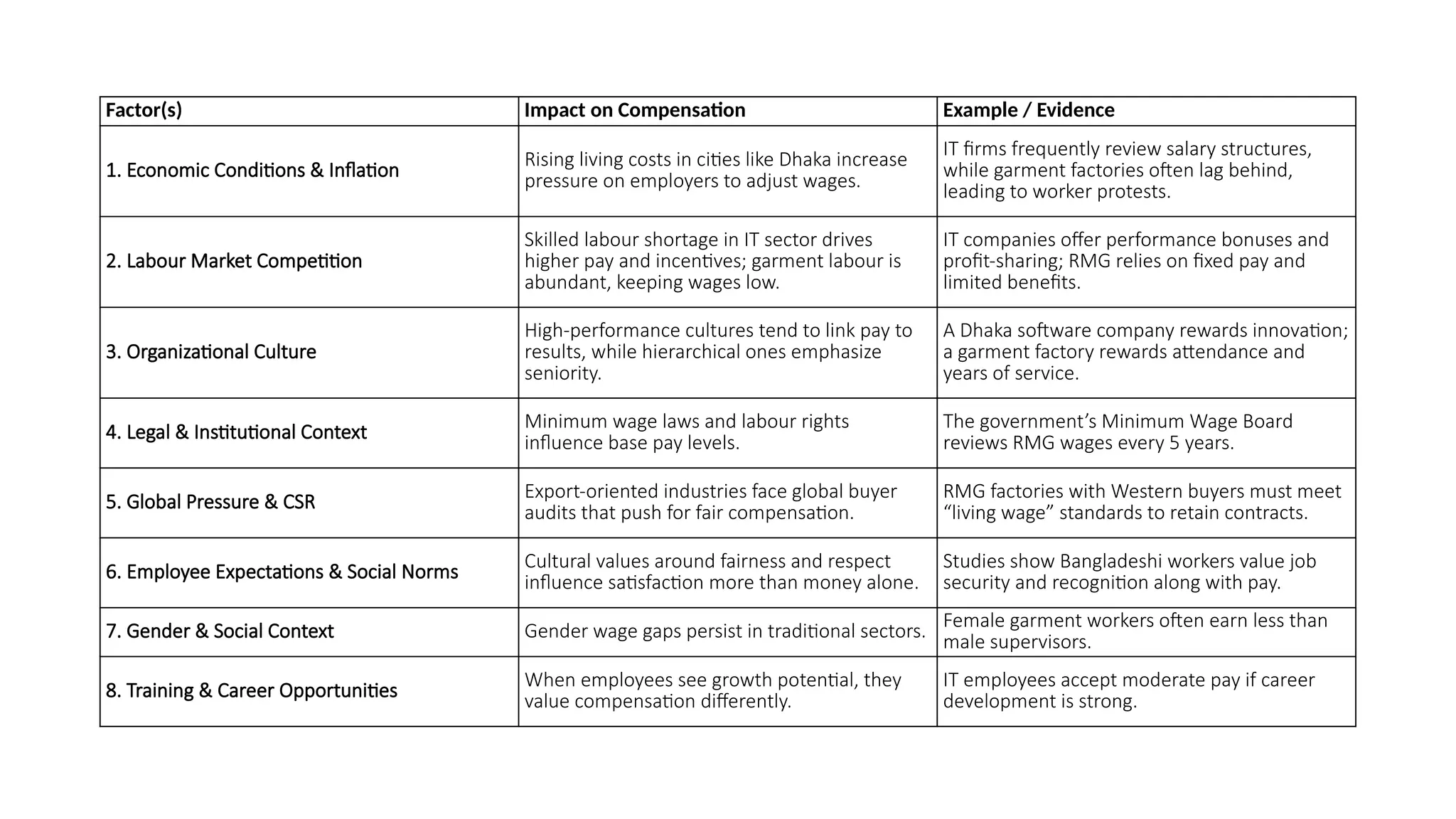
Factor(s) Impact onCompensation Example / Evidence
1. Economic Conditions & Inflation
Rising living costs in cities like Dhaka increase
pressure on employers to adjust wages.
IT firms frequently review salary structures,
while garment factories often lag behind,
leading to worker protests.
2. Labour Market Competition
Skilled labour shortage in IT sector drives
higher pay and incentives; garment labour is
abundant, keeping wages low.
IT companies offer performance bonuses and
profit-sharing; RMG relies on fixed pay and
limited benefits.
3. Organizational Culture
High-performance cultures tend to link pay to
results, while hierarchical ones emphasize
seniority.
A Dhaka software company rewards innovation;
a garment factory rewards attendance and
years of service.
4. Legal & Institutional Context
Minimum wage laws and labour rights
influence base pay levels.
The government’s Minimum Wage Board
reviews RMG wages every 5 years.
5. Global Pressure & CSR
Export-oriented industries face global buyer
audits that push for fair compensation.
RMG factories with Western buyers must meet
“living wage” standards to retain contracts.
6. Employee Expectations & Social Norms Cultural values around fairness and respect
influence satisfaction more than money alone.
Studies show Bangladeshi workers value job
security and recognition along with pay.
7. Gender & Social Context Gender wage gaps persist in traditional sectors.
Female garment workers often earn less than
male supervisors.
8. Training & Career Opportunities
When employees see growth potential, they
value compensation differently.
IT employees accept moderate pay if career
development is strong.