© 2023, IRJET | Impact Factor value: 8.226 | ISO 9001:2008 Certified Journal | Page 590
COMPENSATION OF FAULT RESISTANCE IN DISTANCE RELAY FOR LONG
TRANSMISSION LINE
Misbah Riyaz1 , Er Baljit Kaur2
Post Graduate Student,Electrical Engineering Dept,IET Bhaddal Punjab India.Assistant professor Electrical
Engineering Dept IET Bhaddal Punjab India
---------------------------------------------------------------------***---------------------------------------------------------------------
Abstract - By designing and simulating this project using
the software PSCAD, it will show us how long transmission
line distance protection behaves when faced with a fault
resistance problem.
In distance relaying, fault resistance is a crucial factor. If
ignored, it could result in the internal flaws causing distance
relays to malfunction. However, as a result of the
overreaching occurrence, the unbalanced nature of loads
and the asymmetry of lines can impact the effectiveness of
the distance protection operation. Distance protection
should possess the ideal quality of operating within faults
that are included in the protection zone in order to carry
out its function flawlessly and error-free. The project
incorporates a new numerical distance relaying technique
that is suggested to improve accuracy of these constraints
and efficiency via fault resistance estimate in the distance
protection process. This is accomplished by measuring the
impedance from the relaying point to the fault point for
various values of fault resistance for various types of faults
[1] and finding the current & voltage at the relay position.
Key Words: PSCAD, DISTANCE RELAYING ,CURRENT
ANDVOLTAGE RELAY SYSTEM
1.INTRODUCTION
It is necessary for the transmission lines to be protected
by extensive and intricate protection measures in order to
keep the impact of power outages on the affected region
and time to a minimum. a safety measure implemented
before the power system becomes unstable. Modern
distance relays offer high-speed fault eradication. They are
employed in situations where overcurrent relays slow
down and when it is challenging to grade time overcurrent
relays for complex networks. At 220 kV,132 kV, and 400
kV, they are utilized to safeguard transmission and sub
transmission lines. Distance protection would not be
commercially feasible for 11 kV distribution lines and 66
kV transmission lines, thus over current relays are
employed instead.
1.1 BASIC PRINCIPLE DISTANCE PROTECTION
A distance relay has the capacity to identify a problem
within a predetermined range along a power cable or
transmission line from its location. Each power line has a
resistance and reactance per kilometer that are related to
the design and construction of the line, so the overall
impedance willdepend on the length of the line. In order
to comparecurrent and voltage, a distance relay looks at
these two values in light of Ohm's law.
International Research Journal of Engineering and Technology (IRJET) e-ISSN: 2395-0056
Volume: 10 Issue: 09 | Sep 2023 www.irjet.net p-ISSN: 2395-0072
Given that a transmission line's impedance is inversely
proportional to its length, a relay that can measure a line's
impedance up to a specific point (the reach point) is suited
for distance measurement. In order to provide
discrimination for faults that may occur in various line
sections, distance relays are designed to only work for
faults that occur between the relay position and the
predefined (reach) point.
Divide the voltage at the relaying point by the observed
current to understand the fundamentals of distance
protection. A comparison between the reach point
impedance and the estimated apparent impedance is
made. When measured impedance is lower than reach
point impedance, it is presumed that a fault exists on the
line between the relay and the reach point
1.2 BASIC OF FAULT RESISTANCE
The four components of fault resistance are electrical
equipment resistance, ground resistance, tower footing
resistance, and arc (flashover at line insulator) resistance.
An arc resistance is added to the fault path in the event of
a flashover from phase to phase or phase to ground.
Higher voltages significantly increase the arc resistance.
The impedance of the line is raised by the addition of the
arc resistance, resulting in a higher overall impedance that
is seeded by the distance relay. When there are ground
faults, the earth's resistance enters the fault route as well.
The resistance of the ground includes the resistance of the
tower, the resistance of the tower footing, and the earth
return path. Fault resistance is the result of adding arc and
earth resistance together. Since there is no earth
resistancein the case of phase-to-phase failures, the fault
resistance simply consists of arc resistance.
The Warrington formula [3] yields the arc resistance.
Rarc = 29 * 103 * l / I1.4
where I is the fault current in amps and l is the arc'slength
in meters.
© 2023, IRJET | Impact Factor value: 8.226 | ISO 9001:2008 Certified Journal | Page 591
For phase faults, l will initially equal the conductor
spacing, and for ground faults, it will equal the distance
between the phase conductor and the tower. The cross
winds that typically accompany a lightningstorm lengthen
the arc.An electrical arc is an electrical breakdown that
occurs when a medium's dielectric strength is exceeded;
the kind of medium can affect the dielectric strength.
While certain electrical arcing, such as that produced by
welding,
plasma cutting, and arc lamps, may be controlled, thepower
system should avoid arcing that is not under control. These
characteristics could also cause significant harm, though, if
no safety precautions aretaken to identify the arc. Electric
arcs on overhead wires can happen when the insulating
element separating the conductor from the support breaks.
Such insulating elements include pins, strains, and others
based on their voltage and the conductor's weight and
support. In addition, when two phases of a line come into
contact, arcing may also occur. For instance, the wind
energy nearby causes the Phase R conductor and Phase Y
conductor to come into contact. Direct contact between a
conductor and the earth or another grounded object, such
as a downed conductor, will result in an arc. Because not all
of the electrical power produced is supplied to the
designated loads, the arcing phenomena also results in a
loss of energy for the power companies. When a foreign
object comes into touch with a conductor, power is lost
while being delivered to the load. As a result of the tiny
current that passes through nearby items that provide high
impedance in the current path to the ground, the typical
relay, such as a distance relay, struggles to identify faults
when they first arise. The issue arises when an arcing fault
occurs close to the zone's end of the relay's range [7].
2. PROBLEM STATEMENT
Circuit breakers, switchboard panels, low voltage
distribution boards, electrical appliances, and overhead
wires are just a few of the places where thefault resistance
might happen. In terms of overhead lines, single line to
ground fault is the most frequent fault connected to the
presence of resistance. The resistance of the arc (flashover
at line insulator), the resistance of the tower footing, and
the resistance of the ground make up the fault resistance.
This type ofproblem, in particular, causes the conventional
relayto experience high impedance arcing faults. due to the
large impedance present in the current path, it is
International Research Journal of Engineering and Technology (IRJET) e-ISSN: 2395-0056
Volume: 10 Issue: 09 | Sep 2023 www.irjet.net p-ISSN: 2395-0072
challenging
to identify the fault current. Flashovers are a component of
the majority of frequent overhead line defects, including
insulator failures and lightning strikes. Most impedance-
type distance to fault locator algorithms were in some way
by the non- linearity in the network caused by these arcs.
However, the majority of fault locators developed today
are based on the supposition that the defect has a
constant resistance. Since fault resistance compensation is
required for long transmission lines, it has become vital to
research the phenomenon of fault resistance on overhead
lines.
3 OBJECTIVE OF THE PROJECT
This project's primary goal is to analyze the impact of
transmission line fault resistance dependent on fault
distance. In addition, this study intends to compute fault
resistance using a mathematical formula and identify the
origins of the occurrence of fault resistance on
transmission lines. Finally, this project was developed to
compensate for fault resistance on the mho protection
system based on the problem statement provided [1].
4 SCOPE OF THE PROJECT
Transmission line distance protection issues are brought
on by fault resistance. First off, this project will only
concentrate on single phase to ground faults, and not on
any other kinds of faults. The next sort of protection
strategy to be used is the polarized mho protection
scheme. Modeling the failure resistance in transmission
line-based schemes using the PSCAD/EMTDC software is
successful. A straightforward power system with fault
resistance can be used for the PSCAD simulations. permit
analysis of several fault resistance types, including
equipment resistance, ground resistance, and tower
footing resistance.
5 LITERATURE SURVEY
5.1 DISTANCE PROTECTION OF TRASNMISSION LINE
We must fully comprehend the operating concepts and
some issues linked with the protection schemes used on
transmission lines in order to adequately address the
issues related to fault resistance on transmission lines
with distance protection scheme.If the fundamental ideas
behind this plan are understood, required adjustments to
the current distance protection plan can be made to
address the issue caused by transmission line fault
resistance. In general, there are three major types of
transmission line protection schemes. The first is an
overcurrent type protection strategy, followed by a
differential type protection scheme and a last one known
as a distance protection method. Pilot protection refers to
the usage of a communications link for protection
issues between ends of the transmission line in the context
of power system protection. Distance protection
schemes can be either non-pilot or pilot. Knowing the
state of the line at both ends is advantageous when using
pilot schemes. Phase comparison relaying method is one of
the three types of approaches, or differential protection
scheme. This differential approach examines the phase of
the currents at both ends of the line to determine if
there is a fault in the middle, as opposed to using
© 2023, IRJET | Impact Factor value: 8.226 | ISO 9001:2008 Certified Journal | Page 592
Figure 1 : Stepped Distance Chracteristics of distance Relay
The most important factor in the power system is thefault
International Research Journal of Engineering and Technology (IRJET) e-ISSN: 2395-0056
Volume: 10 Issue: 09 | Sep 2023 www.irjet.net p-ISSN: 2395-0072
clearance time for any type of protective strategy. When
protecting a transmission line utilizing non-pilot distance
protection techniques, it is vital to rely on stepped zones
of protection because impedance measurements are
imprecise. With more than one zone, a distance protection
technique enables to protect any specific piece of
transmission line. Zone 1 protection immediately resolves
Close in faults.About 80– 90% of the railway is protected
under Zone 1. If a defect occurs at the far end of the line, the
relay may not be able to determine whether it is actually on
that segment of line or an adjacent section based on the
accuracy of the impedance measurements. Therefore, it is
desirable to allow for a delay in tripping for faults that
the relay determines are within the upper limits of zones 1
and 2, or between 120 and 150 percent of the length of the
line in question. The line's third zone serves as a backup for
the lines next to it. By allowing for trip delays on zone 2 and
zone 3 faults, zone 1 protection of the adjacent line can be
operated during this period. The fault will be fixed in zone 2
if it is located at 95% of the line in question.
This plan's inclusion of a delay ensures adequate
coordination and aids in the endeavor to prevent shutting
down more line than is required to repair the fault. One
relay can offer both primary and backup protection
features thanks to distance protection schemes.
Figure above displays Distance relays with stepped
distances divide the entire line into three zones for
protection. Since the line is fed from both sides, 6 relays
are employed to safeguard it from damage. R1,R3, and R5
are used in the same direction as the figure, while R2, R4,
and R6 are used in the other direction. The distance
protection relaying not only offers the protected line main
protection but also time-delayed backup protection for
the protected line as well as for nearby lines.
distance relaying principles. There are numerous more
protection system options outside the phase
comparison protection scheme, some of which
(distance relaying techniques) rely on impedance
measurements. Stepped distance protection is a need for
all techniques that consider impedance measurements.
All other distance protection programs that are not
pilot-based program are subject to the same type of notion.
6 PROPOSED WORKS
6.1 OVERVIEW OF PROPOSED WORKS
We must enhance the distance protection strategy in
6.2 Alogirithim of Proposed Scheme
The fault site is estimated using a two-terminal technique
[1]. The source impedance parameters are not required by
the algorithm, and the estimated fault location is unaffected
by the fault resistance value. Single Line to Ground (SLG)
fault location computation is represented by Equation (1),
and the
SLG fault situation at a phase line is depicted in Fig 2 Where
M= Fault of Location Estimation Z1= Postitive sequence
impedance Z2= Negative sequence impedance Z0 = zero
sequance impedance VA= Phase to ground voltage for local
substation VB = Phase to ground voltage for remote
substation IA = Phase current from local substation IB =
Phase current fromremote substation
Single line to ground fault Fig 2.1
order
to address the challenges caused by fault resistance when
it is utilized for long transmission lines, as was stated
above. The impedance of the transmission line between
the fault point and the relay point is used as the basis
for the distance protection scheme's operation.
Impedance is measured by determining the ratio of the
voltage and current at the relay point. If fault resistance is
present in the fault loop, it is important to subtract
the fault resistance from the observed impedance in
order to measure impedance accurately in transmission
lines. The primary goal of this work is to identify the
defect.
© 2023, IRJET | Impact Factor value: 8.226 | ISO 9001:2008 Certified Journal | Page 593
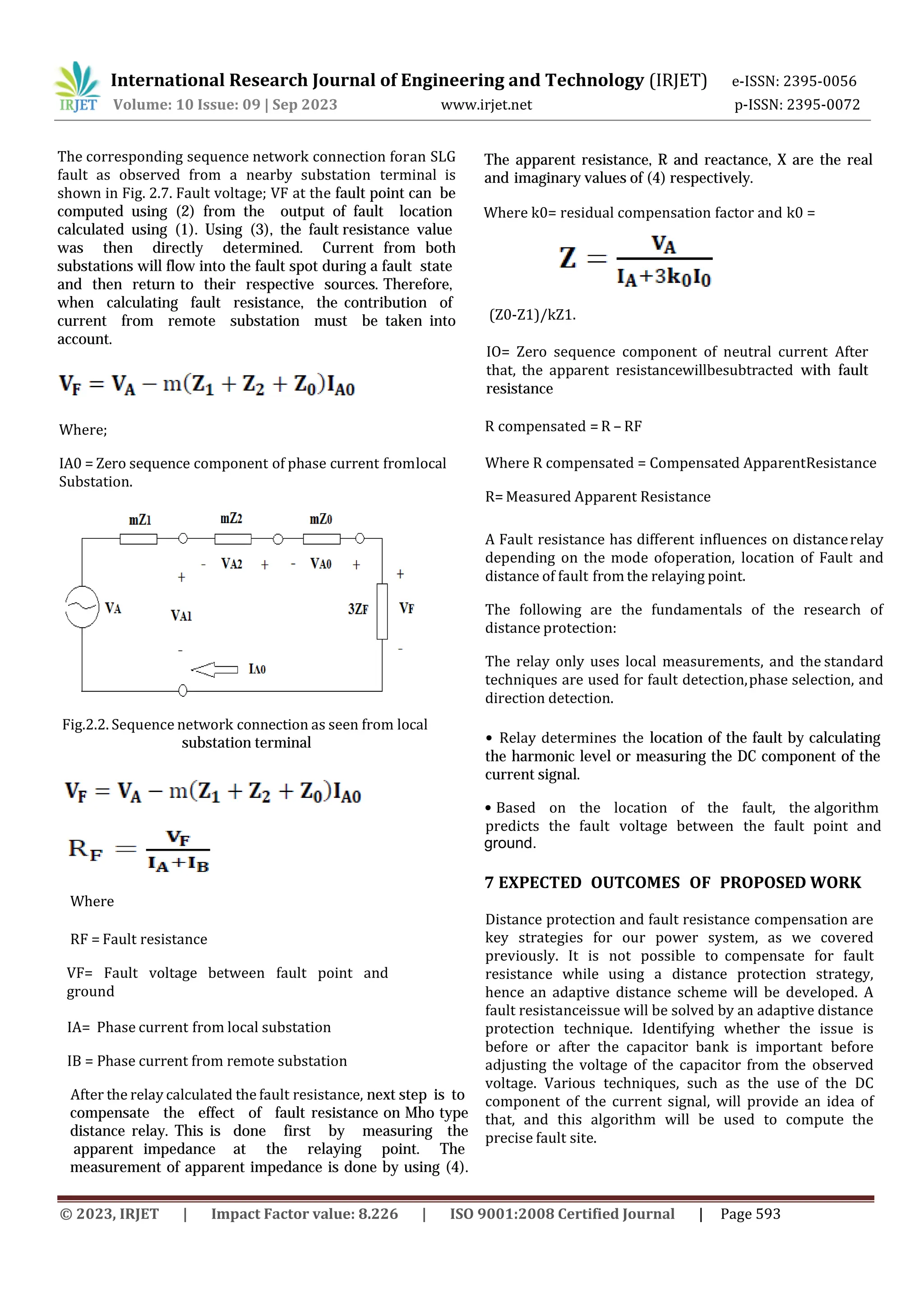
The corresponding sequence network connection for
International Research Journal of Engineering and Technology (IRJET) e-ISSN: 2395-0056
Volume: 10 Issue: 09 | Sep 2023 www.irjet.net p-ISSN: 2395-0072
an SLG
fault as observed from a nearby substation terminal is
shown in Fig. 2.7. Fault voltage; VF at the fault point can be
computed using (2) from the output of fault location
calculated using (1). Using (3), the fault resistance value
was then directly determined. Current from both
substations will flow into the fault spot during a fault state
and then return to their respective sources. Therefore,
when calculating fault resistance, the contribution of
current from remote substation must be taken into
account.
Where;
IA0 = Zero sequence component of phase current fromlocal
Substation.
Where
VF= Fault voltage between fault point and
ground
Fig.2.2. Sequence network connection as seen from local
substation terminal
RF = Fault resistance
IA= Phase current from local substation
IB = Phase current from remote substation
After the relay calculated the fault resistance, next step is to
compensate the effect of fault resistance on Mho type
distance relay. This is done first by measuring the
apparent impedance at the relaying point. The
measurement of apparent impedance is done by using (4).
Where k0= residual compensation factor and k0 =
(Z0-Z1)/kZ1.
The apparent resistance, R and reactance, X are the real
and imaginary values of (4) respectively.
IO= Zero sequence component of neutral current After
that, the apparent resistancewillbesubtracted with fault
resistance
Where R compensated = Compensated ApparentResistance
R= Measured Apparent Resistance
A Fault resistance has different influences on distancerelay
depending on the mode ofoperation, location of Fault and
distance of fault from the relaying point.
The following are the fundamentals of the research of
distance protection:
The relay only uses local measurements, and the standard
techniques are used for fault detection,phase selection, and
direction detection.
R compensated = R – RF
• Relay determines the location of the fault by calculating
the harmonic level or measuring the DC component of the
current signal.
• Based on the location of the fault, the algorithm
predicts the fault voltage between the fault point and
ground.
7 EXPECTED OUTCOMES OF PROPOSED WORK
Distance protection and fault resistance compensation are
key strategies for our power system, as we covered
previously. It is not possible to compensate for fault
resistance while using a distance protection strategy,
hence an adaptive distance scheme will be developed. A
fault resistanceissue will be solved by an adaptive distance
protection technique. Identifying whether the issue is
before or after the capacitor bank is important before
adjusting the voltage of the capacitor from the observed
voltage. Various techniques, such as the use of the DC
component of the current signal, will provide an idea of
that, and this algorithm will be used to compute the
precise fault site.
International Research Journal of Engineering and Technology (IRJET) e-ISSN: 2395-0056
Volume: 10 Issue: 09 | Sep 2023 www.irjet.net p-ISSN: 2395-0072
WHAT is PSCAD?
The EMTDC electromagnetic transient simulation engine
has a robust and adaptable graphical user interface called
PSCAD (Power Systems Computer Aided Design). In a fully
integrated, graphical interface, PSCAD assists the user in
schematically building a circuit, running simulations,
analyzing the results, and managing data. Additionally, the
user can change system parameters during a simulation
run and see the results as the simulation is running thanks
to online charting features, controls, and meters. PSCAD is
comprehensive software that includes a library of
simulation models that have been pre-programmed and
validated, ranging from simpler passive elements and
control functions to more intricate models, such as
electrical equipment, FACTS devices in their whole,
transmission lines, andcables. In the absence of an existing
model, PSCAD offers options for creating unique models.
For instance, primitive models can be built from start in a
flexible design environment, or existing models can be
pieced together to build a module to create bespoke
models.
The PSCAD master library contains the following typical
models:
• Mutually connected windings, similar to those in
transformers; • Frequency-dependent transmission lines
and cables; • Capacitors, resistors, and
inductors; Thyristors, Diodes, and GTOs are examples of
analog and digital control devices. Other components
include DC and AC machines, exciters, governors,
stabilizers, and inertial models.
8.2 FEATURES OF PSCAD
The following list of new and improved features to beaware
of is not all-inclusive:
The main new feature in this edition is Multiple Instance
Modules (MIM).
• EMTDC Runtime Configuration: The term "runtime
configuration" refers to a group of modifications made to
the EMTDC system dynamics structure and component
design methodologies in order to enableMIM support.
• Improved Searching: There are now better searching
options. X Path, a query language for choosing nodes in an
XML document, serves as the foundation for the background
search engine at the moment.
• Support for Fortran Compilers: PSCAD X4 now comes with
the new G Fortran free FORTRAN 95 compiler. Please take
note that GNU FORTRAN 77, the previous free compiler, is
no longer maintained.
8.3 MODELLING OF DISTANCE PROTECTIONRELAY
The distance protection relay circuit, the signal processing
stage, and the protection scheme stage are the three
components that make up the transmission line modeling.
An illustration of a distance protection relay circuit is shown
in Figure
3.5 below. A single line diagram of the circuit, which is a
three-phase system, may be seen. The three phase
transmission line follows the line model sinceit is the most
accurate model available in this software and the resistance
varies with the conductor's length.
8 SIMULATION WORK IN PSCAD
8.1 Introduction of PSCAD
line AB + 50 % of
the protected line 2) Zone-3 = 182.52 Ω (100 % of
protectedline AB + 100 % of the protected BC +25 % of
the protected line 3)
Figure 3 Distance Protection Relay Circuit
Setting ofthe mho relay is
Zone-1 = 64.95 Ω (80 % of protected line 1).
Zone-2 = 121.16 Ω (100 % of protected
Zone R X
1 7.33 Ω 27.425 Ω
2 13.738Ω 51.385 Ω
3 24.675Ω 92.30 Ω
Table 1 Resistance & Reactance of Different Zone
© 2023, IRJET | Impact Factor value: 8.226 | ISO 9001:2008 Certified Journal | Page 594
8.4 SIGNAL PROCESSING STAGE
Figure 4 Input Data Processing Stage Systems
The signal is being processed at this point. A few of the
parts required for the distance relay system are shown in
Figure 4.7. Fast Fourier Transform is used for the "Online
Frequency Scanner" rather than Discrete Fourier
Transform. Instead of using DFT, this FFT offers a quicker
and more effective data processing method. The voltage and
current signals contain fading DC components with higher
order frequency and lower order frequency when a
transmission line has a fault. This FFT component's job is to
retrieve the source signal's fundamental magnitudes and
phases. The extracted data will thenbe turned into positive,
negative, and zero sequence using "Sequence Filter" once
the signal has been extracted using FFT. In order to be used
for a mho impedance relay, the transformed data will then
be combined once again according to their phase.
International Research Journal of Engineering and Technology (IRJET) e-ISSN: 2395-0056
Volume: 10 Issue: 09 | Sep 2023 www.irjet.net p-ISSN: 2395-0072
8.5 PROTECTION STAGE SCHEME
Figure 5 Polarized Mho Protection Scheme Stage
As illustrated in Figure 5, the system requires six
protection units in order to detect all fault types including
line-ground, double line-ground, line-line, and three-phase
faults. Three of these units measure line to ground
impedance, while the remaining three measure line to line
impedance. Therefore, all of the input used in the PSCAD
program comes from the extracted databased on the Signal
Processing Stage, and the unit components are already
available. The "mho circle" will then be connected to each
unit's output. If the OR gateoutput will be showing “1” than
there is the reach of the distance relay and ifthe OR gate
output will be showing “0” than there is fault out of relay
characteristic.
9 CONCLUSION
A common transmission line protection strategy is distance
protection. Nonlinear properties of the mho relay cause a
number of issues with impedance measurement in the
distance protection system when it is employed with fault
resistance in the transmission line. Instead of using the
traditional distance protection technique, an adaptive one
should be employed to address this issue. During adaptive
distance protection, the fault resistance linecan be adjusted
in angle while the fault resistance is calculated and made
up for using the line impedance. Relay characteristics can
be altered if fault resistancechanges line impedance. Relay
can adjust for changes in line impedance and function in
accordance with its genuine impedance value in an
adaptive distance protection scheme.
10 REFERENCES
[1] G.ZIEGLAR(2018) Effect of fault resistance on the
operating behaviorof distance relay
[2] M.R.ARJAOE(2017) A practical first- zone distance
relaying algorithm forlong parallel transmission lines
[3] Z.y.xu(2016) First-zone distance relaying algorithm of
parallel transmission lines for single-phase to ground
faults
[4] R. Dubey (2015) An Extreme Learning Machine based
fast and accurate adaptive distance relayingscheme
[5] E.Sorrentino 2014 Comparison Of Five Methods of
Compensation for the ground Distance Function and
Assesment of their effect on the Resistive Reach in
quadrilateral Characteristics
[6] Ying Zhong, Xiaoning Kang, Zaibin Jiao, Zengchao
Wang, and Jiale Suonan, Member, IEEE Transactions
ON Power Delivery, VOL. 29, NO. 4, August 2014 on “A
Novel Distance Protection Algorithm for the Phase-
Ground Fault”
© 2023, IRJET | Impact Factor value: 8.226 | ISO 9001:2008 Certified Journal | Page 595
[7] M.P. Thakre, V.S.Kale,Jan 2014 International Joutnal of
Advances in Engineering & Technology ,Electrical
Engineering Department, V.N.I.T,Nagpur,M.S.,India on
“Distance protection for Long Transmissionline using
PSCAD”.
International Research Journal of Engineering and Technology (IRJET) e-ISSN: 2395-0056
Volume: 10 Issue: 09 | Sep 2023 www.irjet.net p-ISSN: 2395-0072
[8] Amit N. Patel, Chirag D. Chauhan, Vipul N. Rajput,
Assistant Professor, Dr.Jivraj Mehta Institute of
Technology, Power Delivery, International Journalfor
Scientific Research & Development, On Volume:1, Oct.
2013 “ A New Fault Resistance Compensation
Scheme for Distance Relaying Application ".
[9] Muhd Hafizi Idris, Mohd Saufi Ahmad, Ahmad Zaidi
Abdullah, Surya Hardi School of Electrical System
Engineering University Malaysia Perlis, Arau, Perlis,
IEEE 7th International Power Engineering and
Optimization Conference, Langkawi, Malaysia, 3-4
June 2013"Adaptive Mho Type DistanceRelaying
Scheme withFault Resistance Compensation".
[10] R.C.D SANTOS (2011)Transmission Lines distance
protection using artificialneutral networks
[11] J.UPENDAR (2011) Comprehensive adaptive distance
relaying scheme forparallel transmission lines
[12] R. H. Salim, D. P. Marzecand, and A. S. Bretas, Student
member, IEEE Transactions Power Delivery, vol. 26
April 2011 "Phase distance relaying withfault-
resistance compensation forunbalanced systems".
[13] M. Resener and A. S. Bretas Student member , IEEE
Transactions Power Delivery., vol. 23 July 2008
"Ground distance relaying with fault-resistance
compensation for unbalanced systems".
[14] B.BHALJA (2007) An adaptive distance relaying
scheme using radial basis function neural network
[15] M.sanaye (2006) Adaptive distance protection
scheme with quadrilateral characteristic for
extremely high- voltage/ultra-high-voltage
transmissionline
[16] Noha Abed Al-bary Al-jawady, M Sc. Thesis
University Mosul, 1998, “Effect of Fault Resistance on
thePerformanceof Mho Relays”.
[17] K .K LI (1997) Ideal operating region of digital
distance relay under high resistance earth fault.
[18] J. Roberts, A. Guzman, E.O.Schweitzer, III Schweitzer
Engineering Laboratories, Inc, Pullman, Washington,
Oct-1993 PowerTech on “Z = V/I does not make a
distance relay”.
© 2023, IRJET | Impact Factor value: 8.226 | ISO 9001:2008 Certified Journal | Page 596

COMPENSATION OF FAULT RESISTANCE IN DISTANCE RELAY FOR LONG TRANSMISSION LINE

  • 1.
    © 2023, IRJET| Impact Factor value: 8.226 | ISO 9001:2008 Certified Journal | Page 590 COMPENSATION OF FAULT RESISTANCE IN DISTANCE RELAY FOR LONG TRANSMISSION LINE Misbah Riyaz1 , Er Baljit Kaur2 Post Graduate Student,Electrical Engineering Dept,IET Bhaddal Punjab India.Assistant professor Electrical Engineering Dept IET Bhaddal Punjab India ---------------------------------------------------------------------***--------------------------------------------------------------------- Abstract - By designing and simulating this project using the software PSCAD, it will show us how long transmission line distance protection behaves when faced with a fault resistance problem. In distance relaying, fault resistance is a crucial factor. If ignored, it could result in the internal flaws causing distance relays to malfunction. However, as a result of the overreaching occurrence, the unbalanced nature of loads and the asymmetry of lines can impact the effectiveness of the distance protection operation. Distance protection should possess the ideal quality of operating within faults that are included in the protection zone in order to carry out its function flawlessly and error-free. The project incorporates a new numerical distance relaying technique that is suggested to improve accuracy of these constraints and efficiency via fault resistance estimate in the distance protection process. This is accomplished by measuring the impedance from the relaying point to the fault point for various values of fault resistance for various types of faults [1] and finding the current & voltage at the relay position. Key Words: PSCAD, DISTANCE RELAYING ,CURRENT ANDVOLTAGE RELAY SYSTEM 1.INTRODUCTION It is necessary for the transmission lines to be protected by extensive and intricate protection measures in order to keep the impact of power outages on the affected region and time to a minimum. a safety measure implemented before the power system becomes unstable. Modern distance relays offer high-speed fault eradication. They are employed in situations where overcurrent relays slow down and when it is challenging to grade time overcurrent relays for complex networks. At 220 kV,132 kV, and 400 kV, they are utilized to safeguard transmission and sub transmission lines. Distance protection would not be commercially feasible for 11 kV distribution lines and 66 kV transmission lines, thus over current relays are employed instead. 1.1 BASIC PRINCIPLE DISTANCE PROTECTION A distance relay has the capacity to identify a problem within a predetermined range along a power cable or transmission line from its location. Each power line has a resistance and reactance per kilometer that are related to the design and construction of the line, so the overall impedance willdepend on the length of the line. In order to comparecurrent and voltage, a distance relay looks at these two values in light of Ohm's law. International Research Journal of Engineering and Technology (IRJET) e-ISSN: 2395-0056 Volume: 10 Issue: 09 | Sep 2023 www.irjet.net p-ISSN: 2395-0072 Given that a transmission line's impedance is inversely proportional to its length, a relay that can measure a line's impedance up to a specific point (the reach point) is suited for distance measurement. In order to provide discrimination for faults that may occur in various line sections, distance relays are designed to only work for faults that occur between the relay position and the predefined (reach) point. Divide the voltage at the relaying point by the observed current to understand the fundamentals of distance protection. A comparison between the reach point impedance and the estimated apparent impedance is made. When measured impedance is lower than reach point impedance, it is presumed that a fault exists on the line between the relay and the reach point 1.2 BASIC OF FAULT RESISTANCE The four components of fault resistance are electrical equipment resistance, ground resistance, tower footing resistance, and arc (flashover at line insulator) resistance. An arc resistance is added to the fault path in the event of a flashover from phase to phase or phase to ground. Higher voltages significantly increase the arc resistance. The impedance of the line is raised by the addition of the arc resistance, resulting in a higher overall impedance that is seeded by the distance relay. When there are ground faults, the earth's resistance enters the fault route as well. The resistance of the ground includes the resistance of the tower, the resistance of the tower footing, and the earth return path. Fault resistance is the result of adding arc and earth resistance together. Since there is no earth resistancein the case of phase-to-phase failures, the fault resistance simply consists of arc resistance. The Warrington formula [3] yields the arc resistance. Rarc = 29 * 103 * l / I1.4 where I is the fault current in amps and l is the arc'slength in meters.
  • 2.
    © 2023, IRJET| Impact Factor value: 8.226 | ISO 9001:2008 Certified Journal | Page 591 For phase faults, l will initially equal the conductor spacing, and for ground faults, it will equal the distance between the phase conductor and the tower. The cross winds that typically accompany a lightningstorm lengthen the arc.An electrical arc is an electrical breakdown that occurs when a medium's dielectric strength is exceeded; the kind of medium can affect the dielectric strength. While certain electrical arcing, such as that produced by welding, plasma cutting, and arc lamps, may be controlled, thepower system should avoid arcing that is not under control. These characteristics could also cause significant harm, though, if no safety precautions aretaken to identify the arc. Electric arcs on overhead wires can happen when the insulating element separating the conductor from the support breaks. Such insulating elements include pins, strains, and others based on their voltage and the conductor's weight and support. In addition, when two phases of a line come into contact, arcing may also occur. For instance, the wind energy nearby causes the Phase R conductor and Phase Y conductor to come into contact. Direct contact between a conductor and the earth or another grounded object, such as a downed conductor, will result in an arc. Because not all of the electrical power produced is supplied to the designated loads, the arcing phenomena also results in a loss of energy for the power companies. When a foreign object comes into touch with a conductor, power is lost while being delivered to the load. As a result of the tiny current that passes through nearby items that provide high impedance in the current path to the ground, the typical relay, such as a distance relay, struggles to identify faults when they first arise. The issue arises when an arcing fault occurs close to the zone's end of the relay's range [7]. 2. PROBLEM STATEMENT Circuit breakers, switchboard panels, low voltage distribution boards, electrical appliances, and overhead wires are just a few of the places where thefault resistance might happen. In terms of overhead lines, single line to ground fault is the most frequent fault connected to the presence of resistance. The resistance of the arc (flashover at line insulator), the resistance of the tower footing, and the resistance of the ground make up the fault resistance. This type ofproblem, in particular, causes the conventional relayto experience high impedance arcing faults. due to the large impedance present in the current path, it is International Research Journal of Engineering and Technology (IRJET) e-ISSN: 2395-0056 Volume: 10 Issue: 09 | Sep 2023 www.irjet.net p-ISSN: 2395-0072 challenging to identify the fault current. Flashovers are a component of the majority of frequent overhead line defects, including insulator failures and lightning strikes. Most impedance- type distance to fault locator algorithms were in some way by the non- linearity in the network caused by these arcs. However, the majority of fault locators developed today are based on the supposition that the defect has a constant resistance. Since fault resistance compensation is required for long transmission lines, it has become vital to research the phenomenon of fault resistance on overhead lines. 3 OBJECTIVE OF THE PROJECT This project's primary goal is to analyze the impact of transmission line fault resistance dependent on fault distance. In addition, this study intends to compute fault resistance using a mathematical formula and identify the origins of the occurrence of fault resistance on transmission lines. Finally, this project was developed to compensate for fault resistance on the mho protection system based on the problem statement provided [1]. 4 SCOPE OF THE PROJECT Transmission line distance protection issues are brought on by fault resistance. First off, this project will only concentrate on single phase to ground faults, and not on any other kinds of faults. The next sort of protection strategy to be used is the polarized mho protection scheme. Modeling the failure resistance in transmission line-based schemes using the PSCAD/EMTDC software is successful. A straightforward power system with fault resistance can be used for the PSCAD simulations. permit analysis of several fault resistance types, including equipment resistance, ground resistance, and tower footing resistance. 5 LITERATURE SURVEY 5.1 DISTANCE PROTECTION OF TRASNMISSION LINE We must fully comprehend the operating concepts and some issues linked with the protection schemes used on transmission lines in order to adequately address the issues related to fault resistance on transmission lines with distance protection scheme.If the fundamental ideas behind this plan are understood, required adjustments to the current distance protection plan can be made to address the issue caused by transmission line fault resistance. In general, there are three major types of transmission line protection schemes. The first is an overcurrent type protection strategy, followed by a differential type protection scheme and a last one known as a distance protection method. Pilot protection refers to the usage of a communications link for protection issues between ends of the transmission line in the context of power system protection. Distance protection schemes can be either non-pilot or pilot. Knowing the state of the line at both ends is advantageous when using pilot schemes. Phase comparison relaying method is one of the three types of approaches, or differential protection scheme. This differential approach examines the phase of the currents at both ends of the line to determine if there is a fault in the middle, as opposed to using
  • 3.
    © 2023, IRJET| Impact Factor value: 8.226 | ISO 9001:2008 Certified Journal | Page 592 Figure 1 : Stepped Distance Chracteristics of distance Relay The most important factor in the power system is thefault International Research Journal of Engineering and Technology (IRJET) e-ISSN: 2395-0056 Volume: 10 Issue: 09 | Sep 2023 www.irjet.net p-ISSN: 2395-0072 clearance time for any type of protective strategy. When protecting a transmission line utilizing non-pilot distance protection techniques, it is vital to rely on stepped zones of protection because impedance measurements are imprecise. With more than one zone, a distance protection technique enables to protect any specific piece of transmission line. Zone 1 protection immediately resolves Close in faults.About 80– 90% of the railway is protected under Zone 1. If a defect occurs at the far end of the line, the relay may not be able to determine whether it is actually on that segment of line or an adjacent section based on the accuracy of the impedance measurements. Therefore, it is desirable to allow for a delay in tripping for faults that the relay determines are within the upper limits of zones 1 and 2, or between 120 and 150 percent of the length of the line in question. The line's third zone serves as a backup for the lines next to it. By allowing for trip delays on zone 2 and zone 3 faults, zone 1 protection of the adjacent line can be operated during this period. The fault will be fixed in zone 2 if it is located at 95% of the line in question. This plan's inclusion of a delay ensures adequate coordination and aids in the endeavor to prevent shutting down more line than is required to repair the fault. One relay can offer both primary and backup protection features thanks to distance protection schemes. Figure above displays Distance relays with stepped distances divide the entire line into three zones for protection. Since the line is fed from both sides, 6 relays are employed to safeguard it from damage. R1,R3, and R5 are used in the same direction as the figure, while R2, R4, and R6 are used in the other direction. The distance protection relaying not only offers the protected line main protection but also time-delayed backup protection for the protected line as well as for nearby lines. distance relaying principles. There are numerous more protection system options outside the phase comparison protection scheme, some of which (distance relaying techniques) rely on impedance measurements. Stepped distance protection is a need for all techniques that consider impedance measurements. All other distance protection programs that are not pilot-based program are subject to the same type of notion. 6 PROPOSED WORKS 6.1 OVERVIEW OF PROPOSED WORKS We must enhance the distance protection strategy in 6.2 Alogirithim of Proposed Scheme The fault site is estimated using a two-terminal technique [1]. The source impedance parameters are not required by the algorithm, and the estimated fault location is unaffected by the fault resistance value. Single Line to Ground (SLG) fault location computation is represented by Equation (1), and the SLG fault situation at a phase line is depicted in Fig 2 Where M= Fault of Location Estimation Z1= Postitive sequence impedance Z2= Negative sequence impedance Z0 = zero sequance impedance VA= Phase to ground voltage for local substation VB = Phase to ground voltage for remote substation IA = Phase current from local substation IB = Phase current fromremote substation Single line to ground fault Fig 2.1 order to address the challenges caused by fault resistance when it is utilized for long transmission lines, as was stated above. The impedance of the transmission line between the fault point and the relay point is used as the basis for the distance protection scheme's operation. Impedance is measured by determining the ratio of the voltage and current at the relay point. If fault resistance is present in the fault loop, it is important to subtract the fault resistance from the observed impedance in order to measure impedance accurately in transmission lines. The primary goal of this work is to identify the defect.
  • 4.
    © 2023, IRJET| Impact Factor value: 8.226 | ISO 9001:2008 Certified Journal | Page 593 The corresponding sequence network connection for International Research Journal of Engineering and Technology (IRJET) e-ISSN: 2395-0056 Volume: 10 Issue: 09 | Sep 2023 www.irjet.net p-ISSN: 2395-0072 an SLG fault as observed from a nearby substation terminal is shown in Fig. 2.7. Fault voltage; VF at the fault point can be computed using (2) from the output of fault location calculated using (1). Using (3), the fault resistance value was then directly determined. Current from both substations will flow into the fault spot during a fault state and then return to their respective sources. Therefore, when calculating fault resistance, the contribution of current from remote substation must be taken into account. Where; IA0 = Zero sequence component of phase current fromlocal Substation. Where VF= Fault voltage between fault point and ground Fig.2.2. Sequence network connection as seen from local substation terminal RF = Fault resistance IA= Phase current from local substation IB = Phase current from remote substation After the relay calculated the fault resistance, next step is to compensate the effect of fault resistance on Mho type distance relay. This is done first by measuring the apparent impedance at the relaying point. The measurement of apparent impedance is done by using (4). Where k0= residual compensation factor and k0 = (Z0-Z1)/kZ1. The apparent resistance, R and reactance, X are the real and imaginary values of (4) respectively. IO= Zero sequence component of neutral current After that, the apparent resistancewillbesubtracted with fault resistance Where R compensated = Compensated ApparentResistance R= Measured Apparent Resistance A Fault resistance has different influences on distancerelay depending on the mode ofoperation, location of Fault and distance of fault from the relaying point. The following are the fundamentals of the research of distance protection: The relay only uses local measurements, and the standard techniques are used for fault detection,phase selection, and direction detection. R compensated = R – RF • Relay determines the location of the fault by calculating the harmonic level or measuring the DC component of the current signal. • Based on the location of the fault, the algorithm predicts the fault voltage between the fault point and ground. 7 EXPECTED OUTCOMES OF PROPOSED WORK Distance protection and fault resistance compensation are key strategies for our power system, as we covered previously. It is not possible to compensate for fault resistance while using a distance protection strategy, hence an adaptive distance scheme will be developed. A fault resistanceissue will be solved by an adaptive distance protection technique. Identifying whether the issue is before or after the capacitor bank is important before adjusting the voltage of the capacitor from the observed voltage. Various techniques, such as the use of the DC component of the current signal, will provide an idea of that, and this algorithm will be used to compute the precise fault site.
  • 5.
    International Research Journalof Engineering and Technology (IRJET) e-ISSN: 2395-0056 Volume: 10 Issue: 09 | Sep 2023 www.irjet.net p-ISSN: 2395-0072 WHAT is PSCAD? The EMTDC electromagnetic transient simulation engine has a robust and adaptable graphical user interface called PSCAD (Power Systems Computer Aided Design). In a fully integrated, graphical interface, PSCAD assists the user in schematically building a circuit, running simulations, analyzing the results, and managing data. Additionally, the user can change system parameters during a simulation run and see the results as the simulation is running thanks to online charting features, controls, and meters. PSCAD is comprehensive software that includes a library of simulation models that have been pre-programmed and validated, ranging from simpler passive elements and control functions to more intricate models, such as electrical equipment, FACTS devices in their whole, transmission lines, andcables. In the absence of an existing model, PSCAD offers options for creating unique models. For instance, primitive models can be built from start in a flexible design environment, or existing models can be pieced together to build a module to create bespoke models. The PSCAD master library contains the following typical models: • Mutually connected windings, similar to those in transformers; • Frequency-dependent transmission lines and cables; • Capacitors, resistors, and inductors; Thyristors, Diodes, and GTOs are examples of analog and digital control devices. Other components include DC and AC machines, exciters, governors, stabilizers, and inertial models. 8.2 FEATURES OF PSCAD The following list of new and improved features to beaware of is not all-inclusive: The main new feature in this edition is Multiple Instance Modules (MIM). • EMTDC Runtime Configuration: The term "runtime configuration" refers to a group of modifications made to the EMTDC system dynamics structure and component design methodologies in order to enableMIM support. • Improved Searching: There are now better searching options. X Path, a query language for choosing nodes in an XML document, serves as the foundation for the background search engine at the moment. • Support for Fortran Compilers: PSCAD X4 now comes with the new G Fortran free FORTRAN 95 compiler. Please take note that GNU FORTRAN 77, the previous free compiler, is no longer maintained. 8.3 MODELLING OF DISTANCE PROTECTIONRELAY The distance protection relay circuit, the signal processing stage, and the protection scheme stage are the three components that make up the transmission line modeling. An illustration of a distance protection relay circuit is shown in Figure 3.5 below. A single line diagram of the circuit, which is a three-phase system, may be seen. The three phase transmission line follows the line model sinceit is the most accurate model available in this software and the resistance varies with the conductor's length. 8 SIMULATION WORK IN PSCAD 8.1 Introduction of PSCAD line AB + 50 % of the protected line 2) Zone-3 = 182.52 Ω (100 % of protectedline AB + 100 % of the protected BC +25 % of the protected line 3) Figure 3 Distance Protection Relay Circuit Setting ofthe mho relay is Zone-1 = 64.95 Ω (80 % of protected line 1). Zone-2 = 121.16 Ω (100 % of protected Zone R X 1 7.33 Ω 27.425 Ω 2 13.738Ω 51.385 Ω 3 24.675Ω 92.30 Ω Table 1 Resistance & Reactance of Different Zone © 2023, IRJET | Impact Factor value: 8.226 | ISO 9001:2008 Certified Journal | Page 594
  • 6.
    8.4 SIGNAL PROCESSINGSTAGE Figure 4 Input Data Processing Stage Systems The signal is being processed at this point. A few of the parts required for the distance relay system are shown in Figure 4.7. Fast Fourier Transform is used for the "Online Frequency Scanner" rather than Discrete Fourier Transform. Instead of using DFT, this FFT offers a quicker and more effective data processing method. The voltage and current signals contain fading DC components with higher order frequency and lower order frequency when a transmission line has a fault. This FFT component's job is to retrieve the source signal's fundamental magnitudes and phases. The extracted data will thenbe turned into positive, negative, and zero sequence using "Sequence Filter" once the signal has been extracted using FFT. In order to be used for a mho impedance relay, the transformed data will then be combined once again according to their phase. International Research Journal of Engineering and Technology (IRJET) e-ISSN: 2395-0056 Volume: 10 Issue: 09 | Sep 2023 www.irjet.net p-ISSN: 2395-0072 8.5 PROTECTION STAGE SCHEME Figure 5 Polarized Mho Protection Scheme Stage As illustrated in Figure 5, the system requires six protection units in order to detect all fault types including line-ground, double line-ground, line-line, and three-phase faults. Three of these units measure line to ground impedance, while the remaining three measure line to line impedance. Therefore, all of the input used in the PSCAD program comes from the extracted databased on the Signal Processing Stage, and the unit components are already available. The "mho circle" will then be connected to each unit's output. If the OR gateoutput will be showing “1” than there is the reach of the distance relay and ifthe OR gate output will be showing “0” than there is fault out of relay characteristic. 9 CONCLUSION A common transmission line protection strategy is distance protection. Nonlinear properties of the mho relay cause a number of issues with impedance measurement in the distance protection system when it is employed with fault resistance in the transmission line. Instead of using the traditional distance protection technique, an adaptive one should be employed to address this issue. During adaptive distance protection, the fault resistance linecan be adjusted in angle while the fault resistance is calculated and made up for using the line impedance. Relay characteristics can be altered if fault resistancechanges line impedance. Relay can adjust for changes in line impedance and function in accordance with its genuine impedance value in an adaptive distance protection scheme. 10 REFERENCES [1] G.ZIEGLAR(2018) Effect of fault resistance on the operating behaviorof distance relay [2] M.R.ARJAOE(2017) A practical first- zone distance relaying algorithm forlong parallel transmission lines [3] Z.y.xu(2016) First-zone distance relaying algorithm of parallel transmission lines for single-phase to ground faults [4] R. Dubey (2015) An Extreme Learning Machine based fast and accurate adaptive distance relayingscheme [5] E.Sorrentino 2014 Comparison Of Five Methods of Compensation for the ground Distance Function and Assesment of their effect on the Resistive Reach in quadrilateral Characteristics [6] Ying Zhong, Xiaoning Kang, Zaibin Jiao, Zengchao Wang, and Jiale Suonan, Member, IEEE Transactions ON Power Delivery, VOL. 29, NO. 4, August 2014 on “A Novel Distance Protection Algorithm for the Phase- Ground Fault” © 2023, IRJET | Impact Factor value: 8.226 | ISO 9001:2008 Certified Journal | Page 595
  • 7.
    [7] M.P. Thakre,V.S.Kale,Jan 2014 International Joutnal of Advances in Engineering & Technology ,Electrical Engineering Department, V.N.I.T,Nagpur,M.S.,India on “Distance protection for Long Transmissionline using PSCAD”. International Research Journal of Engineering and Technology (IRJET) e-ISSN: 2395-0056 Volume: 10 Issue: 09 | Sep 2023 www.irjet.net p-ISSN: 2395-0072 [8] Amit N. Patel, Chirag D. Chauhan, Vipul N. Rajput, Assistant Professor, Dr.Jivraj Mehta Institute of Technology, Power Delivery, International Journalfor Scientific Research & Development, On Volume:1, Oct. 2013 “ A New Fault Resistance Compensation Scheme for Distance Relaying Application ". [9] Muhd Hafizi Idris, Mohd Saufi Ahmad, Ahmad Zaidi Abdullah, Surya Hardi School of Electrical System Engineering University Malaysia Perlis, Arau, Perlis, IEEE 7th International Power Engineering and Optimization Conference, Langkawi, Malaysia, 3-4 June 2013"Adaptive Mho Type DistanceRelaying Scheme withFault Resistance Compensation". [10] R.C.D SANTOS (2011)Transmission Lines distance protection using artificialneutral networks [11] J.UPENDAR (2011) Comprehensive adaptive distance relaying scheme forparallel transmission lines [12] R. H. Salim, D. P. Marzecand, and A. S. Bretas, Student member, IEEE Transactions Power Delivery, vol. 26 April 2011 "Phase distance relaying withfault- resistance compensation forunbalanced systems". [13] M. Resener and A. S. Bretas Student member , IEEE Transactions Power Delivery., vol. 23 July 2008 "Ground distance relaying with fault-resistance compensation for unbalanced systems". [14] B.BHALJA (2007) An adaptive distance relaying scheme using radial basis function neural network [15] M.sanaye (2006) Adaptive distance protection scheme with quadrilateral characteristic for extremely high- voltage/ultra-high-voltage transmissionline [16] Noha Abed Al-bary Al-jawady, M Sc. Thesis University Mosul, 1998, “Effect of Fault Resistance on thePerformanceof Mho Relays”. [17] K .K LI (1997) Ideal operating region of digital distance relay under high resistance earth fault. [18] J. Roberts, A. Guzman, E.O.Schweitzer, III Schweitzer Engineering Laboratories, Inc, Pullman, Washington, Oct-1993 PowerTech on “Z = V/I does not make a distance relay”. © 2023, IRJET | Impact Factor value: 8.226 | ISO 9001:2008 Certified Journal | Page 596