Comparitive History
“Imperialism was a practice, colonialism was a state of mind”


                 Joshua M. Holloway
Imperialism: U.K. vs. U.S.
• While European empires had to go over seas
   and to distant lands to conquer more empires
   while America’s first empire was at hand—
   west of Missourri.
• American had more of a continentalism
  rather than an imperialism.
• Eventually, when mainland was mostly
   accounted for, America went across seas to
   “colonize” islands such as the
   Phillipines, Hawaii, Cuba, etc.
Imperialism: positivity
• From Nineteenth century thought and
  terms, Imperialism is a beautiful thing.
• Changing the culture of nations and tribesman
  more towards the conquerer’s preference was
  an honorable thing
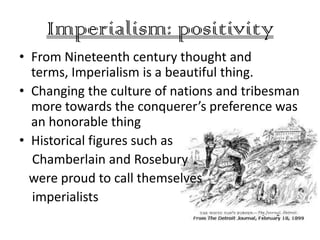
• Historical figures such as
  Chamberlain and Rosebury
  were proud to call themselves
  imperialists
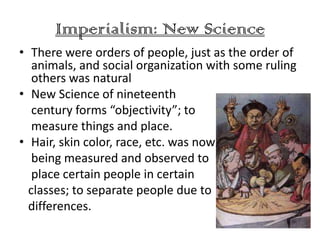
Imperialism: New Science
• There were orders of people, just as the order of
   animals, and social organization with some ruling
   others was natural
• New Science of nineteenth
   century forms “objectivity”; to
   measure things and place.
• Hair, skin color, race, etc. was now
   being measured and observed to
   place certain people in certain
  classes; to separate people due to
  differences.
Imperialism: relativity
• Tribes—such as the Maori or Navajo—
  hadn’t called themselves what they’re
  known as today until the Europeans
  coined the phrases
• Near-East, Far-East, and Middle-East
   were relative to European maps
• Latin American became the portion of map where
   Spanish and Portuguese were spoken because
   Americans decided though even though French-
   Canadians considered themselves Latin.
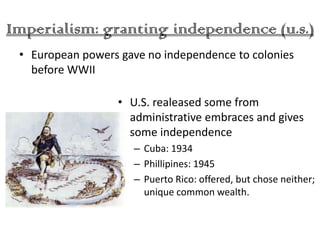
Imperialism: granting independence (u.s.)
 • European powers gave no independence to colonies
   before WWII

                  • U.S. realeased some from
                    administrative embraces and gives
                    some independence
                     – Cuba: 1934
                     – Phillipines: 1945
                     – Puerto Rico: offered, but chose neither;
                       unique common wealth.
Globalization: Modern American
             Empire
• Political figures use phrases to suggest at, but
  not quite say, existence as an imperial empire;
  “sole super-power”, etc.
• Historians—Robert Kaplan, Charles
  Krauthammer, Dinesh D’Souza—agree
  America is an empire
• Kaplan: “future historians will look back on
  21st-century U.S. as an empire and a Republic”
Globalization: Hegemony
• Term originally used to describe Athens
  compared to other Greek-city states; they led
  but did not rule over
• “hegemon’s dilemma”: U.S. faced the same
  obstacle the British seemed to have in 1914;
  whether to keep up(economically) via
  protectionist policies or stick to free-trade and
  risk decline
• Problematic defining of “hegemony” and
  “empire” due to definition of “direct rule”
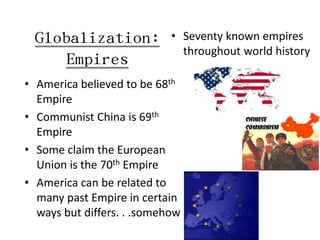
Globalization:            • Seventy known empires
                              throughout world history
     Empires
• America believed to be 68th
  Empire
• Communist China is 69th
  Empire
• Some claim the European
  Union is the 70th Empire
• America can be related to
  many past Empire in certain
  ways but differs. . .somehow
Globalization: Soft Power
• Globalization is essentially American-centric; It helps
   that America trends are geared to multi-ethnic
   audiences which rest of world can relate to.
• “Soft Power”: the ability to have dominance over others
   without force; entices others.
• Some things America enforces,
  other countries simply can’t
  refuse but to copy; Secure
  FDA regulations, security
 and fraudulent laws,
 Internet governing, etc.
Globalization: Not For Everyone
     Globalization—worldwide networks of interdependence
•   :Does not imply universality, equity, or homogenization
•   Most people do not have telephones
•   Americans use the Internet most
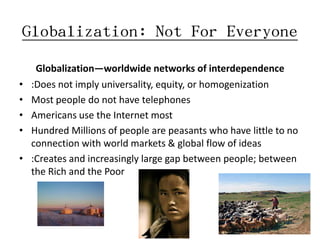
•   Hundred Millions of people are peasants who have little to no
    connection with world markets & global flow of ideas
•   :Creates and increasingly large gap between people; between
    the Rich and the Poor

Comparitive

  • 1.
    Comparitive History “Imperialism wasa practice, colonialism was a state of mind” Joshua M. Holloway
  • 2.
    Imperialism: U.K. vs.U.S. • While European empires had to go over seas and to distant lands to conquer more empires while America’s first empire was at hand— west of Missourri. • American had more of a continentalism rather than an imperialism. • Eventually, when mainland was mostly accounted for, America went across seas to “colonize” islands such as the Phillipines, Hawaii, Cuba, etc.
  • 3.
    Imperialism: positivity • FromNineteenth century thought and terms, Imperialism is a beautiful thing. • Changing the culture of nations and tribesman more towards the conquerer’s preference was an honorable thing • Historical figures such as Chamberlain and Rosebury were proud to call themselves imperialists
  • 4.
    Imperialism: New Science •There were orders of people, just as the order of animals, and social organization with some ruling others was natural • New Science of nineteenth century forms “objectivity”; to measure things and place. • Hair, skin color, race, etc. was now being measured and observed to place certain people in certain classes; to separate people due to differences.
  • 5.
    Imperialism: relativity • Tribes—suchas the Maori or Navajo— hadn’t called themselves what they’re known as today until the Europeans coined the phrases • Near-East, Far-East, and Middle-East were relative to European maps • Latin American became the portion of map where Spanish and Portuguese were spoken because Americans decided though even though French- Canadians considered themselves Latin.
  • 6.
    Imperialism: granting independence(u.s.) • European powers gave no independence to colonies before WWII • U.S. realeased some from administrative embraces and gives some independence – Cuba: 1934 – Phillipines: 1945 – Puerto Rico: offered, but chose neither; unique common wealth.
  • 7.
    Globalization: Modern American Empire • Political figures use phrases to suggest at, but not quite say, existence as an imperial empire; “sole super-power”, etc. • Historians—Robert Kaplan, Charles Krauthammer, Dinesh D’Souza—agree America is an empire • Kaplan: “future historians will look back on 21st-century U.S. as an empire and a Republic”
  • 8.
    Globalization: Hegemony • Termoriginally used to describe Athens compared to other Greek-city states; they led but did not rule over • “hegemon’s dilemma”: U.S. faced the same obstacle the British seemed to have in 1914; whether to keep up(economically) via protectionist policies or stick to free-trade and risk decline • Problematic defining of “hegemony” and “empire” due to definition of “direct rule”
  • 9.
    Globalization: • Seventy known empires throughout world history Empires • America believed to be 68th Empire • Communist China is 69th Empire • Some claim the European Union is the 70th Empire • America can be related to many past Empire in certain ways but differs. . .somehow
  • 10.
    Globalization: Soft Power •Globalization is essentially American-centric; It helps that America trends are geared to multi-ethnic audiences which rest of world can relate to. • “Soft Power”: the ability to have dominance over others without force; entices others. • Some things America enforces, other countries simply can’t refuse but to copy; Secure FDA regulations, security and fraudulent laws, Internet governing, etc.
  • 11.
    Globalization: Not ForEveryone Globalization—worldwide networks of interdependence • :Does not imply universality, equity, or homogenization • Most people do not have telephones • Americans use the Internet most • Hundred Millions of people are peasants who have little to no connection with world markets & global flow of ideas • :Creates and increasingly large gap between people; between the Rich and the Poor