1
TTwwoo mmuullttiillaatteerraall oorrggaanniissaattiioonnss
ddeeaalliinngg wwiitthh ttrraaddee::
UNCTAD and WTO
MMoorree ddiiffffeerreenncceess tthhaann ssiimmiillaarriittiieess
Manuela Tortora
Chief, Technical Cooperation
UNCTAD
2
TTHHEE DDIIFFFFEERREENNCCEESS LLIIEE OONN::
• The oorriiggiinnss of both organisations
• Their mmaannddaatteess
• The institutional functioning
• Their thinking on trade and development
3
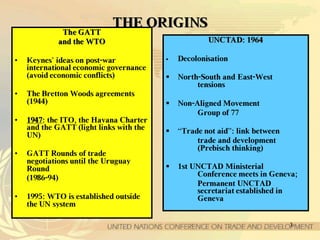
TTHHEE OORRIIGGIINNSS
TThhee GGAATTTT
aanndd tthhee WWTTOO
• Keynes’ ideas on post-war
international economic governance
(avoid economic conflicts)
• The Bretton Woods agreements
(1944)
• 11994477: the ITO, the Havana Charter
and the GATT (light links with the
UN)
• GATT Rounds of trade
negotiations until the Uruguay
Round
(1986-94)
• 1995: WTO is established outside
the UN system
UUNNCCTTAADD:: 11996644
 Decolonisation
 North-South and East-West
tensions
 Non-Aligned Movement
Group of 77
 “Trade not aid”: link between
trade and development
(Prebisch thinking)
 1st UNCTAD Ministerial
Conference meets in Geneva;
Permanent UNCTAD
secretariat established in
Geneva
44
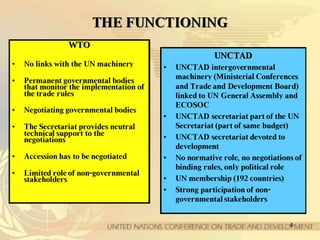
TTHHEE FFUUNNCCTTIIOONNIINNGG
WWTTOO
• No links with the UN machinery
• Permanent governmental bodies
that monitor the implementation of
the trade rules
• Negotiating governmental bodies
• The Secretariat provides neutral
technical support to the
negotiations
• Accession has to be negotiated
• Limited role of non-governmental
stakeholders
UUNNCCTTAADD
• UNCTAD intergovernmental
machinery (Ministerial Conferences
and Trade and Development Board)
linked to UN General Assembly and
ECOSOC
• UNCTAD secretariat part of the UN
Secretariat (part of same budget)
• UNCTAD secretariat devoted to
development
• No normative role, no negotiations of
binding rules, only political role
• UN membership (192 countries)
• Strong participation of non-
governmental stakeholders
5
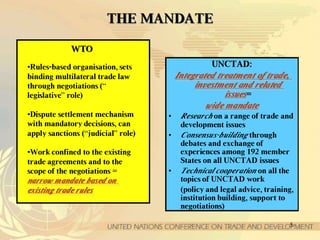
TTHHEE MMAANNDDAATTEE
UUNNCCTTAADD::
IInntteeggrraatteedd ttrreeaattmmeenntt ooff ttrraaddee,,
iinnvveessttmmeenntt aanndd rreellaatteedd
iissssuueess==
wwiiddee mmaannddaattee
• Research on a range of trade and
development issues
• Consensus-building through
debates and exchange of
experiences among 192 member
States on all UNCTAD issues
• Technical cooperation on all the
topics of UNCTAD work
(policy and legal advice, training,
institution building, support to
negotiations)
WWTTOO
•Rules-based organisation, sets
binding multilateral trade law
through negotiations (“
legislative” role)
•Dispute settlement mechanism
with mandatory decisions, can
apply sanctions (“judicial” role)
•Work confined to the existing
trade agreements and to the
scope of the negotiations =
nnaarrrrooww mmaannddaattee bbaasseedd oonn
eexxiissttiinngg ttrraaddee rruulleess
6
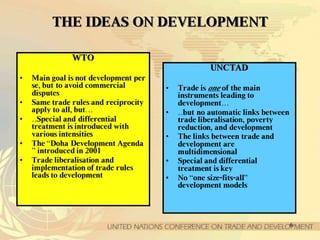
TTHHEE IIDDEEAASS OONN DDEEVVEELLOOPPMMEENNTT
WWTTOO
• Main goal is not development per
se, but to avoid commercial
disputes
• Same trade rules and reciprocity
apply to all, but…
• …Special and differential
treatment is introduced with
various intensities
• The “Doha Development Agenda
” introduced in 2001
• Trade liberalisation and
implementation of trade rules
leads to development
UUNNCCTTAADD
• Trade is one of the main
instruments leading to
development…
• …but no automatic links between
trade liberalisation, poverty
reduction, and development
• The links between trade and
development are
multidimensional
• Special and differential
treatment is key
• No “one size-fits-all”
development models
7
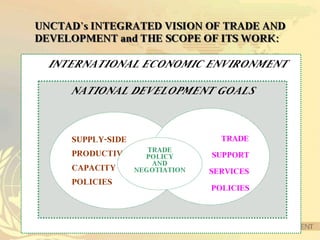
UUNNCCTTAADD’’ss IINNTTEEGGRRAATTEEDD VVIISSIIOONN OOFF TTRRAADDEE AANNDD
DDEEVVEELLOOPPMMEENNTT aanndd TTHHEE SSCCOOPPEE OOFF IITTSS WWOORRKK::
INTERNATIONAL ECONOMIC ENVIRONMENT
NATIONAL DEVELOPMENT GOALS
SUPPLY-SIDE
PRODUCTIVE
CAPACITY
POLICIES
TRADE
SUPPORT
SERVICES
POLICIES
TRADE
POLICY
AND
NEGOTIATION
8
SSOOMMEE UUNNCCTTAADD IIDDEEAASS
• Special and differential treatment and recognition of different levels
of development (including trade preferences)
• Identify the development content and impact of trade negotiations
• Need for a development-friendly coherence between the
international financial and trading systems
• Development impact of bilateral and regional trade and investment
agreements
• Enhance endogenous capacities and homegrown development
policies
• Links between investment, science and technology, ICTs and trade
flows
• Role of commodities in international trade
• Development-friendly structure of the GATS
• LDCs’ terms of WTO accession
• Need for debt reduction and debt sustainability
• Role of competition law and policies in development processes
• Traditional work on trade facilitation and related issues
• Research on non-trade barriers
9
TTHHAANNKK YYOOUU !!
www.unctad.org

Comparison UNCTAD and WTO.

  • 1.
    1 TTwwoo mmuullttiillaatteerraall oorrggaanniissaattiioonnss ddeeaalliinnggwwiitthh ttrraaddee:: UNCTAD and WTO MMoorree ddiiffffeerreenncceess tthhaann ssiimmiillaarriittiieess Manuela Tortora Chief, Technical Cooperation UNCTAD
  • 2.
    2 TTHHEE DDIIFFFFEERREENNCCEESS LLIIEEOONN:: • The oorriiggiinnss of both organisations • Their mmaannddaatteess • The institutional functioning • Their thinking on trade and development
  • 3.
    3 TTHHEE OORRIIGGIINNSS TThhee GGAATTTT aannddtthhee WWTTOO • Keynes’ ideas on post-war international economic governance (avoid economic conflicts) • The Bretton Woods agreements (1944) • 11994477: the ITO, the Havana Charter and the GATT (light links with the UN) • GATT Rounds of trade negotiations until the Uruguay Round (1986-94) • 1995: WTO is established outside the UN system UUNNCCTTAADD:: 11996644  Decolonisation  North-South and East-West tensions  Non-Aligned Movement Group of 77  “Trade not aid”: link between trade and development (Prebisch thinking)  1st UNCTAD Ministerial Conference meets in Geneva; Permanent UNCTAD secretariat established in Geneva
  • 4.
    44 TTHHEE FFUUNNCCTTIIOONNIINNGG WWTTOO • Nolinks with the UN machinery • Permanent governmental bodies that monitor the implementation of the trade rules • Negotiating governmental bodies • The Secretariat provides neutral technical support to the negotiations • Accession has to be negotiated • Limited role of non-governmental stakeholders UUNNCCTTAADD • UNCTAD intergovernmental machinery (Ministerial Conferences and Trade and Development Board) linked to UN General Assembly and ECOSOC • UNCTAD secretariat part of the UN Secretariat (part of same budget) • UNCTAD secretariat devoted to development • No normative role, no negotiations of binding rules, only political role • UN membership (192 countries) • Strong participation of non- governmental stakeholders
  • 5.
    5 TTHHEE MMAANNDDAATTEE UUNNCCTTAADD:: IInntteeggrraatteedd ttrreeaattmmeennttooff ttrraaddee,, iinnvveessttmmeenntt aanndd rreellaatteedd iissssuueess== wwiiddee mmaannddaattee • Research on a range of trade and development issues • Consensus-building through debates and exchange of experiences among 192 member States on all UNCTAD issues • Technical cooperation on all the topics of UNCTAD work (policy and legal advice, training, institution building, support to negotiations) WWTTOO •Rules-based organisation, sets binding multilateral trade law through negotiations (“ legislative” role) •Dispute settlement mechanism with mandatory decisions, can apply sanctions (“judicial” role) •Work confined to the existing trade agreements and to the scope of the negotiations = nnaarrrrooww mmaannddaattee bbaasseedd oonn eexxiissttiinngg ttrraaddee rruulleess
  • 6.
    6 TTHHEE IIDDEEAASS OONNDDEEVVEELLOOPPMMEENNTT WWTTOO • Main goal is not development per se, but to avoid commercial disputes • Same trade rules and reciprocity apply to all, but… • …Special and differential treatment is introduced with various intensities • The “Doha Development Agenda ” introduced in 2001 • Trade liberalisation and implementation of trade rules leads to development UUNNCCTTAADD • Trade is one of the main instruments leading to development… • …but no automatic links between trade liberalisation, poverty reduction, and development • The links between trade and development are multidimensional • Special and differential treatment is key • No “one size-fits-all” development models
  • 7.
    7 UUNNCCTTAADD’’ss IINNTTEEGGRRAATTEEDD VVIISSIIOONNOOFF TTRRAADDEE AANNDD DDEEVVEELLOOPPMMEENNTT aanndd TTHHEE SSCCOOPPEE OOFF IITTSS WWOORRKK:: INTERNATIONAL ECONOMIC ENVIRONMENT NATIONAL DEVELOPMENT GOALS SUPPLY-SIDE PRODUCTIVE CAPACITY POLICIES TRADE SUPPORT SERVICES POLICIES TRADE POLICY AND NEGOTIATION
  • 8.
    8 SSOOMMEE UUNNCCTTAADD IIDDEEAASS •Special and differential treatment and recognition of different levels of development (including trade preferences) • Identify the development content and impact of trade negotiations • Need for a development-friendly coherence between the international financial and trading systems • Development impact of bilateral and regional trade and investment agreements • Enhance endogenous capacities and homegrown development policies • Links between investment, science and technology, ICTs and trade flows • Role of commodities in international trade • Development-friendly structure of the GATS • LDCs’ terms of WTO accession • Need for debt reduction and debt sustainability • Role of competition law and policies in development processes • Traditional work on trade facilitation and related issues • Research on non-trade barriers
  • 9.