International Research Journal of Engineering and Technology (IRJET) e-ISSN: 2395-0056
Volume: 04 Issue: 07 | July -2017 www.irjet.net p-ISSN: 2395-0072
© 2017, IRJET | Impact Factor value: 5.181 | ISO 9001:2008 Certified Journal | Page 3388
COMPARISON OF PERFORMANCE OF NON METALLIC FIBRE REINFORCED
CONCRETE AND PLAIN CEMENT CONCRETE
Madhuri M1, Jaya chandra K2 , Balakrishna Bharath B3
1PG Student, Department of structural Engineering, Sree Rama Engineering college, Andhra pradesh, India
2Professor & Principalr, Department of structural Engineering, Sree Rama Engineering college, Andhra pradesh, India
3Assisstant Professor, Department of structural Engineering, Sree Rama Engineering college, Andhra pradesh, India
-------------------------------------------------------------------------***------------------------------------------------------------------------
Abstract: If properly designed, constructed and maintained,
reinforced or pre-stressed concrete structures are generally
very durable. However, for structures in aggressive
environment , corrosion of steel can be significant problem.
Examples of structures that may be particularly at risk
include marine structures, bridges subjected to de-icing salts
and industrial buildings. In the last decade, there has been a
considerable increase in interest in the use of non-metallic
reinforcement to cope with this corrosion problem at many
institution, advanced composite reinforcing materials have
been developed, typically consisting of align continuous
fibers embedded in resin and shaped to form beams and
slabs, grid shape structures.
Synthetic fibers used in our study are Polypropylene
and Polyester. Recron Fibers are engineered micro fibers
with a unique “Triangular” Cross-section, used as secondary
reinforcement of Concrete. It complements Structural Steel
in enhancing Concrete’s resistance to shrinkage cracking
and improves mechanical properties such as Flexural / Split
Tensile and transverse Strengths of Concrete along with the
desired improvement in Abrasion and Impact Strengths.
Compressive strength test and flexural strength
tests was conducted on the cubical and beam specimens
respectively for all the mixes at different curing periods as
per IS 516 (1991). Three cubes of size 150 mm x 150 x 150
mm were cast and tested for compressive strength.
Key Words: Fibre Reinforced Concrete, Polypropylene
Fibre, Polyster Fibre, Flexural strength and Sorptivity test.
1.INTRODUCTION
Transportation contributes to the economic, industrial,
social and cultural development of a country. Even though
there are four modes of transportation, namely, roadways,
railways, waterways and airways the transportation by
road is the only mode which can give maximum service to
one and all. This mode has maximum flexibility for travel
with reference to route, direction, time and speed of travel
etc. Therefore the construction of roads and its
maintenance has got much importance than other modes
of transportation.
2.FIBER REINFORCED CONCRETE
Plain concrete possesses a very low tensile
strength, limited ductility and little resistance to cracking.
Internal micro cracks are inherently present in the
concrete and its poor strength is due to the propagation of
such micro cracks, eventually leading to brittle fracture of
the concrete.
In plain concrete and similar brittle materials,
structural cracks (micro-cracks) develop even before
loading, particularly due to drying shrinkage or other
causes of volume change. The width of these initial cracks
seldom exceeds a few microns, but their other two
dimensions may be of higher magnitude.
When loaded, the micro cracks propagate and
open up, and owing to the effect of stress concentration,
additional cracks form in places of minor defects. The
structural cracks proceed slowly or by tiny jumps because
they are retarded by various obstacles, change of direction
in bypassing the more resistant grains in matrix. The
development of such micro cracks is the main cause of
inelastic deformations in concrete.
It has been recognized that the addition of small,
closely spaced and uniformly dispersed fibers to concrete
would act as crack arrester and would substantially
improve its static and dynamic properties. This type of
concrete is known as Fiber Reinforced Concrete.
Fiber reinforced concrete can be defined as a
“composite material consisting of mixtures of cement
mortar or concrete and discontinuous, discrete, uniformly
dispersed suitable fibers”.
The concept of using fibers as reinforcement is not
new. Fibers have been used as reinforcement since ancient
times. Historically, horsehair was used the concept
of composite materials came into being and fiber-
reinforced concrete was one of the topics of interest. Once
the health risks associated with asbestos were discovered,
there was a need to find a replacement for the substance in
concrete and other building materials. By the
International Research Journal of Engineering and Technology (IRJET) e-ISSN: 2395-0056
Volume: 04 Issue: 07 | July -2017 www.irjet.net p-ISSN: 2395-0072
© 2017, IRJET | Impact Factor value: 5.181 | ISO 9001:2008 Certified Journal | Page 3389
1960s, steel, glass (GFRC), and synthetic fibers such
as polypropylene fibers were used in concrete. Research
into new fiber-reinforced concretes continues today.
3.MATERIALS USED
The materials used for the preparation of concrete
samples were cement, water, aggregates, water reducing
agent admixture and the fibers.
3.1 Cement
Penna cement 53 grade as per specified IS-269:1989
.
Table -1: Properties of Cement
Specific gravity 3.15
Fineness of cement 225 m2/kg
Initial setting time 30 min
Final setting time 600 min
3.2 Coarse Aggregates
Aggregates which retain on 4.75 mm sieve
Grading of CA is supplied in nominal sizes.
Granite, angular crushed of maximum size 20 mm
confirming to is-383:1970 is used.
Proportions of other sizes are determined as per is-
2386:1986.
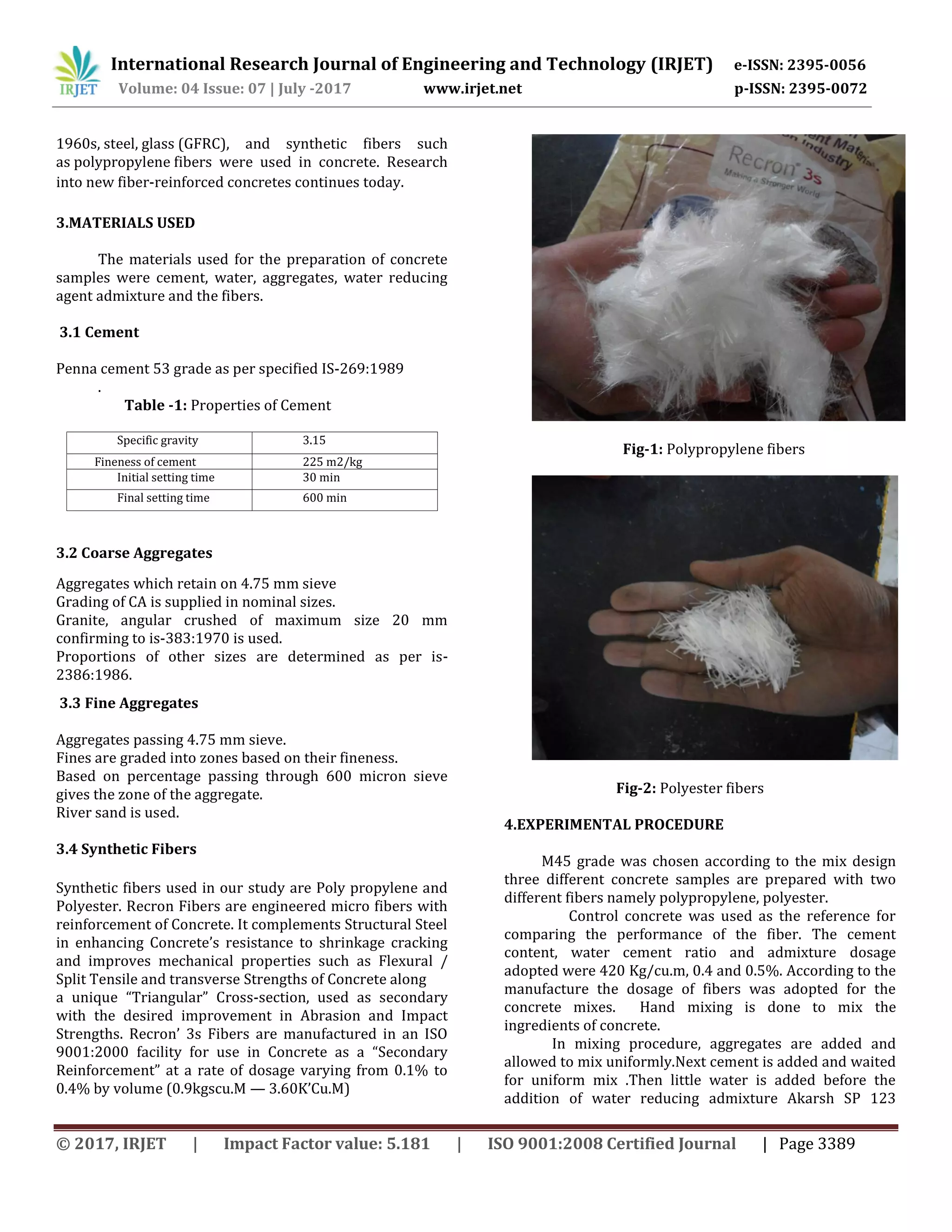
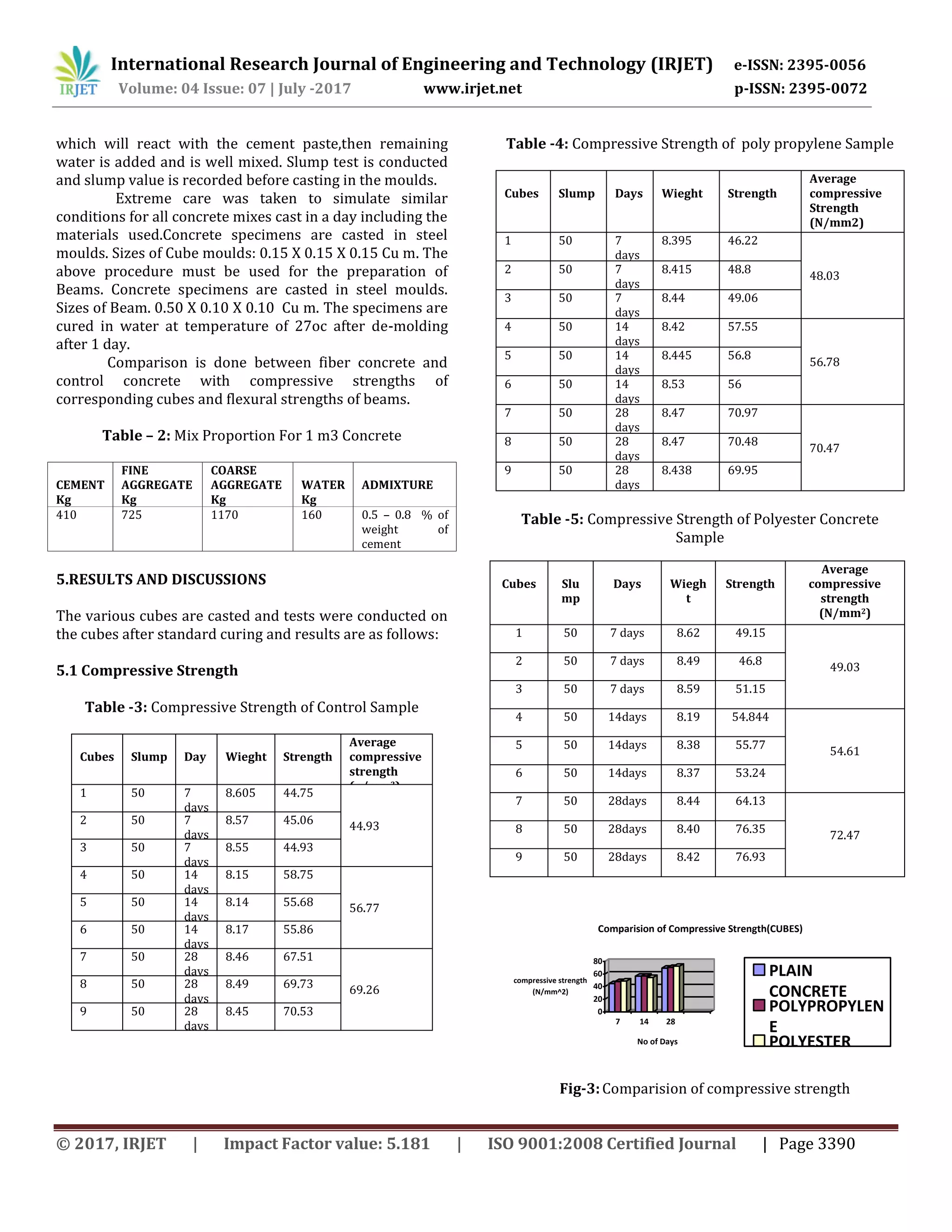
Synthetic fibers used in our study are Poly propylene and
Polyester. Recron Fibers are engineered micro fibers with
reinforcement of Concrete. It complements Structural Steel
in enhancing Concrete’s resistance to shrinkage cracking
and improves mechanical properties such as Flexural /
Split Tensile and transverse Strengths of Concrete along
a unique “Triangular” Cross-section, used as secondary
with the desired improvement in Abrasion and Impact
Strengths. Recron’ 3s Fibers are manufactured in an ISO
9001:2000 facility for use in Concrete as a “Secondary
Reinforcement” at a rate of dosage varying from 0.1% to
0.4% by volume (0.9kgscu.M — 3.60K’Cu.M)
Fig-1: Polypropylene fibers
Fig-2: Polyester fibers
4.EXPERIMENTAL PROCEDURE
M45 grade was chosen according to the mix design
three different concrete samples are prepared with two
different fibers namely polypropylene, polyester.
Control concrete was used as the reference for
comparing the performance of the fiber. The cement
content, water cement ratio and admixture dosage
adopted were 420 Kg/cu.m, 0.4 and 0.5%. According to the
manufacture the dosage of fibers was adopted for the
concrete mixes. Hand mixing is done to mix the
ingredients of concrete.
In mixing procedure, aggregates are added and
allowed to mix uniformly.Next cement is added and waited
for uniform mix .Then little water is added before the
addition of water reducing admixture Akarsh SP 123
3.3 Fine Aggregates
Aggregates passing 4.75 mm sieve.
Fines are graded into zones based on their fineness.
Based on percentage passing through 600 micron sieve
gives the zone of the aggregate.
River sand is used.
3.4 Synthetic Fibers
International Research Journal of Engineering and Technology (IRJET) e-ISSN: 2395-0056
Volume: 04 Issue: 07 | July -2017 www.irjet.net p-ISSN: 2395-0072
© 2017, IRJET | Impact Factor value: 5.181 | ISO 9001:2008 Certified Journal | Page 3390
which will react with the cement paste,then remaining
water is added and is well mixed. Slump test is conducted
and slump value is recorded before casting in the moulds.
Extreme care was taken to simulate similar
conditions for all concrete mixes cast in a day including the
materials used.Concrete specimens are casted in steel
moulds. Sizes of Cube moulds: 0.15 X 0.15 X 0.15 Cu m. The
above procedure must be used for the preparation of
Beams. Concrete specimens are casted in steel moulds.
Sizes of Beam. 0.50 X 0.10 X 0.10 Cu m. The specimens are
cured in water at temperature of 27oc after de-molding
after 1 day.
Comparison is done between fiber concrete and
control concrete with compressive strengths of
corresponding cubes and flexural strengths of beams.
Table – 2: Mix Proportion For 1 m3 Concrete
CEMENT
Kg
FINE
AGGREGATE
Kg
COARSE
AGGREGATE
Kg
WATER
Kg
ADMIXTURE
410 725 1170 160 0.5 – 0.8 % of
weight of
cement
5.RESULTS AND DISCUSSIONS
The various cubes are casted and tests were conducted on
the cubes after standard curing and results are as follows:
5.1 Compressive Strength
Table -3: Compressive Strength of Control Sample
Cubes Slump Day Wieght Strength
Average
compressive
strength
(n/mm2)
1 50 7
days
8.605 44.75
44.932 50 7
days
8.57 45.06
3 50 7
days
8.55 44.93
4 50 14
days
8.15 58.75
56.775 50 14
days
8.14 55.68
6 50 14
days
8.17 55.86
7 50 28
days
8.46 67.51
69.268 50 28
days
8.49 69.73
9 50 28
days
8.45 70.53
Table -4: Compressive Strength of poly propylene Sample
Cubes Slump Days Wieght Strength
Average
compressive
Strength
(N/mm2)
1 50 7
days
8.395 46.22
48.03
2 50 7
days
8.415 48.8
3 50 7
days
8.44 49.06
4 50 14
days
8.42 57.55
56.78
5 50 14
days
8.445 56.8
6 50 14
days
8.53 56
7 50 28
days
8.47 70.97
70.47
8 50 28
days
8.47 70.48
9 50 28
days
8.438 69.95
Table -5: Compressive Strength of Polyester Concrete
Sample
0
20
40
60
80
compressive strength
(N/mm^2)
7 14 28
No of Days
Comparision of Compressive Strength(CUBES)
PLAIN
CONCRETE
POLYPROPYLEN
E
POLYESTER
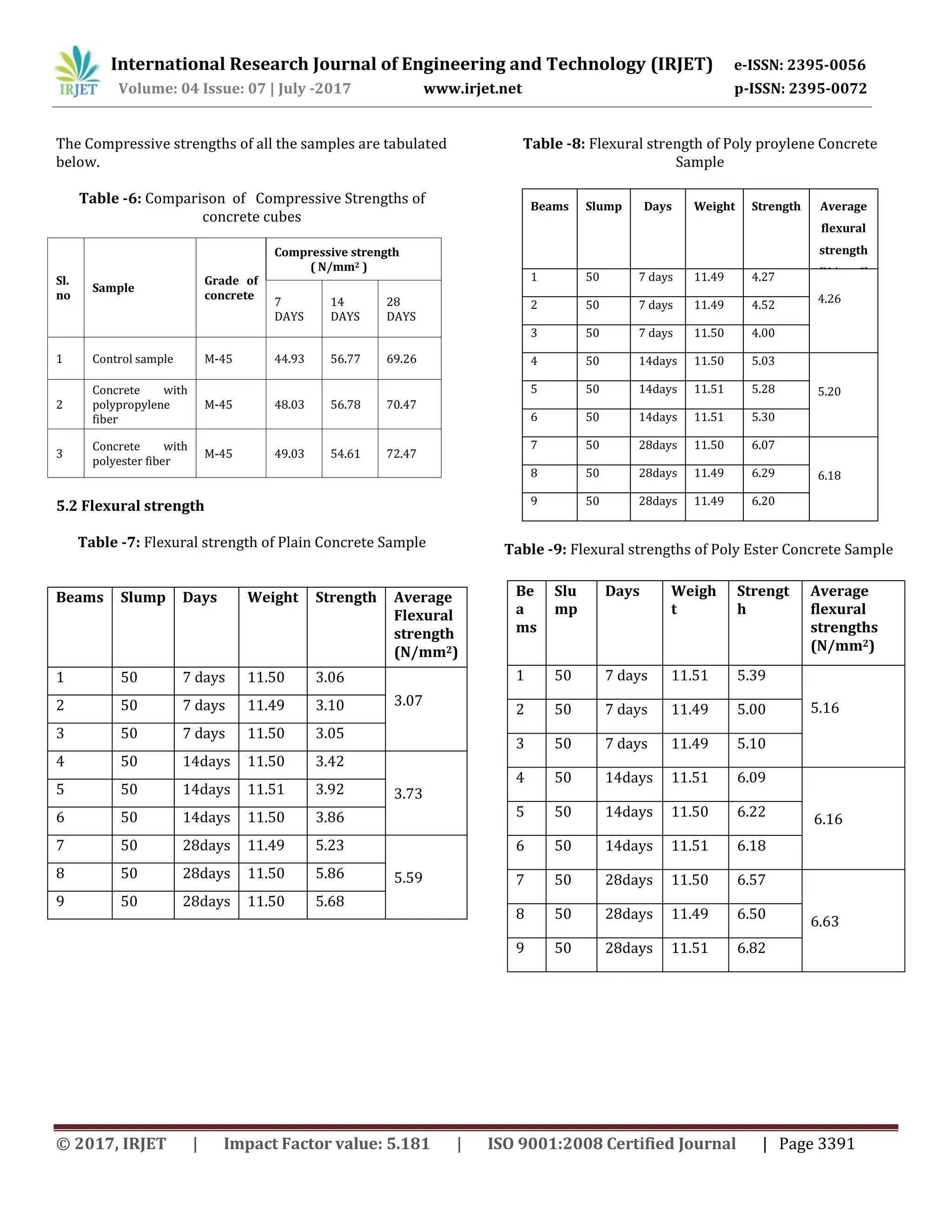
Fig-3:Comparision of compressive strength
Cubes Slu
mp
Days Wiegh
t
Strength
Average
compressive
strength
(N/mm2)
1 50 7 days 8.62 49.15
49.03
2 50 7 days 8.49 46.8
3 50 7 days 8.59 51.15
4 50 14days 8.19 54.844
54.61
5 50 14days 8.38 55.77
6 50 14days 8.37 53.24
7 50 28days 8.44 64.13
72.47
8 50 28days 8.40 76.35
9 50 28days 8.42 76.93
International Research Journal of Engineering and Technology (IRJET) e-ISSN: 2395-0056
Volume: 04 Issue: 07 | July -2017 www.irjet.net p-ISSN: 2395-0072
© 2017, IRJET | Impact Factor value: 5.181 | ISO 9001:2008 Certified Journal | Page 3391
The Compressive strengths of all the samples are tabulated
below.
Table -6: Comparison of Compressive Strengths of
concrete cubes
5.2 Flexural strength
Table -7: Flexural strength of Plain Concrete Sample
Table -8: Flexural strength of Poly proylene Concrete
Sample
Beams Slump Days Weight Strength Average
flexural
strength
(N/mm2)1 50 7 days 11.49 4.27
4.262 50 7 days 11.49 4.52
3 50 7 days 11.50 4.00
4 50 14days 11.50 5.03
5.205 50 14days 11.51 5.28
6 50 14days 11.51 5.30
7 50 28days 11.50 6.07
6.188 50 28days 11.49 6.29
9 50 28days 11.49 6.20
Table -9: Flexural strengths of Poly Ester Concrete Sample
Sl.
no
Sample
Grade of
concrete
Compressive strength
( N/mm2 )
7
DAYS
14
DAYS
28
DAYS
1 Control sample M-45 44.93 56.77 69.26
2
Concrete with
polypropylene
fiber
M-45 48.03 56.78 70.47
3
Concrete with
polyester fiber
M-45 49.03 54.61 72.47
Beams Slump Days Weight Strength Average
Flexural
strength
(N/mm2)
1 50 7 days 11.50 3.06
3.072 50 7 days 11.49 3.10
3 50 7 days 11.50 3.05
4 50 14days 11.50 3.42
3.735 50 14days 11.51 3.92
6 50 14days 11.50 3.86
7 50 28days 11.49 5.23
5.598 50 28days 11.50 5.86
9 50 28days 11.50 5.68
Be
a
ms
Slu
mp
Days Weigh
t
Strengt
h
Average
flexural
strengths
(N/mm2)
1 50 7 days 11.51 5.39
5.162 50 7 days 11.49 5.00
3 50 7 days 11.49 5.10
4 50 14days 11.51 6.09
6.165 50 14days 11.50 6.22
6 50 14days 11.51 6.18
7 50 28days 11.50 6.57
6.638 50 28days 11.49 6.50
9 50 28days 11.51 6.82
International Research Journal of Engineering and Technology (IRJET) e-ISSN: 2395-0056
Volume: 04 Issue: 07 | July -2017 www.irjet.net p-ISSN: 2395-0072
© 2017, IRJET | Impact Factor value: 5.181 | ISO 9001:2008 Certified Journal | Page 3392
The flexural strengths of all the samples are tabulated
below:
Table -10: Comparison of Flexural Strengths of concrete
beams
5.3 Split tensile strength
Table -11: Split tensile strength of FRC
Sl.n
o
Sample
Grade of
concrete
Flexural strength
( N/mm2 )
7
days
14
days
28
days
1 Control sample M-45 3.07 3.73 5.59
2
Concrete with
polypropylene fiber
M-45 4.26 5.20 6.18
3
Concrete with
polyester fiber
M-45 5.16 6.16 6.63
0
2
4
6
8
Flexural
STRENGTH
(MPa)
7 14 28
No of Days
COMPARISION OF FLEXURAL STRENGTH (BEAMS)
PLAIN CONCRTE
POLYPROPYLENE
POLYESTER
Fig-4: Comparision of flexural strength
The compressive strength and flexural strength of
polyester has higher values when compared to other
samples and control sample has least value. The
compressive strength of the polyester reinforced concrete
is 72.47N/mm2 which is far better than required i.e.
45N/mm2 and the flexural strength is 6.63 N/mm2 which
is greater than control samples flexural strength. So
inclusion of polyester fibers in concrete increases not only
strength but also resists cracking which is far better than
required
,
% of Fibers
Age
(days)
Split tensile
strength
(MPa)
% Variation of split
tensile
strength of HFRC
over controlled
concrete
0
7
2.59 0
0.5 2.74 5.79
1 2.88 11.20
1.5 2.95 13.90
2 2.62 1.16
0
28
3.09 0
0.5 3.25 5.18
1 3.34 8.09
1.5 3.41 10.36
2 3.21 3.88
.
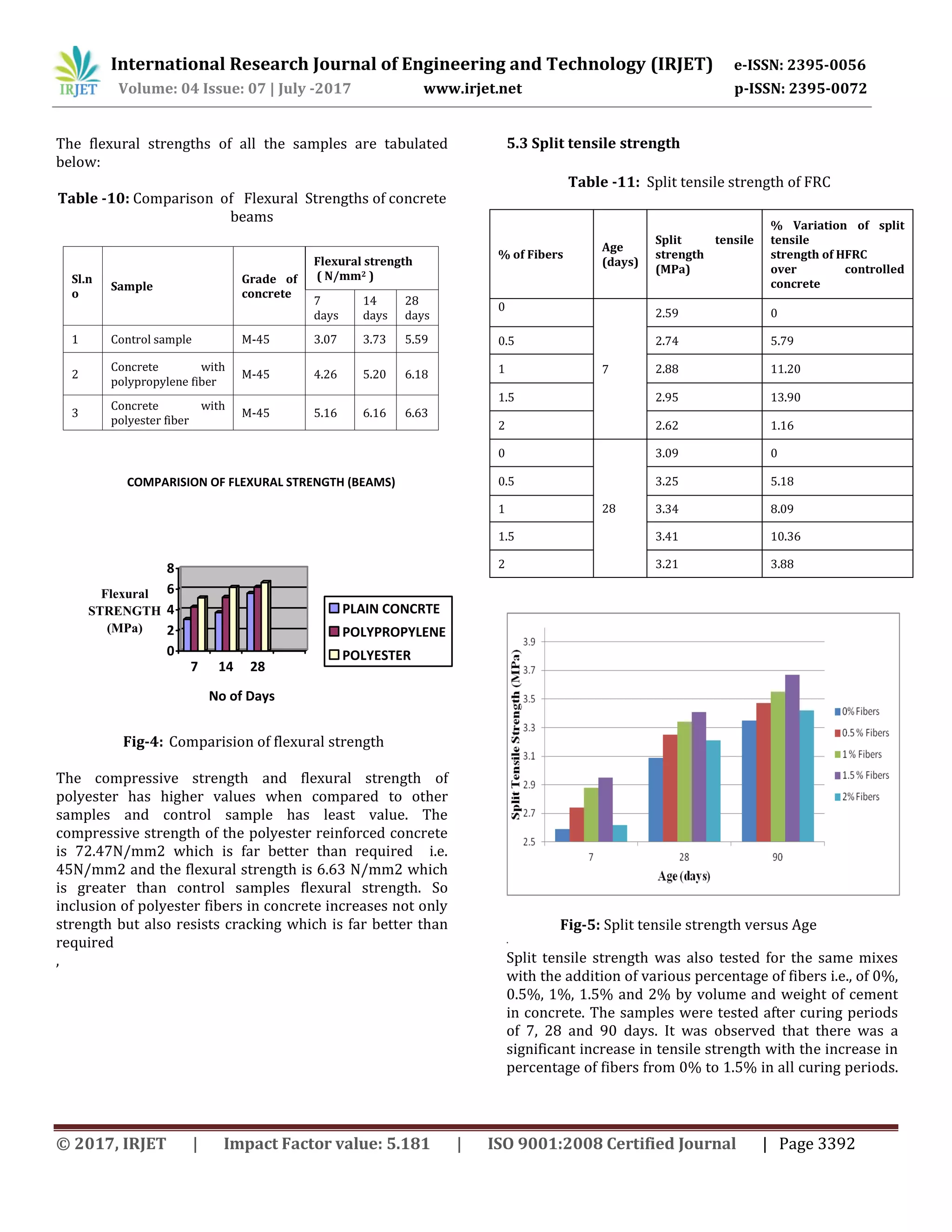
Fig-5: Split tensile strength versus Age
Split tensile strength was also tested for the same mixes
with the addition of various percentage of fibers i.e., of 0%,
0.5%, 1%, 1.5% and 2% by volume and weight of cement
in concrete. The samples were tested after curing periods
of 7, 28 and 90 days. It was observed that there was a
significant increase in tensile strength with the increase in
percentage of fibers from 0% to 1.5% in all curing periods.
International Research Journal of Engineering and Technology (IRJET) e-ISSN: 2395-0056
Volume: 04 Issue: 07 | July -2017 www.irjet.net p-ISSN: 2395-0072
© 2017, IRJET | Impact Factor value: 5.181 | ISO 9001:2008 Certified Journal | Page 3393
After 7 days of curing, 1.5% fibers sample exhibited a
tensile strength of 2.95 MPa, whereas after 28 days of
curing it was 3.41 MPa .
5.4 Sorptivity test
Table -12: Sorptivity test results of HFRC
%
Fibers
Dry weight
(gm)
Wet weight
(gm)
Sorptivity
(10-5
mm/min0.5 )
0 8108 8112 3.24
0.5 9036 9044 6.49
1.0 8624 8636 9.73
1.5 8642 8655 10.54
2 8672 8687 12.17
Fig-6: Comparision of sorptivity test on FRC
From the Table 8.0 and it is clear that the sorptivity values
have been increasing from 0% to 2%. At 0.5% fiber
percentage the sorptivity value is 3.24. As the fiber
percentage is increased from 0.5%, 1%, 1.5% and 2% the
values of sorptivity are 6.49, 9.73, 10.54 and 12.17
respectively. Finally I concluded that the percentage of
fibers influence the sorptivity of HFRC directly. Here, the
sorptivity values are in 10-5 mm/ min0.5
6.CONCLUSION
From the discussions it has been proved that the fiber-
reinforced concrete not only has capability to reduce the
cracks but also has capability of inducing additional
compressive strength to the concrete. Fiber reinforced
concrete utilization in pavements reduces the maintenance
cost by reducing the overall lifecycle cost though it has
high initial cost. The inclusion of fibers is more advantage
in case of pavements by reducing the crack formation and
also giving additional early compressive strength to the
concrete.
The concrete with Polyester fiber is most efficient in
inducing the additional strength to the concrete when
compared to other fibers.The concrete with Polyester fiber
is most economical when compared to other fibers.
So we conclude that the concrete with Polyester fiber is
the best fiber for Pavement Quality Concrete when
compared to Control plain sample and Polypropylene
fiber.
REFERENCES
[1] V. Bindiganavile and N. Banthia, “Polymer and
Steel Fiber Reinforced Cementitious Composites under
Impact Loading”, American Concrete Institute, Materials
Journal, Vol. 98,2001.
[2] A. Bentur, “Comprehensive Approach for the
Design of Concrete for Durability and Long Term
Performance of Structures”, University of British Columbia,
2005.
[3] Highway Engineering text book by S.K.Khanna and
C.E.G. Justho ,8th Edition Nem Chand & Brothers
Publications.
[4] Concrete Technology text book by M.S.Shetty, 6th
edition, S. Chand Publications.
[5] IS 12269:1987, Ordinary Portland Cement 53
Grade.
[6] IS 10086:1982, Specification for moulds for use in
tests of cement and concrete.
[7] IS 383:1970, Specification for Course and Fine
Aggregates from Natural Sources for Concrete.
[8] IS 9103:1999, Concrete Admixture Specification.
[9] IS 516:1959, Method of Testing Strength of
Concrete.
[10] IS 456:2000, Plain and Reinforced Concrete-Code
of Practice
[11] IS 10262:2009, Concrete Mix Proportioning
Guidelines.
[12] IS 516:1991 ,Flexural Strength of Concrete.

Comparison of Performance of Non Metallic Fibre Reinforced Concrete and Plain Cement Concrete

  • 1.
    International Research Journalof Engineering and Technology (IRJET) e-ISSN: 2395-0056 Volume: 04 Issue: 07 | July -2017 www.irjet.net p-ISSN: 2395-0072 © 2017, IRJET | Impact Factor value: 5.181 | ISO 9001:2008 Certified Journal | Page 3388 COMPARISON OF PERFORMANCE OF NON METALLIC FIBRE REINFORCED CONCRETE AND PLAIN CEMENT CONCRETE Madhuri M1, Jaya chandra K2 , Balakrishna Bharath B3 1PG Student, Department of structural Engineering, Sree Rama Engineering college, Andhra pradesh, India 2Professor & Principalr, Department of structural Engineering, Sree Rama Engineering college, Andhra pradesh, India 3Assisstant Professor, Department of structural Engineering, Sree Rama Engineering college, Andhra pradesh, India -------------------------------------------------------------------------***------------------------------------------------------------------------ Abstract: If properly designed, constructed and maintained, reinforced or pre-stressed concrete structures are generally very durable. However, for structures in aggressive environment , corrosion of steel can be significant problem. Examples of structures that may be particularly at risk include marine structures, bridges subjected to de-icing salts and industrial buildings. In the last decade, there has been a considerable increase in interest in the use of non-metallic reinforcement to cope with this corrosion problem at many institution, advanced composite reinforcing materials have been developed, typically consisting of align continuous fibers embedded in resin and shaped to form beams and slabs, grid shape structures. Synthetic fibers used in our study are Polypropylene and Polyester. Recron Fibers are engineered micro fibers with a unique “Triangular” Cross-section, used as secondary reinforcement of Concrete. It complements Structural Steel in enhancing Concrete’s resistance to shrinkage cracking and improves mechanical properties such as Flexural / Split Tensile and transverse Strengths of Concrete along with the desired improvement in Abrasion and Impact Strengths. Compressive strength test and flexural strength tests was conducted on the cubical and beam specimens respectively for all the mixes at different curing periods as per IS 516 (1991). Three cubes of size 150 mm x 150 x 150 mm were cast and tested for compressive strength. Key Words: Fibre Reinforced Concrete, Polypropylene Fibre, Polyster Fibre, Flexural strength and Sorptivity test. 1.INTRODUCTION Transportation contributes to the economic, industrial, social and cultural development of a country. Even though there are four modes of transportation, namely, roadways, railways, waterways and airways the transportation by road is the only mode which can give maximum service to one and all. This mode has maximum flexibility for travel with reference to route, direction, time and speed of travel etc. Therefore the construction of roads and its maintenance has got much importance than other modes of transportation. 2.FIBER REINFORCED CONCRETE Plain concrete possesses a very low tensile strength, limited ductility and little resistance to cracking. Internal micro cracks are inherently present in the concrete and its poor strength is due to the propagation of such micro cracks, eventually leading to brittle fracture of the concrete. In plain concrete and similar brittle materials, structural cracks (micro-cracks) develop even before loading, particularly due to drying shrinkage or other causes of volume change. The width of these initial cracks seldom exceeds a few microns, but their other two dimensions may be of higher magnitude. When loaded, the micro cracks propagate and open up, and owing to the effect of stress concentration, additional cracks form in places of minor defects. The structural cracks proceed slowly or by tiny jumps because they are retarded by various obstacles, change of direction in bypassing the more resistant grains in matrix. The development of such micro cracks is the main cause of inelastic deformations in concrete. It has been recognized that the addition of small, closely spaced and uniformly dispersed fibers to concrete would act as crack arrester and would substantially improve its static and dynamic properties. This type of concrete is known as Fiber Reinforced Concrete. Fiber reinforced concrete can be defined as a “composite material consisting of mixtures of cement mortar or concrete and discontinuous, discrete, uniformly dispersed suitable fibers”. The concept of using fibers as reinforcement is not new. Fibers have been used as reinforcement since ancient times. Historically, horsehair was used the concept of composite materials came into being and fiber- reinforced concrete was one of the topics of interest. Once the health risks associated with asbestos were discovered, there was a need to find a replacement for the substance in concrete and other building materials. By the
  • 2.
    International Research Journalof Engineering and Technology (IRJET) e-ISSN: 2395-0056 Volume: 04 Issue: 07 | July -2017 www.irjet.net p-ISSN: 2395-0072 © 2017, IRJET | Impact Factor value: 5.181 | ISO 9001:2008 Certified Journal | Page 3389 1960s, steel, glass (GFRC), and synthetic fibers such as polypropylene fibers were used in concrete. Research into new fiber-reinforced concretes continues today. 3.MATERIALS USED The materials used for the preparation of concrete samples were cement, water, aggregates, water reducing agent admixture and the fibers. 3.1 Cement Penna cement 53 grade as per specified IS-269:1989 . Table -1: Properties of Cement Specific gravity 3.15 Fineness of cement 225 m2/kg Initial setting time 30 min Final setting time 600 min 3.2 Coarse Aggregates Aggregates which retain on 4.75 mm sieve Grading of CA is supplied in nominal sizes. Granite, angular crushed of maximum size 20 mm confirming to is-383:1970 is used. Proportions of other sizes are determined as per is- 2386:1986. Synthetic fibers used in our study are Poly propylene and Polyester. Recron Fibers are engineered micro fibers with reinforcement of Concrete. It complements Structural Steel in enhancing Concrete’s resistance to shrinkage cracking and improves mechanical properties such as Flexural / Split Tensile and transverse Strengths of Concrete along a unique “Triangular” Cross-section, used as secondary with the desired improvement in Abrasion and Impact Strengths. Recron’ 3s Fibers are manufactured in an ISO 9001:2000 facility for use in Concrete as a “Secondary Reinforcement” at a rate of dosage varying from 0.1% to 0.4% by volume (0.9kgscu.M — 3.60K’Cu.M) Fig-1: Polypropylene fibers Fig-2: Polyester fibers 4.EXPERIMENTAL PROCEDURE M45 grade was chosen according to the mix design three different concrete samples are prepared with two different fibers namely polypropylene, polyester. Control concrete was used as the reference for comparing the performance of the fiber. The cement content, water cement ratio and admixture dosage adopted were 420 Kg/cu.m, 0.4 and 0.5%. According to the manufacture the dosage of fibers was adopted for the concrete mixes. Hand mixing is done to mix the ingredients of concrete. In mixing procedure, aggregates are added and allowed to mix uniformly.Next cement is added and waited for uniform mix .Then little water is added before the addition of water reducing admixture Akarsh SP 123 3.3 Fine Aggregates Aggregates passing 4.75 mm sieve. Fines are graded into zones based on their fineness. Based on percentage passing through 600 micron sieve gives the zone of the aggregate. River sand is used. 3.4 Synthetic Fibers
  • 3.
    International Research Journalof Engineering and Technology (IRJET) e-ISSN: 2395-0056 Volume: 04 Issue: 07 | July -2017 www.irjet.net p-ISSN: 2395-0072 © 2017, IRJET | Impact Factor value: 5.181 | ISO 9001:2008 Certified Journal | Page 3390 which will react with the cement paste,then remaining water is added and is well mixed. Slump test is conducted and slump value is recorded before casting in the moulds. Extreme care was taken to simulate similar conditions for all concrete mixes cast in a day including the materials used.Concrete specimens are casted in steel moulds. Sizes of Cube moulds: 0.15 X 0.15 X 0.15 Cu m. The above procedure must be used for the preparation of Beams. Concrete specimens are casted in steel moulds. Sizes of Beam. 0.50 X 0.10 X 0.10 Cu m. The specimens are cured in water at temperature of 27oc after de-molding after 1 day. Comparison is done between fiber concrete and control concrete with compressive strengths of corresponding cubes and flexural strengths of beams. Table – 2: Mix Proportion For 1 m3 Concrete CEMENT Kg FINE AGGREGATE Kg COARSE AGGREGATE Kg WATER Kg ADMIXTURE 410 725 1170 160 0.5 – 0.8 % of weight of cement 5.RESULTS AND DISCUSSIONS The various cubes are casted and tests were conducted on the cubes after standard curing and results are as follows: 5.1 Compressive Strength Table -3: Compressive Strength of Control Sample Cubes Slump Day Wieght Strength Average compressive strength (n/mm2) 1 50 7 days 8.605 44.75 44.932 50 7 days 8.57 45.06 3 50 7 days 8.55 44.93 4 50 14 days 8.15 58.75 56.775 50 14 days 8.14 55.68 6 50 14 days 8.17 55.86 7 50 28 days 8.46 67.51 69.268 50 28 days 8.49 69.73 9 50 28 days 8.45 70.53 Table -4: Compressive Strength of poly propylene Sample Cubes Slump Days Wieght Strength Average compressive Strength (N/mm2) 1 50 7 days 8.395 46.22 48.03 2 50 7 days 8.415 48.8 3 50 7 days 8.44 49.06 4 50 14 days 8.42 57.55 56.78 5 50 14 days 8.445 56.8 6 50 14 days 8.53 56 7 50 28 days 8.47 70.97 70.47 8 50 28 days 8.47 70.48 9 50 28 days 8.438 69.95 Table -5: Compressive Strength of Polyester Concrete Sample 0 20 40 60 80 compressive strength (N/mm^2) 7 14 28 No of Days Comparision of Compressive Strength(CUBES) PLAIN CONCRETE POLYPROPYLEN E POLYESTER Fig-3:Comparision of compressive strength Cubes Slu mp Days Wiegh t Strength Average compressive strength (N/mm2) 1 50 7 days 8.62 49.15 49.03 2 50 7 days 8.49 46.8 3 50 7 days 8.59 51.15 4 50 14days 8.19 54.844 54.61 5 50 14days 8.38 55.77 6 50 14days 8.37 53.24 7 50 28days 8.44 64.13 72.47 8 50 28days 8.40 76.35 9 50 28days 8.42 76.93
  • 4.
    International Research Journalof Engineering and Technology (IRJET) e-ISSN: 2395-0056 Volume: 04 Issue: 07 | July -2017 www.irjet.net p-ISSN: 2395-0072 © 2017, IRJET | Impact Factor value: 5.181 | ISO 9001:2008 Certified Journal | Page 3391 The Compressive strengths of all the samples are tabulated below. Table -6: Comparison of Compressive Strengths of concrete cubes 5.2 Flexural strength Table -7: Flexural strength of Plain Concrete Sample Table -8: Flexural strength of Poly proylene Concrete Sample Beams Slump Days Weight Strength Average flexural strength (N/mm2)1 50 7 days 11.49 4.27 4.262 50 7 days 11.49 4.52 3 50 7 days 11.50 4.00 4 50 14days 11.50 5.03 5.205 50 14days 11.51 5.28 6 50 14days 11.51 5.30 7 50 28days 11.50 6.07 6.188 50 28days 11.49 6.29 9 50 28days 11.49 6.20 Table -9: Flexural strengths of Poly Ester Concrete Sample Sl. no Sample Grade of concrete Compressive strength ( N/mm2 ) 7 DAYS 14 DAYS 28 DAYS 1 Control sample M-45 44.93 56.77 69.26 2 Concrete with polypropylene fiber M-45 48.03 56.78 70.47 3 Concrete with polyester fiber M-45 49.03 54.61 72.47 Beams Slump Days Weight Strength Average Flexural strength (N/mm2) 1 50 7 days 11.50 3.06 3.072 50 7 days 11.49 3.10 3 50 7 days 11.50 3.05 4 50 14days 11.50 3.42 3.735 50 14days 11.51 3.92 6 50 14days 11.50 3.86 7 50 28days 11.49 5.23 5.598 50 28days 11.50 5.86 9 50 28days 11.50 5.68 Be a ms Slu mp Days Weigh t Strengt h Average flexural strengths (N/mm2) 1 50 7 days 11.51 5.39 5.162 50 7 days 11.49 5.00 3 50 7 days 11.49 5.10 4 50 14days 11.51 6.09 6.165 50 14days 11.50 6.22 6 50 14days 11.51 6.18 7 50 28days 11.50 6.57 6.638 50 28days 11.49 6.50 9 50 28days 11.51 6.82
  • 5.
    International Research Journalof Engineering and Technology (IRJET) e-ISSN: 2395-0056 Volume: 04 Issue: 07 | July -2017 www.irjet.net p-ISSN: 2395-0072 © 2017, IRJET | Impact Factor value: 5.181 | ISO 9001:2008 Certified Journal | Page 3392 The flexural strengths of all the samples are tabulated below: Table -10: Comparison of Flexural Strengths of concrete beams 5.3 Split tensile strength Table -11: Split tensile strength of FRC Sl.n o Sample Grade of concrete Flexural strength ( N/mm2 ) 7 days 14 days 28 days 1 Control sample M-45 3.07 3.73 5.59 2 Concrete with polypropylene fiber M-45 4.26 5.20 6.18 3 Concrete with polyester fiber M-45 5.16 6.16 6.63 0 2 4 6 8 Flexural STRENGTH (MPa) 7 14 28 No of Days COMPARISION OF FLEXURAL STRENGTH (BEAMS) PLAIN CONCRTE POLYPROPYLENE POLYESTER Fig-4: Comparision of flexural strength The compressive strength and flexural strength of polyester has higher values when compared to other samples and control sample has least value. The compressive strength of the polyester reinforced concrete is 72.47N/mm2 which is far better than required i.e. 45N/mm2 and the flexural strength is 6.63 N/mm2 which is greater than control samples flexural strength. So inclusion of polyester fibers in concrete increases not only strength but also resists cracking which is far better than required , % of Fibers Age (days) Split tensile strength (MPa) % Variation of split tensile strength of HFRC over controlled concrete 0 7 2.59 0 0.5 2.74 5.79 1 2.88 11.20 1.5 2.95 13.90 2 2.62 1.16 0 28 3.09 0 0.5 3.25 5.18 1 3.34 8.09 1.5 3.41 10.36 2 3.21 3.88 . Fig-5: Split tensile strength versus Age Split tensile strength was also tested for the same mixes with the addition of various percentage of fibers i.e., of 0%, 0.5%, 1%, 1.5% and 2% by volume and weight of cement in concrete. The samples were tested after curing periods of 7, 28 and 90 days. It was observed that there was a significant increase in tensile strength with the increase in percentage of fibers from 0% to 1.5% in all curing periods.
  • 6.
    International Research Journalof Engineering and Technology (IRJET) e-ISSN: 2395-0056 Volume: 04 Issue: 07 | July -2017 www.irjet.net p-ISSN: 2395-0072 © 2017, IRJET | Impact Factor value: 5.181 | ISO 9001:2008 Certified Journal | Page 3393 After 7 days of curing, 1.5% fibers sample exhibited a tensile strength of 2.95 MPa, whereas after 28 days of curing it was 3.41 MPa . 5.4 Sorptivity test Table -12: Sorptivity test results of HFRC % Fibers Dry weight (gm) Wet weight (gm) Sorptivity (10-5 mm/min0.5 ) 0 8108 8112 3.24 0.5 9036 9044 6.49 1.0 8624 8636 9.73 1.5 8642 8655 10.54 2 8672 8687 12.17 Fig-6: Comparision of sorptivity test on FRC From the Table 8.0 and it is clear that the sorptivity values have been increasing from 0% to 2%. At 0.5% fiber percentage the sorptivity value is 3.24. As the fiber percentage is increased from 0.5%, 1%, 1.5% and 2% the values of sorptivity are 6.49, 9.73, 10.54 and 12.17 respectively. Finally I concluded that the percentage of fibers influence the sorptivity of HFRC directly. Here, the sorptivity values are in 10-5 mm/ min0.5 6.CONCLUSION From the discussions it has been proved that the fiber- reinforced concrete not only has capability to reduce the cracks but also has capability of inducing additional compressive strength to the concrete. Fiber reinforced concrete utilization in pavements reduces the maintenance cost by reducing the overall lifecycle cost though it has high initial cost. The inclusion of fibers is more advantage in case of pavements by reducing the crack formation and also giving additional early compressive strength to the concrete. The concrete with Polyester fiber is most efficient in inducing the additional strength to the concrete when compared to other fibers.The concrete with Polyester fiber is most economical when compared to other fibers. So we conclude that the concrete with Polyester fiber is the best fiber for Pavement Quality Concrete when compared to Control plain sample and Polypropylene fiber. REFERENCES [1] V. Bindiganavile and N. Banthia, “Polymer and Steel Fiber Reinforced Cementitious Composites under Impact Loading”, American Concrete Institute, Materials Journal, Vol. 98,2001. [2] A. Bentur, “Comprehensive Approach for the Design of Concrete for Durability and Long Term Performance of Structures”, University of British Columbia, 2005. [3] Highway Engineering text book by S.K.Khanna and C.E.G. Justho ,8th Edition Nem Chand & Brothers Publications. [4] Concrete Technology text book by M.S.Shetty, 6th edition, S. Chand Publications. [5] IS 12269:1987, Ordinary Portland Cement 53 Grade. [6] IS 10086:1982, Specification for moulds for use in tests of cement and concrete. [7] IS 383:1970, Specification for Course and Fine Aggregates from Natural Sources for Concrete. [8] IS 9103:1999, Concrete Admixture Specification. [9] IS 516:1959, Method of Testing Strength of Concrete. [10] IS 456:2000, Plain and Reinforced Concrete-Code of Practice [11] IS 10262:2009, Concrete Mix Proportioning Guidelines. [12] IS 516:1991 ,Flexural Strength of Concrete.