Comparing Surface Energy Balances for the Black Forest,
Germany, Niamey, Niger, and Southern Great Plains,
Oklahoma Atmospheric Radiation Measurement Sites
Ryan Bourgart
Valparaiso University, Valparaiso, Indiana
Office of Science, Science Undergraduate Laboratory Internship Program
Argonne National Laboratory
Lemont, Illinois
August 1st, 2008
1
Abstract:
Solar energy is received and used in various amounts in different regions of the
world. The goal of this experiment was to determine how the surface energy balance
varied in three regions and how it related to the climate in those regions. Data collected at
the Southern Great Plains site (SGP), the Black Forest region in Germany (FKB), and the
Niamey, Niger site (NIM) by the Atmospheric Radiation Measurement (ARM) program
were chosen for their variability in climactic patterns. The variability between the sites is
primarily a result of latitude, cloud cover, and vegetation on the surface. One of the
reasons why climate models are not accurate is because they do not take into account
how the various physical geographies influence surface energy balances and thus regional
climates. Measurements of the components of the surface energy balance; latent and
sensible heat flux and net radiation were compared between the three sites during the
month of June of 2007 (SGP and FKB) and 2006 (NIM) Ground heat flux, generally the
smallest term in the budget, was not available at all sites and so was excluded from this
study. Closure, or the residual of the measured surface energy balance, was used to
determine the accuracy of the measurements. Latent heat flux was greatest at the FKB
site, sensible heat flux at the NIM site, and net radiation at the SGP site. The FKB site
had the most latent heat flux because it had dense vegetation that contributed to the
formation of clouds and precipitation. The NIM site had the most sensible heat flux
because it had less vegetation and more exposed soil, which contributed to a warmer and
dryer climate. The SGP site had the most net radiation due to the longer days and the
position of the sun associated with the summer season. The results of this study help
quantify how the components of the surface energy balance vary with climatic regions,
from a warmer, dryer climate like the NIM site to a cooler climate with more
precipitation like the FKB site.
2
Table of Contents
1. INTRODUCTION.................................................................................................................................................3
1.1 SITES:.:................................................................................................................................................................4
1.1.a Black Forest, Germany (FKB):.........................................................................................................4
1.1.b Niamey, Niger (NIM)FKB):...............................................................................................................5
1.1.c Southern Great Plains, Oklahoma (SGP):....................................................................................5
2. INSTRUMENTATION AND TECHNIQUE:.:..........................................................................................6
2.1 SURFACE ENERGY BALANCE......................................................................................................................6
2.2 SENSIBLE AND LATENT HEAT FLUX:........................................................................................................7
2.2 NET RADIATION:..............................................................................................................................................7
2.3 RADAR DATA:...................................................................................................................................................8
3. ANALYSIS:.:..........................................................................................................................................................8
3.1 SENSIBLE AND LATENT HEAT FLUX:........................................................................................................9
3.2 NET RADIATION:...........................................................................................................................................10
3.2.a SIRS:........................................................................................................................................................10
3.2.b SKYRAD:................................................................................................................................................10
5. CONCLUSION...................................................................................................................................................13
APPENDIX:...........................................................................................ERROR! BOOKMARK NOT DEFINED.
FIGURES AND TABLES.....................................................................................................................................17
3
1. Introduction.
Global climate change is and will continue to be a major political and economic
issue. The uncertainty and complexity associated with it makes it a difficult issue to
establish a consensus on a resolution. The greatest uncertainty is how the climate will
change in different regions. While different places have different climates, the building
blocks of climate are the same everywhere.
The sun is the energy source that drives weather and climate. The amount of
solar radiation that passes through the earth’s atmosphere and reaches the surface is
reduced by absorption, scattering, and reflection. These processes are primarily
controlled by cloud amount, aerosol content (atmospheric particulates) and chemical
composition of the atmosphere. How the solar radiation that actually reaches the surface
is used is determined by the Surface Energy Balance (SEB), which is the primary focus
of this research.
Most measurements that have been made of the SEB are only representative of
local scales due to the highly variable nature of the earth’s surface. Therefore these
measurements cannot readily be extended to regional and global levels due to land
surface heterogeneity and the variability of heat transfer processes [1]. The ability to
extend the range to regional and global scales is an imperative for being able to predict
how the climate will change using Global Climate Models (GCMs).
The Atmospheric Radiation Measurement Program (ARM) was established by
the Department of Energy (DOE) to improve GCMs and other climate models [2]. ARM
studies the interaction between clouds and radiative feedback processes in the
4
atmosphere. The purpose of doing so is to better understand how clouds are involved in
climate change [3]. This study analyzed data concerning the surface energy balance
collected by the ARM Climate Research Facility (ACRF), each from a different climatic
region. The results may be useful to help quantify regional differences in the SEB.
1.1 Sites:
All ACRF fixed sites have instrumentation that measures most of the individual
components of the SEB. ACRF also operates a mobile facility (AMF), which typically
moves to a different, climatically significant region each year based on science proposals.
For this study three sites were chosen that represent three very different climate regions;
the Black Forest region in Germany, a desert area in Niger, Africa and the central plains
of Oklahoma.
1.1.a Black Forest, Germany (FKB):
The Black Forest region in Germany was chosen as the deployment site for the
AMF in 2006. This deployment was part of the Convective and Orographically Induced
Precipitation Study (COPS), which had the primary goal of improving our ability to
predict orographic precipitation, which is the result of rising convection over
mountainous regions. Data from this study will be useful for determining how clouds
affect climate in regions with complex terrain [4]. The Black Forest region has a mean
terrain height of 1000 m and is dominated by coniferous woodlands and agricultural
areas. The temperature varies during the summer, depending on the region in question
and the humidity is typically high, with convective precipitation [5]. The data being used
5
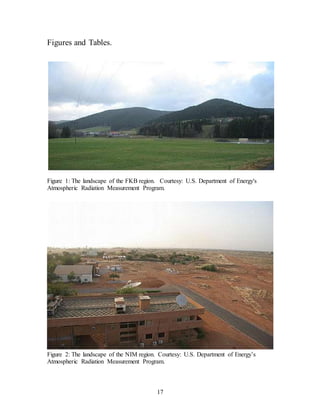
in this study was collected in a fairly lush valley (see Figure 1) within the Black Forest
region during June 2006.
1.1.b Niamey, Niger (NIM):
Niamey in Niger, Africa was the site for the Radiative Divergence study and the
location of the AMF in 2006. The GERB (Geostationary Earth Radiation Budget), and
AMMA (African Monsoon Multidisciplinary Analysis) Stations (RADAGAST) were
also located in this area. Niger, being located in the Sahara Desert, is one of the hottest
countries in the world, which is a contributing factor to dust storms. The dust particles
from these storms influence the amount of radiation received at the surface and thus
influence climate [6]. Because its normal climate is so hot and dry, there are few trees
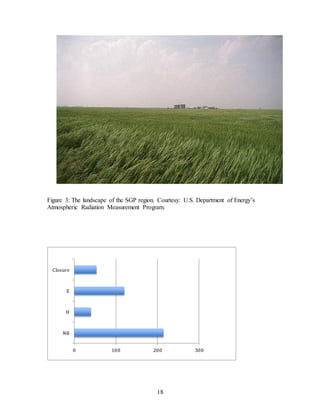
and shrubs, which shows the deficiency of nutrients in the soil. AMF data from June
2006 was examined to see how the SEB changes in a hot, dry desert region (see Figure
2).
1.1.c Southern Great Plains, Oklahoma (SGP):
The Southern Great Plains (SGP) site was the first ARM field measurement site
and is located in the central Great Plains, encompassing large parts of Kansas and
Oklahoma. It has a generally homogeneous geography and is easily accessible. The
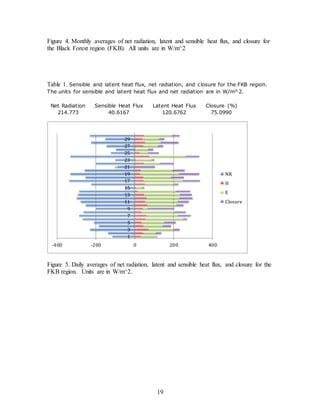
Central Facility (CF) is located on 160 acres of cattle pasture and wheat fields (see Figure
3). The climate is variable with large seasonal variation in temperature and humidity,
different types of cloud formations, and variable surface flux properties [7]. This site
6
represents the third climatic region that will be examined in this study. Data from the
SGP CF from June 2007 was used to study the SEB in this region.
The ultimate purpose for using the data from these sites in this study was to
compare the SEB in three very different climatic regions and determine the differences in
the various components of the SEB. These two objectives may provide insight into how
climates may change in these regions and help with making climate models more
accurate.
2. Instrumentation and Technique:
2.1 SurfaceEnergy Balance
The Surface Energy Balance (SEB) describes the process by which the solar
radiation reaching the earth’s surface is used to drive energy exchanges between the
atmosphere and the surface. The general form of the SEB is:
Rn - H - LE – G = 0
where Rn is the net radiation at the surface, H is the sensible heat flux, LE the latent heat
flux and G is the ground heat flux. By definition energy transported toward the surface is
positive and negative away from the surface. Rn is defined as:
Rn = Sd – Su +Ld - Lu
where Sd is the downwelling solar radiation reaching the surface, Su is the amount of
solar radiation reflected from the surface, Ld is the net downward longwave (thermal)
radiation at the surface and Lu is the amount of longwave radiation emitted by the
surface. Therefore Sd – Su is the net solar radiation, Snet, and Ld – Lu is the net
longwave radiation (Lnet). By definition Rn = Snet + Lnet. The partitioning of latent,
7
sensible, and ground heat flux in a given region is probably the most important
determinant of its microclimate. Latent heat is generally considered the most important
of the three. The dominant role is a result of the availability of moisture for evaporation.
When moisture isn’t as prevalent, the role of sensible heat flux becomes more important.
It is involved with changes in temperature. Ground heat flux is the flow of heat
associated with the changing temperature of the soil. It is a significant hourly energy
source, but over the course of a day, it doesn’t have a significant impact on the
microclimate of a region [8].
2.2 Sensible and LatentHeat Flux:
Half hour measurements of sensible and latent heat flux were taken using the
Eddy Correlation Flux Measurement System (ECOR). The system is located on the north
side of a wheat field at the SGP site [9]. At the FKB sites they were located south of a
mowed grass drainage ditch, south of which are alfalfa crops. At the NIM site they were
located in a rather barren area, mostly bare soil characteristic of the local area. **DO
WE NEED THE FOLLOWING SENTENCES?** Do you have a source for this? I
couldn’t find out where they were. A sonic anemometer, which is a fast-response, three-
dimensional wind sensor, was used at a height of 3 meters to get the wind components
and the speed of sound (to derive air temperature). To obtain the water vapor density and
the CO2 concentration, an open-path infrared gas analyzer was used [9].
2.2 Net Radiation:
8
Solar radiation measurements were taken by pyranometers and longwave or
thermal radiation measurements were taken by pyrgeometers. The SGP site measured the
individual components of the net radiation using a Solar Infrared Radiation Station
(SIRS) system. Data collected from the SIRS were available as 1-minute average values.
At the AMF site in NIM the 4 components of net radiation were measured with a
Ground Radiation Measurement (GRNRAD) system and a Sky Radiation (SKYRAD)
system. SKYRAD collected one-minute data for thermal radiation. GRNRAD was used
for upwelling solar radiation, upwelling thermal radiation, and downwelling thermal
radiation. SKYRAD was used for downwelling solar radiation. All AMF radiation
measurements were also available as 1-minute averages.
GNDRAD and SKYRAD were also used from the FKB site to measure the 4
components of net radiation. GNDRAD was used for upwelling solar and thermal
radiation and SKYRAD was used for downwelling solar and thermal radiation.
2.3 RadarData:
The SGP site uses the Millimeter Wavelength Cloud Radar (MMCR), which
operates at a frequency of 35 GHz, to measure the size and composition of clouds at
millimeter wavelengths. It can also determine cloud boundaries, radar reflectivity up to
20 km high, and cloud constituent vertical velocities [10].
3. Analysis:
The Interactive Data Language (IDL) computer program was used to read data
from the ARM archive. Latent heat flux, sensible heat flux, and radar data were used
9
from the SGP, NIM, and FKB sites. Net radiation was also used, but it needed to be
calculated using multiple instruments that measured downwelling solar, up-welling solar,
down-welling thermal, and upwelling thermal radiation. Daily averages of these variables
were used to analyze how precipitation and cloud cover affected the SEB. To analyze
climate, which is the meteorological conditions over the course of an extended period of
time, monthly average data for June 2006 and 2007 were used. Due to persistent
measurement errors in the night time latent heat flux, the early morning and late night
data were disregarded from this study. This did not affect the results because major SEB
changes happen during after the sun rises and before it sets.
3.1 Sensible and LatentHeat Flux:
The ECOR data were processed and averaged by a computer every half hour. The
eddy covariance technique was used to obtain the fluxes. This involved correlating the
vertical wind component with the horizontal component, the air temperature, the water
vapor density, and the CO2 concentration [9]. Expected measurement uncertainties for
sensible and latent heat fluxes were 6% and 5% respectively. Sensible heat flux is
typically underestimated due to the slope of the temperature sensor differing from 1:1.
Flux shortfalls of 10-25% have been seen, with 35% being less common. This typically
happens because the eddy covariance technique does not take into account energy storage
in vegetation canopies, the sonic anemometer cannot measure the lowest frequency
components of flux, and unstable conditions in the atmosphere (like shifts in wind
direction and precipitation) make it difficult to calculate covariances [9].
10
3.2 Net Radiation:
Net radiation was measured as 1 minute averages. In order to coincide with the
other components of the SEB, 30 minute averages were calculated. The components
were then used to calculate the 30 minute SEB averages. Daily and monthly SEB
averages were calculated afterwards, the latter being more representative of climate than
the former.
3.2.a SIRS:
Estimated measurement uncertainty associated with: downwelling solar radiation
was expected to be 6.0%, upwelling solar radiation was expected to be 6.0%, and
upwelling thermal radiation was expected to be 2.5% [11]. Like the ECOR system, the
SIRS system does not take into account the energy stored in vegetation canopies [9].
3.2.b SKYRAD:
Estimated measurement uncertainty associated with: downwelling solar radiation
was expected to be 6.0% and downwelling thermal radiation was expected to be 2.5%
[12].
GNDRAD:
Estimated measurement uncertainty associated with: upwelling solar radiation
was expected to be 6.0% and upwelling thermal was expected to be 2.5%. The angular
response of a pyranometer is a major contributor to the estimated measurement
uncertainty for solar radiation [13].
11
3.3 RadarData:
MMCR:
Expected uncertainty for reflectivity was .5 dB and .1 m/s for mean Doppler
velocity [10].
4. Results and Discussion:
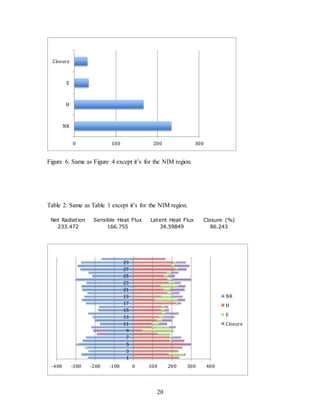
A summary of the results or the SEB analysis from FKB are shown in Figure 4
and Table 1. They show that the majority of the SEB for FKB was the latent heat flux
(120.6762 Wm-2) as opposed to sensible heat flux (40.6167 Wm-2). This was the result of
extensive cloud cover and precipitation at the site which was measured by the radar (not
shown). The decreased amount of net radiation shown in Figure 5 on the 15th, 21st, 23rd,
and 25th-27th supports the argument that there was more cloud cover absorbing solar
radiation.
The SEB results for NIM are shown in Figure 6 and Table 2. They indicate that
the major portion of the SEB for NIM was sensible heat flux (H) except for the 9th and
the 18th (as shown in Figure 7). Niamey’s climate is usually hot and dry [6], and the
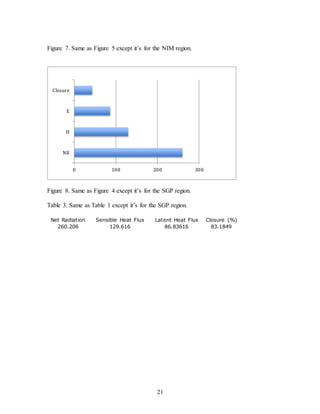
abundance of H and the small amount of latent heat that were found (Figure 7) supports
it. Latent heat was significantly less at the NIM site than the FKB site which is to be
expected in a hot and dry climate region. The low latent heat flux was because of the dry
soil and the lack of abundant vegetation, which contributed to the much larger latent heat
in the FKB region.
The shortages of net radiation of the SGP region on the 10th, 17th, 18th, and from
the 26th to the 29th were the results of increased cloud cover and precipitation as indicated
12
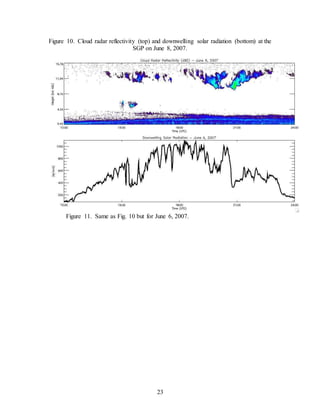
in the radar data (not shown). Figures 10 and 11 demonstrate how cloud cover influences
net radiation. The top panels of both figures are radar reflectivity from the MMCR. The
lower panels are downwelling solar radiation measured at the surface by the SIRS located
near the MMCR. The radar signals near the surface are not clouds, but signals from
insects [14]. June 8th was a nearly cloudless day, indicated by the absence of radar signal.
The corresponding SIRS data shows a clean signal, with the net radiation increasing
steadily as the day progresses. June 6th on the other hand had a significant number of
clouds as demonstrated by the radar reflectivity (Figure 11). The influence of clouds on
the radiation reaching the surface is significant and can be clearly seen in the SIRS data
(Figure 11). The mean solar radiation on June 8th was 350 Wm-2 and only 290 Wm-2 on
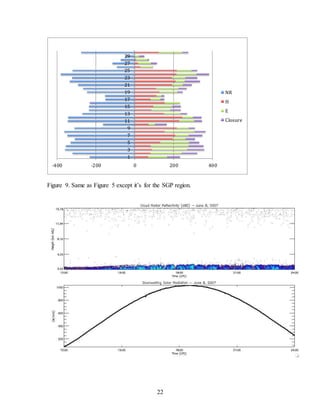
June 6. Even though figure 9 shows that SGP had a few rainy days, figure 8 shows that it
had the most net radiation on average for the month of June. During the summer, the tilt
of the Earth increases day length, which means the SGP and FKB regions get more net
radiation than NIM. Since the FKB region has lush vegetation that contributes to the
increased latent heat flux of the region, cloud cover diminishes the amount of net
radiation that reaches the surface [15].
Closure of the SEB is a tool used to measure the how accurately the components
of the SEB were measured and is defined as:
RN – H – E – G = 0
Instrument error, surface heterogeneity, and fetch can affect SEB measurements and
therefore the magnitude of closure [16]. Closure for this study was affected by these
errors and by the lack of data concerning the ground heat flux. Our values were close to
those found in other studies [16], so the results of this study are reliable and
13
representative of the local climates. Comparison of closure of the SEB at each site
indicates the lowest values of closure (best measure of the SEB) are where latent heat
flux is lowest. Latent heat is generally the measurement with the most uncertainty [16].
Therefore in general the measurements of the SEB have the highest accuracy at NIM
(86.243% closure) with more uncertainty at the SGP (83.1849%) and FKB (75.0990%)
sites.
5. Conclusion.
The uncertainties associated with climate change prevent considerable action
from being taken to diminish the possible effects it will have on the future. Predicting
changes in climate is difficult because climates vary from region to region. By analyzing
the SEB at the FKB, NIM, and SGP sites, this study found that the SEBs varied
significantly for each region and that the climates of the regions reflected the SEBs.
Continued monitoring and analyzing of SEBs in various regions over extended periods of
time would improve global climate models, which would help predictions of the effects
of climate change.
Acknowledgements:
This research was done at Argonne National Laboratory from May 27th until
August 1st 2008. I would like to thank Brad Orr for his supervision of the research and
his revisions to this paper. I would also like to thank Rachel Dearing for her help with
the research. I would like to thank the Atmospheric Radiation Measurement Program for
the use of their data. Finally, I would like to thank the Department of Energy, Office of
14
Science and Argonne National Laboratory for creating, funding, and organizing the
Science Undergraduate Laboratory Internship.
15
Literature Cited:
[1] Z. Su. (2002). The Surface Energy Balance System (SEBS) for estimation of
turbulent heat fluxes. Hydrology and Earth System Sciences. [Online]. 6(1), pp. 85-
99. Available at:
www.hydrol-earth-syst-sci.net/6/85/2002/hess-6-85-2002.pdf
[2] G. M. Stokes and S. E. Schwartz. (1994, Jul.). The Atmospheric Radiation
Measurement (ARM) program: programmatic background and design of the Cloud
and Radiation Test Bed. Bulletin of the American Meteorological Society. [Online].
75(7), pp.1201-1221. Available at:
http://ams.allenpress.com/perlserv/?request=get-abstract&doi=10.1175%2F1520-
0477(1994)075%3C1201%3ATARMPP%3E2.0.CO%3B2
[3] “About ARM.” [29 Nov. 2006]. Available at: http://www.arm.gov/about/
[4] “AMF Deployments - Black Forest, Germany.” [26 Feb. 2007]. Available at:
http://www.arm.gov/sites/amf/blackforest/
[5] “AMF COPS – Initiation of Convection and the Microphysical Properties of Clouds
in Orographic Terrain 2007-04-02 – 2007-12-31.” Available at:
http://www.db.arm.gov/cgi-
bin/IOP2/selectExecSummary.pl?iopName=amf2007cops&person_id=
[6] “AMF Deployments – Niamey, Niger, West Africa.” [26 Feb. 2007]. Available at:
http://www.arm.gov/sites/amf/niamey/
[7] “Southern Great Plains.” [19 July 2007]. Available at:
http://www.arm.gov/sites/sgp.stm
[8] T. R. Oke, Boundary Layer Climates. London, Great Britain and New York, New
York: Routledge, 1995, pp. 25.
[9] D. R. Cook and M. S. Pekour. (2008, Jan.). Eddy Correlation Flux Measurement
System (ECOR) Handbook. DOE/SC-ARM/TR-05. Available at:
www.arm.gov/publications/tech_reports/handbooks/ecor_handbook.pdf
[10] K. B. Widener and K. Johnson. (2005, Jan.). Millimeter Wave Cloud Radar
(MMCR) Handbook. ARM TR-018. Available at:
www.arm.gov/publications/tech_reports/handbooks/mmcr_handbook.pdf
[11] T. Stoffel. (2004, Nov.). Solar Infrared Radiation Station (SIRS) Handbook. ARM
TR-025. Available at:
www.arm.gov/publications/tech_reports/handbooks/sirs_handbook.pdf
16
[12] T. Stoffel. (2004, Nov.). SKYRAD Handbook. ARM TR-026. Available at:
www.arm.gov/publications/tech_reports/handbooks/skyrad_handbook.pdf
[13] T. Stoffel. (2004, Nov.). Ground Radiation (GNDRAD) Handbook. ARM TR-027.
Available at:
www.arm.gov/publications/tech_reports/handbooks/gndrad_handbook.pdf
[14] A. Khandwalla, N. Majurec, S. M. Sekelsky, C. R. Williams, and K. S. Gage.
(2002). “Characterization of radar boundary layer data collected during the 2001
multi-frequency radar IOP,” in Proceedings of the Twelfth ARM Science Team
Meeting, 2002, pp. 1-5.
[15] T. Konzelmann, P. Calanca, G. Muller, L. Menzel, and H. Lang. (1997). Energy
balance and evapotranspiration in a high mountain area during summer. Journal of
Applied Meteorology. [Online]. 36(7), pp. 966-973. Available at:
http://ams.allenpress.com/perlserv/?request=get-abstract&doi=10.1175%2F1520-
0450(1997)036%3C0966:EBAEIA%3E2.0.CO%3B2
[16] J. A. Brotzge and K. C. Crawford. (2003). Examination of the surface energy
budget: a comparison of eddy correlation and Bowen ratio measurement systems.
Journal of Hydrometeorology. [Online]. 4(2), pp. 160-178. Available at:
rc.ihas.nagoya-u.ac.jp
17
Figures and Tables.
Figure 1: The landscape of the FKB region. Courtesy: U.S. Department of Energy's
Atmospheric Radiation Measurement Program.
Figure 2: The landscape of the NIM region. Courtesy: U.S. Department of Energy’s
Atmospheric Radiation Measurement Program.
18
Figure 3: The landscape of the SGP region. Courtesy: U.S. Department of Energy’s
Atmospheric Radiation Measurement Program.
0 100 200 300
NR
H
E
Closure
19
Figure 4. Monthly averages of net radiation, latent and sensible heat flux, and closure for
the Black Forest region (FKB). All units are in W/m^2
Table 1. Sensible and latent heat flux, net radiation, and closure for the FKB region.
The units for sensible and latent heat flux and net radiation are in W/m^2.
Net Radiation Sensible Heat Flux Latent Heat Flux Closure (%)
214.773 40.6167 120.6762 75.0990
Figure 5. Daily averages of net radiation, latent and sensible heat flux, and closure for the
FKB region. Units are in W/m^2.
-400 -200 0 200 400
1
3
5
7
9
11
13
15
17
19
21
23
25
27
29
NR
H
E
Closure
20
Figure 6. Same as Figure 4 except it’s for the NIM region.
Table 2. Same as Table 1 except it’s for the NIM region.
Net Radiation Sensible Heat Flux Latent Heat Flux Closure (%)
233.472 166.755 34.59849 86.243
0 100 200 300
NR
H
E
Closure
-400 -300 -200 -100 0 100 200 300 400
1
3
5
7
9
11
13
15
17
19
21
23
25
27
29
NR
H
E
Closure
21
Figure 7. Same as Figure 5 except it’s for the NIM region.
Figure 8. Same as Figure 4 except it’s for the SGP region.
Table 3. Same as Table 1 except it’s for the SGP region.
Net Radiation Sensible Heat Flux Latent Heat Flux Closure (%)
260.206 129.616 86.83616 83.1849
0 100 200 300
NR
H
E
Closure
22
Figure 9. Same as Figure 5 except it’s for the SGP region.
-400 -200 0 200 400
1
3
5
7
9
11
13
15
17
19
21
23
25
27
29
NR
H
E
Closure
23
Figure 10. Cloud radar reflectivity (top) and downwelling solar radiation (bottom) at the
SGP on June 8, 2007.
Figure 11. Same as Fig. 10 but for June 6, 2007.

Comparing Surface Energy Balances for the Black Forest

  • 1.
    Comparing Surface EnergyBalances for the Black Forest, Germany, Niamey, Niger, and Southern Great Plains, Oklahoma Atmospheric Radiation Measurement Sites Ryan Bourgart Valparaiso University, Valparaiso, Indiana Office of Science, Science Undergraduate Laboratory Internship Program Argonne National Laboratory Lemont, Illinois August 1st, 2008
  • 2.
    1 Abstract: Solar energy isreceived and used in various amounts in different regions of the world. The goal of this experiment was to determine how the surface energy balance varied in three regions and how it related to the climate in those regions. Data collected at the Southern Great Plains site (SGP), the Black Forest region in Germany (FKB), and the Niamey, Niger site (NIM) by the Atmospheric Radiation Measurement (ARM) program were chosen for their variability in climactic patterns. The variability between the sites is primarily a result of latitude, cloud cover, and vegetation on the surface. One of the reasons why climate models are not accurate is because they do not take into account how the various physical geographies influence surface energy balances and thus regional climates. Measurements of the components of the surface energy balance; latent and sensible heat flux and net radiation were compared between the three sites during the month of June of 2007 (SGP and FKB) and 2006 (NIM) Ground heat flux, generally the smallest term in the budget, was not available at all sites and so was excluded from this study. Closure, or the residual of the measured surface energy balance, was used to determine the accuracy of the measurements. Latent heat flux was greatest at the FKB site, sensible heat flux at the NIM site, and net radiation at the SGP site. The FKB site had the most latent heat flux because it had dense vegetation that contributed to the formation of clouds and precipitation. The NIM site had the most sensible heat flux because it had less vegetation and more exposed soil, which contributed to a warmer and dryer climate. The SGP site had the most net radiation due to the longer days and the position of the sun associated with the summer season. The results of this study help quantify how the components of the surface energy balance vary with climatic regions, from a warmer, dryer climate like the NIM site to a cooler climate with more precipitation like the FKB site.
  • 3.
    2 Table of Contents 1.INTRODUCTION.................................................................................................................................................3 1.1 SITES:.:................................................................................................................................................................4 1.1.a Black Forest, Germany (FKB):.........................................................................................................4 1.1.b Niamey, Niger (NIM)FKB):...............................................................................................................5 1.1.c Southern Great Plains, Oklahoma (SGP):....................................................................................5 2. INSTRUMENTATION AND TECHNIQUE:.:..........................................................................................6 2.1 SURFACE ENERGY BALANCE......................................................................................................................6 2.2 SENSIBLE AND LATENT HEAT FLUX:........................................................................................................7 2.2 NET RADIATION:..............................................................................................................................................7 2.3 RADAR DATA:...................................................................................................................................................8 3. ANALYSIS:.:..........................................................................................................................................................8 3.1 SENSIBLE AND LATENT HEAT FLUX:........................................................................................................9 3.2 NET RADIATION:...........................................................................................................................................10 3.2.a SIRS:........................................................................................................................................................10 3.2.b SKYRAD:................................................................................................................................................10 5. CONCLUSION...................................................................................................................................................13 APPENDIX:...........................................................................................ERROR! BOOKMARK NOT DEFINED. FIGURES AND TABLES.....................................................................................................................................17
  • 4.
    3 1. Introduction. Global climatechange is and will continue to be a major political and economic issue. The uncertainty and complexity associated with it makes it a difficult issue to establish a consensus on a resolution. The greatest uncertainty is how the climate will change in different regions. While different places have different climates, the building blocks of climate are the same everywhere. The sun is the energy source that drives weather and climate. The amount of solar radiation that passes through the earth’s atmosphere and reaches the surface is reduced by absorption, scattering, and reflection. These processes are primarily controlled by cloud amount, aerosol content (atmospheric particulates) and chemical composition of the atmosphere. How the solar radiation that actually reaches the surface is used is determined by the Surface Energy Balance (SEB), which is the primary focus of this research. Most measurements that have been made of the SEB are only representative of local scales due to the highly variable nature of the earth’s surface. Therefore these measurements cannot readily be extended to regional and global levels due to land surface heterogeneity and the variability of heat transfer processes [1]. The ability to extend the range to regional and global scales is an imperative for being able to predict how the climate will change using Global Climate Models (GCMs). The Atmospheric Radiation Measurement Program (ARM) was established by the Department of Energy (DOE) to improve GCMs and other climate models [2]. ARM studies the interaction between clouds and radiative feedback processes in the
  • 5.
    4 atmosphere. The purposeof doing so is to better understand how clouds are involved in climate change [3]. This study analyzed data concerning the surface energy balance collected by the ARM Climate Research Facility (ACRF), each from a different climatic region. The results may be useful to help quantify regional differences in the SEB. 1.1 Sites: All ACRF fixed sites have instrumentation that measures most of the individual components of the SEB. ACRF also operates a mobile facility (AMF), which typically moves to a different, climatically significant region each year based on science proposals. For this study three sites were chosen that represent three very different climate regions; the Black Forest region in Germany, a desert area in Niger, Africa and the central plains of Oklahoma. 1.1.a Black Forest, Germany (FKB): The Black Forest region in Germany was chosen as the deployment site for the AMF in 2006. This deployment was part of the Convective and Orographically Induced Precipitation Study (COPS), which had the primary goal of improving our ability to predict orographic precipitation, which is the result of rising convection over mountainous regions. Data from this study will be useful for determining how clouds affect climate in regions with complex terrain [4]. The Black Forest region has a mean terrain height of 1000 m and is dominated by coniferous woodlands and agricultural areas. The temperature varies during the summer, depending on the region in question and the humidity is typically high, with convective precipitation [5]. The data being used
  • 6.
    5 in this studywas collected in a fairly lush valley (see Figure 1) within the Black Forest region during June 2006. 1.1.b Niamey, Niger (NIM): Niamey in Niger, Africa was the site for the Radiative Divergence study and the location of the AMF in 2006. The GERB (Geostationary Earth Radiation Budget), and AMMA (African Monsoon Multidisciplinary Analysis) Stations (RADAGAST) were also located in this area. Niger, being located in the Sahara Desert, is one of the hottest countries in the world, which is a contributing factor to dust storms. The dust particles from these storms influence the amount of radiation received at the surface and thus influence climate [6]. Because its normal climate is so hot and dry, there are few trees and shrubs, which shows the deficiency of nutrients in the soil. AMF data from June 2006 was examined to see how the SEB changes in a hot, dry desert region (see Figure 2). 1.1.c Southern Great Plains, Oklahoma (SGP): The Southern Great Plains (SGP) site was the first ARM field measurement site and is located in the central Great Plains, encompassing large parts of Kansas and Oklahoma. It has a generally homogeneous geography and is easily accessible. The Central Facility (CF) is located on 160 acres of cattle pasture and wheat fields (see Figure 3). The climate is variable with large seasonal variation in temperature and humidity, different types of cloud formations, and variable surface flux properties [7]. This site
  • 7.
    6 represents the thirdclimatic region that will be examined in this study. Data from the SGP CF from June 2007 was used to study the SEB in this region. The ultimate purpose for using the data from these sites in this study was to compare the SEB in three very different climatic regions and determine the differences in the various components of the SEB. These two objectives may provide insight into how climates may change in these regions and help with making climate models more accurate. 2. Instrumentation and Technique: 2.1 SurfaceEnergy Balance The Surface Energy Balance (SEB) describes the process by which the solar radiation reaching the earth’s surface is used to drive energy exchanges between the atmosphere and the surface. The general form of the SEB is: Rn - H - LE – G = 0 where Rn is the net radiation at the surface, H is the sensible heat flux, LE the latent heat flux and G is the ground heat flux. By definition energy transported toward the surface is positive and negative away from the surface. Rn is defined as: Rn = Sd – Su +Ld - Lu where Sd is the downwelling solar radiation reaching the surface, Su is the amount of solar radiation reflected from the surface, Ld is the net downward longwave (thermal) radiation at the surface and Lu is the amount of longwave radiation emitted by the surface. Therefore Sd – Su is the net solar radiation, Snet, and Ld – Lu is the net longwave radiation (Lnet). By definition Rn = Snet + Lnet. The partitioning of latent,
  • 8.
    7 sensible, and groundheat flux in a given region is probably the most important determinant of its microclimate. Latent heat is generally considered the most important of the three. The dominant role is a result of the availability of moisture for evaporation. When moisture isn’t as prevalent, the role of sensible heat flux becomes more important. It is involved with changes in temperature. Ground heat flux is the flow of heat associated with the changing temperature of the soil. It is a significant hourly energy source, but over the course of a day, it doesn’t have a significant impact on the microclimate of a region [8]. 2.2 Sensible and LatentHeat Flux: Half hour measurements of sensible and latent heat flux were taken using the Eddy Correlation Flux Measurement System (ECOR). The system is located on the north side of a wheat field at the SGP site [9]. At the FKB sites they were located south of a mowed grass drainage ditch, south of which are alfalfa crops. At the NIM site they were located in a rather barren area, mostly bare soil characteristic of the local area. **DO WE NEED THE FOLLOWING SENTENCES?** Do you have a source for this? I couldn’t find out where they were. A sonic anemometer, which is a fast-response, three- dimensional wind sensor, was used at a height of 3 meters to get the wind components and the speed of sound (to derive air temperature). To obtain the water vapor density and the CO2 concentration, an open-path infrared gas analyzer was used [9]. 2.2 Net Radiation:
  • 9.
    8 Solar radiation measurementswere taken by pyranometers and longwave or thermal radiation measurements were taken by pyrgeometers. The SGP site measured the individual components of the net radiation using a Solar Infrared Radiation Station (SIRS) system. Data collected from the SIRS were available as 1-minute average values. At the AMF site in NIM the 4 components of net radiation were measured with a Ground Radiation Measurement (GRNRAD) system and a Sky Radiation (SKYRAD) system. SKYRAD collected one-minute data for thermal radiation. GRNRAD was used for upwelling solar radiation, upwelling thermal radiation, and downwelling thermal radiation. SKYRAD was used for downwelling solar radiation. All AMF radiation measurements were also available as 1-minute averages. GNDRAD and SKYRAD were also used from the FKB site to measure the 4 components of net radiation. GNDRAD was used for upwelling solar and thermal radiation and SKYRAD was used for downwelling solar and thermal radiation. 2.3 RadarData: The SGP site uses the Millimeter Wavelength Cloud Radar (MMCR), which operates at a frequency of 35 GHz, to measure the size and composition of clouds at millimeter wavelengths. It can also determine cloud boundaries, radar reflectivity up to 20 km high, and cloud constituent vertical velocities [10]. 3. Analysis: The Interactive Data Language (IDL) computer program was used to read data from the ARM archive. Latent heat flux, sensible heat flux, and radar data were used
  • 10.
    9 from the SGP,NIM, and FKB sites. Net radiation was also used, but it needed to be calculated using multiple instruments that measured downwelling solar, up-welling solar, down-welling thermal, and upwelling thermal radiation. Daily averages of these variables were used to analyze how precipitation and cloud cover affected the SEB. To analyze climate, which is the meteorological conditions over the course of an extended period of time, monthly average data for June 2006 and 2007 were used. Due to persistent measurement errors in the night time latent heat flux, the early morning and late night data were disregarded from this study. This did not affect the results because major SEB changes happen during after the sun rises and before it sets. 3.1 Sensible and LatentHeat Flux: The ECOR data were processed and averaged by a computer every half hour. The eddy covariance technique was used to obtain the fluxes. This involved correlating the vertical wind component with the horizontal component, the air temperature, the water vapor density, and the CO2 concentration [9]. Expected measurement uncertainties for sensible and latent heat fluxes were 6% and 5% respectively. Sensible heat flux is typically underestimated due to the slope of the temperature sensor differing from 1:1. Flux shortfalls of 10-25% have been seen, with 35% being less common. This typically happens because the eddy covariance technique does not take into account energy storage in vegetation canopies, the sonic anemometer cannot measure the lowest frequency components of flux, and unstable conditions in the atmosphere (like shifts in wind direction and precipitation) make it difficult to calculate covariances [9].
  • 11.
    10 3.2 Net Radiation: Netradiation was measured as 1 minute averages. In order to coincide with the other components of the SEB, 30 minute averages were calculated. The components were then used to calculate the 30 minute SEB averages. Daily and monthly SEB averages were calculated afterwards, the latter being more representative of climate than the former. 3.2.a SIRS: Estimated measurement uncertainty associated with: downwelling solar radiation was expected to be 6.0%, upwelling solar radiation was expected to be 6.0%, and upwelling thermal radiation was expected to be 2.5% [11]. Like the ECOR system, the SIRS system does not take into account the energy stored in vegetation canopies [9]. 3.2.b SKYRAD: Estimated measurement uncertainty associated with: downwelling solar radiation was expected to be 6.0% and downwelling thermal radiation was expected to be 2.5% [12]. GNDRAD: Estimated measurement uncertainty associated with: upwelling solar radiation was expected to be 6.0% and upwelling thermal was expected to be 2.5%. The angular response of a pyranometer is a major contributor to the estimated measurement uncertainty for solar radiation [13].
  • 12.
    11 3.3 RadarData: MMCR: Expected uncertaintyfor reflectivity was .5 dB and .1 m/s for mean Doppler velocity [10]. 4. Results and Discussion: A summary of the results or the SEB analysis from FKB are shown in Figure 4 and Table 1. They show that the majority of the SEB for FKB was the latent heat flux (120.6762 Wm-2) as opposed to sensible heat flux (40.6167 Wm-2). This was the result of extensive cloud cover and precipitation at the site which was measured by the radar (not shown). The decreased amount of net radiation shown in Figure 5 on the 15th, 21st, 23rd, and 25th-27th supports the argument that there was more cloud cover absorbing solar radiation. The SEB results for NIM are shown in Figure 6 and Table 2. They indicate that the major portion of the SEB for NIM was sensible heat flux (H) except for the 9th and the 18th (as shown in Figure 7). Niamey’s climate is usually hot and dry [6], and the abundance of H and the small amount of latent heat that were found (Figure 7) supports it. Latent heat was significantly less at the NIM site than the FKB site which is to be expected in a hot and dry climate region. The low latent heat flux was because of the dry soil and the lack of abundant vegetation, which contributed to the much larger latent heat in the FKB region. The shortages of net radiation of the SGP region on the 10th, 17th, 18th, and from the 26th to the 29th were the results of increased cloud cover and precipitation as indicated
  • 13.
    12 in the radardata (not shown). Figures 10 and 11 demonstrate how cloud cover influences net radiation. The top panels of both figures are radar reflectivity from the MMCR. The lower panels are downwelling solar radiation measured at the surface by the SIRS located near the MMCR. The radar signals near the surface are not clouds, but signals from insects [14]. June 8th was a nearly cloudless day, indicated by the absence of radar signal. The corresponding SIRS data shows a clean signal, with the net radiation increasing steadily as the day progresses. June 6th on the other hand had a significant number of clouds as demonstrated by the radar reflectivity (Figure 11). The influence of clouds on the radiation reaching the surface is significant and can be clearly seen in the SIRS data (Figure 11). The mean solar radiation on June 8th was 350 Wm-2 and only 290 Wm-2 on June 6. Even though figure 9 shows that SGP had a few rainy days, figure 8 shows that it had the most net radiation on average for the month of June. During the summer, the tilt of the Earth increases day length, which means the SGP and FKB regions get more net radiation than NIM. Since the FKB region has lush vegetation that contributes to the increased latent heat flux of the region, cloud cover diminishes the amount of net radiation that reaches the surface [15]. Closure of the SEB is a tool used to measure the how accurately the components of the SEB were measured and is defined as: RN – H – E – G = 0 Instrument error, surface heterogeneity, and fetch can affect SEB measurements and therefore the magnitude of closure [16]. Closure for this study was affected by these errors and by the lack of data concerning the ground heat flux. Our values were close to those found in other studies [16], so the results of this study are reliable and
  • 14.
    13 representative of thelocal climates. Comparison of closure of the SEB at each site indicates the lowest values of closure (best measure of the SEB) are where latent heat flux is lowest. Latent heat is generally the measurement with the most uncertainty [16]. Therefore in general the measurements of the SEB have the highest accuracy at NIM (86.243% closure) with more uncertainty at the SGP (83.1849%) and FKB (75.0990%) sites. 5. Conclusion. The uncertainties associated with climate change prevent considerable action from being taken to diminish the possible effects it will have on the future. Predicting changes in climate is difficult because climates vary from region to region. By analyzing the SEB at the FKB, NIM, and SGP sites, this study found that the SEBs varied significantly for each region and that the climates of the regions reflected the SEBs. Continued monitoring and analyzing of SEBs in various regions over extended periods of time would improve global climate models, which would help predictions of the effects of climate change. Acknowledgements: This research was done at Argonne National Laboratory from May 27th until August 1st 2008. I would like to thank Brad Orr for his supervision of the research and his revisions to this paper. I would also like to thank Rachel Dearing for her help with the research. I would like to thank the Atmospheric Radiation Measurement Program for the use of their data. Finally, I would like to thank the Department of Energy, Office of
  • 15.
    14 Science and ArgonneNational Laboratory for creating, funding, and organizing the Science Undergraduate Laboratory Internship.
  • 16.
    15 Literature Cited: [1] Z.Su. (2002). The Surface Energy Balance System (SEBS) for estimation of turbulent heat fluxes. Hydrology and Earth System Sciences. [Online]. 6(1), pp. 85- 99. Available at: www.hydrol-earth-syst-sci.net/6/85/2002/hess-6-85-2002.pdf [2] G. M. Stokes and S. E. Schwartz. (1994, Jul.). The Atmospheric Radiation Measurement (ARM) program: programmatic background and design of the Cloud and Radiation Test Bed. Bulletin of the American Meteorological Society. [Online]. 75(7), pp.1201-1221. Available at: http://ams.allenpress.com/perlserv/?request=get-abstract&doi=10.1175%2F1520- 0477(1994)075%3C1201%3ATARMPP%3E2.0.CO%3B2 [3] “About ARM.” [29 Nov. 2006]. Available at: http://www.arm.gov/about/ [4] “AMF Deployments - Black Forest, Germany.” [26 Feb. 2007]. Available at: http://www.arm.gov/sites/amf/blackforest/ [5] “AMF COPS – Initiation of Convection and the Microphysical Properties of Clouds in Orographic Terrain 2007-04-02 – 2007-12-31.” Available at: http://www.db.arm.gov/cgi- bin/IOP2/selectExecSummary.pl?iopName=amf2007cops&person_id= [6] “AMF Deployments – Niamey, Niger, West Africa.” [26 Feb. 2007]. Available at: http://www.arm.gov/sites/amf/niamey/ [7] “Southern Great Plains.” [19 July 2007]. Available at: http://www.arm.gov/sites/sgp.stm [8] T. R. Oke, Boundary Layer Climates. London, Great Britain and New York, New York: Routledge, 1995, pp. 25. [9] D. R. Cook and M. S. Pekour. (2008, Jan.). Eddy Correlation Flux Measurement System (ECOR) Handbook. DOE/SC-ARM/TR-05. Available at: www.arm.gov/publications/tech_reports/handbooks/ecor_handbook.pdf [10] K. B. Widener and K. Johnson. (2005, Jan.). Millimeter Wave Cloud Radar (MMCR) Handbook. ARM TR-018. Available at: www.arm.gov/publications/tech_reports/handbooks/mmcr_handbook.pdf [11] T. Stoffel. (2004, Nov.). Solar Infrared Radiation Station (SIRS) Handbook. ARM TR-025. Available at: www.arm.gov/publications/tech_reports/handbooks/sirs_handbook.pdf
  • 17.
    16 [12] T. Stoffel.(2004, Nov.). SKYRAD Handbook. ARM TR-026. Available at: www.arm.gov/publications/tech_reports/handbooks/skyrad_handbook.pdf [13] T. Stoffel. (2004, Nov.). Ground Radiation (GNDRAD) Handbook. ARM TR-027. Available at: www.arm.gov/publications/tech_reports/handbooks/gndrad_handbook.pdf [14] A. Khandwalla, N. Majurec, S. M. Sekelsky, C. R. Williams, and K. S. Gage. (2002). “Characterization of radar boundary layer data collected during the 2001 multi-frequency radar IOP,” in Proceedings of the Twelfth ARM Science Team Meeting, 2002, pp. 1-5. [15] T. Konzelmann, P. Calanca, G. Muller, L. Menzel, and H. Lang. (1997). Energy balance and evapotranspiration in a high mountain area during summer. Journal of Applied Meteorology. [Online]. 36(7), pp. 966-973. Available at: http://ams.allenpress.com/perlserv/?request=get-abstract&doi=10.1175%2F1520- 0450(1997)036%3C0966:EBAEIA%3E2.0.CO%3B2 [16] J. A. Brotzge and K. C. Crawford. (2003). Examination of the surface energy budget: a comparison of eddy correlation and Bowen ratio measurement systems. Journal of Hydrometeorology. [Online]. 4(2), pp. 160-178. Available at: rc.ihas.nagoya-u.ac.jp
  • 18.
    17 Figures and Tables. Figure1: The landscape of the FKB region. Courtesy: U.S. Department of Energy's Atmospheric Radiation Measurement Program. Figure 2: The landscape of the NIM region. Courtesy: U.S. Department of Energy’s Atmospheric Radiation Measurement Program.
  • 19.
    18 Figure 3: Thelandscape of the SGP region. Courtesy: U.S. Department of Energy’s Atmospheric Radiation Measurement Program. 0 100 200 300 NR H E Closure
  • 20.
    19 Figure 4. Monthlyaverages of net radiation, latent and sensible heat flux, and closure for the Black Forest region (FKB). All units are in W/m^2 Table 1. Sensible and latent heat flux, net radiation, and closure for the FKB region. The units for sensible and latent heat flux and net radiation are in W/m^2. Net Radiation Sensible Heat Flux Latent Heat Flux Closure (%) 214.773 40.6167 120.6762 75.0990 Figure 5. Daily averages of net radiation, latent and sensible heat flux, and closure for the FKB region. Units are in W/m^2. -400 -200 0 200 400 1 3 5 7 9 11 13 15 17 19 21 23 25 27 29 NR H E Closure
  • 21.
    20 Figure 6. Sameas Figure 4 except it’s for the NIM region. Table 2. Same as Table 1 except it’s for the NIM region. Net Radiation Sensible Heat Flux Latent Heat Flux Closure (%) 233.472 166.755 34.59849 86.243 0 100 200 300 NR H E Closure -400 -300 -200 -100 0 100 200 300 400 1 3 5 7 9 11 13 15 17 19 21 23 25 27 29 NR H E Closure
  • 22.
    21 Figure 7. Sameas Figure 5 except it’s for the NIM region. Figure 8. Same as Figure 4 except it’s for the SGP region. Table 3. Same as Table 1 except it’s for the SGP region. Net Radiation Sensible Heat Flux Latent Heat Flux Closure (%) 260.206 129.616 86.83616 83.1849 0 100 200 300 NR H E Closure
  • 23.
    22 Figure 9. Sameas Figure 5 except it’s for the SGP region. -400 -200 0 200 400 1 3 5 7 9 11 13 15 17 19 21 23 25 27 29 NR H E Closure
  • 24.
    23 Figure 10. Cloudradar reflectivity (top) and downwelling solar radiation (bottom) at the SGP on June 8, 2007. Figure 11. Same as Fig. 10 but for June 6, 2007.