Research Paper
Topic: Comparative Study of Digital Forensics Tools
Abstract
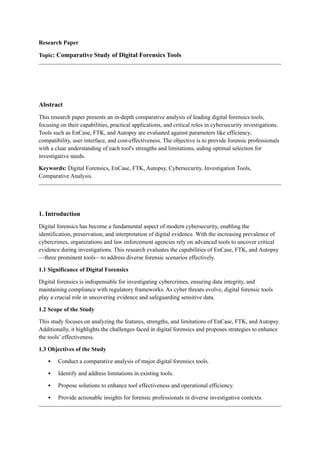
This research paper presents an in-depth comparative analysis of leading digital forensics tools,
focusing on their capabilities, practical applications, and critical roles in cybersecurity investigations.
Tools such as EnCase, FTK, and Autopsy are evaluated against parameters like efficiency,
compatibility, user interface, and cost-effectiveness. The objective is to provide forensic professionals
with a clear understanding of each tool's strengths and limitations, aiding optimal selection for
investigative needs.
Keywords: Digital Forensics, EnCase, FTK, Autopsy, Cybersecurity, Investigation Tools,
Comparative Analysis.
1. Introduction
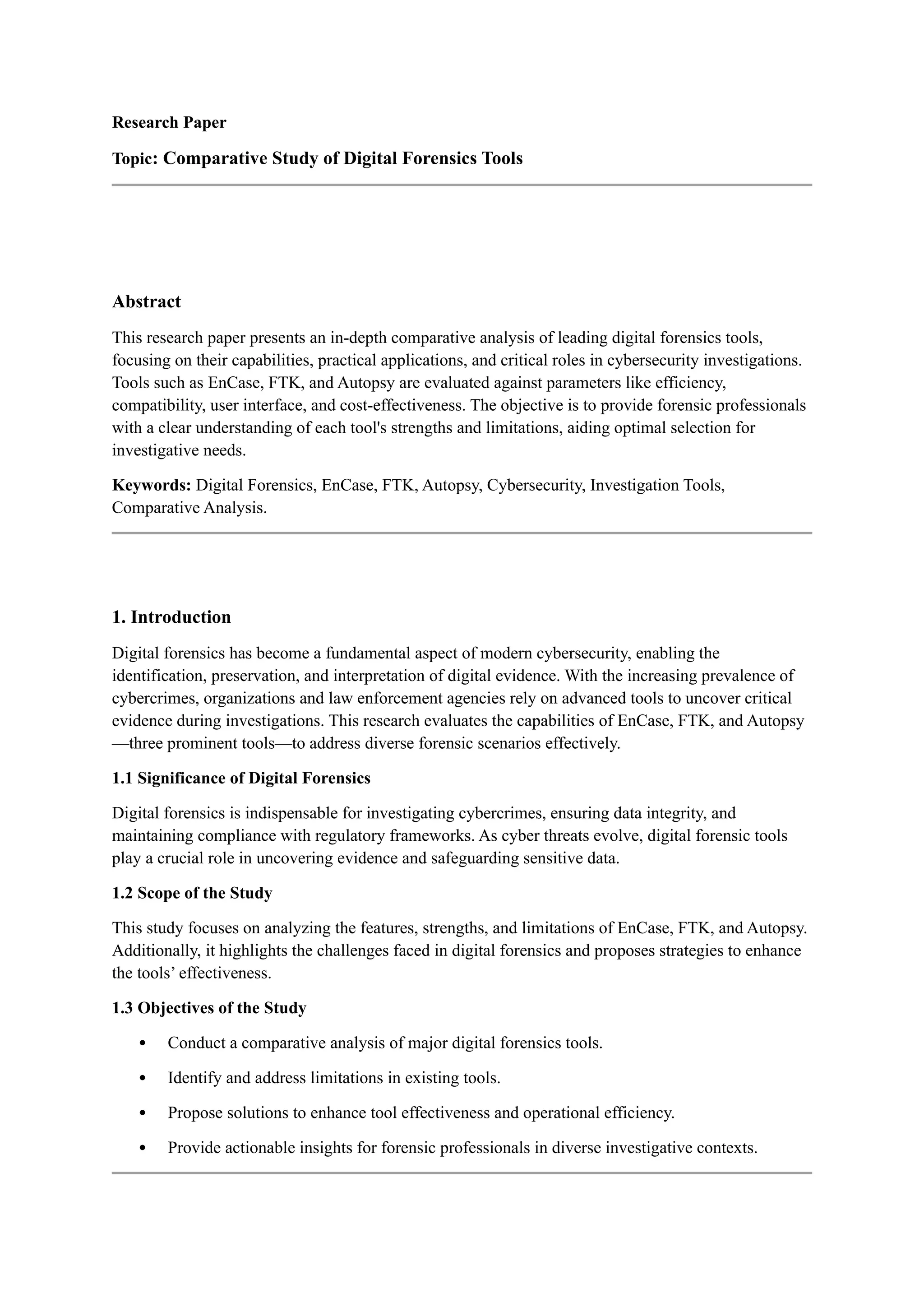
Digital forensics has become a fundamental aspect of modern cybersecurity, enabling the
identification, preservation, and interpretation of digital evidence. With the increasing prevalence of
cybercrimes, organizations and law enforcement agencies rely on advanced tools to uncover critical
evidence during investigations. This research evaluates the capabilities of EnCase, FTK, and Autopsy
—three prominent tools—to address diverse forensic scenarios effectively.
1.1 Significance of Digital Forensics
Digital forensics is indispensable for investigating cybercrimes, ensuring data integrity, and
maintaining compliance with regulatory frameworks. As cyber threats evolve, digital forensic tools
play a crucial role in uncovering evidence and safeguarding sensitive data.
1.2 Scope of the Study
This study focuses on analyzing the features, strengths, and limitations of EnCase, FTK, and Autopsy.
Additionally, it highlights the challenges faced in digital forensics and proposes strategies to enhance
the tools’ effectiveness.
1.3 Objectives of the Study
 Conduct a comparative analysis of major digital forensics tools.
 Identify and address limitations in existing tools.
 Propose solutions to enhance tool effectiveness and operational efficiency.
 Provide actionable insights for forensic professionals in diverse investigative contexts.
2. Historical Evolution of Digital Forensics Tools
2.1 Early Beginnings
 Digital forensics emerged in the late 1980s as a response to increasing cybercrime.
 Initial tools focused on basic data recovery and file carving.
2.2 Advancements in Technology
 Introduction of specialized tools like EnCase and FTK in the 1990s revolutionized forensic
investigations.
 Open-source tools such as Autopsy became prominent in the 2000s, democratizing access to
forensic capabilities.
2.3 Modern Trends
 Integration of artificial intelligence (AI) for predictive analysis.
 Use of blockchain technology for tamper-proof evidence trails.
 Development of cloud-based forensic platforms.
3. Problem Domain
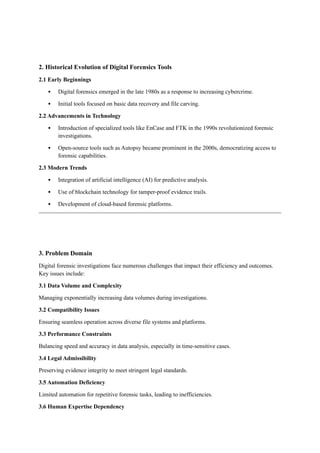
Digital forensic investigations face numerous challenges that impact their efficiency and outcomes.
Key issues include:
3.1 Data Volume and Complexity
Managing exponentially increasing data volumes during investigations.
3.2 Compatibility Issues
Ensuring seamless operation across diverse file systems and platforms.
3.3 Performance Constraints
Balancing speed and accuracy in data analysis, especially in time-sensitive cases.
3.4 Legal Admissibility
Preserving evidence integrity to meet stringent legal standards.
3.5 Automation Deficiency
Limited automation for repetitive forensic tasks, leading to inefficiencies.
3.6 Human Expertise Dependency
High reliance on skilled personnel for effective utilization of tools.
3.7 Security Vulnerabilities in Tools
The tools themselves are susceptible to tampering or exploitation by threat actors.
4. Comparative Analysis
Performance Metrics of Tools
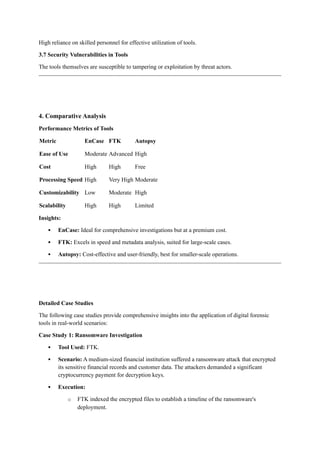
Metric EnCase FTK Autopsy
Ease of Use Moderate Advanced High
Cost High High Free
Processing Speed High Very High Moderate
Customizability Low Moderate High
Scalability High High Limited
Insights:
 EnCase: Ideal for comprehensive investigations but at a premium cost.
 FTK: Excels in speed and metadata analysis, suited for large-scale cases.
 Autopsy: Cost-effective and user-friendly, best for smaller-scale operations.
Detailed Case Studies
The following case studies provide comprehensive insights into the application of digital forensic
tools in real-world scenarios:
Case Study 1: Ransomware Investigation
 Tool Used: FTK.
 Scenario: A medium-sized financial institution suffered a ransomware attack that encrypted
its sensitive financial records and customer data. The attackers demanded a significant
cryptocurrency payment for decryption keys.
 Execution:
o FTK indexed the encrypted files to establish a timeline of the ransomware's
deployment.
o Metadata analysis helped identify the initial point of compromise, which was traced
to a phishing email targeting an employee.
o FTK’s advanced search capabilities located hidden payloads that had evaded
detection.
 Outcome:
o The forensic team identified the specific malware variant and shared findings with
law enforcement.
o The organization implemented stronger phishing detection protocols to prevent future
attacks.
Case Study 2: Data Breach Analysis
 Tool Used: EnCase.
 Scenario: A global e-commerce company experienced a data breach exposing millions of
customer records, including payment details.
 Execution:
o EnCase was used to image server logs and reconstruct the breach timeline.
o Investigators identified that attackers had exploited a vulnerability in a third-party
payment processor’s API.
o Deleted log files were recovered, providing critical insights into unauthorized access
attempts.
 Outcome:
o The vulnerability was patched, and the company adopted stricter security measures
for third-party integrations.
o Evidence collected was used to prosecute the attackers.
Case Study 3: Corporate Espionage
 Tool Used: Autopsy.
 Scenario: A technology firm suspected an insider of leaking proprietary information to
competitors.
 Execution:
o Autopsy analyzed the employee’s workstation and identified unauthorized data
transfers to external USB devices.
o Chat logs and email communications were recovered, revealing coordination with a
competing firm.
 Outcome:
o The employee was terminated and legal action was initiated against the competitor.
o The firm enhanced endpoint security to prevent future incidents.
Case Study 4: Mobile Device Forensics
 Tool Used: Oxygen Forensic Detective.
 Scenario: A law enforcement agency investigated a suspect involved in a human trafficking
network.
 Execution:
o Oxygen Forensic Detective extracted deleted text messages, call logs, and GPS data
from the suspect’s smartphone.
o Social media activity and encrypted chat app communications were decrypted and
analyzed.
 Outcome:
o The investigation led to the identification and rescue of multiple victims.
o Evidence gathered was used to secure a conviction in court.
Case Study 5: Financial Fraud Investigation
 Tool Used: Magnet AXIOM.
 Scenario: A multinational corporation discovered discrepancies in its financial records,
indicating potential internal fraud.
 Execution:
o Magnet AXIOM examined accounting system logs, uncovering unauthorized edits to
transaction records.
o Deleted financial documents were recovered, providing evidence of collusion
between employees and external vendors.
 Outcome:
o The implicated employees were dismissed, and the company recovered a portion of
the stolen funds.
o Internal controls were strengthened to prevent future fraud.
Case Study 6: Cyber Espionage in a Government Agency
 Tool Used: Volatility Framework and Wireshark.
 Scenario: A government agency detected unusual network traffic, suspecting a state-
sponsored cyber espionage campaign.
 Execution:
o Wireshark analyzed live network traffic, identifying exfiltration of sensitive files to
foreign servers.
o Volatility Framework examined memory dumps from compromised workstations,
revealing advanced persistent threat (APT) activity.
 Outcome:
o The agency mitigated the breach by isolating affected systems and reinforcing
network defenses.
o The findings contributed to international diplomatic discussions on cybersecurity
norms.
 .
6. Examples of Digital Forensics Tools and Their Usage
6.1 EnCase
 Scenario: Corporate espionage case, used to recover deleted files and trace unauthorized
access.
6.2 FTK
 Scenario: Ransomware attack, used to index encrypted files and trace malware origins.
6.3 Autopsy
 Scenario: Small business data breach, identified malicious scripts in the website code.
6.4 Wireshark
 Scenario: Phishing attack, traced suspicious network activity to the attacker’s IP address.
6.5 Volatility Framework
 Scenario: Cyber espionage, revealed hidden processes and command-and-control
communications.
7. Proposed Solutions
7.1 Hybrid Deployment Models
 Combine strengths of multiple tools for comprehensive investigations.
7.2 AI-Driven Automation
 Implement AI modules for evidence sorting, anomaly detection, and predictive analysis.
7.3 Enhanced Security Protocols
 Develop tamper-proof mechanisms to secure tools against potential exploitation.
7.4 Interoperability Standards
 Enable seamless data exchange between tools via APIs.
7.5 Scalable Solutions
 Design cloud-based tools to handle large-scale data investigations effectively.
7.6 Cross-Border Collaboration Frameworks
 Develop unified international standards for evidence handling and investigation processes.
8. References
1. Carrier, B. (2019). Digital Forensics with Open-Source Tools. Syngress.
2. Harlan, C. (2020). Practical Guide to Computer Forensics. Addison-Wesley.
3. National Institute of Standards and Technology. (2022). Forensics Tool Testing Results.
4. Bazzi, M. (2021). Network Forensic Techniques for Cloud Environments. ACM Computing
Reviews.
5. Garfinkel, S. (2020). Memory Forensics in Practice. IEEE Forensics Journal.
6. Smith, J. (2022). Cybersecurity and Digital Forensics. Academic Press.

Comparative Study of Digital Forensics Tools.docx

  • 1.
    Research Paper Topic: ComparativeStudy of Digital Forensics Tools Abstract This research paper presents an in-depth comparative analysis of leading digital forensics tools, focusing on their capabilities, practical applications, and critical roles in cybersecurity investigations. Tools such as EnCase, FTK, and Autopsy are evaluated against parameters like efficiency, compatibility, user interface, and cost-effectiveness. The objective is to provide forensic professionals with a clear understanding of each tool's strengths and limitations, aiding optimal selection for investigative needs. Keywords: Digital Forensics, EnCase, FTK, Autopsy, Cybersecurity, Investigation Tools, Comparative Analysis. 1. Introduction Digital forensics has become a fundamental aspect of modern cybersecurity, enabling the identification, preservation, and interpretation of digital evidence. With the increasing prevalence of cybercrimes, organizations and law enforcement agencies rely on advanced tools to uncover critical evidence during investigations. This research evaluates the capabilities of EnCase, FTK, and Autopsy —three prominent tools—to address diverse forensic scenarios effectively. 1.1 Significance of Digital Forensics Digital forensics is indispensable for investigating cybercrimes, ensuring data integrity, and maintaining compliance with regulatory frameworks. As cyber threats evolve, digital forensic tools play a crucial role in uncovering evidence and safeguarding sensitive data. 1.2 Scope of the Study This study focuses on analyzing the features, strengths, and limitations of EnCase, FTK, and Autopsy. Additionally, it highlights the challenges faced in digital forensics and proposes strategies to enhance the tools’ effectiveness. 1.3 Objectives of the Study  Conduct a comparative analysis of major digital forensics tools.  Identify and address limitations in existing tools.  Propose solutions to enhance tool effectiveness and operational efficiency.  Provide actionable insights for forensic professionals in diverse investigative contexts.
  • 2.
    2. Historical Evolutionof Digital Forensics Tools 2.1 Early Beginnings  Digital forensics emerged in the late 1980s as a response to increasing cybercrime.  Initial tools focused on basic data recovery and file carving. 2.2 Advancements in Technology  Introduction of specialized tools like EnCase and FTK in the 1990s revolutionized forensic investigations.  Open-source tools such as Autopsy became prominent in the 2000s, democratizing access to forensic capabilities. 2.3 Modern Trends  Integration of artificial intelligence (AI) for predictive analysis.  Use of blockchain technology for tamper-proof evidence trails.  Development of cloud-based forensic platforms. 3. Problem Domain Digital forensic investigations face numerous challenges that impact their efficiency and outcomes. Key issues include: 3.1 Data Volume and Complexity Managing exponentially increasing data volumes during investigations. 3.2 Compatibility Issues Ensuring seamless operation across diverse file systems and platforms. 3.3 Performance Constraints Balancing speed and accuracy in data analysis, especially in time-sensitive cases. 3.4 Legal Admissibility Preserving evidence integrity to meet stringent legal standards. 3.5 Automation Deficiency Limited automation for repetitive forensic tasks, leading to inefficiencies. 3.6 Human Expertise Dependency
  • 3.
    High reliance onskilled personnel for effective utilization of tools. 3.7 Security Vulnerabilities in Tools The tools themselves are susceptible to tampering or exploitation by threat actors. 4. Comparative Analysis Performance Metrics of Tools Metric EnCase FTK Autopsy Ease of Use Moderate Advanced High Cost High High Free Processing Speed High Very High Moderate Customizability Low Moderate High Scalability High High Limited Insights:  EnCase: Ideal for comprehensive investigations but at a premium cost.  FTK: Excels in speed and metadata analysis, suited for large-scale cases.  Autopsy: Cost-effective and user-friendly, best for smaller-scale operations. Detailed Case Studies The following case studies provide comprehensive insights into the application of digital forensic tools in real-world scenarios: Case Study 1: Ransomware Investigation  Tool Used: FTK.  Scenario: A medium-sized financial institution suffered a ransomware attack that encrypted its sensitive financial records and customer data. The attackers demanded a significant cryptocurrency payment for decryption keys.  Execution: o FTK indexed the encrypted files to establish a timeline of the ransomware's deployment.
  • 4.
    o Metadata analysishelped identify the initial point of compromise, which was traced to a phishing email targeting an employee. o FTK’s advanced search capabilities located hidden payloads that had evaded detection.  Outcome: o The forensic team identified the specific malware variant and shared findings with law enforcement. o The organization implemented stronger phishing detection protocols to prevent future attacks. Case Study 2: Data Breach Analysis  Tool Used: EnCase.  Scenario: A global e-commerce company experienced a data breach exposing millions of customer records, including payment details.  Execution: o EnCase was used to image server logs and reconstruct the breach timeline. o Investigators identified that attackers had exploited a vulnerability in a third-party payment processor’s API. o Deleted log files were recovered, providing critical insights into unauthorized access attempts.  Outcome: o The vulnerability was patched, and the company adopted stricter security measures for third-party integrations. o Evidence collected was used to prosecute the attackers. Case Study 3: Corporate Espionage  Tool Used: Autopsy.  Scenario: A technology firm suspected an insider of leaking proprietary information to competitors.  Execution: o Autopsy analyzed the employee’s workstation and identified unauthorized data transfers to external USB devices. o Chat logs and email communications were recovered, revealing coordination with a competing firm.  Outcome: o The employee was terminated and legal action was initiated against the competitor. o The firm enhanced endpoint security to prevent future incidents.
  • 5.
    Case Study 4:Mobile Device Forensics  Tool Used: Oxygen Forensic Detective.  Scenario: A law enforcement agency investigated a suspect involved in a human trafficking network.  Execution: o Oxygen Forensic Detective extracted deleted text messages, call logs, and GPS data from the suspect’s smartphone. o Social media activity and encrypted chat app communications were decrypted and analyzed.  Outcome: o The investigation led to the identification and rescue of multiple victims. o Evidence gathered was used to secure a conviction in court. Case Study 5: Financial Fraud Investigation  Tool Used: Magnet AXIOM.  Scenario: A multinational corporation discovered discrepancies in its financial records, indicating potential internal fraud.  Execution: o Magnet AXIOM examined accounting system logs, uncovering unauthorized edits to transaction records. o Deleted financial documents were recovered, providing evidence of collusion between employees and external vendors.  Outcome: o The implicated employees were dismissed, and the company recovered a portion of the stolen funds. o Internal controls were strengthened to prevent future fraud. Case Study 6: Cyber Espionage in a Government Agency  Tool Used: Volatility Framework and Wireshark.  Scenario: A government agency detected unusual network traffic, suspecting a state- sponsored cyber espionage campaign.  Execution: o Wireshark analyzed live network traffic, identifying exfiltration of sensitive files to foreign servers. o Volatility Framework examined memory dumps from compromised workstations, revealing advanced persistent threat (APT) activity.
  • 6.
     Outcome: o Theagency mitigated the breach by isolating affected systems and reinforcing network defenses. o The findings contributed to international diplomatic discussions on cybersecurity norms.  . 6. Examples of Digital Forensics Tools and Their Usage 6.1 EnCase  Scenario: Corporate espionage case, used to recover deleted files and trace unauthorized access. 6.2 FTK  Scenario: Ransomware attack, used to index encrypted files and trace malware origins. 6.3 Autopsy  Scenario: Small business data breach, identified malicious scripts in the website code. 6.4 Wireshark  Scenario: Phishing attack, traced suspicious network activity to the attacker’s IP address. 6.5 Volatility Framework  Scenario: Cyber espionage, revealed hidden processes and command-and-control communications. 7. Proposed Solutions 7.1 Hybrid Deployment Models  Combine strengths of multiple tools for comprehensive investigations. 7.2 AI-Driven Automation  Implement AI modules for evidence sorting, anomaly detection, and predictive analysis. 7.3 Enhanced Security Protocols  Develop tamper-proof mechanisms to secure tools against potential exploitation. 7.4 Interoperability Standards  Enable seamless data exchange between tools via APIs.
  • 7.
    7.5 Scalable Solutions Design cloud-based tools to handle large-scale data investigations effectively. 7.6 Cross-Border Collaboration Frameworks  Develop unified international standards for evidence handling and investigation processes. 8. References 1. Carrier, B. (2019). Digital Forensics with Open-Source Tools. Syngress. 2. Harlan, C. (2020). Practical Guide to Computer Forensics. Addison-Wesley. 3. National Institute of Standards and Technology. (2022). Forensics Tool Testing Results. 4. Bazzi, M. (2021). Network Forensic Techniques for Cloud Environments. ACM Computing Reviews. 5. Garfinkel, S. (2020). Memory Forensics in Practice. IEEE Forensics Journal. 6. Smith, J. (2022). Cybersecurity and Digital Forensics. Academic Press.