“COMPARATIVE STUDY ON PERFORMANCE
EVALUATIONOF MUTUAL FUND SCHEMES OF
SBI bank AND HDFC bank”
Submitted to : Submitted By :
Oakbrook business school Rajdeep Butani
Yogesh Kalal
FLOW OF PRESENTATION
-INDUSTRY OVERVIEW
- MUTUAL FUNDS IN INDIA
-MAJOR MUTUAL FUND COMPANIES IN INDIA
-LITERATURE REVIEW
-RATIONAL OF STUDY
-TOPIC INTRODUCTION
-OBJECTIVES OF THE STUDY
-RESEARCH METHODOLOGY
-FINDING & CONCLUSATION
-BIBLIOGRAPHY
INDUSTRY OVERVIEW
 The mutual fund industry in India started in 1963
 First Phase – 1964-87. Unit Trust of India (UTI) was established on 1963 by an Act of
Parliament. It was set up by the Reserve Bank of India and functioned under the
Regulatory and administrative control of the Reserve Bank of India.
 Second Phase – 1987-1993 (Entry of Public Sector Funds). In the year 1987 marked
the entry of non- UTI, public sector mutual funds set up by public sector banks and Life
Insurance Corporation of India (LIC) and General Insurance Corporation of India (GIC)
 Third Phase – 1993-2003 (Entry of Private Sector Funds). With the entry of private
sector funds in 1993, a new era started in the Indian mutual fund industry, giving the
Indian investors a wider choice of fund families. Also, 1993 was the year in which the first
Mutual Fund Regulations came into being, under which all mutual funds, except UTI were
to be registered and governed.
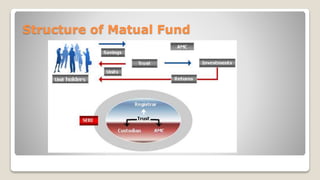
Structure of Matual Fund
MUTUAL FUNDS IN INDIA
 In 1963, the day the concept of Mutual Fund took birth
in India. Unit Trust of India invited investors or rather to
those who believed in savings, to park their money in UTI
Mutual Fund.
 The securities and Exchange Board of India (SEBI) came
out with comprehensive regulation in 1993 which defined
the structure of Mutual Fund and Asset Management
Companies for the first time.
MAJOR MUTUAL FUND COMPANIES IN INDIA
 AEGON Asset Management Company Pvt. Ltd.
 AIG Global Asset Management Company (India) Pvt. Ltd.
 Axis Asset Management Company Ltd.
 Baroda Pioneer Asset Management Company Limited
 Benchmark Asset Management Company Pvt. Ltd.
 Bharti AXA Investment Managers Private Limited
 Birla Sun Life Asset Management Company Limited
 Canara Robeco Asset Management Company Limited
 DBS Cholamandalam Asset Management Ltd.
 Deutsche Asset Management (India) Pvt. Ltd.
 DSP Black Rock Investment Managers Private Limited
LITERATURE REVIEW
Auther Books Finding
Sapar N. and
Madava R.,
“Performance
Evaluation of
Indian Mutual
Funds”.
Evaluates the performance of 269 open ended
schemes of mutual funds in a bear market using
risk-return analysis observe that most of the
mutual fund schemes in the sample outperformed
the investor's expectations by giving excess return
over expected return based on premium for
systematic risk and total risk.
Sharpe, W. F., The Journal of
Business, Vol.39,
1966, pp. 119-
138.
Developed model of portfolio performance
evaluation and used total risk in place of
systematic risk. According to this model it may be
said that the return is not the only factor in
evaluating mutual fund performance; the element
of risk also apparently influences mutual fund
performance.
RATIONAL OF STUDY
“research problem statement is to know detail
study comparisition mutual fund of sbi bank and
hdfc bank” which is the best investment for people
and gives good return and which mutual fund is
provided many types of investment of avenue in
mutual fund.
OBJECTIVES OF THE STUDY
 To evaluate and compare the performance of equity
diversified mutual fund schemes of SBI &HDFC.
 To compare the performance of equity diversified
mutual fund schemes of selected companies vis-à-vis
the market
 To examine the performance of selected schemes by
using the portfolio performance evaluation models
namely Sharpe, Treynor and Jensen.
RESEARCH METHODOLOGY
SR. NO. PARTICULARS DISCRIPTION
1 Research design
2 Source of data Secondary data from Internet.
3 Data collection method Secondary
4 Coverage All mutual fund
5 Sampling method on the basis of
1>Debt fund,
2>Equity fund,
3>Hybrid multi asset funds,
4>Liquid fund
0.71
47.79
2.56
0.370.73
73.99
4.23
0.45
Debt Debt Liquid Equity Hybrid Arbitrage
Stdv
Stdv hdfc Stdv sbi
Debt Debt Liquid Equity Hybrid Arbitrage
Beta hdfc 0.02 -0.06 0.75 0.00
Beta sbi 0.02 -0.01 0.76 -0.01
-0.20
-0.10
0.00
0.10
0.20
0.30
0.40
0.50
0.60
0.70
0.80
0.90
AxisTitle
Beta
26.48
2158.33
32.02 16.7927.60
3030.00
49.59 18.67
Debt Debt Liquid Equity Hybrid Arbitrage
Nav
hdfc sbi
8.25
53.19
25.83
7.09
8.64 7.93
28.99
7.71
Debt Debt Liquid Equity Hybrid Arbitrage
Average Return
Hdfc sbi
Debt Debt Liquid Equity Hybrid Arbitrage
hdfc -0.98 -0.03 2.61 -4.45
sbi 0.07 -0.01 4.18 -2.26
-5.00
-4.00
-3.00
-2.00
-1.00
0.00
1.00
2.00
3.00
4.00
5.00
AxisTitle
sharp Ratio
Debt Debt Liquid Equity Hybrid Arbitrage
hdfc 2.22 -104.63 32.29 144.44
sbi -56.36 104.44 41.17 100.00
-150.00
-100.00
-50.00
0.00
50.00
100.00
150.00
200.00
AxisTitle Treynor Ratio
8.92 9.11
25.33
9.018.91 9.01
24.79
9.01
Debt Debt Liquid Equity Hybrid Arbitrage
jensen
hdfc sbi
BIBLIOGRAPHY….
 www.fundsindia.com
 www.moneycontrol.com
 www.wikipidea.com
 www.nscindia.com
Comparative  study

Comparative study

  • 1.
    “COMPARATIVE STUDY ONPERFORMANCE EVALUATIONOF MUTUAL FUND SCHEMES OF SBI bank AND HDFC bank” Submitted to : Submitted By : Oakbrook business school Rajdeep Butani Yogesh Kalal
  • 2.
    FLOW OF PRESENTATION -INDUSTRYOVERVIEW - MUTUAL FUNDS IN INDIA -MAJOR MUTUAL FUND COMPANIES IN INDIA -LITERATURE REVIEW -RATIONAL OF STUDY -TOPIC INTRODUCTION -OBJECTIVES OF THE STUDY -RESEARCH METHODOLOGY -FINDING & CONCLUSATION -BIBLIOGRAPHY
  • 3.
    INDUSTRY OVERVIEW  Themutual fund industry in India started in 1963  First Phase – 1964-87. Unit Trust of India (UTI) was established on 1963 by an Act of Parliament. It was set up by the Reserve Bank of India and functioned under the Regulatory and administrative control of the Reserve Bank of India.  Second Phase – 1987-1993 (Entry of Public Sector Funds). In the year 1987 marked the entry of non- UTI, public sector mutual funds set up by public sector banks and Life Insurance Corporation of India (LIC) and General Insurance Corporation of India (GIC)  Third Phase – 1993-2003 (Entry of Private Sector Funds). With the entry of private sector funds in 1993, a new era started in the Indian mutual fund industry, giving the Indian investors a wider choice of fund families. Also, 1993 was the year in which the first Mutual Fund Regulations came into being, under which all mutual funds, except UTI were to be registered and governed.
  • 4.
  • 5.
    MUTUAL FUNDS ININDIA  In 1963, the day the concept of Mutual Fund took birth in India. Unit Trust of India invited investors or rather to those who believed in savings, to park their money in UTI Mutual Fund.  The securities and Exchange Board of India (SEBI) came out with comprehensive regulation in 1993 which defined the structure of Mutual Fund and Asset Management Companies for the first time.
  • 6.
    MAJOR MUTUAL FUNDCOMPANIES IN INDIA  AEGON Asset Management Company Pvt. Ltd.  AIG Global Asset Management Company (India) Pvt. Ltd.  Axis Asset Management Company Ltd.  Baroda Pioneer Asset Management Company Limited  Benchmark Asset Management Company Pvt. Ltd.  Bharti AXA Investment Managers Private Limited  Birla Sun Life Asset Management Company Limited  Canara Robeco Asset Management Company Limited  DBS Cholamandalam Asset Management Ltd.  Deutsche Asset Management (India) Pvt. Ltd.  DSP Black Rock Investment Managers Private Limited
  • 7.
    LITERATURE REVIEW Auther BooksFinding Sapar N. and Madava R., “Performance Evaluation of Indian Mutual Funds”. Evaluates the performance of 269 open ended schemes of mutual funds in a bear market using risk-return analysis observe that most of the mutual fund schemes in the sample outperformed the investor's expectations by giving excess return over expected return based on premium for systematic risk and total risk. Sharpe, W. F., The Journal of Business, Vol.39, 1966, pp. 119- 138. Developed model of portfolio performance evaluation and used total risk in place of systematic risk. According to this model it may be said that the return is not the only factor in evaluating mutual fund performance; the element of risk also apparently influences mutual fund performance.
  • 8.
    RATIONAL OF STUDY “researchproblem statement is to know detail study comparisition mutual fund of sbi bank and hdfc bank” which is the best investment for people and gives good return and which mutual fund is provided many types of investment of avenue in mutual fund.
  • 9.
    OBJECTIVES OF THESTUDY  To evaluate and compare the performance of equity diversified mutual fund schemes of SBI &HDFC.  To compare the performance of equity diversified mutual fund schemes of selected companies vis-à-vis the market  To examine the performance of selected schemes by using the portfolio performance evaluation models namely Sharpe, Treynor and Jensen.
  • 10.
    RESEARCH METHODOLOGY SR. NO.PARTICULARS DISCRIPTION 1 Research design 2 Source of data Secondary data from Internet. 3 Data collection method Secondary 4 Coverage All mutual fund 5 Sampling method on the basis of 1>Debt fund, 2>Equity fund, 3>Hybrid multi asset funds, 4>Liquid fund
  • 11.
    0.71 47.79 2.56 0.370.73 73.99 4.23 0.45 Debt Debt LiquidEquity Hybrid Arbitrage Stdv Stdv hdfc Stdv sbi
  • 12.
    Debt Debt LiquidEquity Hybrid Arbitrage Beta hdfc 0.02 -0.06 0.75 0.00 Beta sbi 0.02 -0.01 0.76 -0.01 -0.20 -0.10 0.00 0.10 0.20 0.30 0.40 0.50 0.60 0.70 0.80 0.90 AxisTitle Beta
  • 13.
    26.48 2158.33 32.02 16.7927.60 3030.00 49.59 18.67 DebtDebt Liquid Equity Hybrid Arbitrage Nav hdfc sbi
  • 14.
    8.25 53.19 25.83 7.09 8.64 7.93 28.99 7.71 Debt DebtLiquid Equity Hybrid Arbitrage Average Return Hdfc sbi
  • 15.
    Debt Debt LiquidEquity Hybrid Arbitrage hdfc -0.98 -0.03 2.61 -4.45 sbi 0.07 -0.01 4.18 -2.26 -5.00 -4.00 -3.00 -2.00 -1.00 0.00 1.00 2.00 3.00 4.00 5.00 AxisTitle sharp Ratio
  • 16.
    Debt Debt LiquidEquity Hybrid Arbitrage hdfc 2.22 -104.63 32.29 144.44 sbi -56.36 104.44 41.17 100.00 -150.00 -100.00 -50.00 0.00 50.00 100.00 150.00 200.00 AxisTitle Treynor Ratio
  • 17.
    8.92 9.11 25.33 9.018.91 9.01 24.79 9.01 DebtDebt Liquid Equity Hybrid Arbitrage jensen hdfc sbi
  • 18.