





ASSIGNMENT ON
MUTUAL FUNDS

SUBMITTED BY:AMIT KUMAR BHANJ
DEEPA SHARMA
DIVESH SHARMA
GAGANPREET KAUR
MUTUAL FUNDS
A mutual fund is a common pool of money into
which investors place their contributions that are to
be invested in different types of securities in
accordance with the stated objective.
TYPES OF MUTUAL FUNDS
Classified under five broad categories:-






According
According
According
According

to ownership.
to the scheme of operation.
to portfolio.
to locations
According to ownership.


Public Sector mutual funds:-

Public Sector Mutual Fund means the Mutual Fund
registered with and regulated by SEBI where the
Government of India, its financial institutions and public
sector banks holds/hold individually or collectively more
than 50 per cent of equity/shares in the Asset
Management Company of that Mutual Fund.
SBI-MUTUAL FUNDS
•The objective of the scheme is to provide the investor
with long term capital appreciation/dividends along
with the liquidity of an open-ended scheme.
•The

scheme will invest in a diversified portfolio of
equities of high growth companies.
•Thereafter

a number of public sector organisations
like IND Bank-MF,CAN Bank-MF,BOI Bank-MF,PNB
Bank-MF,LIC-MF etc have joined operations in MF
business.


Private Sector Mutual Funds

The Govt. of India allowed the private sector
corporates to join the Mutual Fund Industry. A
number of private sector companies approached
SEBI for permission to set up Private Mutual
Funds.
ACCORDING TO SCHEME
OF OPERATIONS


Open-Ended Funds

1. It offers units for sale without specifying any
duration
for redemption.
2. No Fixed Maturity period.
3. Subscription and Redemption can be done at any
time.
4. These are not listed
For eg:- ULIP, Dhanraksha & Dhanvridhi of LIC Mutual
fund
ULIP
(unit linked insurance plans)
Top

up facilities
Fund switch
Liquidity
Riders
Increase or decrease the level of protection.
Cover continuance option.
DHANRAKSHA

Death

Benefits.
No Survival Benefits.
Surrender Benefit.
Tax Benefits.
DHANVRIDHI
Guaranteed

returns.
Limited Premium Payment.
Riders.
Rebate.
Survival Benefits.
Close

ended Funds

1.Period of Maturity is specified.
2.Subscription is only at the time of initial
issue.
3.These are listed.
For eg:- Dhanshree and Dhansamaridhi of
LIC Mutual Fund, Canshare of Canara
Bank , Ind Jyoti and Swaran jyoti of Indian
Bank.
Interval
1.
2.
3.

4.

Funds

Kept open for specific interval and after
that operates as a close ended.
Recently permitted by SEBI.
Open for sale or repurchase at fixed
predetermined intervals (disclosed in offer
document).
Units are also traded in stock exchange.
ACCORDING TO PORTFOLIO
Income

Funds:>Aims at providing maximum current
return.
>Investments are made in stocks
yielding high returns.
>Income is distributed periodically.
>Capital appreciation is of small
importance.
Growth

Funds:-

>Aims at providing capital appreciation.
>Investment in growth oriented securities (
long run).
>Concentrate on value appreciation of
securities and not on regularity of income.
Balanced

Funds:-

>Spend both on common stock and
preferred stock.
>Ensure both appreciation in stock as well
as regular income (interest and dividend).
>Also known as conservative Funds.
Bond

Funds:-

>Employ resources in Bonds.
>Ensure Fixed and Regular Income.
>Some Funds are available at lower than
face value.( net income on Face value)
Money

Market Mutual Funds:-

>Investments exclusively in Money Market
Instruments.
>Instruments Include treasury bills , govt
securities with an unexpired maturity of up
to 1 yr, commercial paper , commercial
bills & certificates of Deposits.
Taxation

Funds:-

>Investors get some concession in income
tax.
>lock up period.(keeping money with fund)
>Distribute the Profit among Unit Holders.
>Amount collected is used to acquire
shares and interest bearing securities.
ACCORDING TO LOCATION
Domestic

Funds:>Mobilise savings of people within the
country where investments are made
Off-Shore

Funds:>Mobilise Funds in countries other than
where investment are to be made.
> Attracts Foreign savings.
PERFORMANCE OF MUTUAL
FUNDS IN
THE MARKET
PASSING THROUGH CRITICAL PHASE
 “LIVING DEAD” IN STOCK MARKETS
 LOST INVESTOR’S CONFIDENCE
 UTTER FAILURE IN INDIA

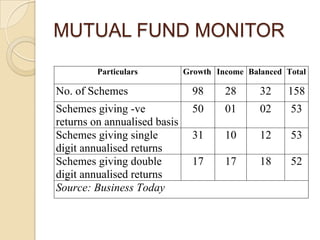
MUTUAL FUND MONITOR
Particulars

Growth Income Balanced Total

No. of Schemes

98

28

32

158

Schemes giving -ve
returns on annualised basis
Schemes giving single
digit annualised returns
Schemes giving double
digit annualised returns
Source: Business Today

50

01

02

53

31

10

12

53

17

17

18

52
PRODUCT DESIGN
 DID
LITTLE TO INNOVATE WITH
INNOVATION
 75% SCHEMES CLOSE END WITH
POOR RETURNS
 INNOVATION ONLY IN OPEN END
SCHEMEDS
 TIME TO DESIGN SECTOR, LOCATION
BASED MFs
FUND MANAGEMENT
 NON-QUALIFIED,
UNPROFESSIONAL
FUND MANAGERS
 LOOK
MFs AS ANOTHER EQUITY
PRODUCT
 IGNORE
ASSET
ALLOCATION,
PORTFOLIO, TURNOVER & COST
 NO QICK ASSET REALLOCATION ON TIME
 DON’T INCLUDE HIGH LIQUID BLUE CHIP
STOCKS
 NOT
BALANCING
RISK
RETURN
EXPECTATION OF INVESTORS
 Mutual

Funds are subject to market
risks and there is no assurance and
no guarantee that the scheme
objective will be achieved. As with
investment in any securities, the NAV
of the units issued under the
schemes may go up or down
depending on the factors and forces
affecting the securities markets.

Assignment on Mutual Funds

  • 1.
    ASSIGNMENT ON MUTUAL FUNDS SUBMITTEDBY:AMIT KUMAR BHANJ DEEPA SHARMA DIVESH SHARMA GAGANPREET KAUR
  • 2.
    MUTUAL FUNDS A mutualfund is a common pool of money into which investors place their contributions that are to be invested in different types of securities in accordance with the stated objective.
  • 3.
    TYPES OF MUTUALFUNDS Classified under five broad categories:-     According According According According to ownership. to the scheme of operation. to portfolio. to locations
  • 4.
    According to ownership.  PublicSector mutual funds:- Public Sector Mutual Fund means the Mutual Fund registered with and regulated by SEBI where the Government of India, its financial institutions and public sector banks holds/hold individually or collectively more than 50 per cent of equity/shares in the Asset Management Company of that Mutual Fund.
  • 5.
    SBI-MUTUAL FUNDS •The objectiveof the scheme is to provide the investor with long term capital appreciation/dividends along with the liquidity of an open-ended scheme. •The scheme will invest in a diversified portfolio of equities of high growth companies. •Thereafter a number of public sector organisations like IND Bank-MF,CAN Bank-MF,BOI Bank-MF,PNB Bank-MF,LIC-MF etc have joined operations in MF business.
  • 6.
     Private Sector MutualFunds The Govt. of India allowed the private sector corporates to join the Mutual Fund Industry. A number of private sector companies approached SEBI for permission to set up Private Mutual Funds.
  • 7.
    ACCORDING TO SCHEME OFOPERATIONS  Open-Ended Funds 1. It offers units for sale without specifying any duration for redemption. 2. No Fixed Maturity period. 3. Subscription and Redemption can be done at any time. 4. These are not listed For eg:- ULIP, Dhanraksha & Dhanvridhi of LIC Mutual fund
  • 8.
    ULIP (unit linked insuranceplans) Top up facilities Fund switch Liquidity Riders Increase or decrease the level of protection. Cover continuance option.
  • 9.
  • 10.
  • 11.
    Close ended Funds 1.Period ofMaturity is specified. 2.Subscription is only at the time of initial issue. 3.These are listed. For eg:- Dhanshree and Dhansamaridhi of LIC Mutual Fund, Canshare of Canara Bank , Ind Jyoti and Swaran jyoti of Indian Bank.
  • 12.
    Interval 1. 2. 3. 4. Funds Kept open forspecific interval and after that operates as a close ended. Recently permitted by SEBI. Open for sale or repurchase at fixed predetermined intervals (disclosed in offer document). Units are also traded in stock exchange.
  • 13.
    ACCORDING TO PORTFOLIO Income Funds:>Aimsat providing maximum current return. >Investments are made in stocks yielding high returns. >Income is distributed periodically. >Capital appreciation is of small importance.
  • 14.
    Growth Funds:- >Aims at providingcapital appreciation. >Investment in growth oriented securities ( long run). >Concentrate on value appreciation of securities and not on regularity of income.
  • 15.
    Balanced Funds:- >Spend both oncommon stock and preferred stock. >Ensure both appreciation in stock as well as regular income (interest and dividend). >Also known as conservative Funds.
  • 16.
    Bond Funds:- >Employ resources inBonds. >Ensure Fixed and Regular Income. >Some Funds are available at lower than face value.( net income on Face value)
  • 17.
    Money Market Mutual Funds:- >Investmentsexclusively in Money Market Instruments. >Instruments Include treasury bills , govt securities with an unexpired maturity of up to 1 yr, commercial paper , commercial bills & certificates of Deposits.
  • 18.
    Taxation Funds:- >Investors get someconcession in income tax. >lock up period.(keeping money with fund) >Distribute the Profit among Unit Holders. >Amount collected is used to acquire shares and interest bearing securities.
  • 19.
    ACCORDING TO LOCATION Domestic Funds:>Mobilisesavings of people within the country where investments are made Off-Shore Funds:>Mobilise Funds in countries other than where investment are to be made. > Attracts Foreign savings.
  • 20.
    PERFORMANCE OF MUTUAL FUNDSIN THE MARKET PASSING THROUGH CRITICAL PHASE  “LIVING DEAD” IN STOCK MARKETS  LOST INVESTOR’S CONFIDENCE  UTTER FAILURE IN INDIA 
  • 21.
    MUTUAL FUND MONITOR Particulars GrowthIncome Balanced Total No. of Schemes 98 28 32 158 Schemes giving -ve returns on annualised basis Schemes giving single digit annualised returns Schemes giving double digit annualised returns Source: Business Today 50 01 02 53 31 10 12 53 17 17 18 52
  • 22.
    PRODUCT DESIGN  DID LITTLETO INNOVATE WITH INNOVATION  75% SCHEMES CLOSE END WITH POOR RETURNS  INNOVATION ONLY IN OPEN END SCHEMEDS  TIME TO DESIGN SECTOR, LOCATION BASED MFs
  • 23.
    FUND MANAGEMENT  NON-QUALIFIED, UNPROFESSIONAL FUNDMANAGERS  LOOK MFs AS ANOTHER EQUITY PRODUCT  IGNORE ASSET ALLOCATION, PORTFOLIO, TURNOVER & COST  NO QICK ASSET REALLOCATION ON TIME  DON’T INCLUDE HIGH LIQUID BLUE CHIP STOCKS  NOT BALANCING RISK RETURN EXPECTATION OF INVESTORS
  • 24.
     Mutual Funds aresubject to market risks and there is no assurance and no guarantee that the scheme objective will be achieved. As with investment in any securities, the NAV of the units issued under the schemes may go up or down depending on the factors and forces affecting the securities markets.