Comparative Social Structures and Welfare 2: How Do Welfare States Differ?
Session Objectives To explore  how  welfare states differ To examine key typologies of welfare Consider key criticisms of typologies
The Welfare State... Why do welfare states differ? Many influences on growth of welfare state: Economics Politics  Demography History Culture Geography Fascinating topic for social scientists
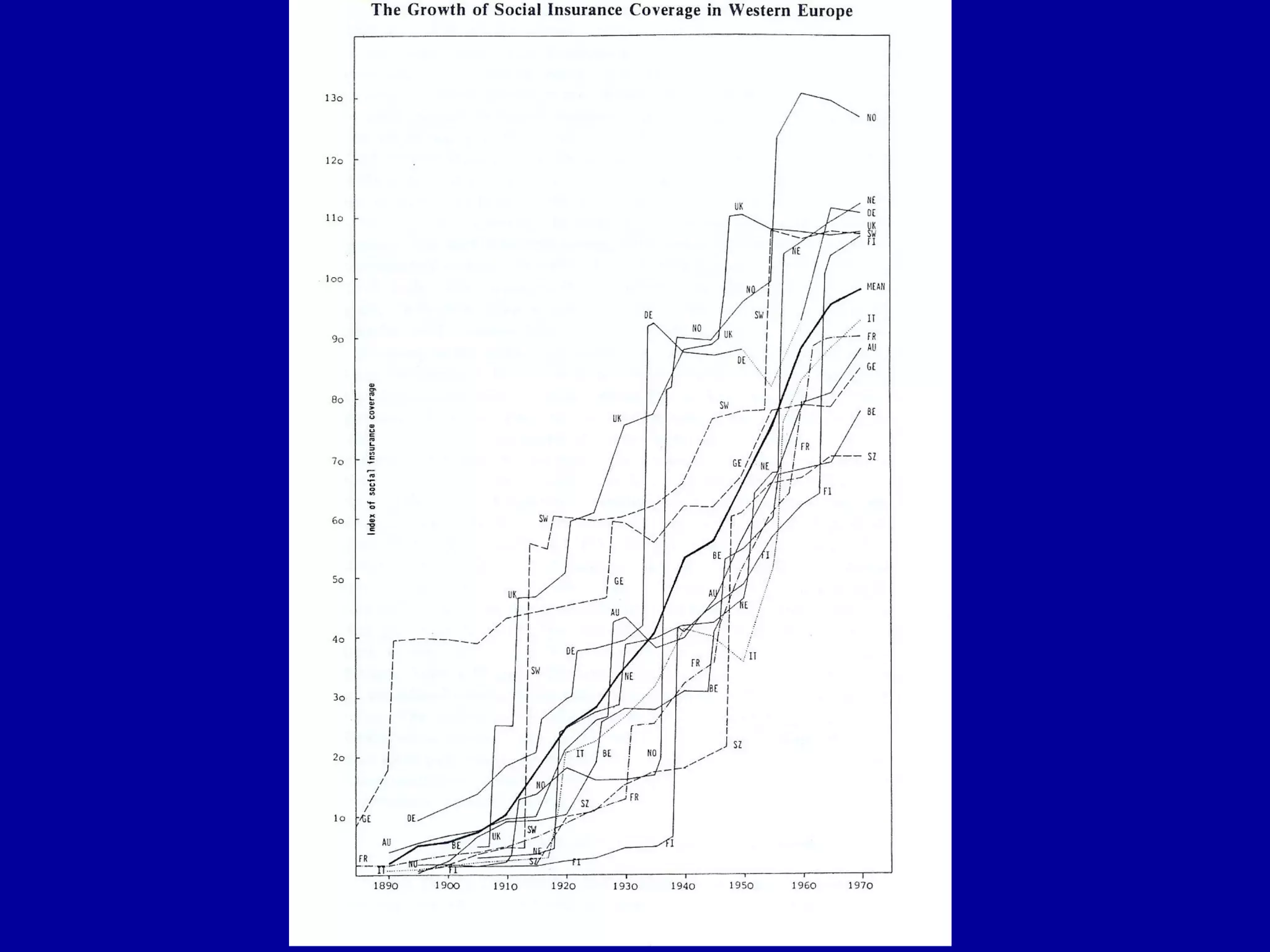
The Welfare State... Economic growth = Welfare State growth affordability increases changing demographics new risks/social problems Convergence Logic laggards eventually catch up Common Argument in 1960s & 1970s
 
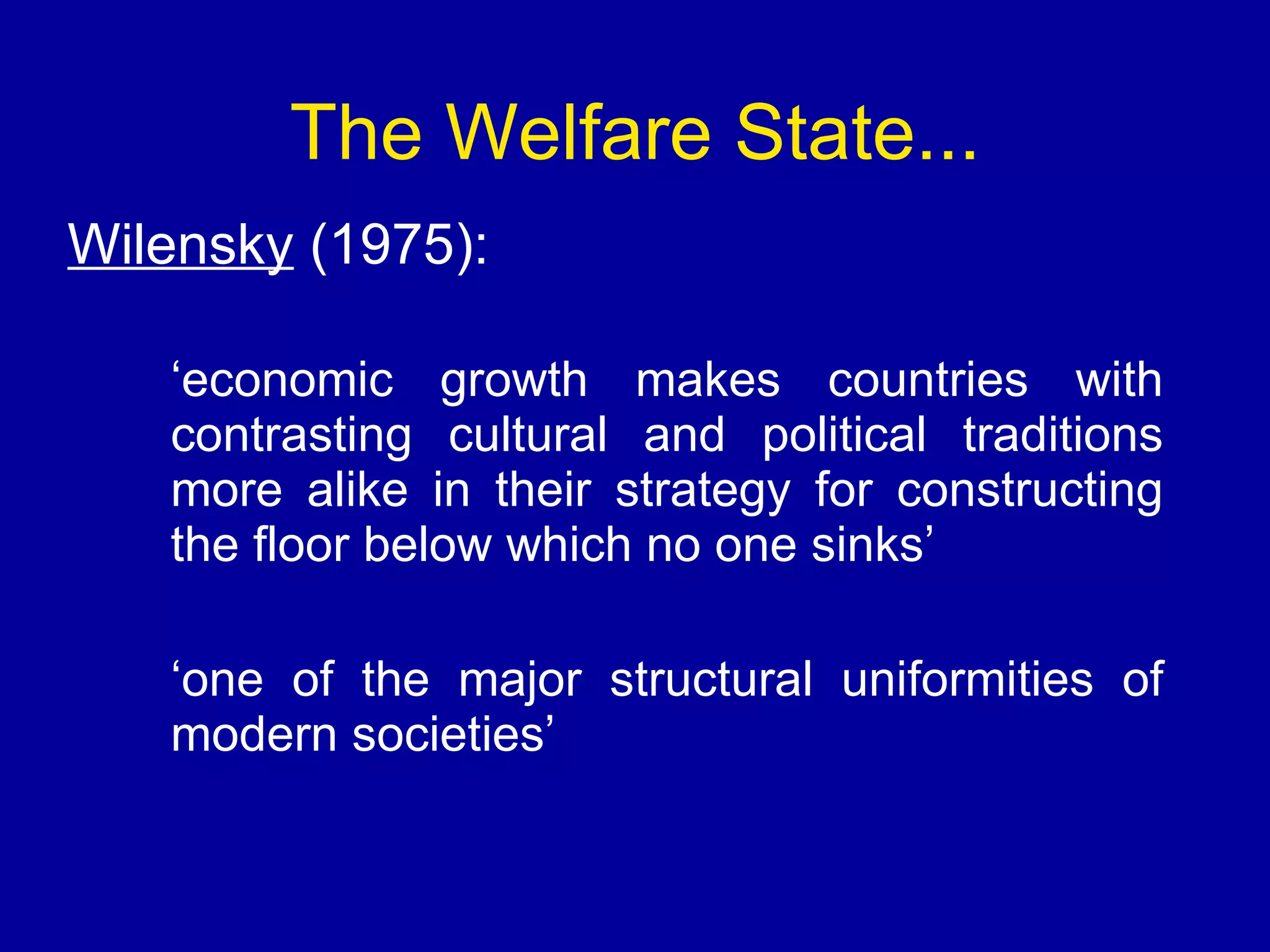
The Welfare State... Wilensky  (1975): ‘ economic growth makes countries with contrasting cultural and political traditions more alike in their strategy for constructing the floor below which no one sinks’ ‘ one of the major structural uniformities of modern societies’
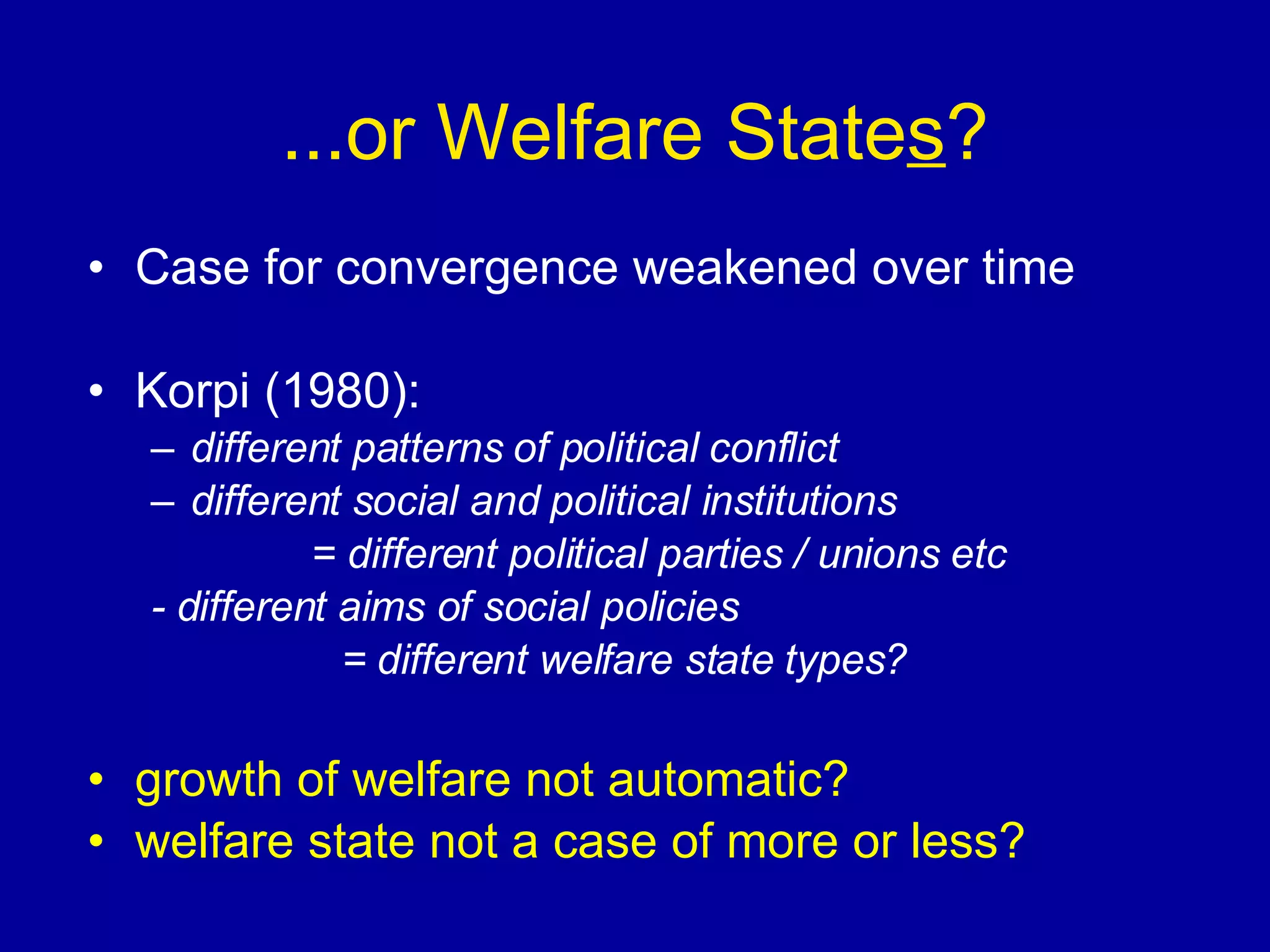
...or Welfare State s ? Case for convergence weakened over time Korpi (1980): different patterns of political conflict different social and political institutions  = different political parties / unions etc - different aims of social policies   = different welfare state types? growth of welfare not automatic? welfare state not a case of more or less?
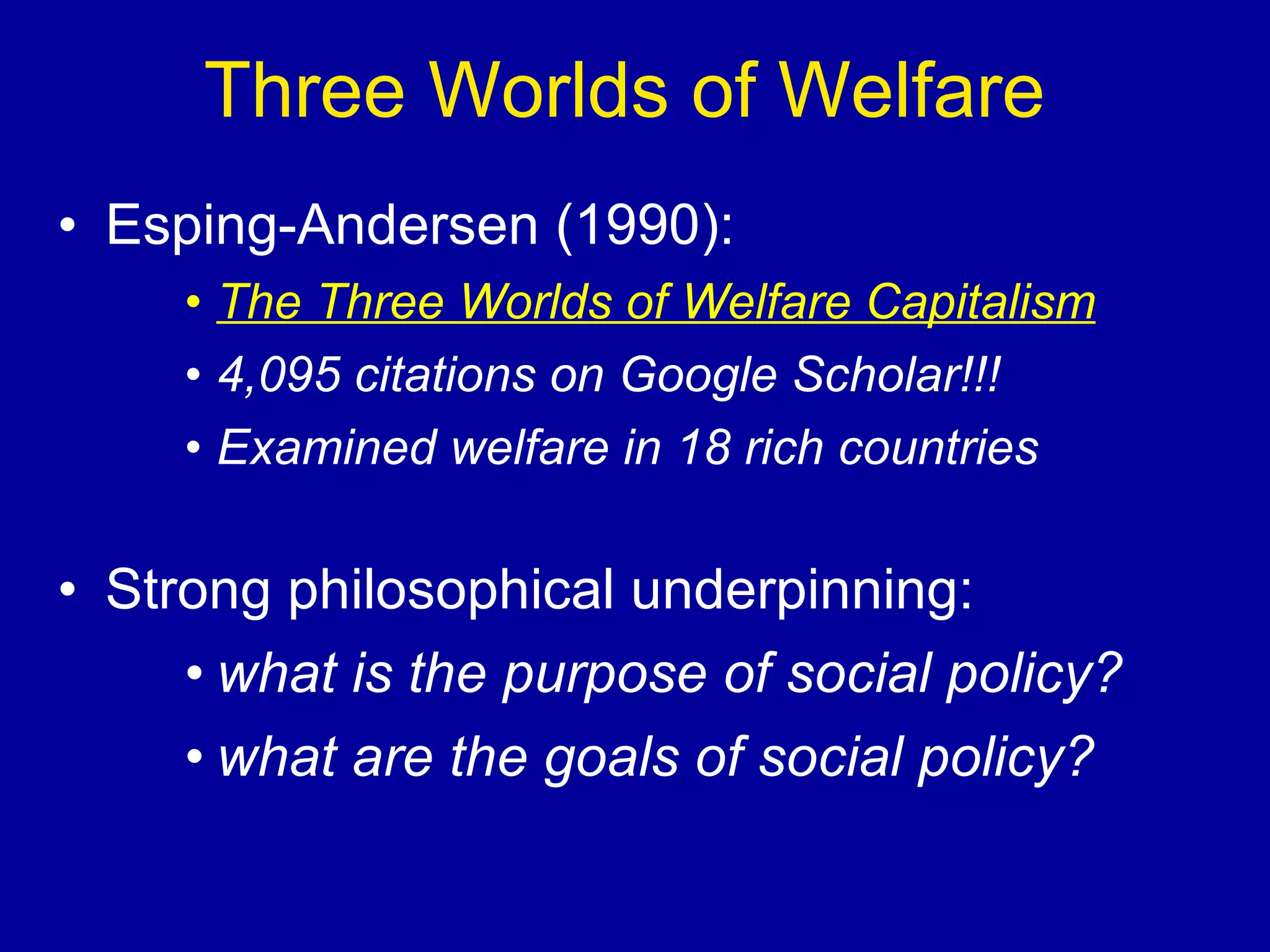
Three Worlds of Welfare Esping-Andersen (1990): The Three Worlds of Welfare Capitalism 4,095 citations on Google Scholar!!! Examined welfare in 18 rich countries Strong philosophical underpinning: what is the purpose of social policy? what are the goals of social policy?
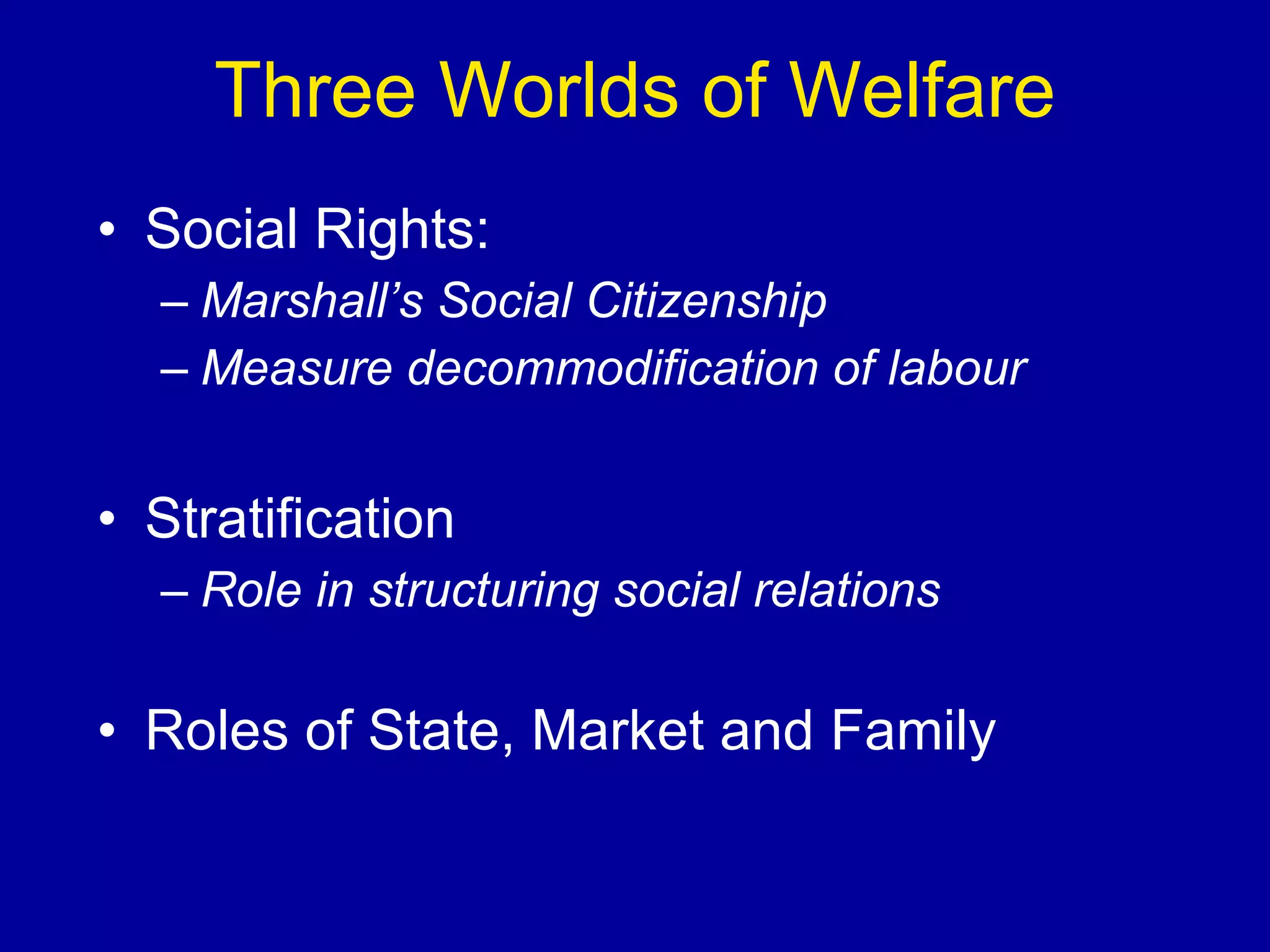
Three Worlds of Welfare Social Rights: Marshall’s Social Citizenship Measure decommodification of labour Stratification Role in structuring social relations Roles of State, Market and Family
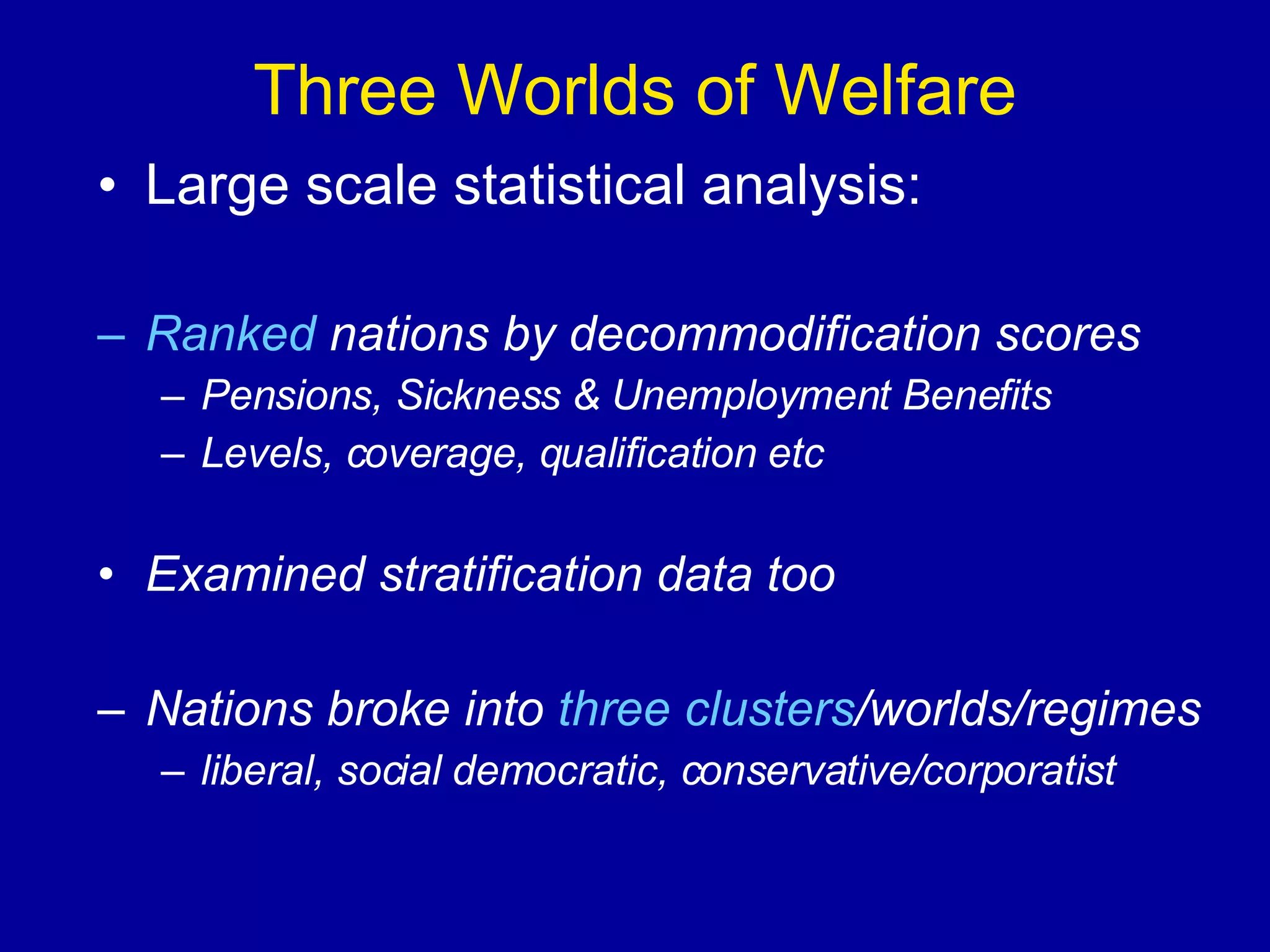
Three Worlds of Welfare Large scale statistical analysis: Ranked  nations by decommodification scores Pensions, Sickness & Unemployment Benefits Levels, coverage, qualification etc Examined stratification data too Nations broke into  three clusters /worlds/regimes liberal, social democratic, conservative/corporatist
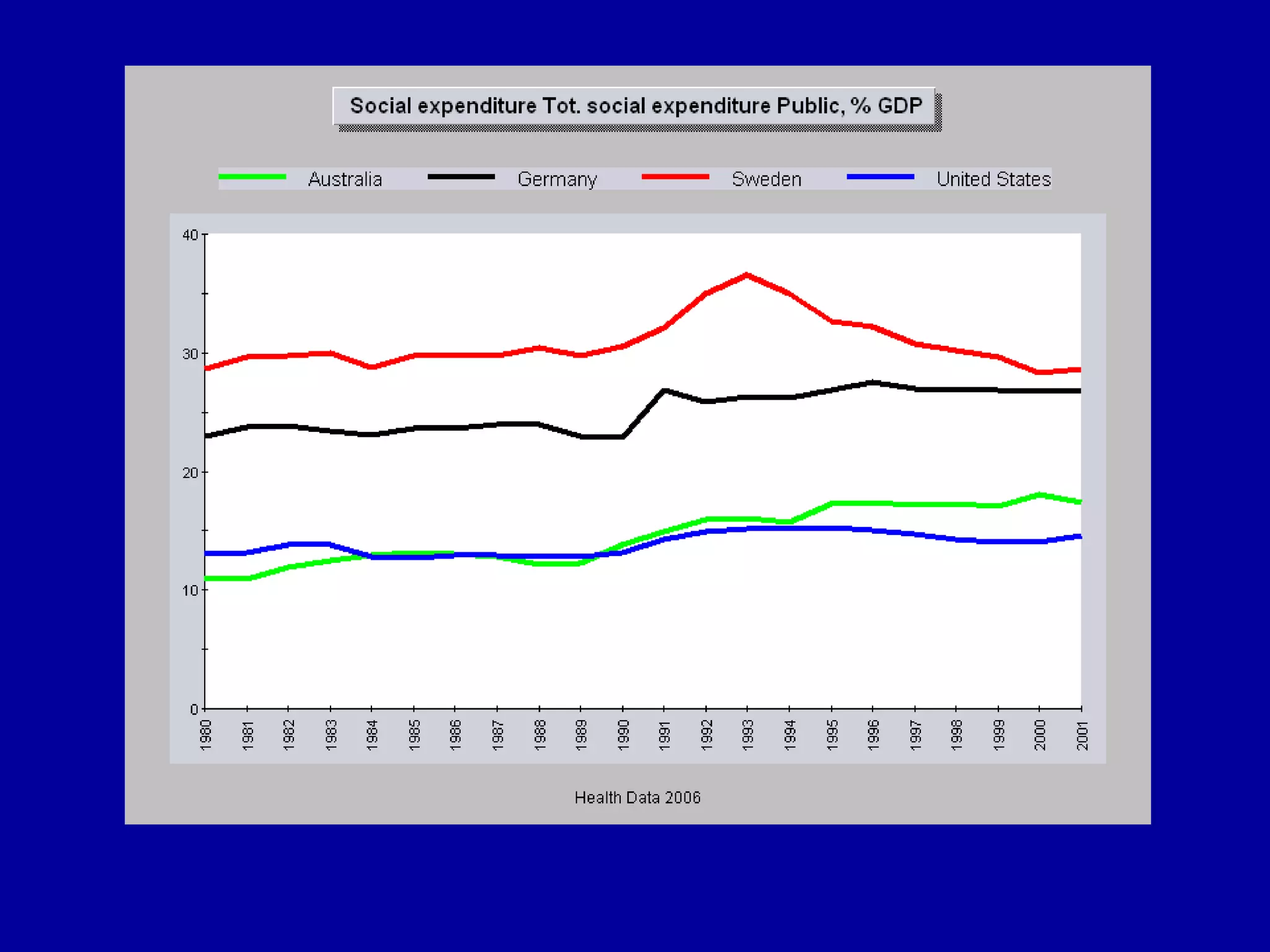
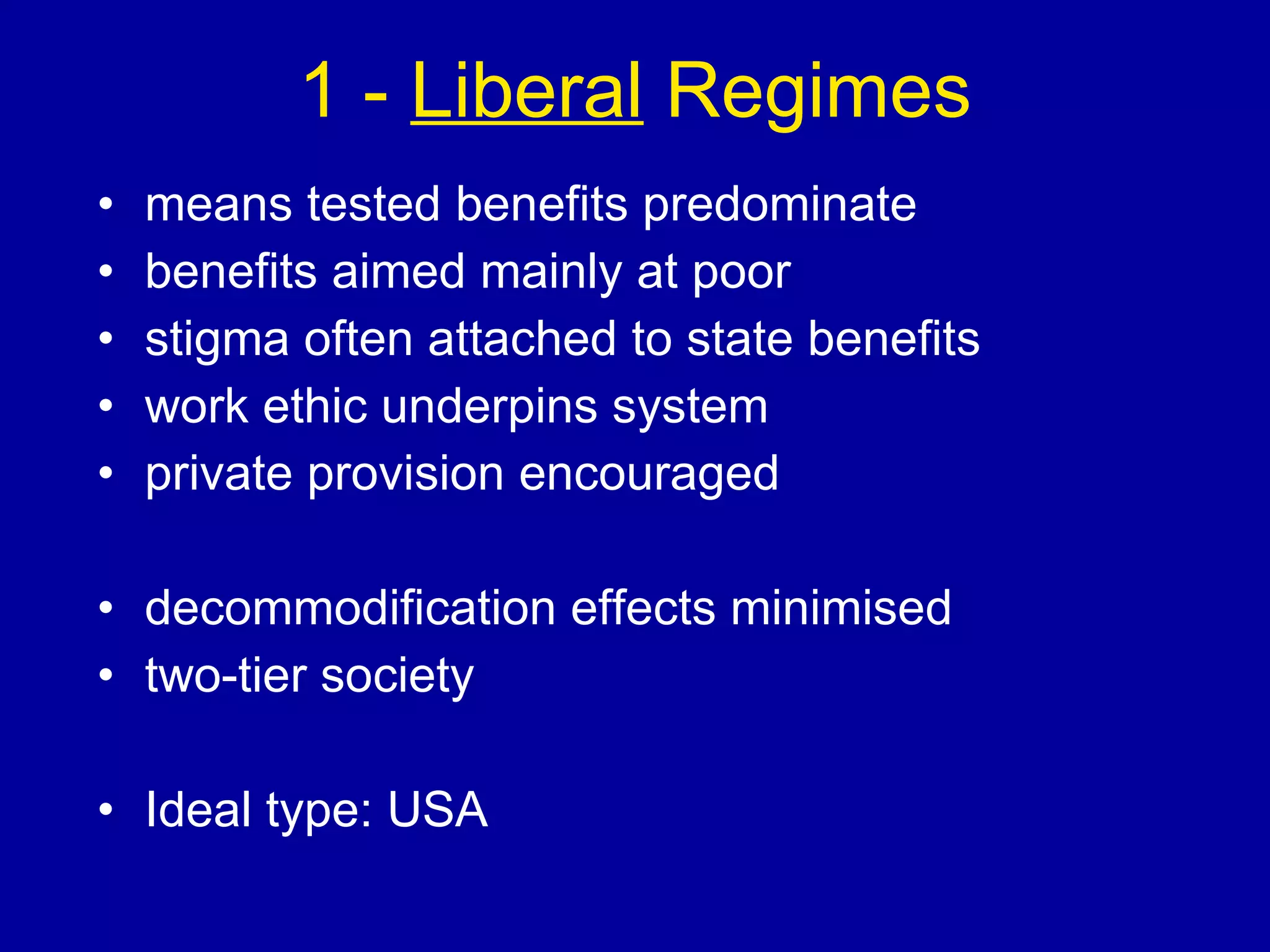
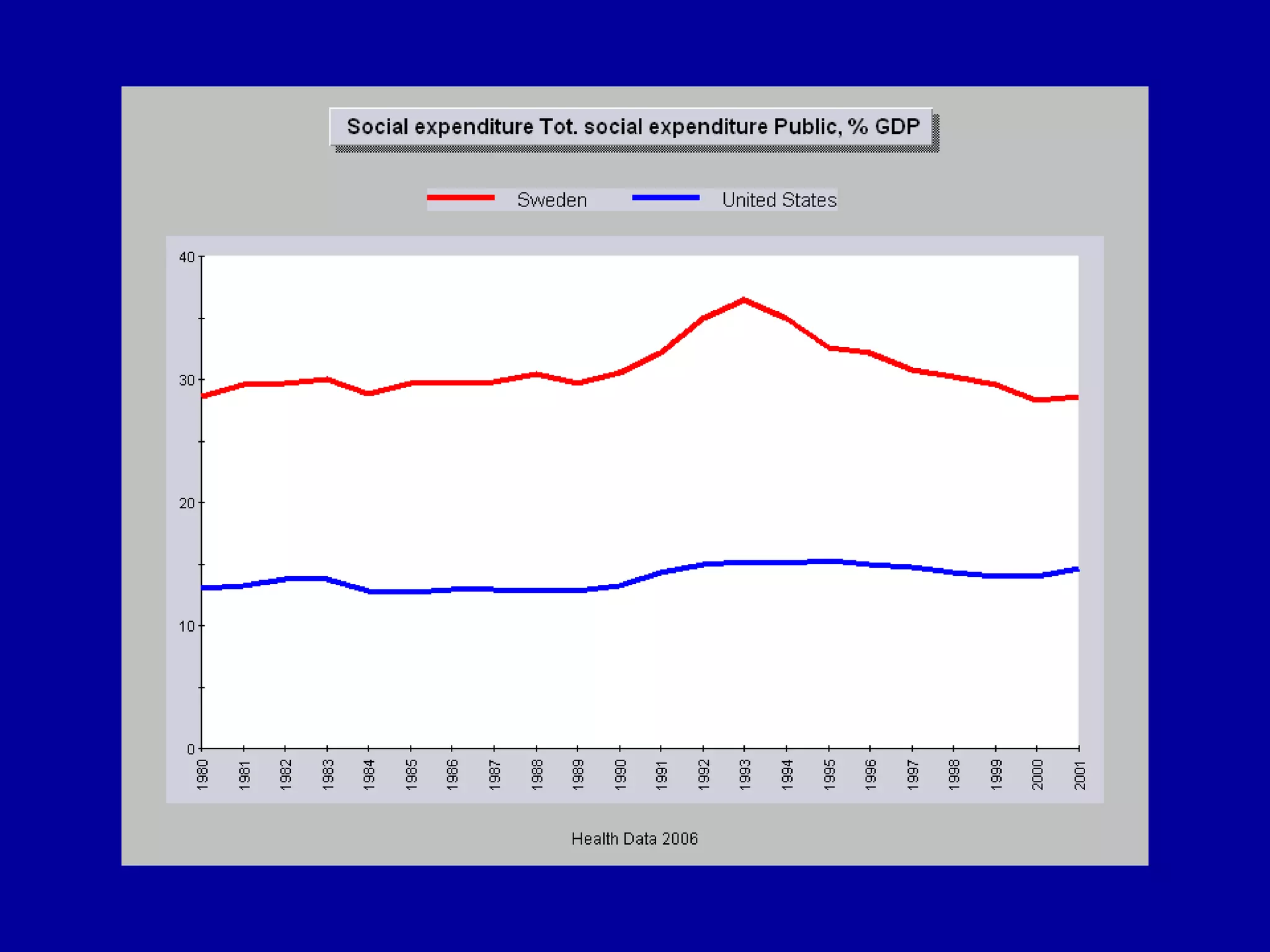
1 -  Liberal  Regimes means tested benefits predominate benefits aimed mainly at poor stigma often attached to state benefits work ethic underpins system private provision encouraged decommodification effects minimised two-tier society Ideal type: USA
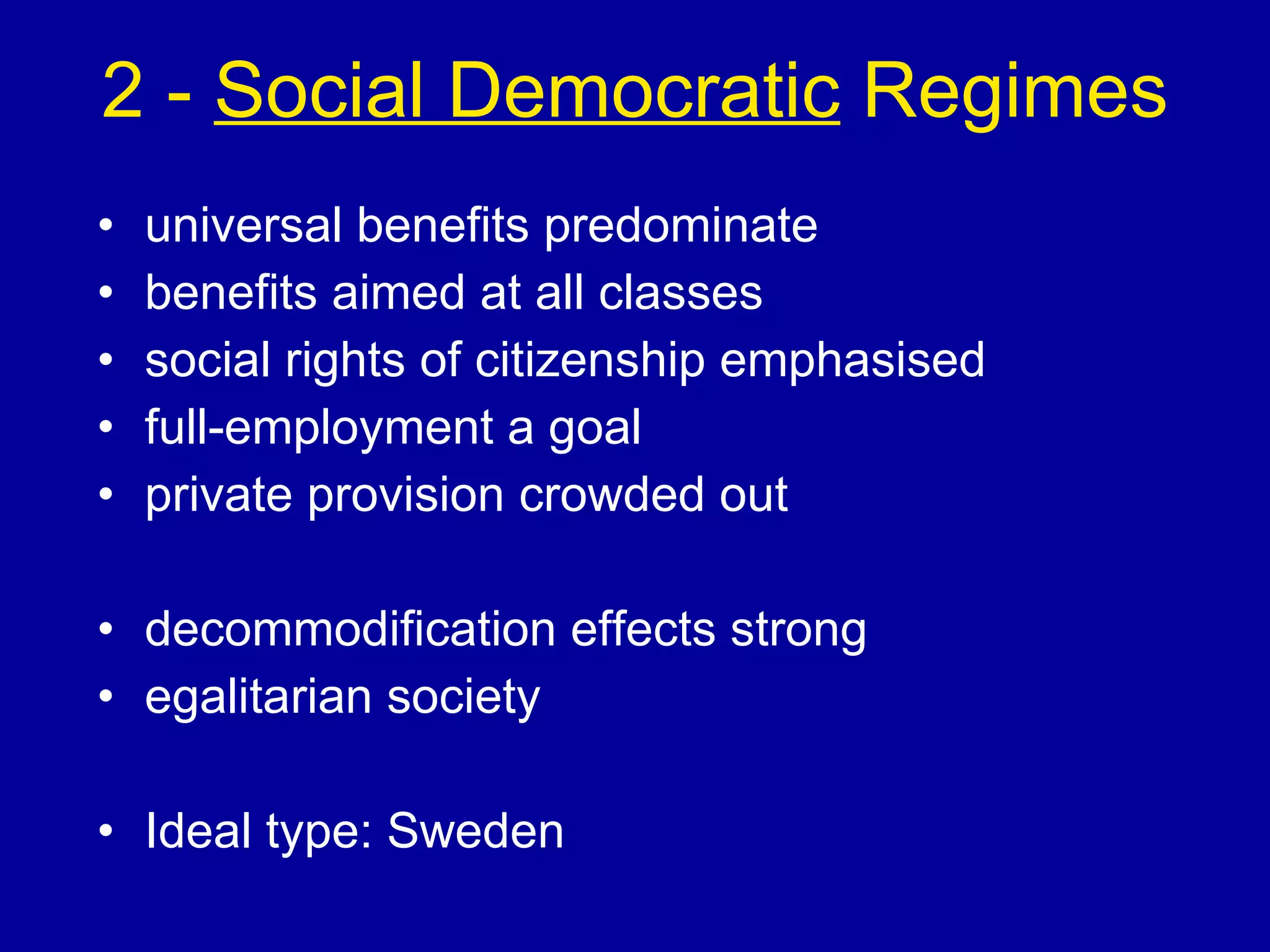
2 -  Social Democratic  Regimes universal benefits predominate benefits aimed at all classes social rights of citizenship emphasised full-employment a goal private provision crowded out decommodification effects strong egalitarian society Ideal type: Sweden
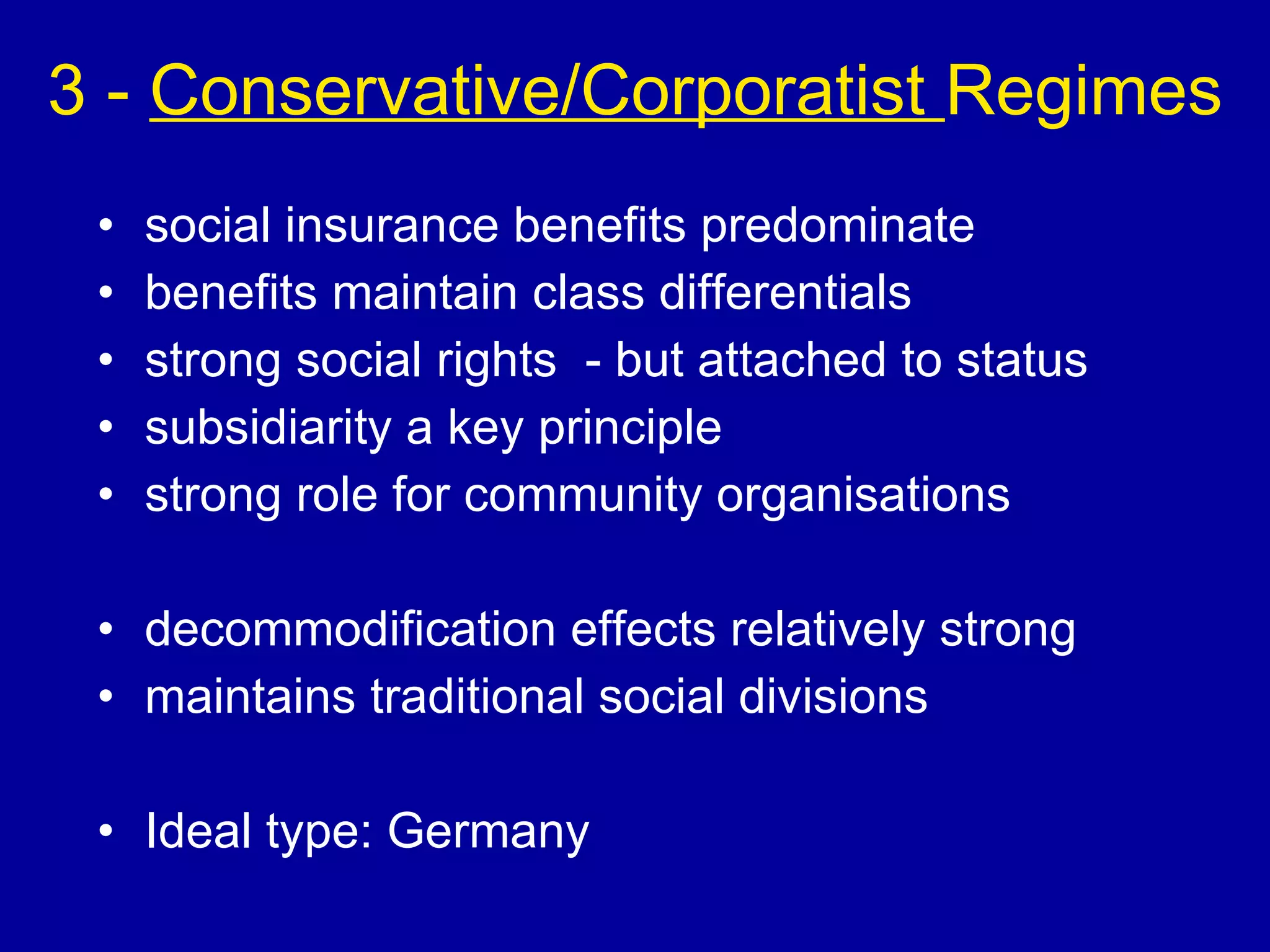
3 -  Conservative/Corporatist  Regimes social insurance benefits predominate benefits maintain class differentials strong social rights  - but attached to status subsidiarity a key principle strong role for community organisations decommodification effects relatively strong maintains traditional social divisions  Ideal type: Germany
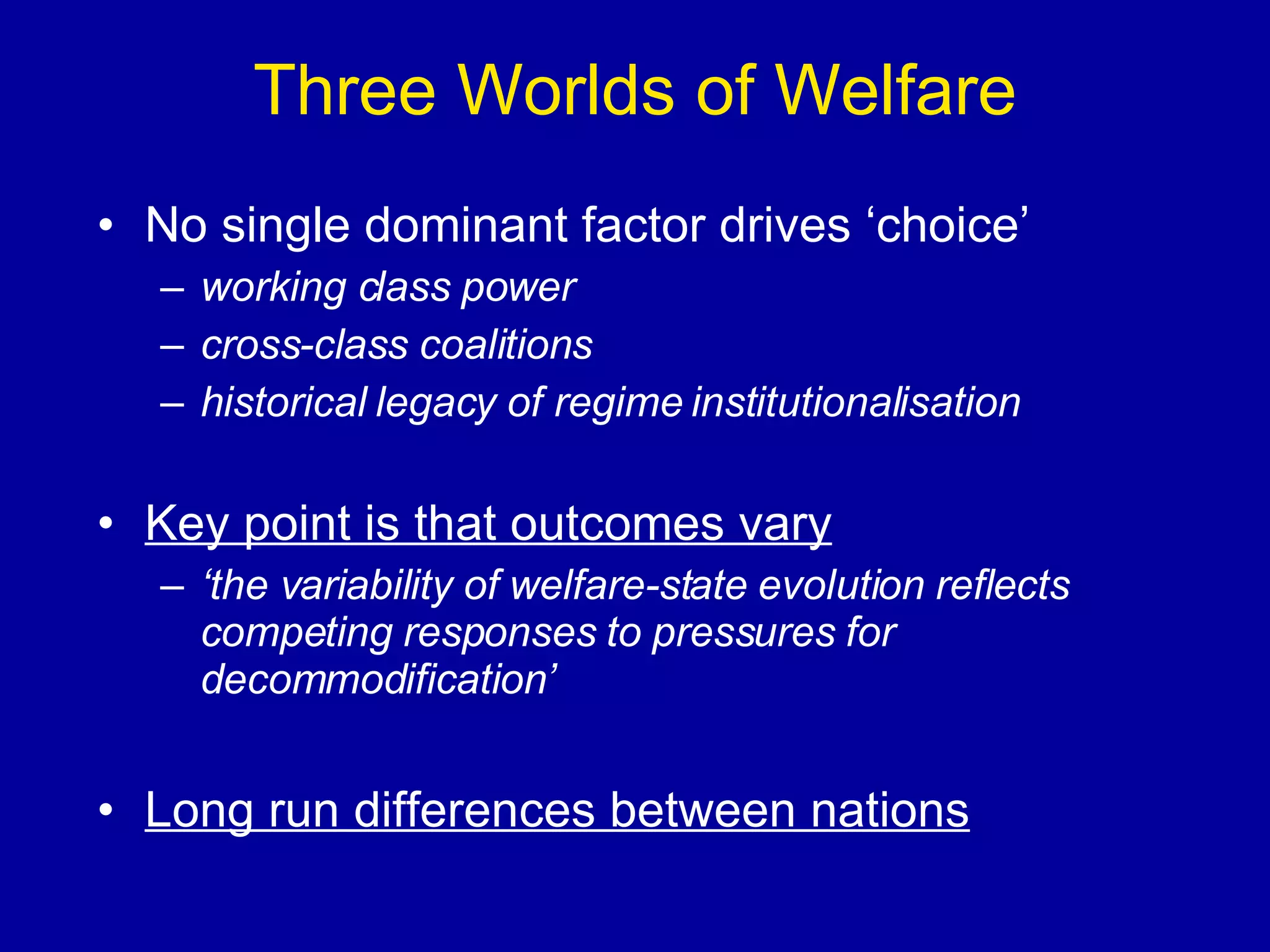
Three Worlds of Welfare No single dominant factor drives ‘choice’ working class power cross-class coalitions historical legacy of regime institutionalisation Key point is that outcomes vary ‘ the variability of welfare-state evolution reflects competing responses to pressures for decommodification’ Long run differences between nations
 
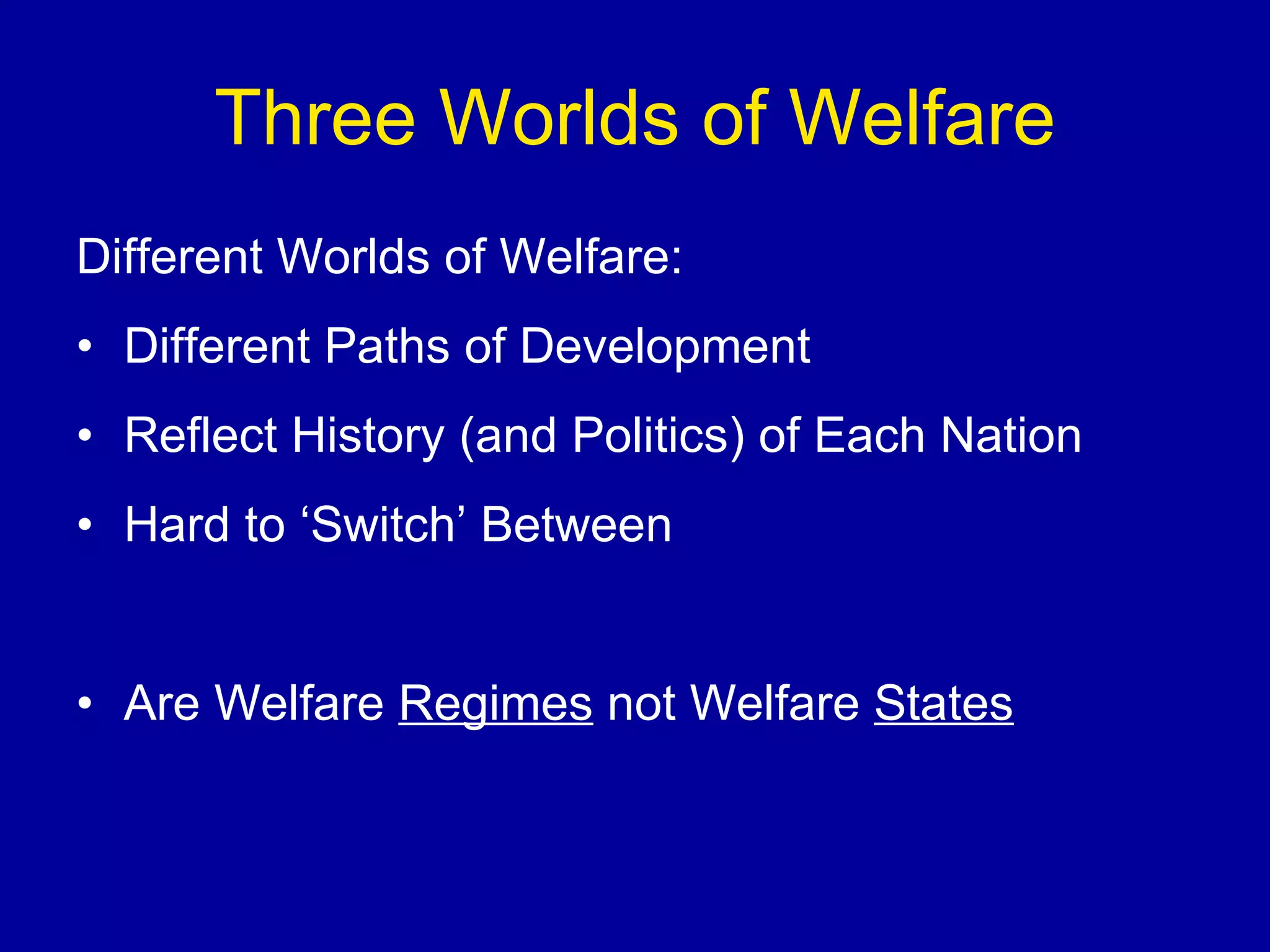
Three Worlds of Welfare Different Worlds of Welfare: Different Paths of Development Reflect History (and Politics) of Each Nation Hard to ‘Switch’ Between Are Welfare  Regimes  not Welfare  States
‘ since [the worlds of welfare] are, in a sense, ideal types there are bound to be ambiguous cases…It is…possible that the criteria employed to demarcate a regime may err: if alternative attributes were considered, the classification might break down or, at least, require additional regimes’ (Esping-Andersen) Three Worlds of Welfare?
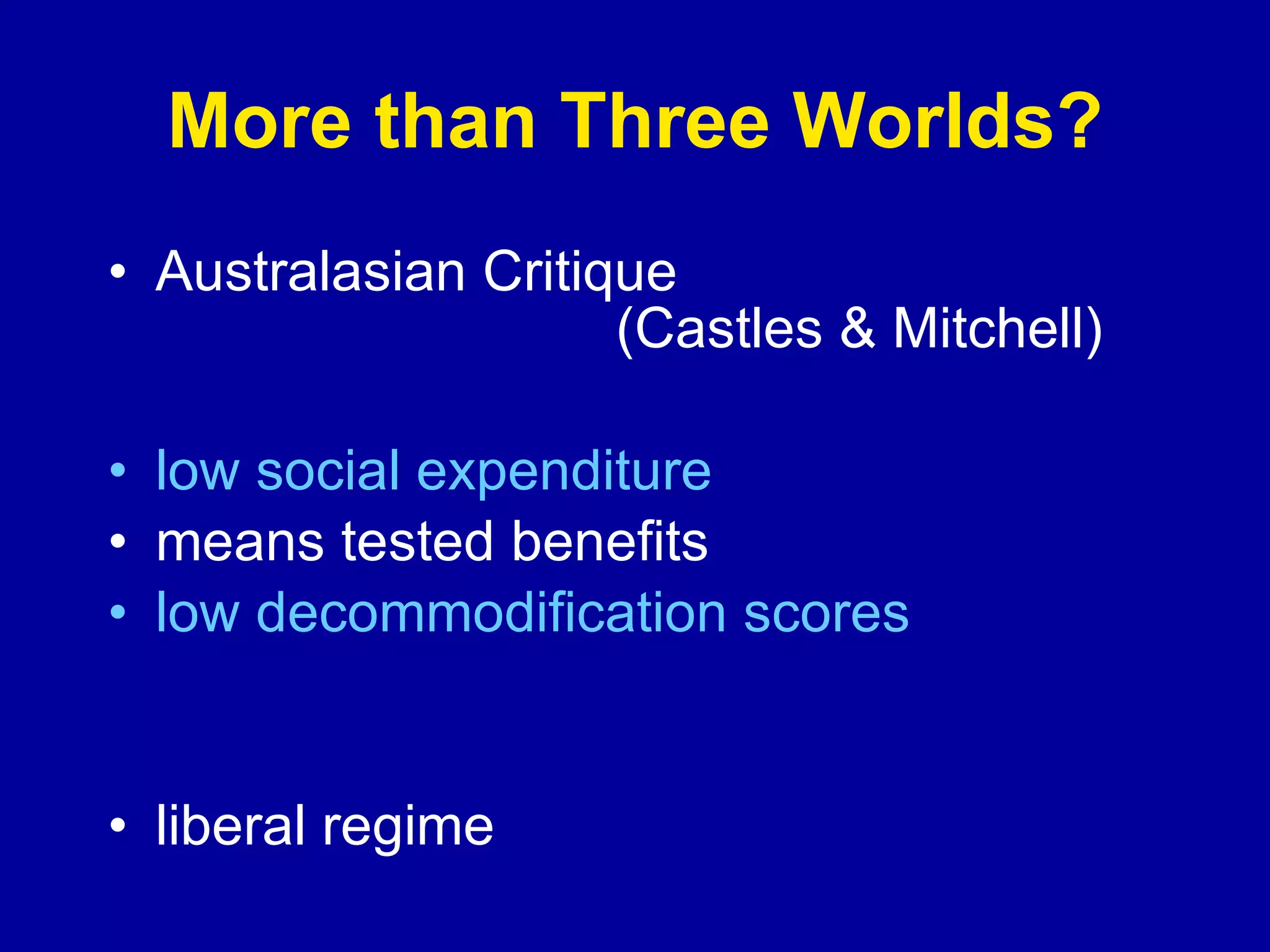
More than Three Worlds? Australasian Critique  (Castles & Mitchell) low social expenditure means tested benefits low decommodification scores liberal regime
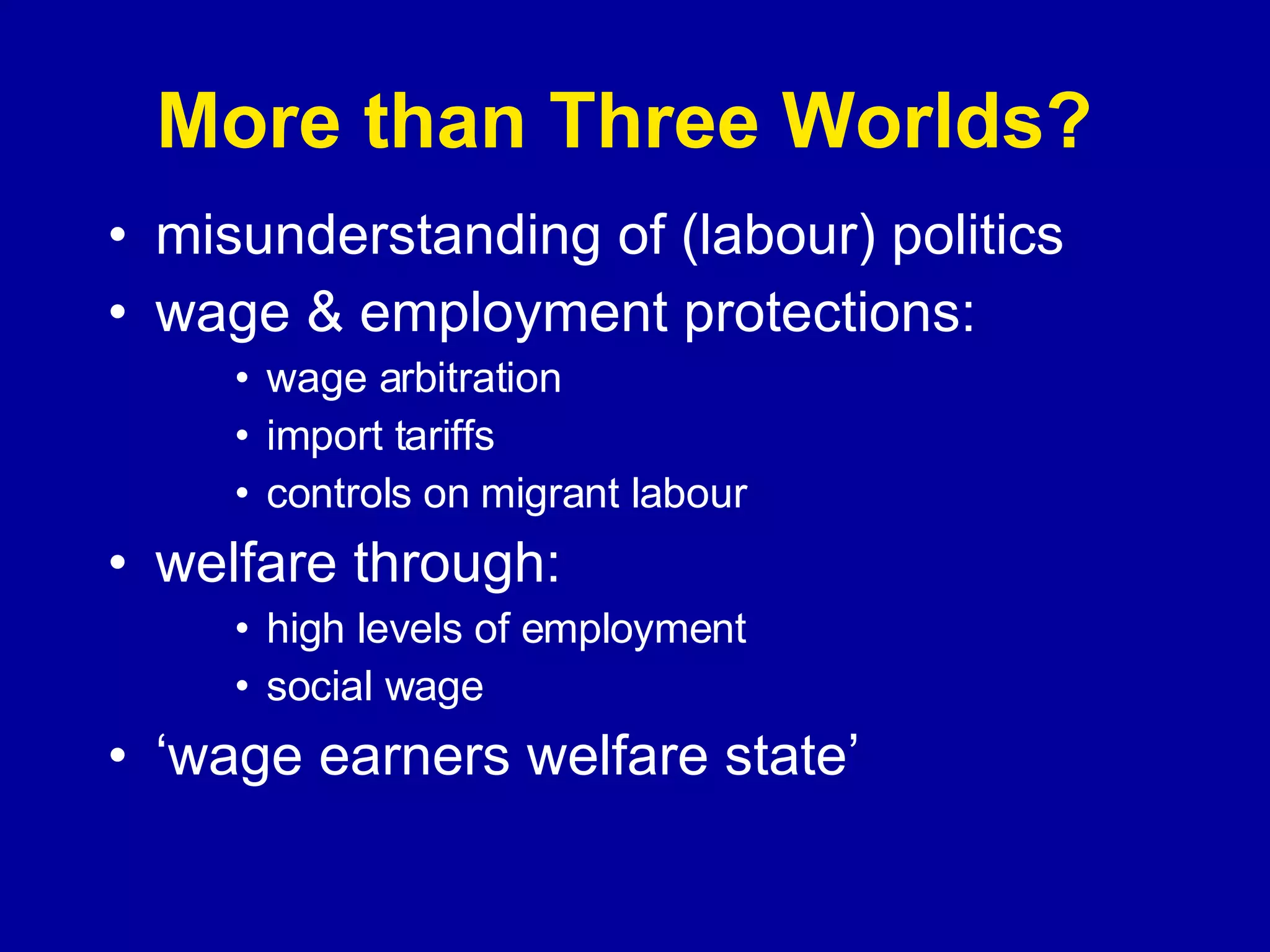
More than Three Worlds?  misunderstanding of (labour) politics wage & employment protections: wage arbitration import tariffs controls on migrant labour welfare through: high levels of employment social wage ‘wage earners welfare state’
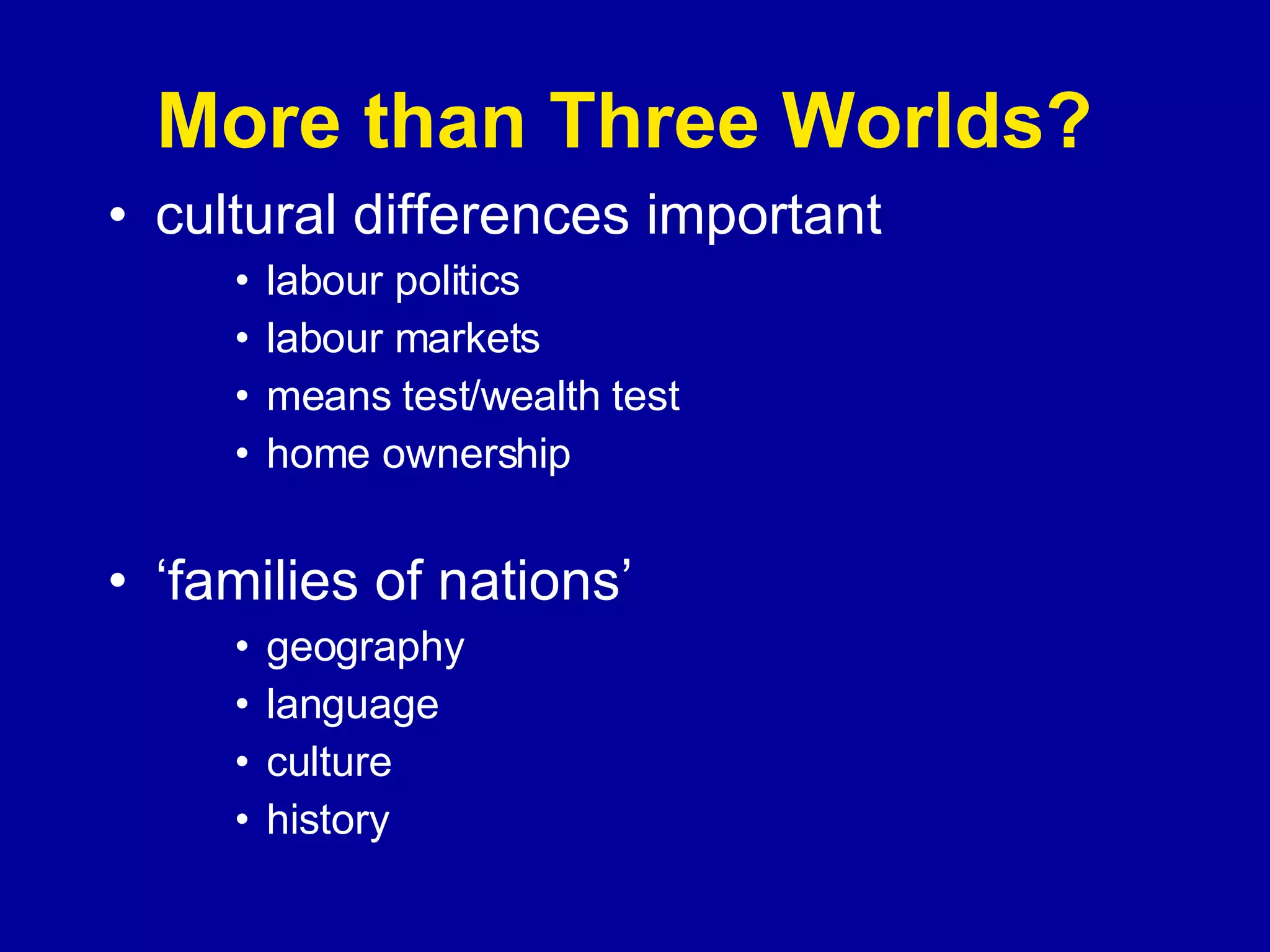
More than Three Worlds?  cultural differences important labour politics labour markets means test/wealth test home ownership ‘families of nations’ geography language culture history
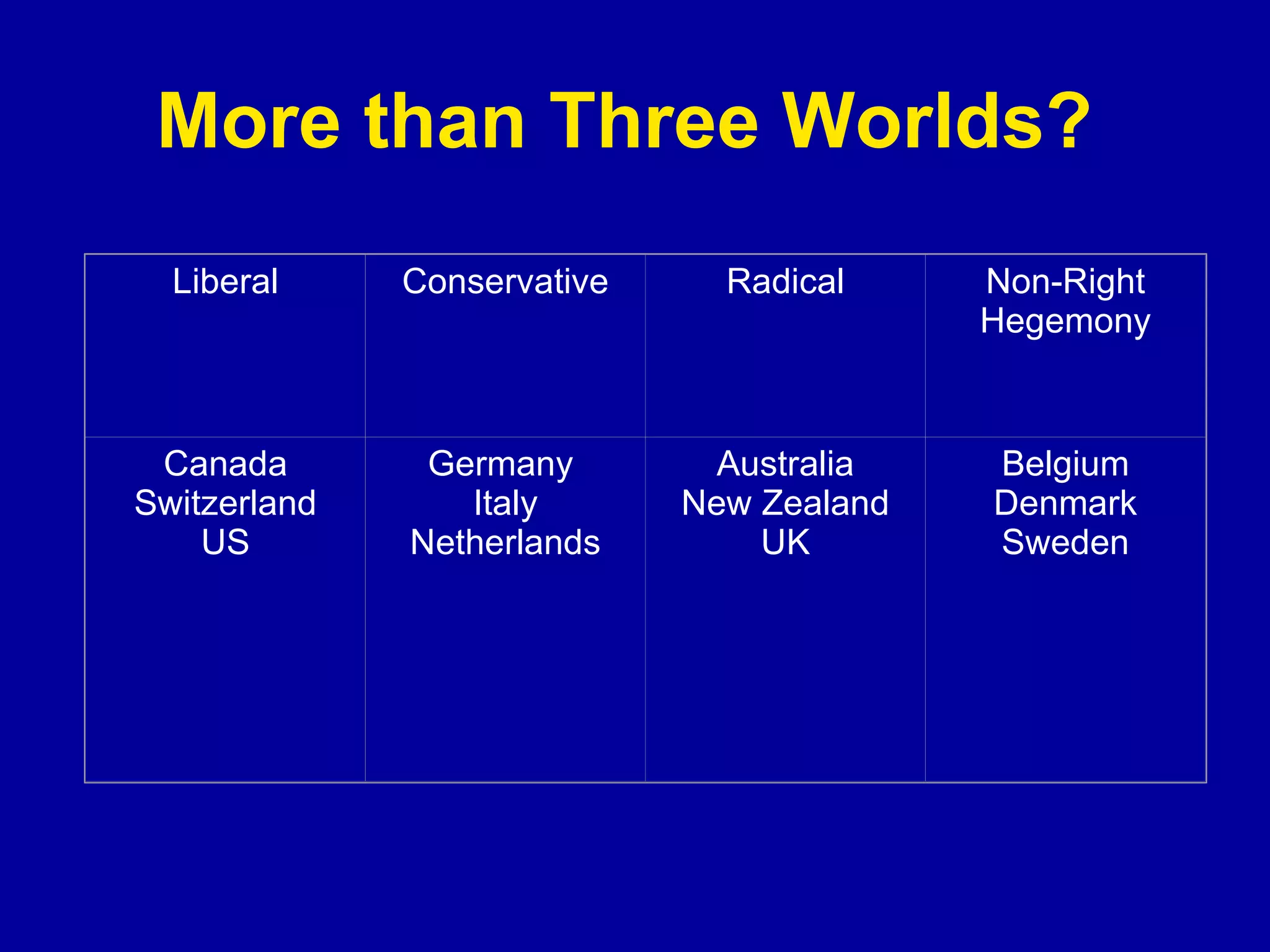
More than Three Worlds?  Liberal Conservative Radical Non-Right Hegemony Canada Switzerland US Germany  Italy Netherlands Australia New Zealand UK Belgium Denmark Sweden
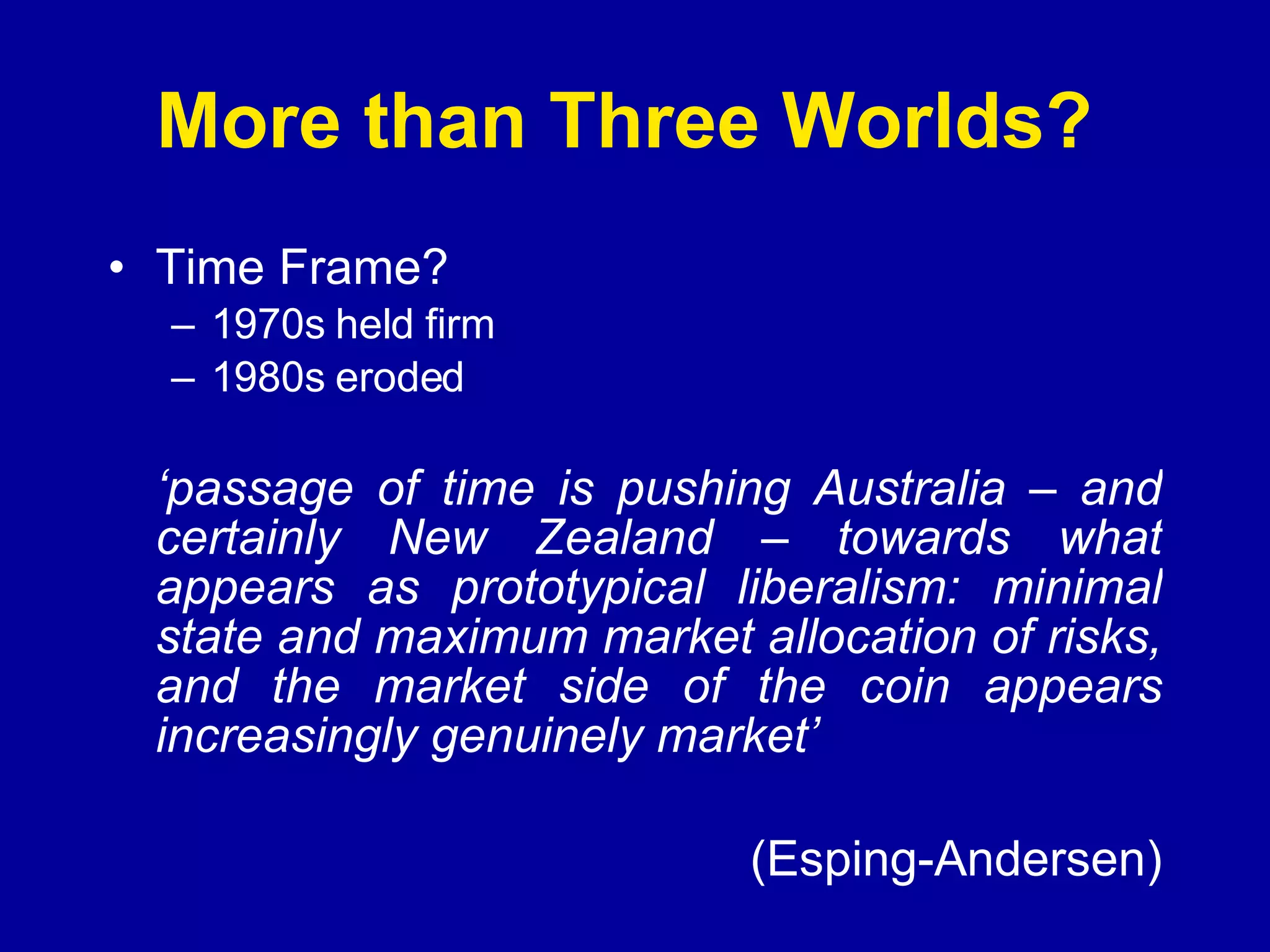
More than Three Worlds?  Time Frame? 1970s held firm 1980s eroded ‘ passage of time is pushing Australia – and certainly New Zealand – towards what appears as prototypical liberalism: minimal state and maximum market allocation of risks, and the market side of the coin appears increasingly genuinely market’   (Esping-Andersen)
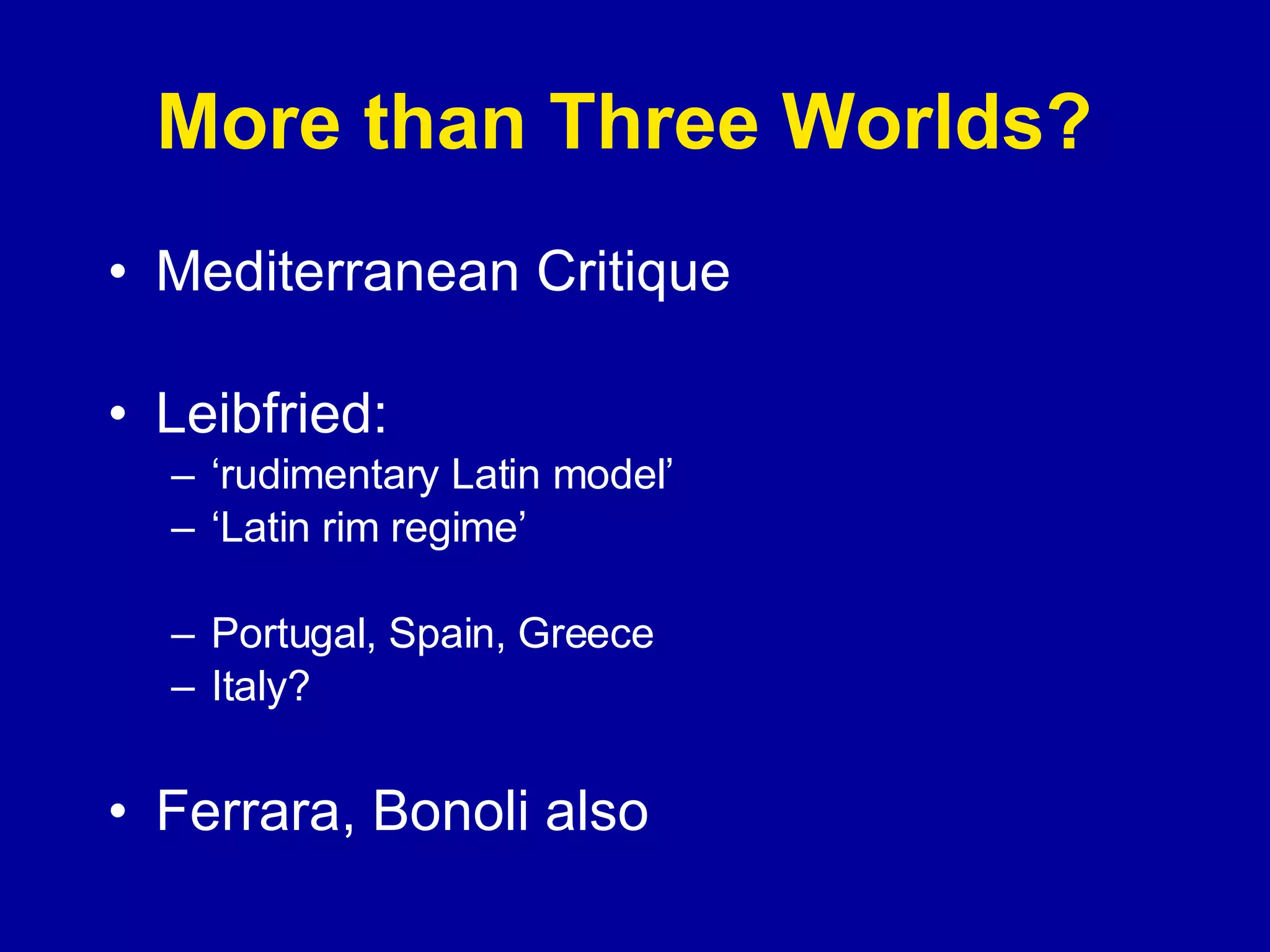
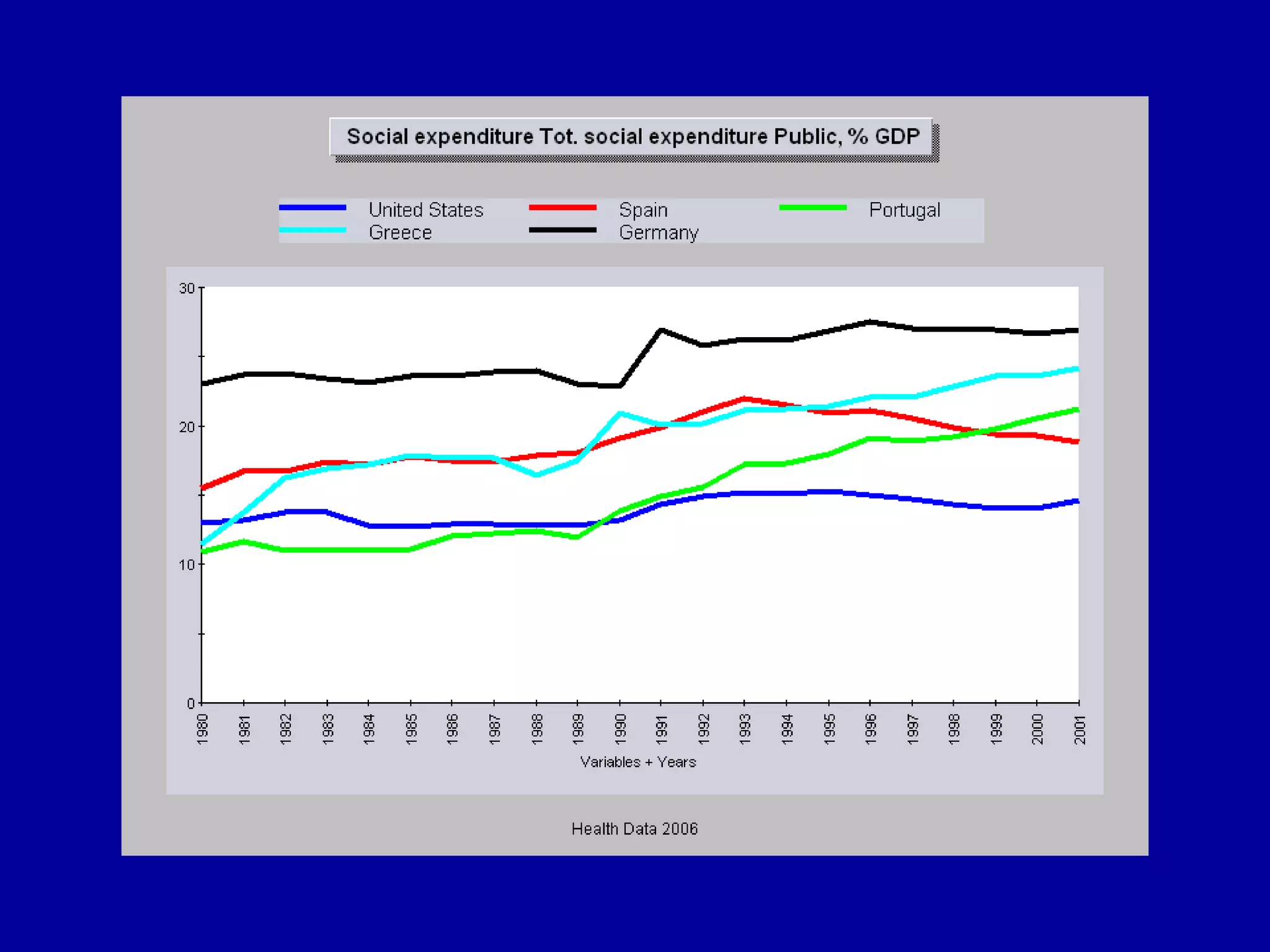
More than Three Worlds?  Mediterranean Critique  Leibfried: ‘ rudimentary Latin model’ ‘ Latin rim regime’ Portugal, Spain, Greece  Italy? Ferrara, Bonoli also
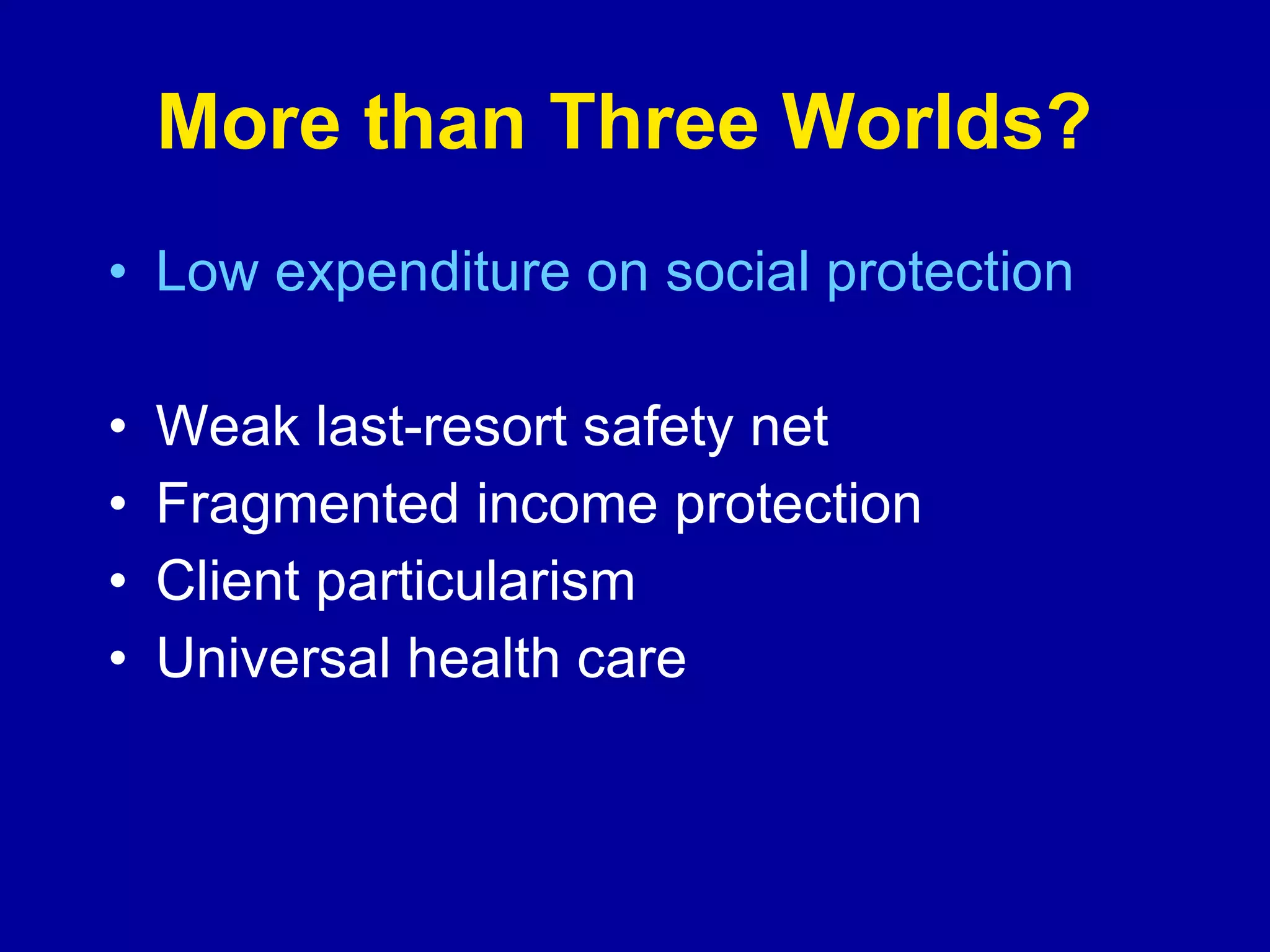
More than Three Worlds?  Low expenditure on social protection  Weak last-resort safety net Fragmented income protection Client particularism Universal health care
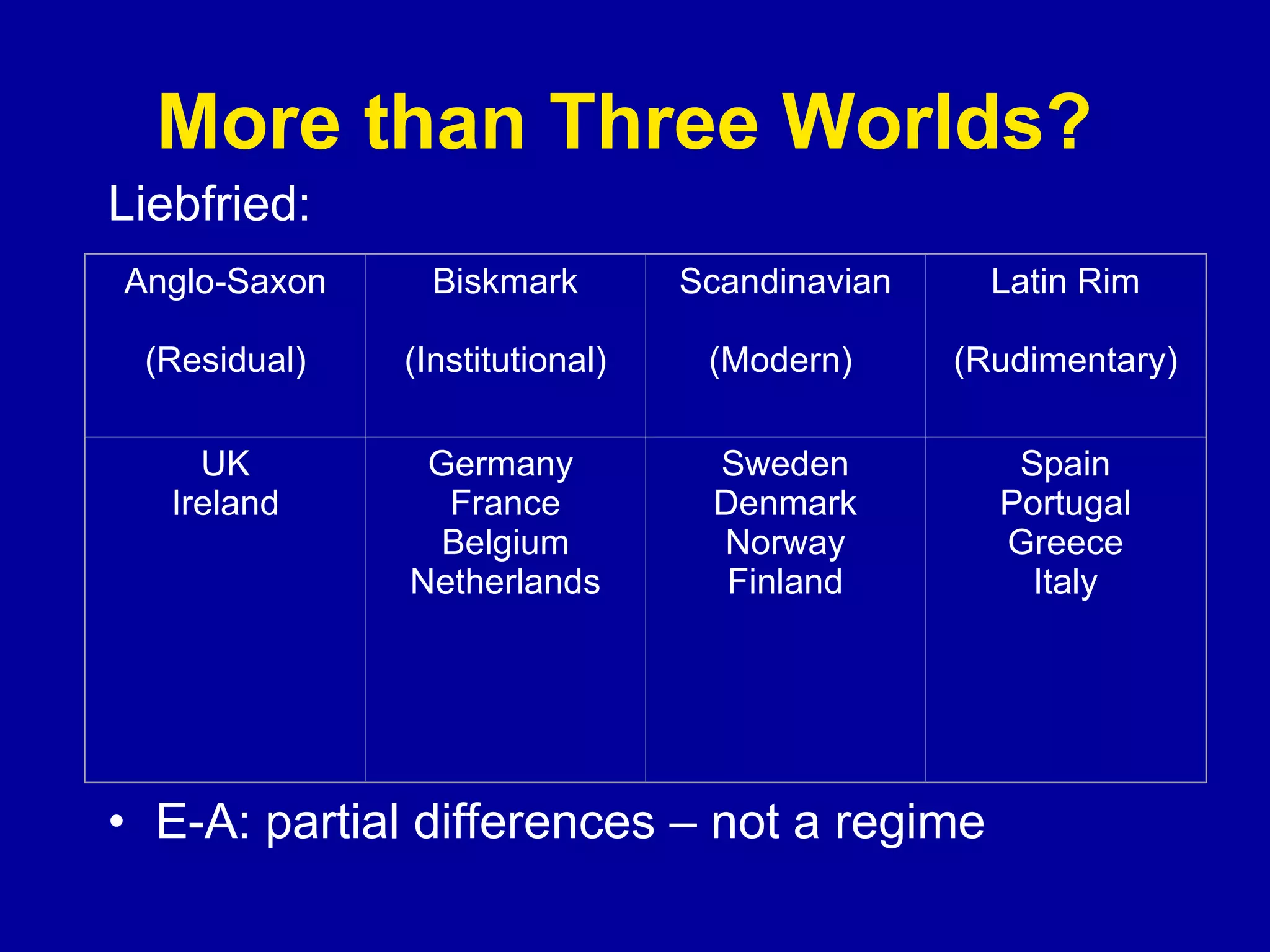
More than Three Worlds?  Liebfried:  E-A: partial differences – not a regime Anglo-Saxon (Residual) Biskmark (Institutional) Scandinavian (Modern)  Latin Rim (Rudimentary) UK Ireland Germany  France Belgium Netherlands Sweden Denmark Norway Finland Spain Portugal Greece Italy
More than Three Worlds?  East-Asian Critique Growing interest: rapid economic growth expanding welfare policies how do they compare with west? Confucian model?
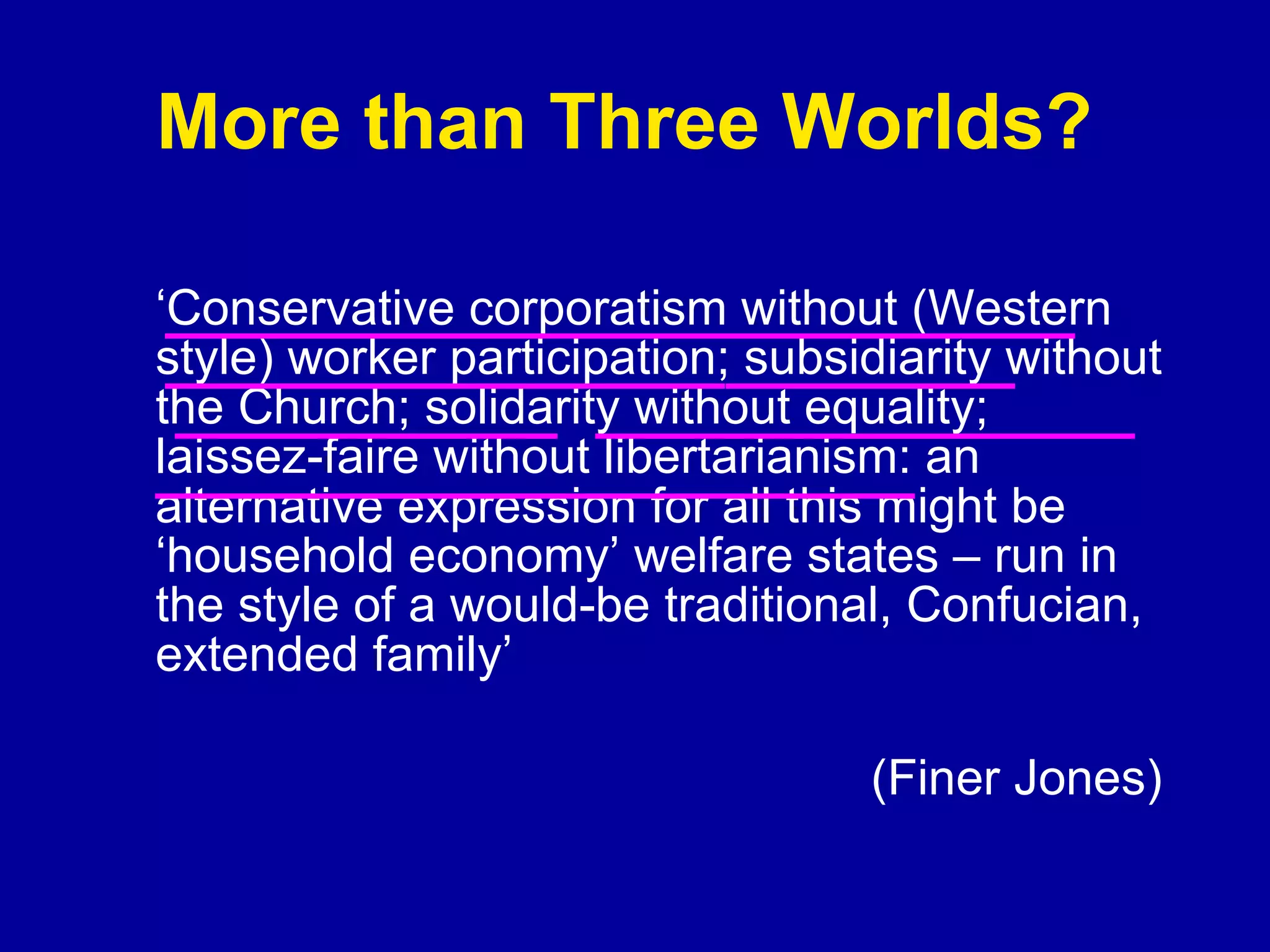
More than Three Worlds?  ‘ Conservative corporatism without (Western style) worker participation; subsidiarity without the Church; solidarity without equality; laissez-faire without libertarianism: an alternative expression for all this might be ‘household economy’ welfare states – run in the style of a would-be traditional, Confucian, extended family’  (Finer Jones)
More than Three Worlds?  Kwon : state regulates rather than provides little significant financial transfer little redistribution of income conservative political forces dominate economic growth often key objective productivist world of welfare
The East Asian Fourth World E-A:  liberal elements conservative elements not unique – a hybrid
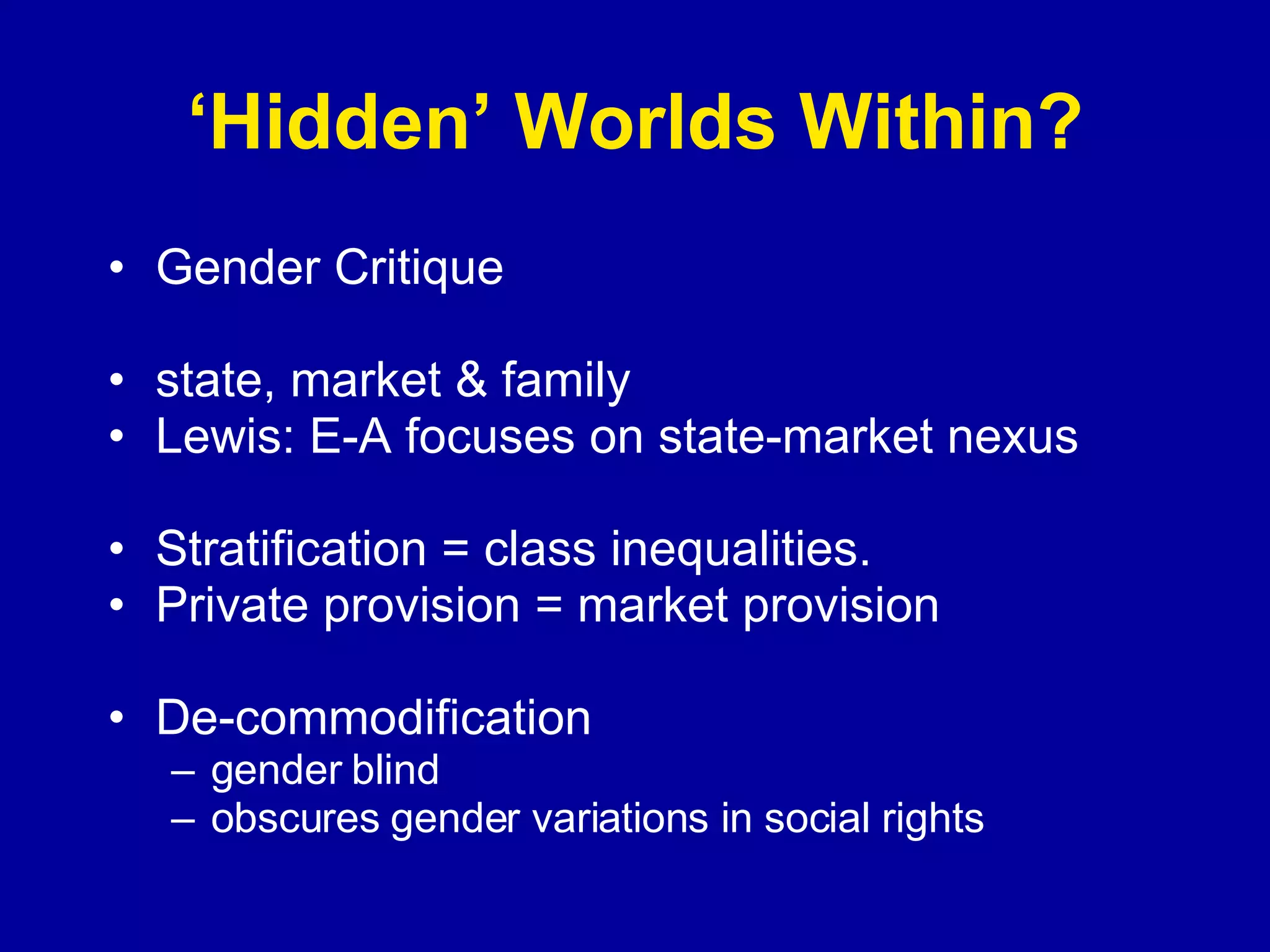
‘ Hidden’ Worlds Within? Gender Critique state, market & family Lewis: E-A focuses on state-market nexus Stratification = class inequalities. Private provision = market provision De-commodification gender blind  obscures gender variations in social rights
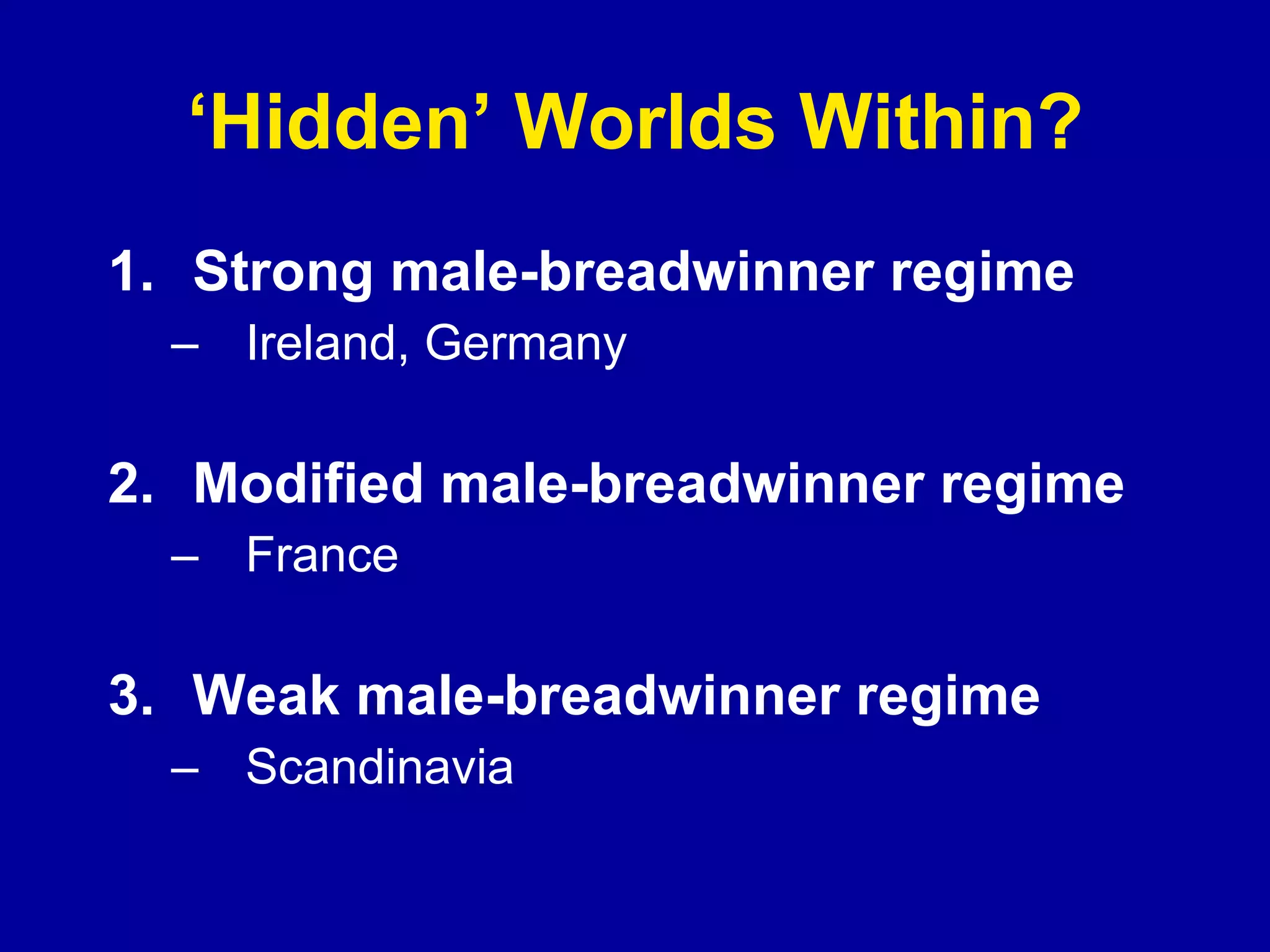
‘ Hidden’ Worlds Within? Strong male-breadwinner regime Ireland, Germany Modified male-breadwinner regime France Weak male-breadwinner regime Scandinavia
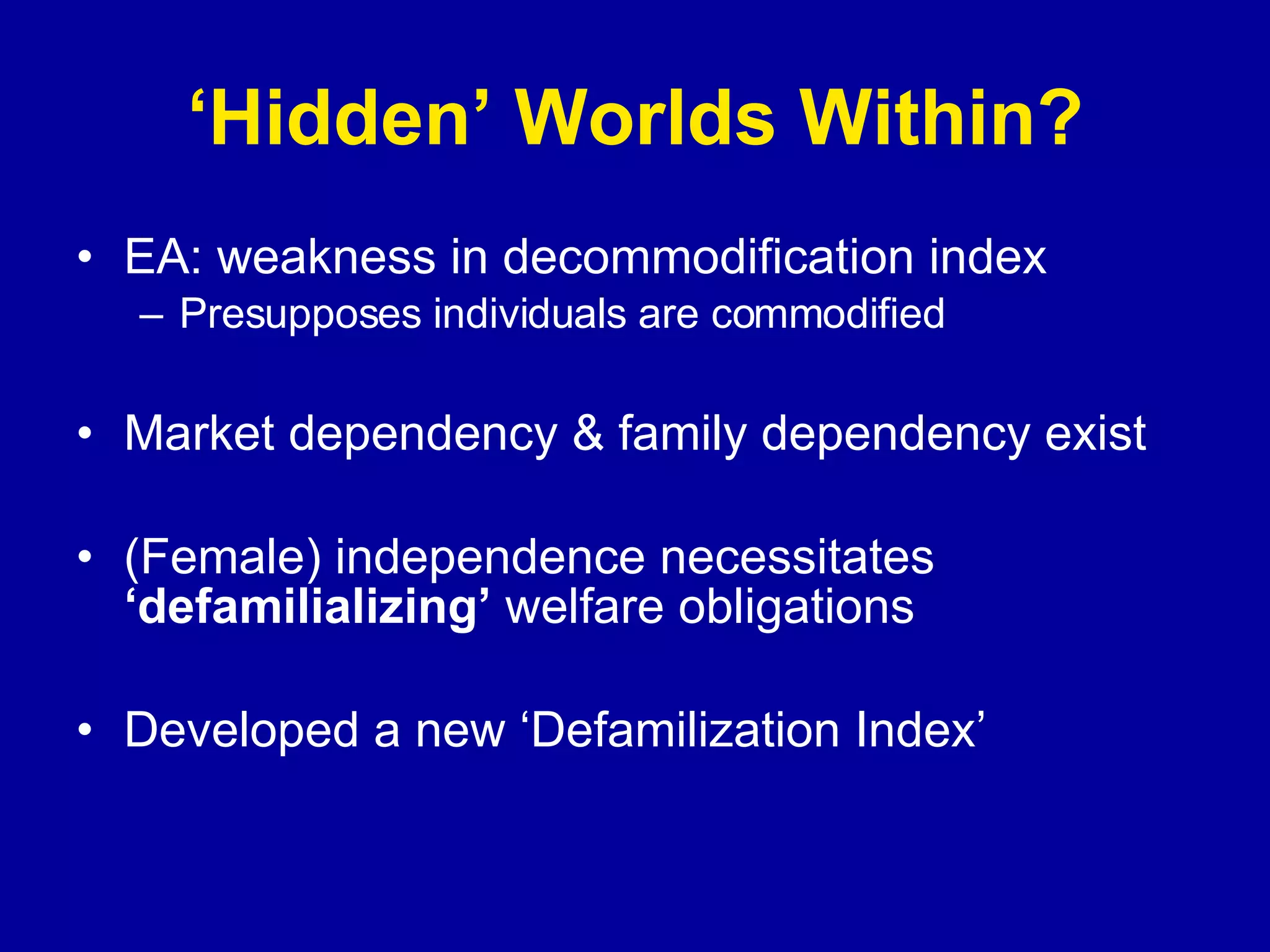
‘ Hidden’ Worlds Within? EA: weakness in decommodification index Presupposes individuals are commodified Market dependency & family dependency exist (Female) independence necessitates  ‘defamilializing’  welfare obligations Developed a new ‘Defamilization Index’
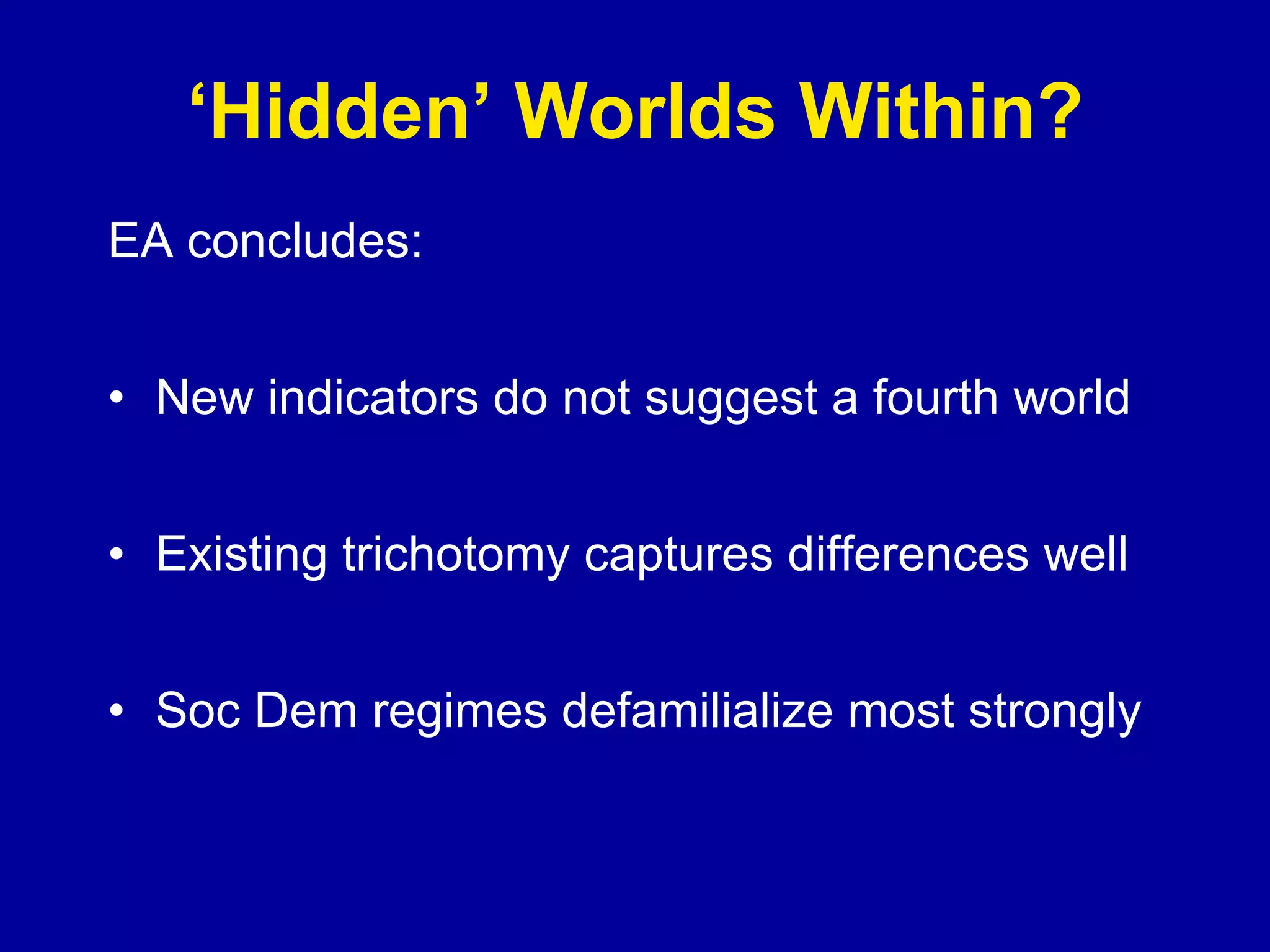
‘ Hidden’ Worlds Within? EA concludes: New indicators do not suggest a fourth world Existing trichotomy captures differences well Soc Dem regimes defamilialize most strongly
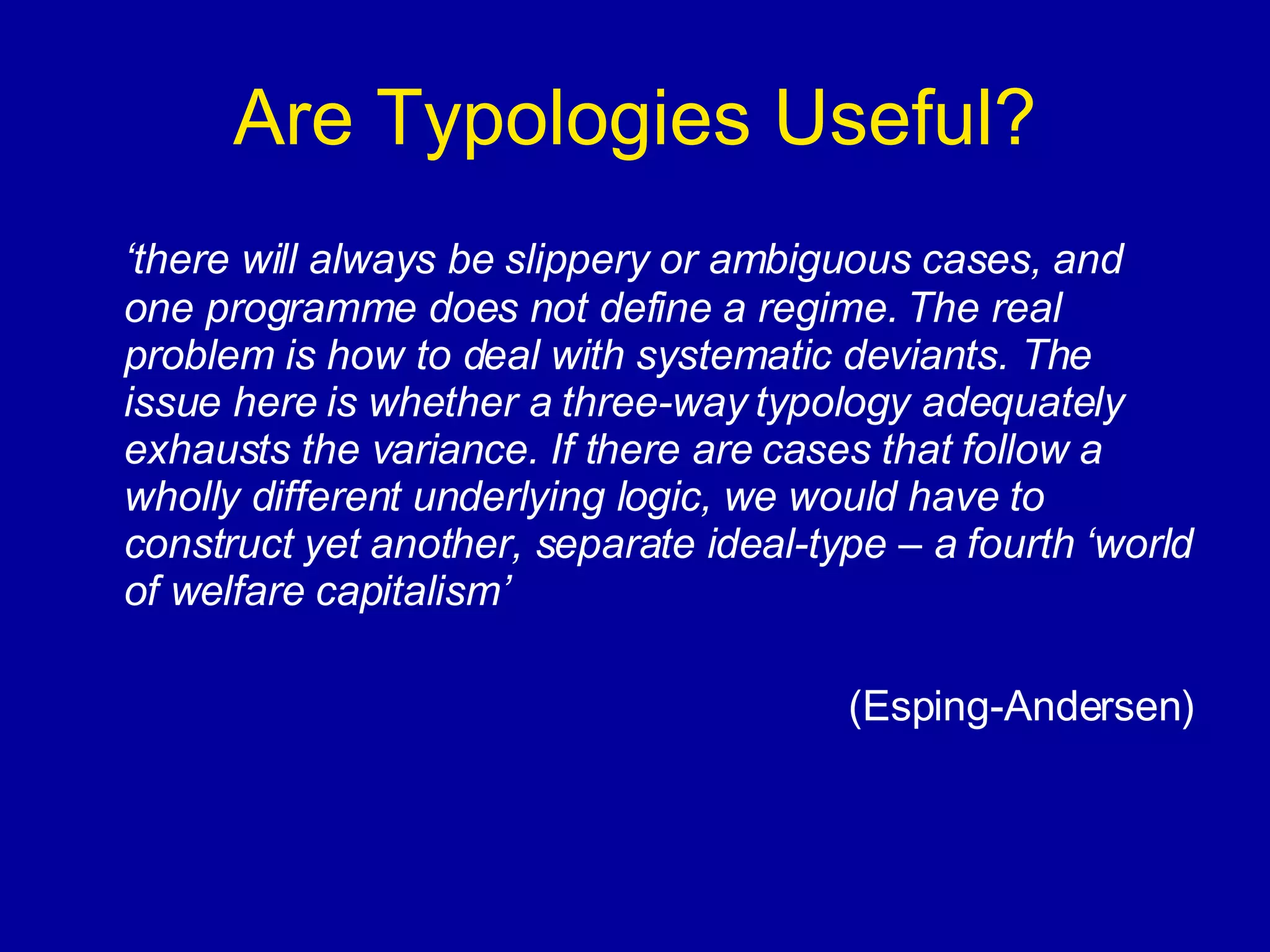
Are Typologies Useful? ‘ there will always be slippery or ambiguous cases, and one programme does not define a regime. The real problem is how to deal with systematic deviants. The issue here is whether a three-way typology adequately exhausts the variance. If there are cases that follow a wholly different underlying logic, we would have to construct yet another, separate ideal-type – a fourth ‘world of welfare capitalism’ (Esping-Andersen)
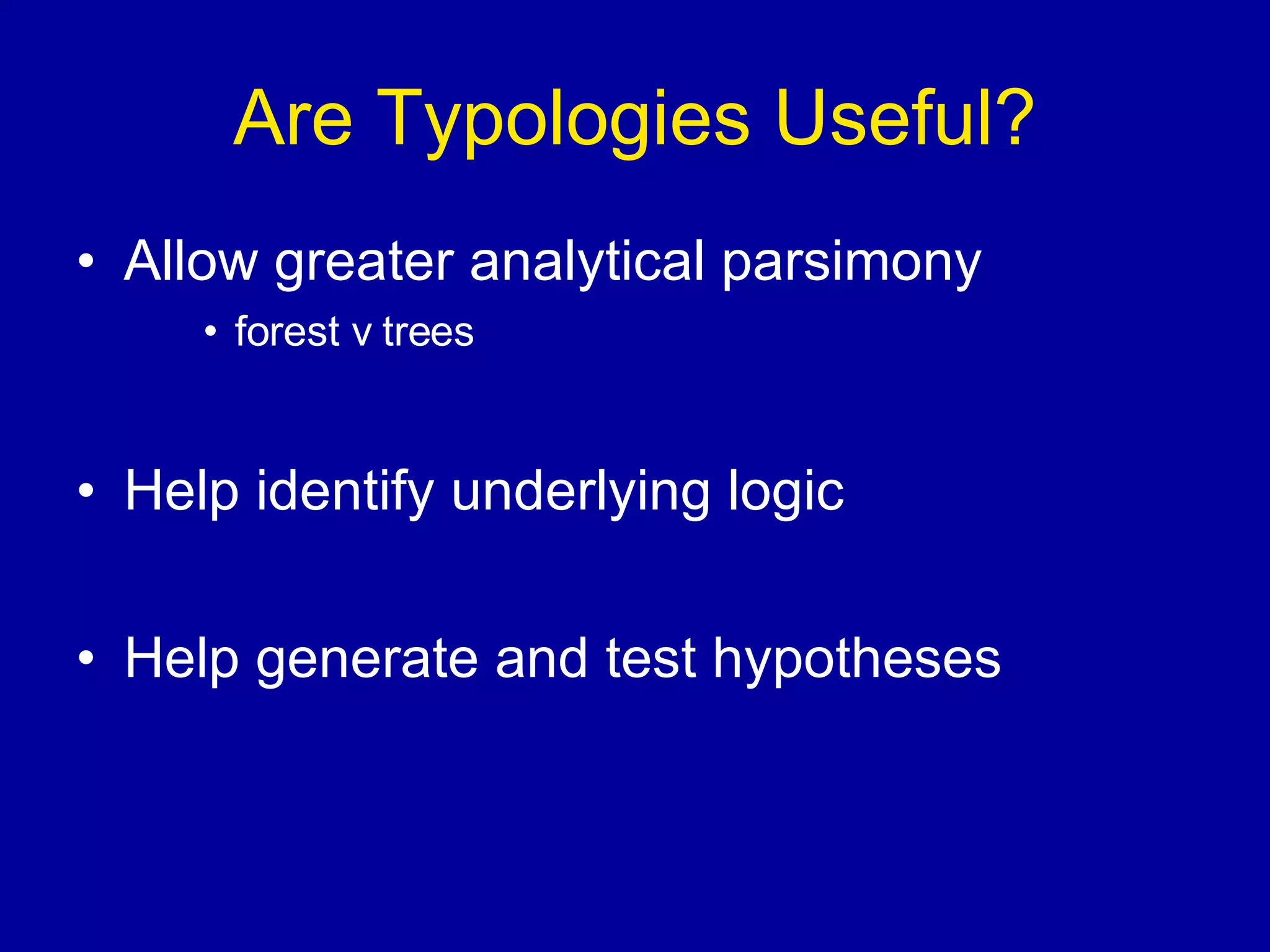
Are Typologies Useful? Allow greater analytical parsimony forest v trees  Help identify underlying logic Help generate and test hypotheses
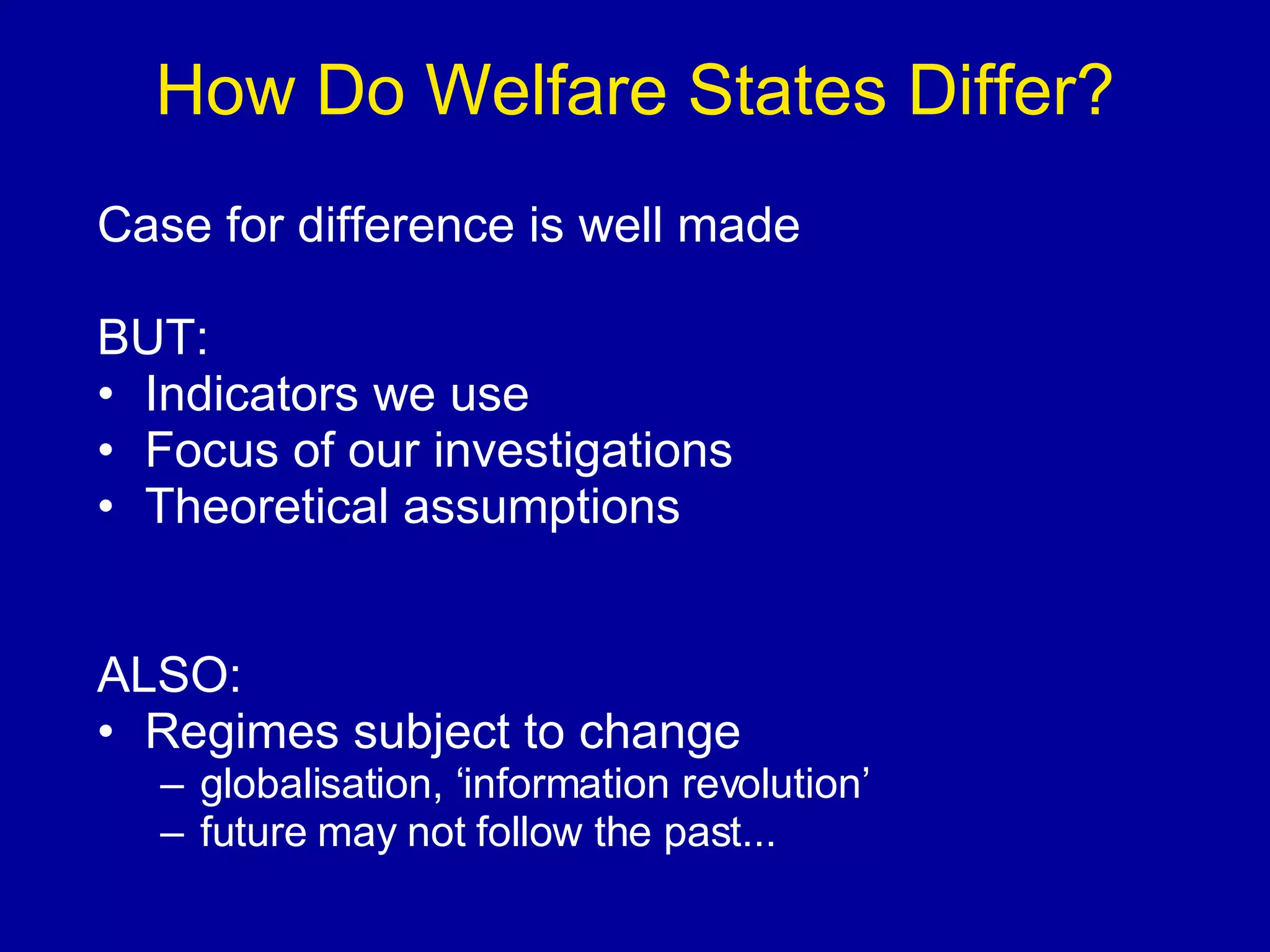
How Do Welfare States Differ? Case for difference is well made BUT: Indicators we use Focus of our investigations Theoretical assumptions ALSO: Regimes subject to change globalisation, ‘information revolution’ future may not follow the past...
 
 
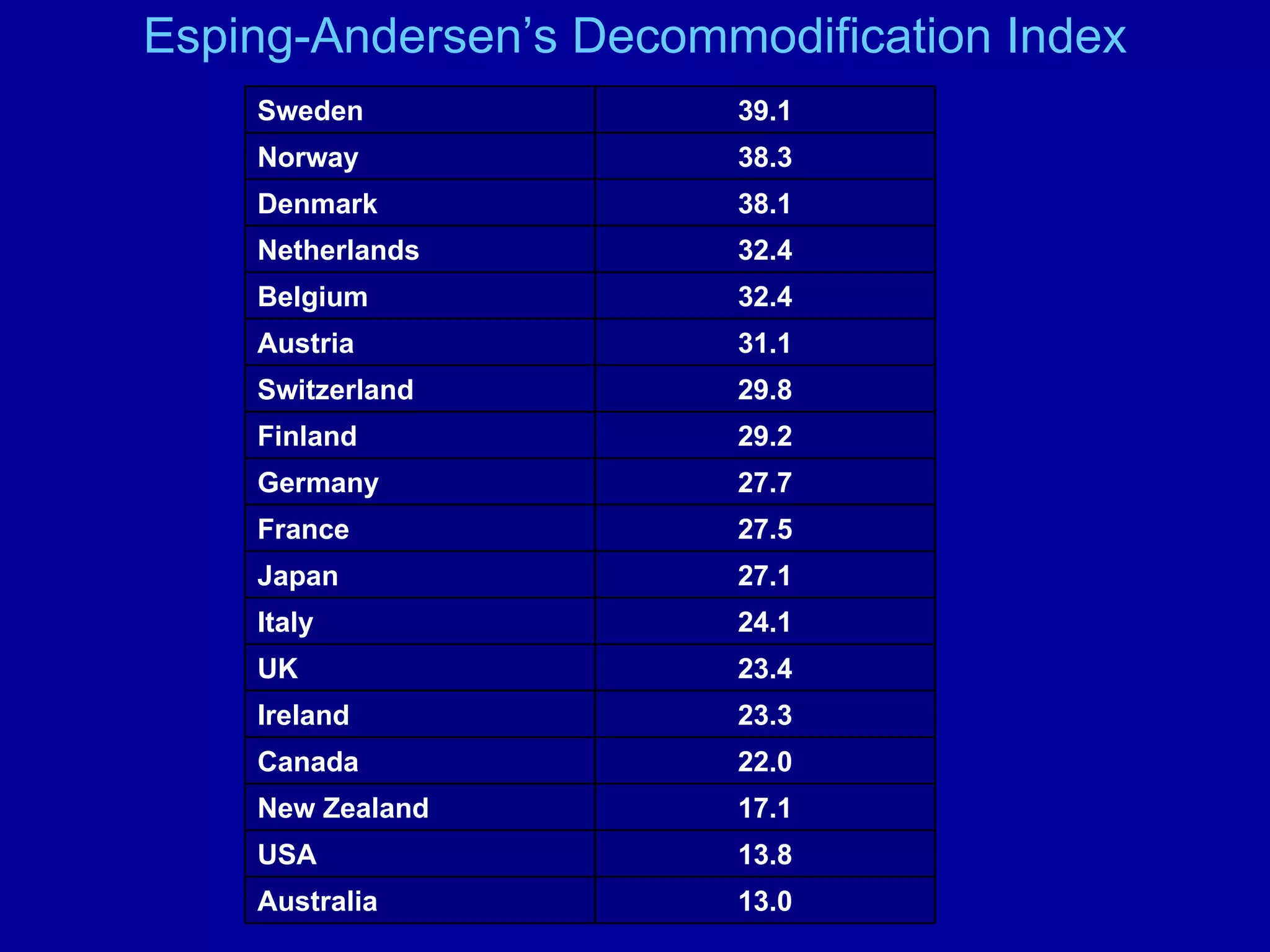
Esping-Andersen’s  Decommodification Index 13.0 Australia 13.8 USA 17.1 New Zealand 22.0 Canada 23.3 Ireland 23.4 UK 24.1 Italy 27.1 Japan 27.5 France 27.7 Germany 29.2 Finland 29.8 Switzerland 31.1 Austria 32.4 Belgium 32.4 Netherlands 38.1 Denmark 38.3 Norway 39.1 Sweden
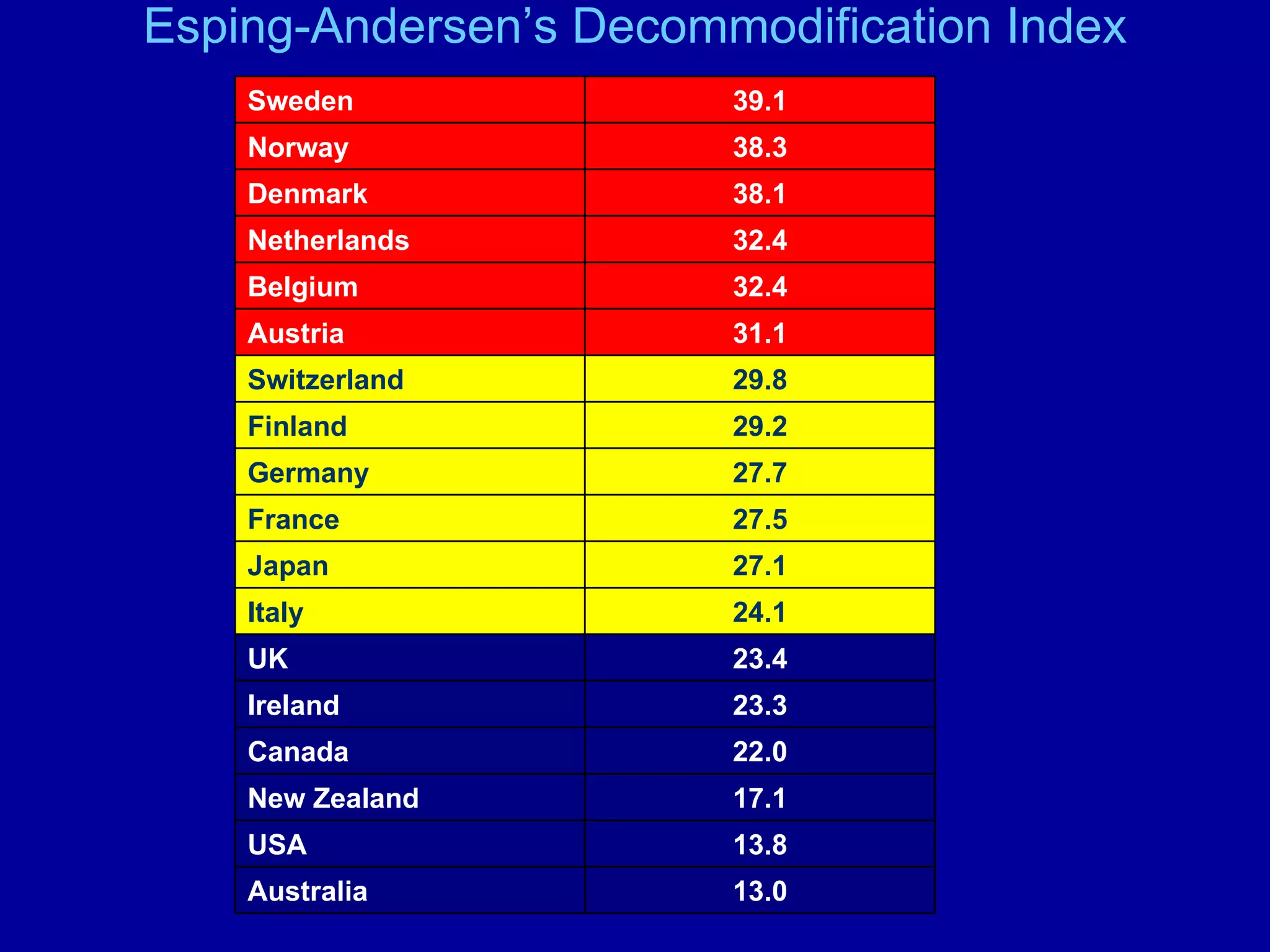
Esping -Andersen’s Decommodification Index 13.0 Australia 13.8 USA 17.1 New Zealand 22.0 Canada 23.3 Ireland 23.4 UK 24.1 Italy 27.1 Japan 27.5 France 27.7 Germany 29.2 Finland 29.8 Switzerland 31.1 Austria 32.4 Belgium 32.4 Netherlands 38.1 Denmark 38.3 Norway 39.1 Sweden
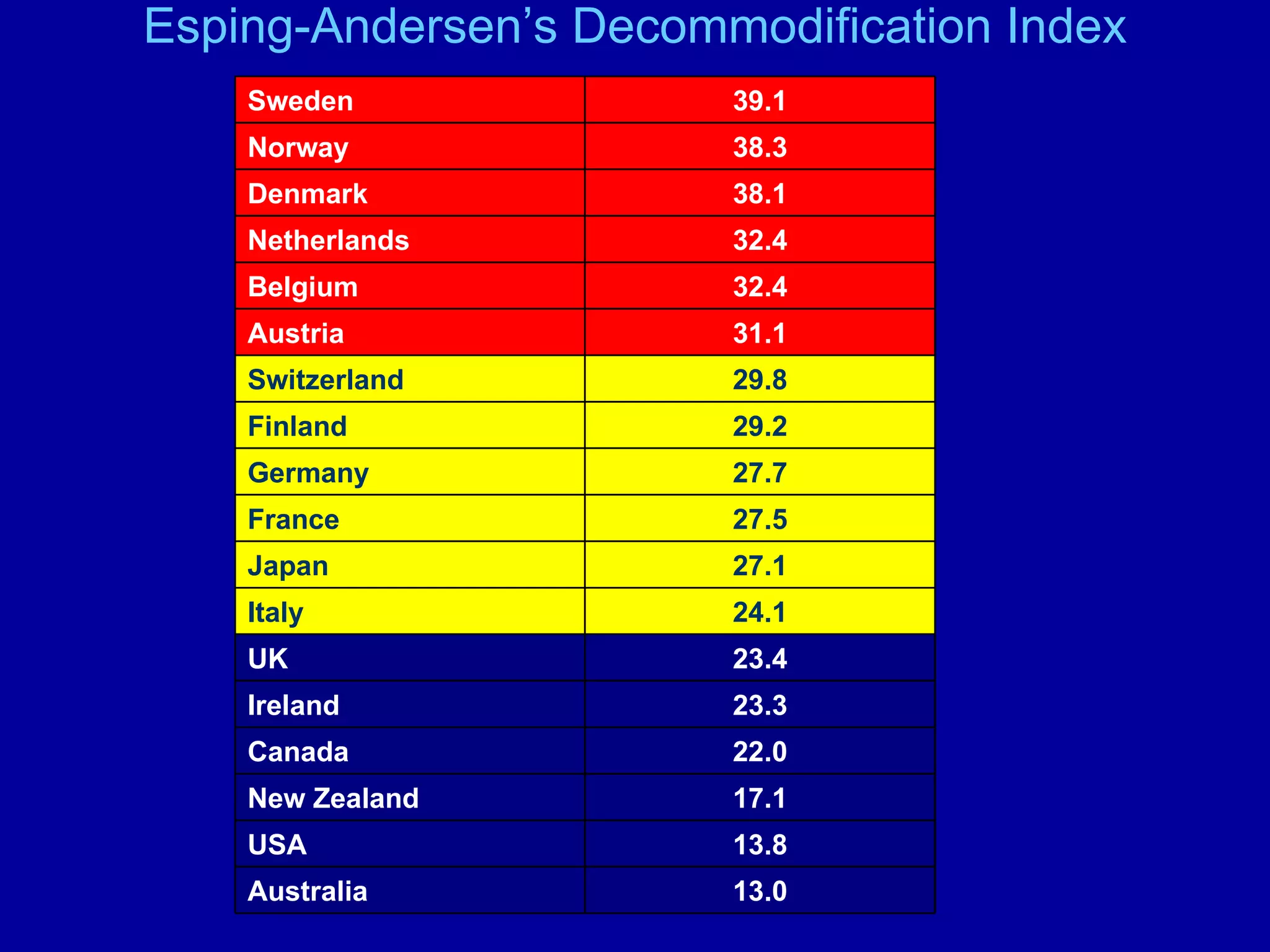
Esping-Andersen’s  Decommodification Index 13.0 Australia 13.8 USA 17.1 New Zealand 22.0 Canada 23.3 Ireland 23.4 UK 24.1 Italy 27.1 Japan 27.5 France 27.7 Germany 29.2 Finland 29.8 Switzerland 31.1 Austria 32.4 Belgium 32.4 Netherlands 38.1 Denmark 38.3 Norway 39.1 Sweden

Comparative Social Structures and Welfare Week 4 Lecture

  • 1.
    Comparative Social Structuresand Welfare 2: How Do Welfare States Differ?
  • 2.
    Session Objectives Toexplore how welfare states differ To examine key typologies of welfare Consider key criticisms of typologies
  • 3.
    The Welfare State...Why do welfare states differ? Many influences on growth of welfare state: Economics Politics Demography History Culture Geography Fascinating topic for social scientists
  • 4.
    The Welfare State...Economic growth = Welfare State growth affordability increases changing demographics new risks/social problems Convergence Logic laggards eventually catch up Common Argument in 1960s & 1970s
  • 5.
  • 6.
    The Welfare State...Wilensky (1975): ‘ economic growth makes countries with contrasting cultural and political traditions more alike in their strategy for constructing the floor below which no one sinks’ ‘ one of the major structural uniformities of modern societies’
  • 7.
    ...or Welfare States ? Case for convergence weakened over time Korpi (1980): different patterns of political conflict different social and political institutions = different political parties / unions etc - different aims of social policies = different welfare state types? growth of welfare not automatic? welfare state not a case of more or less?
  • 8.
    Three Worlds ofWelfare Esping-Andersen (1990): The Three Worlds of Welfare Capitalism 4,095 citations on Google Scholar!!! Examined welfare in 18 rich countries Strong philosophical underpinning: what is the purpose of social policy? what are the goals of social policy?
  • 9.
    Three Worlds ofWelfare Social Rights: Marshall’s Social Citizenship Measure decommodification of labour Stratification Role in structuring social relations Roles of State, Market and Family
  • 10.
    Three Worlds ofWelfare Large scale statistical analysis: Ranked nations by decommodification scores Pensions, Sickness & Unemployment Benefits Levels, coverage, qualification etc Examined stratification data too Nations broke into three clusters /worlds/regimes liberal, social democratic, conservative/corporatist
  • 11.
    1 - Liberal Regimes means tested benefits predominate benefits aimed mainly at poor stigma often attached to state benefits work ethic underpins system private provision encouraged decommodification effects minimised two-tier society Ideal type: USA
  • 12.
    2 - Social Democratic Regimes universal benefits predominate benefits aimed at all classes social rights of citizenship emphasised full-employment a goal private provision crowded out decommodification effects strong egalitarian society Ideal type: Sweden
  • 13.
    3 - Conservative/Corporatist Regimes social insurance benefits predominate benefits maintain class differentials strong social rights - but attached to status subsidiarity a key principle strong role for community organisations decommodification effects relatively strong maintains traditional social divisions Ideal type: Germany
  • 14.
    Three Worlds ofWelfare No single dominant factor drives ‘choice’ working class power cross-class coalitions historical legacy of regime institutionalisation Key point is that outcomes vary ‘ the variability of welfare-state evolution reflects competing responses to pressures for decommodification’ Long run differences between nations
  • 15.
  • 16.
    Three Worlds ofWelfare Different Worlds of Welfare: Different Paths of Development Reflect History (and Politics) of Each Nation Hard to ‘Switch’ Between Are Welfare Regimes not Welfare States
  • 17.
    ‘ since [theworlds of welfare] are, in a sense, ideal types there are bound to be ambiguous cases…It is…possible that the criteria employed to demarcate a regime may err: if alternative attributes were considered, the classification might break down or, at least, require additional regimes’ (Esping-Andersen) Three Worlds of Welfare?
  • 18.
    More than ThreeWorlds? Australasian Critique (Castles & Mitchell) low social expenditure means tested benefits low decommodification scores liberal regime
  • 19.
    More than ThreeWorlds? misunderstanding of (labour) politics wage & employment protections: wage arbitration import tariffs controls on migrant labour welfare through: high levels of employment social wage ‘wage earners welfare state’
  • 20.
    More than ThreeWorlds? cultural differences important labour politics labour markets means test/wealth test home ownership ‘families of nations’ geography language culture history
  • 21.
    More than ThreeWorlds? Liberal Conservative Radical Non-Right Hegemony Canada Switzerland US Germany Italy Netherlands Australia New Zealand UK Belgium Denmark Sweden
  • 22.
    More than ThreeWorlds? Time Frame? 1970s held firm 1980s eroded ‘ passage of time is pushing Australia – and certainly New Zealand – towards what appears as prototypical liberalism: minimal state and maximum market allocation of risks, and the market side of the coin appears increasingly genuinely market’ (Esping-Andersen)
  • 23.
    More than ThreeWorlds? Mediterranean Critique Leibfried: ‘ rudimentary Latin model’ ‘ Latin rim regime’ Portugal, Spain, Greece Italy? Ferrara, Bonoli also
  • 24.
    More than ThreeWorlds? Low expenditure on social protection Weak last-resort safety net Fragmented income protection Client particularism Universal health care
  • 25.
    More than ThreeWorlds? Liebfried: E-A: partial differences – not a regime Anglo-Saxon (Residual) Biskmark (Institutional) Scandinavian (Modern) Latin Rim (Rudimentary) UK Ireland Germany France Belgium Netherlands Sweden Denmark Norway Finland Spain Portugal Greece Italy
  • 26.
    More than ThreeWorlds? East-Asian Critique Growing interest: rapid economic growth expanding welfare policies how do they compare with west? Confucian model?
  • 27.
    More than ThreeWorlds? ‘ Conservative corporatism without (Western style) worker participation; subsidiarity without the Church; solidarity without equality; laissez-faire without libertarianism: an alternative expression for all this might be ‘household economy’ welfare states – run in the style of a would-be traditional, Confucian, extended family’ (Finer Jones)
  • 28.
    More than ThreeWorlds? Kwon : state regulates rather than provides little significant financial transfer little redistribution of income conservative political forces dominate economic growth often key objective productivist world of welfare
  • 29.
    The East AsianFourth World E-A: liberal elements conservative elements not unique – a hybrid
  • 30.
    ‘ Hidden’ WorldsWithin? Gender Critique state, market & family Lewis: E-A focuses on state-market nexus Stratification = class inequalities. Private provision = market provision De-commodification gender blind obscures gender variations in social rights
  • 31.
    ‘ Hidden’ WorldsWithin? Strong male-breadwinner regime Ireland, Germany Modified male-breadwinner regime France Weak male-breadwinner regime Scandinavia
  • 32.
    ‘ Hidden’ WorldsWithin? EA: weakness in decommodification index Presupposes individuals are commodified Market dependency & family dependency exist (Female) independence necessitates ‘defamilializing’ welfare obligations Developed a new ‘Defamilization Index’
  • 33.
    ‘ Hidden’ WorldsWithin? EA concludes: New indicators do not suggest a fourth world Existing trichotomy captures differences well Soc Dem regimes defamilialize most strongly
  • 34.
    Are Typologies Useful?‘ there will always be slippery or ambiguous cases, and one programme does not define a regime. The real problem is how to deal with systematic deviants. The issue here is whether a three-way typology adequately exhausts the variance. If there are cases that follow a wholly different underlying logic, we would have to construct yet another, separate ideal-type – a fourth ‘world of welfare capitalism’ (Esping-Andersen)
  • 35.
    Are Typologies Useful?Allow greater analytical parsimony forest v trees Help identify underlying logic Help generate and test hypotheses
  • 36.
    How Do WelfareStates Differ? Case for difference is well made BUT: Indicators we use Focus of our investigations Theoretical assumptions ALSO: Regimes subject to change globalisation, ‘information revolution’ future may not follow the past...
  • 37.
  • 38.
  • 39.
    Esping-Andersen’s DecommodificationIndex 13.0 Australia 13.8 USA 17.1 New Zealand 22.0 Canada 23.3 Ireland 23.4 UK 24.1 Italy 27.1 Japan 27.5 France 27.7 Germany 29.2 Finland 29.8 Switzerland 31.1 Austria 32.4 Belgium 32.4 Netherlands 38.1 Denmark 38.3 Norway 39.1 Sweden
  • 40.
    Esping -Andersen’s DecommodificationIndex 13.0 Australia 13.8 USA 17.1 New Zealand 22.0 Canada 23.3 Ireland 23.4 UK 24.1 Italy 27.1 Japan 27.5 France 27.7 Germany 29.2 Finland 29.8 Switzerland 31.1 Austria 32.4 Belgium 32.4 Netherlands 38.1 Denmark 38.3 Norway 39.1 Sweden
  • 41.
    Esping-Andersen’s DecommodificationIndex 13.0 Australia 13.8 USA 17.1 New Zealand 22.0 Canada 23.3 Ireland 23.4 UK 24.1 Italy 27.1 Japan 27.5 France 27.7 Germany 29.2 Finland 29.8 Switzerland 31.1 Austria 32.4 Belgium 32.4 Netherlands 38.1 Denmark 38.3 Norway 39.1 Sweden