
The State, Technology & Social Policy Week 2 - Introduction
Session Overview Introductions  Module Content Lecture Practical Session
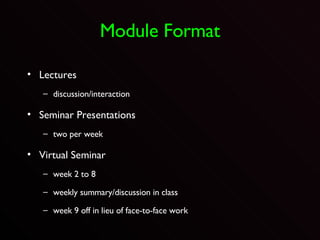
Module Format Lectures discussion/interaction Seminar Presentations two per week Virtual Seminar week 2 to 8 weekly summary/discussion in class week 9 off in lieu of face-to-face work
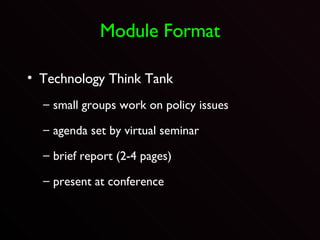
Module Format Technology Think Tank small groups work on policy issues agenda set by virtual seminar brief report (2-4 pages) present at conference
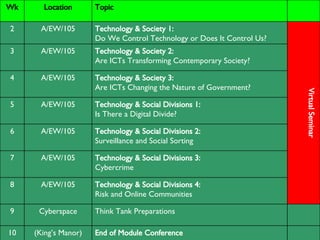
End of Module Conference (King’s Manor) 10 Think Tank Preparations Cyberspace 9 Technology & Social Divisions 4: Risk and Online Communities A/EW/105 8 Technology & Social Divisions 3: Cybercrime A/EW/105 7 Technology & Social Divisions 2: Surveillance and Social Sorting A/EW/105 6 Technology & Social Divisions 1: Is There a Digital Divide? A/EW/105 5 Technology & Society 3: Are ICTs Changing the Nature of Government? A/EW/105 4 Technology & Society 2: Are ICTs Transforming Contemporary Society? A/EW/105 3 Virtual Seminar Technology & Society 1: Do We Control Technology or Does It Control Us? A/EW/105 2 Topic Location Wk
Core Reading Diverse topics – no single text Lengthy reading list Module web site – ‘virtual reader’ Electronic sources academic journals – new research news media – contemporary debates think tanks – new policy thinking
Allocation of Work Tasks Seminar Presenters Weekly Virtual Seminar Leaders
Technology and Society I Do we control technology or does it control us?
Session Objectives explore issues about the ‘power’ of technology explore issues around the ‘control’ of technology to ask ‘do we control technology or does it control us?’
The ‘Power’ of Technology The ‘power’ of technology is a long standing conundrum in social sciences Some (e.g. Dowding) argue that inanimate objects cannot have power BUT: existence of technology makes a difference Pandora’s Box type effect Irrespective of issue of power a question of  control  is important
The Luddites Who were they? Early working class movement (1812) Industrial Revolution – textile industry Notts, Lancs, Yorks Resisted specific technological deployments Destroyed machines threatening trades
The Luddites Chant no more your old rhymes about bold Robin Hood  His feats I but little admire  I will sing the achievements of General Ludd  Now the Hero of Nottinghamshire  The guilty may fear, but no vengeance he aims At honest man's life or Estate  His wrath is entirely confined to wide frames  And to those that old prices abate
The Luddites ‘ All these demands looked forwards, as much as backwards; and they contained within them a shadowy image… of a democratic community, in which industrial growth should be regulated according to ethical priorities and the pursuit of profit be subordinated to human needs’ EP Thompson
The Luddites Ended on the scaffold Defeat inevitable? Crushed by technology or state? Any human agency?
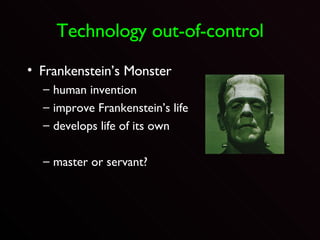
Technology out-of-control Frankenstein’s Monster human invention improve Frankenstein’s life develops life of its own master or servant?
Autonomous Technology Winner: Autonomous Technology Technology out of control Humans have no choice of direction of change Frakenstein’s monster “ the belief that somehow technology has gotten out of control and follows its own course independent of human direction” (Winner).  “ a relentless and constant pressure for change [that] affords no opportunity to decide how” (Street 1992).
Autonomous Technology Claims technological development has its own logic Doesn’t matter who works on projects Simultaneous inventions human values over-ridden by logic Argues technological solutions always triumph
Autonomous Technology Has distopian overtones: ‘ all protest is senseless, and the individual who would insist on freedom would become a crank. There is no personal escape from the apparatus which has mechanised and standardised the world. It is a rational apparatus, combining utmost expediency with utmost convenience, saving time and energy, removing waste, adapting all means to ends...’ (Marcuse).
Technological Determinism A moderate ‘cousin’ Sees technology as a key  driver  of change ‘makes no particular claims about the ideological rationale provided by technology or about the extent of its impact’ (Street).
Technological Determinism Argues technology poses ‘questions’ for society people can  choose  to resist change resistance will lead to disadvantage Hobson’s choice More positive outlook than autonomous technology
Technological Determinism Hard & Soft views of determinism Hard view discredited? ‘ not a good candidate as a theory of social change’ MacKenzie and Wajcman (1999: 4)  Causes of change are complex rather than direct
Social Shaping of Technology Generally accepted that technological change is socially shaped Human decisions impact on: direction of development nature of deployment who has access Technology itself is only one variable
Social Shaping of Technology POLITICS military technology nuclear weapons chemical weapons ICTs in government policy networks resist change social security officials v medics nurses v doctors
Social Shaping of Technology ECONOMICS & BUSINESS information technology Microsoft music and video technology Betamax video control of supply chain
Social Shaping of Technology SOCIAL RELATIONS reproductive technologies male dominance of medical profession built environment bridges in Florida
Technological Determinism Soft view still popular Complexity of social change does not rule out technology as key driver of change Mobile phones Cars Winner: Somnambulism
Methodological Issue Difficulty of distinguishing cause & effect Methodological Luddism Complex – many factors more than one social factor technology can make a difference
Actor-Network Theory re-promotes technology as a key variable accepts social relations impact on technology... ...vice-versa also true
Actor-Network Theory humans  and  technologies have impact ‘actors’ ‘principle of symmetry’ connected together in ‘networks’ shape, constrain, enable action
Actor-Network Theory ‘ it is mistaken to think of technology and society as separate spheres influencing each other: technology and society are mutually constitutive’  (MacKenzie and Wajcman )
Actor-Network Theory Cars Information Technology
Conclusion: Complex Interactions Complex process of continuous interactions Giddens: Structuration Theory Agents shape structures Structures shape agents Reflex, iterative process No different from any social change?
Conclusion: Complex Interactions Distinguishing cause and effect is difficult Truth is complex Answer to original question? we have choices we have power power unevenly distributed technological change can impact on power
Finally... Practical Workshop Virtual Seminar Set-Up & Training Coffee Break First Meet in D/114 at 15.15
 

Week2 (STSP)

  • 1.
    The State, Technology& Social Policy Week 2 - Introduction
  • 2.
    Session Overview Introductions Module Content Lecture Practical Session
  • 3.
    Module Format Lecturesdiscussion/interaction Seminar Presentations two per week Virtual Seminar week 2 to 8 weekly summary/discussion in class week 9 off in lieu of face-to-face work
  • 4.
    Module Format TechnologyThink Tank small groups work on policy issues agenda set by virtual seminar brief report (2-4 pages) present at conference
  • 5.
    End of ModuleConference (King’s Manor) 10 Think Tank Preparations Cyberspace 9 Technology & Social Divisions 4: Risk and Online Communities A/EW/105 8 Technology & Social Divisions 3: Cybercrime A/EW/105 7 Technology & Social Divisions 2: Surveillance and Social Sorting A/EW/105 6 Technology & Social Divisions 1: Is There a Digital Divide? A/EW/105 5 Technology & Society 3: Are ICTs Changing the Nature of Government? A/EW/105 4 Technology & Society 2: Are ICTs Transforming Contemporary Society? A/EW/105 3 Virtual Seminar Technology & Society 1: Do We Control Technology or Does It Control Us? A/EW/105 2 Topic Location Wk
  • 6.
    Core Reading Diversetopics – no single text Lengthy reading list Module web site – ‘virtual reader’ Electronic sources academic journals – new research news media – contemporary debates think tanks – new policy thinking
  • 7.
    Allocation of WorkTasks Seminar Presenters Weekly Virtual Seminar Leaders
  • 8.
    Technology and SocietyI Do we control technology or does it control us?
  • 9.
    Session Objectives exploreissues about the ‘power’ of technology explore issues around the ‘control’ of technology to ask ‘do we control technology or does it control us?’
  • 10.
    The ‘Power’ ofTechnology The ‘power’ of technology is a long standing conundrum in social sciences Some (e.g. Dowding) argue that inanimate objects cannot have power BUT: existence of technology makes a difference Pandora’s Box type effect Irrespective of issue of power a question of control is important
  • 11.
    The Luddites Whowere they? Early working class movement (1812) Industrial Revolution – textile industry Notts, Lancs, Yorks Resisted specific technological deployments Destroyed machines threatening trades
  • 12.
    The Luddites Chantno more your old rhymes about bold Robin Hood His feats I but little admire I will sing the achievements of General Ludd Now the Hero of Nottinghamshire The guilty may fear, but no vengeance he aims At honest man's life or Estate His wrath is entirely confined to wide frames And to those that old prices abate
  • 13.
    The Luddites ‘All these demands looked forwards, as much as backwards; and they contained within them a shadowy image… of a democratic community, in which industrial growth should be regulated according to ethical priorities and the pursuit of profit be subordinated to human needs’ EP Thompson
  • 14.
    The Luddites Endedon the scaffold Defeat inevitable? Crushed by technology or state? Any human agency?
  • 15.
    Technology out-of-control Frankenstein’sMonster human invention improve Frankenstein’s life develops life of its own master or servant?
  • 16.
    Autonomous Technology Winner:Autonomous Technology Technology out of control Humans have no choice of direction of change Frakenstein’s monster “ the belief that somehow technology has gotten out of control and follows its own course independent of human direction” (Winner). “ a relentless and constant pressure for change [that] affords no opportunity to decide how” (Street 1992).
  • 17.
    Autonomous Technology Claimstechnological development has its own logic Doesn’t matter who works on projects Simultaneous inventions human values over-ridden by logic Argues technological solutions always triumph
  • 18.
    Autonomous Technology Hasdistopian overtones: ‘ all protest is senseless, and the individual who would insist on freedom would become a crank. There is no personal escape from the apparatus which has mechanised and standardised the world. It is a rational apparatus, combining utmost expediency with utmost convenience, saving time and energy, removing waste, adapting all means to ends...’ (Marcuse).
  • 19.
    Technological Determinism Amoderate ‘cousin’ Sees technology as a key driver of change ‘makes no particular claims about the ideological rationale provided by technology or about the extent of its impact’ (Street).
  • 20.
    Technological Determinism Arguestechnology poses ‘questions’ for society people can choose to resist change resistance will lead to disadvantage Hobson’s choice More positive outlook than autonomous technology
  • 21.
    Technological Determinism Hard& Soft views of determinism Hard view discredited? ‘ not a good candidate as a theory of social change’ MacKenzie and Wajcman (1999: 4) Causes of change are complex rather than direct
  • 22.
    Social Shaping ofTechnology Generally accepted that technological change is socially shaped Human decisions impact on: direction of development nature of deployment who has access Technology itself is only one variable
  • 23.
    Social Shaping ofTechnology POLITICS military technology nuclear weapons chemical weapons ICTs in government policy networks resist change social security officials v medics nurses v doctors
  • 24.
    Social Shaping ofTechnology ECONOMICS & BUSINESS information technology Microsoft music and video technology Betamax video control of supply chain
  • 25.
    Social Shaping ofTechnology SOCIAL RELATIONS reproductive technologies male dominance of medical profession built environment bridges in Florida
  • 26.
    Technological Determinism Softview still popular Complexity of social change does not rule out technology as key driver of change Mobile phones Cars Winner: Somnambulism
  • 27.
    Methodological Issue Difficultyof distinguishing cause & effect Methodological Luddism Complex – many factors more than one social factor technology can make a difference
  • 28.
    Actor-Network Theory re-promotestechnology as a key variable accepts social relations impact on technology... ...vice-versa also true
  • 29.
    Actor-Network Theory humans and technologies have impact ‘actors’ ‘principle of symmetry’ connected together in ‘networks’ shape, constrain, enable action
  • 30.
    Actor-Network Theory ‘it is mistaken to think of technology and society as separate spheres influencing each other: technology and society are mutually constitutive’ (MacKenzie and Wajcman )
  • 31.
    Actor-Network Theory CarsInformation Technology
  • 32.
    Conclusion: Complex InteractionsComplex process of continuous interactions Giddens: Structuration Theory Agents shape structures Structures shape agents Reflex, iterative process No different from any social change?
  • 33.
    Conclusion: Complex InteractionsDistinguishing cause and effect is difficult Truth is complex Answer to original question? we have choices we have power power unevenly distributed technological change can impact on power
  • 34.
    Finally... Practical WorkshopVirtual Seminar Set-Up & Training Coffee Break First Meet in D/114 at 15.15
  • 35.