Companies Act, 1956 Anandaraj A MBA Banking Technology Pondicherry University 03/21/11   12:07
Meaning and Definition of a Company   Section 3(1)(i) of the Companies Act, 1956 defines a company as: “a company formed and registered under this Act or an existing Company”. ‘ Existing Company’ means a company formed and registered under any of the earlier Company Laws.  03/21/11   12:07
What is a Company? A company is a body corporate or corporation There are 4 types of corporation.  Those created by Royal Charter This was the earliest way of creating corporations. 03/21/11   12:07
What is a Company? (cont.) However, nowadays, it is not used to create trading bodies.  It is used for charitable and educational bodies The BBC (British Broadcasting Corporation) and the Bank of England were both created by Royal Charter 03/21/11   12:07
What is a Company? (cont.) by special Act of Parliament Again, this is an old way of creating corporations which is no longer used Bank of Scotland was created in 1695 by and Act of the old Scots Parliament The Governor and Company of the Bank of Scotland 03/21/11   12:07
What is a Company? (cont.) by registration under the Companies Act 1985 The current law relating to companies is mainly contained in this Act It is the most common way of creating a corporation by registration under the Limited Liability Partnership Act 2000 03/21/11   12:07
Characteristic Features   Registration Separate Legal Entity Artificial legal person A company is an artificial legal person which is created by law and can be dissolved by law alone It is invisible, intangible and exists only in the eyes of the law   03/21/11   12:07
Limited Liability However, liability of a company is never limited. It’s liability of members only that is limited. Free Transferability of Shares Other Features: Separate property and Common Seal. 03/21/11   12:07
Separate Legal Personality As companies are a kind of corporation, they have their own separate identity In law, they are regarded as a person Although a company is not a natural person (like you or me) the law treats it in the same way in many areas 03/21/11   12:07
Separate Legal Personality  (cont.) The most famous case in this area is Salomon v Salomon & Co Mr Salomon was in business as a leather merchant In 1892, he formed Salomon & Co Ltd He held most of the shares with his wife and 5 of his children each holding one share as company law at that time required at least 7 shareholders in a company  03/21/11   12:07
Separate Legal Personality  (cont.) Unfortunately, the company did not do well and it went into liquidation A liquidator was appointed to sell the assets of the company and pay its debts 03/21/11   12:07
Separate Legal Personality  (cont.) The liquidator claimed that the company was a fake because Mr Salomon owned  20 001 shares and his family owned only 6 altogether Mr Salomon was really just running the same business Therefore, the liquidator argued that Mr Salomon was liable for all the debts of the company 03/21/11   12:07
Separate Legal Personality  (cont.) However, the House of Lords disagreed The court held that The fact that some shareholders only held 1 share as a technicality was not relevant The registration procedure could be used to create a one-man company 03/21/11   12:07
Separate Legal Personality  (cont.) A company which is properly formed under the Companies Act is a separate person As a result the debts of a company were its own and not those of its members 03/21/11   12:07
Separate Legal Personality  (cont.) Two more cases also help to demonstrate the idea of separate legal personality. In Macaura v Northern Assurance Co, Macaura sold all the timber on his estate to a company in return for all the shares in that company The timber was stored on Macaura’s estate Macaura insured the timber in his own name 03/21/11   12:07
Separate Legal Personality  (cont.) Two weeks later, the timber was destroyed in a fire The insurance company refused to pay out because it said Macaura did not have an insurable interest in the timber because he did not own it.  The company owned it. The House of Lords agreed 03/21/11   12:07
Separate Legal Personality  (cont.) The court held The timber belonged to the company not Macaura Macaura had not insurable interest in the timber even though he owned all the shared in the company Just as the separate legal identity of a company gives the members limited liability, it also means that the assets of a company belong to it and not to its shareholders 03/21/11   12:07
Consequences This concept of separate legal personality has several consequences Limited liability Perpetual succession Business property Court actions Liability in tort and crime The rule in Foss v Harbottle 03/21/11   12:07
Limited Liability The liability of the members of a company for its debts is limited Under the Companies Act 1985 a member of a company limited by shares is only liable to pay the full amount of his shares, and a member of a company limited by guarantee is only liable to pay the amount which he guarantees to pay if the company is wound up 03/21/11   12:07
Perpetual Succession Changes in the membership of a company have no effect on the continuation of that company Unlike a partnership, the death or bankruptcy of a member does not end the company In public limited companies, members are free to sell their shares on the stock exchange 03/21/11   12:07
Business Property Business property is owned by the company and not its shareholders That means a creditor cannot take action against company assets in respect of a debt due by a member of that company 03/21/11   12:07
Court Actions A company can sue and be sued in its own name It can also enter contracts in its own name The company’s liability for contractual debts is unlimited It is only the members’ liability which is limited 03/21/11   12:07
Liability in Tort and Crime Companies are vicariously liable for the torts of their employees Companies can be guilty of crimes which do not require a mental element (eg intention or recklessness) However, it has been more difficult to prosecute companies where the crime has such an element as it has to be shown that one of the directors of the company had the required mental element This can be very difficult in a large company where the directors are not involved in the day to day operation of the business 03/21/11   12:07
Foss v Harbottle This case gives us the idea of ‘majority rule’ in a company If a company suffers injury then the majority of members must agree to raise a court action A single member cannot take action against the wrongdoer 03/21/11   12:07
Lifting the Veil of Incorporation Although the general rule is that a company has a separate legal identity from its members, there are exceptions to this rule when a court will not treat a company as a separate entity This is often referred to as “lifting the veil of incorporation” Often, this is to prevent abuse of the principle of separate identity  03/21/11   12:07
Lifting the Veil of Incorporation (cont.) For example, under the Companies Act 1985, if a company trades with fewer than two members then the sole member has unlimited liability for company debts Also under the Companies Act, officers of the company will become personally liable if they issue bills of exchange or enter into contracts on behalf of the company but do not use the company’s full name 03/21/11   12:07
Lifting the Veil of Incorporation (cont.) At common law, the general principle is that the courts will not allow a company to be used for a fraudulent purpose or to avoid a legal duty For example, in Gilford Motor Co v Horne, a term in an employee’s contract prevented him from approaching former customers after he left Gilford Motor Co 03/21/11   12:07
Lifting the Veil of Incorporation (cont.) Therefore, when he left he formed his own company, and the company approached his former customers The court held the company was a sham being used to avoid the term in his contract 03/21/11   12:07
Difference between Company and Partnership creation: A partnership is created by the agreement of partnership; while a company is established in accordance with company law; B) Numbers of members/ partners minimum of 2 and maximum of 50 in private companies Minimum of 7 and no limit on maximum in public company Minimum of 2 persons is required to form partnership, maximum is 10 for banking business and 20 for other business 03/21/11   12:07
C) ownership of assets In the case of a partnership, the total assets of a partnership are owned by all the partners;  while in the case of company,  the assets contributed by all the shareholders are owned by the company. In other words, as long as the shareholder contribute their capital, they lose the direct control of these capital. D) Management The company is managed by BOD elected by shareholders. A paternship is managed by partners except the dormant and sleeping partners. 03/21/11   12:07
E) legal person quality A partnership has no legal person quality, while a company has legal person quality. F) Perpetual existence A company has a perpetual existence A partnership does not have a perpetual existence. G) Contracts A member of the company can contract with company. A partner cannot contract with the partnership firm  03/21/11   12:07
H) assuming liability In the case of a partnership, not only the partnership, but also all the partners are responsible for all the debts owed by the partnership. A creditor is entitled to asking either the partnership or one or some or all of the partners to repay part or all the debts owed by the partnership. Death The death of any members of the company does not end the existence of company.  Death of a partner dissolves the partnership unless the partnership deed provides 03/21/11   12:07
Kind of companies The Companies Act provided for a variety of companies that may be promoted and registered under the Act. However, two basic types of companies which may be registered under the Act are ‘private’ and ‘public’ companies. These may further be incorporated as limited liability companies or as unlimited liability companies. 03/21/11   12:07
A  private company   [(as per  Companies (Amendment) Act, 2000] means a company which has a minimum paid-up capital of Rs. 1 lakh or such higher paid-up capital as may be prescribed and which by its articles : Restricts the right to transfer its share , if any Prohibits invitations to the public to subscribe for any shares in, or debentures of, the company Limits the total number of members to 50 Prohibits any invitation or acceptance of deposits from persons other than its members, directors or their relatives 03/21/11   12:07
A  public company   [as per Companies (Amendment) Act, 2000] means a company which : Is not a private company; Has a minimum paid-up capital of Rs. 5 lakh or such  higher paid-up capital, as may be prescribed. Is a private company which is a subsidiary of a company  which is not a private company. A company registered under section 25, before or after the commencement of the Companies (Amendment) Act, 2000, shall not be required to fulfil the requirement of ‘minimum paid-up capital’ with respect to private or public company, as aforesaid. 03/21/11   12:07
A  statutory company   is a company created by a special Act of Parliament and is accordingly governed by the statute creating it. However, the provisions of Companies Act, 1956 apply to them, insofar as the same are not inconsistent with the special Acts under which these companies are formed. Examples Reserve Bank of India incorporated under the reserve bank of India act, 1934. 03/21/11   12:07
Limited liability companies   may limit the liability of their members by the amount unpaid on the shares held by them or by the amount guaranteed or by both. A  Government company   is one in which either the Central Government or the State Governments taken together hold not less than 51% of its paid-up capital. The term further includes a subsidiary of such a Government company. 03/21/11   12:07
A Government company may be incorporated as a private company or a public company.  A Government company is governed by the provisions of the Companies Act unless exempted by the Central Government under powers conferred under section 620.  The Central Government has exempted the Government companies from most of the provisions of the Companies Act. 03/21/11   12:07
A  foreign company   means a company incorporated outside India but having a place of business in India.  A foreign company is required to furnish to the Registrar documents specified in section 592. Besides, it is subjected to certain obligations spelt out under sections 594, 595,600, 603-608.  Where foreign companies in which more than 50% the paid-up share capital is in Indian hands, section 591(2) provides that it should be, for its business in India, treated as a Indian company.  A foreign company if it ceases to carry on business in India, may be wound up as an unregistered company. 03/21/11   12:07
Even where foreign company is a Government company, it may be wound up in India. ‘ Holding’ and ‘Subsidiary’  companies are relative terms.  A company shall be holding company of another where  it controls the composition of its board of directors;  holds more than half I nominal value of its equity share capital; or it is subsidiary of its subsidiary. 03/21/11   12:07
‘ Investment company’  has been defined as a company whose principle business is the acquisition of shares, stock, debentures or other securities. Producer Companies This is a new addition made by companies (Amendment Act 2002). Producer companies means Cooperative Societies engaged in any activities connected with or related to any Primary Producer 03/21/11   12:07
An association of persons with a membership exceeding 10 in case of banking business and 20 incase of any other business shall be regarded as an illegal association under section 11 of the Companies Act unless the same is registered as a company under the Companies Act or under any other law. However, section does not cover a stock exchange, associations not for profit and Hindu Undivided Families.  03/21/11   12:07
A person who becomes a member of such an association shall personally liable for all transactions and also subject to a fine upto Rs. 10,000.  Such an association cannot be dissolved through the Court since in the eyes of the law it does not exist. However, its profits shall be subject of tax. 03/21/11   12:07
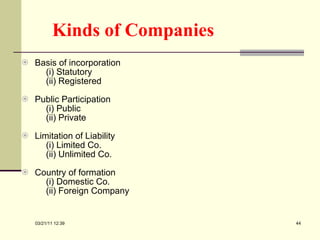
Kinds of Companies Basis of incorporation  (i) Statutory  (ii) Registered Public Participation (i) Public (ii) Private Limitation of Liability (i) Limited Co. (ii) Unlimited Co. Country of formation (i) Domestic Co.  (ii) Foreign Company 03/21/11   12:07
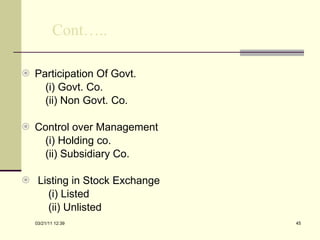
Cont….. Participation Of Govt. (i) Govt. Co. (ii) Non Govt. Co. Control over Management (i) Holding co. (ii) Subsidiary Co. Listing in Stock Exchange (i) Listed (ii) Unlisted 03/21/11   12:07
Types of Companies   Private Company Public Company 03/21/11   12:07
Private Company  [Section 3(1)(iii)] A private company means a company which has a minimum paid up capital of one lakh rupees or such higher paid-up capital as may be prescribed and by its articles : ( a ) restricts the right to transfer its shares, if any; ( b ) limits the number of its members to 50, not including: 03/21/11   12:07
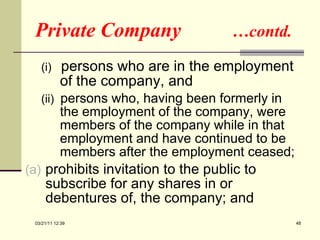
Private Company  …contd. (i)  persons who are in the employment of the company, and (ii)  persons who, having been formerly in the employment of the company, were members of the company while in that employment and have continued to be members after the employment ceased;  prohibits invitation to the public to subscribe for any shares in or debentures of, the company; and 03/21/11   12:07
Private Company  …contd. (d) prohibits any invitation or acceptance of deposits from persons other than its members, directors or their relatives. Where two or more persons hold one or more shares in a company jointly, they shall, for the purposes of membership, be treated as a single member. 03/21/11   12:07
Public Company  [Section 3(1)(iv)] A public company means a company which: (a)  is not a private company [In other words, it should not have the restrictions of Section 3(1)(iii) in its articles   ]; (b) has a minimum paid-up capital of five lakh rupees or such higher paid-up capital, as may be prescribed; and (c) is a private company, which a subsidiary of a company, which is not a private company. For more details   03/21/11   12:07
How to form a company? The whole process of formation of a company may be divided into four stages, namely: (i)  Promotion (ii) Registration (iii) Floatation/Raising of Capital (iv) Commencement of Business. 03/21/11   12:07
Promotion Who is a Promoter? The term promoter is “a term not of law but of business”, usefully summing up, in a single word— promotion, “a number of business operations familiar to the commercial world by which a company is brought into existence”.  However, the  persons assisting the promoters by acting in a professional capacity do not thereby become promoters themselves .  03/21/11   12:07
Legal Position of a Promoter Promoter stands in a fiduciary position towards the company. In other words, he is not allowed to make  secret profits . Case:   Gluckstein  v.  Barnes 03/21/11   12:07
Pre-incorporation contracts Void-ab-initio .(Thee term  void ab initio , which means "to be treated as invalid from the outset“)  However, pre-incorporation contracts shall be valid if: The contract is made for the purpose of the company and the contract is warranted by the terms of incorporation. The company adopts the transactions after incorporation. 03/21/11   12:07
Registration/Incorporation Private Company Minimum Number of Members required – 2. Public Company Minimum Number of Members required – 7. 03/21/11   12:07
Steps Application for availability of name:  Three names in order of priority conforming to the provisions of the Act and the Guidelines issued by Department of Company Affairs in this regard: Name to end with the word(s) ‘Limited’ or ‘Private Limited’, as the case may be, except: Section 25 Companies Govt. Companies (need not use Pvt. Ltd.) Producer Companies. 03/21/11   12:07
Steps  …contd. Name should not be identical or too similar to the name of an already existing company. Should not include the name of a registered trade mark. 2.  Preparation of Memorandum and  Articles  of Association Memorandum defines and limits the scope of activities of a company. 03/21/11   12:07
Steps  …contd. Contents of Memorandum  Name clause Registered office clause Object clause Doctrine of  ultra-vires Liability clause Capital clause 03/21/11   12:07
Steps  …contd. 3.   Preparation of other documents Power of Attorney in favour of a professional to effect registration. Consent of Directors (in case of a Public Company) Particulars of Directors, Manager, Secretary, etc. in the prescribed form. Notice of registered address  To be supplied within 30 days of incorporation. 03/21/11   12:07
Steps  …contd. Statutory Declaration To the effect that all requirements of law with respect to incorporation have been duly complied with. The declaration to be signed by: Advocate of Supreme Court or High Court;  OR C.A../C.S. practising in India and associated with the formation of the company;  OR Director, Manager, Secretary of the company (as named in the Articles) 4.   Filing of documents with ROC 03/21/11   12:07
Certificate of Incorporation Effect of Certificate of Incorporation (Section 34) On incorporation, the association of persons becomes a body corporate by the name contained in the memorandum, capable forthwith of exercising all the functions of an incorporated company and having perpetual succession and a common seal but with such liability on the part of the members to contribute to the assets of the company in the event of its being wound-up as is mentioned in the Act.  03/21/11   12:07
Conclusiveness of Certificate of Incorporation  (Section 35) Conclusive to the effect that all requirements of law relating to registration and matters precedent and incidental thereto have been duly complied with. Case Laws: Moosa  v.  Ibrahim   Jubilee Cotton Mills Ltd.  v.  Lewis   03/21/11   12:07
Provisional Contracts Contracts entered into by company after incorporation but before getting the certificate to commence business are called ‘provisional contracts’. Provisional contracts are, therefore, relevant to public companies only. Such contracts become void, if company fails to obtain certificate to commence business and automatically become valid, and binding if company obtains the certificate. 03/21/11   12:07
Raising of Capital A company may raise capital through Private placement Issue of Prospectus Private placement   means raising of capital from friends, relatives and through brokers. 03/21/11   12:07
Commencement of Business   (Section 149) Where Company has issued a Prospectus: a company cannot commence business or exercise borrowing powers unless: (a) shares up to the amount of the minimum subscription have been allotted by the company; (b) every director of the company has paid to the company, on each of the shares taken or contracted to be taken by him and for which he is liable to pay in cash, 03/21/11   12:07
Commencement of Business   …contd. the same proportion as is payable on application and allotment on the shares, offered for public subscription; ( c ) no money is, or may become, liable to be repaid to the applicants for shares or debentures offered for public subscription, for failure to obtain permission for the shares to be dealt in on any recognised stock exchange;  03/21/11   12:07
Commencement of Business   …contd. ( d ) there has been filed with the Registrar a duly verified declaration by one of the directors or the secretary or, where the company has not appointed a secretary, a secretary in whole time practice in the prescribed form that clauses ( a ), ( b ) and ( c ) (mentioned above) have been complied with. Penalty: Every person at fault may be fined upto Rs.5,000/- for every day of default.  03/21/11   12:07
Memorandum  of Association Every company has to have a Memorandum of Association. It contains, besides other significant information, the objects for which the company is formed. ‘ Object clause’ defines as well as confines the powers of the company. Anything done beyond these objects is  ultra-vires  the company and void. 03/21/11   12:07
Contents of Memorandum 1.  Name Clause:  It contains the name with which company is proposed to be registered.  Companies Act requires that: The name chosen should end with the word ‘Limited’ or the words ‘Private Limited’, as the case may be. The name should not be undesirable i.e., it should not be identical or too similar to the name of an already existing company  OR  include the name of a registered trade mark unless consent of the owner of the trade mark is obtained.  03/21/11   12:07
Contents of Memorandum 2.  Registered Office Clause:  This clause states the name of the State in which registered office of the company is to be situated. 3. Objects Clause This clause is to be divided into: Main objects and objects incidental or ancillary to main objects Other objects A company cannot commence any business stated under other objects unless ‘special resolution’ by the shareholders is passed. 03/21/11   12:07
Doctrine of  Ultra-Vires Effects of  Ultra-vires transactions void-ab-initio   Injunction Personal liability of directors towards the company towards the outsiders 03/21/11   12:07
Contents of Memorandum 4.  Liability Clause 5.  Capital Clause This clause states the authorised capital and the number of shares into which the same shall be divided. 03/21/11   12:07
ALTERATION OF MEMORANDUM: 1. CHANGE OF NAME: Procedure of alteration- i. by special resolution ii. by ordinary resolution 2. CHANGE OF REGISTERED OFFICE: a. change within the city b. change within the state c. change from one state to another 03/21/11   12:07
Procedure of alteration- i. Special resolution ii. Confirmation by the NCLT iii. Notice to affected parties  iv. Notice to Registrar  v. Power of the Tribunal to confirm change discretionary vi. Rights and interests of members and creditors to be taken care of. vii. Copy of special resolution and the order of the Tribunal to be filed with the registrar. 03/21/11   12:07
3. ALTERATION OF OBJECTS: The objects clause is very important clause in the Memorandum of  Association. The objects of a company may be altered by special resolution  so as to enable the company- a. To carry on its business more economically or more efficiently. b. To attain its main purpose by new or improved means. c. To carry on some business which may conveniently or advantageously be combined with the objects specified in the Memorandum. 03/21/11   12:07
d. To enlarge or change the local area of its operations. e. To restrict or abandon any of the objects specified in the Memorandum. f. To sell or dispose of the whole, or any part, of the undertaking, or of any of the undertakings, of the company; or g. To amalgamate with any other company or body of persons. 03/21/11   12:07
Procedure of alteration: i. Special resolution. ii. Copy of special resolution to be filed. iii. Certification of registration. 4. CHANGE IN LIABILITY CLAUSE: A company limited by shares or guarantee cannot change its  Memorandum so as to impose any additional liability on the members or to compel them to buy additional shares of the company unless all the members agree in writing to such change either before or after the change (Sec.38). 5. CHANGE IN CAPITAL CLAUSE: For change in the capital clause which involves increase, reduction or reorganization of capital, refer to “Share Capital”. 03/21/11   12:07
DOCTRINE OF ULTRA VIRES: The term ultra vires a company means that the doing of the act is beyond the legal power and authority of the company. The purpose of these restrictions is to protect- Investors in the company. Creditors. 03/21/11   12:07
ARTICLES  OF  ASSSOCIATION 03/21/11   12:07
DEFINITION: The Articles of Association or just Articles are the rules, regulations and bye-laws for the internal management of the affairs of a company. They are framed with the object of carrying out the aims and objects as set in the memorandum of Association. 03/21/11   12:07
CONTENTS OF ARTICLES: Articles usually contain provisions relating to the following matters: 1. Share capital, rights of shareholders, variation of these rights, payment of commissions, share certificates. 2. Lien on shares. 3. Calls on shares. 4. Transfer of shares. 5. Transmission of shares. 6. Forfeiture of shares. 7. Conversion of shares into stock. 8. Share warrants. 9. Alteration of capital. 10. General meetings and proceedings thereat. 03/21/11   12:07
11. Voting rights of members, voting and poll, proxies. 12. Directors, their appointment, remuneration, qualifications, powers and proceedings of Board of directors. 13. Manager. 14. Secretary. 15. Dividends and reserves. 16. Accounts, audit and borrowing powers. 17. Capitalization of profits. 18. Winding up. 03/21/11   12:07
COMPANIES WHICH MUST HAVE THEIR OWN ARTICLES: According to Sec.26 the following companies shall have their own articles, namely, a. unlimited companies, b. companies limited by guarantee, c. private companies limited by shares. 03/21/11   12:07
RELATIONS REQUIRED: In case of Unlimited company the articles shall state- a. the no. of members with which the company is to be registered. b. if it has a share capital, the amount of share capital with which  the company is to be registered. 2. In case of company limited by guarantee the articles shall state the no. of members with which the company is to be registered. 03/21/11   12:07
3. In case of private company having a share capital the articles  shall contain provisions which- a. restrict the right to transfer shares. b. limit the no. of its members to 50 c. prohibit any invitation to the public to subscribe for any  shares in, or debentures of, the company. 03/21/11   12:07
FORM AND SIGNATURE OF ARTICLES: The shall be- a. printed, b. divided into paragraphs, and c. signed by the each subscriber of the memorandum. 03/21/11   12:07
ALTERATION OF ARTICLES: Companies have been given very wide powers to alter their articles. The right to alter the articles is so imp that a company cannot in any manner, either by express provision in the articles or by an independent contract, deprive itself of the power to alter its articles.  Any clause in the articles that restricts or prohibits alteration of articles is invalid.  For example, the articles of the company contain any restriction that the company shall not alter its articles, it will be contrary to the Companies Act and, therefore, inoperative. 03/21/11   12:07
LIMITATIONS TO ALTERATION: Must not be inconsistent with the Act. Must not conflict with the memorandum. Must not sanction anything illegal. Must be for the benefit of the company. Must not increase liability of members. Alteration by special resolution only. Approval of central government when a public company is converted  into a private company. 8. Breach of contract. 9. Must not result in expulsion of a member. 10. No power of the Tribunal to amend Articles. 11. Alteration may be with retrospective effect. 03/21/11   12:07
ARTICLES AND MEMORANDUM – THEIR RELATION The Articles are subordinate to Memorandum. The Memorandum must be read in conjunction with Articles. The terms of the Memorandum cannot be modified or controlled by  the Articles. 03/21/11   12:07
DISTINCTION OF MEMORANDUM AND ARTICLES It is the charter of the company indicating the nature of its business, its nationality, and its capital. It also defines the company’s relationship with outside world. It defines the scope of the activities of the company, or the area beyond which the actions of the company cannot go. It, being the charter of the company, is the supreme document. Every company must have its own Memorandum. There are strict restrictions on its alteration. Some of the conditions of incorporation contained in it cannot be altered except with the sanction of the NCLT. Any Act of the company which is ultra vires the Memorandum is wholly void and cannot be ratified even by the whole body of shareholders. They are the regulations for the internal management of the company and are subsidiary to the Memorandum. They are the rules for carrying out the objects of the company as set out in the Memorandum. They are subordinate  to the Memorandum. If there is a conflict between the Articles and the Memorandum, the latter prevails. A company limited by shares need not have articles of its own. They can be altered by a special resolution, to any extent, provided they do not conflict with the Memorandum and the Companies Act. Any Act of the company which is ultra vires the Articles (but is ultra vires the Memorandum) can be confirmed by the share holders. 03/21/11   12:07
MEMORANDUM OF ASSOCIATION AND ARTICLES OF ASSOCIATION 03/21/11   12:07
Doctrine of Constructive Notice According to Section 610, every person dealing with the company is deemed to have read M/A and A/A and understood the contents thereof in the correct perspective.  Doctrine of Indoor Management The rule was first laid down in  Royal British Bank  v.  Turquand.  Rule of Indoor Management is an exception to the Doctrine of Constructive notice. 03/21/11   12:07
Exceptions of Indoor Management Knowledge  of irregularity  :  Case:   Howard v. Patent Ivory Co.   Negligence  :  Case:   Anand Behari Lal   v.  Dinshaw & Co. (Bankers) Ltd.   Forgery  :  Case:   Ruben   v.  Great Fingal Consolidated  [Secy. Forged signatures of two directors] No knowledge of articles  :  Case:   Rama Corporation  v.  Proved Tin &  General Investment Co.   03/21/11   12:07
Prospectus A prospectus, as per Section 2(36), means any document described or issued as prospectus and includes any notice, circular, advertisement or other document inviting deposits from the public or inviting offers from the public for the subscription or purchase of any shares or debentures of a body corporate.   03/21/11   12:07
Prospectus  … contd.  Thus, a prospectus is not merely an advertisement; it may be a circular or even a notice. A document shall be called a prospectus if it satisfies two things: (a) It invites subscription to shares or debentures or invites deposits. (b) The aforesaid invitation is made to the public. 03/21/11   12:07
What constitutes Invitation to Public As per Section 67, Invitation to public includes: invitation to any section of the public howsoever selected provided the invitation is made to all the members of that section of public indiscriminately. Invitation calculated to be made available even to those who do not receive the same. Invitation to 50 or more persons. 03/21/11   12:07
Mis-statement in a Prospectus and its consequences  What is Mis-statement?   According to Section 65(1) of the Act: ( a ) a statement included in a prospectus shall be deemed to be untrue, if the statement is misleading in the form and context in which it is included; and ( b ) where the omission from a prospectus of any matter is calculated to mislead, the prospectus shall be deemed in respect of such omission, to be a prospectus in which an untrue statement is included.  Case:   Rex  v.  Kylsant 03/21/11   12:07
Share and Share Capital  According to Section 2(46), A ‘Share’ represents a unit into which capital of a company is divided.  However, courts have held that a share is not merely a unit of capital, it represents a bundle of rights and obligations.  Holder of a share is entitled to certain rights (say, right to receive dividends, to receive notice of meetings, to participate in the proceedings of a meeting, to elect directors) and is also subjected to a number of obligations (say, to abide by Articles of Association, to maintain decorum of the meetings). 03/21/11   12:07
Kinds of Shares The following kinds of shares may be issued by a company: Equity shares carrying voting rights. Equity shares carrying differential rights as to voting or dividend (commonly called Non-Voting Equity Shares) Preference Shares Cumulative convertible Preferable Shares 03/21/11   12:07
Kinds of Shares  … contd. Preference Shares  carry preference with respect to two things: Preference with respect to dividend at a fixed rate or of a fixed amount. Preference with respect to return of capital in case of winding up. Equity Shares  means a share which is not a preference share. 03/21/11   12:07
Allotment of Shares ‘ Allotment’ is an acceptance to an offer for purchase of shares. Where allotment does not conform to the statutory requirements, it is called irregular allotment.  For allotment to be valid, following requirements must be satisfied: A copy of prospectus or statement in lieu of prospectus must have been delivered to Registrar of Companies. 03/21/11   12:07
Allotment of Shares  … contd. Application money must not be less than 5% of the nominal value. Minimum subscription (i.e., at least 90% of the issue) must have been received. Application money must be kept deposited in a Scheduled Bank till the minimum subscription has been received. Shares must have been listed on the stock exchange(s) mentioned in the Prospectus. 03/21/11   12:07
Administration/Management of a company A company functions through the medium of Board of Directors.  However, certain powers have been reserved to be exercised by shareholders in general body meetings.  Section 291 of the Companies Act, 1956 confers general power on the Board of Directors. It provides: “Subject to the provisions of the Act, the Board of Directors of a company shall be entitled to exercise all such powers, and to do all such acts and things, as the company is authorised to exercise and do.  03/21/11   12:07
Powers which are exerciseable only by the shareholders.  1.   Sell, lease or otherwise dispose of the whole, substantially the whole, of the undertaking of the company, or where the company owns more than one undertaking, of the whole or substantially the whole, of any such undertaking.  2. Remit or give time for the repayment of any debt due by a director except in the case of renewal or of continuance of an advance made by a banking company to its directors in the ordinary course of business.  03/21/11   12:07
Powers  …contd. 3.  Invest, otherwise than in trust securities, the amount of compensation received by the company in respect of compulsory acquisition of any property or fixed assets of the company. 4.  Borrow monies exceeding the aggregate of the paid-up capital of the company and its free reserves. ‘Borrowing’ does not include temporary loans ( i.e. , loans payable on demand or within six months but excluding loans for capital expenditure) obtained from the company’s bankers in the ordinary course of business. 03/21/11   12:07
Powers  …contd. The resolution passed at the general meeting must specify the total amount upto which moneys may be borrowed by the Board of directors in any financial year.  5. Contribute in any year, to charitable and other funds not directly relating to the business of the company or the welfare of its employees any amount exceeding Rs. 50,000 or five per cent of its average net profits of the last three financial years, whichever is higher.  03/21/11   12:07
Powers  …contd. However, the resolution must specify the total amount that may be contributed by the Board of directors in any financial year. However, contributions to National Defence Fund, the Prime Minister’s National Relief Fund or any other fund approved by the Central Government* for the purpose are exempted from the above provisions.  03/21/11   12:07
Qualifications and Disqualifications for Directors Qualifications A public company cannot prescribe any qualifications for directorship except share qualification.  Again, share qualification requirement cannot exceed holding of shares exceeding Rs. 5000/- in nominal value or value of one share where nominal value of one share exceeds Rs.5000/-.  A director may obtain his share qualification within 2 months after his appointment.  03/21/11   12:07
Disq ualifications Section 274 of the Companies Act, 1956 provides that the following  persons shall not be capable of being appointed as directors of any company : (a) a person found by a competent court to be of unsound mind and such finding remaining in force; (b) an undischarged insolvent; (c)  a person who has applied to be adjudged an insolvent; 03/21/11   12:07
Disq ualifications  …contd. ( d ) a person who has been convicted by a Court of an offence involving moral turpitude and sentenced in respect thereof to imprisonment for not less than six months, and a period of five years has not elapsed from the date of the expiry of the sentence; ( e ) a person who has not paid any call in respect of shares of the company held by him, whether alone or jointly with others and six months have elapsed from the last date fixed for the payment of the call; and 03/21/11   12:07
Disq ualifications  …contd. ( g ) a person who is already a director of a public company which,— ( i ) has not filed the annual accounts and annual returns for any continuous three financial years commencing on and after the first day of April, 1999; or ( ii ) has failed to repay its deposit or interest thereon on due date or redeem its debentures on due date or pay dividend and such failure continues for one year or more. 03/21/11   12:07
Number of Directorships Whole-time Directorship A person cannot be appointed as a whole-time director in more than one company. Part-time Directorship Not more than 15 companies  excluding  the directorships of,  03/21/11   12:07
No. of Directorships  …contd. private companies [other than subsidiaries or holding companies of public company(ies)]. unlimited companies, associations not carrying on business for profit or which prohibit payment of a dividend, and alternate directorships ( i.e.,  he is appointed to act as a director only during the absence or incapacity of some other director). 03/21/11   12:07
03/21/11   12:07

1690companiesact 1956

  • 1.
    Companies Act, 1956Anandaraj A MBA Banking Technology Pondicherry University 03/21/11 12:07
  • 2.
    Meaning and Definitionof a Company Section 3(1)(i) of the Companies Act, 1956 defines a company as: “a company formed and registered under this Act or an existing Company”. ‘ Existing Company’ means a company formed and registered under any of the earlier Company Laws. 03/21/11 12:07
  • 3.
    What is aCompany? A company is a body corporate or corporation There are 4 types of corporation. Those created by Royal Charter This was the earliest way of creating corporations. 03/21/11 12:07
  • 4.
    What is aCompany? (cont.) However, nowadays, it is not used to create trading bodies. It is used for charitable and educational bodies The BBC (British Broadcasting Corporation) and the Bank of England were both created by Royal Charter 03/21/11 12:07
  • 5.
    What is aCompany? (cont.) by special Act of Parliament Again, this is an old way of creating corporations which is no longer used Bank of Scotland was created in 1695 by and Act of the old Scots Parliament The Governor and Company of the Bank of Scotland 03/21/11 12:07
  • 6.
    What is aCompany? (cont.) by registration under the Companies Act 1985 The current law relating to companies is mainly contained in this Act It is the most common way of creating a corporation by registration under the Limited Liability Partnership Act 2000 03/21/11 12:07
  • 7.
    Characteristic Features Registration Separate Legal Entity Artificial legal person A company is an artificial legal person which is created by law and can be dissolved by law alone It is invisible, intangible and exists only in the eyes of the law 03/21/11 12:07
  • 8.
    Limited Liability However,liability of a company is never limited. It’s liability of members only that is limited. Free Transferability of Shares Other Features: Separate property and Common Seal. 03/21/11 12:07
  • 9.
    Separate Legal PersonalityAs companies are a kind of corporation, they have their own separate identity In law, they are regarded as a person Although a company is not a natural person (like you or me) the law treats it in the same way in many areas 03/21/11 12:07
  • 10.
    Separate Legal Personality (cont.) The most famous case in this area is Salomon v Salomon & Co Mr Salomon was in business as a leather merchant In 1892, he formed Salomon & Co Ltd He held most of the shares with his wife and 5 of his children each holding one share as company law at that time required at least 7 shareholders in a company 03/21/11 12:07
  • 11.
    Separate Legal Personality (cont.) Unfortunately, the company did not do well and it went into liquidation A liquidator was appointed to sell the assets of the company and pay its debts 03/21/11 12:07
  • 12.
    Separate Legal Personality (cont.) The liquidator claimed that the company was a fake because Mr Salomon owned 20 001 shares and his family owned only 6 altogether Mr Salomon was really just running the same business Therefore, the liquidator argued that Mr Salomon was liable for all the debts of the company 03/21/11 12:07
  • 13.
    Separate Legal Personality (cont.) However, the House of Lords disagreed The court held that The fact that some shareholders only held 1 share as a technicality was not relevant The registration procedure could be used to create a one-man company 03/21/11 12:07
  • 14.
    Separate Legal Personality (cont.) A company which is properly formed under the Companies Act is a separate person As a result the debts of a company were its own and not those of its members 03/21/11 12:07
  • 15.
    Separate Legal Personality (cont.) Two more cases also help to demonstrate the idea of separate legal personality. In Macaura v Northern Assurance Co, Macaura sold all the timber on his estate to a company in return for all the shares in that company The timber was stored on Macaura’s estate Macaura insured the timber in his own name 03/21/11 12:07
  • 16.
    Separate Legal Personality (cont.) Two weeks later, the timber was destroyed in a fire The insurance company refused to pay out because it said Macaura did not have an insurable interest in the timber because he did not own it. The company owned it. The House of Lords agreed 03/21/11 12:07
  • 17.
    Separate Legal Personality (cont.) The court held The timber belonged to the company not Macaura Macaura had not insurable interest in the timber even though he owned all the shared in the company Just as the separate legal identity of a company gives the members limited liability, it also means that the assets of a company belong to it and not to its shareholders 03/21/11 12:07
  • 18.
    Consequences This conceptof separate legal personality has several consequences Limited liability Perpetual succession Business property Court actions Liability in tort and crime The rule in Foss v Harbottle 03/21/11 12:07
  • 19.
    Limited Liability Theliability of the members of a company for its debts is limited Under the Companies Act 1985 a member of a company limited by shares is only liable to pay the full amount of his shares, and a member of a company limited by guarantee is only liable to pay the amount which he guarantees to pay if the company is wound up 03/21/11 12:07
  • 20.
    Perpetual Succession Changesin the membership of a company have no effect on the continuation of that company Unlike a partnership, the death or bankruptcy of a member does not end the company In public limited companies, members are free to sell their shares on the stock exchange 03/21/11 12:07
  • 21.
    Business Property Businessproperty is owned by the company and not its shareholders That means a creditor cannot take action against company assets in respect of a debt due by a member of that company 03/21/11 12:07
  • 22.
    Court Actions Acompany can sue and be sued in its own name It can also enter contracts in its own name The company’s liability for contractual debts is unlimited It is only the members’ liability which is limited 03/21/11 12:07
  • 23.
    Liability in Tortand Crime Companies are vicariously liable for the torts of their employees Companies can be guilty of crimes which do not require a mental element (eg intention or recklessness) However, it has been more difficult to prosecute companies where the crime has such an element as it has to be shown that one of the directors of the company had the required mental element This can be very difficult in a large company where the directors are not involved in the day to day operation of the business 03/21/11 12:07
  • 24.
    Foss v HarbottleThis case gives us the idea of ‘majority rule’ in a company If a company suffers injury then the majority of members must agree to raise a court action A single member cannot take action against the wrongdoer 03/21/11 12:07
  • 25.
    Lifting the Veilof Incorporation Although the general rule is that a company has a separate legal identity from its members, there are exceptions to this rule when a court will not treat a company as a separate entity This is often referred to as “lifting the veil of incorporation” Often, this is to prevent abuse of the principle of separate identity 03/21/11 12:07
  • 26.
    Lifting the Veilof Incorporation (cont.) For example, under the Companies Act 1985, if a company trades with fewer than two members then the sole member has unlimited liability for company debts Also under the Companies Act, officers of the company will become personally liable if they issue bills of exchange or enter into contracts on behalf of the company but do not use the company’s full name 03/21/11 12:07
  • 27.
    Lifting the Veilof Incorporation (cont.) At common law, the general principle is that the courts will not allow a company to be used for a fraudulent purpose or to avoid a legal duty For example, in Gilford Motor Co v Horne, a term in an employee’s contract prevented him from approaching former customers after he left Gilford Motor Co 03/21/11 12:07
  • 28.
    Lifting the Veilof Incorporation (cont.) Therefore, when he left he formed his own company, and the company approached his former customers The court held the company was a sham being used to avoid the term in his contract 03/21/11 12:07
  • 29.
    Difference between Companyand Partnership creation: A partnership is created by the agreement of partnership; while a company is established in accordance with company law; B) Numbers of members/ partners minimum of 2 and maximum of 50 in private companies Minimum of 7 and no limit on maximum in public company Minimum of 2 persons is required to form partnership, maximum is 10 for banking business and 20 for other business 03/21/11 12:07
  • 30.
    C) ownership ofassets In the case of a partnership, the total assets of a partnership are owned by all the partners; while in the case of company, the assets contributed by all the shareholders are owned by the company. In other words, as long as the shareholder contribute their capital, they lose the direct control of these capital. D) Management The company is managed by BOD elected by shareholders. A paternship is managed by partners except the dormant and sleeping partners. 03/21/11 12:07
  • 31.
    E) legal personquality A partnership has no legal person quality, while a company has legal person quality. F) Perpetual existence A company has a perpetual existence A partnership does not have a perpetual existence. G) Contracts A member of the company can contract with company. A partner cannot contract with the partnership firm 03/21/11 12:07
  • 32.
    H) assuming liabilityIn the case of a partnership, not only the partnership, but also all the partners are responsible for all the debts owed by the partnership. A creditor is entitled to asking either the partnership or one or some or all of the partners to repay part or all the debts owed by the partnership. Death The death of any members of the company does not end the existence of company. Death of a partner dissolves the partnership unless the partnership deed provides 03/21/11 12:07
  • 33.
    Kind of companiesThe Companies Act provided for a variety of companies that may be promoted and registered under the Act. However, two basic types of companies which may be registered under the Act are ‘private’ and ‘public’ companies. These may further be incorporated as limited liability companies or as unlimited liability companies. 03/21/11 12:07
  • 34.
    A privatecompany [(as per Companies (Amendment) Act, 2000] means a company which has a minimum paid-up capital of Rs. 1 lakh or such higher paid-up capital as may be prescribed and which by its articles : Restricts the right to transfer its share , if any Prohibits invitations to the public to subscribe for any shares in, or debentures of, the company Limits the total number of members to 50 Prohibits any invitation or acceptance of deposits from persons other than its members, directors or their relatives 03/21/11 12:07
  • 35.
    A publiccompany [as per Companies (Amendment) Act, 2000] means a company which : Is not a private company; Has a minimum paid-up capital of Rs. 5 lakh or such higher paid-up capital, as may be prescribed. Is a private company which is a subsidiary of a company which is not a private company. A company registered under section 25, before or after the commencement of the Companies (Amendment) Act, 2000, shall not be required to fulfil the requirement of ‘minimum paid-up capital’ with respect to private or public company, as aforesaid. 03/21/11 12:07
  • 36.
    A statutorycompany is a company created by a special Act of Parliament and is accordingly governed by the statute creating it. However, the provisions of Companies Act, 1956 apply to them, insofar as the same are not inconsistent with the special Acts under which these companies are formed. Examples Reserve Bank of India incorporated under the reserve bank of India act, 1934. 03/21/11 12:07
  • 37.
    Limited liability companies may limit the liability of their members by the amount unpaid on the shares held by them or by the amount guaranteed or by both. A Government company is one in which either the Central Government or the State Governments taken together hold not less than 51% of its paid-up capital. The term further includes a subsidiary of such a Government company. 03/21/11 12:07
  • 38.
    A Government companymay be incorporated as a private company or a public company. A Government company is governed by the provisions of the Companies Act unless exempted by the Central Government under powers conferred under section 620. The Central Government has exempted the Government companies from most of the provisions of the Companies Act. 03/21/11 12:07
  • 39.
    A foreigncompany means a company incorporated outside India but having a place of business in India. A foreign company is required to furnish to the Registrar documents specified in section 592. Besides, it is subjected to certain obligations spelt out under sections 594, 595,600, 603-608. Where foreign companies in which more than 50% the paid-up share capital is in Indian hands, section 591(2) provides that it should be, for its business in India, treated as a Indian company. A foreign company if it ceases to carry on business in India, may be wound up as an unregistered company. 03/21/11 12:07
  • 40.
    Even where foreigncompany is a Government company, it may be wound up in India. ‘ Holding’ and ‘Subsidiary’ companies are relative terms. A company shall be holding company of another where it controls the composition of its board of directors; holds more than half I nominal value of its equity share capital; or it is subsidiary of its subsidiary. 03/21/11 12:07
  • 41.
    ‘ Investment company’ has been defined as a company whose principle business is the acquisition of shares, stock, debentures or other securities. Producer Companies This is a new addition made by companies (Amendment Act 2002). Producer companies means Cooperative Societies engaged in any activities connected with or related to any Primary Producer 03/21/11 12:07
  • 42.
    An association ofpersons with a membership exceeding 10 in case of banking business and 20 incase of any other business shall be regarded as an illegal association under section 11 of the Companies Act unless the same is registered as a company under the Companies Act or under any other law. However, section does not cover a stock exchange, associations not for profit and Hindu Undivided Families. 03/21/11 12:07
  • 43.
    A person whobecomes a member of such an association shall personally liable for all transactions and also subject to a fine upto Rs. 10,000. Such an association cannot be dissolved through the Court since in the eyes of the law it does not exist. However, its profits shall be subject of tax. 03/21/11 12:07
  • 44.
    Kinds of CompaniesBasis of incorporation (i) Statutory (ii) Registered Public Participation (i) Public (ii) Private Limitation of Liability (i) Limited Co. (ii) Unlimited Co. Country of formation (i) Domestic Co. (ii) Foreign Company 03/21/11 12:07
  • 45.
    Cont….. Participation OfGovt. (i) Govt. Co. (ii) Non Govt. Co. Control over Management (i) Holding co. (ii) Subsidiary Co. Listing in Stock Exchange (i) Listed (ii) Unlisted 03/21/11 12:07
  • 46.
    Types of Companies Private Company Public Company 03/21/11 12:07
  • 47.
    Private Company [Section 3(1)(iii)] A private company means a company which has a minimum paid up capital of one lakh rupees or such higher paid-up capital as may be prescribed and by its articles : ( a ) restricts the right to transfer its shares, if any; ( b ) limits the number of its members to 50, not including: 03/21/11 12:07
  • 48.
    Private Company …contd. (i) persons who are in the employment of the company, and (ii) persons who, having been formerly in the employment of the company, were members of the company while in that employment and have continued to be members after the employment ceased; prohibits invitation to the public to subscribe for any shares in or debentures of, the company; and 03/21/11 12:07
  • 49.
    Private Company …contd. (d) prohibits any invitation or acceptance of deposits from persons other than its members, directors or their relatives. Where two or more persons hold one or more shares in a company jointly, they shall, for the purposes of membership, be treated as a single member. 03/21/11 12:07
  • 50.
    Public Company [Section 3(1)(iv)] A public company means a company which: (a) is not a private company [In other words, it should not have the restrictions of Section 3(1)(iii) in its articles ]; (b) has a minimum paid-up capital of five lakh rupees or such higher paid-up capital, as may be prescribed; and (c) is a private company, which a subsidiary of a company, which is not a private company. For more details 03/21/11 12:07
  • 51.
    How to forma company? The whole process of formation of a company may be divided into four stages, namely: (i) Promotion (ii) Registration (iii) Floatation/Raising of Capital (iv) Commencement of Business. 03/21/11 12:07
  • 52.
    Promotion Who isa Promoter? The term promoter is “a term not of law but of business”, usefully summing up, in a single word— promotion, “a number of business operations familiar to the commercial world by which a company is brought into existence”. However, the persons assisting the promoters by acting in a professional capacity do not thereby become promoters themselves . 03/21/11 12:07
  • 53.
    Legal Position ofa Promoter Promoter stands in a fiduciary position towards the company. In other words, he is not allowed to make secret profits . Case: Gluckstein v. Barnes 03/21/11 12:07
  • 54.
    Pre-incorporation contracts Void-ab-initio.(Thee term  void ab initio , which means "to be treated as invalid from the outset“)  However, pre-incorporation contracts shall be valid if: The contract is made for the purpose of the company and the contract is warranted by the terms of incorporation. The company adopts the transactions after incorporation. 03/21/11 12:07
  • 55.
    Registration/Incorporation Private CompanyMinimum Number of Members required – 2. Public Company Minimum Number of Members required – 7. 03/21/11 12:07
  • 56.
    Steps Application foravailability of name: Three names in order of priority conforming to the provisions of the Act and the Guidelines issued by Department of Company Affairs in this regard: Name to end with the word(s) ‘Limited’ or ‘Private Limited’, as the case may be, except: Section 25 Companies Govt. Companies (need not use Pvt. Ltd.) Producer Companies. 03/21/11 12:07
  • 57.
    Steps …contd.Name should not be identical or too similar to the name of an already existing company. Should not include the name of a registered trade mark. 2. Preparation of Memorandum and Articles of Association Memorandum defines and limits the scope of activities of a company. 03/21/11 12:07
  • 58.
    Steps …contd.Contents of Memorandum Name clause Registered office clause Object clause Doctrine of ultra-vires Liability clause Capital clause 03/21/11 12:07
  • 59.
    Steps …contd.3. Preparation of other documents Power of Attorney in favour of a professional to effect registration. Consent of Directors (in case of a Public Company) Particulars of Directors, Manager, Secretary, etc. in the prescribed form. Notice of registered address To be supplied within 30 days of incorporation. 03/21/11 12:07
  • 60.
    Steps …contd.Statutory Declaration To the effect that all requirements of law with respect to incorporation have been duly complied with. The declaration to be signed by: Advocate of Supreme Court or High Court; OR C.A../C.S. practising in India and associated with the formation of the company; OR Director, Manager, Secretary of the company (as named in the Articles) 4. Filing of documents with ROC 03/21/11 12:07
  • 61.
    Certificate of IncorporationEffect of Certificate of Incorporation (Section 34) On incorporation, the association of persons becomes a body corporate by the name contained in the memorandum, capable forthwith of exercising all the functions of an incorporated company and having perpetual succession and a common seal but with such liability on the part of the members to contribute to the assets of the company in the event of its being wound-up as is mentioned in the Act. 03/21/11 12:07
  • 62.
    Conclusiveness of Certificateof Incorporation (Section 35) Conclusive to the effect that all requirements of law relating to registration and matters precedent and incidental thereto have been duly complied with. Case Laws: Moosa v. Ibrahim Jubilee Cotton Mills Ltd. v. Lewis 03/21/11 12:07
  • 63.
    Provisional Contracts Contractsentered into by company after incorporation but before getting the certificate to commence business are called ‘provisional contracts’. Provisional contracts are, therefore, relevant to public companies only. Such contracts become void, if company fails to obtain certificate to commence business and automatically become valid, and binding if company obtains the certificate. 03/21/11 12:07
  • 64.
    Raising of CapitalA company may raise capital through Private placement Issue of Prospectus Private placement means raising of capital from friends, relatives and through brokers. 03/21/11 12:07
  • 65.
    Commencement of Business (Section 149) Where Company has issued a Prospectus: a company cannot commence business or exercise borrowing powers unless: (a) shares up to the amount of the minimum subscription have been allotted by the company; (b) every director of the company has paid to the company, on each of the shares taken or contracted to be taken by him and for which he is liable to pay in cash, 03/21/11 12:07
  • 66.
    Commencement of Business …contd. the same proportion as is payable on application and allotment on the shares, offered for public subscription; ( c ) no money is, or may become, liable to be repaid to the applicants for shares or debentures offered for public subscription, for failure to obtain permission for the shares to be dealt in on any recognised stock exchange; 03/21/11 12:07
  • 67.
    Commencement of Business …contd. ( d ) there has been filed with the Registrar a duly verified declaration by one of the directors or the secretary or, where the company has not appointed a secretary, a secretary in whole time practice in the prescribed form that clauses ( a ), ( b ) and ( c ) (mentioned above) have been complied with. Penalty: Every person at fault may be fined upto Rs.5,000/- for every day of default. 03/21/11 12:07
  • 68.
    Memorandum ofAssociation Every company has to have a Memorandum of Association. It contains, besides other significant information, the objects for which the company is formed. ‘ Object clause’ defines as well as confines the powers of the company. Anything done beyond these objects is ultra-vires the company and void. 03/21/11 12:07
  • 69.
    Contents of Memorandum1. Name Clause: It contains the name with which company is proposed to be registered. Companies Act requires that: The name chosen should end with the word ‘Limited’ or the words ‘Private Limited’, as the case may be. The name should not be undesirable i.e., it should not be identical or too similar to the name of an already existing company OR include the name of a registered trade mark unless consent of the owner of the trade mark is obtained. 03/21/11 12:07
  • 70.
    Contents of Memorandum2. Registered Office Clause: This clause states the name of the State in which registered office of the company is to be situated. 3. Objects Clause This clause is to be divided into: Main objects and objects incidental or ancillary to main objects Other objects A company cannot commence any business stated under other objects unless ‘special resolution’ by the shareholders is passed. 03/21/11 12:07
  • 71.
    Doctrine of Ultra-Vires Effects of Ultra-vires transactions void-ab-initio Injunction Personal liability of directors towards the company towards the outsiders 03/21/11 12:07
  • 72.
    Contents of Memorandum4. Liability Clause 5. Capital Clause This clause states the authorised capital and the number of shares into which the same shall be divided. 03/21/11 12:07
  • 73.
    ALTERATION OF MEMORANDUM:1. CHANGE OF NAME: Procedure of alteration- i. by special resolution ii. by ordinary resolution 2. CHANGE OF REGISTERED OFFICE: a. change within the city b. change within the state c. change from one state to another 03/21/11 12:07
  • 74.
    Procedure of alteration-i. Special resolution ii. Confirmation by the NCLT iii. Notice to affected parties iv. Notice to Registrar v. Power of the Tribunal to confirm change discretionary vi. Rights and interests of members and creditors to be taken care of. vii. Copy of special resolution and the order of the Tribunal to be filed with the registrar. 03/21/11 12:07
  • 75.
    3. ALTERATION OFOBJECTS: The objects clause is very important clause in the Memorandum of Association. The objects of a company may be altered by special resolution so as to enable the company- a. To carry on its business more economically or more efficiently. b. To attain its main purpose by new or improved means. c. To carry on some business which may conveniently or advantageously be combined with the objects specified in the Memorandum. 03/21/11 12:07
  • 76.
    d. To enlargeor change the local area of its operations. e. To restrict or abandon any of the objects specified in the Memorandum. f. To sell or dispose of the whole, or any part, of the undertaking, or of any of the undertakings, of the company; or g. To amalgamate with any other company or body of persons. 03/21/11 12:07
  • 77.
    Procedure of alteration:i. Special resolution. ii. Copy of special resolution to be filed. iii. Certification of registration. 4. CHANGE IN LIABILITY CLAUSE: A company limited by shares or guarantee cannot change its Memorandum so as to impose any additional liability on the members or to compel them to buy additional shares of the company unless all the members agree in writing to such change either before or after the change (Sec.38). 5. CHANGE IN CAPITAL CLAUSE: For change in the capital clause which involves increase, reduction or reorganization of capital, refer to “Share Capital”. 03/21/11 12:07
  • 78.
    DOCTRINE OF ULTRAVIRES: The term ultra vires a company means that the doing of the act is beyond the legal power and authority of the company. The purpose of these restrictions is to protect- Investors in the company. Creditors. 03/21/11 12:07
  • 79.
    ARTICLES OF ASSSOCIATION 03/21/11 12:07
  • 80.
    DEFINITION: The Articlesof Association or just Articles are the rules, regulations and bye-laws for the internal management of the affairs of a company. They are framed with the object of carrying out the aims and objects as set in the memorandum of Association. 03/21/11 12:07
  • 81.
    CONTENTS OF ARTICLES:Articles usually contain provisions relating to the following matters: 1. Share capital, rights of shareholders, variation of these rights, payment of commissions, share certificates. 2. Lien on shares. 3. Calls on shares. 4. Transfer of shares. 5. Transmission of shares. 6. Forfeiture of shares. 7. Conversion of shares into stock. 8. Share warrants. 9. Alteration of capital. 10. General meetings and proceedings thereat. 03/21/11 12:07
  • 82.
    11. Voting rightsof members, voting and poll, proxies. 12. Directors, their appointment, remuneration, qualifications, powers and proceedings of Board of directors. 13. Manager. 14. Secretary. 15. Dividends and reserves. 16. Accounts, audit and borrowing powers. 17. Capitalization of profits. 18. Winding up. 03/21/11 12:07
  • 83.
    COMPANIES WHICH MUSTHAVE THEIR OWN ARTICLES: According to Sec.26 the following companies shall have their own articles, namely, a. unlimited companies, b. companies limited by guarantee, c. private companies limited by shares. 03/21/11 12:07
  • 84.
    RELATIONS REQUIRED: Incase of Unlimited company the articles shall state- a. the no. of members with which the company is to be registered. b. if it has a share capital, the amount of share capital with which the company is to be registered. 2. In case of company limited by guarantee the articles shall state the no. of members with which the company is to be registered. 03/21/11 12:07
  • 85.
    3. In caseof private company having a share capital the articles shall contain provisions which- a. restrict the right to transfer shares. b. limit the no. of its members to 50 c. prohibit any invitation to the public to subscribe for any shares in, or debentures of, the company. 03/21/11 12:07
  • 86.
    FORM AND SIGNATUREOF ARTICLES: The shall be- a. printed, b. divided into paragraphs, and c. signed by the each subscriber of the memorandum. 03/21/11 12:07
  • 87.
    ALTERATION OF ARTICLES:Companies have been given very wide powers to alter their articles. The right to alter the articles is so imp that a company cannot in any manner, either by express provision in the articles or by an independent contract, deprive itself of the power to alter its articles. Any clause in the articles that restricts or prohibits alteration of articles is invalid. For example, the articles of the company contain any restriction that the company shall not alter its articles, it will be contrary to the Companies Act and, therefore, inoperative. 03/21/11 12:07
  • 88.
    LIMITATIONS TO ALTERATION:Must not be inconsistent with the Act. Must not conflict with the memorandum. Must not sanction anything illegal. Must be for the benefit of the company. Must not increase liability of members. Alteration by special resolution only. Approval of central government when a public company is converted into a private company. 8. Breach of contract. 9. Must not result in expulsion of a member. 10. No power of the Tribunal to amend Articles. 11. Alteration may be with retrospective effect. 03/21/11 12:07
  • 89.
    ARTICLES AND MEMORANDUM– THEIR RELATION The Articles are subordinate to Memorandum. The Memorandum must be read in conjunction with Articles. The terms of the Memorandum cannot be modified or controlled by the Articles. 03/21/11 12:07
  • 90.
    DISTINCTION OF MEMORANDUMAND ARTICLES It is the charter of the company indicating the nature of its business, its nationality, and its capital. It also defines the company’s relationship with outside world. It defines the scope of the activities of the company, or the area beyond which the actions of the company cannot go. It, being the charter of the company, is the supreme document. Every company must have its own Memorandum. There are strict restrictions on its alteration. Some of the conditions of incorporation contained in it cannot be altered except with the sanction of the NCLT. Any Act of the company which is ultra vires the Memorandum is wholly void and cannot be ratified even by the whole body of shareholders. They are the regulations for the internal management of the company and are subsidiary to the Memorandum. They are the rules for carrying out the objects of the company as set out in the Memorandum. They are subordinate to the Memorandum. If there is a conflict between the Articles and the Memorandum, the latter prevails. A company limited by shares need not have articles of its own. They can be altered by a special resolution, to any extent, provided they do not conflict with the Memorandum and the Companies Act. Any Act of the company which is ultra vires the Articles (but is ultra vires the Memorandum) can be confirmed by the share holders. 03/21/11 12:07
  • 91.
    MEMORANDUM OF ASSOCIATIONAND ARTICLES OF ASSOCIATION 03/21/11 12:07
  • 92.
    Doctrine of ConstructiveNotice According to Section 610, every person dealing with the company is deemed to have read M/A and A/A and understood the contents thereof in the correct perspective. Doctrine of Indoor Management The rule was first laid down in Royal British Bank v. Turquand. Rule of Indoor Management is an exception to the Doctrine of Constructive notice. 03/21/11 12:07
  • 93.
    Exceptions of IndoorManagement Knowledge of irregularity : Case: Howard v. Patent Ivory Co. Negligence : Case: Anand Behari Lal v. Dinshaw & Co. (Bankers) Ltd. Forgery : Case: Ruben v. Great Fingal Consolidated [Secy. Forged signatures of two directors] No knowledge of articles : Case: Rama Corporation v. Proved Tin & General Investment Co. 03/21/11 12:07
  • 94.
    Prospectus A prospectus,as per Section 2(36), means any document described or issued as prospectus and includes any notice, circular, advertisement or other document inviting deposits from the public or inviting offers from the public for the subscription or purchase of any shares or debentures of a body corporate. 03/21/11 12:07
  • 95.
    Prospectus …contd. Thus, a prospectus is not merely an advertisement; it may be a circular or even a notice. A document shall be called a prospectus if it satisfies two things: (a) It invites subscription to shares or debentures or invites deposits. (b) The aforesaid invitation is made to the public. 03/21/11 12:07
  • 96.
    What constitutes Invitationto Public As per Section 67, Invitation to public includes: invitation to any section of the public howsoever selected provided the invitation is made to all the members of that section of public indiscriminately. Invitation calculated to be made available even to those who do not receive the same. Invitation to 50 or more persons. 03/21/11 12:07
  • 97.
    Mis-statement in aProspectus and its consequences What is Mis-statement? According to Section 65(1) of the Act: ( a ) a statement included in a prospectus shall be deemed to be untrue, if the statement is misleading in the form and context in which it is included; and ( b ) where the omission from a prospectus of any matter is calculated to mislead, the prospectus shall be deemed in respect of such omission, to be a prospectus in which an untrue statement is included. Case: Rex v. Kylsant 03/21/11 12:07
  • 98.
    Share and ShareCapital According to Section 2(46), A ‘Share’ represents a unit into which capital of a company is divided. However, courts have held that a share is not merely a unit of capital, it represents a bundle of rights and obligations. Holder of a share is entitled to certain rights (say, right to receive dividends, to receive notice of meetings, to participate in the proceedings of a meeting, to elect directors) and is also subjected to a number of obligations (say, to abide by Articles of Association, to maintain decorum of the meetings). 03/21/11 12:07
  • 99.
    Kinds of SharesThe following kinds of shares may be issued by a company: Equity shares carrying voting rights. Equity shares carrying differential rights as to voting or dividend (commonly called Non-Voting Equity Shares) Preference Shares Cumulative convertible Preferable Shares 03/21/11 12:07
  • 100.
    Kinds of Shares … contd. Preference Shares carry preference with respect to two things: Preference with respect to dividend at a fixed rate or of a fixed amount. Preference with respect to return of capital in case of winding up. Equity Shares means a share which is not a preference share. 03/21/11 12:07
  • 101.
    Allotment of Shares‘ Allotment’ is an acceptance to an offer for purchase of shares. Where allotment does not conform to the statutory requirements, it is called irregular allotment. For allotment to be valid, following requirements must be satisfied: A copy of prospectus or statement in lieu of prospectus must have been delivered to Registrar of Companies. 03/21/11 12:07
  • 102.
    Allotment of Shares … contd. Application money must not be less than 5% of the nominal value. Minimum subscription (i.e., at least 90% of the issue) must have been received. Application money must be kept deposited in a Scheduled Bank till the minimum subscription has been received. Shares must have been listed on the stock exchange(s) mentioned in the Prospectus. 03/21/11 12:07
  • 103.
    Administration/Management of acompany A company functions through the medium of Board of Directors. However, certain powers have been reserved to be exercised by shareholders in general body meetings. Section 291 of the Companies Act, 1956 confers general power on the Board of Directors. It provides: “Subject to the provisions of the Act, the Board of Directors of a company shall be entitled to exercise all such powers, and to do all such acts and things, as the company is authorised to exercise and do. 03/21/11 12:07
  • 104.
    Powers which areexerciseable only by the shareholders. 1. Sell, lease or otherwise dispose of the whole, substantially the whole, of the undertaking of the company, or where the company owns more than one undertaking, of the whole or substantially the whole, of any such undertaking. 2. Remit or give time for the repayment of any debt due by a director except in the case of renewal or of continuance of an advance made by a banking company to its directors in the ordinary course of business. 03/21/11 12:07
  • 105.
    Powers …contd.3. Invest, otherwise than in trust securities, the amount of compensation received by the company in respect of compulsory acquisition of any property or fixed assets of the company. 4. Borrow monies exceeding the aggregate of the paid-up capital of the company and its free reserves. ‘Borrowing’ does not include temporary loans ( i.e. , loans payable on demand or within six months but excluding loans for capital expenditure) obtained from the company’s bankers in the ordinary course of business. 03/21/11 12:07
  • 106.
    Powers …contd.The resolution passed at the general meeting must specify the total amount upto which moneys may be borrowed by the Board of directors in any financial year. 5. Contribute in any year, to charitable and other funds not directly relating to the business of the company or the welfare of its employees any amount exceeding Rs. 50,000 or five per cent of its average net profits of the last three financial years, whichever is higher. 03/21/11 12:07
  • 107.
    Powers …contd.However, the resolution must specify the total amount that may be contributed by the Board of directors in any financial year. However, contributions to National Defence Fund, the Prime Minister’s National Relief Fund or any other fund approved by the Central Government* for the purpose are exempted from the above provisions. 03/21/11 12:07
  • 108.
    Qualifications and Disqualificationsfor Directors Qualifications A public company cannot prescribe any qualifications for directorship except share qualification. Again, share qualification requirement cannot exceed holding of shares exceeding Rs. 5000/- in nominal value or value of one share where nominal value of one share exceeds Rs.5000/-. A director may obtain his share qualification within 2 months after his appointment. 03/21/11 12:07
  • 109.
    Disq ualifications Section274 of the Companies Act, 1956 provides that the following persons shall not be capable of being appointed as directors of any company : (a) a person found by a competent court to be of unsound mind and such finding remaining in force; (b) an undischarged insolvent; (c) a person who has applied to be adjudged an insolvent; 03/21/11 12:07
  • 110.
    Disq ualifications …contd. ( d ) a person who has been convicted by a Court of an offence involving moral turpitude and sentenced in respect thereof to imprisonment for not less than six months, and a period of five years has not elapsed from the date of the expiry of the sentence; ( e ) a person who has not paid any call in respect of shares of the company held by him, whether alone or jointly with others and six months have elapsed from the last date fixed for the payment of the call; and 03/21/11 12:07
  • 111.
    Disq ualifications …contd. ( g ) a person who is already a director of a public company which,— ( i ) has not filed the annual accounts and annual returns for any continuous three financial years commencing on and after the first day of April, 1999; or ( ii ) has failed to repay its deposit or interest thereon on due date or redeem its debentures on due date or pay dividend and such failure continues for one year or more. 03/21/11 12:07
  • 112.
    Number of DirectorshipsWhole-time Directorship A person cannot be appointed as a whole-time director in more than one company. Part-time Directorship Not more than 15 companies excluding the directorships of, 03/21/11 12:07
  • 113.
    No. of Directorships …contd. private companies [other than subsidiaries or holding companies of public company(ies)]. unlimited companies, associations not carrying on business for profit or which prohibit payment of a dividend, and alternate directorships ( i.e., he is appointed to act as a director only during the absence or incapacity of some other director). 03/21/11 12:07
  • 114.
    03/21/11 12:07