Program Planning: Community
Nutrition Assessment
Program Planning Basics
• Systematic process
• Continual feedback and evaluation
• Cyclical: based on increasing
understandings of the true nature of the
situation and the effectiveness of
interventions.
• Starts with an assessment of the current
situation
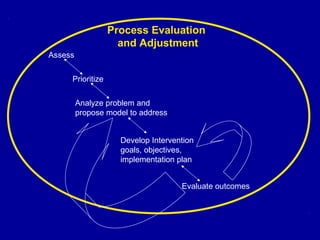
Assess
Prioritize
Analyze problem and
propose model to address
Develop Intervention
goals, objectives,
implementation plan
Evaluate outcomes
Process Evaluation
and Adjustment
Why Do Assessment?
Community Nutrition Assessment:
• Anchors program/intervention in the reality
of the community
• Essential part of ongoing process:
– Needs assessment
– Designing and implementing services
– Evaluation
– Improving programs and services
• Includes community and stakeholders as
fully active participants
Community Nutrition Assessment:
• Based on assets more than deficits
• Helps to integrate nutrition programs into
community-based health programs and
plans
Successful Community
Assessment Includes:
• Understanding current conditions of
families and individuals
• Evaluating local capacities for supporting
health and nutrition needs
• Building community support for
implementing changes
Models and Protocols for
Community Assessment
• Planned Approaches to Community Health
(PATCH) – CDC
• Assessment Protocol for Excellence in
Public Health (APEXPH) – NACHO (National
Association of County Health Officials)
• Moving to the Future: Developing
Community Based Nutrition Services –
ASTPHND (Association of State and Territorial Public Health
Nutrition Directors)
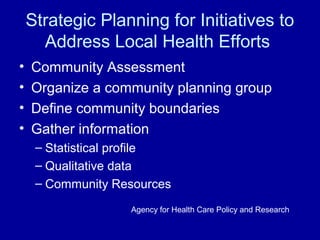
Strategic Planning for Initiatives to
Address Local Health Efforts
• Community Assessment
• Organize a community planning group
• Define community boundaries
• Gather information
– Statistical profile
– Qualitative data
– Community Resources
Agency for Health Care Policy and Research
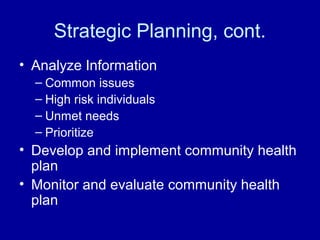
Strategic Planning, cont.
• Analyze Information
– Common issues
– High risk individuals
– Unmet needs
– Prioritize
• Develop and implement community health
plan
• Monitor and evaluate community health
plan
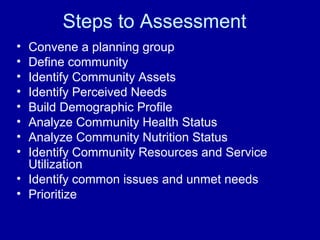
Steps to Assessment
• Convene a planning group
• Define community
• Identify Community Assets
• Identify Perceived Needs
• Build Demographic Profile
• Analyze Community Health Status
• Analyze Community Nutrition Status
• Identify Community Resources and Service
Utilization
• Identify common issues and unmet needs
• Prioritize
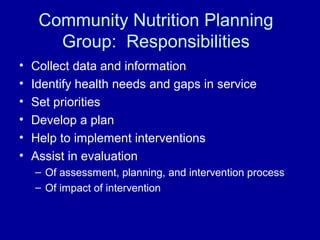
Community Nutrition Planning
Group: Responsibilities
• Collect data and information
• Identify health needs and gaps in service
• Set priorities
• Develop a plan
• Help to implement interventions
• Assist in evaluation
– Of assessment, planning, and intervention process
– Of impact of intervention
Community Nutrition Planning
Group: Potential Members
• Community leaders
• Consumers
• Health and Nutrition Service providers
• Health organizations
• Schools
• Political office holders or their staff
• Fitness professionals
• Representatives from greater community health
planning groups
Define the Parameters
• Public Health Nutrition: Assuring
conditions in which people can be
nutritionally healthy
• Community: “A community is any group
sharing something in common”
Community Tool Box
Community Description
• Geographic boundaries
• General history
• Key people and leaders
• Demographics
• Financial & economic information
• Important issues
• Morale and involvement levels
• Key allies and rivals
• Unspoken rules and norms
• Attitudes and opinions
• Strengths and shortcomings
Identify Community Assets
• Physical structure, place, business
• Concerned citizens
• History of successful efforts
• Organizations
• Individual and group skills
• Communications systems
• Relationships
Identify Perceived Needs
• WHY?
– To understand public opinion
– To become aware of needs the planning
group doesn’t know about
– To gather support & expand group expertise
– To make decisions about priorities
– To plan programs in ways that will be
acceptable to stakeholders
How do we assess perceived
needs?
• Listening sessions
• Public forums
• Key informant interviews
• Needs assessment survey or survey of
concerns
Demographic Profile
• Economic status: income, employment, %
below poverty
• Education levels
• Age and gender
• Race & ethnicity
• Social factors: homelessness,
immigration status, family composition,
TANF utilization
Community Health Status
• Causes of Mortality
• Hospital discharge data
• Disease prevalence data
• Food bourne illness reports
• Years of potential life lost
• Infant mortality
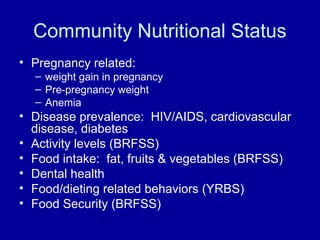
Community Nutritional Status
• Pregnancy related:
– weight gain in pregnancy
– Pre-pregnancy weight
– Anemia
• Disease prevalence: HIV/AIDS, cardiovascular
disease, diabetes
• Activity levels (BRFSS)
• Food intake: fat, fruits & vegetables (BRFSS)
• Dental health
• Food/dieting related behaviors (YRBS)
• Food Security (BRFSS)
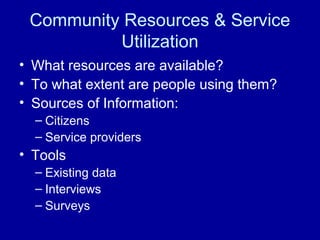
Community Resources & Service
Utilization
• What resources are available?
• To what extent are people using them?
• Sources of Information:
– Citizens
– Service providers
• Tools
– Existing data
– Interviews
– Surveys
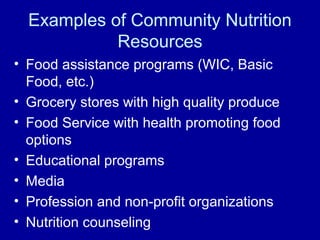
Examples of Community Nutrition
Resources
• Food assistance programs (WIC, Basic
Food, etc.)
• Grocery stores with high quality produce
• Food Service with health promoting food
options
• Educational programs
• Media
• Profession and non-profit organizations
• Nutrition counseling
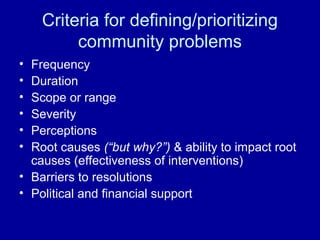
Criteria for defining/prioritizing
community problems
• Frequency
• Duration
• Scope or range
• Severity
• Perceptions
• Root causes (“but why?”) & ability to impact root
causes (effectiveness of interventions)
• Barriers to resolutions
• Political and financial support
Group Work: Develop Problem List
• Brainstorm nutrition related issues &
problems that arise from these data
• Choose 5 issues that are of interest to all
stakeholders
• Prioritize these issues using criteria in
these slides
• Establish the one issue or problem that all
stakeholders will be comfortable working
on for the next two weeks

Communitynutritionassessment09

  • 1.
  • 2.
    Program Planning Basics •Systematic process • Continual feedback and evaluation • Cyclical: based on increasing understandings of the true nature of the situation and the effectiveness of interventions. • Starts with an assessment of the current situation
  • 3.
    Assess Prioritize Analyze problem and proposemodel to address Develop Intervention goals, objectives, implementation plan Evaluate outcomes Process Evaluation and Adjustment
  • 4.
  • 5.
    Community Nutrition Assessment: •Anchors program/intervention in the reality of the community • Essential part of ongoing process: – Needs assessment – Designing and implementing services – Evaluation – Improving programs and services • Includes community and stakeholders as fully active participants
  • 6.
    Community Nutrition Assessment: •Based on assets more than deficits • Helps to integrate nutrition programs into community-based health programs and plans
  • 7.
    Successful Community Assessment Includes: •Understanding current conditions of families and individuals • Evaluating local capacities for supporting health and nutrition needs • Building community support for implementing changes
  • 8.
    Models and Protocolsfor Community Assessment • Planned Approaches to Community Health (PATCH) – CDC • Assessment Protocol for Excellence in Public Health (APEXPH) – NACHO (National Association of County Health Officials) • Moving to the Future: Developing Community Based Nutrition Services – ASTPHND (Association of State and Territorial Public Health Nutrition Directors)
  • 9.
    Strategic Planning forInitiatives to Address Local Health Efforts • Community Assessment • Organize a community planning group • Define community boundaries • Gather information – Statistical profile – Qualitative data – Community Resources Agency for Health Care Policy and Research
  • 10.
    Strategic Planning, cont. •Analyze Information – Common issues – High risk individuals – Unmet needs – Prioritize • Develop and implement community health plan • Monitor and evaluate community health plan
  • 11.
    Steps to Assessment •Convene a planning group • Define community • Identify Community Assets • Identify Perceived Needs • Build Demographic Profile • Analyze Community Health Status • Analyze Community Nutrition Status • Identify Community Resources and Service Utilization • Identify common issues and unmet needs • Prioritize
  • 12.
    Community Nutrition Planning Group:Responsibilities • Collect data and information • Identify health needs and gaps in service • Set priorities • Develop a plan • Help to implement interventions • Assist in evaluation – Of assessment, planning, and intervention process – Of impact of intervention
  • 13.
    Community Nutrition Planning Group:Potential Members • Community leaders • Consumers • Health and Nutrition Service providers • Health organizations • Schools • Political office holders or their staff • Fitness professionals • Representatives from greater community health planning groups
  • 14.
    Define the Parameters •Public Health Nutrition: Assuring conditions in which people can be nutritionally healthy • Community: “A community is any group sharing something in common” Community Tool Box
  • 15.
    Community Description • Geographicboundaries • General history • Key people and leaders • Demographics • Financial & economic information • Important issues • Morale and involvement levels • Key allies and rivals • Unspoken rules and norms • Attitudes and opinions • Strengths and shortcomings
  • 16.
    Identify Community Assets •Physical structure, place, business • Concerned citizens • History of successful efforts • Organizations • Individual and group skills • Communications systems • Relationships
  • 17.
    Identify Perceived Needs •WHY? – To understand public opinion – To become aware of needs the planning group doesn’t know about – To gather support & expand group expertise – To make decisions about priorities – To plan programs in ways that will be acceptable to stakeholders
  • 18.
    How do weassess perceived needs? • Listening sessions • Public forums • Key informant interviews • Needs assessment survey or survey of concerns
  • 19.
    Demographic Profile • Economicstatus: income, employment, % below poverty • Education levels • Age and gender • Race & ethnicity • Social factors: homelessness, immigration status, family composition, TANF utilization
  • 20.
    Community Health Status •Causes of Mortality • Hospital discharge data • Disease prevalence data • Food bourne illness reports • Years of potential life lost • Infant mortality
  • 21.
    Community Nutritional Status •Pregnancy related: – weight gain in pregnancy – Pre-pregnancy weight – Anemia • Disease prevalence: HIV/AIDS, cardiovascular disease, diabetes • Activity levels (BRFSS) • Food intake: fat, fruits & vegetables (BRFSS) • Dental health • Food/dieting related behaviors (YRBS) • Food Security (BRFSS)
  • 22.
    Community Resources &Service Utilization • What resources are available? • To what extent are people using them? • Sources of Information: – Citizens – Service providers • Tools – Existing data – Interviews – Surveys
  • 23.
    Examples of CommunityNutrition Resources • Food assistance programs (WIC, Basic Food, etc.) • Grocery stores with high quality produce • Food Service with health promoting food options • Educational programs • Media • Profession and non-profit organizations • Nutrition counseling
  • 24.
    Criteria for defining/prioritizing communityproblems • Frequency • Duration • Scope or range • Severity • Perceptions • Root causes (“but why?”) & ability to impact root causes (effectiveness of interventions) • Barriers to resolutions • Political and financial support
  • 25.
    Group Work: DevelopProblem List • Brainstorm nutrition related issues & problems that arise from these data • Choose 5 issues that are of interest to all stakeholders • Prioritize these issues using criteria in these slides • Establish the one issue or problem that all stakeholders will be comfortable working on for the next two weeks