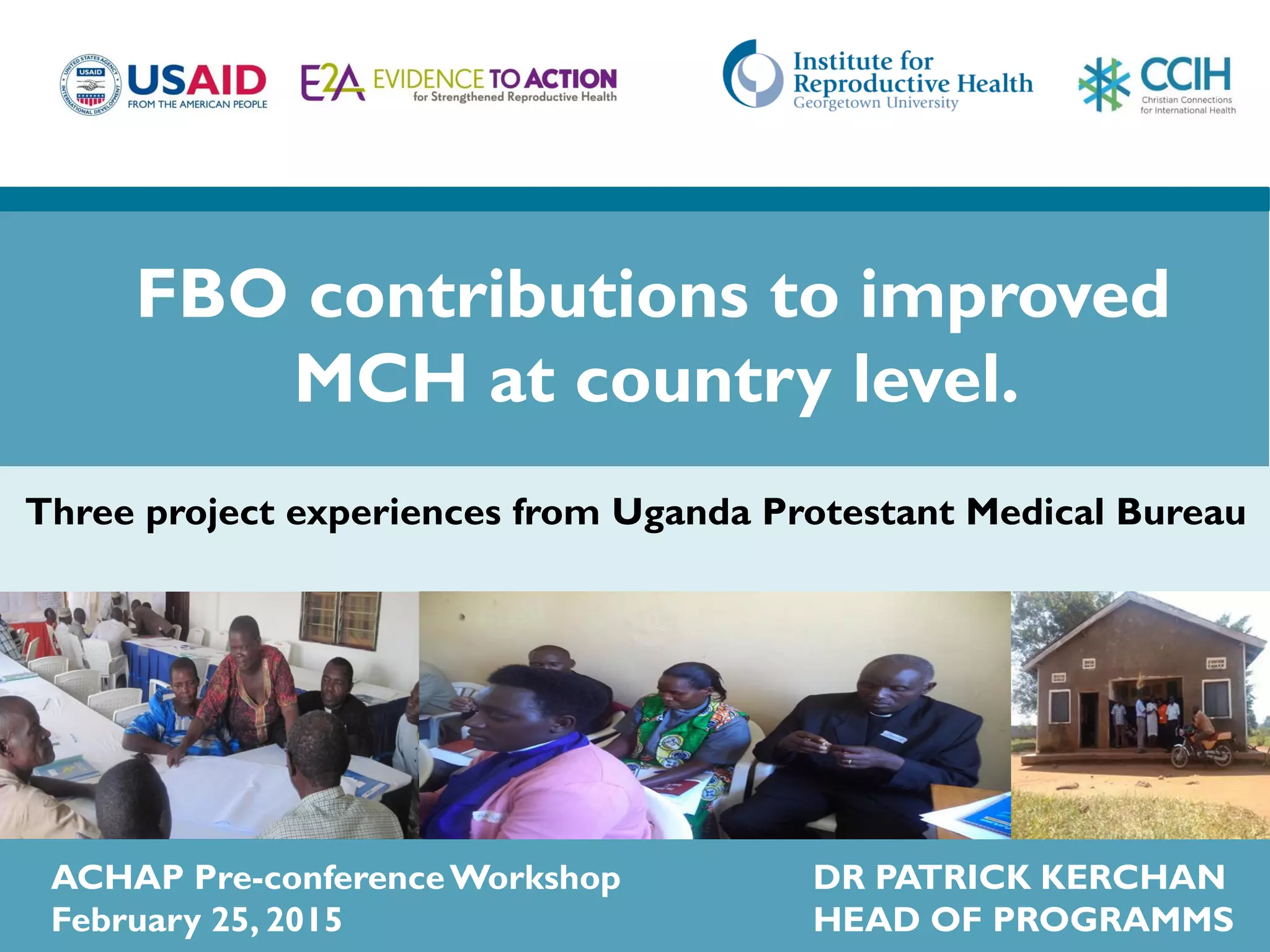
ACHAP Pre-conferenceWorkshop DR PATRICK KERCHAN
February 25, 2015 HEAD OF PROGRAMMS
Three project experiences from Uganda Protestant Medical Bureau
FBO contributions to improved
MCH at country level.
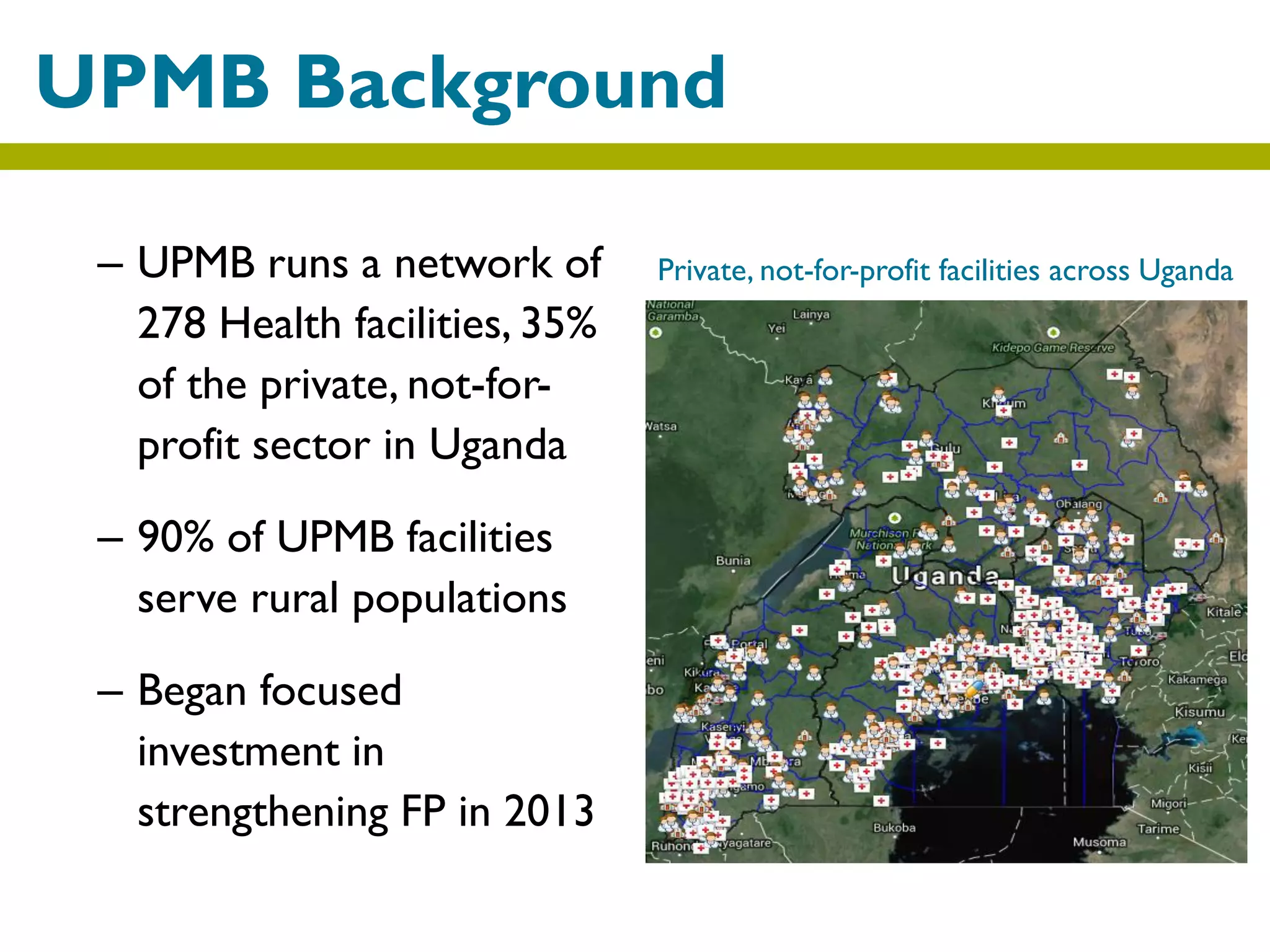
– UPMB runs a network of
278 Health facilities, 35%
of the private, not-for-
profit sector in Uganda
– 90% of UPMB facilities
serve rural populations
– Began focused
investment in
strengthening FP in 2013
UPMB Background
Private, not-for-profit facilities across Uganda
Maternal and Child Health in Uganda
MCH cluster is composed of five elements;
• Sexual and Reproductive Health (SRH),
• Newborn care,
• Common childhood illnesses,
• Immunization
• Nutrition.
This emphasizes the link between maternal and
child health and the cumulative nature of health
problems through the entire lifecycle.
Sexual and Reproductive Health and
Rights
Core HSSIP Indicators
• Maternal Mortality Ratio 438/100,000 – UDHS
2011
• % pregnant women attending 4 ANC sessions.
• % deliveries in health facilities.
• % pregnant women who have completed IPT2
• Contraceptive Prevalence Rate. Achieved 30%
2011/12 UDHS findings.
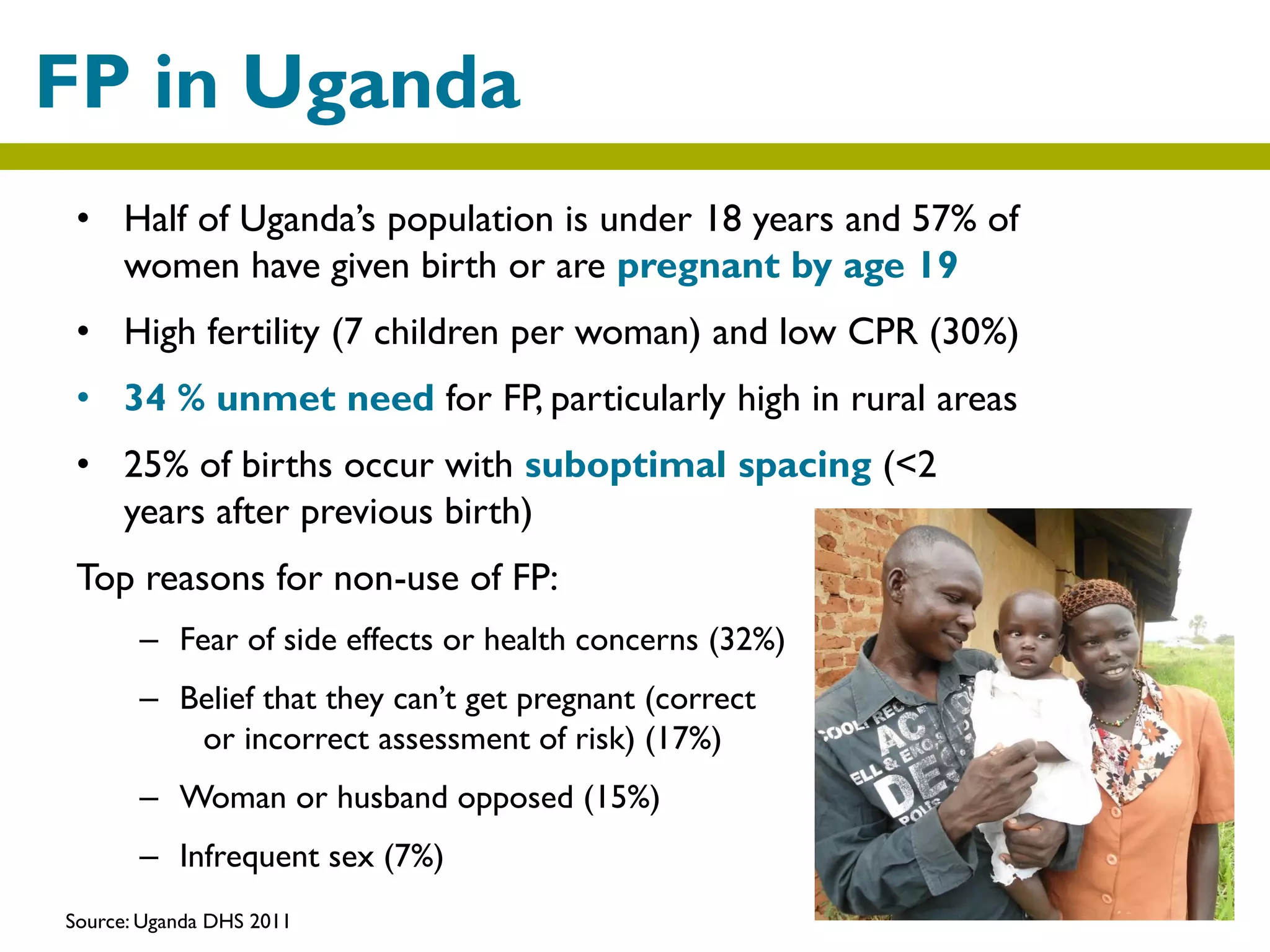
• Half of Uganda’s population is under 18 years and 57% of
women have given birth or are pregnant by age 19
• High fertility (7 children per woman) and low CPR (30%)
• 34 % unmet need for FP, particularly high in rural areas
• 25% of births occur with suboptimal spacing (<2
years after previous birth)
Top reasons for non-use of FP:
– Fear of side effects or health concerns (32%)
– Belief that they can’t get pregnant (correct
or incorrect assessment of risk) (17%)
– Woman or husband opposed (15%)
– Infrequent sex (7%)
FP in Uganda
Source: Uganda DHS 2011
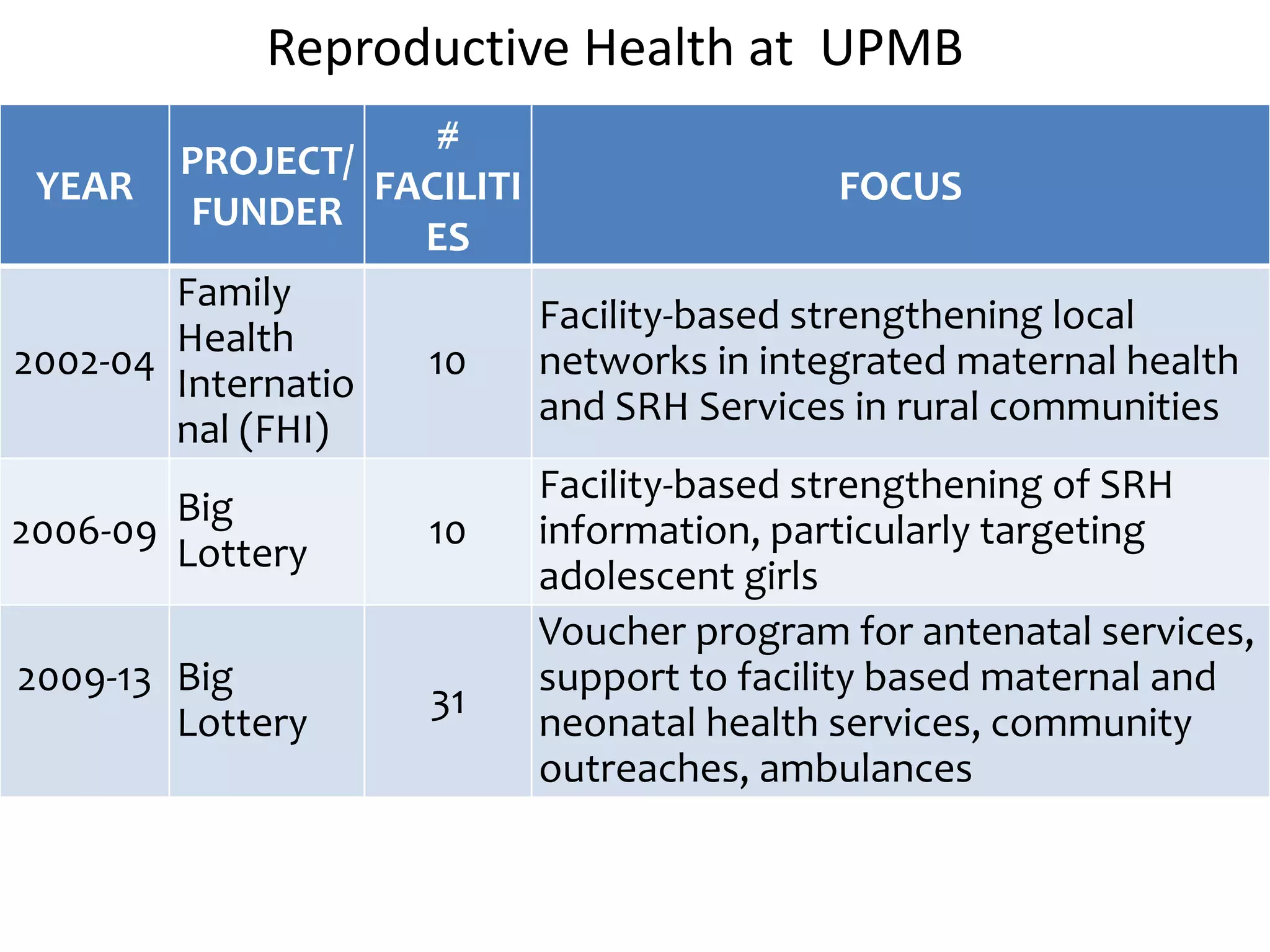
Reproductive Health at UPMB
UPMB
YEAR
PROJECT/
FUNDER
#
FACILITI
ES
FOCUS
2002-04
Family
Health
Internatio
nal (FHI)
10
Facility-based strengthening local
networks in integrated maternal health
and SRH Services in rural communities
2006-09
Big
Lottery
10
Facility-based strengthening of SRH
information, particularly targeting
adolescent girls
2009-13 Big
Lottery
31
Voucher program for antenatal services,
support to facility based maternal and
neonatal health services, community
outreaches, ambulances
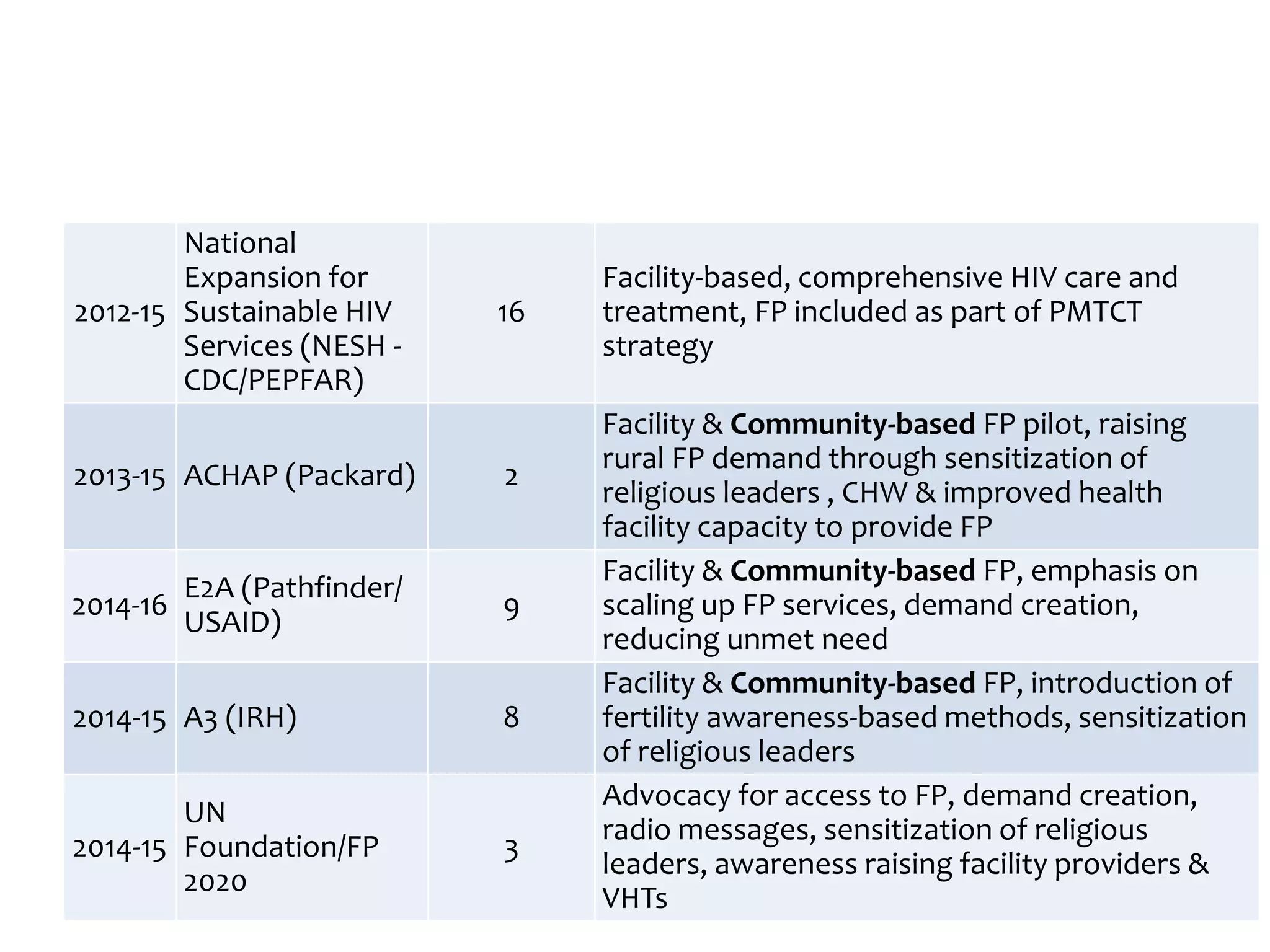
2012-15
National
Expansion for
Sustainable HIV
Services (NESH -
CDC/PEPFAR)
16
Facility-based, comprehensive HIV care and
treatment, FP included as part of PMTCT
strategy
2013-15 ACHAP (Packard) 2
Facility & Community-based FP pilot, raising
rural FP demand through sensitization of
religious leaders , CHW & improved health
facility capacity to provide FP
2014-16
E2A (Pathfinder/
USAID)
9
Facility & Community-based FP, emphasis on
scaling up FP services, demand creation,
reducing unmet need
2014-15 A3 (IRH) 8
Facility & Community-based FP, introduction of
fertility awareness-based methods, sensitization
of religious leaders
2014-15
UN
Foundation/FP
2020
3
Advocacy for access to FP, demand creation,
radio messages, sensitization of religious
leaders, awareness raising facility providers &
VHTs
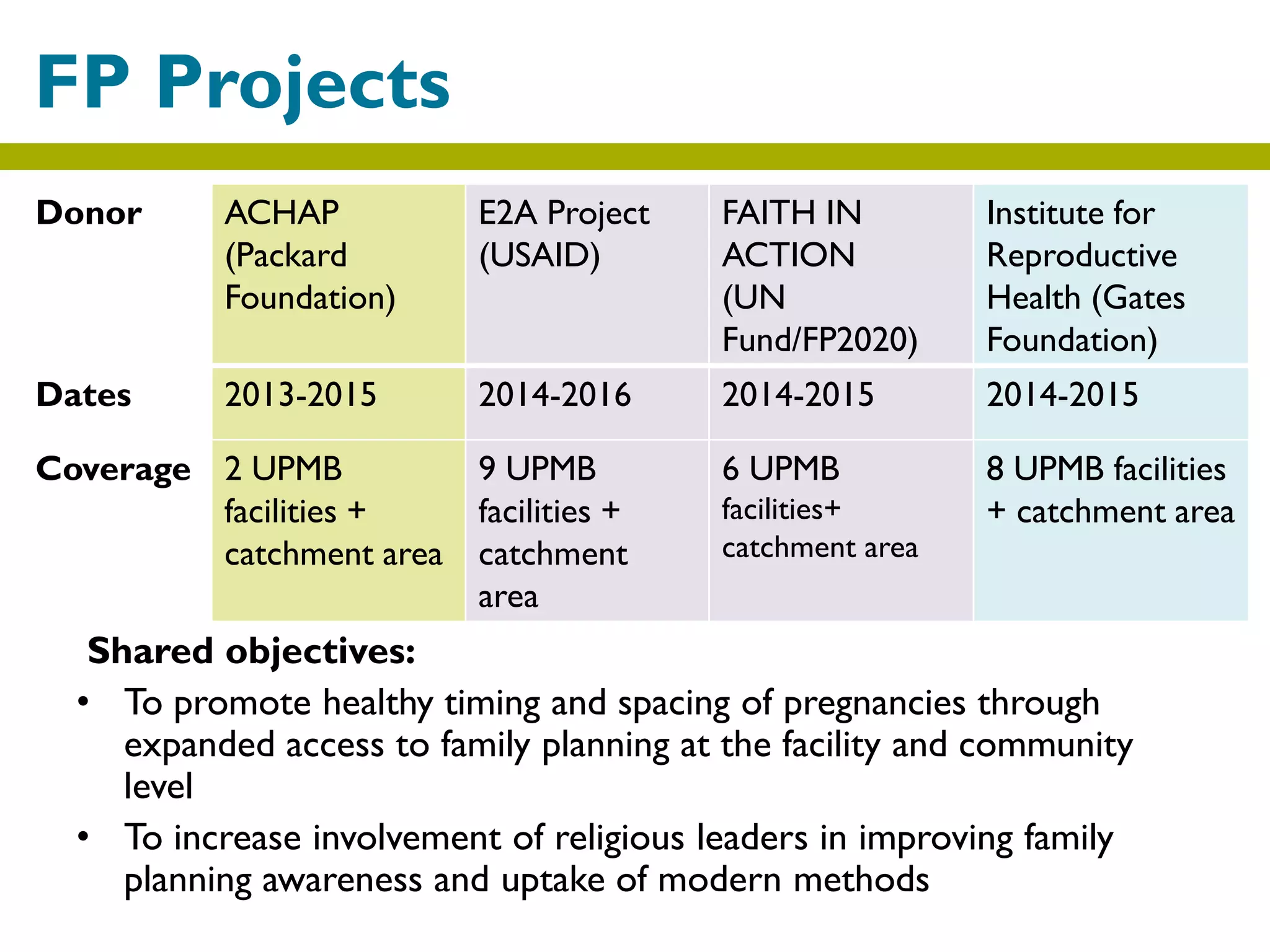
Shared objectives:
• To promote healthy timing and spacing of pregnancies through
expanded access to family planning at the facility and community
level
• To increase involvement of religious leaders in improving family
planning awareness and uptake of modern methods
FP Projects
Donor ACHAP
(Packard
Foundation)
E2A Project
(USAID)
FAITH IN
ACTION
(UN
Fund/FP2020)
Institute for
Reproductive
Health (Gates
Foundation)
Dates 2013-2015 2014-2016 2014-2015 2014-2015
Coverage 2 UPMB
facilities +
catchment area
9 UPMB
facilities +
catchment
area
6 UPMB
facilities+
catchment area
8 UPMB facilities
+ catchment area
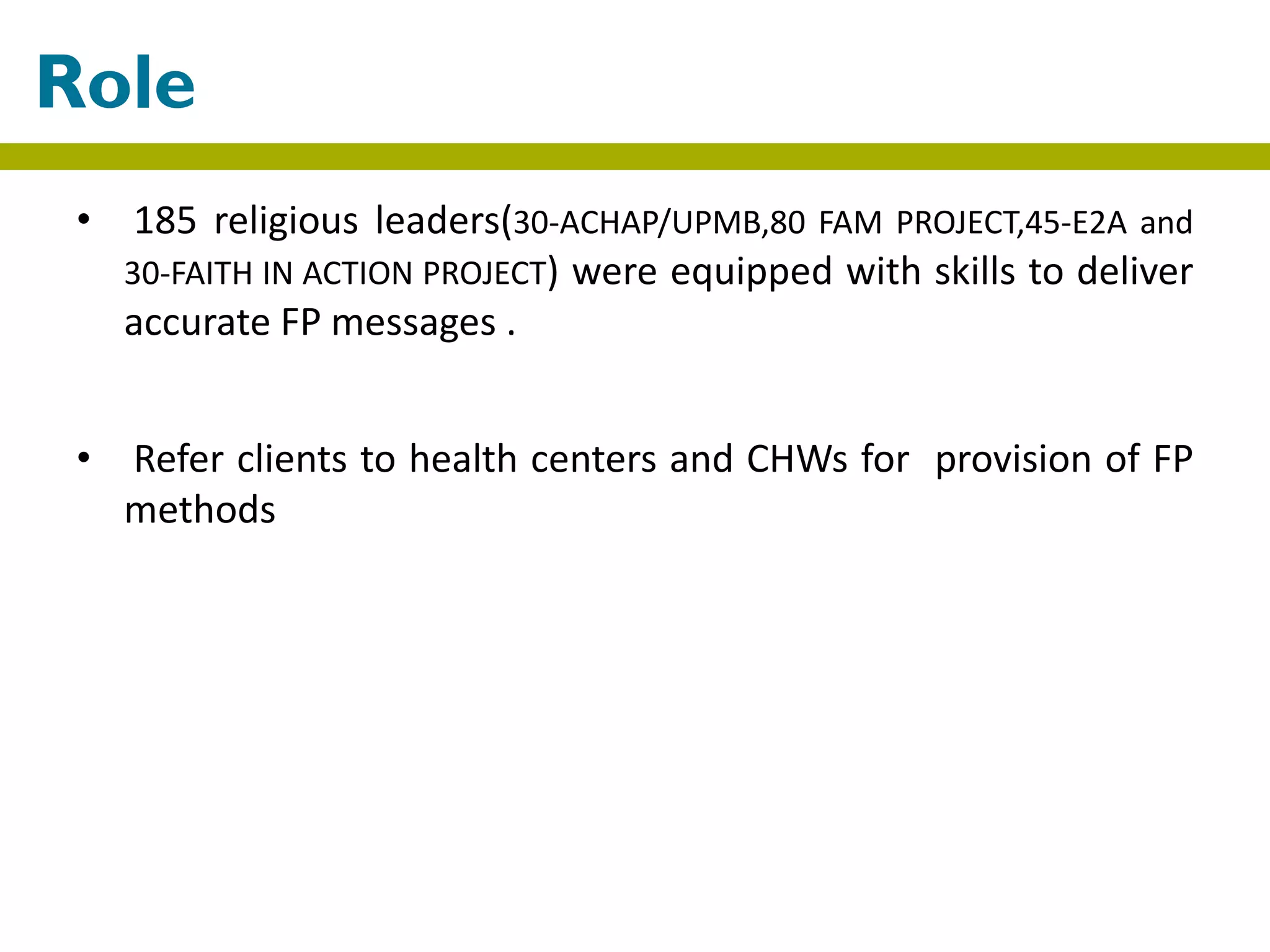
• 185 religious leaders(30-ACHAP/UPMB,80 FAM PROJECT,45-E2A and
30-FAITH IN ACTION PROJECT) were equipped with skills to deliver
accurate FP messages .
• Refer clients to health centers and CHWs for provision of FP
methods
Role
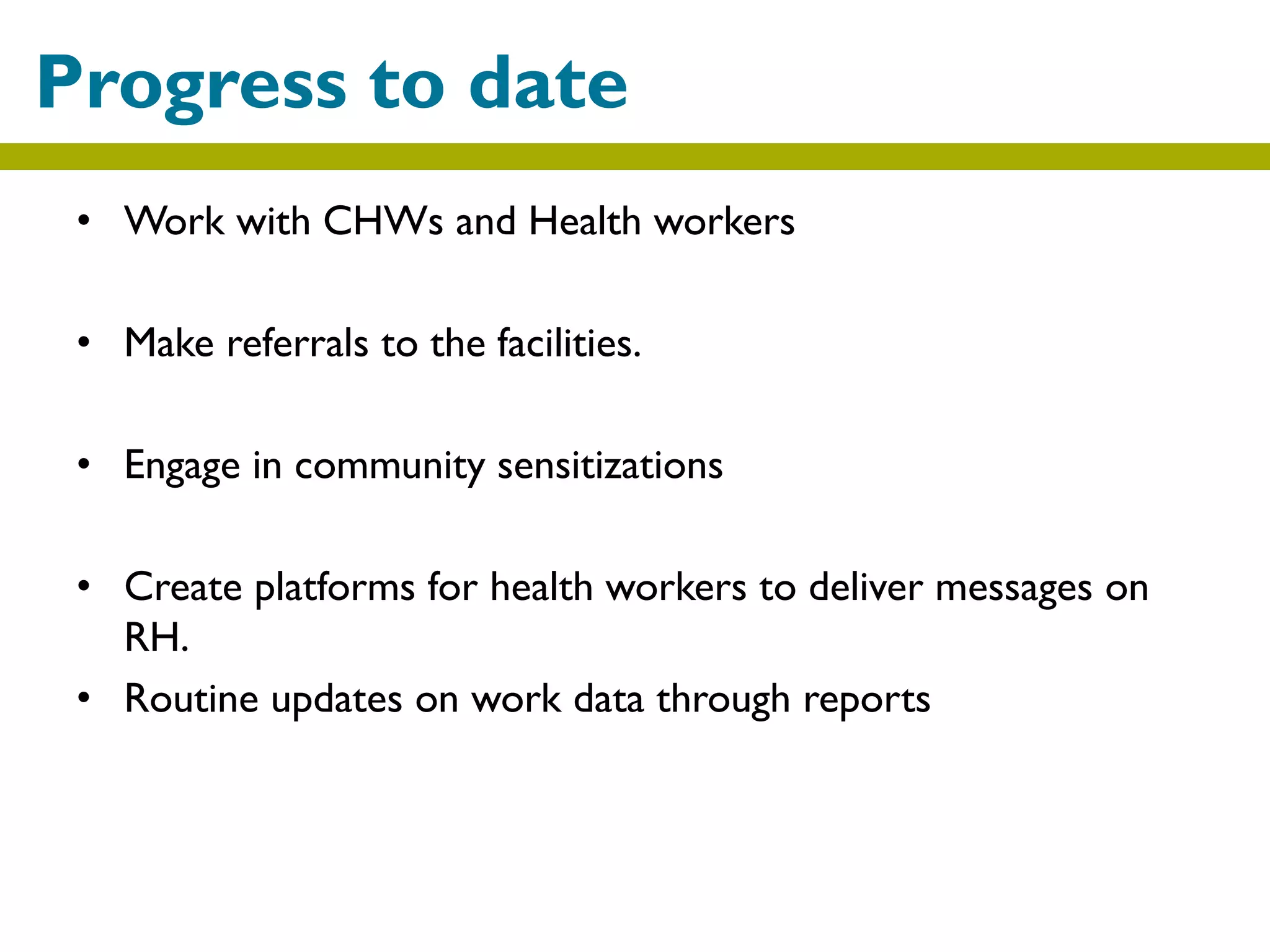
• Work with CHWs and Health workers
• Make referrals to the facilities.
• Engage in community sensitizations
• Create platforms for health workers to deliver messages on
RH.
• Routine updates on work data through reports
Progress to date
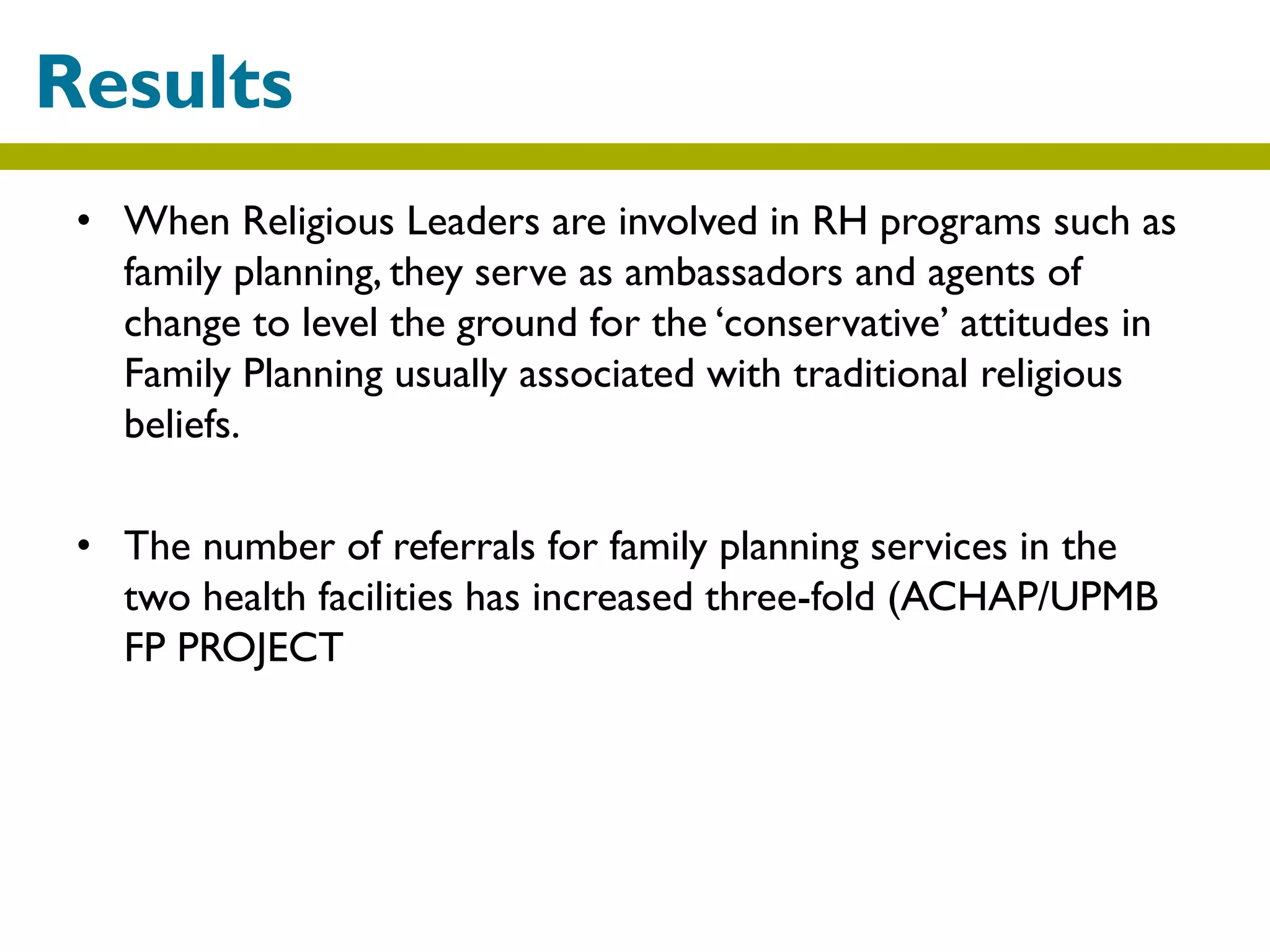
• When Religious Leaders are involved in RH programs such as
family planning, they serve as ambassadors and agents of
change to level the ground for the ‘conservative’ attitudes in
Family Planning usually associated with traditional religious
beliefs.
• The number of referrals for family planning services in the
two health facilities has increased three-fold (ACHAP/UPMB
FP PROJECT
Results
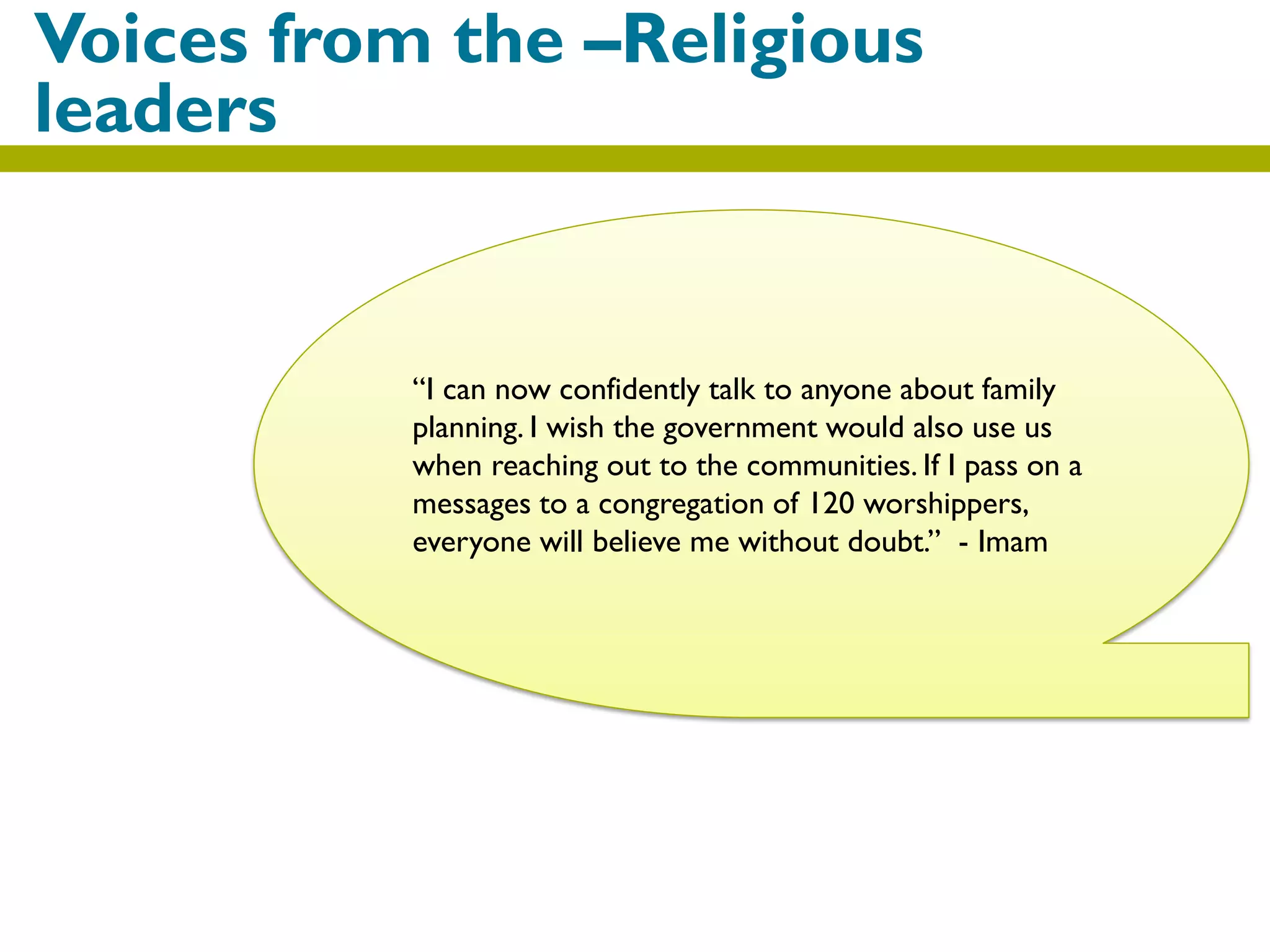
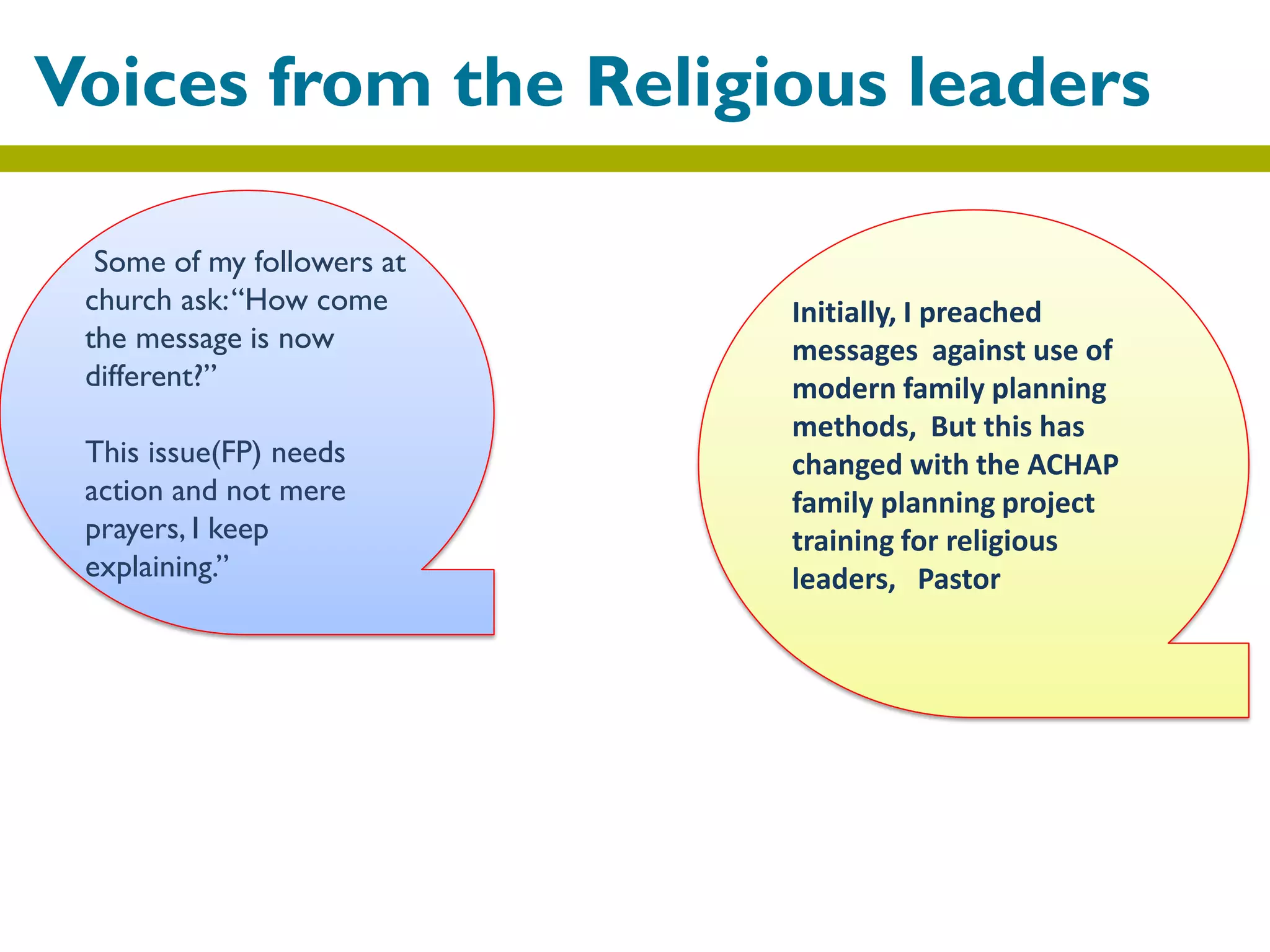
Voices from the –Religious
leaders
“I can now confidently talk to anyone about family
planning. I wish the government would also use us
when reaching out to the communities. If I pass on a
messages to a congregation of 120 worshippers,
everyone will believe me without doubt.” - Imam
Voices from the Religious leaders
Some of my followers at
church ask:“How come
the message is now
different?”
This issue(FP) needs
action and not mere
prayers, I keep
explaining.”
Initially, I preached
messages against use of
modern family planning
methods, But this has
changed with the ACHAP
family planning project
training for religious
leaders, Pastor
• Routine support supervision to member units
• Strengthen collaborations with public sector (District and
national level)
• Scholarship programs supporting health workers
• Extension of donor support to the rural
• Improved health information management systems.
Reaching the hard to reach
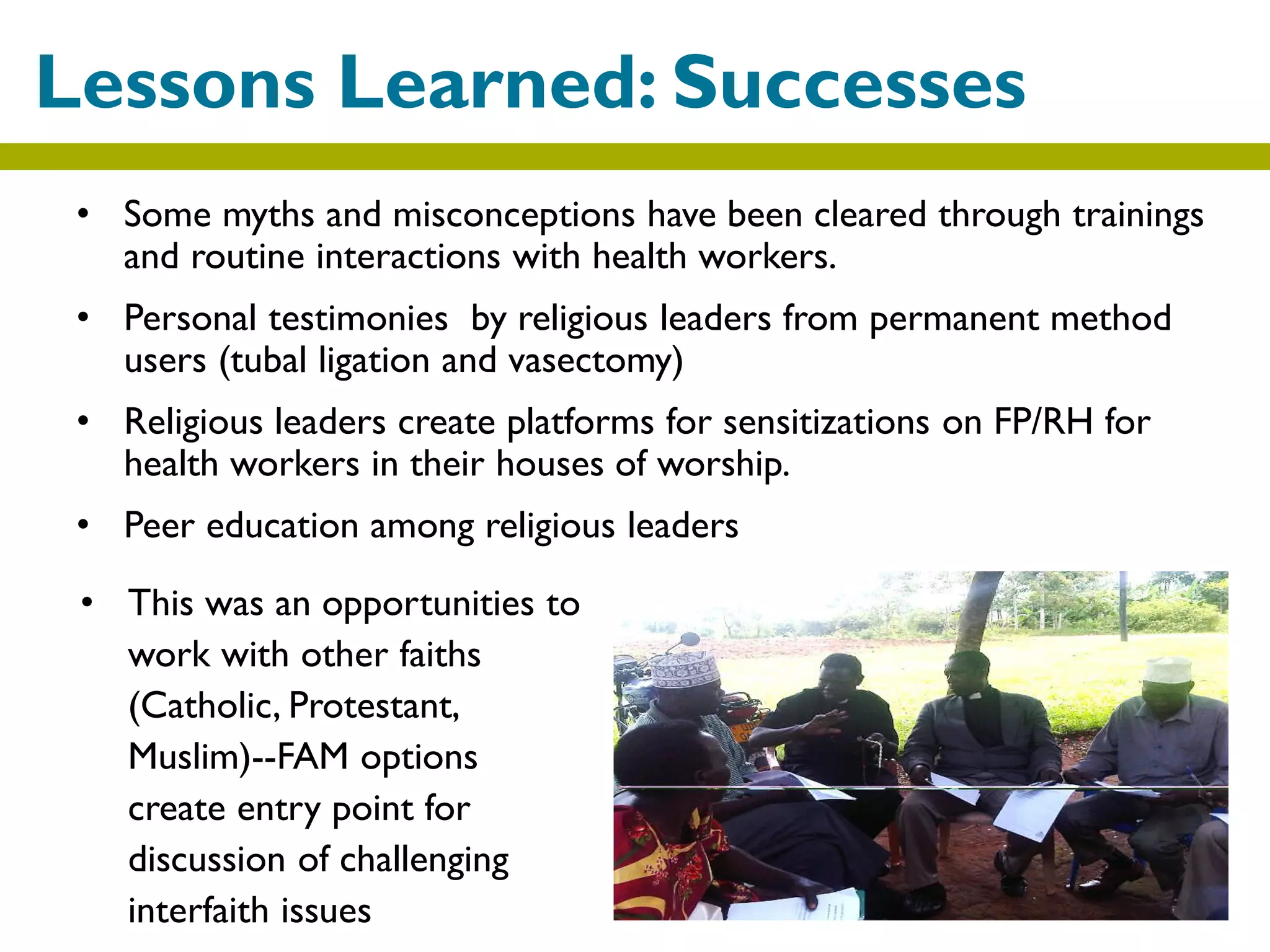
• Some myths and misconceptions have been cleared through trainings
and routine interactions with health workers.
• Personal testimonies by religious leaders from permanent method
users (tubal ligation and vasectomy)
• Religious leaders create platforms for sensitizations on FP/RH for
health workers in their houses of worship.
• Peer education among religious leaders
Lessons Learned: Successes
• This was an opportunities to
work with other faiths
(Catholic, Protestant,
Muslim)--FAM options
create entry point for
discussion of challenging
interfaith issues
• Some religious leaders still hold some myths and
misconceptions.
• Religious leaders have high expectations in terms of monthly
facilitation and allowances which makes sustainability hard.
• Need for routine refresher trainings for religious leaders to
keep abreast of new developments in RH
• Strong supportive supervision is needed for accurate data
collection and reporting at all levels
Lessons Learned: Challenges
• Routine reviews and mentorships for religious leaders by
family planning focal persons at facility level
• Refresher trainings for religious leaders
• Strengthen collaborations with public sector (District and
national level)
• Continue engaging religious leaders as champions in FP
• Advocate for a standardized training curriculum for religious
leaders
Interventions ahead
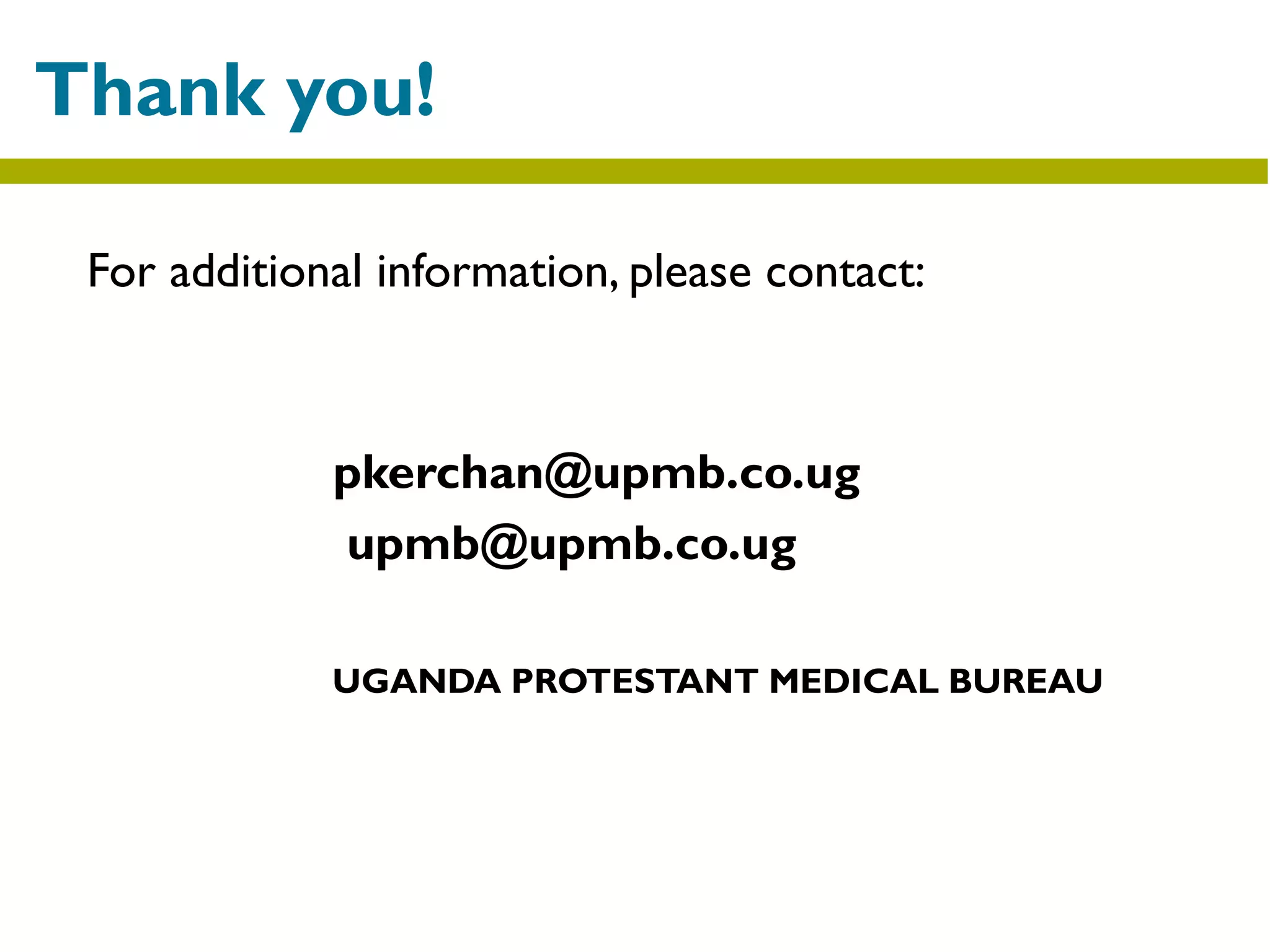
Discussion Guide for Religious
Leaders
Useful information
For additional information, please contact:
pkerchan@upmb.co.ug
upmb@upmb.co.ug
UGANDA PROTESTANT MEDICAL BUREAU
Thank you!

Uganda experience by Dr Patrick Kerchan, UPMB

  • 1.
    ACHAP Pre-conferenceWorkshop DRPATRICK KERCHAN February 25, 2015 HEAD OF PROGRAMMS Three project experiences from Uganda Protestant Medical Bureau FBO contributions to improved MCH at country level.
  • 2.
    – UPMB runsa network of 278 Health facilities, 35% of the private, not-for- profit sector in Uganda – 90% of UPMB facilities serve rural populations – Began focused investment in strengthening FP in 2013 UPMB Background Private, not-for-profit facilities across Uganda
  • 3.
    Maternal and ChildHealth in Uganda MCH cluster is composed of five elements; • Sexual and Reproductive Health (SRH), • Newborn care, • Common childhood illnesses, • Immunization • Nutrition. This emphasizes the link between maternal and child health and the cumulative nature of health problems through the entire lifecycle.
  • 4.
    Sexual and ReproductiveHealth and Rights Core HSSIP Indicators • Maternal Mortality Ratio 438/100,000 – UDHS 2011 • % pregnant women attending 4 ANC sessions. • % deliveries in health facilities. • % pregnant women who have completed IPT2 • Contraceptive Prevalence Rate. Achieved 30% 2011/12 UDHS findings.
  • 5.
    • Half ofUganda’s population is under 18 years and 57% of women have given birth or are pregnant by age 19 • High fertility (7 children per woman) and low CPR (30%) • 34 % unmet need for FP, particularly high in rural areas • 25% of births occur with suboptimal spacing (<2 years after previous birth) Top reasons for non-use of FP: – Fear of side effects or health concerns (32%) – Belief that they can’t get pregnant (correct or incorrect assessment of risk) (17%) – Woman or husband opposed (15%) – Infrequent sex (7%) FP in Uganda Source: Uganda DHS 2011
  • 6.
    Reproductive Health atUPMB UPMB YEAR PROJECT/ FUNDER # FACILITI ES FOCUS 2002-04 Family Health Internatio nal (FHI) 10 Facility-based strengthening local networks in integrated maternal health and SRH Services in rural communities 2006-09 Big Lottery 10 Facility-based strengthening of SRH information, particularly targeting adolescent girls 2009-13 Big Lottery 31 Voucher program for antenatal services, support to facility based maternal and neonatal health services, community outreaches, ambulances
  • 7.
    2012-15 National Expansion for Sustainable HIV Services(NESH - CDC/PEPFAR) 16 Facility-based, comprehensive HIV care and treatment, FP included as part of PMTCT strategy 2013-15 ACHAP (Packard) 2 Facility & Community-based FP pilot, raising rural FP demand through sensitization of religious leaders , CHW & improved health facility capacity to provide FP 2014-16 E2A (Pathfinder/ USAID) 9 Facility & Community-based FP, emphasis on scaling up FP services, demand creation, reducing unmet need 2014-15 A3 (IRH) 8 Facility & Community-based FP, introduction of fertility awareness-based methods, sensitization of religious leaders 2014-15 UN Foundation/FP 2020 3 Advocacy for access to FP, demand creation, radio messages, sensitization of religious leaders, awareness raising facility providers & VHTs
  • 8.
    Shared objectives: • Topromote healthy timing and spacing of pregnancies through expanded access to family planning at the facility and community level • To increase involvement of religious leaders in improving family planning awareness and uptake of modern methods FP Projects Donor ACHAP (Packard Foundation) E2A Project (USAID) FAITH IN ACTION (UN Fund/FP2020) Institute for Reproductive Health (Gates Foundation) Dates 2013-2015 2014-2016 2014-2015 2014-2015 Coverage 2 UPMB facilities + catchment area 9 UPMB facilities + catchment area 6 UPMB facilities+ catchment area 8 UPMB facilities + catchment area
  • 9.
    • 185 religiousleaders(30-ACHAP/UPMB,80 FAM PROJECT,45-E2A and 30-FAITH IN ACTION PROJECT) were equipped with skills to deliver accurate FP messages . • Refer clients to health centers and CHWs for provision of FP methods Role
  • 10.
    • Work withCHWs and Health workers • Make referrals to the facilities. • Engage in community sensitizations • Create platforms for health workers to deliver messages on RH. • Routine updates on work data through reports Progress to date
  • 11.
    • When ReligiousLeaders are involved in RH programs such as family planning, they serve as ambassadors and agents of change to level the ground for the ‘conservative’ attitudes in Family Planning usually associated with traditional religious beliefs. • The number of referrals for family planning services in the two health facilities has increased three-fold (ACHAP/UPMB FP PROJECT Results
  • 12.
    Voices from the–Religious leaders “I can now confidently talk to anyone about family planning. I wish the government would also use us when reaching out to the communities. If I pass on a messages to a congregation of 120 worshippers, everyone will believe me without doubt.” - Imam
  • 13.
    Voices from theReligious leaders Some of my followers at church ask:“How come the message is now different?” This issue(FP) needs action and not mere prayers, I keep explaining.” Initially, I preached messages against use of modern family planning methods, But this has changed with the ACHAP family planning project training for religious leaders, Pastor
  • 14.
    • Routine supportsupervision to member units • Strengthen collaborations with public sector (District and national level) • Scholarship programs supporting health workers • Extension of donor support to the rural • Improved health information management systems. Reaching the hard to reach
  • 15.
    • Some mythsand misconceptions have been cleared through trainings and routine interactions with health workers. • Personal testimonies by religious leaders from permanent method users (tubal ligation and vasectomy) • Religious leaders create platforms for sensitizations on FP/RH for health workers in their houses of worship. • Peer education among religious leaders Lessons Learned: Successes • This was an opportunities to work with other faiths (Catholic, Protestant, Muslim)--FAM options create entry point for discussion of challenging interfaith issues
  • 16.
    • Some religiousleaders still hold some myths and misconceptions. • Religious leaders have high expectations in terms of monthly facilitation and allowances which makes sustainability hard. • Need for routine refresher trainings for religious leaders to keep abreast of new developments in RH • Strong supportive supervision is needed for accurate data collection and reporting at all levels Lessons Learned: Challenges
  • 17.
    • Routine reviewsand mentorships for religious leaders by family planning focal persons at facility level • Refresher trainings for religious leaders • Strengthen collaborations with public sector (District and national level) • Continue engaging religious leaders as champions in FP • Advocate for a standardized training curriculum for religious leaders Interventions ahead
  • 18.
    Discussion Guide forReligious Leaders Useful information
  • 19.
    For additional information,please contact: pkerchan@upmb.co.ug upmb@upmb.co.ug UGANDA PROTESTANT MEDICAL BUREAU Thank you!