Linda Angona, Partners for Better Health Julie Dorey, City of Ontario Dora Barilla, Loma Linda University/ Partners for Better Health
Healthy People 2010/ Healthy Ontario Initiative VISION Healthy people in healthy communities Understanding and improving health Objectives for improving health
Healthy People 2010 Leading Health Indicators Physical activity Overweight and obesity Tobacco use Substance abuse Responsible sexual behavior Mental health Injury and violence Environmental quality Immunization Access to health care
Healthy People 2010 Community health is profoundly affected by the collective beliefs, attitudes, and behaviors of everyone who lives in the community. Partnerships are effective tools for improving health in communities.
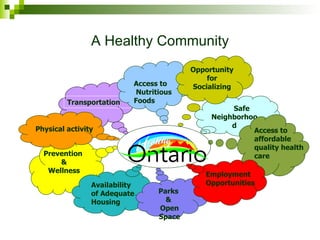
A Healthy Community Safe Neighborhood Prevention  & Wellness Parks  &  Open Space Opportunity for Socializing Transportation Access to affordable quality health care Availability of Adequate  Housing Physical activity Access to Nutritious  Foods Employment  Opportunities
History Group of people convened in 2003 concerned about the health of Ontario residents Future Search 2004/2005 West-End Community Assessment Project American Health Care Congress 2004/2005/2006 WE-CAN – Focusing on health care Healthy Communities Initiative Countywide April 2006 Planning Session for Health Ontario June 2006 Healthy Ontario Initiative 2007
Future Search Vision for health care Care for all Culturally sensitive health care providers Affordable services Accessible High quality and mission driven Focus on prevention – Chronic disease management Designed by the community and healthcare providers built on existing resources
Future Search/Needs   Lack of transportation Facility closures Culturally competent providers Affordability of specialty services Lack of integrated systems Lack of faith-based involvement in healthcare Inappropriate utilization of services in comparison to community needs
Healthy Ontario First Steps Develop a customized framework for a Health Ontario Initiative Marketing campaign Monitoring and Evaluation component of the initiative Compile the community needs assessment data into a report to be disseminated  Coordinate and facilitate a city-wide collaborative
Report to the  Community Action oriented document Compilation of data on health indicators coupled with opportunities (where we are, where we want to be & how we can get there) Process and analysis to inform the general public and create a feedback mechanism  Help inform the General Plan process June 2007
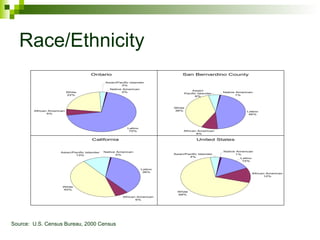
Race/Ethnicity Source:  U.S. Census Bureau, 2000 Census
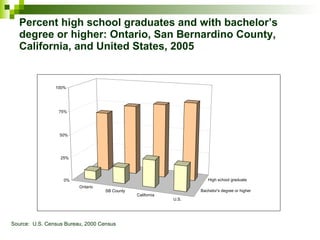
Percent high school graduates and with bachelor’s degree or higher: Ontario, San Bernardino County, California, and United States, 2005 Source:  U.S. Census Bureau, 2000 Census
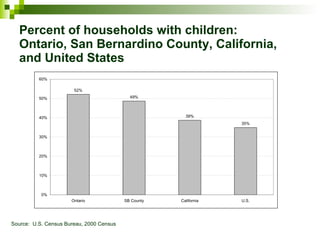
Percent of households with children:  Ontario, San Bernardino County, California, and United States Source:  U.S. Census Bureau, 2000 Census
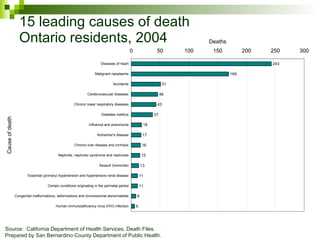
15 leading causes of death Ontario residents, 2004 Source:  California Department of Health Services, Death Files. Prepared by San Bernardino County Department of Public Health.
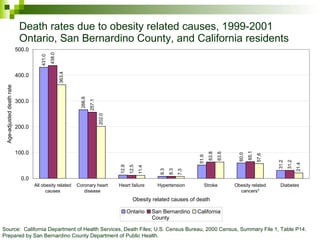
Death rates due to obesity related causes, 1999-2001 Ontario, San Bernardino County, and California residents Source:  California Department of Health Services, Death Files; U.S. Census Bureau, 2000 Census, Summary File 1, Table P14. Prepared by San Bernardino County Department of Public Health.
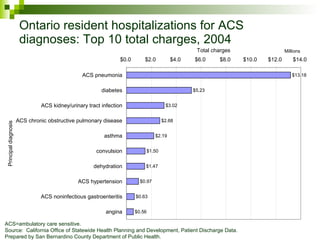
Ontario resident hospitalizations for ACS diagnoses: Top 10 total charges, 2004 ACS=ambulatory care sensitive. Source:  California Office of Statewide Health Planning and Development, Patient Discharge Data. Prepared by San Bernardino County Department of Public Health.
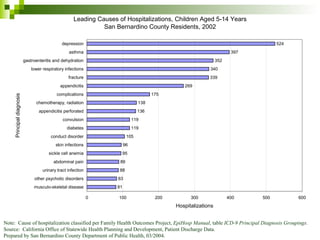
Note:  Cause of hospitalization classified per Family Health Outcomes Project,  EpiHosp Manual , table  ICD-9 Principal Diagnosis Groupings. Source:  California Office of Statewide Health Planning and Development, Patient Discharge Data. Prepared by San Bernardino County Department of Public Health, 03/2004.
Healthy Ontario 2007 Expand the vision of health to be more comprehensive and launch a citywide Healthy Ontario Initiative
Purpose Statement Healthy Ontario Initiative Empower the community of Ontario to take ownership of its health and make Ontario a model city by improving physical, social, and economic health and well-being.
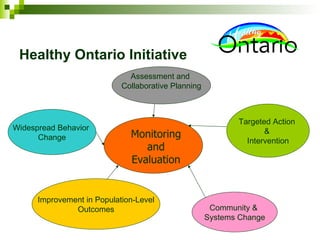
Healthy Ontario Initiative Chan Agent Monitoring and Evaluation Assessment and  Collaborative Planning Widespread Behavior  Change Improvement in Population-Level Outcomes Community &  Systems Change Targeted Action  &  Intervention
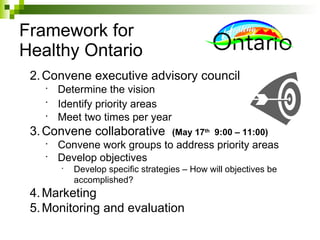
Framework for  Healthy Ontario Convene executive advisory council Determine the vision  Identify priority areas   Meet two times per year Convene collaborative  (May 17 th   9:00 – 11:00) Convene work groups to address priority areas Develop objectives Develop specific strategies – How will objectives be accomplished? Marketing Monitoring and evaluation
Defined Priority Areas Advisory committee (April 12, 2007) Website survey Community events
Healthy Ontario  Collaborative Meeting Meet 6 times per year Feedback mechanism Community input from diverse sources Work groups for priority areas Objectives Strategies to achieve objectives
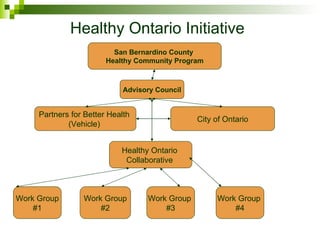
Healthy Ontario Initiative San Bernardino   County  Healthy Community Program Advisory Council Partners for Better Health  (Vehicle)  City of Ontario Healthy Ontario  Collaborative  Work Group #1 Work Group #2 Work Group  #3 Work Group  #4
Advisory Council Paul Leon – Mayor
Marketing Ongoing marketing campaign throughout the Healthy Ontario Initiative Healthy Ontario Ambassadors Kick-off event Newsletter Web presence Ongoing presence at community events
Community Partners
Evaluation Set up an evaluation framework from the beginning Set clear objectives and measure them Loma Linda University School of Public Health
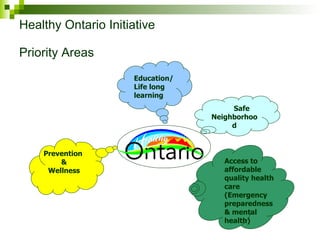
Healthy Ontario Initiative Priority Areas Safe Neighborhood Prevention  & Wellness Access to affordable quality health care (Emergency preparedness & mental health) Education/ Life long  learning
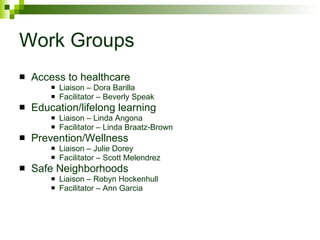
Work Groups Access to healthcare Liaison – Dora Barilla Facilitator – Beverly Speak Education/lifelong learning Liaison – Linda Angona Facilitator – Linda Braatz-Brown Prevention/Wellness Liaison – Julie Dorey Facilitator – Scott Melendrez Safe Neighborhoods Liaison – Robyn Hockenhull Facilitator – Ann Garcia
Thank you! Linda Angona, Healthy Ontario (909) 984- 9153 Dora Barilla, Loma Linda University, School of Public Health (909) 984-9153 Julie Dorey, City of Ontario (909) 395-2366 Robyn Hockenhull, City of Ontario (909) 395-2368

Healthy Ontario Initiative

  • 1.
    Linda Angona, Partnersfor Better Health Julie Dorey, City of Ontario Dora Barilla, Loma Linda University/ Partners for Better Health
  • 2.
    Healthy People 2010/Healthy Ontario Initiative VISION Healthy people in healthy communities Understanding and improving health Objectives for improving health
  • 3.
    Healthy People 2010Leading Health Indicators Physical activity Overweight and obesity Tobacco use Substance abuse Responsible sexual behavior Mental health Injury and violence Environmental quality Immunization Access to health care
  • 4.
    Healthy People 2010Community health is profoundly affected by the collective beliefs, attitudes, and behaviors of everyone who lives in the community. Partnerships are effective tools for improving health in communities.
  • 5.
    A Healthy CommunitySafe Neighborhood Prevention & Wellness Parks & Open Space Opportunity for Socializing Transportation Access to affordable quality health care Availability of Adequate Housing Physical activity Access to Nutritious Foods Employment Opportunities
  • 6.
    History Group ofpeople convened in 2003 concerned about the health of Ontario residents Future Search 2004/2005 West-End Community Assessment Project American Health Care Congress 2004/2005/2006 WE-CAN – Focusing on health care Healthy Communities Initiative Countywide April 2006 Planning Session for Health Ontario June 2006 Healthy Ontario Initiative 2007
  • 7.
    Future Search Visionfor health care Care for all Culturally sensitive health care providers Affordable services Accessible High quality and mission driven Focus on prevention – Chronic disease management Designed by the community and healthcare providers built on existing resources
  • 8.
    Future Search/Needs Lack of transportation Facility closures Culturally competent providers Affordability of specialty services Lack of integrated systems Lack of faith-based involvement in healthcare Inappropriate utilization of services in comparison to community needs
  • 9.
    Healthy Ontario FirstSteps Develop a customized framework for a Health Ontario Initiative Marketing campaign Monitoring and Evaluation component of the initiative Compile the community needs assessment data into a report to be disseminated Coordinate and facilitate a city-wide collaborative
  • 10.
    Report to the Community Action oriented document Compilation of data on health indicators coupled with opportunities (where we are, where we want to be & how we can get there) Process and analysis to inform the general public and create a feedback mechanism Help inform the General Plan process June 2007
  • 11.
    Race/Ethnicity Source: U.S. Census Bureau, 2000 Census
  • 12.
    Percent high schoolgraduates and with bachelor’s degree or higher: Ontario, San Bernardino County, California, and United States, 2005 Source: U.S. Census Bureau, 2000 Census
  • 13.
    Percent of householdswith children: Ontario, San Bernardino County, California, and United States Source: U.S. Census Bureau, 2000 Census
  • 14.
    15 leading causesof death Ontario residents, 2004 Source: California Department of Health Services, Death Files. Prepared by San Bernardino County Department of Public Health.
  • 15.
    Death rates dueto obesity related causes, 1999-2001 Ontario, San Bernardino County, and California residents Source: California Department of Health Services, Death Files; U.S. Census Bureau, 2000 Census, Summary File 1, Table P14. Prepared by San Bernardino County Department of Public Health.
  • 16.
    Ontario resident hospitalizationsfor ACS diagnoses: Top 10 total charges, 2004 ACS=ambulatory care sensitive. Source: California Office of Statewide Health Planning and Development, Patient Discharge Data. Prepared by San Bernardino County Department of Public Health.
  • 17.
    Note: Causeof hospitalization classified per Family Health Outcomes Project, EpiHosp Manual , table ICD-9 Principal Diagnosis Groupings. Source: California Office of Statewide Health Planning and Development, Patient Discharge Data. Prepared by San Bernardino County Department of Public Health, 03/2004.
  • 18.
    Healthy Ontario 2007Expand the vision of health to be more comprehensive and launch a citywide Healthy Ontario Initiative
  • 19.
    Purpose Statement HealthyOntario Initiative Empower the community of Ontario to take ownership of its health and make Ontario a model city by improving physical, social, and economic health and well-being.
  • 20.
    Healthy Ontario InitiativeChan Agent Monitoring and Evaluation Assessment and Collaborative Planning Widespread Behavior Change Improvement in Population-Level Outcomes Community & Systems Change Targeted Action & Intervention
  • 21.
    Framework for Healthy Ontario Convene executive advisory council Determine the vision Identify priority areas Meet two times per year Convene collaborative (May 17 th 9:00 – 11:00) Convene work groups to address priority areas Develop objectives Develop specific strategies – How will objectives be accomplished? Marketing Monitoring and evaluation
  • 22.
    Defined Priority AreasAdvisory committee (April 12, 2007) Website survey Community events
  • 23.
    Healthy Ontario Collaborative Meeting Meet 6 times per year Feedback mechanism Community input from diverse sources Work groups for priority areas Objectives Strategies to achieve objectives
  • 24.
    Healthy Ontario InitiativeSan Bernardino County Healthy Community Program Advisory Council Partners for Better Health (Vehicle) City of Ontario Healthy Ontario Collaborative Work Group #1 Work Group #2 Work Group #3 Work Group #4
  • 25.
    Advisory Council PaulLeon – Mayor
  • 26.
    Marketing Ongoing marketingcampaign throughout the Healthy Ontario Initiative Healthy Ontario Ambassadors Kick-off event Newsletter Web presence Ongoing presence at community events
  • 27.
  • 28.
    Evaluation Set upan evaluation framework from the beginning Set clear objectives and measure them Loma Linda University School of Public Health
  • 29.
    Healthy Ontario InitiativePriority Areas Safe Neighborhood Prevention & Wellness Access to affordable quality health care (Emergency preparedness & mental health) Education/ Life long learning
  • 30.
    Work Groups Accessto healthcare Liaison – Dora Barilla Facilitator – Beverly Speak Education/lifelong learning Liaison – Linda Angona Facilitator – Linda Braatz-Brown Prevention/Wellness Liaison – Julie Dorey Facilitator – Scott Melendrez Safe Neighborhoods Liaison – Robyn Hockenhull Facilitator – Ann Garcia
  • 31.
    Thank you! LindaAngona, Healthy Ontario (909) 984- 9153 Dora Barilla, Loma Linda University, School of Public Health (909) 984-9153 Julie Dorey, City of Ontario (909) 395-2366 Robyn Hockenhull, City of Ontario (909) 395-2368